REVIEW 3 major objections 6 minor 4 cited by
Primordial Black Hole Formation in a Scalar Field Dominated Universe: Investigation of the Critical nature of the Collapse
T0 review · 3 major / 6 minor · reviewed 2026-08-15 · deepseek-v4-flash
Pith's one-line read A quartic scalar field and a radiation fluid collapse into primordial black holes with nearly identical critical exponents.
desk verdict Useful first measurement of the quartic-scalar critical exponent, but the abstract overstates the difference from radiation and the gauge-defining fluid is never tested. read the letter →
The pith
A machine-rendered reading of the paper's core claim, the machinery that carries it, and where it could break.
The reading
What carries the argument
The central object is the power-law scaling of the black hole mass near threshold, $M_{\rm BH}\propto(p-p_{\rm th})^\gamma$, in type II critical collapse. The machinery that extracts it is the Misner-Sharp formulation of spherical relativistic collapse, evolved with a fourth-order Runge-Kutta method and finite differences, with a scalar field plus an extremely diluted homogeneous perfect fluid that defines the comoving frame. Black hole formation is detected through the apparent-horizon condition $\Theta_+=0$; the final mass is read from the Misner-Sharp mass once the apparent-horizon velocity satisfies $v_{\rm AH}\approx 1$, and $\gamma$ is obtained by fitting the mass against $p-p_{\rm th}$.
What would settle it
Run the same scalar-field collapse with the homogeneous background fluid density reduced by factors of 10 while holding the scalar perturbation fixed; if the fitted exponent $\gamma$ moves, or if the fluid's share of the Misner-Sharp mass near horizon formation grows, the quoted scalar-field exponent is contaminated by the frame-defining fluid.
Extended reading notes
Core claim
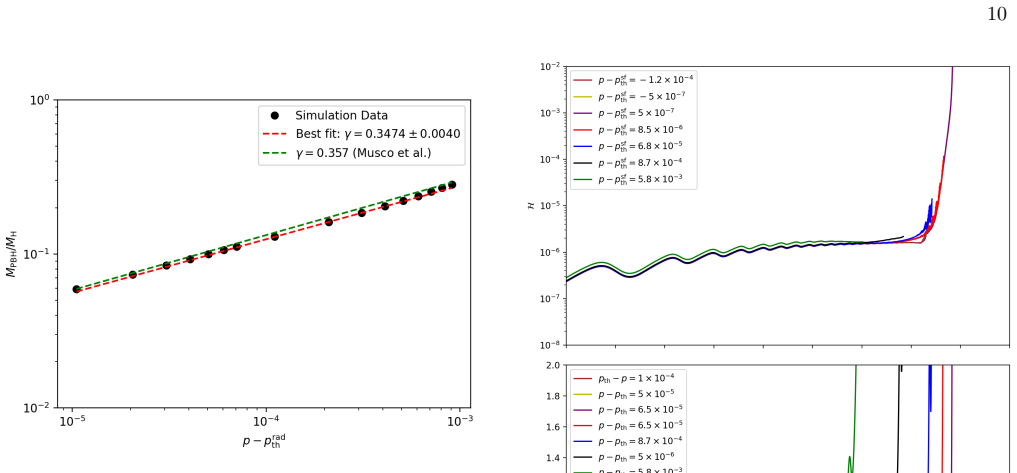
The paper's central claim is that a quartic self-interacting scalar field, $V(\psi)\propto\psi^4$, exhibits type II critical collapse (black hole mass becoming arbitrarily small near threshold and scaling as a power law) with critical exponent $\gamma = 0.3401 \pm 0.0071$, statistically close to the radiation-fluid value $\gamma = 0.3474 \pm 0.004$ measured with the same code. The threshold amplitudes are also close: $p_{\rm th}^{\rm sf}=0.0271205$ versus $p_{\rm th}^{\rm rad}=0.0270895$. The authors present this as the first explicit verification that the scalar-field/perfect-fluid correspondence extends into the critical collapse regime, at least for the quartic potential, while emphasising that the two exponents differ by about $2\sigma$ and that the quadratic case departs from dust-like behaviour.
Load-bearing premise
The scalar-field simulations carry a tiny homogeneous perfect fluid purely to define the comoving frame, and the paper does not show that this fluid stays dynamically negligible at the critical threshold.
Editorial extensions
If this is right
- For quartic-potential scenarios, primordial black hole abundance calculations that approximate the field as a radiation fluid should capture the near-threshold scaling, with the $\sim2\%$ exponent difference entering as a small systematic uncertainty.
- The same code reproduces the known radiation critical exponent, so the comparison baseline is not an artefact of the numerical setup.
- The quadratic scalar-field case departs from dust-like behaviour, so the fluid analogy is potential-dependent and cannot be assumed for all scalar-field models.
- The $2\sigma$ separation between the two exponents defines a concrete target: higher-resolution runs will either close the gap or establish a genuine matter-model dependence of $\gamma$.
Reading between the lines
- Varying the potential exponent between the quadratic and quartic cases, or changing the quartic coupling, could map how $\gamma$ drifts with the effective equation of state and reveal whether the $2\sigma$ gap is a physical trend rather than a numerical artefact.
- The frame-defining homogeneous fluid could be eliminated by reformulating the evolution in a different gauge; if the same exponent survives, the near-universality claim would no longer rest on that technical crutch.
- The compaction function oscillates near threshold in the scalar-field runs, so peak-theory estimates of primordial black hole abundance that rely on a single maximum of the compaction function may need oscillation-aware prescriptions.
Signed reviews
Editorial analysis
A structured set of objections, weighed in public.
Referee Report
Summary. This paper uses a Misner–Sharp, spherically symmetric, fully nonlinear relativistic code to study critical collapse of a quartic self-interacting scalar field and a radiation fluid in an expanding universe. It reports type II critical behavior in both cases, with critical exponents γ = 0.3474 ± 0.004 (radiation) and γ = 0.3401 ± 0.0071 (scalar field), and interprets the difference as about 2σ, supporting the near universality of the critical exponent in primordial black hole formation. The numerical methodology includes horizon detection, excision, Hamiltonian-constraint monitoring, and resolution tests.
Significance. If the result is robust, this is a useful first direct numerical test of the scalar-field/perfect-fluid correspondence in the critical collapse regime, with implications for PBH mass calculations in scalar-field-dominated early-universe scenarios. The paper's strengths are that it uses a fully nonlinear evolution with constraint monitoring, reports resolution dependence, and compares two matter models with the same code. However, the central quantitative claim depends on an unquantified artificial fluid in the scalar-field runs, and the stated 2σ separation is not supported by the quoted errors.
major comments (3)
- [II.C.2 and Eqs. (12e), (12h)] The diluted perfect fluid is not demonstrated to be dynamically negligible. The fluid is not a passive marker: it contributes to the stress-energy tensor and, through Eq. (12h), it directly fixes the lapse gradient. Eq. (12e) sources δρ_pf/ρ_pf through terms independent of the fluid's initial amplitude because the source is proportional to (ρ_pf+P_pf), so fractional perturbations of order unity can develop even for an 'extremely diluted' initial fluid. The manuscript gives no value for ρ_b0pf, does not include fluid perturbations in the initial-data list, and shows no diagnostic for the fluid density in Fig. 4. Please quantify ρ_b0pf and demonstrate by explicit convergence tests, for example by varying ρ_b0pf over several orders of magnitude, that γ_sf is unaffected; otherwise the measured exponent may be contaminated by the gauge fluid.
- [Abstract and Sections V.B, VI] The claimed 'about 2σ' difference between the exponents is not consistent with the quoted errors. The difference is 0.3474 − 0.3401 = 0.0073; the quadrature-summed error is sqrt(0.004^2 + 0.0071^2) ≈ 0.0082, giving about 0.9σ. Please correct this statement and avoid interpreting the result as evidence for a statistically significant difference.
- [IV.B and V.A] The quoted uncertainties in γ are fit errors only. The conclusion of 'near universality' rests on a small difference between exponents, so systematic uncertainties from the choice of fitting range, resolution, threshold bracket in Eq. (36), horizon-mass extrapolation, and the excision criterion need to be estimated. Without such estimates, the comparison between γ_sf and γ_rad cannot be assigned a reliable significance.
minor comments (6)
- [Throughout] There are typos: 'dominateed' in the Introduction, 'collaps' in the Introduction, and 'threashold' in Section V.A.
- [II.C.2, Eq. (16)] The initial condition for the scalar field is normalized as ~Π_b0^2/2 = 1 − ρ_b0pf, but ρ_b0pf is never specified; please state its value and justify that it is too small to alter the background dynamics.
- [V.A, Eq. (36)] The threshold is defined as the midpoint between p_min_bh and p_max_no-bh, but the bracketing procedure and how close to threshold the simulations are run are not described; please specify the bisection or bracketing algorithm.
- [Figs. 2 and 5] The set of resolutions used for the convergence tests is not stated in the captions; please list the dA values and the corresponding line styles.
- [III.C and IV.B] The notation for the horizon velocity criterion is inconsistent: Section IV.B uses v_c − 1 < 3 × 10^-3, while Section III.C and Appendix A define v_AH; please unify the notation.
- [IV.A, footnote 2] The footnote acknowledges that w = 1/3 is only an effective equation of state for the quartic scalar field; near criticality the field may not oscillate rapidly, so please discuss how this could affect the interpretation of the comparison with radiation.
Circularity Check
No significant circularity: the critical exponents are dynamical outputs of independent numerical evolutions, and self-citations are methodological rather than load-bearing.
full rationale
The central claim—gamma_sf = 0.3401 +/- 0.0071 versus gamma_rad = 0.3474 +/- 0.004—is obtained by evolving the full Misner-Sharp equations (12) for different initial amplitudes p, locating apparent horizons, measuring PBH masses, and fitting the scaling law M proportional to (p - p_th)^gamma. The critical exponent is not an input to the code; it is a fitting output. The initial conditions (16)-(19) are physical setup choices (purely kinetic scalar field, Gaussian curvature profile, background equation of state w = 1/3, quartic coupling lambda4 = 10) and do not encode the target scaling exponent. The paper's reliance on Ref. [21] for the derivation of initial conditions and the numerical code is a self-citation, but it is methodological rather than load-bearing: the scalar-field result is compared with a radiation-fluid run performed with the same code and with the external value of Musco et al. The 'inherently circular' remark about determining lambda by iteration is a numerical fixed-point procedure, not a logical circularity. The homogeneous, extremely diluted fluid used to define the Misner-Sharp comoving frame is an admitted modeling choice; whether it contaminates the dynamics is a robustness/correctness concern, not a case of the prediction being equivalent to its inputs by construction. No fitted parameter is renamed as a prediction, and no uniqueness theorem from the authors' prior work is invoked to forbid alternatives. Therefore no circular step is identified.
Assumptions & free parameters
free parameters (4)
- p (initial amplitude of Gaussian overdensity) =
p_rad_th = 0.0270895, p_sf_th = 0.0271205
- Sigma (Gaussian width) =
5 R_H
- lambda_hat_4 (quartic coupling) =
10
- rho_b0pf (diluted fluid density) =
not specified
assumptions (5)
- domain assumption The Misner-Sharp formalism with spherical symmetry is sufficient to capture critical collapse in an expanding universe.
- domain assumption Initial conditions are valid to first order in gradient and amplitude perturbations, selecting the growing mode.
- domain assumption The scalar field starts purely kinetic at the initial time (psi0 = 0, chi0 = 0).
- domain assumption The background universe obeys an effective barotropic equation of state w = 1/3 for the quartic scalar field.
- ad hoc to paper The diluted perfect fluid in scalar field runs is dynamically negligible.
Cite this review
Pith. "Pith review of Primordial Black Hole Formation in a Scalar Field Dominated Universe: Investigation of the Critical nature of the Collapse." pith.science (2026). https://pith.science/paper/Y3J7Z3DH
@misc{pith2026250910431,
  author       = {Pith},
  title        = {Pith review of: Primordial Black Hole Formation in a Scalar Field Dominated Universe: Investigation of the Critical nature of the Collapse},
  year         = {2026},
  howpublished = {\url{https://pith.science/paper/Y3J7Z3DH}},
  note         = {Machine review of arXiv:2509.10431}
}
abstract
In this paper, we investigate the critical collapse leading to primordial black hole (PBH) formation in a universe dominated by a self-interacting scalar field with a quartic potential, comparing it to the well-known radiation-dominated case. Using fully relativistic nonlinear numerical simulations in spherical symmetry, based on the Misner--Sharp formalism, we analyze the dynamics near the collapse threshold and track the scaling of the black hole mass. Our results confirm that both the scalar field and radiation cases exhibit type II critical behavior with similar -- though not identical -- critical exponents, differing by about $2\sigma$. This suggests that, while a quartic scalar field effectively mimics a radiation fluid even in the nonlinear collapse regime, small differences in the critical exponent persist. Our findings provide direct numerical evidence for the near universality of the critical exponent in PBH formation, with only mild dependence on whether the collapse is driven by a scalar field or a perfect fluid.
Figures


Figures from the paper (2 more)


Forward citations
Cited by 4 Pith papers
-
Long-term 3+1 simulations of primordial black hole formation during radiation domination
A new time-step gauge makes long 3D primordial black hole formation simulations about 94 times cheaper and reproduces the known spherical collapse threshold and critical exponent.
-
The statistics of curvature-profile dispersion in primordial black hole formation
Shape dispersion around the average peak profile is a genuine statistical ingredient: rare deformed curvature profiles can dominate primordial black hole formation when the power spectrum is broad or non-Gaussianity i...
-
Primordial black holes forming during kination: the trapped, the overdense, and the void
In one non-attractor inflation model, initially similar field fluctuations produce three distinct black-hole formation channels—trapped, overdense, void—with collapse thresholds determined by the full density profile,...
-
Numerical simulations of primordial black hole formation via delayed first-order phase transitions
Spherically symmetric numerical relativity shows false-vacuum domains from delayed first-order phase transitions form type B (baby-universe) or type A (direct-collapse) primordial black holes, separated by a robust t_...
Reference graph
Works this paper leans on
-
[1]
Initial conditions for a perfect fluid-dominated scenario The idea behind the derivation of our initial conditions is to linearize the equations of motion by expressing the 5 variables as ˜X= ˜Xb +ϵδ X,(13) where ˜Xstands for the relevant dynamical quantities, such as ˜mpf, ˜U, ˜R, ˜ρpf, etc.; ˜Xb denotes the correspond- ing background value1, andϵis a fo...
-
[2]
Initial conditions for a scalar field-dominated scenario Since our system is evolved in coordinates comoving with a perfect fluid, even in this scalar field-dominated 1 Note that most variables are unity at the background level. scenario, we include a homogeneous, isotropic, and ex- tremely diluted fluid component to regularize the origin and maintain the...
work page 2024
-
[3]
Universality and scaling in gravita- tional collapse of a massless scalar field,
M. W. Choptuik, “Universality and scaling in gravita- tional collapse of a massless scalar field,” Phys. Rev. Lett., vol. 70, pp. 9–12, Jan 1993
1993
-
[4]
Dynamics of pri- mordial black hole formation,
J. C. Niemeyer and K. Jedamzik, “Dynamics of pri- mordial black hole formation,” Phys. Rev. D, vol. 59, p. 124013, May 1999
work page 1999
-
[5]
Near-critical gravita- tional collapse and the initial mass function of primordial black holes,
J. C. Niemeyer and K. Jedamzik, “Near-critical gravita- tional collapse and the initial mass function of primordial black holes,” Phys. Rev. Lett., vol. 80, pp. 5481–5484, Jun 1998
work page 1998
-
[6]
The dynamics of primordial black-hole formation,
I. Hawke and J. M. Stewart, “The dynamics of primordial black-hole formation,” Classical and Quantum Gravity, vol. 19, p. 3687, jun 2002
work page 2002
-
[7]
Computa- tions of primordial black-hole formation,
I. Musco, J. C. Miller, and L. Rezzolla, “Computa- tions of primordial black-hole formation,” Classical and Quantum Gravity, vol. 22, p. 1405, mar 2005
work page 2005
-
[8]
Curvature profiles as initial conditions for primordial black hole formation,
A. G. Polnarev and I. Musco, “Curvature profiles as initial conditions for primordial black hole formation,” Classical and Quantum Gravity, vol. 24, p. 1405, mar 2007
work page 2007
Show all 44 references
-
[9]
Primordial black hole formation in the radiative era: Investigation of the critical nature of the collapse,
I. Musco, J. C. Miller, and A. G. Polnarev, “Primordial black hole formation in the radiative era: Investigation of the critical nature of the collapse,” Class. Quant. Grav., vol. 26, p. 235001, 2009
2009
-
[10]
Critical be- havior in gravitational collapse of a yang-mills field,
M. W. Choptuik, T. Chmaj, and P. Bizo´ n, “Critical be- havior in gravitational collapse of a yang-mills field,” 13 Phys. Rev. Lett., vol. 77, pp. 424–427, Jul 1996
1996
-
[11]
Phases of massive scalar field collapse,
P. R. Brady, C. M. Chambers, and S. M. C. V. Gon¸ calves, “Phases of massive scalar field collapse,” Phys. Rev. D, vol. 56, pp. R6057–R6061, Nov 1997
1997
-
[12]
Boson stars driven to the brink of black hole formation,
S. H. Hawley and M. W. Choptuik, “Boson stars driven to the brink of black hole formation,” Phys. Rev. D, vol. 62, p. 104024, Oct 2000
2000
-
[13]
Critical gravi- tational collapse of a massive complex scalar field,
E. Jimenez-Vazquez and M. Alcubierre, “Critical gravi- tational collapse of a massive complex scalar field,”Phys. Rev. D, vol. 106, no. 4, p. 044071, 2022
2022
-
[14]
Critical phenom- ena in gravitational collapse,
C. Gundlach and J. M. Martin-Garcia, “Critical phenom- ena in gravitational collapse,” Living Rev. Rel., vol. 10, p. 5, 2007
2007
-
[15]
Collapse threshold for a cosmological Klein Gordon field,
J. C. Hidalgo, J. De Santiago, G. German, N. Barbosa- Cendejas, and W. Ruiz-Luna, “Collapse threshold for a cosmological Klein Gordon field,” Phys. Rev. D, vol. 96, no. 6, p. 063504, 2017
2017
-
[16]
Gravother- malizing into primordial black holes, boson stars, and cannibal stars,
P. Ralegankar, D. Perri, and T. Kobayashi, “Gravother- malizing into primordial black holes, boson stars, and cannibal stars,” 10 2024
2024
-
[17]
Complex Scalar Field Reheating and Primordial Black Hole production,
K. Carrion, J. C. Hidalgo, A. Montiel, and L. E. Padilla, “Complex Scalar Field Reheating and Primordial Black Hole production,” JCAP, vol. 07, p. 001, 2021
2021
-
[18]
Primordial black holes from the preheating instability in single-field inflation,
J. Martin, T. Papanikolaou, and V. Vennin, “Primordial black holes from the preheating instability in single-field inflation,” JCAP, vol. 01, p. 024, 2020
2020
-
[19]
Black hole threshold solutions in stiff fluid col- lapse,
P. R. Brady, M. W. Choptuik, C. Gundlach, and D. W. Neilsen, “Black hole threshold solutions in stiff fluid col- lapse,” Class. Quant. Grav., vol. 19, pp. 6359–6376, 2002
2002
-
[20]
Growth of primordial black holes in a universe containing a massless scalar field,
T. Harada and B. J. Carr, “Growth of primordial black holes in a universe containing a massless scalar field,” Phys. Rev. D, vol. 71, p. 104010, 2005
2005
-
[21]
Long- wavelength nonlinear perturbations of a complex scalar field,
L. E. Padilla, J. C. Hidalgo, and D. N´ u˜ nez, “Long- wavelength nonlinear perturbations of a complex scalar field,” Phys. Rev. D, vol. 104, no. 8, p. 083513, 2021
2021
-
[22]
Coherent scalar-field oscillations in an expanding universe,
M. S. Turner, “Coherent scalar-field oscillations in an expanding universe,” Phys. Rev. D, vol. 28, pp. 1243– 1247, Sep 1983
1983
-
[23]
Primordial Black Hole Formation in a Scalar Field Dominated Universe,
E. Milligan, L. E. Padilla, D. J. Mulryne, and J. C. Hidalgo, “Primordial Black Hole Formation in a Scalar Field Dominated Universe,” 4 2025
2025
-
[24]
New mechanism for primordial black hole formation during reheating,
L. E. Padilla, J. C. Hidalgo, and K. A. Malik, “New mechanism for primordial black hole formation during reheating,” Phys. Rev. D, vol. 106, no. 2, p. 023519, 2022
2022
-
[25]
Produc- tion of PBHs from inflaton structures,
J. C. Hidalgo, L. E. Padilla, and G. German, “Produc- tion of PBHs from inflaton structures,” Phys. Rev. D, vol. 107, no. 6, p. 063519, 2023
2023
-
[26]
Constrain- ing inflationary potentials with inflaton PBHs,
L. E. Padilla, J. C. Hidalgo, and G. German, “Constrain- ing inflationary potentials with inflaton PBHs,” Phys. Rev. D, vol. 108, no. 6, p. 063511, 2023
2023
-
[27]
Detecting the stochastic gravitational wave background from primordial black holes in slow-reheating scenarios,
L. E. Padilla, J. C. Hidalgo, K. A. Malik, and D. Mulryne, “Detecting the stochastic gravitational wave background from primordial black holes in slow-reheating scenarios,” JCAP, vol. 12, p. 011, 2024
2024
-
[28]
Inflaton clusters and inflaton stars,
J. C. Niemeyer and R. Easther, “Inflaton clusters and inflaton stars,” JCAP, vol. 07, p. 030, 2020
2020
-
[29]
Primordial black hole formation during slow-reheating: a review,
L. E. Padilla, J. C. Hidalgo, T. D. Gomez-Aguilar, K. A. Malik, and G. German, “Primordial black hole formation during slow-reheating: a review,” Front. Astron. Space Sci., vol. 11, p. 1361399, 2024
2024
-
[30]
Relativistic equations for adiabatic, spherically symmetric gravitational collapse,
C. W. Misner and D. H. Sharp, “Relativistic equations for adiabatic, spherically symmetric gravitational collapse,” Phys. Rev., vol. 136, pp. B571–B576, Oct 1964
1964
-
[31]
Dynamics of pri- mordial black hole formation,
J. C. Niemeyer and K. Jedamzik, “Dynamics of pri- mordial black hole formation,” Phys. Rev. D, vol. 59, p. 124013, 1999
1999
-
[32]
Simulation of primordial black hole forma- tion using pseudo-spectral methods,
A. Escriv` a, “Simulation of primordial black hole forma- tion using pseudo-spectral methods,” Phys. Dark Univ., vol. 27, p. 100466, 2020
2020
-
[33]
Computations of primordial black hole formation,
I. Musco, J. C. Miller, and L. Rezzolla, “Computations of primordial black hole formation,” Class. Quant. Grav., vol. 22, pp. 1405–1424, 2005
2005
-
[34]
Identifying the most crucial parameters of the initial curvature profile for primordial black hole formation,
T. Nakama, T. Harada, A. G. Polnarev, and J. Yokoyama, “Identifying the most crucial parameters of the initial curvature profile for primordial black hole formation,” JCAP, vol. 01, p. 037, 2014
2014
-
[36]
Black hole formation in the friedmann universe: Formulation and computation in nu- merical relativity,
M. Shibata and M. Sasaki, “Black hole formation in the friedmann universe: Formulation and computation in nu- merical relativity,” Physical Review D, vol. 60, Sept. 1999
1999
-
[37]
Formalism for Primordial Black Hole Formation in Spherical Symme- try,
J. Bloomfield, D. Bulhosa, and S. Face, “Formalism for Primordial Black Hole Formation in Spherical Symme- try,” 4 2015
2015
-
[38]
Self- consistent initial conditions for primordial black hole formation,
A. Polnarev, T. Nakama, and J. Yokoyama, “Self- consistent initial conditions for primordial black hole formation,” Journal of Cosmology and Astroparticle Physics, vol. 2012, p. 027–027, Sept. 2012
2012
-
[39]
Identifying the most crucial parameters of the ini- tial curvature profile for primordial black hole forma- tion,
T. Nakama, T. Harada, A. Polnarev, and J. Yokoyama, “Identifying the most crucial parameters of the ini- tial curvature profile for primordial black hole forma- tion,” Journal of Cosmology and Astroparticle Physics, vol. 2014, p. 037–037, Jan. 2014
2014
-
[40]
Causal nature and dynamics of trapping horizons in black hole collapse,
A. Helou, I. Musco, and J. C. Miller, “Causal nature and dynamics of trapping horizons in black hole collapse,” Classical and Quantum Gravity, vol. 34, p. 135012, June 2017
2017
-
[41]
Causal Nature and Dynamics of Trapping Horizons in Black Hole Collapse,
A. Helou, I. Musco, and J. C. Miller, “Causal Nature and Dynamics of Trapping Horizons in Black Hole Collapse,” Class. Quant. Grav., vol. 34, no. 13, p. 135012, 2017
2017
-
[42]
Towards a singularity-proof scheme in numerical relativity,
E. Seidel and W.-M. Suen, “Towards a singularity-proof scheme in numerical relativity,”Phys. Rev. Lett., vol. 69, pp. 1845–1848, Sep 1992
1992
-
[43]
Horizon boundary condition for black hole space- times,
P. Anninos, G. Daues, J. Mass´ o, E. Seidel, and W.-M. Suen, “Horizon boundary condition for black hole space- times,” Phys. Rev. D, vol. 51, pp. 5562–5578, May 1995
1995
-
[44]
A new approach for simulating PBH forma- tion from generic curvature fluctuations with the Misner- Sharp formalism,
A. Escriv` a, “A new approach for simulating PBH forma- tion from generic curvature fluctuations with the Misner- Sharp formalism,” 4 2025
2025
-
[45]
Comparison of accurate methods for the integration of hyperbolic equations,
H.-O. Kreiss and J.Oliger, “Comparison of accurate methods for the integration of hyperbolic equations,” Tellus, vol. 24, pp. 199–125, 1972
1972
Reviewed August 15, 2026 · model on record in the stance chip above.
Discussion (0). Continue with ORCID to comment.