REVIEW 3 major objections 6 minor 84 references
Long-term 3+1 simulations of primordial black hole formation during radiation domination
T0 review · 3 major / 6 minor · reviewed 2026-08-15 · deepseek-v4-flash
Pith's one-line read A rescaled gauge condition lets 3D primordial black hole simulations run up to 94 times faster.
desk verdict A genuinely useful numerical-gauge advance that makes long 3D PBH formation runs tractable, with the main open question being how far the scaled driver extends beyond spherical symmetric tests. read the letter →
The pith
A machine-rendered reading of the paper's core claim, the machinery that carries it, and where it could break.
The reading
What carries the argument
The cosmologically scaled Gamma-driver is the load-bearing object: in the moving-puncture shift condition, the response coefficient is set to $b=b_0(a_i/a)^2$ and the damping coefficient to $\eta_{\mathrm{GD}}=\eta_{\mathrm{GD},0}(a_i/a)$, evaluated from the background scale factor at every Runge-Kutta substep. On the expanding background, the driver's fastest gauge mode otherwise keeps unit coordinate speed and the damping term imposes a $\eta_{\mathrm{GD}}\Delta t$ stability bound independent of resolution, both of which would forbid $\Delta t\propto a\,\Delta x$; the scaling keeps the corresponding CFL numbers constant so the time step can grow with the scale factor. A conformal-time version of the moving-puncture gauge, obtained by reparametrizing the lapse and shift, is used as an independent check that the long-term horizon-mass evolution is not an artifact of the rescaling.
What would settle it
Evolve a strongly nonspherical superhorizon perturbation with the scaled driver through horizon formation and compare the $L^2$ norm of the Hamiltonian constraint and the apparent-horizon mass against a standard-driver run at the same resolution: sustained constraint growth or a horizon-mass disagreement before the horizon forms would falsify the claim that the speedup is generic. A lighter check is to repeat the factor-94 comparison at a different amplitude or with a different window function and see whether the step-count reduction and mass agreement survive.
Extended reading notes
Core claim
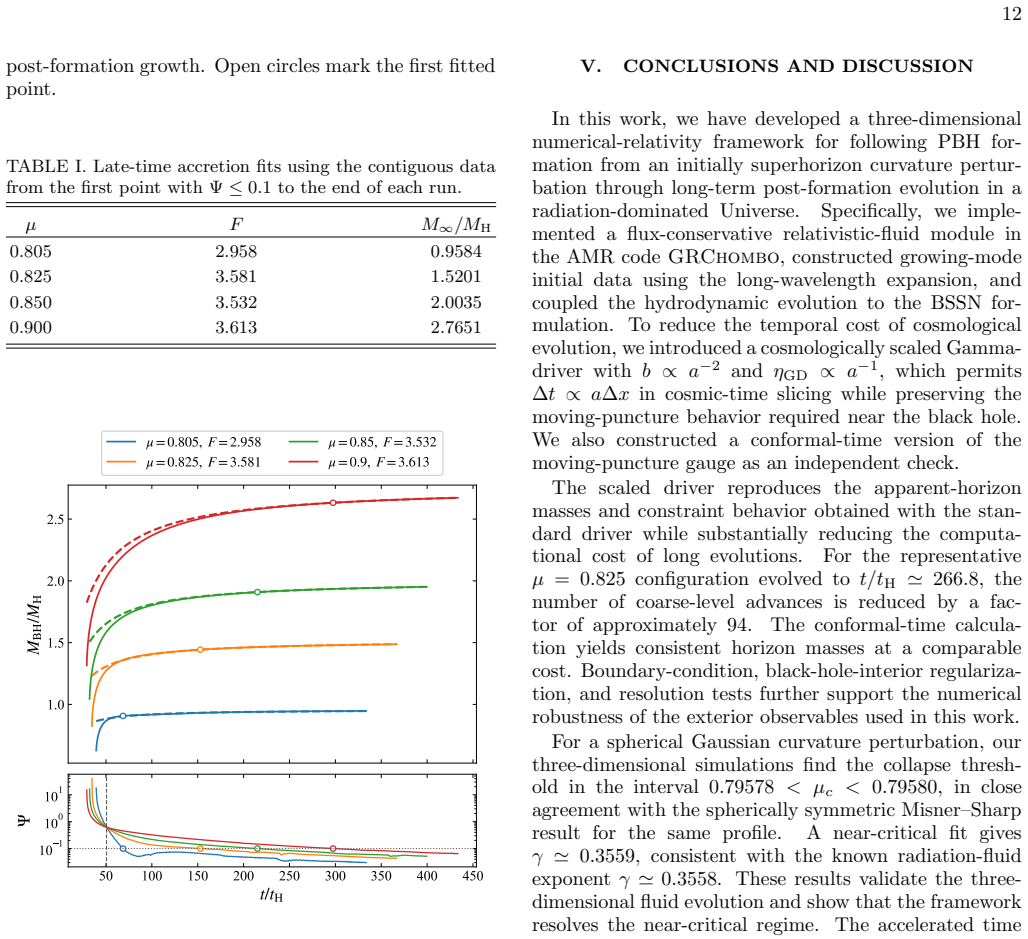
The paper's claim is that the standard Gamma-driver shift condition is the obstruction to long cosmological black-hole evolutions in cosmic time, and that a simple rescaling removes it. On an expanding background the shift gauge mode propagates at a fixed coordinate speed rather than the $a^{-1}$ speed of physical modes, and its damping term imposes a resolution-independent time-step bound; scaling the driver coefficients as $b(t)=b_0(a_i/a)^2$ and $\eta_{\mathrm{GD}}(t)=\eta_{\mathrm{GD},0}(a_i/a)$ keeps both dimensionless stability parameters constant while taking $\Delta t\propto a\,\Delta x$. The paper shows empirically that this scaled driver reproduces the standard driver's central lapse, apparent-horizon masses, and constraint norms for spherical amplitudes across the threshold, while reducing coarse-level advances by a factor of approximately 94. It further reports, from the same three-dimensional framework, a collapse threshold $0.79578<\mu_c<0.79580$ and a near-critical exponent $\gamma\simeq0.3559$ consistent with the radiation-fluid value, and a late-time accretion fit with efficiencies $F\simeq2.96$ to $3.61$ that is broadly consistent with earlier spherically symmetric results.
Load-bearing premise
The load-bearing premise is that the time-dependent driver coefficients, fixed by the background scale factor, remain stable and singularity-avoiding in the strong-field region near a newly formed black hole, so the enlarged time step is safe there; the paper validates this for a handful of spherical amplitudes rather than proving it.
Editorial extensions
If this is right
- Long post-formation runs that previously needed more than a hundred thousand coarse-level steps can be done with about a thousand, so multi-Hubble-time three-dimensional evolutions become routine.
- The same framework can be pointed at nonspherical initial data, where the collapse threshold, critical exponent, and black-hole spin have not yet been measured in three dimensions.
- The threshold interval $0.79578<\mu_c<0.79580$ and $\gamma\simeq0.3559$ give a three-dimensional confirmation that spherical critical collapse behavior survives in a full 3+1 treatment.
- Post-formation black-hole masses can be compared with the analytic accretion formula over many Hubble times, giving an efficiency parameter that is foliation-dependent but useful for abundance estimates.
Reading between the lines
- Because the scaling only relies on the background expansion rate, it should transfer to other barotropic fluids, massless scalar collapse, and kination-type cosmologies; the paper itself notes that an oscillating massive scalar field breaks the scaling because its intrinsic frequency sets an expansion-independent time step.
- A direct test of the method's reach is to repeat the threshold scan for ellipsoidal profiles and check whether the factor-of-94 step reduction survives when the collapse is no longer reflection-symmetric; the paper's full-box runs suggest the main risk is interior, not exterior, behavior.
- The interior regularization used to keep full-periodic-box runs alive is a pragmatic device whose exterior invariance is verified empirically; a stronger validation would vary the regularization strength in a spinning collapse and confirm that exterior fields and horizon mass remain unchanged.
- If the fitted accretion efficiencies cluster near a narrow range, late-time mass growth may admit a simple universal prescription that abundance calculations could adopt without rerunning full 3D evolutions.
Signed reviews
Editorial analysis
A structured set of objections, weighed in public.
Referee Report
Summary. The manuscript presents a three-dimensional numerical-relativity framework for primordial black hole (PBH) formation in a radiation-dominated universe, implemented in GRChombo with flux-conservative relativistic hydrodynamics. The central methodological development is a cosmologically scaled Gamma-driver with b proportional to a^{-2} and eta_GD proportional to a^{-1}, which allows the cosmic-time step to grow as Delta t proportional to a Delta x while keeping the shift-gauge and physical CFL numbers approximately constant. For a representative spherical run, the authors report a factor-approximately-94 reduction in coarse-level steps compared to the standard driver, with matching apparent-horizon mass and constraint behavior; a conformal-time moving-puncture gauge provides an independent check. For a spherical Gaussian curvature profile, the code locates the threshold 0.79578 < mu_c < 0.79580 and a critical exponent gamma approximately 0.3559, consistent with the radiation-fluid value 0.3558. Late-time mass growth is fit to the Zel'dovich-Novikov accretion law with fitted efficiencies F approximately 2.96-3.61.
Significance. If the claims hold, this is a substantial methodological advance for cosmological numerical relativity. The scaled Gamma-driver attacks the temporal bottleneck of long PBH evolutions and, together with AMR, makes multi-Hubble-time three-dimensional runs feasible at roughly two orders of magnitude lower cost. The conformal-time gauge, boundary-condition tests, full-periodic-box regularization tests, and a three-level resolution study provide strong internal evidence that the spherical results are robust. The threshold and critical-exponent values agree with independent spherically symmetric calculations, and the step-count comparison is algorithmic rather than wall-clock dependent, which lends credibility to the efficiency gain. The main limitations are that the scaled driver is validated only for spherical data, and the critical-scaling fit is reported without uncertainty quantification; both need attention before the framework can be used as advertised for nonspherical collapse.
major comments (3)
- [Sec. IV C / Fig. 4] The critical-scaling result is one of the two main physical validations, but the paper reports only point estimates (K approximately 3.624, mu_c approximately 0.7957813, gamma approximately 0.3559) with no error bars, no table of the ten fitted amplitudes and first-detection masses, no residuals, and no stated fit range. In addition, the threshold classification criterion (maximum evolution time used to decide dispersal, and the minimum apparent-horizon size detected) is not given. Without these details, the four-significant-digit agreement with gamma = 0.3558 cannot be evaluated or reproduced. Please provide the fit data, parameter covariances, a sensitivity test to the number of fitted points and to the choice of mass diagnostic, and a statement of the classification protocol.
- [Sec. III A / Sec. V] The scaled Gamma-driver is justified by a frozen-coefficient FLRW analysis and by empirical tests on spherical octant-symmetric data (Fig. 1), and the paper explicitly acknowledges that the far-field argument does not guarantee strong-field behavior near a newly formed black hole. The conclusion nevertheless states that the framework 'can be extended to nonspherical profiles' and provides a 'foundation' for such studies. No genuinely nonspherical initial data are tested; the full periodic-box test of Sec. IV B is still spherical and in fact requires an ad hoc interior regularization to survive past t/t_H approximately 45.3. To support the advertised applicability, the authors should either present a nontrivial nonspherical (or at least non-octant) test with the scaled driver, or explicitly restrict the validation claim to spherical configurations and mark the nonspherical extension as an open problem.
- [Sec. IV D / Table I] The accretion-law fit for the near-threshold run mu = 0.805 returns F = 2.958, well outside the quoted consistency range 3.5 <= F <= 3.75 from Ref. [35], while the three larger amplitudes cluster near 3.5-3.6. Because all four runs use the same foliation, the blanket attribution to foliation dependence is insufficient. Please quantify the fit uncertainties for F and M_infty, and provide evidence (e.g., longer runs or a different fitting start time) that the mu = 0.805 fit is indeed in the Zel'dovich-Novikov regime rather than an artifact of an early or short fitting interval.
minor comments (6)
- [Sec. IV C] Please report the actual evolution times at which the nearest supercritical runs form an apparent horizon, since near-critical classification depends on the total simulated time.
- [Sec. IV D / Table I] Please give standard errors for the fitted F and M_infty values and show the fit residuals in Fig. 5.
- [Sec. II D] Please state whether the simulation code and input parameter files will be released, which would greatly aid reproducibility of the threshold and exponent fits.
- [Sec. III A / Eq. (38)] The statement that the effective damping is eta_GD + 2H follows from the time-dependent b, but the derivation is compressed; one sentence showing the algebra would remove ambiguity.
- [Sec. IV C / Ref. [12]] The Misner-Sharp benchmark cited in Sec. IV C is a preprint by the same group; please also cite an independent published calculation if available, or clarify the provenance of this benchmark.
- [Fig. 1] The early-time constraint transients saturate the lower-right panel; consider using a logarithmic vertical axis or starting the plot after the transient has relaxed.
Circularity Check
No significant circularity: the speedup is a gauge prescription tested in code, and the threshold, critical exponent, and accretion fits are measurements benchmarked against independent or separately checkable results.
full rationale
The central derivation chain is self-contained. The cosmologically scaled Gamma-driver in Sec. III A is derived as a sufficient gauge choice: Eqs. (33) and (35) define the shift wave-CFL and damping bounds, and Eqs. (36) set b(t) and eta_GD(t) so that C_beta and C_eta stay constant when dt scales with a dx. The paper explicitly states that this choice is 'a sufficient gauge prescription... rather than a unique consequence of the Einstein equations' and then validates it against the standard driver in Sec. IV A, so no prediction is being repackaged as an input. The collapse threshold in Sec. IV C is a direct apparent-horizon existence scan; the interval 0.79578 < mu_c < 0.79580 is not imposed by the cited Misner-Sharp value, and the comparison includes external reference [45] and the COSMOS interval [41]. The critical exponent gamma ~ 0.3559 is a free fit to the simulated horizon masses, checked against the literature value 0.3558; the fit is not constructed from that literature value. The post-formation accretion efficiencies F in Sec. IV D are fitted parameters in an explicitly foliation-dependent prescription, not claimed as predictions. Self-citations (Refs. 12, 41, 47, 71) appear as methodology references or as validation sources whose values are separately checkable and do not enter the evolution equations as inputs. No equation in the paper reduces by construction to its own input, and no fitted parameter is renamed as a prediction.
Assumptions & free parameters
free parameters (14)
- b_0 (initial Gamma-driver coefficient) =
3/4
- eta_GD,0 (initial Gamma-driver damping) =
1
- C_CFL, C_H (time-step safety factors) =
0.25, 0.02
- K (critical scaling amplitude) =
3.624 (free fit), 3.621 (fixed gamma)
- mu_c (collapse threshold in scaling fit) =
0.7957813 (fit); bracket 0.79578-0.79580
- gamma (critical exponent in free fit) =
0.3559
- F (accretion efficiency, mu=0.805) =
2.958
- F (accretion efficiency, mu=0.825) =
3.581
- F (accretion efficiency, mu=0.85) =
3.532
- F (accretion efficiency, mu=0.9) =
3.613
- M_infty/M_H (mu=0.805) =
0.9584
- M_infty/M_H (mu=0.825) =
1.5201
- M_infty/M_H (mu=0.85) =
2.0035
- M_infty/M_H (mu=0.9) =
2.7651
assumptions (5)
- domain assumption The long-wavelength gradient-expansion solution to O(epsilon^2) of Harada et al. provides valid superhorizon initial data for the subsequent nonlinear collapse.
- domain assumption The matter is a perfect fluid with the linear barotropic equation of state p = omega rho and omega = 1/3.
- domain assumption The frozen-coefficient dispersion analysis of the Gamma-driver on a homogeneous FLRW background controls the stability of the full nonlinear BSSN system.
- domain assumption The Zel'dovich-Novikov accretion formula with a constant efficiency F describes late-time PBH mass growth in a radiation background.
- domain assumption Suppressing the evolution inside the apparent horizon with the regularization factor does not contaminate exterior physics or horizon-mass measurements.
Cite this review
Pith. "Pith review of Long-term 3+1 simulations of primordial black hole formation during radiation domination." pith.science (2026). https://pith.science/paper/Z57IR4WN
@misc{pith2026260813206,
  author       = {Pith},
  title        = {Pith review of: Long-term 3+1 simulations of primordial black hole formation during radiation domination},
  year         = {2026},
  howpublished = {\url{https://pith.science/paper/Z57IR4WN}},
  note         = {Machine review of arXiv:2608.13206}
}
abstract
We develop an efficient three-dimensional numerical-relativity framework for primordial black-hole (PBH) formation from superhorizon curvature perturbations in a radiation-dominated Universe. We implement flux-conservative relativistic hydrodynamics in the adaptive-mesh-refinement code \textsc{GRChombo} and introduce a cosmologically scaled Gamma-driver that allows the cosmic-time step to grow in proportion to the scale factor. For a representative long-term simulation, the scaled driver preserves the apparent-horizon mass evolution and constraint behavior while reducing the number of coarse-level advances by a factor of approximately $94$ relative to the standard driver. We also construct a conformal-time version of the moving-puncture gauge as an independent check. Applying the framework to a spherical Gaussian curvature profile, we find a collapse threshold $0.79578 < \mu_c < 0.79580$ and a critical exponent $\gamma \simeq 0.3559$, consistent with previous spherically symmetric results. We further fit the late-time PBH mass growth to the Zel'dovich--Novikov accretion law, demonstrating that the code can follow both near-critical collapse and long-term post-formation evolution in three dimensions. The framework provides a foundation for future studies of PBH formation beyond spherical symmetry.
Figures


Figures from the paper (3 more)


Reference graph
Works this paper leans on
-
[35]
Computations of primordial black hole formation,
Ilia Musco, John C. Miller, and Luciano Rezzolla, “Computations of primordial black hole formation,” Class. Quant. Grav.22, 1405–1424 (2005), arXiv:gr- qc/0412063
arXiv 2005
-
[1]
(9) impliesS 2 = (E+p) 2v2
Conserved-to-primitive recovery After each time-integration substep, we first recover the Eulerian variables from their densitized counterparts as E= E√γ, S i = Si √γ.(A1) DefiningS 2≡γ ijSiSj, Eq. (9) impliesS 2 = (E+p) 2v2. For the linear barotropic equation of statep=ωρ, elim- inating the Lorentz factor gives ωρ2 + (1−ω)Eρ−(E 2−S 2) = 0.(A2) Forω >0, t...
-
[2]
The coarsest conformal-time step is chosen as ∆η0 = min CCFL∆x0, CH H(η) ,(43) with the sameC CFL = 0.25 andC H = 0.02 as in the cosmic-time runs
We can con- sequently use the standard Gamma-driver with constant coefficients, ∂ηβi η =bB i η,(42a) ∂ηBi η =∂ η˜Γi−η GDBi η.(42b) We useb= 3/4 andη GD = 1, so that the fastest lon- gitudinal shift mode has unit coordinate speed and the damping timescale is constant in conformal time. The coarsest conformal-time step is chosen as ∆η0 = min CCFL∆x0, CH H(η...
2025
-
[3]
Black holes in the early Universe,
Bernard J. Carr and S. W. Hawking, “Black holes in the early Universe,” Mon. Not. Roy. Astron. Soc.168, 399– 415 (1974)
1974
-
[4]
Consider one coordinate direction and suppress the transverse grid indices
MUSCL reconstruction and numerical flux We reconstruct the primitive variables component by component using the monotonic upstream-centered scheme for conservation laws (MUSCL) with a general- ized minmod limiter [60, 61]. Consider one coordinate direction and suppress the transverse grid indices. For any primitive variableq∈{ρ,v 1,v 2,v 3}, we define the...
-
[5]
The geometric and gauge variables are interpolated to the same face using fourth-order midpoint interpolation. We then convert the reconstructed primitive states to the densitized conserved statesU L,R = (E,S 1,S 2,S 3)T L,R using the common face-centered geometry. For a face normal to thex k direction, the components of the physical fluxF (k) = (F (k) E ...
-
[6]
Yoo et al. use 1/k Y oo as the character- istic scale, whereas our compaction-maximum definition gives rm = √ 6/kY oo = 1/k; the corresponding horizon-entry time and horizon-mass normalizations therefore differ. 4 where∂ 2≡δ ij∂i∂j and (∂ζ) 2≡δ ij∂iζ∂jζ. In our BSSN variables, the growing-mode solution throughO(ϵ 2) is χ=a −2 i e−2ζ 1 + 2f 3(1 +ω) 1 (aiHi...
-
[7]
The Hypothesis of Cores Retarded during Expansion and the Hot Cosmo- logical Model,
Ya. B. Zel’dovich and I. D. Novikov, “The Hypothesis of Cores Retarded during Expansion and the Hot Cosmo- logical Model,” Sov. Astron.10, 602 (1967)
1967
Show all 84 references
-
[8]
Gravitationally collapsed objects of 15 very low mass,
Stephen Hawking, “Gravitationally collapsed objects of 15 very low mass,” Mon. Not. Roy. Astron. Soc.152, 75 (1971)
1971
-
[9]
The Primordial black hole mass spec- trum,
Bernard J. Carr, “The Primordial black hole mass spec- trum,” Astrophys. J.201, 1–19 (1975)
1975
-
[10]
Cosmological effects of primordial black holes,
George F. Chapline, “Cosmological effects of primordial black holes,” Nature253, 251–252 (1975)
1975
-
[11]
Constraints on the induced gravitational wave background from primor- dial black holes,
Edgar Bugaev and Peter Klimai, “Constraints on the induced gravitational wave background from primor- dial black holes,” Phys. Rev. D83, 083521 (2011), arXiv:1012.4697 [astro-ph.CO]
2011 arXiv
-
[12]
Primor- dial black holes and induced gravitational waves from logarithmic non-Gaussianity,
Ryoto Inui, Cristian Joana, Hayato Motohashi, Shi Pi, Yuichiro Tada, and Shuichiro Yokoyama, “Primor- dial black holes and induced gravitational waves from logarithmic non-Gaussianity,” JCAP03, 021 (2025), arXiv:2411.07647 [astro-ph.CO]
2025 arXiv
-
[13]
Sound waves from primordial black hole formations,
Zhuan Ning, Xiang-Xi Zeng, Zi-Yan Yuwen, Shao-Jiang Wang, Heling Deng, and Rong-Gen Cai, “Sound waves from primordial black hole formations,” Phys. Rev. D 113, 024020 (2026), arXiv:2504.12243 [gr-qc]
2026
-
[14]
Relic gravi- tational waves from primordial gravitational collapses,
Xiang-Xi Zeng, Zhuan Ning, Zi-Yan Yuwen, Shao-Jiang Wang, Heling Deng, and Rong-Gen Cai, “Relic gravi- tational waves from primordial gravitational collapses,” (2025), arXiv:2504.11275 [gr-qc]
2025 arXiv
-
[15]
Scalar-induced gravitational waves with non-Gaussianity up to all orders,
Xiang-Xi Zeng, Zhuan Ning, Rong-Gen Cai, and Shao-Jiang Wang, “Scalar-induced gravitational waves with non-Gaussianity up to all orders,” (2025), arXiv:2508.10812 [astro-ph.CO]
2025 arXiv
-
[16]
Primordial Black Holes (PBHs) and The Signatures of Cosmic Non-Gaussianity,
Owais Farooq, Romana Zahoor, and Balungi Francis, “Primordial Black Holes (PBHs) and The Signatures of Cosmic Non-Gaussianity,” (2025), arXiv:2509.10851 [astro-ph.CO]
2025 arXiv
-
[17]
Acoustic gravitational waves from primordial curvature perturbations,
Zhuan Ning, Zi-Yan Yuwen, Xiang-Xi Zeng, Rong-Gen Cai, and Shao-Jiang Wang, “Acoustic gravitational waves from primordial curvature perturbations,” (2025), arXiv:2512.21151 [gr-qc]
2025
-
[18]
Primordial Black Holes as Dark Matter,
Bernard Carr, Florian Kuhnel, and Marit Sandstad, “Primordial Black Holes as Dark Matter,” Phys. Rev. D94, 083504 (2016), arXiv:1607.06077 [astro-ph.CO]
2016 arXiv
-
[19]
Primordial Black Holes as Dark Matter: Recent Developments,
Bernard Carr and Florian Kuhnel, “Primordial Black Holes as Dark Matter: Recent Developments,” Ann. Rev. Nucl. Part. Sci.70, 355–394 (2020), arXiv:2006.02838 [astro-ph.CO]
2020 arXiv
-
[20]
Primordial Black Holes as a dark matter candidate,
Anne M. Green and Bradley J. Kavanagh, “Primordial Black Holes as a dark matter candidate,” J. Phys. G48, 043001 (2021), arXiv:2007.10722 [astro-ph.CO]
2021 arXiv
-
[21]
Primordial black holes: constraints, potential evidence and prospects,
Bernard Carr, Antonio J. Iovino, Gabriele Perna, Ville Vaskonen, and Hardi Veerm¨ ae, “Primordial black holes: constraints, potential evidence and prospects,” Riv. Nuovo Cim.49, 225–274 (2026), arXiv:2601.06024 [astro- ph.CO]
2026
-
[22]
Did LIGO detect dark matter?
Simeon Bird, Ilias Cholis, Julian B. Mu˜ noz, Yacine Ali- Ha¨ ımoud, Marc Kamionkowski, Ely D. Kovetz, Alvise Raccanelli, and Adam G. Riess, “Did LIGO detect dark matter?” Phys. Rev. Lett.116, 201301 (2016), arXiv:1603.00464 [astro-ph.CO]
2016 arXiv
-
[23]
Primordial Black Hole Scenario for the Gravitational-Wave Event GW150914,
Misao Sasaki, Teruaki Suyama, Takahiro Tanaka, and Shuichiro Yokoyama, “Primordial Black Hole Scenario for the Gravitational-Wave Event GW150914,” Phys. Rev. Lett.117, 061101 (2016), [Erratum: Phys.Rev.Lett. 121, 059901 (2018)], arXiv:1603.08338 [astro-ph.CO]
2016 arXiv
-
[24]
Primordial black holes—perspectives in gravitational wave astronomy,
Misao Sasaki, Teruaki Suyama, Takahiro Tanaka, and Shuichiro Yokoyama, “Primordial black holes—perspectives in gravitational wave astronomy,” Class. Quant. Grav.35, 063001 (2018), arXiv:1801.05235 [astro-ph.CO]
2018 arXiv
-
[25]
Could supermassive black holes be quintessential primordial black holes?
Rachel Bean and Joao Magueijo, “Could supermassive black holes be quintessential primordial black holes?” Phys. Rev. D66, 063505 (2002), arXiv:astro-ph/0204486
2002 arXiv
-
[26]
Supermassive black holes from pri- mordial black hole seeds,
Norbert Duechting, “Supermassive black holes from pri- mordial black hole seeds,” Phys. Rev. D70, 064015 (2004), arXiv:astro-ph/0406260
2004 arXiv
-
[27]
Primordial seeds of supermas- sive black holes,
Masahiro Kawasaki, Alexander Kusenko, and Tsu- tomu T. Yanagida, “Primordial seeds of supermas- sive black holes,” Phys. Lett. B711, 1–5 (2012), arXiv:1202.3848 [astro-ph.CO]
2012 arXiv
-
[28]
Primordial Black Holes as Generators of Cosmic Structures,
Bernard Carr and Joseph Silk, “Primordial Black Holes as Generators of Cosmic Structures,” Mon. Not. Roy. Astron. Soc.478, 3756–3775 (2018), arXiv:1801.00672 [astro-ph.CO]
2018 arXiv
-
[29]
Threshold of primordial black hole formation,
Tomohiro Harada, Chul-Moon Yoo, and Kazunori Kohri, “Threshold of primordial black hole formation,” Phys. Rev. D88, 084051 (2013), [Erratum: Phys.Rev.D 89, 029903 (2014)], arXiv:1309.4201 [astro-ph.CO]
2013 arXiv
-
[30]
Analytical thresholds for black hole formation in gen- eral cosmological backgrounds,
Albert Escriv` a, Cristiano Germani, and Ravi K. Sheth, “Analytical thresholds for black hole formation in gen- eral cosmological backgrounds,” JCAP01, 030 (2021), arXiv:2007.05564 [gr-qc]
2021 arXiv
-
[31]
Threshold for primordial black holes: Dependence on the shape of the cosmological per- turbations,
Ilia Musco, “Threshold for primordial black holes: Dependence on the shape of the cosmological per- turbations,” Phys. Rev. D100, 123524 (2019), arXiv:1809.02127 [gr-qc]
2019 arXiv
-
[32]
Universal threshold for primordial black hole formation,
Albert Escriv` a, Cristiano Germani, and Ravi K. Sheth, “Universal threshold for primordial black hole formation,” Phys. Rev. D101, 044022 (2020), arXiv:1907.13311 [gr-qc]
2020 arXiv
-
[33]
Dynamics of pri- mordial black hole formation,
Jens C. Niemeyer and K. Jedamzik, “Dynamics of pri- mordial black hole formation,” Phys. Rev. D59, 124013 (1999), arXiv:astro-ph/9901292
1999 arXiv
-
[34]
The dynamics of primor- dial black hole formation,
I. Hawke and J. M. Stewart, “The dynamics of primor- dial black hole formation,” Class. Quant. Grav.19, 3687– 3707 (2002)
2002
-
[36]
Primordial black hole formation in the radiative era: Investigation of the critical nature of the collapse,
Ilia Musco, John C. Miller, and Alexander G. Polnarev, “Primordial black hole formation in the radiative era: Investigation of the critical nature of the collapse,” Class. Quant. Grav.26, 235001 (2009), arXiv:0811.1452 [gr-qc]
2009 arXiv
-
[37]
Primordial black hole formation in the early universe: critical behaviour and self-similarity,
Ilia Musco and John C. Miller, “Primordial black hole formation in the early universe: critical behaviour and self-similarity,” Class. Quant. Grav.30, 145009 (2013), arXiv:1201.2379 [gr-qc]
2013 arXiv
-
[38]
Black hole formation in the Friedmann universe: Formulation and computa- tion in numerical relativity,
Masaru Shibata and Misao Sasaki, “Black hole formation in the Friedmann universe: Formulation and computa- tion in numerical relativity,” Phys. Rev. D60, 084002 (1999), arXiv:gr-qc/9905064
1999 arXiv
-
[39]
Primordial black hole and wormhole formation by do- main walls,
Heling Deng, Jaume Garriga, and Alexander Vilenkin, “Primordial black hole and wormhole formation by do- main walls,” JCAP04, 050 (2017), arXiv:1612.03753 [gr- qc]
2017 arXiv
-
[40]
Simulation of primordial black hole formation using pseudo-spectral methods,
Albert Escriv` a, “Simulation of primordial black hole formation using pseudo-spectral methods,” Phys. Dark Univ.27, 100466 (2020), arXiv:1907.13065 [gr-qc]
2020 arXiv
-
[41]
Primordial black 16 holes from primordial voids,
Cristian Joana and Zi-Yan Yuwen, “Primordial black 16 holes from primordial voids,” Phys. Rev. D113, 023518 (2026), arXiv:2510.11611 [astro-ph.CO]
2026
-
[42]
Numerical simulations of primordial black hole formation via delayed first-order phase transitions,
Zhuan Ning, Xiang-Xi Zeng, Rong-Gen Cai, and Shao- Jiang Wang, “Numerical simulations of primordial black hole formation via delayed first-order phase transitions,” JCAP07, 073 (2026), arXiv:2601.21878 [gr-qc]
2026 arXiv
-
[43]
Primordial black hole formation in bulk- viscous cosmology,
Zi-Yan Yuwen, Cristian Joana, Shao-Jiang Wang, and Rong-Gen Cai, “Primordial black hole formation in bulk- viscous cosmology,” (2026), arXiv:2606.26532 [gr-qc]
2026 arXiv
-
[44]
The statistics of curvature-profile dis- persion in primordial black hole formation,
Albert Escriv` a, “The statistics of curvature-profile dis- persion in primordial black hole formation,” (2026), arXiv:2607.08738 [astro-ph.CO]
2026 arXiv
-
[45]
PBH Formation from Spherically Sym- metric Hydrodynamical Perturbations: A Review,
Albert Escriv` a, “PBH Formation from Spherically Sym- metric Hydrodynamical Perturbations: A Review,” Uni- verse8, 66 (2022), arXiv:2111.12693 [gr-qc]
2022 arXiv
-
[46]
Threshold of Primordial Black Hole Formation in Nonspherical Collapse,
Chul-Moon Yoo, Tomohiro Harada, and Hirotada Okawa, “Threshold of Primordial Black Hole Formation in Nonspherical Collapse,” Phys. Rev. D102, 043526 (2020), [Erratum: Phys.Rev.D 107, 049901 (2023)], arXiv:2004.01042 [gr-qc]
2020 arXiv
-
[47]
Primordial black hole formation from a nonspherical density profile with a misaligned de- formation tensor,
Chul-Moon Yoo, “Primordial black hole formation from a nonspherical density profile with a misaligned de- formation tensor,” Phys. Rev. D110, 043526 (2024), arXiv:2403.11147 [gr-qc]
2024 arXiv
-
[48]
Simulations of el- lipsoidal primordial black hole formation,
Albert Escriv` a and Chul-Moon Yoo, “Simulations of el- lipsoidal primordial black hole formation,” Phys. Rev. D 112, 083518 (2025), arXiv:2410.03452 [gr-qc]
2025
-
[49]
Nonspherical ef- fects on the mass function of primordial black holes,
Albert Escriv` a and Chul-Moon Yoo, “Nonspherical ef- fects on the mass function of primordial black holes,” Phys. Rev. D112, L081304 (2025), arXiv:2410.03451 [gr- qc]
2025
-
[50]
Primor- dial Black Holes in a Radiation-Dominated Universe,
Thomas W. Baumgarte, Katy Clough, Mary Ger- hardinger, John T. Giblin, and Amanda Miller, “Primor- dial Black Holes in a Radiation-Dominated Universe,” (2026), arXiv:2606.30641 [astro-ph.CO]
2026 arXiv
-
[51]
Gravitational Collapse of a Massless Scalar Field in a Periodic Box,
Chul-Moon Yoo, Taishi Ikeda, and Hirotada Okawa, “Gravitational Collapse of a Massless Scalar Field in a Periodic Box,” Class. Quant. Grav.36, 075004 (2019), arXiv:1811.00762 [gr-qc]
2019 arXiv
-
[52]
COSMOS: A numerical relativity code specialized for PBH formation,
Chul-Moon Yoo, Hirotada Okawa, Albert Escriv` a, To- mohiro Harada, Hayami Iizuka, Taishi Ikeda, Yasutaka Koga, Daiki Saito, Masaaki Shimada, and Koichiro Ue- hara, “COSMOS: A numerical relativity code specialized for PBH formation,” J. Open Source Softw.11, 9570 (2026), arXiv...
2026 arXiv
-
[53]
Gauge conditions for long term numerical black hole evolutions without excision,
Miguel Alcubierre, Bernd Bruegmann, Peter Diener, Michael Koppitz, Denis Pollney, Edward Seidel, and Ry- oji Takahashi, “Gauge conditions for long term numerical black hole evolutions without excision,” Phys. Rev. D67, 084023 (2003), arXiv:gr-qc/0206072
2003 arXiv
-
[54]
How to move a black hole without excision: Gauge conditions for the numerical evolution of a moving puncture,
James R. van Meter, John G. Baker, Michael Koppitz, and Dae-Il Choi, “How to move a black hole without excision: Gauge conditions for the numerical evolution of a moving puncture,” Phys. Rev. D73, 124011 (2006), arXiv:gr-qc/0605030
2006 arXiv
-
[55]
Boson star-black hole binaries: initial data and head-on collisions,
Zhuan Ning, “Boson star-black hole binaries: initial data and head-on collisions,” (2026), arXiv:2604.15240 [gr- qc]
2026 arXiv
-
[56]
GRChombo : Numerical Relativity with Adaptive Mesh Refinement,
Katy Clough, Pau Figueras, Hal Finkel, Markus Kunesch, Eugene A. Lim, and Saran Tunyasuvunakool, “GRChombo : Numerical Relativity with Adaptive Mesh Refinement,” Class. Quant. Grav.32, 245011 (2015), arXiv:1503.03436 [gr-qc]
2015 arXiv
-
[57]
Lessons for adaptive mesh refinement in numer- ical relativity,
Miren Radia, Ulrich Sperhake, Amelia Drew, Katy Clough, Pau Figueras, Eugene A. Lim, Justin L. Rip- ley, Josu C. Aurrekoetxea, Tiago Fran¸ ca, and Thomas Helfer, “Lessons for adaptive mesh refinement in numer- ical relativity,” Class. Quant. Grav.39, 135006 (2022), arXiv:2112....
2022 arXiv
-
[58]
GRChombo: An adaptable nu- merical relativity code for fundamental physics,
Tomas Andradeet al., “GRChombo: An adaptable nu- merical relativity code for fundamental physics,” J. Open Source Softw.6, 3703 (2021), arXiv:2201.03458 [gr-qc]
2021 arXiv
-
[59]
3+1 formalism and bases of numer- ical relativity,
Eric Gourgoulhon, “3+1 formalism and bases of numer- ical relativity,” (2007), arXiv:gr-qc/0703035
2007 arXiv
-
[60]
Miguel Alcubierre,Introduction to 3+1 Numerical Rela- tivity(Oxford University Press, 2008)
2008
-
[61]
Masaru Shibata,Numerical Relativity(World Scientific, 2016)
2016
-
[62]
General Rel- ativistic Collapse to Black Holes and Gravitational Waves from Black Holes,
T. Nakamura, K. Oohara, and Y. Kojima, “General Rel- ativistic Collapse to Black Holes and Gravitational Waves from Black Holes,” Prog. Theor. Phys. Suppl.90, 1–218 (1987)
1987
-
[63]
Evolution of three-dimensional gravitational waves: Harmonic slicing case,
Masaru Shibata and Takashi Nakamura, “Evolution of three-dimensional gravitational waves: Harmonic slicing case,” Phys. Rev. D52, 5428–5444 (1995)
1995
-
[64]
On the numerical integration of Einstein’s field equations,
Thomas W. Baumgarte and Stuart L. Shapiro, “On the numerical integration of Einstein’s field equations,” Phys. Rev. D59, 024007 (1998), arXiv:gr-qc/9810065
1998 arXiv
-
[65]
New High- Resolution Central Schemes for Nonlinear Conservation Laws and Convection–Diffusion Equations,
Alexander Kurganov and Eitan Tadmor, “New High- Resolution Central Schemes for Nonlinear Conservation Laws and Convection–Diffusion Equations,” J. Comput. Phys.160, 241–282 (2000)
2000
-
[66]
Robustness of a high-resolution central scheme for hydrodynamic simula- tions in full general relativity,
Masaru Shibata and Jose A. Font, “Robustness of a high-resolution central scheme for hydrodynamic simula- tions in full general relativity,” Phys. Rev. D72, 047501 (2005), arXiv:gr-qc/0507099
2005 arXiv
-
[67]
Cosmological long-wavelength so- lutions and primordial black hole formation,
Tomohiro Harada, Chul-Moon Yoo, Tomohiro Nakama, and Yasutaka Koga, “Cosmological long-wavelength so- lutions and primordial black hole formation,” Phys. Rev. D91, 084057 (2015), arXiv:1503.03934 [gr-qc]
2015 arXiv
-
[68]
Chombo software package for AMR applications - design document,
M. Adamset al., “Chombo software package for AMR applications - design document,” (2015)
2015
-
[69]
Dynamics of black holes in de Sitter spacetimes,
Miguel Zilhao, Vitor Cardoso, Leonardo Gualtieri, Carlos Herdeiro, Ulrich Sperhake, and Helvi Witek, “Dynamics of black holes in de Sitter spacetimes,” Phys. Rev. D85, 104039 (2012), arXiv:1204.2019 [gr-qc]
2012 arXiv
-
[70]
Black Hole Universe: Time Evolution,
Chul-Moon Yoo, Hirotada Okawa, and Ken-ichi Nakao, “Black Hole Universe: Time Evolution,” Phys. Rev. Lett. 111, 161102 (2013), arXiv:1306.1389 [gr-qc]
2013 arXiv
-
[71]
Preheating in Full General Relativity,
John T. Giblin and Avery J. Tishue, “Preheating in Full General Relativity,” Phys. Rev. D100, 063543 (2019), arXiv:1907.10601 [gr-qc]
2019 arXiv
-
[72]
Well- posedness of formulations of the Einstein equations with dynamical lapse and shift conditions,
Carsten Gundlach and Jose M. Martin-Garcia, “Well- posedness of formulations of the Einstein equations with dynamical lapse and shift conditions,” Phys. Rev. D74, 024016 (2006), arXiv:gr-qc/0604035
2006 arXiv
-
[73]
Time Step Size Limitation Introduced by the BSSN Gamma Driver,
Erik Schnetter, “Time Step Size Limitation Introduced by the BSSN Gamma Driver,” Class. Quant. Grav.27, 167001 (2010), arXiv:1003.0859 [gr-qc]
2010 arXiv
-
[74]
General relativistic cosmological N-body simulations. Part I. Time integration,
David Daverio, Yves Dirian, and Ermis Mitsou, “General relativistic cosmological N-body simulations. Part I. Time integration,” JCAP10, 065 (2019), arXiv:1904.07841 [astro-ph.CO]
2019 arXiv
-
[75]
Chul-Moon Yoo, Albert Escriv` a, Tomohiro Harada, and Kazunori Kohri, In preparation
-
[76]
Primordial black hole formation from massless scalar isocurvature,
Chul-Moon Yoo, Tomohiro Harada, Shin’ichi Hirano, Hi- rotada Okawa, and Misao Sasaki, “Primordial black hole formation from massless scalar isocurvature,” Phys. Rev. 17 D105, 103538 (2022), arXiv:2112.12335 [gr-qc]
2022 arXiv
-
[77]
Observation of critical phenomena and selfsimilarity in the gravitational collapse of radiation fluid,
Charles R. Evans and Jason S. Coleman, “Observation of critical phenomena and selfsimilarity in the gravitational collapse of radiation fluid,” Phys. Rev. Lett.72, 1782– 1785 (1994), arXiv:gr-qc/9402041
1994 arXiv
-
[78]
Critical behavior in gravitational collapse of radia- tion fluid: A Renormalization group (linear perturba- tion) analysis,
Tatsuhiko Koike, Takashi Hara, and Satoshi Adachi, “Critical behavior in gravitational collapse of radia- tion fluid: A Renormalization group (linear perturba- tion) analysis,” Phys. Rev. Lett.74, 5170–5173 (1995), arXiv:gr-qc/9503007
1995 arXiv
-
[79]
Critical phenomena in perfect fluids,
David W. Neilsen and Matthew W. Choptuik, “Critical phenomena in perfect fluids,” Class. Quant. Grav.17, 761–782 (2000), arXiv:gr-qc/9812053
2000 arXiv
-
[80]
Cosmological discrete self- similarity in primordial black hole formation,
Luis E. Padilla, Tomohiro Harada, Ethan Milli- gan, and David Mulryne, “Cosmological discrete self- similarity in primordial black hole formation,” (2026), arXiv:2604.21520 [astro-ph.CO]
2026 arXiv
-
[81]
Non-linear dynamics and primor- dial black hole formation during kination,
Cheng Cheng, Panagiotis Giannadakis, Lucien Heurtier, and Eugene A. Lim, “Non-linear dynamics and primor- dial black hole formation during kination,” JCAP07, 048 (2026), arXiv:2507.19166 [astro-ph.CO]
2026 arXiv
-
[82]
Primordial black holes forming during kination: the trapped, the overdense, and the void,
Cristian Joana, “Primordial black holes forming during kination: the trapped, the overdense, and the void,” (2026), arXiv:2607.20423 [astro-ph.CO]
2026 arXiv
-
[83]
Primordial black hole formation in a scalar field dominated universe,
Ethan Milligan, Luis E. Padilla, David J. Mulryne, and Juan Carlos Hidalgo, “Primordial black hole formation in a scalar field dominated universe,” JCAP10, 025 (2025), arXiv:2504.02600 [astro-ph.CO]
2025 arXiv
-
[84]
Primordial Black Hole formation in a scalar field dominated Universe: Investigation of the critical nature of the collapse,
Luis E. Padilla, Ethan Milligan, David J. Mulryne, and Juan Carlos Hidalgo, “Primordial Black Hole formation in a scalar field dominated Universe: Investigation of the critical nature of the collapse,” JCAP04, 049 (2026), arXiv:2509.10431 [astro-ph.CO]
2026 arXiv
Reviewed August 15, 2026 · model on record in the stance chip above.
Discussion (0). Continue with ORCID to comment.