Excitons in Large Disordered Boron-Nitride Layer using Linear-Scaling Bethe-Salpeter Simulations
Pith reviewed 2026-06-30 04:41 UTC · model grok-4.3
The pith
A real-space linear-scaling Bethe-Salpeter method computes excitonic spectra in disordered boron-nitride systems with up to 100,000 orbitals.
A machine-rendered reading of the paper's core claim, the machinery that carries it, and where it could break.
Core claim
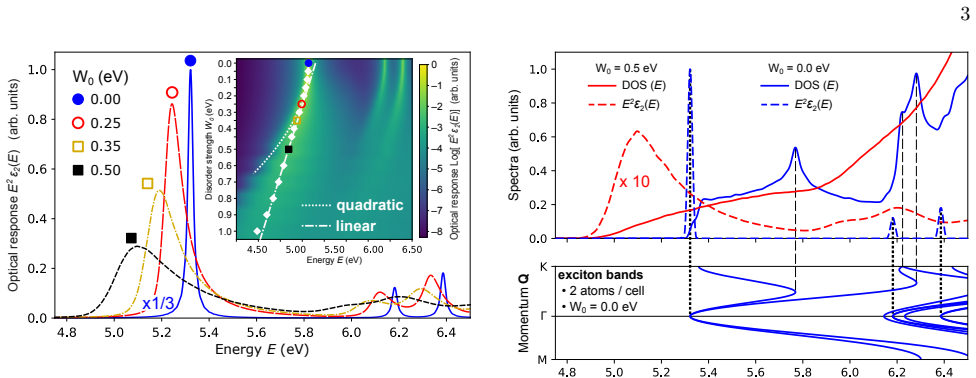
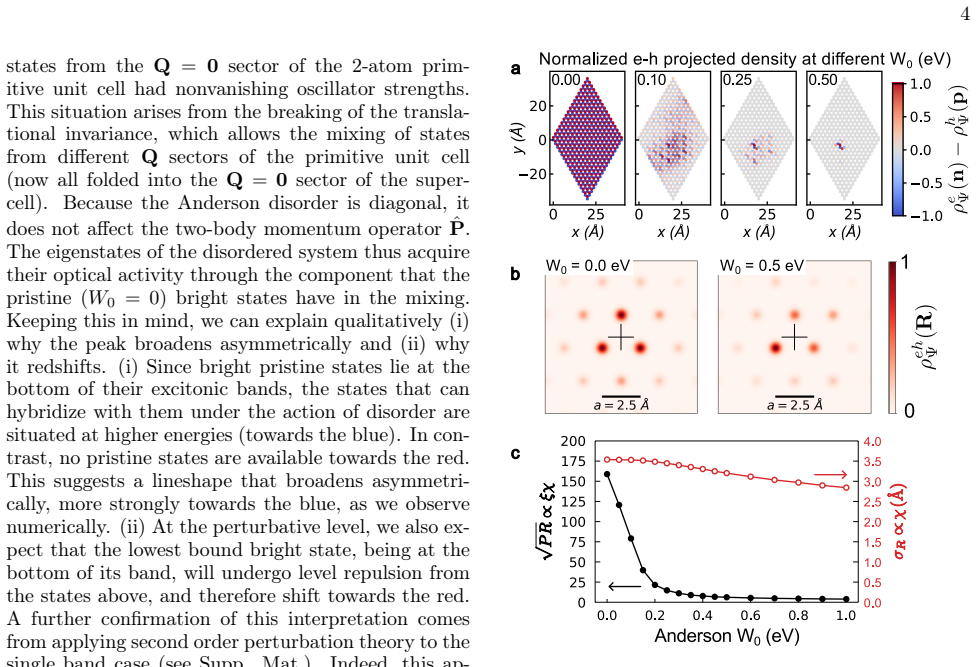
A sublattice-resolved perturbative decoupling maps localized electron-hole pairs onto a sparse tight-binding model, allowing the kernel polynomial method to evaluate absorption spectra at O(N) cost within a real-space Bethe-Salpeter framework; when applied to Anderson-disordered monolayer hexagonal boron nitride containing up to 10^5 orbitals, the calculations show disorder-induced asymmetric broadening of bright excitons, a quadratic-to-linear crossover in the redshift of the main peak, and Anderson localization of the exciton center of mass.
What carries the argument
Sublattice-resolved perturbative decoupling that maps localized electron-hole pairs onto a sparse tight-binding model, combined with the kernel polynomial method to achieve linear-scaling spectra.
If this is right
- Excitonic spectroscopy becomes accessible for systems containing 10^5 orbitals or more.
- Disorder produces asymmetric broadening of bright excitons together with a crossover from quadratic to linear redshift of the main absorption peak.
- The exciton center of mass undergoes Anderson localization under increasing disorder strength.
- Optical properties can be studied in moiré, quasicrystalline, and structurally complex quantum materials.
Where Pith is reading between the lines
- The same linear-scaling strategy could be transferred to other two-dimensional materials that exhibit localized excitons.
- Predictions of exciton localization may guide design of disordered optoelectronic devices based on boron-nitride layers.
- Extensions that incorporate finite temperature or external electric fields would follow naturally from the existing O(N) machinery.
- Systematic benchmarking against conventional GW-BSE results on progressively larger ordered clusters would quantify the mapping error.
Load-bearing premise
The sublattice-resolved perturbative decoupling accurately maps localized electron-hole pairs onto the sparse tight-binding model without introducing significant errors for the disordered systems studied.
What would settle it
Direct numerical comparison of absorption spectra or exciton localization lengths obtained from the linear-scaling method against exact diagonalization results on the same small disordered clusters.
Figures
read the original abstract
We introduce a real-space, linear-scaling Bethe-Salpeter framework that enables excitonic spectroscopy in large and possibly disordered boron-nitride-derived systems. Thanks to the use of a sublattice-resolved perturbative decoupling that maps localized electron-hole pairs onto a sparse tight-binding model, we implement the Kernel Polynomial Method to compute absorption spectra with O(N) cost. To illustrate the capabilities of our method, we apply it to Anderson-disordered monolayer hexagonal boron nitride with up to $10^{5}$ orbitals. The method reveals a disorder-induced asymmetric broadening of bright excitons, a crossover from quadratic to linear redshift of the main absorption peak, and Anderson localization of the exciton center of mass. This approach extends excitonic calculations beyond the reach of conventional ab initio Green's function methods (GW approximation and Bethe-Salpeter equation), opening optical spectroscopy to large-scale, disordered, moir\'e, quasicrystalline, and structurally complex quantum materials.
Editorial analysis
A structured set of objections, weighed in public.
Referee Report
Summary. The paper introduces a real-space linear-scaling Bethe-Salpeter framework for excitonic spectroscopy in large and disordered boron-nitride systems. It employs a sublattice-resolved perturbative decoupling to map localized electron-hole pairs onto a sparse tight-binding model, enabling the kernel polynomial method for O(N) absorption spectra. The approach is demonstrated on Anderson-disordered monolayer hBN with up to 10^5 orbitals, reporting asymmetric broadening of bright excitons, a quadratic-to-linear crossover in the redshift of the main peak, and Anderson localization of the exciton center of mass. This extends conventional GW+BSE methods to previously inaccessible scales.
Significance. If the central approximation holds with controlled accuracy, the work would enable first-principles excitonic calculations in large disordered, moiré, and structurally complex materials, a capability currently limited by the cubic or worse scaling of standard BSE implementations. The reported physical effects on exciton broadening, redshift, and localization in disordered hBN illustrate the method's potential to generate new, testable predictions in materials science.
major comments (1)
- [Abstract / method description of the sublattice-resolved perturbative decoupling] Abstract and method description of the sublattice-resolved perturbative decoupling: the central claim that this decoupling maps localized e-h pairs onto a sparse TB model without significant errors for Anderson-disordered systems (up to 10^5 orbitals) is load-bearing for all reported spectra and phenomena, yet the manuscript provides no controlled error estimate, convergence test with respect to disorder strength, or direct comparison to dense BSE on the same small disordered realizations.
Simulated Author's Rebuttal
We thank the referee for their careful reading and constructive feedback on our manuscript. The major comment raises a valid point about validation of the central approximation. We address it point-by-point below and will incorporate the requested material in a revised version.
read point-by-point responses
-
Referee: Abstract and method description of the sublattice-resolved perturbative decoupling: the central claim that this decoupling maps localized e-h pairs onto a sparse TB model without significant errors for Anderson-disordered systems (up to 10^5 orbitals) is load-bearing for all reported spectra and phenomena, yet the manuscript provides no controlled error estimate, convergence test with respect to disorder strength, or direct comparison to dense BSE on the same small disordered realizations.
Authors: We agree that controlled validation of the sublattice-resolved perturbative decoupling is important. The manuscript focuses on demonstrating O(N) scaling for systems where dense BSE is infeasible, but we acknowledge the absence of direct benchmarks. In the revised manuscript we will add a dedicated validation section comparing the approximate spectra and exciton properties against dense BSE on the same small Anderson-disordered hBN realizations (up to several hundred orbitals) for a range of disorder strengths. This will include quantitative error estimates on peak positions, broadening, and oscillator strengths, as well as tests of convergence with disorder strength. These additions will directly address the load-bearing nature of the approximation. revision: yes
Circularity Check
No significant circularity in derivation chain
full rationale
The paper presents a new real-space linear-scaling BSE framework based on sublattice-resolved perturbative decoupling mapped to a sparse TB model followed by KPM for spectra. No equations or claims in the provided text reduce results to self-definitions, fitted inputs renamed as predictions, or load-bearing self-citations that collapse the central result. The method is framed as an extension enabling new applications, with independent content in the implementation for disordered systems up to 10^5 orbitals. This is the expected self-contained case for a methods paper.
Axiom & Free-Parameter Ledger
Reference graph
Works this paper leans on
-
[1]
Excitons in boron nitride single layer , author =. Phys. Rev. B , volume =. 2016 , month =. doi:10.1103/PhysRevB.94.125303 , url =
-
[2]
Emergence of flat bands in the quasicrystal limit of boron nitride twisted bilayers , author =. Phys. Rev. B , volume =. 2024 , month =. doi:10.1103/PhysRevB.109.L161403 , url =
-
[3]
Reviews of modern physics , volume=
The kernel polynomial method , author=. Reviews of modern physics , volume=. 2006 , publisher=
2006
-
[4]
Physics Reports , volume=
Linear scaling quantum transport methodologies , author=. Physics Reports , volume=. 2021 , publisher=
2021
-
[5]
2D Materials , volume=
Excitons in few-layer hexagonal boron nitride: Davydov splitting and surface localization , author=. 2D Materials , volume=. 2018 , publisher=
2018
-
[6]
Physical Review B , volume=
Twisting in h-BN bilayers and their angle-dependent properties , author=. Physical Review B , volume=. 2025 , publisher=
2025
-
[7]
Physical Review B , volume=
Two-photon absorption in two-dimensional materials: The case of hexagonal boron nitride , author=. Physical Review B , volume=. 2018 , publisher=
2018
-
[8]
Physical Review B , volume=
Direct and indirect excitons in boron nitride polymorphs: A story of atomic configuration and electronic correlation , author=. Physical Review B , volume=. 2018 , publisher=
2018
-
[9]
Nature Materials , volume =
Onga, Masaru and Zhang, Yijin and Ideue, Toshiya and Iwasa, Yoshihiro , title =. Nature Materials , volume =. 2017 , doi =
2017
-
[10]
and Jones, Aaron M
Rivera, Pasqual and Schaibley, John R. and Jones, Aaron M. and Ross, Jason S. and Wu, Sanfeng and Aivazian, Grant and Klement, Philip and Seyler, Kyle and Clark, Gary and Ghimire, Nirmal J. and Yan, Jiaqiang and Mandrus, David G. and Yao, Wang and Xu, Xiaodong , title =. Nature Communications , volume =. 2015 , doi =
2015
-
[11]
Nature Photonics , volume =
Ciarrocchi, Alberto and Unuchek, Dmitrii and Avsar, Ahmet and Watanabe, Kenji and Taniguchi, Takashi and Kis, Andras , title =. Nature Photonics , volume =. 2019 , doi =
2019
-
[12]
and Joe, Andrew Y
Jauregui, Luis A. and Joe, Andrew Y. and Pistunova, Kateryna and Wild, Dominik S. and High, Alexander A. and Zhou, You and Scuri, Giovanni and. Electrical control of interlayer exciton dynamics in atomically thin heterostructures , journal =. 2019 , doi =
2019
-
[13]
and Kara, Dhiren M
Montblanch, Alejandro R.-P. and Kara, Dhiren M. and Paradisanos, Ioannis and Purser, Carola M. and Feuer, Matthew S. G. and Alexeev, Evgeny M. and others , title =. Communications Physics , volume =. 2021 , doi =
2021
-
[14]
and Purser, Carola M
Alexeev, Evgeny M. and Purser, Carola M. and Gilardoni, Carmem M. and Kerfoot, James and Chen, Hao and Cadore, Alisson R. and Rosa, B. Nature of long-lived moir. Nano Letters , volume =. 2024 , doi =
2024
-
[15]
and Deng, Hui , title =
Zhang, Long and Zhang, Zhe and Wu, Fengcheng and Wang, Danqing and Gogna, Rahul and Hou, Shaocong and Watanabe, Kenji and Taniguchi, Takashi and Kulkarni, Krishnamurthy and Kuo, Thomas and Forrest, Stephen R. and Deng, Hui , title =. Nature Communications , volume =. 2020 , doi =
2020
-
[16]
and Regan, Emma C
Naik, Mit H. and Regan, Emma C. and Zhang, Zuocheng and Chan, Yang-Hao and Li, Zhenglu and Wang, Danqing and Yoon, Yoseob and Ong, Chin Shen and Zhao, Wenyu and Zhao, Sihan and Utama, M. Iqbal Bakti and Gao, Beini and Wei, Xin and Sayyad, Mohammed and Yumigeta, Kentaro and Watanabe, Kenji and Taniguchi, Takashi and Tongay, Sefaattin and da Jornada, Felipe...
2022
-
[17]
Structure of the moir
Karni, Ouri and Barr. Structure of the moir. Nature , volume =. 2022 , doi =
2022
-
[18]
and Kim, Woochang and Li, Zhenglu and Sailus, Renee and Banerjee, Rounak and Taniguchi, Takashi and Watanabe, Kenji and Tongay, Sefaattin and Zettl, Alex and da Jornada, Felipe H
Li, Hongyuan and Xiang, Ziyu and Naik, Mit H. and Kim, Woochang and Li, Zhenglu and Sailus, Renee and Banerjee, Rounak and Taniguchi, Takashi and Watanabe, Kenji and Tongay, Sefaattin and Zettl, Alex and da Jornada, Felipe H. and Louie, Steven G. and Crommie, Michael F. and Wang, Feng , title =. Nature Materials , volume =. 2024 , doi =
2024
-
[19]
SciPost Physics , volume =
Latil, Sylvain and Amara, Hakim and Sponza, Lorenzo , title =. SciPost Physics , volume =. 2023 , doi =
2023
-
[20]
The Journal of chemical physics , volume=
Optical properties of disordered molecular aggregates: A numerical study , author=. The Journal of chemical physics , volume=. 1991 , publisher=
1991
-
[21]
American Journal of Physics , volume=
A simple approach to Anderson localization in one-dimensional disordered lattices , author=. American Journal of Physics , volume=. 2004 , publisher=
2004
-
[22]
Progress of Theoretical Physics , volume =
Toyozawa, Yutaka , title =. Progress of Theoretical Physics , volume =. 1958 , doi =
1958
-
[23]
Reviews of Modern Physics , volume =
Onida, Giovanni and Reining, Lucia and Rubio, Angel , title =. Reviews of Modern Physics , volume =. 2002 , doi =
2002
-
[24]
and Chaves, A
Ferreira, F. and Chaves, A. J. and Peres, N. M. R. and Ribeiro, R. M. , title =. Journal of the Optical Society of America B , volume =. 2019 , doi =
2019
-
[25]
Physical Review Letters , volume =
Wirtz, Ludger and Marini, Andrea and Rubio, Angel , title =. Physical Review Letters , volume =. 2006 , doi =
2006
-
[26]
Two-photon absorption in two-dimensional materials: The case of hexagonal boron nitride , journal =
Attaccalite, Claudio and Gr. Two-photon absorption in two-dimensional materials: The case of hexagonal boron nitride , journal =. 2018 , doi =
2018
-
[27]
and Man, Michael K
Karni, Ouri and Barré, Elyse and Pareek, Vivek and Georgaras, Johnathan D. and Man, Michael K. L. and Sahoo, Chakradhar and Bacon, David R. and Zhu, Xing and Ribeiro, Henrique B. and O'Beirne, Aidan L. and Hu, Jenny and Al-Mahboob, Abdullah and Abdelrasoul, Mohamed M. M. and Chan, Nicholas S. and Karmakar, Arka and Winchester, Andrew J. and Kim, Bumho and...
2022
-
[28]
and Blach, Daria D
Susarla, Sandhya and Naik, Mit H. and Blach, Daria D. and Zipfel, Jonas and Taniguchi, Takashi and Watanabe, Kenji and Huang, Libai and Ramesh, Ramamoorthy and da Jornada, Felipe H. and Louie, Steven G. and Ercius, Peter and Raja, Archana , title =. Science , volume =. 2022 , doi =
2022
-
[29]
Progress of Theoretical Physics , volume =
Toyozawa, Yutaka , title =. Progress of Theoretical Physics , volume =. 1962 , doi =
1962
-
[30]
Physical Review B , volume=
Theory of the absorption line shape in monolayers of transition metal dichalcogenides , author=. Physical Review B , volume=. 2020 , publisher=
2020
-
[31]
Physical Review Materials , volume=
First-principles study of luminescence in hexagonal boron nitride single layer: Exciton-phonon coupling and the role of substrate , author=. Physical Review Materials , volume=. 2023 , publisher=
2023
-
[32]
1998 , publisher=
ARPACK users' guide: solution of large-scale eigenvalue problems with implicitly restarted Arnoldi methods , author=. 1998 , publisher=
1998
-
[33]
Scientific reports , volume=
Interlayer excitons in van der Waals heterostructures: Binding energy, Stark shift, and field-induced dissociation , author=. Scientific reports , volume=. 2020 , publisher=
2020
-
[34]
Exciton Self-Trapping in Twisted Hexagonal Boron Nitride homostructures , author =. Phys. Rev. X , volume =. 2025 , month =. doi:10.1103/PhysRevX.15.021067 , url =
-
[35]
npj 2D Materials and Applications , volume=
Atomistic theory of twist-angle dependent intralayer and interlayer exciton properties in twisted bilayer materials , author=. npj 2D Materials and Applications , volume=. 2025 , publisher=
2025
-
[36]
New Journal of Physics , volume=
Kwant: a software package for quantum transport , author=. New Journal of Physics , volume=. 2014 , publisher=
2014
-
[37]
Analysis of approximate nearest neighbor searching with clustered point sets
Analysis of approximate nearest neighbor searching with clustered point sets , author=. arXiv preprint cs/9901013 , year=
work page internal anchor Pith review Pith/arXiv arXiv
-
[38]
American Mathematical Soc
Maneewongvatana, Songrit and Mount, David M , title =. Data Structures, Near Neighbor Searches, and Methodology: Fifth and Sixth DIMACS Implementation Challenges , publisher = "American Mathematical Soc.", year = "2002", editor =
2002
-
[39]
Moscow University Physics Bulletin , volume=
Screened potential of a point charge in a thin film , author=. Moscow University Physics Bulletin , volume=
-
[40]
JETP Lett
Coulomb interaction in thin semiconductor and semimetal films , author=. JETP Lett. , volume=
-
[41]
Dielectric screening in two-dimensional insulators: Implications for excitonic and impurity states in graphane , author =. Phys. Rev. B , volume =. 2011 , month =. doi:10.1103/PhysRevB.84.085406 , url =
-
[42]
Scientific reports , volume=
Model dielectric function for 2D semiconductors including substrate screening , author=. Scientific reports , volume=. 2017 , publisher=
2017
-
[43]
, title =
Andersen, Kirsten and Latini, Simone and Thygesen, Kristian S. , title =. Nano Letters , volume =. 2015 , doi =
2015
-
[44]
Gjerding, M. N. and Cavalcante, L. S. R. and Chaves, Andrey and Thygesen, K. S. , title =. The Journal of Physical Chemistry C , volume =. 2020 , doi =
2020
-
[45]
Formation of Bloch Flat Bands in Polar Twisted Bilayers without Magic Angles , author =. Phys. Rev. Lett. , volume =. 2020 , month =. doi:10.1103/PhysRevLett.124.086401 , url =
-
[46]
Physical review letters , volume=
Exciton band structure in two-dimensional materials , author=. Physical review letters , volume=. 2016 , publisher=
2016
-
[47]
Nature Physics , volume=
Direct observation of massless excitons and linear exciton dispersion , author=. Nature Physics , volume=. 2026 , publisher=
2026
-
[48]
and Noguez, Cecilia , journal =
Roman-Taboada, Pedro and Obregon-Castillo, Estefania and Botello-Mendez, Andr\'es R. and Noguez, Cecilia , journal =. Excitons in twisted. 2023 , month =. doi:10.1103/PhysRevB.108.075109 , url =
-
[49]
Nano Letters , volume =
Apelian, Arsineh and Canestraight, Annabelle and Liu, Songyuan and Vlček, Vojtěch , title =. Nano Letters , volume =. 2024 , doi =
2024
-
[50]
García-Blázquez and Juan José Palacios , keywords =
Alejandro José Uría-Álvarez and Juan José Esteve-Paredes and M.A. García-Blázquez and Juan José Palacios , keywords =. Efficient computation of optical excitations in two-dimensional materials with the Xatu code , journal =. 2024 , issn =. doi:https://doi.org/10.1016/j.cpc.2023.109001 , url =
-
[51]
arXiv preprint arXiv:2603.24860 , year=
Efficient all-electron Bethe-Salpeter implementation using crystal symmetries , author=. arXiv preprint arXiv:2603.24860 , year=
-
[52]
Symmetries of excitons , author =. Phys. Rev. B , volume =. 2026 , month =. doi:10.1103/7h2w-ys9h , url =
-
[53]
2021 , school =
Tight-binding perspective on excitons in hexagonal boron nitride , author=. 2021 , school =
2021
-
[54]
Efficient
Schmidt, WG and Glutsch, S and Hahn, PH and Bechstedt, F , journal=. Efficient. 2003 , publisher=
2003
-
[55]
Fuchs, F. and R\"odl, C. and Schleife, A. and Bechstedt, F. , journal =. Efficient. 2008 , month =. doi:10.1103/PhysRevB.78.085103 , url =
-
[56]
Expeditious computation of nonlinear optical properties of arbitrary order with native electronic interactions in the time domain , author =. Phys. Rev. B , volume =. 2020 , month =. doi:10.1103/PhysRevB.102.245110 , url =
-
[57]
The Structure of Electronic Excitation Levels in Insulating Crystals , author =. Phys. Rev. , volume =. 1937 , month =. doi:10.1103/PhysRev.52.191 , url =
-
[58]
Physical Review , volume=
Intensity of optical absorption by excitons , author=. Physical Review , volume=. 1957 , publisher=
1957
-
[59]
A Relativistic Equation for Bound-State Problems , author =. Phys. Rev. , volume =. 1951 , month =. doi:10.1103/PhysRev.84.1232 , url =
-
[60]
Many-particle effects in the optical spectrum of a semiconductor , author =. Phys. Rev. B , volume =. 1980 , month =. doi:10.1103/PhysRevB.21.4656 , url =
-
[61]
Huge Excitonic Effects in Layered Hexagonal Boron Nitride , author =. Phys. Rev. Lett. , volume =. 2006 , month =. doi:10.1103/PhysRevLett.96.026402 , url =
-
[62]
Comment on ``Huge Excitonic Effects in Layered Hexagonal Boron Nitride'' , author =. Phys. Rev. Lett. , volume =. 2008 , month =. doi:10.1103/PhysRevLett.100.189701 , url =
-
[63]
Arnaud, B. and Leb\`egue, S. and Rabiller, P. and Alouani, M. , journal =. Arnaud,. 2008 , month =. doi:10.1103/PhysRevLett.100.189702 , url =
-
[64]
Electron correlation in semiconductors and insulators: Band gaps and quasiparticle energies , author =. Phys. Rev. B , volume =. 1986 , month =. doi:10.1103/PhysRevB.34.5390 , url =
-
[65]
Electron-hole excitations and optical spectra from first principles , author =. Phys. Rev. B , volume =. 2000 , month =. doi:10.1103/PhysRevB.62.4927 , url =
-
[66]
Alexandre C. Dias and Julian F.R.V. Silveira and Fanyao Qu , keywords =. WanTiBEXOS: A Wannier based Tight Binding code for electronic band structure, excitonic and optoelectronic properties of solids , journal =. 2023 , issn =. doi:https://doi.org/10.1016/j.cpc.2022.108636 , url =
-
[67]
Excitons in moir\'e superlattices with disordered electrons , author =. Phys. Rev. B , volume =. 2026 , month =. doi:10.1103/th3z-lt7x , url =
-
[68]
Journal of Physics: Materials , volume =
Linear scaling approach for optical excitations using maximally localized Wannier functions , author =. Journal of Physics: Materials , volume =. 2024 , publisher =. doi:10.1088/2515-7639/ad06cd , url =
-
[69]
arXiv preprint arXiv:2603.10966 , year =
Microscopic screening theory for excitons in two-dimensional materials: A bridge between effective models and ab initio descriptions , author =. arXiv preprint arXiv:2603.10966 , year =. doi:10.48550/arXiv.2603.10966 , url =. 2603.10966 , archivePrefix =
-
[70]
Excitonic optical absorption in strained monolayer
Quintela, Maur. Excitonic optical absorption in strained monolayer. Phys. Rev. Research , volume =. 2026 , month =. doi:10.1103/8pdd-5md4 , url =
-
[71]
Esteve-Paredes, J. J. and Garc. Excitons in nonlinear optical responses: shift current in. npj Computational Materials , volume =. 2025 , doi =
2025
-
[72]
Electronic excitations: density-functional versus many-body
Onida, Giovanni and Reining, Lucia and Rubio, Angel , journal =. Electronic excitations: density-functional versus many-body. 2002 , month =. doi:10.1103/RevModPhys.74.601 , url =
-
[73]
Simple Screened Hydrogen Model of Excitons in Two-Dimensional Materials , author =. Phys. Rev. Lett. , volume =. 2016 , month =. doi:10.1103/PhysRevLett.116.056401 , url =
-
[74]
Journal of Mathematical Physics , volume=
The two-dimensional hydrogen atom revisited , author=. Journal of Mathematical Physics , volume=. 2002 , publisher=
2002
-
[75]
Analytic solution of a two-dimensional hydrogen atom. I. Nonrelativistic theory , author=. Physical Review A , volume=. 1991 , publisher=
1991
-
[76]
Kirichenko, E. V. and Stephanovich, V. A. The influence of disorder on the exciton spectra in two-dimensional structures. Phys. Chem. Chem. Phys. 2019. doi:10.1039/C9CP04111G
-
[77]
The influence of Coulomb interaction screening on the excitons in disordered two-dimensional insulators , author=. Scientific Reports , volume=. 2021 , publisher=. doi:10.1038/s41598-021-91414-w , url=
-
[78]
Surface recombination and out-of-plane diffusivity of free excitons in hexagonal boron nitride , author =. Phys. Rev. B , volume =. 2024 , month =. doi:10.1103/PhysRevB.109.155305 , url =
-
[79]
arXiv preprint arXiv:2603.02011 , year=
Tensor-network methodology for super-moir 'e excitons beyond one billion sites , author=. arXiv preprint arXiv:2603.02011 , year=
discussion (0)
Sign in with ORCID, Apple, or X to comment. Anyone can read and Pith papers without signing in.