Analysis of J/psi and psi(2S) Charmonium Production in Ultraperipheral Lead-Lead and Proton-Lead Collisions at LHC Energies
Pith reviewed 2026-06-26 20:46 UTC · model grok-4.3
The pith
A single phenomenological suppression factor aligns two-gluon exchange model predictions with LHC data on charmonium production in ultraperipheral collisions.
A machine-rendered reading of the paper's core claim, the machinery that carries it, and where it could break.
Core claim
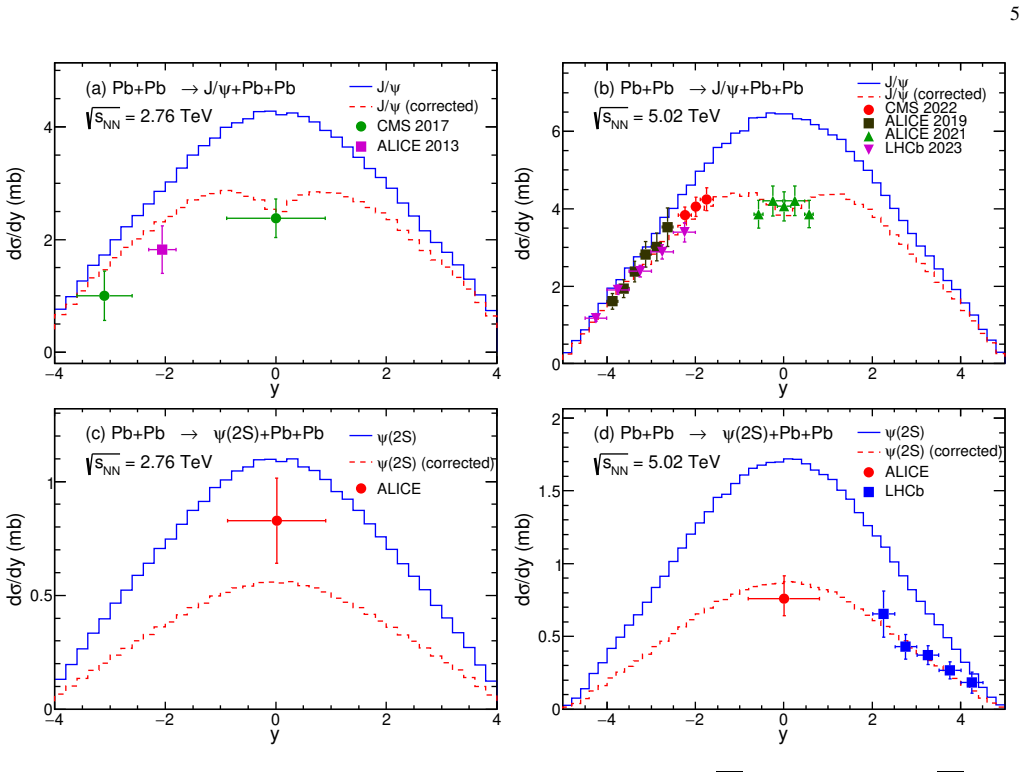
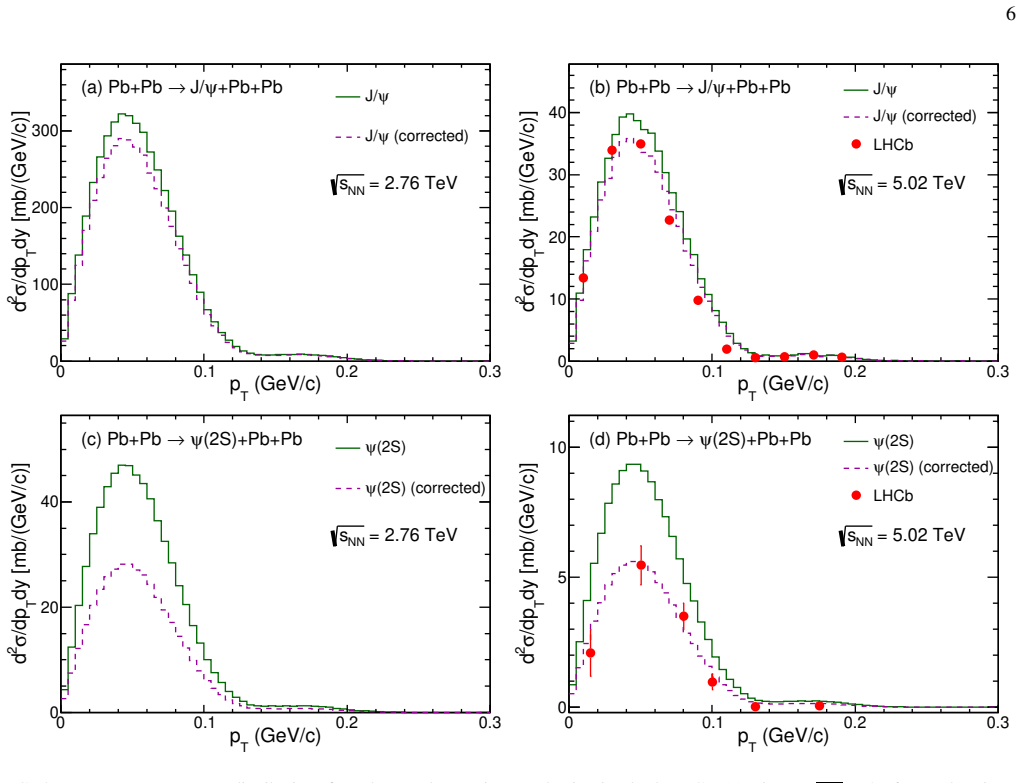
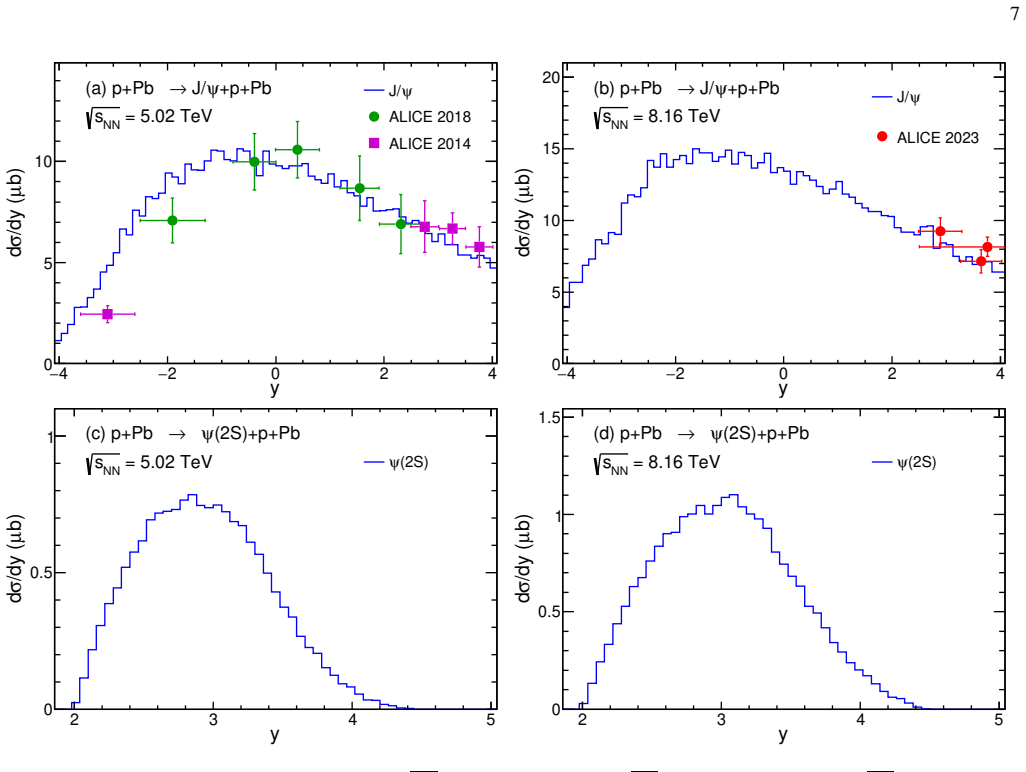
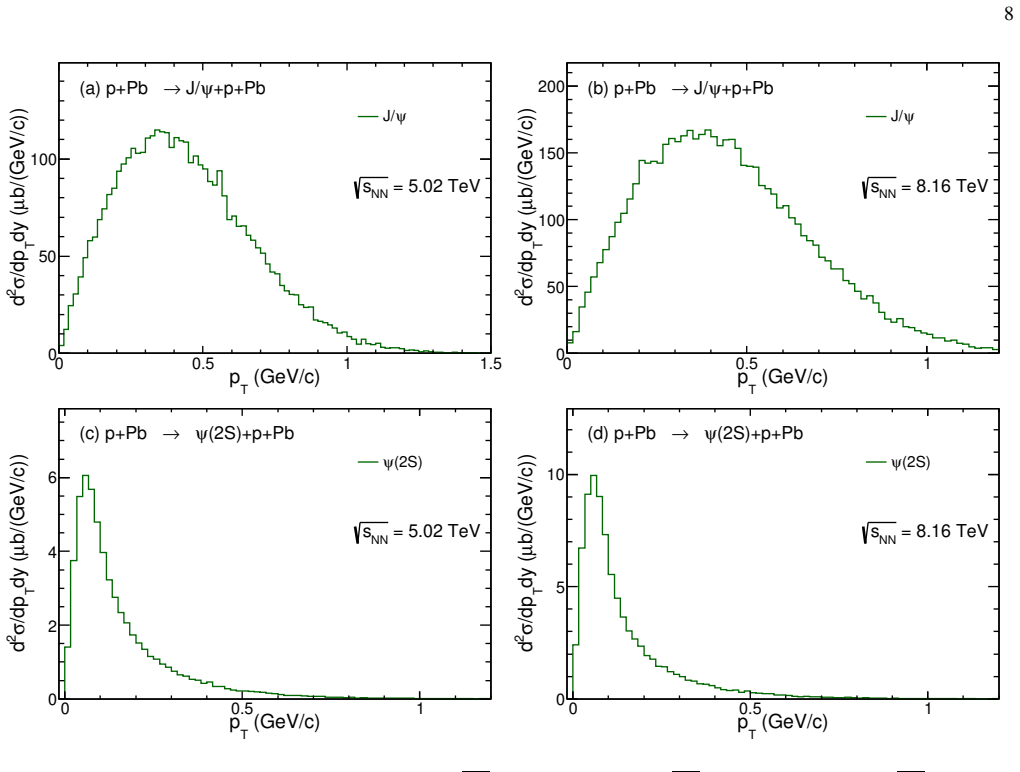
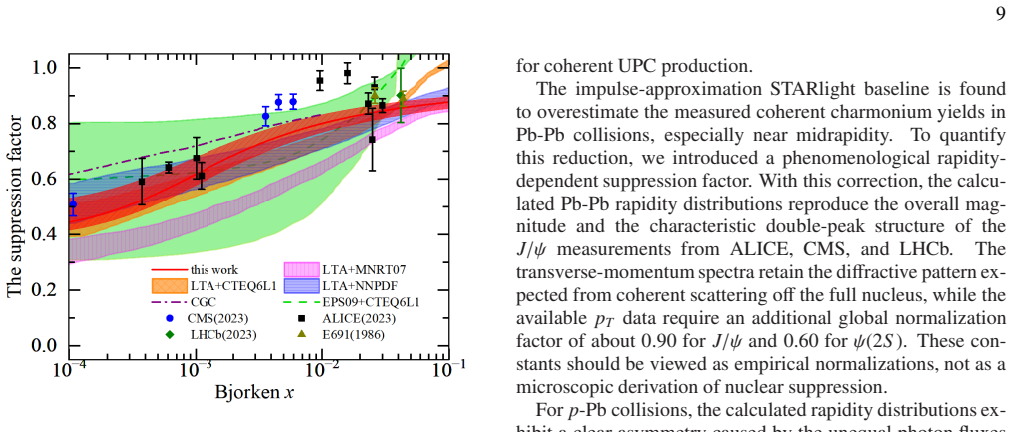
When the two-gluon exchange photoproduction cross sections are implemented in STARlight and multiplied by a single phenomenological suppression factor in the PbPb channel, the resulting rapidity and transverse-momentum distributions for J/ψ and ψ(2S) agree with LHC experimental data within uncertainties and reproduce the characteristic double-peak rapidity structure; no suppression is required in the pPb channel.
What carries the argument
Two-gluon exchange model for heavy-vector-meson photoproduction cross sections, corrected by a single phenomenological suppression factor and evaluated inside the STARlight Monte Carlo for ultraperipheral collisions.
If this is right
- The corrected cross sections can be used directly for planning and interpreting future charmonium UPC measurements at the LHC.
- The absence of suppression in pPb collisions follows from the asymmetric photon fluxes and the dominance of the photoproduction branch.
- Transverse-momentum spectra retain the diffractive coherent-production pattern after the suppression is applied.
- The approach supplies a practical phenomenological bridge between the two-gluon exchange framework and existing LHC data.
Where Pith is reading between the lines
- The suppression factor may be encoding nuclear-shadowing or higher-order QCD effects that the base model omits.
- Similar single-parameter corrections could be tested for other vector mesons or for different nuclear species.
- The framework could be extended to predict yields at higher LHC luminosities or in oxygen-oxygen collisions.
Load-bearing premise
All discrepancies between the two-gluon exchange predictions and PbPb data can be absorbed into one overall multiplicative suppression factor without changing the underlying model.
What would settle it
A new measurement of the J/ψ rapidity distribution in PbPb ultraperipheral collisions at 5.02 TeV that shows a single central peak rather than the predicted double-peak structure would falsify the corrected-model claim.
Figures
read the original abstract
The two gluon exchange model serves as a key framework for describing the photoproduction of heavy vector mesons, and the photoproduction cross sections derived from it provide essential input for studies of Ultra-Peripheral Collisions (UPCs). Building on the model successful description of $J/\psi$ and $\psi(2S)$ photoproduction in previous work, we use the STARlight program to systematically investigate charmonium UPCs in PbPb and $p$Pb collisions at LHC energies. To reduce discrepancies between theoretical predictions and experimental data for rapidity and transverse momentum distributions in PbPb collisions, a phenomenological suppression factor is introduced to correct the theoretical results. We find that, in the TeV energy range, the corrected predictions agree well with experimental data within uncertainties and successfully reproduce the characteristic double-peak structure in rapidity distributions. In contrast, no significant suppression is observed in $p$Pb UPCs, which reflects the asymmetric photon fluxes and the dominant contribution from the photoproduction interaction branch. The transverse momentum distributions from STARlight simulations also match the diffractive pattern of coherent production seen experimentally, although the overall yield remains slightly overpredicted. This work further validates the applicability of photoproduction cross sections from the two gluon exchange model for charmonium UPC studies, and offers valuable phenomenological guidance for future experimental design and data analysis in UPC measurements of charmonium production.
Editorial analysis
A structured set of objections, weighed in public.
Referee Report
Summary. The paper implements photoproduction cross sections for J/ψ and ψ(2S) from the two-gluon exchange model inside the STARlight Monte Carlo to compute charmonium yields in ultraperipheral PbPb and pPb collisions at LHC energies. A phenomenological suppression factor is introduced specifically to reduce discrepancies with PbPb data; after this correction the model is reported to agree with measured rapidity and pT distributions (including the double-peak rapidity structure) within uncertainties, while no suppression is required for pPb collisions, which the authors attribute to asymmetric photon fluxes.
Significance. The work provides a systematic comparison of the two-gluon model predictions against existing LHC UPC data in both symmetric and asymmetric systems. If the suppression factor can be replaced by a physically derived correction (e.g., from nuclear shadowing or gluon saturation calculations), the results would strengthen the case for using the two-gluon cross sections as input for future UPC phenomenology; as written, the agreement is achieved through a data-tuned rescaling whose functional form is not predicted by the underlying model.
major comments (1)
- [Abstract] Abstract: the headline claim that 'the corrected predictions agree well with experimental data within uncertainties and successfully reproduce the characteristic double-peak structure' rests entirely on the introduction of a phenomenological suppression factor 'to reduce discrepancies'; the manuscript provides no derivation of this factor from the two-gluon exchange amplitude, from nuclear parton distributions, or from a specific QCD mechanism, so the reported validation is constructed by the fit rather than emerging as a parameter-free prediction.
minor comments (1)
- [Abstract] The statement that the pT yield 'remains slightly overpredicted' should be accompanied by quantitative ratios or χ² values from the STARlight simulations versus data to allow readers to judge the size of the residual discrepancy.
Simulated Author's Rebuttal
We thank the referee for the careful reading of our manuscript and the constructive comment on the abstract. We respond to the major comment below and indicate the revision we will make.
read point-by-point responses
-
Referee: [Abstract] Abstract: the headline claim that 'the corrected predictions agree well with experimental data within uncertainties and successfully reproduce the characteristic double-peak structure' rests entirely on the introduction of a phenomenological suppression factor 'to reduce discrepancies'; the manuscript provides no derivation of this factor from the two-gluon exchange amplitude, from nuclear parton distributions, or from a specific QCD mechanism, so the reported validation is constructed by the fit rather than emerging as a parameter-free prediction.
Authors: We agree that the suppression factor is phenomenological and is introduced explicitly to reconcile the two-gluon exchange model predictions with PbPb data, as already stated in the manuscript. The work does not derive this factor from the underlying amplitude or from nuclear PDFs; its purpose is to demonstrate that, once applied, the model reproduces the measured rapidity and pT distributions (including the double-peak structure) in PbPb, while no such factor is required in pPb due to the asymmetric photon fluxes. This contrast between the two systems is a central result. To address the referee's concern, we will revise the abstract to state more explicitly that the agreement is obtained after applying the phenomenological correction and is not a parameter-free prediction of the model. revision: yes
Circularity Check
Phenomenological suppression factor fitted to PbPb data constructs the claimed agreement and double-peak reproduction
specific steps
-
fitted input called prediction
[Abstract]
"To reduce discrepancies between theoretical predictions and experimental data for rapidity and transverse momentum distributions in PbPb collisions, a phenomenological suppression factor is introduced to correct the theoretical results. We find that, in the TeV energy range, the corrected predictions agree well with experimental data within uncertainties and successfully reproduce the characteristic double-peak structure in rapidity distributions."
The factor is defined and applied solely to eliminate the very discrepancies whose resolution is then presented as successful model validation. Once the multiplier is chosen to restore agreement (including the double-peak shape), the 'prediction' reduces to the input fit by construction; the two-gluon model itself is not independently tested at the claimed level.
full rationale
The paper's central validation—that the two-gluon-exchange model (via STARlight) reproduces LHC PbPb data after correction—rests on a single load-bearing step: introducing a suppression factor explicitly 'to reduce discrepancies' with the same rapidity and pT distributions later claimed to agree. This matches the fitted-input-called-prediction pattern exactly; the agreement is achieved by construction rather than predicted from the underlying photoproduction cross sections. The abstract provides the direct evidence. No other circular steps (self-citation chains, ansatz smuggling, or renaming) are identifiable from the supplied text, but this one step forces the headline result.
Axiom & Free-Parameter Ledger
free parameters (1)
- phenomenological suppression factor
axioms (1)
- domain assumption The two gluon exchange model provides an accurate description of J/psi and psi(2S) photoproduction cross sections.
Reference graph
Works this paper leans on
-
[1]
rabbit-ear
247 ±0. 006 −0. 208 ±0. 004 1. 161 ±0. 037 1 . 949 The total cross section is obtained by integrating the differential cross section over the kinematically allowed momentum-transfer range from tmin to tmax: σ= ∫ tmax tmin dσ dt dt, (8) with tmin and tmax given by tmax(min) = m4 V 4W 2 −(pγ∓pV )2 (9) while the center-of-mass energies and momenta of the phot...
2017
-
[2]
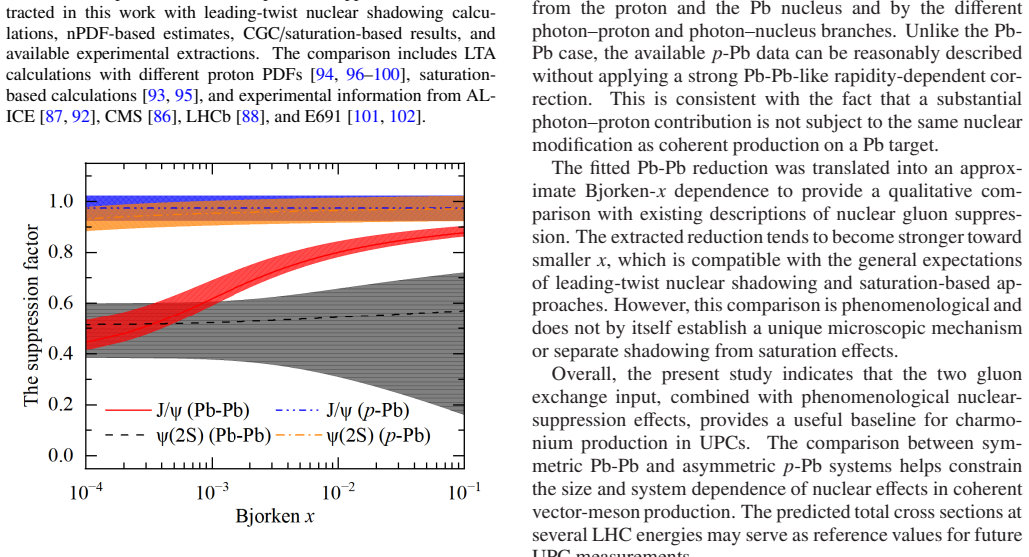
shows that the forward charmonium photo- production cross section scales approximately as [ xg(x, Q2)]2; coherent charmonium production is therefore highly sensit ive to the nuclear gluon distribution at small x. Fig. 8 compares the suppression factor obtained in the present work with several existing descriptions in the regi on 10−4 < x < 10−1. The extra...
-
[3]
Experimental Observation of a Heavy Particle J,
J. J. Aubert et al. [E598], “Experimental Observation of a Heavy Particle J,” Phys. Rev. Lett. 33, 1404-1406 (1974)
1974
-
[4]
Discovery of a Narrow Resonance in e+e− Annihilation,
J. E. Augustin et al. [SLAC-SP-017], “Discovery of a Narrow Resonance in e+e− Annihilation,” Phys. Rev. Lett. 33, 1406- 1408 (1974)
1974
-
[5]
Search for Narrow Resonances in e+ e− Annihilation in the Mass Region 3.2-GeV to 5.9-GeV ,
A. Boyarski et al. , “Search for Narrow Resonances in e+ e− Annihilation in the Mass Region 3.2-GeV to 5.9-GeV ,” Phys. Rev. Lett. 34, 762 (1975). 10
1975
-
[6]
Di ffractive leptoproduction of vector mesons in QCD,
S. J. Brodsky, L. Frankfurt and J. F. Gunion et al., “Di ffractive leptoproduction of vector mesons in QCD,” Phys. Rev. D 50, 3134-3144 (1994)
1994
-
[7]
The Quantum Numbers and Decay Widths of theψ(3095),
A. Boyarski et al., “The Quantum Numbers and Decay Widths of theψ(3095),” Phys. Rev. Lett. 34, 1357 (1975)
1975
-
[8]
Observation of thirteen new ex- clusive multi-body hadronic decays of the ψ(2S ),
R. A. Briere et al. [CLEO], “Observation of thirteen new ex- clusive multi-body hadronic decays of the ψ(2S ),” Phys. Rev. Lett. 95, 062001 (2005)
2005
-
[9]
Review of particle physics,
S. Navas et al. [Particle Data Group], “Review of particle physics,” Phys. Rev. D 110, 030001 (2024)
2024
-
[10]
Number of J/ψ events at BESIII,
M. Ablikim et al. [BESIII], “Number of J/ψ events at BESIII,” Chin. Phys. C 46, 074001 (2022)
2022
-
[11]
Determination of the number of ψ(3686) events taken at BESIII,
M. Ablikim et al. [BESIII], “Determination of the number of ψ(3686) events taken at BESIII,” Chin. Phys. C 48, 093001 (2024)
2024
-
[12]
An updated review of the new hadron states,
H. X. Chen, W. Chen and X. Liu et al., “An updated review of the new hadron states,” Rept. Prog. Phys. 86, 026201 (2023)
2023
-
[13]
Nucleon Electromagnetic Form Fac- tors in the Timelike Region,
A. Denig and G. Salme, “Nucleon Electromagnetic Form Fac- tors in the Timelike Region,” Prog. Part. Nucl. Phys. 68, 113- 157 (2013)
2013
-
[14]
Analysis of Strong Cou- pling Constant with Machine Learning and Its Application,
X. Y . Wang, C. Dong and X. Liu, “Analysis of Strong Cou- pling Constant with Machine Learning and Its Application,” Chin. Phys. Lett. 41, 031201 (2023)
2023
-
[15]
Development Status and Future Plan of Meson Beam Experiments at Home and Abroad,
X. Y . Wang and X. Liu, “Development Status and Future Plan of Meson Beam Experiments at Home and Abroad,” Nucl. Phys. Rev. 42, 10-24 (2025)
2025
-
[16]
Understanding of the BESIII measurement of (anti)hyperon-nucleon scattering,
X. Y . Wang, Y . Gao and X. Liu, “Understanding of the BESIII measurement of (anti)hyperon-nucleon scattering,” Phys. Lett. B 862, 139321 (2025)
2025
-
[17]
Production potential of hidden-strange molecular pentaquarks through the π−p → K∗Σprocess,
X. Y . Wang, Y . Gao and X. Liu, “Production potential of hidden-strange molecular pentaquarks through the π−p → K∗Σprocess,” Phys. Rev. D 111, 034021 (2025)
2025
-
[18]
Producing Λ(1405) and Λ(1520) in π−p reaction to explore their inner structures,
Y . Gao, X. Y . Wang and X. Liu, “Producing Λ(1405) and Λ(1520) in π−p reaction to explore their inner structures,” Phys. Rev. D 113, 114006 (2026)
2026
-
[19]
QCD Analysis of Near-Threshold Photon-Proton Production of Heavy Quarkonium,
Y . Guo, X. Ji and Y . Liu, “QCD Analysis of Near-Threshold Photon-Proton Production of Heavy Quarkonium,” Phys. Rev. D 103, 096010 (2021)
2021
-
[20]
Testing the double- logarithm asymptotic gluon density in ultraperipheral hea vy ion collisions at the Large Hadron Collider,
D. A. Fagundes and M. V . T. Machado, “Testing the double- logarithm asymptotic gluon density in ultraperipheral hea vy ion collisions at the Large Hadron Collider,” Physics 7, 24 (2025)
2025
-
[21]
Nuclear geometry at high energy from exclusive vector meson production,
H. M¨ antysaari, F. Salazar and B. Schenke, “Nuclear geometry at high energy from exclusive vector meson production,” Phys. Rev. D 106, 074019 (2022)
2022
-
[22]
Comparative analysis of ωp, φp, and J/ψ p scattering lengths from A2, CLAS, and GlueX threshold measurements,
I. I. Strakovsky, L. Pentchev and A. Titov, “Comparative analysis of ωp, φp, and J/ψ p scattering lengths from A2, CLAS, and GlueX threshold measurements,” Phys. Rev. C 101, 045201 (2020)
2020
-
[23]
J/ψ p scatter- ing length from GlueX threshold measurements,
I. Strakovsky, D. Epifanov and L. Pentchev, “ J/ψ p scatter- ing length from GlueX threshold measurements,” Phys. Rev. C 101, 042201 (2020)
2020
-
[24]
J/ψ photopro- duction and the gluon structure of the nucleon,
D. Kharzeev, H. Satz and A. Syamtomov et al.,“ J/ψ photopro- duction and the gluon structure of the nucleon,” Eur. Phys. J . C 9, 459-462 (1999)
1999
-
[25]
Gluon gravitational form factors of protons from charmonium photoproduction,
X. Y . Wang, F. Zeng and Q. Wang,“Gluon gravitational form factors of protons from charmonium photoproduction,” Chin . Phys. C 47, 074101 (2023)
2023
-
[26]
Perturbative QCD analysis of near threshold heavy quarkonium photoproduction at larg e momentum transfer,
P . Sun, X. B. Tong and F. Y uan, “Perturbative QCD analysis of near threshold heavy quarkonium photoproduction at larg e momentum transfer,” Phys. Lett. B 822, 136655 (2021)
2021
-
[27]
Di ffractive photoproduction of J/ψ and Υusing holographic QCD: gravitational form factors and GPD of gluons in the proton,
K. A. Mamo and I. Zahed, “Di ffractive photoproduction of J/ψ and Υusing holographic QCD: gravitational form factors and GPD of gluons in the proton,” Phys. Rev. D 101, 086003 (2020)
2020
-
[28]
The origin of proton mass from J/ψ photo-production data,
R. Wang, J. Evslin and X. Chen, “The origin of proton mass from J/ψ photo-production data,” Eur. Phys. J. C 80, 507 (2020)
2020
-
[29]
ψ(∗) p scatter- ing length based on near-threshold charmonium photoproduc - tion,
X. Y . Wang, F. Zeng and I. I. Strakovsky, “ ψ(∗) p scatter- ing length based on near-threshold charmonium photoproduc - tion,” Phys. Rev. C 106, 015202 (2022)
2022
-
[30]
Thresh- old Upsilon-meson photoproduction at the EIC and EicC,
I. I. Strakovsky, W. J. Briscoe and L. Pentchev et al., “Thresh- old Upsilon-meson photoproduction at the EIC and EicC,” Phys. Rev. D 104, 074028 (2021)
2021
-
[31]
Near threshold J/ψ and Υ photoproduction at JLab and RHIC,
Y . Hatta, A. Rajan and D. L. Yang, “Near threshold J/ψ and Υ photoproduction at JLab and RHIC,” Phys. Rev. D 100, 014032 (2019)
2019
-
[32]
Mass radius of the proton,
D. E. Kharzeev, “Mass radius of the proton,” Phys. Rev. D 104, 054015 (2021)
2021
-
[33]
Mass structure of hadrons and light-front sum rules in the ′t Hooft model,
X. Ji, Y . Liu and I. Zahed, “Mass structure of hadrons and light-front sum rules in the ′t Hooft model,” Phys. Rev. D 103, 074002 (2021)
2021
-
[34]
Determining the gluonic gravitational form factors of the proton,
B. Duran, Z. E. Meziani and S. Joosten et al. , “Determining the gluonic gravitational form factors of the proton,” Natu re 615, 813-816 (2023)
2023
-
[35]
Holographic J/ψ production near threshold and the proton mass problem,
Y . Hatta and D. L. Yang, “Holographic J/ψ production near threshold and the proton mass problem,” Phys. Rev. D 98, 074003 (2018)
2018
-
[36]
Quantum anomalous energy e ffects on the nucleon mass,
X. Ji and Y . Liu, “Quantum anomalous energy e ffects on the nucleon mass,” Sci. China Phys. Mech. Astron. 64, 281012 (2021)
2021
-
[37]
Analysis of the contribution of the quantum anomaly energy to the proton mass,
X. Y . Wang, J. Bu and F. Zeng, “Analysis of the contribution of the quantum anomaly energy to the proton mass,” Phys. Rev. D 106, 094029 (2022)
2022
-
[38]
Gravitational form factors of the proton from near-threshold vector meson photoproduc - tion,
X. Y . Wang, F. Zeng and J. Zhang, “Gravitational form factors of the proton from near-threshold vector meson photoproduc - tion,” Chin. Phys. C 48, 054102 (2024)
2024
-
[39]
Exploration of trace anomaly contribution to proton mass based on light vector me- son photoproduction,
C. Dong, J. Zhang and J. Bu et al. , “Exploration of trace anomaly contribution to proton mass based on light vector me- son photoproduction,” Eur. Phys. J. C 83, 122 (2023)
2023
-
[40]
Analysis of the inter- action between the φmeson and nucleus,
X. Y . Wang, C. Dong and Q. Wang, “Analysis of the inter- action between the φmeson and nucleus,” Chin. Phys. C 47, 014106 (2023)
2023
-
[41]
Mass radius and mechan- ical properties of the proton via strange φmeson photoproduc- tion,
X. Y . Wang, C. Dong and Q. Wang, “Mass radius and mechan- ical properties of the proton via strange φmeson photoproduc- tion,” Phys. Rev. D 106, 056027 (2022)
2022
-
[42]
Systematic analysis of the proton mass radius based on photoproduction of vector char- moniums,
X. Y . Wang, F. Zeng and Q. Wang, “Systematic analysis of the proton mass radius based on photoproduction of vector char- moniums,” Phys. Rev. D 105, 096033 (2022)
2022
-
[43]
First Measurement of Near-Threshold J/ψ Exclusive Photoproduction o ffthe Proton,
A. Ali et al. [GlueX], “First Measurement of Near-Threshold J/ψ Exclusive Photoproduction o ffthe Proton,” Phys. Rev. Lett. 123, 072001 (2019)
2019
-
[44]
Exclusive photoproduction of J/ψ mesons at HERA,
S. Chekanov et al. [ZEUS], “Exclusive photoproduction of J/ψ mesons at HERA,” Eur. Phys. J. C 24, 345-360 (2002)
2002
-
[45]
J/ψ Photopro- duction from 60-GeV/c to 300-GeV/c,
M. E. Binkley, C. Bohler and J. Butler et al., “ J/ψ Photopro- duction from 60-GeV/c to 300-GeV/c,” Phys. Rev. Lett. 48, 73 (1982)
1982
-
[46]
A Measurement of Elastic J/ψ Photoproduction Cross Section at Fermilab E687,
P . L. Frabetti et al. [E687], “A Measurement of Elastic J/ψ Photoproduction Cross Section at Fermilab E687,” Phys. Let t. B 316, 197-206 (1993)
1993
-
[47]
Elastic and Proton-Dissociative Photo- production of J/ψ Mesons at HERA,
C. Alexa et al. [H1], “Elastic and Proton-Dissociative Photo- production of J/ψ Mesons at HERA,” Eur. Phys. J. C 73, 2466 (2013)
2013
-
[48]
Exclusive J/ψ photoproduction offprotons in ultra-peripheral p-Pb collisions at √sNN = 5. 02 TeV ,
B. B. Abelev et al. [ALICE], “Exclusive J/ψ photoproduction offprotons in ultra-peripheral p-Pb collisions at √sNN = 5. 02 TeV ,” Phys. Rev. Lett.113, 232504 (2014)
2014
-
[49]
Exclusive J/ψ and ψ(2S ) production in pp collisions at √s = 7 TeV ,
R. Aaij et al. [LHCb], “Exclusive J/ψ and ψ(2S ) production in pp collisions at √s = 7 TeV ,” J. Phys. G40, 045001 (2013). 11
2013
-
[50]
Energy dependence of exclusive J/ψ photoproduction offprotons in ultra-peripheral p–Pb col- lisions at √sNN = 5. 02 TeV ,
S. Acharya et al. [ALICE], “Energy dependence of exclusive J/ψ photoproduction offprotons in ultra-peripheral p–Pb col- lisions at √sNN = 5. 02 TeV ,” Eur. Phys. J. C 79, 402 (2019)
2019
-
[51]
Di ffractive photoproduction of ψ(2S ) mesons at HERA,
C. Adlo ffet al. [H1], “Di ffractive photoproduction of ψ(2S ) mesons at HERA,” Phys. Lett. B 541, 251-264 (2002)
2002
-
[52]
Central exclusive production of J/ψ and ψ(2S ) mesons in pp collisions at √s = 13 TeV ,
R. Aaij et al. [LHCb], “Central exclusive production of J/ψ and ψ(2S ) mesons in pp collisions at √s = 13 TeV ,” JHEP 10, 167 (2018)
2018
-
[53]
S. Joosten et al. [007], “Near-Threshold J/ψ → µ+µ− Photo- production and the Gluonic Gravitational Form Factors of th e Proton,” [arXiv:2602.14416 [nucl-ex]]
-
[54]
Measurement of the near- threshold J/ψ photoproduction cross section with the CLAS12 experiment,
P . Chatagnon et al. [CLAS], “Measurement of the near- threshold J/ψ photoproduction cross section with the CLAS12 experiment,” [arXiv:2602.22128 [hep-ex]]
-
[55]
Estimation of Υ(1S) pro- duction in ep process near threshold,
Y . Xu, Y . Xie and R. Wang et al. , “Estimation of Υ(1S) pro- duction in ep process near threshold,” Eur. Phys. J. C 80, 283 (2020)
2020
-
[57]
QCD analysis of near-threshold quarkonium leptoproduction at large photon virtualities,
R. Boussarie and Y . Hatta, “QCD analysis of near-threshold quarkonium leptoproduction at large photon virtualities, ” Phys. Rev. D 101, 114004 (2020)
2020
-
[58]
Υphotopro- duction on the proton at the Electron-Ion Collider,
O. Gryniuk, S. Joosten and Z. E. Meziani et al., “ Υphotopro- duction on the proton at the Electron-Ion Collider,” Phys. R ev. D 102, 014016 (2020)
2020
-
[59]
Near-threshold photoproduction of J/ψ in two-gluon exchange model,
F. Zeng, X. Y . Wang and L. Zhang et al. , “Near-threshold photoproduction of J/ψ in two-gluon exchange model, ” Eur. Phys. J. C 80, 1027 (2020)
2020
-
[60]
Electron Ion Collider: The Next QCD Frontier: Understanding the glue that binds us all,
A. Accardi, J. L. Albacete and M. Anselmino et al., “Electron Ion Collider: The Next QCD Frontier: Understanding the glue that binds us all,” Eur. Phys. J. A 52, 268 (2016)
2016
-
[61]
Electron-ion col- lider in China,
D. P . Anderle, V . Bertone and X. Caoet al., “Electron-ion col- lider in China,” Front. Phys. (Beijing) 16, 64701 (2021)
2021
-
[62]
Electron ion collider in China (J /OL),
X. Cao, L. Chang and N. Chang et al., “Electron ion collider in China (J /OL),” Nucl. Tech. 43(2), 020001-020001 (2020)
2020
-
[63]
Photoproduction of vector mesons in the soft dipole pomeron model,
E. Martynov, E. Predazzi and A. Prokudin, “Photoproduction of vector mesons in the soft dipole pomeron model,” Phys. Rev. D 67, 074023 (2003)
2003
-
[64]
Production of strangeonium φ(1680) state in electromagnetic probe-driven scatterings and hadron–hadron ultraperipheral collision s,
C. Dong, Y . Hou and X. Y . Wang et al. , “Production of strangeonium φ(1680) state in electromagnetic probe-driven scatterings and hadron–hadron ultraperipheral collision s,” Eur. Phys. J. C 83, 430 (2023)
2023
-
[65]
Systematic anal- ysis of charmonium photoproduction,
A. Sibirtsev, S. Krewald and A. W. Thomas, “Systematic anal- ysis of charmonium photoproduction,” J. Phys. G 30, 1427- 1444 (2004)
2004
-
[66]
Double polarization observables in pentaquark photoproduction,
D. Winney et al. [JPAC], “Double polarization observables in pentaquark photoproduction,” Phys. Rev. D 100, 034019 (2019)
2019
-
[67]
Probing strangeonium φ(2170) state in lepton-proton scattering and ultra-periph eral collisions,
Y . Hou, Y . Gao and X. Y . Wang, “Probing strangeonium φ(2170) state in lepton-proton scattering and ultra-periph eral collisions,” Nucl. Phys. A 1050, 122925 (2024)
2024
-
[68]
Studying the Pc(4450) resonance in J/ψ photoproduction off protons,
A. N. Hiller Blin, C. Fern´ andez-Ram´ ırez and A. Jackuraet al., “Studying the Pc(4450) resonance in J/ψ photoproduction off protons,” Few Body Syst. 59, 104 (2018)
2018
-
[69]
Physics of ultr a- peripheral nuclear collisions,
C. A. Bertulani, S. R. Klein and J. Nystrand, “Physics of ultr a- peripheral nuclear collisions,” Ann. Rev. Nucl. Part. Sci. 55, 271-310 (2005)
2005
-
[70]
Coherent γγ andγ-A interactions in very peripheral collisions at relativistic ion colliders,
G. Baur, K. Hencken and D. Trautmann et al. , “Coherent γγ andγ-A interactions in very peripheral collisions at relativistic ion colliders,” Phys. Rept. 364, 359-450 (2002)
2002
-
[71]
The Physics of ultraperipheral collisions at the LHC,
A. J. Baltz, G. Baur and D. d’Enterria et al., “The Physics of ultraperipheral collisions at the LHC,” Phys. Rept. 458, 1-171 (2008)
2008
-
[72]
Ultra-peripheral collisions and hadronic str uc- ture,
S. R. Klein, “Ultra-peripheral collisions and hadronic str uc- ture,” Nucl. Phys. A 967, 249-256 (2017)
2017
-
[73]
Di ffractive leptoproduction of vector mesons in QCD,
S. J. Brodsky, L. Frankfurt and J. F. Gunion et al., “Di ffractive leptoproduction of vector mesons in QCD,” Phys. Rev. D 50, 3134 (1994)
1994
-
[74]
Di ffractive J/ψ electroproduction in LLA QCD,
M. G. Ryskin, “Di ffractive J/ψ electroproduction in LLA QCD,” Z. Phys. C 57, 89-92 (1993)
1993
-
[75]
Charmonium photoproduction,
A. Sibirtsev, S. Krewald and A. W. Thomas, “Charmonium photoproduction,” [arXiv:nucl-th /0301082 [nucl-th]]
-
[76]
New generation of parton distributions with uncertainties from global QCD analysis,
J. Pumplin, D. R. Stump and J. Huston et al., “New generation of parton distributions with uncertainties from global QCD analysis,” JHEP 07, 012 (2002)
2002
-
[77]
Exclusive J/ψ and ψ(2S ) photo-production as a probe of QCD low x evolution equations,
M. Hentschinski and E. Padr´ on Molina, “Exclusive J/ψ and ψ(2S ) photo-production as a probe of QCD low x evolution equations,” Phys. Rev. D 103, 074008 (2021)
2021
-
[78]
Exclusive vector meson productio n in relativistic heavy ion collisions,
S. Klein and J. Nystrand,“Exclusive vector meson productio n in relativistic heavy ion collisions,” Phys. Rev. C 60, 014903 (1999)
1999
-
[79]
STARlight: A Monte Carlo simulation program for ultra-peripheral colli - sions of relativistic ions,
S. R. Klein, J. Nystrand and J. Seger et al. , “STARlight: A Monte Carlo simulation program for ultra-peripheral colli - sions of relativistic ions,” Comput. Phys. Commun. 212, 258- 268 (2017)
2017
-
[80]
Ex- clusive photoproduction of J/ψ and ψ(2S ) states in proton- proton collisions at the CERN LHC,
M. B. Gay Ducati, M. T. Griep and M. V . T. Machado, “Ex- clusive photoproduction of J/ψ and ψ(2S ) states in proton- proton collisions at the CERN LHC,” Phys. Rev. D 88, 017504 (2013)
2013
-
[81]
Coherent J/ψ photoproduction in ultra-peripheral Pb-Pb collisions at √sNN = 2. 76 TeV ,
B. Abelev et al. [ALICE],“Coherent J/ψ photoproduction in ultra-peripheral Pb-Pb collisions at √sNN = 2. 76 TeV ,” Phys. Lett. B 718, 1273-1283 (2013)
2013
discussion (0)
Sign in with ORCID, Apple, or X to comment. Anyone can read and Pith papers without signing in.