REVIEW 2 major objections 2 minor 1 cited by
SLU-2K: A Question-Based Benchmark for Semantic Evaluation of Sign Language Translation
T0 review · 2 major / 2 minor · reviewed 2026-06-28 · grok-4.3
Pith's one-line read Sign language translation systems still miss key semantic details even after fine-tuning, scoring 56.7 to 75.2 percent on a new question benchmark.
desk verdict SLU-2K gives a concrete QA benchmark for semantic gaps in sign language translation, but its value hinges on how well the automated pipeline matches actual video content. read the letter →
The pith
A machine-rendered reading of the paper's core claim, the machinery that carries it, and where it could break.
The reading
What carries the argument
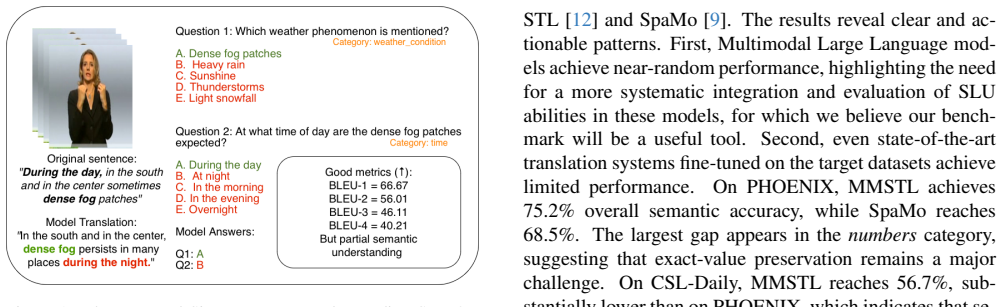
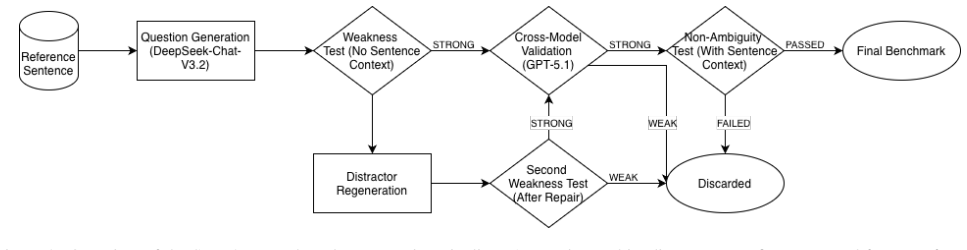
SLU-2K, a dataset of 2,350 closed-ended video question-answer pairs produced by an automated pipeline across the seven categories of actions, locations, numbers, objects, people, time, and weather conditions.
What would settle it
A study in which independent human raters judge a random sample of the generated questions as failing to capture the actual semantic content of their source videos would falsify the benchmark's validity.
Extended reading notes
Core claim
The central claim is that state-of-the-art sign language translation systems fine-tuned on in-domain data still exhibit a substantial semantic gap on SLU-2K, reaching only 56.7 to 75.2 percent accuracy, while multimodal large language models reach near-random performance; this demonstrates that surface-form metrics overestimate true semantic understanding and that future SLT evaluation should incorporate semantic correctness.
Load-bearing premise
The automated question-generation pipeline produces questions that accurately and without bias reflect the semantic content of the original sign videos across the seven categories.
Editorial extensions
If this is right
- Current SLT evaluation protocols overestimate true understanding because they rely only on fluency and n-gram overlap.
- Future progress in sign language translation should be measured by semantic correctness in addition to existing surface metrics.
- Systematic integration of semantic understanding evaluation is required in current AI systems for sign language.
- Automated pipelines can generate large-scale question sets for semantic evaluation from existing translation datasets.
Reading between the lines
- The same question-based approach could be extended to additional sign language corpora beyond the two source datasets used here.
- Models may be exploiting dataset-specific patterns rather than learning general semantic mappings, which would explain the gap between translation fluency and question-answering accuracy.
- Pairing SLU-2K scores with traditional metrics on the same outputs would give a more complete picture of model behavior.
Signed reviews
Editorial analysis
A structured set of objections, weighed in public.
Referee Report
Summary. The paper introduces SLU-2K, a benchmark of 2,350 closed-ended video question-answer pairs derived from PHOENIX-2014T and CSL-Daily via an automated pipeline across seven semantic categories (actions, locations, numbers, objects, people, time, weather). It evaluates MLLMs and two SOTA SLT systems (MMSTL, SpaMo), reporting near-random MLLM performance and SOTA accuracies of 56.7%–75.2%, and argues that surface metrics like BLEU overestimate semantic understanding in SLT. Code, prompts, and benchmark files are released publicly.
Significance. If the automated pipeline produces questions that faithfully and without bias capture semantic content directly from the sign videos, SLU-2K would offer a useful complement to n-gram metrics by directly testing meaning preservation, a key requirement for assistive SLT applications. The public release of code and data is a clear strength supporting reproducibility.
major comments (2)
- [automated data generation pipeline] Abstract and automated data generation pipeline section: the claim that the pipeline was 'extensively evaluated' is not supported by any reported quantitative validation (e.g., inter-annotator agreement, fraction of questions verified answerable from video alone, or error analysis for artifacts); this directly affects the reliability of the headline accuracy figures (56.7%–75.2%).
- [evaluation section] Abstract and evaluation section: it is not stated whether question generation begins from video content, glosses, or text translations; if the latter, the benchmark cannot be guaranteed to test video-based semantic recovery, which is the central premise for evaluating SLT systems on semantic gap.
minor comments (2)
- [Abstract] Abstract: the range 56.7% to 75.2% should be broken down by system (MMSTL vs. SpaMo) for precise interpretation of results.
- References: ensure full citations are provided for MMSTL and SpaMo, which are described as representative SOTA systems.
Simulated Author's Rebuttal
We thank the referee for their detailed and constructive feedback. We address each major comment below and will revise the manuscript to improve the description of the data generation pipeline and its validation.
read point-by-point responses
-
Referee: Abstract and automated data generation pipeline section: the claim that the pipeline was 'extensively evaluated' is not supported by any reported quantitative validation (e.g., inter-annotator agreement, fraction of questions verified answerable from video alone, or error analysis for artifacts); this directly affects the reliability of the headline accuracy figures (56.7%–75.2%).
Authors: We agree that the current manuscript does not provide quantitative validation metrics for the pipeline, such as inter-annotator agreement or explicit error rates on answerability from video. The description relies on qualitative checks and manual inspection of a subset of outputs. In the revised version, we will add a new subsection in the data generation section reporting quantitative results, including the fraction of questions verified as answerable from video alone and a systematic error analysis of artifacts. revision: yes
-
Referee: Abstract and evaluation section: it is not stated whether question generation begins from video content, glosses, or text translations; if the latter, the benchmark cannot be guaranteed to test video-based semantic recovery, which is the central premise for evaluating SLT systems on semantic gap.
Authors: The pipeline generates questions from the text translations in the source datasets (PHOENIX-2014T and CSL-Daily), which are time-aligned with the videos and glosses. Questions are designed to target semantic content that is visually present in the sign videos. We acknowledge that the starting point of generation is not explicitly stated in the current text. In the revision, we will add a clear description of the pipeline steps, including examples, and explain how the resulting questions still evaluate video-based semantic recovery when applied to MLLMs and SLT systems. revision: yes
Circularity Check
No circularity; benchmark and pipeline are externally constructed and evaluated
full rationale
The paper introduces SLU-2K as a new benchmark of 2,350 video QA pairs generated via an automated pipeline from public datasets (PHOENIX-2014T, CSL-Daily) across 7 categories, then reports empirical results on MLLMs and SLT systems (MMSTL, SpaMo). No equations, fitted parameters, predictions, or derivations appear. Central claims rest on direct evaluation of existing models against the new benchmark rather than any self-referential reduction, self-citation load-bearing step, or ansatz. Matches reader's assessment of score ~1 with no load-bearing circularity.
Assumptions & free parameters
Cite this review
Pith. "Pith review of SLU-2K: A Question-Based Benchmark for Semantic Evaluation of Sign Language Translation." pith.science (2026). https://pith.science/paper/Y44UJOE7
@misc{pith2026260603788,
  author       = {Pith},
  title        = {Pith review of: SLU-2K: A Question-Based Benchmark for Semantic Evaluation of Sign Language Translation},
  year         = {2026},
  howpublished = {\url{https://pith.science/paper/Y44UJOE7}},
  note         = {Machine review of arXiv:2606.03788}
}
read the original abstract
Sign Language Translation (SLT) is typically evaluated with surface-form metrics such as BLEU and ROUGE, which reward lexical overlap but do not directly measure whether a translation preserves the meaning of the source sign sequence. This is in contrast with the final objective of integrating SLT in assistive technology. In this work, we shift the focus from Sign Language Translation (SLT) to Sign Language Understanding (SLU), with particular emphasis on semantic understanding. Specifically, we evaluate systems based on their ability to correctly recover, from the input video, key semantic aspects of the original sentence, such as actions taking place and facts about people and objects. To enable this evaluation systematically, we propose SLU-2K, a dataset of 2,350 closed-ended video question-answer pairs based on the popular PHOENIX-2014T and CSL-Daily datasets. To obtain SLU-2K, we propose and extensively evaluate an automated data generation pipeline which produces questions across 7 categories, namely actions, locations, numbers, objects, people, time, and weather conditions. We show the potential of SLU-2K by evaluating popular Multimodal Large Language Models (MLLMs) and two representative state-of-the-art systems, MMSTL and SpaMo. Our results show that MLLMs reach near-random performance, highlighting the need for a more systematic integration of SLU in current AI systems. Furthermore, state-of-the-art translation systems carefully fine-tuned on in-domain data still exhibit a substantial semantic gap, with results ranging from 56.7% to 75.2%. These findings suggest that current SLT evaluation protocols overestimate true understanding and that future progress should be measured not only by fluency and n-gram overlap, but also by semantic correctness. Code, prompts, and benchmark files are available at https://github.com/ZenoTsT/SLU-2K
Figures

Figures from the paper (1 more)

Forward citations
Cited by 1 Pith paper
-
Sign Language Question Answering: A New Task, Benchmark, and Baseline for Sign Language Understanding
Sign Language QA benchmarks are introduced from PHOENIX14T and CSL-Daily via template-generated questions, and a question-conditioned baseline outperforms video-language and cascaded baselines.
Reference graph
Works this paper leans on
-
[1]
Hierarchical feature alignment for gloss-free sign language translation
Sobhan Asasi, Mohamed Ilyes Lakhal, and Richard Bowden. Hierarchical feature alignment for gloss-free sign language translation. InAdjunct Proceedings of the 25th ACM Inter- national Conference on Intelligent Virtual Agents, pages 1–6,
-
[2]
Sobhan Asasi, Mohamed Ilyas Lakhal, Ozge Mercanoglu Sincan, and Richard Bowden. Beyond gloss: A hand-centric framework for gloss-free sign language translation.arXiv preprint arXiv:2507.23575, 2025. 1, 2
-
[3]
Neural sign language trans- lation
Necati Cihan Camgoz, Simon Hadfield, Oscar Koller, Her- mann Ney, and Richard Bowden. Neural sign language trans- lation. InProceedings of the IEEE conference on computer vision and pattern recognition, pages 7784–7793, 2018. 2, 3
2018
-
[4]
Factorized learn- ing assisted with large language model for gloss-free sign language translation
Zhigang Chen, Benjia Zhou, Jun Li, Jun Wan, Zhen Lei, Ning Jiang, Quan Lu, and Guoqing Zhao. Factorized learn- ing assisted with large language model for gloss-free sign language translation. InProceedings of the 2024 Joint In- ternational Conference on Computational Linguistics, Lan- guage Resources and Evaluation (LREC-COLING 2024), pages 7071–7081, 2024. 1, 2
2024
-
[5]
C2RL: Content and context representation learning for gloss- free sign language translation and retrieval.IEEE Transac- tions on Circuits and Systems for Video Technology, 2025
Zhigang Chen, Benjia Zhou, Yiqing Huang, Jun Wan, Yibo Hu, Hailin Shi, Yanyan Liang, Zhen Lei, and Du Zhang. C2RL: Content and context representation learning for gloss- free sign language translation and retrieval.IEEE Transac- tions on Circuits and Systems for Video Technology, 2025
2025
-
[6]
LLMs are good sign language translators
Jia Gong, Lin Geng Foo, Yixuan He, Hossein Rahmani, and Jun Liu. LLMs are good sign language translators. InPro- ceedings of the IEEE/CVF conference on computer vision and pattern recognition, pages 18362–18372, 2024. 1, 2
2024
-
[7]
Q2: Evaluating fac- tual consistency in knowledge-grounded dialogues via ques- tion generation and question answering
Or Honovich, Leshem Choshen, Roee Aharoni, Ella Nee- man, Idan Szpektor, and Omri Abend. Q2: Evaluating fac- tual consistency in knowledge-grounded dialogues via ques- tion generation and question answering. InProceedings of the 2021 Conference on Empirical Methods in Natural Lan- guage Processing, pages 7856–7870, 2021. 3
2021
-
[8]
True: Re-evaluating factual consistency evaluation
Or Honovich, Roee Aharoni, Jonathan Herzig, Hagai Taitel- baum, Doron Kukliansy, Vered Cohen, Thomas Scialom, Idan Szpektor, Avinatan Hassidim, and Yossi Matias. True: Re-evaluating factual consistency evaluation. InProceedings of the 2022 Conference of the North American Chapter of the Association for Computational Linguistics: Human Lan- guage Technolog...
2022
Show all 23 references
-
[9]
An efficient sign language translation using spa- tial configuration and motion dynamics with LLMs.arXiv preprint arXiv:2408.10593, 2024
Eui Jun Hwang, Sukmin Cho, Junmyeong Lee, and Jong C Park. An efficient sign language translation using spa- tial configuration and motion dynamics with LLMs.arXiv preprint arXiv:2408.10593, 2024. 1, 2
2024
-
[10]
A spatio-temporal representation learn- ing as an alternative to traditional glosses in sign language translation and production
Eui Jun Hwang, Sukmin Cho, Huije Lee, Youngwoo Yoon, and Jong C Park. A spatio-temporal representation learn- ing as an alternative to traditional glosses in sign language translation and production. In2025 IEEE/CVF Winter Con- ference on Applications of Computer Vision (WACV)...
2025
-
[11]
Lost in translation, found in context: Sign language translation with contextual cues
Youngjoon Jang, Haran Raajesh, Liliane Momeni, G¨ul Varol, and Andrew Zisserman. Lost in translation, found in context: Sign language translation with contextual cues. InProceed- ings of the Computer Vision and Pattern Recognition Con- ference, pages 8742–8752, 2025. 2
2025
-
[12]
Leveraging the power of mllms for gloss-free sign language translation
Jungeun Kim, Hyeongwoo Jeon, Jongseong Bae, and Ha Young Kim. Leveraging the power of mllms for gloss-free sign language translation. InProceedings of the IEEE/CVF International Conference on Computer Vision, pages 21048–21058, 2025. 1, 2
2025
-
[13]
Faithfulness in natural language generation: A systematic survey of analysis, evaluation and optimization methods.arXiv preprint arXiv:2203.05227, 2022
Wei Li, Wenhao Wu, Moye Chen, Jiachen Liu, Xinyan Xiao, and Hua Wu. Faithfulness in natural language generation: A systematic survey of analysis, evaluation and optimization methods.arXiv preprint arXiv:2203.05227, 2022. 3
2022
-
[14]
Rouge: A package for automatic evaluation of summaries
Chin-Yew Lin. Rouge: A package for automatic evaluation of summaries. InText summarization branches out, pages 74–81, 2004. 3
2004
-
[15]
Spotter+ GPT: Turning sign spottings into sentences with LLMs
Ozge Mercanoglu Sincan and Richard Bowden. Spotter+ GPT: Turning sign spottings into sentences with LLMs. In Adjunct Proceedings of the 25th ACM International Confer- ence on Intelligent Virtual Agents, pages 1–6, 2025. 2
2025
-
[16]
Bleu: a method for automatic evaluation of machine translation
Kishore Papineni, Salim Roukos, Todd Ward, and Wei-Jing Zhu. Bleu: a method for automatic evaluation of machine translation. InProceedings of the 40th annual meeting of the Association for Computational Linguistics, pages 311–318,
-
[17]
Multilin- gual gloss-free sign language translation: Towards building a sign language foundation model
Sihan Tan, Taro Miyazaki, and Kazuhiro Nakadai. Multilin- gual gloss-free sign language translation: Towards building a sign language foundation model. InProceedings of the 63rd Annual Meeting of the Association for Computational Linguistics (Volume 2: Short Papers), pages 553...
2025
-
[18]
Stochastic transformer networks with linear competing units: Application to end-to-end sl translation
Andreas V oskou, Konstantinos P Panousis, Dimitrios Kos- mopoulos, Dimitris N Metaxas, and Sotirios Chatzis. Stochastic transformer networks with linear competing units: Application to end-to-end sl translation. InProceedings of the IEEE/CVF International Conference on Compute...
2021
-
[19]
Sign2GPT: Leveraging large language models for gloss-free sign language translation.arXiv preprint arXiv:2405.04164,
Ryan Wong, Necati Cihan Camgoz, and Richard Bowden. Sign2GPT: Leveraging large language models for gloss-free sign language translation.arXiv preprint arXiv:2405.04164,
-
[20]
Towards inclusive communication: A unified framework for generating spoken language from sign, lip, and audio.arXiv preprint arXiv:2508.20476, 2025
Jeong Hun Yeo, Hyeongseop Rha, Sungjune Park, Junil Won, and Yong Man Ro. Towards inclusive communication: A unified framework for generating spoken language from sign, lip, and audio.arXiv preprint arXiv:2508.20476, 2025. 2
2025
-
[21]
SLTUNET: A simple unified model for sign language translation.arXiv preprint arXiv:2305.01778, 2023
Biao Zhang, Mathias M ¨uller, and Rico Sennrich. SLTUNET: A simple unified model for sign language translation.arXiv preprint arXiv:2305.01778, 2023. 2
2023
-
[22]
Gloss-free sign language translation: Improving from visual- language pretraining
Benjia Zhou, Zhigang Chen, Albert Clap ´es, Jun Wan, Yanyan Liang, Sergio Escalera, Zhen Lei, and Du Zhang. Gloss-free sign language translation: Improving from visual- language pretraining. InProceedings of the IEEE/CVF In- ternational Conference on Computer Vision, pages 208...
2023
-
[23]
Improving sign language translation with monolingual data by sign back-translation
Hao Zhou, Wengang Zhou, Weizhen Qi, Junfu Pu, and Houqiang Li. Improving sign language translation with monolingual data by sign back-translation. InProceedings of the IEEE/CVF conference on computer vision and pattern recognition, pages 1316–1325, 2021. 2, 3
2021
Reviewed June 28, 2026 · model on record in the stance chip above.
Discussion (0). Continue with ORCID to comment.