Hamiltonian-Guided Leverage Embedding: Robust Subspace Compression for Efficient QAOA Parameter Estimation
Pith reviewed 2026-06-27 21:31 UTC · model grok-4.3
The pith
Compressing QAOA feature matrices with leverage scores preserves the dominant subspace for efficient parameter estimation.
A machine-rendered reading of the paper's core claim, the machinery that carries it, and where it could break.
Core claim
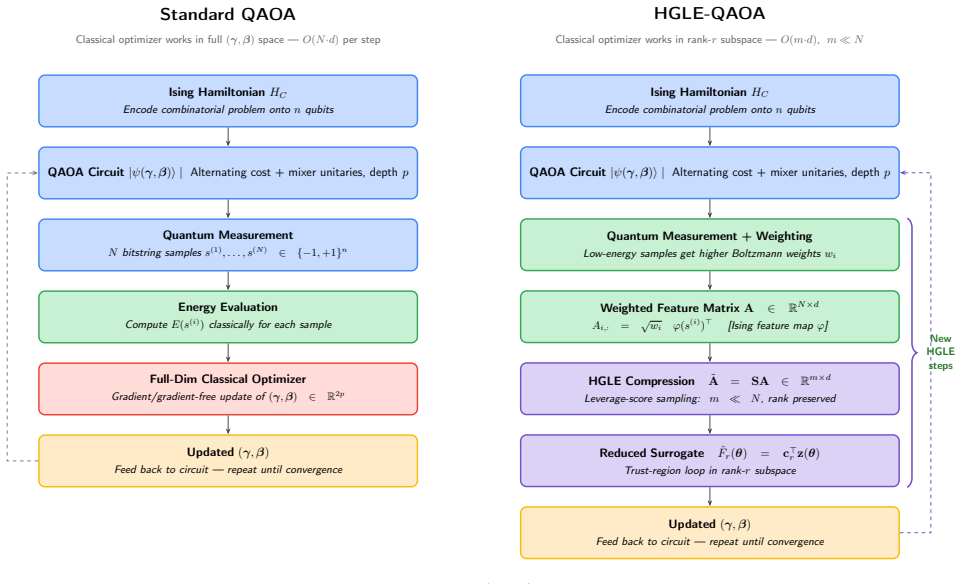
The Hamiltonian-Guided Leverage Embedding algorithm encodes low-energy quantum samples into a weighted Ising feature matrix and compresses it via leverage-score row sampling that provably preserves the dominant rank-r subspace geometry. The compressed representation then drives a classical trust-region loop for estimating the QAOA parameters γ and β at reduced cost, with formal guarantees on rank preservation and energy approximation error, demonstrated across Max-Cut, Maximum Independent Set, and varying graph densities.
What carries the argument
Leverage-score row sampling on the weighted Ising feature matrix derived from QAOA samples, which maintains the dominant subspace for downstream optimization.
If this is right
- QAOA parameter searches complete with far fewer classical operations.
- Optimization remains robust to sampling noise across different problem types and graph structures.
- Formal bounds ensure the compressed matrix yields similar energy approximations as the full matrix.
- The method scales to larger instances by reducing the dimension of the feature space.
Where Pith is reading between the lines
- If the low-rank property holds more broadly, similar compression could apply to other variational quantum algorithms.
- Testing on real quantum hardware would reveal how device noise interacts with the sampling-based compression.
- Alternative sampling methods or iterative refinement of the embedding could further improve the error bounds.
Load-bearing premise
The feature matrices built from QAOA measurement samples have a pronounced low-rank structure that leverage sampling can exploit without distorting the important directions.
What would settle it
Running the full and compressed optimization on the same set of QAOA samples and observing that the compressed version produces parameter values leading to approximation ratios more than a few percent lower would falsify the claim of effective preservation.
Figures
read the original abstract
The Quantum Approximate Optimization Algorithm (QAOA) is a hybrid quantum-classical framework for combinatorial optimization on near-term quantum devices. A central bottleneck is the classical estimation of its variational parameters {\gamma} and {\beta}, which must be optimized over a high-dimensional, non-convex landscape corrupted by sampling noise. We observe that the classical feature matrices constructed from QAOA measurement samples exhibit pronounced low-rank structure, and exploit this property for noise-robust, reduced-dimension parameter search. We present the Hamiltonian-Guided Leverage Embedding (HGLE) algorithm - a hybrid pipeline that encodes low-energy quantum samples into a weighted Ising feature matrix and compresses it via leverage-score row sampling, provably preserving the dominant rank-rsubspace geometry. The compressed representation drives a classical trust-region loop for ({\gamma}, {\beta}) estimation at a fraction of the original cost. We provide formal guarantees for rank preservation and energy approximation error, and demonstrate robustness across problem types (Max-Cut, Maximum Independent Set) and graph topologies of varying density.
Editorial analysis
A structured set of objections, weighed in public.
Referee Report
Summary. The manuscript introduces the Hamiltonian-Guided Leverage Embedding (HGLE) algorithm for QAOA parameter estimation. Low-energy measurement samples are encoded into a weighted Ising feature matrix that is compressed by leverage-score row sampling; the resulting low-dimensional representation is fed to a classical trust-region optimizer to estimate the variational parameters (γ, β). The paper states formal guarantees on preservation of the dominant rank-r subspace geometry and on the resulting energy approximation error, and reports numerical results on Max-Cut and Maximum Independent Set instances across graphs of varying density.
Significance. If the claimed low-rank structure of QAOA-derived feature matrices holds generally and the stated rank-preservation and error bounds are rigorously established, the method offers a concrete route to reducing the classical overhead of variational optimization in QAOA. The combination of a sampling-based compression step with formal subspace guarantees and a trust-region loop is a distinctive contribution that could improve scalability on near-term hardware.
minor comments (3)
- [Abstract] The abstract asserts formal guarantees on rank preservation and energy error but does not cite the theorem or section containing the proof; add an explicit pointer (e.g., “see Theorem 3.2 in §3.2”) so readers can locate the argument immediately.
- Notation for the leverage scores and the weighted Ising matrix is introduced without a consolidated table of symbols; a short notation table would improve readability.
- Figure captions should explicitly state the graph ensemble (Erdős–Rényi, regular, etc.) and the number of QAOA layers p used in each panel.
Simulated Author's Rebuttal
We thank the referee for the positive summary, significance assessment, and recommendation of minor revision. No specific major comments were provided in the report.
Circularity Check
No significant circularity; derivation self-contained
full rationale
The paper observes that QAOA measurement-derived feature matrices exhibit low-rank structure (an empirical input), then applies standard leverage-score row sampling to compress while preserving rank-r geometry, with the compressed matrix feeding a classical trust-region optimizer. No step reduces a claimed prediction or guarantee to a quantity fitted from the same data by construction; no uniqueness theorem, ansatz, or central premise is justified solely by self-citation; the formal rank-preservation and error bounds are standard results from the sampling literature applied to the observed matrices. The chain therefore rests on an external empirical property and independent algorithmic guarantees rather than internal redefinition.
Axiom & Free-Parameter Ledger
Reference graph
Works this paper leans on
-
[1]
A quantum approximate optimization algorithm,
E. Farhi, J. Goldstone, and S. Gutmann, “A quantum approximate optimization algorithm,”arXiv preprint, vol. arXiv:1411.4028, 2014
Pith/arXiv arXiv 2014
-
[2]
HamLib: A library of Hamiltonians for benchmarking quantum algorithms and hardware,
N. P. D. Sawaya, D. Marti-Dafcik, Y . Ho, D. P. Tabor, D. E. Bernal Neira, A. B. Magann, S. Prber, D. Trenev, E. G. Rieffelet al., “HamLib: A library of Hamiltonians for benchmarking quantum algorithms and hardware,”Quantum, vol. 8, p. 1559, 2024
2024
-
[3]
Reducibility among combinatorial problems,
R. M. Karp, “Reducibility among combinatorial problems,” inComplex- ity of Computer Computations. Plenum Press, 1972, pp. 85–103
1972
-
[4]
From the quantum approximate optimization algorithm to a quantum alternating operator ansatz,
S. Hadfield, Z. Wang, B. O’Gorman, E. G. Rieffel, D. Venturelli, and R. Biswas, “From the quantum approximate optimization algorithm to a quantum alternating operator ansatz,”Algorithms, vol. 12, no. 2, p. 34, 2019
2019
-
[5]
Improved approximation algo- rithms for maximum cut and satisfiability problems using semidefinite programming,
M. X. Goemans and D. P. Williamson, “Improved approximation algo- rithms for maximum cut and satisfiability problems using semidefinite programming,”Journal of the ACM, vol. 42, no. 6, pp. 1115–1145, 1995
1995
-
[6]
Linear degree extractors and the inapproximability of max clique and chromatic number,
D. Zuckerman, “Linear degree extractors and the inapproximability of max clique and chromatic number,”Theory of Computing, vol. 3, pp. 103–128, 2007
2007
-
[7]
F. G. S. L. Brandao, M. Broughton, E. Farhi, S. Gutmann, and H. Neven, “For fixed control parameters the quantum approximate optimization algorithm’s objective function value concentrates for typical instances,” arXiv preprint, vol. arXiv:1812.04170, 2018
Pith/arXiv arXiv 2018
-
[8]
Quantum approximate optimization algorithm: Performance, mechanism, and im- plementation on near-term devices,
L. Zhou, S.-T. Wang, S. Choi, H. Pichler, and M. D. Lukin, “Quantum approximate optimization algorithm: Performance, mechanism, and im- plementation on near-term devices,”Physical Review X, vol. 10, no. 2, p. 021067, 2020
2020
-
[9]
Barren plateaus in quantum neural network training landscapes,
J. R. McClean, S. Boixo, V . N. Smelyanskiy, R. Babbush, and H. Neven, “Barren plateaus in quantum neural network training landscapes,”Nature Communications, vol. 9, no. 1, p. 4812, 2018
2018
-
[10]
A variational eigenvalue solver on a photonic quantum processor,
A. Peruzzoet al., “A variational eigenvalue solver on a photonic quantum processor,”Nature Communications, vol. 5, p. 4213, 2014
2014
-
[11]
The quantum approximate optimization algorithm at high depth for MaxCut on large-girth regular graphs,
J. Basso, E. Farhi, K. Marwaha, B. Villalonga, and L. Zhou, “The quantum approximate optimization algorithm at high depth for MaxCut on large-girth regular graphs,” in17th Conference on the Theory of Quantum Computation, Communication and Cryptography (TQC 2022), ser. LIPIcs, vol. 232, 2022, pp. 7:1–7:21
2022
-
[12]
Performance and limitations of the QAOA at constant levels on large sparse hypergraphs and spin glass models,
——, “Performance and limitations of the QAOA at constant levels on large sparse hypergraphs and spin glass models,” in63rd IEEE Annual Symposium on Foundations of Computer Science (FOCS). IEEE, 2022, pp. 335–343
2022
-
[13]
Clas- sical optimizers for noisy intermediate-scale quantum devices,
W. Lavrijsen, A. Tudor, J. M ¨uller, C. Iancu, and W. de Jong, “Clas- sical optimizers for noisy intermediate-scale quantum devices,”arXiv preprint, vol. arXiv:2004.10412, 2020
arXiv 2004
-
[14]
A direct search optimization method that models the objective and constraint functions by linear interpolation,
M. J. D. Powell, “A direct search optimization method that models the objective and constraint functions by linear interpolation,” inAdvances in Optimization and Numerical Analysis, S. Gomez and J.-P. Hennart, Eds. Springer, 1994, pp. 51–67
1994
-
[15]
A simplex method for function minimiza- tion,
J. A. Nelder and R. Mead, “A simplex method for function minimiza- tion,”The Computer Journal, vol. 7, no. 4, pp. 308–313, 1965
1965
-
[16]
On the limited memory BFGS method for large scale optimization,
D. C. Liu and J. Nocedal, “On the limited memory BFGS method for large scale optimization,”Mathematical Programming, vol. 45, no. 1–3, pp. 503–528, 1989
1989
-
[17]
An overview of the simultaneous perturbation method for efficient optimization,
J. C. Spall, “An overview of the simultaneous perturbation method for efficient optimization,”Johns Hopkins APL Technical Digest, vol. 19, no. 4, pp. 482–492, 1998
1998
-
[18]
A. R. Conn, N. I. M. Gould, and P. L. Toint,Trust-Region Methods. SIAM, 2000
2000
-
[19]
Transferability of optimal QAOA parameters between random graphs,
A. Galda, X. Liu, D. Lykov, Y . Alexeev, and I. Safro, “Transferability of optimal QAOA parameters between random graphs,” in2021 IEEE International Conference on Quantum Computing and Engineering (QCE). IEEE, 2021, pp. 171–180
2021
-
[20]
Multistart methods for quantum approximate optimization,
R. Shaydulin, I. Safro, and J. Larson, “Multistart methods for quantum approximate optimization,” in2019 IEEE High Performance Extreme Computing Conference (HPEC). IEEE, 2019
2019
-
[21]
Quantum-informed recursive optimization algorithms,
M. Dupont, N. Didier, M. J. Hodson, J. E. Moore, and M. J. Reagor, “Quantum-informed recursive optimization algorithms,”PRX Quantum, vol. 5, no. 2, p. 020327, 2024
2024
-
[22]
Warm-starting quantum optimization,
D. J. Egger, J. Mare ˇcek, and S. Woerner, “Warm-starting quantum optimization,”Quantum, vol. 5, p. 479, 2021
2021
-
[23]
Graph neural network initialisation of quantum approximate optimisation,
N. Jain, B. Coyle, E. Kashefi, and N. Kumar, “Graph neural network initialisation of quantum approximate optimisation,”Quantum, vol. 6, p. 861, 2022
2022
-
[24]
Learning to optimize variational quantum circuits to solve combina- torial problems,
M. Khairy, R. Shaydulin, L. Cincio, Y . Alexeev, and P. Balaprakash, “Learning to optimize variational quantum circuits to solve combina- torial problems,” inProceedings of the AAAI Conference on Artificial Intelligence, 2020
2020
-
[25]
Parameter setting in quantum approximate optimization of weighted problems,
S. H. Sureshbabu, D. Herman, R. Shaydulin, J. Basso, S. Chakrabarti, Y . Sun, and M. Pistoia, “Parameter setting in quantum approximate optimization of weighted problems,”Quantum, vol. 8, p. 1231, 2024
2024
-
[26]
Sketching as a tool for numerical linear algebra,
D. P. Woodruff, “Sketching as a tool for numerical linear algebra,” Foundations and Trends in Theoretical Computer Science, vol. 10, no. 1–2, pp. 1–157, 2014
2014
-
[27]
Fast approximation of matrix coherence and statistical leverage,
P. Drineas, M. Magdon-Ismail, M. W. Mahoney, and D. P. Woodruff, “Fast approximation of matrix coherence and statistical leverage,”Jour- nal of Machine Learning Research, vol. 13, pp. 3475–3506, 2012
2012
-
[28]
Randomized numerical linear alge- bra: Foundations and algorithms,
P.-G. Martinsson and J. A. Tropp, “Randomized numerical linear alge- bra: Foundations and algorithms,”Acta Numerica, vol. 29, pp. 403–572, 2020
2020
-
[29]
Quantum-inspired algorithms from randomized numerical linear alge- bra,
N. Chepurko, K. L. Clarkson, L. Horesh, H. Lin, and D. P. Woodruff, “Quantum-inspired algorithms from randomized numerical linear alge- bra,”arXiv preprint, vol. arXiv:2011.04125, 2020
arXiv 2011
-
[30]
Quantum speedup of leverage score sampling and its appli- cation,
C. Shao, “Quantum speedup of leverage score sampling and its appli- cation,”arXiv preprint, vol. arXiv:2301.06107, 2023
arXiv 2023
-
[31]
Predicting many properties of a quantum system from very few measurements,
H.-Y . Huang, R. Kueng, and J. Preskill, “Predicting many properties of a quantum system from very few measurements,”Nature Physics, vol. 16, no. 10, pp. 1050–1057, 2020
2020
-
[32]
Quantum computing with Qiskit,
A. Javadi-Abhari, M. Treinish, K. Krsulich, C. J. Wood, J. Lishman, J. Gacon, S. Martiel, P. D. Nation, L. S. Bishop, A. W. Cross, B. R. Johnson, and J. M. Gambetta, “Quantum computing with Qiskit,” 2024
2024
-
[33]
Efficient classical simulation of slightly entangled quantum computations,
G. Vidal, “Efficient classical simulation of slightly entangled quantum computations,”Physical Review Letters, vol. 91, no. 14, p. 147902, 2003
2003
-
[34]
cuSOLVER library,
NVIDIA Corporation, “cuSOLVER library,” https://docs.nvidia.com/ cuda/cusolver/, 2024, accessed: 2024
2024
-
[35]
JAX: Composable transformations of Python+NumPy pro- grams,
J. Bradbury, R. Frostig, P. Hawkins, M. J. Johnson, C. Leary, D. Maclau- rin, G. Necula, A. Paszke, J. VanderPlas, S. Wanderman-Milne, and Q. Zhang, “JAX: Composable transformations of Python+NumPy pro- grams,” http://github.com/google/jax, 2018
2018
discussion (0)
Sign in with ORCID, Apple, or X to comment. Anyone can read and Pith papers without signing in.