REVIEW 3 major objections 5 minor 79 references
Random site percolation with complex neighborhoods in five dimension
T0 review · 3 major / 5 minor · reviewed 2026-08-01 · deepseek-v4-flash
Pith's one-line read The paper tries to establish that in five-dimensional site percolation, the random occupation threshold p_c for any neighborhood built from the first seven coordination zones is governed by a single quantity—the weighted coordination number
desk verdict A large, useful 5D percolation threshold table, but the headline exponent is internally inconsistent and the new thresholds have no error bars; worth a round of revision. read the letter →
The pith
A machine-rendered reading of the paper's core claim, the machinery that carries it, and where it could break.
The reading
What carries the argument
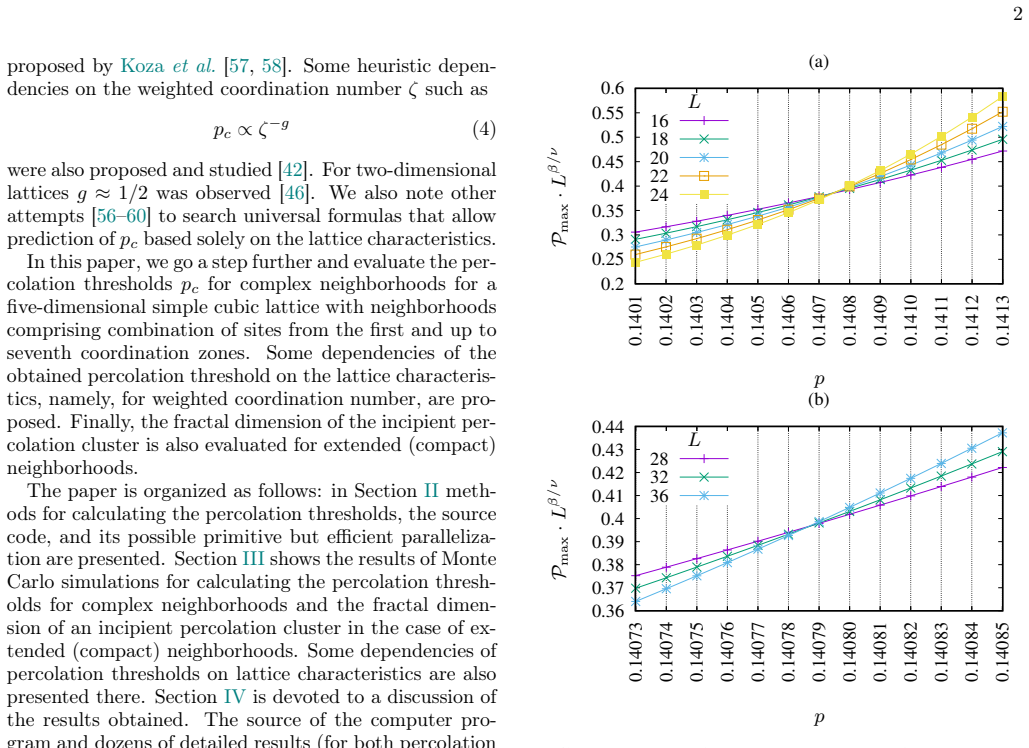
The argument rests on two mechanisms: (1) a fast Monte Carlo algorithm that constructs clusters by adding one occupied site at a time and uses binomial convolution to convert site-count data into occupation-probability data, and (2) finite-size scaling, where the rescaled probability of belonging to the largest cluster, P_max L^{β/ν}, plotted against p, gives a size-independent crossing point at p_c. The crossing point is located using R = 10^6 repetitions per system, claimed to give 10^-5 accuracy.
What would settle it
Compare the extracted crossing point for the simplest neighborhood (sc(5)-1) with the high-precision literature value 0.14079633(4); a discrepancy beyond 10^-5 would indicate a systematic bias in the finite-size scaling procedure. Alternatively, recompute one new threshold at much larger lattice sizes (e.g., L = 48 or 64) and observe whether the crossing point drifts outside the claimed 10^-5 accuracy.
Extended reading notes
Core claim
The central claim is that percolation thresholds for complex neighborhoods in five-dimensional simple cubic lattices obey a universality in the weighted coordination number ζ: plotting p_c against ζ yields a power law p_c ∝ ζ^{-g} with g ≈ 0.7913(43), supported by 127 thresholds (120 new). For the seven extended neighborhoods tested, the fractal dimension of the incipient percolation cluster averages ⟨d_f⟩ = 3.5581(70), with individual values within 0.26%–1.76% of the theoretically predicted d*_f = 3.5215 derived from the best current critical exponents.
Load-bearing premise
The entire threshold table rests on the assumption that the finite-size scaling ansatz with the literature values β_5 = 0.8457 and ν_5 ≈ 0.572–0.575 holds for systems of linear size L = 16–32; if those exponents are wrong, every new p_c inherits a common error, and the fitted g ≈ 0.7913 could change.
Editorial extensions
If this is right
- If g ≈ 0.79 is universal in five dimensions, thresholds for neighborhoods extending to any coordination zone can be predicted without new simulations.
- The 120 new thresholds provide a benchmark dataset for evaluating other heuristic formulas, such as p_c = c/(z + b).
- The mean fractal dimension ⟨d_f⟩ = 3.5581(70) supports the universality of d_f across extended and complex neighborhoods in five dimensions.
- The parallelized Monte Carlo implementation shows a practical route to high-precision percolation thresholds in higher dimensions with modest wall-clock time.
Reading between the lines
- The observed ζ-scaling suggests a cross-dimensional check: computing similar thresholds in d = 4 or d = 6 would reveal whether the exponent g depends on dimension or is a constant, potentially connecting to continuous-percolation limits.
- Because all 120 new thresholds share the same finite-size scaling analysis, any bias in the assumed critical exponents (β_5 = 0.8457, ν_5 ≈ 0.572–0.575) will appear as a common systematic shift; an independent high-precision measurement of a single new threshold would bound that bias.
- The residual scatter around the ζ power law may encode information about the contribution of individual coordination shells; adding a shape-dependent correction term could tighten the fit and refine the predicted thresholds.
Signed reviews
Editorial analysis
A structured set of objections, weighed in public.
Referee Report
Summary. The paper reports a parallel C++ implementation of the Newman–Ziff algorithm and uses it to study random site percolation on the five-dimensional simple cubic lattice with neighborhoods built from coordination zones up to the seventh. The authors present 127 percolation thresholds, 120 of which they state are new, fit the thresholds to the heuristic relations p_c ∝ ζ^{-g} and p_c = c/(z+b), and compute fractal dimensions d_f for seven compact neighborhoods. The abstract and Section IV quote g ≈ 0.7913(43), ⟨d_f⟩ ≈ 3.5581(70), and relative deviations of d_f from the scaling-relation value d*_f ≈ 3.5215 that range from 0.26% to 1.76%.
Significance. If the threshold catalog is accurate, it is a useful benchmark for percolation in d=5 with long-range neighborhoods, and the 120 new values are a substantial numerical contribution. The public code and the use of a standard, independent algorithm (Newman–Ziff) are strengths. However, the central quantitative claims — the ζ-scaling exponent g and the compatibility of the fractal dimensions with scaling relations — are currently not supported by the reported statistics: the value of g is internally inconsistent, the thresholds are given without error bars or a stated choice of the fixed exponents used in the finite-size scaling, and the d_f estimates deviate from d*_f by many times their quoted uncertainties. These issues must be resolved before the numerical conclusions can be relied upon.
major comments (3)
- [§III.B, Fig. 3, §IV] The value of g for p_c(ζ) is reported twice: g ≈ 0.8293(24) in the text of Section III.B, and g ≈ 0.7913(43) in the Fig. 3 caption, the abstract, and Section IV. These differ by 0.038, far outside the quoted uncertainties. Since the ζ-scaling exponent is a central result, the manuscript must state which fit is correct, and if the two fits use different data sets or different definitions of ζ, that must be made explicit.
- [§II.A.1 and §III.A] The thresholds in Table I are obtained by common crossings of P_max L^{β/ν} with β_5 = 0.8457 and one of three listed ν_5 values (0.5746, 0.5737(33), or 0.5720(43)), but the text never states which ν was used, and no per-threshold statistical uncertainty is reported. The claimed 10^-5 precision in Fig. 1 is read off the sharpness of the crossing, not from a bootstrap/jackknife or from the variance among the L-pair crossings. Any error in the assumed exponents or uncorrected finite-size corrections enters all 120 new thresholds coherently, and the low-p_c/high-ζ points that dominate the log-log fit for g are precisely the ones for which no independent validation exists. The authors should supply per-threshold error bars, state the exponent choice, and test sensitivity to the FSS ansatz (e.g., by using different L ranges or by comparing with the seven previously known thresholds only).
- [Table II and §IV] The d_f values are not merely 'not differ[ing] much' from d*_f = 3.5215. Using the quoted uncertainties, the deviations range from ~4σ (sc(5)-1,2, d_f = 3.5307(23)) to ~45σ (sc(5)-1,2,3,4,5,6, d_f = 3.57944(80)) when the 0.0010 uncertainty on d*_f is included. The sign is also uniform: every estimate exceeds d*_f, which suggests a systematic finite-size effect rather than statistical scatter. The text and abstract should either quantify and explain this discrepancy or soften the claim that the fractal dimensions confirm the scaling-relation value.
minor comments (5)
- [Title and Abstract] The phrase 'in five dimension' should be 'in five dimensions' or 'in five-dimensional space'.
- [Eq. (11) and Table II] Equation (11) defines δ = (d*_f − d_f)/d*_f · 100%, which is negative for all rows in Table II because every d_f exceeds d*_f. The table lists positive values; either use the absolute value or define δ as |d*_f − d_f|/d*_f.
- [References] Reference [4] spells 'Birkhäuser' as 'Brikhauser'; reference [59] is a duplicate of reference [40] and should be consolidated.
- [§IV] The statement that equation (2) is 'qualitatively not worse' than p_c ∝ (z+1)^{-1} is vague. Since equation (2) has two fitted parameters, the comparison should be quantitative, e.g., residual per data point or AIC.
- [Fig. 4 caption] The phrase 'more or less agree' is too vague for a quantitative comparison. The caption should state the difference and the combined uncertainty, especially in view of the deviations noted in the major comments.
Circularity Check
No significant circularity: thresholds and fractal dimensions are measured independently, with only minor non-load-bearing self-citations.
full rationale
The central results are Monte Carlo thresholds obtained with the Newman–Ziff algorithm, which is independent of the scaling laws subsequently fitted. The finite-size scaling relation (Eq. 6) is a standard analysis tool and uses literature exponents β5=0.8457 and ν5 from Refs. [64,65,66], not from the data being predicted. The compact-neighborhood thresholds are validated against the external results of Refs. [50,51] to six-digit accuracy, and the measured fractal dimensions are compared with the theoretically predicted d*_f=3.5215 as well as with the independent d_f=3.5260(14) of Ref. [65]. The p_c ∝ ζ^{-g} relation is not used to produce the thresholds; it is a post-hoc fit to measured values, so calling it a 'verification' is methodologically weak but not circular. Self-citations appear (Refs. [42,46,71] for the ζ heuristic and d_f universality in lower dimensions), but they are not load-bearing for the present 5D claims; ζ is a definition and the universality claim is tested on new data. Non-circular weaknesses that should be addressed: the paper does not state which of the three ν5 values was used in the crossings, per-threshold error bars are absent, and Section III.B reports g≈0.8293(24) while Figure 3, the abstract, and Section IV report g≈0.7913(43). These are reporting/correctness concerns, not circularity of the derivation chain.
Assumptions & free parameters
free parameters (4)
- g (ζ-scaling exponent) =
0.7913(43) (vs 0.8293(24) in §III.B)
- b (in Eq. 2) =
1.01(18)
- c (in Eq. 2) =
1.553(22)
- d_f (per compact neighborhood) =
3.5453(30), 3.5307(23), 3.5525(16), 3.5579(11), 3.5575(25), 3.57944(80), 3.5836(25)
assumptions (4)
- domain assumption Finite-size scaling relation (6) holds exactly with the quoted critical exponents.
- domain assumption Literature values β_5=0.8457, ν_5=0.572–0.575 are accurate.
- domain assumption L = 16–32 are large enough that corrections to scaling are negligible for all 127 neighborhoods.
- standard math The Newman–Ziff algorithm and R=10^6 repetitions yield unbiased Smax for each configuration.
Cite this review
Pith. "Pith review of Random site percolation with complex neighborhoods in five dimension." pith.science (2026). https://pith.science/paper/Y4FLLGG5
@misc{pith2026260718991,
  author       = {Pith},
  title        = {Pith review of: Random site percolation with complex neighborhoods in five dimension},
  year         = {2026},
  howpublished = {\url{https://pith.science/paper/Y4FLLGG5}},
  note         = {Machine review of arXiv:2607.18991}
}
abstract
In this paper, the random site percolation problem in a five-dimensional space for complex neighborhoods is studied. The efficient C++ code (with ordinary work division) of the classical Newman--Ziff algorithm is presented. The obtained speed-up of computations reduces 2170 years of single-core computations -- necessary for obtaining the results presented in this paper -- much below the typical half-decay time of the scientist. For complex neighborhoods, it is for neighborhoods composed with sites taken from several coordination zones (up to the seventh coordination zone), the 127 percolation thresholds are calculated (with 120 among them being estimated for the first time). For seven extended (compact) neighborhoods, the fractal dimensions are also calculated. The mean value of these fractal dimensions, averaged over these seven compact neighborhoods, is estimated as $\langle d_f\rangle\approx 3.5581(70)$. The percentage errors of the values obtained for the fractal dimensions for compact neighborhoods vary from 0.26\% to 1.76\% with respect to the theoretically predicted value based on scaling relations and the most recent estimates of critical exponents for five-dimensional space. The universality of the percolation threshold as dependent on the weighted coordination number $\zeta=\sum_i z_i r_i$ (where $z_i$ is the number of sites in the $i$-th coordination zone and $r_i$ is the Euclidean distance from the sites in the $i$-th coordination zone to the central site) is also verified. The latter manifests itself as the power law ($p_c\propto\zeta^{-g}$) with $g\approx 0.7913(43)$
Figures


Figures from the paper (1 more)

Reference graph
Works this paper leans on
-
[65]
The mean value of the computed fractal dimensions for seven extended neighborhoods is ⟨df ⟩= 3.5581(70)
The percentage errors obtained for all the extended neighborhoods (complex and compact) considered here are0.26%≤δ≤1.76%. The mean value of the computed fractal dimensions for seven extended neighborhoods is ⟨df ⟩= 3.5581(70). In summary, in this paper we show the results of mas- sively parallel computations based on the Newman–Ziff algorithm implemented ...
2026
-
[1]
Finite-size scaling theory Accordingtothefinite-sizescalingtheory[62,63]inthe vicinity of the percolation thresholdpc the probability of belonging to the largest cluster is Pmax(p;L) =S max(p;L)/L 5,(5) whereS max is the size of the largest cluster, scales with the linear size of the systemLand the distance to the critical point(p−p c)as Pmax(p;L)·L β/ν =...
-
[2]
One can also consider the weighted coordination number ζ= X i ziri,(8) wherer i is the Euclidean distance from the sites in thei-th coordination zone to the central site [42, 46]
Universality ofp c behavior The total coordination number of the lattice with pre- defined neighborhood is defined as z= X i zi,(7) wherez i is number of sites ini-th coordination zone. One can also consider the weighted coordination number ζ= X i ziri,(8) wherer i is the Euclidean distance from the sites in thei-th coordination zone to the central site [...
-
[3]
Fractal dimensiond f of the incipient percolation cluster At percolation thresholdp=p c the largest cluster of occupied sites (the incipient percolation cluster) has frac- tal properties [67–69] (see Reference 70 for the most re- cent review). The size of the incipient percolation cluster scales with linear system sizeLas Smax ∝L df .(9) For standard perc...
-
[4]
Kesten,Percolation Theory for Mathematicians (Brikhauser, Boston, 1982)
H. Kesten,Percolation Theory for Mathematicians (Brikhauser, Boston, 1982)
1982
-
[5]
Stauffer and A
D. Stauffer and A. Aharony,Introduction to Percolation Theory, 2nd ed. (Taylor and Francis, London, 1994)
1994
-
[6]
Bollobás and O
B. Bollobás and O. Riordan,Percolation(Cambridge UP, Cambridge, 2006)
2006
-
[7]
Sahimi,Applications of Percolation Theory(Taylor and Francis, London, 1994)
M. Sahimi,Applications of Percolation Theory(Taylor and Francis, London, 1994)
1994
Show all 79 references
-
[8]
Berkowitz and I
B. Berkowitz and I. Balberg, Percolation theory and its application to groundwater hydrology, Water Resources Research29, 775–794 (1993)
1993
-
[9]
S. R. Broadbent and J. M. Hammersley, Percolation pro- cesses: I. Crystals and mazes, Mathematical Proceedings of the Cambridge Philosophical Society53, 629 (1957)
1957
-
[10]
J. M. Hammersley, Percolation processes: II. The con- nective constant, Mathematical Proceedings of the Cam- bridge Philosophical Society53, 642 (1957)
1957
-
[11]
Sahimi, Flow phenomena in rocks: from continuum models to fractals, percolation, cellular automata, and simulated annealing, Reviews of Modern Physics65, 1393–1534 (1993)
M. Sahimi, Flow phenomena in rocks: from continuum models to fractals, percolation, cellular automata, and simulated annealing, Reviews of Modern Physics65, 1393–1534 (1993)
1993
-
[12]
Bialas, P
P. Bialas, P. Blanchard, S. Fortunato, D. Gandolfo, and H. Satz, Percolation and magnetization in the continuous spin Ising model, Nuclear Physics B583, 368–378 (2000)
2000
-
[13]
Ghanbarian, F
B. Ghanbarian, F. Liang, and H.-H. Liu, Modeling gas relative permeability in shales and tight porous rocks, Fuel272, 117686 (2020)
2020
-
[14]
Fortuin and P
C. Fortuin and P. Kasteleyn, On the random-cluster model: I. Introduction and relation to other models, Physica57, 536–564 (1972)
1972
-
[15]
Coniglio and W
A. Coniglio and W. Klein, Clusters and Ising critical droplets: A renormalisation group approach, Journal of Physics A: Mathematical and General13, 2775–2780 (1980)
1980
-
[16]
Broderix, H
K. Broderix, H. Löwe, P. Müller, and A. Zippelius, Crit- ical dynamics of gelation, Physical Review E63, 011510 (2000)
2000
-
[17]
Buczek, L
P. Buczek, L. M. Sandratskii, N. Buczek, S. Thomas, G. Vignale, and A. Ernst, Magnons in disordered nonsto- ichiometric low-dimensional magnets, Physical Review B 94, 054407 (2016)
2016
-
[18]
Alguero, M
M. Alguero, M. Perez-Cerdan, R. P. del Real, J. Ricote, and A. Castro, Novel Aurivillius Bi4Ti3−2xNbxFexO12 phases with increasing magnetic-cation fraction until percolation: A novel approach for room temperature multiferroism, Journal of Materials Chemistry C8, 12457–12469 (2020)
2020
-
[19]
Stauffer, Gelation in concentrated critically branched polymer solutions
D. Stauffer, Gelation in concentrated critically branched polymer solutions. Percolation scaling theory of in- tramolecular bond cycles, Journal of the Chemical So- ciety, Faraday Transactions 272, 1354–1364 (1976)
1976
-
[20]
Tsangaris and M
G. Tsangaris and M. Kazilas, Conductivity and percola- tion in epoxy resin/conductive filler composites, Materi- als Science and Technology18, 226–230 (2002)
2002
-
[21]
A. L. Efros and B. I. Shklovskii, Critical behaviour of conductivity and dielectric constant near the metal-non- metal transition threshold, Physica Status Solidi B76, 475–485 (1976)
1976
-
[22]
D. S. McLachlan, An equation for the conductivity of bi- nary mixtures with anisotropic grain structures, Journal of Physics C: Solid State Physics20, 865 (1987)
1987
-
[23]
Kirkpatrick, Percolation and conduction, Reviews of Modern Physics45, 574–588 (1973)
S. Kirkpatrick, Percolation and conduction, Reviews of Modern Physics45, 574–588 (1973)
1973
-
[24]
Malarz, S
K. Malarz, S. Kaczanowska, and K. Kułakowski, Are for- est fires predictable?, International Journal of Modern Physics C13, 1017 (2002)
2002
-
[25]
L. Qing, K. Sun, and M. Li, Effects of percolated ITZ and aggregate-induced tortuosity on concrete diffusivity, Construction and Building Materials535, 146910 (2026)
2026
-
[26]
Drossel and F
B. Drossel and F. Schwabl, Self-organized critical forest- fire model, Physical Review Letters69, 1629–1632 (1992)
1992
-
[27]
S. Clar, B. Drossel, and F. Schwabl, Forest fires and other examples of self-organized criticality, Journal of Physics Condensed Matter8, 6803–6824 (1996)
1996
-
[28]
J. E. Ramírez, C. Pajares, M. I. Martínez, R. Ro- dríguez Fernández, E. Molina-Gayosso, J. Lozada- Lechuga, and A. Fernández Téllez, Site-bond percolation solution to preventing the propagation ofPhytophthora zoosporeson plantations, Physical Review E101, 032301 8 (2020)
2020
-
[29]
M. E. J. Newman, Spread of epidemic disease on net- works, Physical Review E66, 016128 (2002)
2002
-
[30]
L. A. Meyers, Contact network epidemiology: Bond per- colation applied to infectious disease prediction and con- trol, Bulletin of the American Mathematical Society44, 63–86 (2007)
2007
-
[31]
R. M. Ziff, Percolation and the pandemic, Physica A568, 125723 (2021)
2021
-
[32]
Li, R.-R
M. Li, R.-R. Liu, L. Lü, M.-B. Hu, S. Xu, and Y.-C. Zhang, Percolation on complex networks: Theory and application, Physics Reports907, 1 (2021)
2021
-
[33]
D. R. Herrera, J. Velázquez-Castro, A. F. Téllez, J. F. López-Olguín,andJ.E.Ramírez,Sitepercolationthresh- old of composite square lattices and its agroecology ap- plications, Physical Review E109, 014304 (2024)
2024
-
[34]
Alonso Tlali, J
J. Alonso Tlali, J. R. Alvarado García, B. Carde- nas Castro, A. Fernández Téllez, E. G. García Prieto, J. F. López-Olguín, Y. Martínez Laguna, J. E. Ramírez, D. Rosales Herrera, and J. D. Silva Montiel, Applications of percolation theory to prevent the propagation of phy- top...
2025
-
[35]
A. A. Saberi, Recent advances in percolation theory and its applications, Physics Reports578, 1 (2015)
2015
-
[36]
d’Iribarne, M
C. d’Iribarne, M. Rasigni, and G. Rasigni, From lat- tice long-range percolation to the continuum one, Physics Letters A263, 65 (1999)
1999
-
[37]
Stauffer, Scaling theory of percolation clusters, Physics Reports54, 1 (1979)
D. Stauffer, Scaling theory of percolation clusters, Physics Reports54, 1 (1979)
1979
-
[38]
N. W. Dalton, C. Domb, and M. F. Sykes, Dependence of critical concentration of a dilute ferromagnet on the range of interaction, Proceedings of the Physical Society 83, 496 (1964)
1964
-
[39]
Domb and N
C. Domb and N. W. Dalton, Crystal statistics with long- range forces: I. The equivalent neighbour model, Pro- ceedings of the Physical Society89, 859 (1966)
1966
-
[41]
Malarz and S
K. Malarz and S. Galam, Square-lattice site percolation at increasing ranges of neighbor bonds, Physical Review E71, 016125 (2005)
2005
-
[42]
Galam and K
S. Galam and K. Malarz, Restoring site percolation on damaged square lattices, Physical Review E72, 027103 (2005)
2005
-
[43]
Majewski and K
M. Majewski and K. Malarz, Square lattice site percola- tion thresholds for complex neighbourhoods, Acta Phys- ica Polonica B38, 2191 (2007)
2007
-
[44]
Malarz, Site percolation thresholds on triangular lat- tice with complex neighborhoods, Chaos30, 123123 (2020)
K. Malarz, Site percolation thresholds on triangular lat- tice with complex neighborhoods, Chaos30, 123123 (2020)
2020
-
[45]
Malarz, Random site percolation thresholds on square lattice for complex neighborhoods containing sites up to the sixth coordination zone, Physica A632, 129347 (2023)
K. Malarz, Random site percolation thresholds on square lattice for complex neighborhoods containing sites up to the sixth coordination zone, Physica A632, 129347 (2023)
2023
-
[46]
Malarz, Universality of percolation thresholds for two- dimensional complex non-compact neighborhoods, Phys- ical Review E109, 034108 (2024)
K. Malarz, Universality of percolation thresholds for two- dimensional complex non-compact neighborhoods, Phys- ical Review E109, 034108 (2024)
2024
-
[47]
A. P. Ciepłucha, M. Utnicki, M. Wołoszyn, and K. Malarz, Lower limit of percolation threshold on a square lattice with complex neighborhoods, Entropy27, 361 (2025)
2025
-
[48]
Malarz, Simple cubic random-site percolation thresh- olds for neighborhoods containing fourth-nearest neigh- bors, Physical Review E91, 043301 (2015)
K. Malarz, Simple cubic random-site percolation thresh- olds for neighborhoods containing fourth-nearest neigh- bors, Physical Review E91, 043301 (2015)
2015
-
[49]
Malarz, Percolation thresholds on triangular lattice for neighbourhoods containing sites up to the fifth coor- dination zone, Physical Review E103, 052107 (2021)
K. Malarz, Percolation thresholds on triangular lattice for neighbourhoods containing sites up to the fifth coor- dination zone, Physical Review E103, 052107 (2021)
2021
-
[50]
Malarz, Random site percolation on honeycomb lat- tices with complex neighborhoods, Chaos32, 083123 (2022)
K. Malarz, Random site percolation on honeycomb lat- tices with complex neighborhoods, Chaos32, 083123 (2022)
2022
-
[51]
Kurzawski and K
Ł. Kurzawski and K. Malarz, Simple cubic random-site percolation thresholds for complex neighbourhoods, Re- ports on Mathematical Physics70, 163 (2012)
2012
-
[52]
Galam and A
S. Galam and A. Mauger, Site percolation thresholds in all dimensions, Physica A205, 502 (1994)
1994
-
[53]
Kotwica, P
M. Kotwica, P. Gronek, and K. Malarz, Efficient space virtualisation for Hoshen–Kopelman algorithm, Interna- tional Journal of Modern Physics C30, 1950055 (2019)
2019
-
[54]
Mertens and C
S. Mertens and C. Moore, Percolation thresholds and Fisher exponents in hypercubic lattices, Physical Review E98, 022120 (2018)
2018
-
[55]
Z. Xun, D. Hao, and R. M. Ziff, Extended-range site and bond percolation in five dimensions, Journal of Statis- tical Mechanics: Theory and Experiment2025, 123301 (2025)
2025
-
[56]
Z.Xun, D.Hao,andR.M.Ziff,Siteandbondpercolation thresholds on regular lattices with compact extended- range neighborhoods in two and three dimensions, Phys- ical Review E105, 024105 (2022)
2022
-
[57]
Galam and A
S. Galam and A. Mauger, Universal formulas for perco- lation thresholds, Physical Review E53, 2177 (1996)
1996
-
[58]
Galam and A
S. Galam and A. Mauger, Universal formulas for perco- lation thresholds. II. Extension to anisotropic and aperi- odic lattices, Physical Review E56, 322–325 (1997)
1997
-
[59]
Galam and A
S. Galam and A. Mauger, Topology invariance in percola- tion thresholds, European Physical Journal B1, 255–258 (1998)
1998
-
[60]
W. Xu, J. Wang, H. Hu, and Y. Deng, Critical polynomi- als in the nonplanar and continuum percolation models, Physical Review E103, 022127 (2021)
2021
-
[61]
Z. Koza, G. Kondrat, and K. Suszczyński, Percolation of overlapping squares or cubes on a lattice, Journal of Statistical Mechanics: Theory and Experiment2014, P11005 (2014)
2014
-
[62]
Koza and J
Z. Koza and J. Poła, From discrete to continuous per- colation in dimensions 3 to 7, Journal of Statistical Me- chanics: Theory and Experiment2016, 103206 (2016)
2016
-
[63]
Z. Xun, D. Hao, and R. M. Ziff, Site percolation on square and simple cubic lattices with extended neigh- borhoods and their continuum limit, Physical Review E 103, 022126 (2021)
2021
-
[64]
J. A. Gracey, Four loop renormalization ofϕ3 theory in six dimensions, Physical Review D92, 025012 (2015)
2015
-
[66]
Malarz and M
K. Malarz and M. Wołoszyn, Random site percolation with complex neighborhoods in five dimension - supple- mental material (2026)
2026
-
[67]
Privman, Finite-size scaling theory, inFinite size scaling and numerical simulation of statistical systems, edited by V
V. Privman, Finite-size scaling theory, inFinite size scaling and numerical simulation of statistical systems, edited by V. Privman (World Scientific, Singapore, 1990) pp. 1–98
1990
-
[68]
D. P. Landau and K. Binder,A Guide to Monte Carlo Simulations in Statistical Physics, 3rd ed. (Cambridge University Press, Cambridge, 2009)
2009
-
[69]
Zhang, P
Z. Zhang, P. Hou, S. Fang, H. Hu, and Y. Deng, Critical exponents and universal excess cluster number of perco- lation in four and five dimensions, Physica A: Statistical Mechanics and its Applications580, 126124 (2021)
2021
-
[70]
Brzeski and G
P. Brzeski and G. Kondrat, Percolation of hyperspheres in dimensions 3 to 5: from discrete to continuous, Journal of Statistical Mechanics: Theory and Experiment2022, 053202 (2022)
2022
-
[71]
Mandelbrot,The Fractal Geometry of Nature, Einaudi paperbacks (Henry Holt and Company, 1983)
B. Mandelbrot,The Fractal Geometry of Nature, Einaudi paperbacks (Henry Holt and Company, 1983). 9
1983
-
[72]
Peitgen, H
H.-O. Peitgen, H. Jürgens, and D. Saupe,Fractals for the Classroom. Part One: Introduction to Fractals and Chaos(Springer, New York, NY, 1992)
1992
-
[73]
Peitgen, H
H.-O. Peitgen, H. Jürgens, and D. Saupe,Fractals for the Classroom. Part Two: Complex Systems and Mandelbrot Set(Springer, New York, NY, 1992)
1992
-
[74]
A. S. Balankin, A survey of fractal features of Bernoulli percolation, Chaos, Solitons & Fractals184, 115044 (2024)
2024
-
[75]
Malarz and M
K. Malarz and M. J. Krawczyk, Confirming universality of the fractal dimension of incipient percolation cluster for complex neighborhoods, Scientific Reports15, 32920 (2025)
2025
-
[76]
M. E. J. Newman and R. M. Ziff, Fast Monte Carlo al- gorithm for site or bond percolation, Physical Review E 64, 016706 (2001)
2001
-
[77]
Dagum and R
L. Dagum and R. Menon, OpenMP: an industry standard API for shared-memory programming, IEEE Computa- tional Science and Engineering5, 46 (1998)
1998
-
[78]
G. M. Amdahl, Validity of the single processor approach to achieving large scale computing capabilities, inPro- ceedings of the April 18-20, 1967, Spring Joint Com- puter Conference, AFIPS ’67 (Spring) (Association for Computing Machinery, New York, NY, USA, 1967) p. 483–485
1967
-
[79]
Academic Computer Centre CYFRONET of the AGH University of Krakow, Our supercomputers
-
[80]
Abramowitz and I
M. Abramowitz and I. A. Stegun, eds.,Handbook of Mathematical Functions With Formulas, Graphs, and Mathematical Tables,6thed.(UnitedStates.Government Printing Office, Washington D.C., 1964)
1964
Reviewed August 1, 2026 · model on record in the stance chip above.
Discussion (0). Continue with ORCID to comment.