REVIEW 4 major objections 4 minor 36 references
Partial Knowledge Distillation for Alleviating the Inherent Inter-Class Discrepancy in Federated Learning
T0 review · 4 major / 4 minor · reviewed 2026-08-12 · deepseek-v4-flash
Pith's one-line read Even with perfectly balanced federated data, certain classes stay consistently weak; selective expert distillation raises worst-class accuracy by up to 10.7% without lowering the global average.
desk verdict A real FL fairness phenomenon and a plausible fix, but the claim of 'no degradation elsewhere' is contradicted by the paper's own Table 1 arithmetic. read the letter →
The pith
A machine-rendered reading of the paper's core claim, the machinery that carries it, and where it could break.
The reading
What carries the argument
The central mechanism is Partial Knowledge Distillation (PKD), a three-stage federated pipeline. Stage 1 is standard FedAvg warmup; Stage 2 identifies weak-class groups from the confusion matrix of softmax outputs and trains one expert model per group on only that group's samples, using the same federated averaging; Stage 3 runs FedAvg again but, whenever the student's prediction for a sample is a misclassification among classes within a known weak group, the corresponding expert's temperature-scaled softmax on those classes is used as a target, and the student updates with an added KL-divergence loss between its own and the expert's probabilities. The trigger condition and the restriction to one expert per sample are what make the distillation 'partial', and the loss is zero for all other samples, keeping the added computation small.
What would settle it
Run a controlled experiment where the expert is trained on the same weak classes plus an equal number of samples from other classes, then distill it in the same PKD pipeline; if the student's weak-class improvement matches the original PKD, the 'class-specific expert' premise is unnecessary. Alternatively, find a benchmark where the set of worst classes changes across random seeds or architectures, which would contradict the claimed consistency of weak classes.
Extended reading notes
Core claim
The central claim is that the inter-class accuracy discrepancy in federated learning is not merely a symptom of imbalanced sample sizes; a set of 'weak' classes persists even under globally and locally balanced class distributions, and this set is stable across network architectures, learning paradigms, and data partitioning schemes. The weak classes—such as T-shirt/shirt and pullover/coat/shirt in FashionMNIST, or bird/cat/deer/dog in CIFAR-10—share similar high-level feature representations, so the model's mistakes are concentrated among them, with up to 88% of a weak class's misclassifications landing on other weak classes. The paper argues that an expert model trained only on the samples of one such weak-class group learns to separate those confusable classes better than a model trained on all classes, and that selectively distilling this expert's soft labels into the global student model—only when the student misclassifies a sample within that group—raises the weakest class accuracy while leaving average accuracy essentially unchanged.
Load-bearing premise
The method works only if an expert model trained solely on a few confusing classes is genuinely better at telling those classes apart than the full model, and if that skill transfers back through the selective distillation loss during federated training.
Editorial extensions
If this is right
- If the inherent ICD is real, then class-rebalancing and augmentation methods that assume sample scarcity will not fix weak-class performance; methods must target the feature confusion itself.
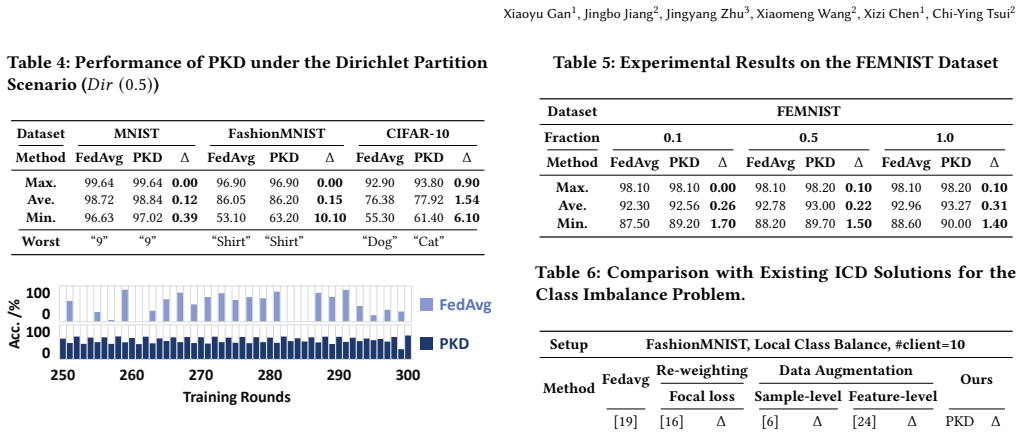
- PKD can be added to any FedAvg-like federated training loop and improves the worst-performing class by 8.2–12.3 points under balanced partitions and by larger margins under pathological partitions, without lowering average accuracy.
- The same weak-class groups appear across different networks and data splits, so the identification step can be done once after a short warmup and reused.
- The method also transfers to realistic non-IID partitions (Dirichlet, FEMNIST native) and to larger label sets (CIFAR-100), where selecting 1–2 worst groups still yields 3–5 point gains in minimum class accuracy.
Reading between the lines
- Because the weak classes are defined by feature similarity rather than sample count, the same PKD trigger logic could be applied in centralized learning, where the paper's own measurements show a smaller but still present discrepancy.
- The expert-in-the-loop design is a form of conditional ensemble: the cost is low because the expert is consulted only on misclassified weak-group samples, so the approach could be combined with existing heterogeneity-robust FL optimizers rather than replacing them.
- One testable extension is to replace the misclassification trigger with a confidence threshold, which would let the method fire on correct-but-uncertain predictions and possibly improve calibration rather than only accuracy.
- If the observed confusion pairs reflect intrinsic dataset structure, then a pretrained feature extractor could predict the weak-class groups in a new dataset before any federated training begins.
Editorial analysis
A structured set of objections, weighed in public.
Referee Report
Summary. This paper studies class-wise accuracy disparities in federated learning under globally and locally balanced class distributions. The authors show that certain "weak classes" are consistently harder to classify across architectures and partitioning strategies, attribute this to high-level feature similarity among classes, and propose a two-expert partial knowledge distillation (PKD) pipeline: after a warmup stage, weak-class groups are identified from local confusion patterns, experts are trained on samples from those groups via FL, and during subsequent FL training a selective KL-divergence distillation loss is applied only when the student misclassifies a sample as another class in the same weak-class group. Experiments on MNIST, FashionMNIST, CIFAR-10/100, and FEMNIST report improvements in the minimum class-wise accuracy (up to 10.7% on FashionMNIST) with roughly preserved average accuracy.
Significance. The phenomenon of inherent inter-class discrepancy, if confirmed, is a genuinely interesting observation with practical implications for fairness in FL. The paper's strengths include: the phenomenon is documented across multiple datasets, network architectures, and partition strategies; the proposed PKD is simple and the overhead analysis (Section 3.3, Tables 9-10) suggests a favorable compute-accuracy trade-off; and the comparison against re-weighting and data augmentation (Table 6) supports the claim that standard imbalance remedies do not solve the problem. The main weakness is that the headline claim--improving weak classes without hurting others--is not supported by the aggregate numbers in Table 1; per-class results and variance estimates are needed. As presented, the evidence is consistent with the alternative explanation that PKD merely shifts which classes are worst rather than resolving the inherent discrepancy.
major comments (4)
- [Section 4.2, Table 1] The aggregate numbers in Table 1 contradict the claim that dominant classes remain largely unchanged. For FashionMNIST with 100 clients, FedAvg has an average accuracy of 84.66 and PKD 84.72, a total change of +0.6 points across the ten classes; the minimum class gains 10.7 points (51.6 to 62.3) while the maximum loses 0.1 points. The remaining eight classes must therefore lose 10.0 points cumulatively, roughly 1.25 points per class on average. The same arithmetic holds for the 10-client row: total change +2.1 = +0.3 (max) + 8.2 (min) + (sum of the other eight), so the other eight classes lose about 6.4 points. This directly contradicts the statement in Section 4.2 that "the accuracy of dominant classes remains largely unchanged or is even slightly improved." Because the paper reports only max/average/min and never per-class accuracies, it does not rule out that PKD is shifting the inter-class discrepancy rather than reducing it. Please report full per-class accuracy tables, with standard deviations, for at least the main setups in Tables 1 and 4.
- [Section 2.2, Fig. 2 vs Table 1 and Fig. 3] The magnitude of the headline discrepancy is reported inconsistently. The abstract says "over 36.9%", the introduction says "up to 45.4% on the FashionMNIST dataset and 36.9% on the CIFAR-10 dataset", Fig. 2 shows Delta_max = 45.4 for FashionMNIST under FL with local class balance, but Table 1 (10 clients) gives max - min = 97.30 - 68.40 = 28.9%, and Fig. 3 gives Delta = 45.1 for the 100-client case. It appears that 45.4 comes from a different architecture (ConvNet-L) than the LeNet-5 used in Table 1; please state explicitly which configuration each reported discrepancy refers to and present one consistent set of numbers for the main setup.
- [Section 1 and Section 3.1, Algorithm 1 Stage 2] The method's central motivation is that "an expert trained specifically on a group of confounding weak classes shows greater proficiency in differentiating among them" (Section 1). This premise is never directly demonstrated: no experiment reports the expert models' class-wise accuracy on the weak-class groups, nor the quality of the distilled soft labels (p_e in Algorithm 2, Line 17). If the expert is not more accurate than the global model on these classes, the reported improvements cannot be attributed to the claimed mechanism. Please add expert accuracy results and/or an ablation that replaces the trained expert with temperature-raised soft labels obtained from the global model itself.
- [Section 4.1, Hyperparameters] The method introduces several hyperparameters (lambda, T, T1, T2, T3, and G for CIFAR-100) that are set to fixed values without a sensitivity study. Given that the reported average accuracy changes are small (e.g., +0.06 on FashionMNIST with 100 clients in Table 1), it is important to know whether the weak-class gains persist across a reasonable range of these hyperparameters and whether the trade-off identified in the first major comment remains. Please include an analysis varying at least lambda, T, and the warmup/expert-training durations.
minor comments (4)
- [Section 4.2] The phrase "without comprising the global average accuracy" should read "without compromising the global average accuracy."
- [Section 2.2, Fig. 4] The text says "Fig. 4(a) assesses the similarities in high-level features between each pair of classes," but in the figure the pairwise distance matrix appears to be panel (b), not (a). Please correct the cross-reference.
- [Figure 3 caption area] The manuscript contains an inserted Chinese annotation in the Figure 3 caption area ("这张图和table1 现在134图都可以对应上...") as well as other small annotations such as "加了class" and "50轮". These appear to be leftover internal notes and must be removed before submission; as they stand, they are unprofessional and could confuse readers.
- [Table 8] The layout of Table 8, with "FedAvg PKD" followed by separate Delta columns for G = 1 and G = 2, is unclear; consider presenting G = 1 and G = 2 as separate method columns or rows.
Circularity Check
No significant circularity: PKD improvements are measured on held-out test classes and do not reduce by construction to the training targets used to fit the experts; the paper's claims are empirical and externally benchmarked.
full rationale
The paper's central empirical claims — that weak classes persist under balanced partitions and that PKD raises their held-out accuracy — are evaluated against external test data (Tables 1-5, 8-10), so they are not fitted inputs renamed as predictions. The weak-class groups are identified from local training-set confusion (Section 3.1), and the reported accuracy gains are measured on test classes, so there is no self-definitional loop. The expert is trained on the weak-class subset and only provides soft labels during a KL training loss (Eq. 1-2, Algorithm 2); this optimizes a training objective rather than manufacturing the test result, and generalization to held-out samples is not guaranteed by construction. No load-bearing self-citations or imported uniqueness theorems appear; references are standard external works (e.g., McMahan et al. FedAvg, Hinton et al. KD). The hyperparameters (λ, T, warmup rounds, G) are hand-chosen, which adds tuning flexibility, but the main claim does not reduce to a fitted value. A non-circularity concern remains: the claimed 'dominant classes remain largely unchanged' in Section 4.2 is arithmetically questionable for FashionMNIST at #clients=100 in Table 1 (the min class gains 10.7, max loses 0.1, average rises only 0.06, implying the other eight classes drop about 10 points total), but this is a correctness or evidence gap, not circularity.
Assumptions & free parameters
free parameters (5)
- lambda (KD loss weight) =
1.0 (MNIST, FashionMNIST, FEMNIST), 0.5 (CIFAR-10/100)
- temperature T =
5
- warmup rounds T1 =
20
- expert training rounds T2 =
25
- number of weak class groups G =
1 for CIFAR-10, 2 for MNIST/FashionMNIST; 1-2 for CIFAR-100
assumptions (4)
- domain assumption Expert models trained only on a weak class group achieve higher accuracy on those classes than a model trained on all classes.
- domain assumption The pattern of misclassifications observed after a short warmup (e.g., 20 rounds) is stable enough to identify the final weak class groups.
- domain assumption KL-divergence distillation from a class-specific expert to the global model on misclassified samples improves the student's own accuracy on those classes.
- standard math Standard federated averaging (FedAvg) converges and serves as a fair baseline.
Cite this review
Pith. "Pith review of Partial Knowledge Distillation for Alleviating the Inherent Inter-Class Discrepancy in Federated Learning." pith.science (2026). https://pith.science/paper/Y4UFBWPU
@misc{pith2026241115403,
  author       = {Pith},
  title        = {Pith review of: Partial Knowledge Distillation for Alleviating the Inherent Inter-Class Discrepancy in Federated Learning},
  year         = {2026},
  howpublished = {\url{https://pith.science/paper/Y4UFBWPU}},
  note         = {Machine review of arXiv:2411.15403}
}
read the original abstract
Substantial efforts have been devoted to alleviating the impact of the long-tailed class distribution in federated learning. In this work, we observe an interesting phenomenon that certain weak classes consistently exist even for class-balanced learning. These weak classes, different from the minority classes in the previous works, are inherent to data and remain fairly consistent for various network structures, learning paradigms, and data partitioning methods. The inherent inter-class accuracy discrepancy can reach over 36.9% for federated learning on the FashionMNIST and CIFAR-10 datasets, even when the class distribution is balanced both globally and locally. In this study, we empirically analyze the potential reason for this phenomenon. Furthermore, a partial knowledge distillation (PKD) method is proposed to improve the model's classification accuracy for weak classes. In this approach, knowledge transfer is initiated upon the occurrence of specific misclassifications within certain weak classes. Experimental results show that the accuracy of weak classes can be improved by 10.7%, reducing the inherent inter-class discrepancy effectively.
Figures


Figures from the paper (6 more)



Reference graph
Works this paper leans on
-
[1]
Mateusz Buda, Atsuto Maki, and Maciej A. Mazurowski. 2018. A systematic study of the class imbalance problem in convolutional neural networks. Neural Networks 106 (2018), 249–259. doi:10.1016/j.neunet.2018.07.011
-
[2]
Brendan McMahan, Virginia Smith, and Ameet Talwalkar
Sebastian Caldas, Peter Wu, Tian Li, Jakub Konečný, H. Brendan McMahan, Virginia Smith, and Ameet Talwalkar. 2018. LEAF: A Benchmark for Federated Settings. CoRR abs/1812.01097 (2018). arXiv:1812.01097
arXiv 2018
-
[3]
Chawla, Kevin W
Nitesh V. Chawla, Kevin W. Bowyer, Lawrence O. Hall, and W. Philip Kegelmeyer
-
[4]
Jiequan Cui, Shu Liu, Zhuotao Tian, Zhisheng Zhong, and Jiaya Jia. 2023. ResLT: Residual Learning for Long-Tailed Recognition. IEEE Transactions on Pattern Analysis and Machine Intelligence 45, 3 (2023), 3695–3706. doi:10.1109/TPAMI. 2022.3174892
arXiv 2023
-
[5]
Yin Cui, Menglin Jia, Tsung-Yi Lin, Yang Song, and Serge J. Belongie. 2019. Class- Balanced Loss Based on Effective Number of Samples. In IEEE Conference on Computer Vision and Pattern Recognition, CVPR 2019, Long Beach, CA, USA, June 16-20, 2019. Computer Vision Foundation / IEEE, 9268–9277. doi:10.1109/CVPR. 2019.00949
arXiv 2019
-
[6]
Terrance Devries and Graham W. Taylor. 2017. Improved Regularization of Convolutional Neural Networks with Cutout. CoRR abs/1708.04552 (2017). arXiv:1708.04552 http://arxiv.org/abs/1708.04552
arXiv 2017
-
[7]
Andrew Estabrooks, Taeho Jo, and Nathalie Japkowicz. 2004. A Multiple Re- sampling Method for Learning from Imbalanced Data Sets. Comput. Intell. 20, 1 (2004), 18–36. doi:10.1111/J.0824-7935.2004.T01-1-00228.X
arXiv 2004
-
[8]
Haibo He and Edwardo A. Garcia. 2009. Learning from Imbalanced Data. IEEE Transactions on Knowledge and Data Engineering 21, 9 (2009), 1263–1284. doi:10. 1109/TKDE.2008.239
work page 2009
Show all 36 references
-
[9]
Kaiming He, Xiangyu Zhang, Shaoqing Ren, and Jian Sun. 2016. Deep Residual Learning for Image Recognition. In 2016 IEEE Conference on Computer Vision and Pattern Recognition (CVPR). 770–778. doi:10.1109/CVPR.2016.90
2016 doi
-
[10]
Geoffrey Hinton, Oriol Vinyals, and Jeff Dean. 2015. Distilling the Knowledge in a Neural Network. arXiv:1503.02531 [stat.ML] https://arxiv.org/abs/1503.02531
2015 arXiv
-
[11]
Jaehyung Kim, Jongheon Jeong, and Jinwoo Shin. 2020. M2m: Imbalanced Classification via Major-to-Minor Translation. In 2020 IEEE/CVF Conference on Computer Vision and Pattern Recognition, CVPR 2020, Seattle, W A, USA, June 13-19,
2020
-
[12]
Alex Krizhevsky. 2009. Learning multiple layers of features from tiny images . Technical Report. Univ. of Toronto, Toronto, Canada
2009
-
[13]
Lecun, L
Y. Lecun, L. Bottou, Y. Bengio, and P. Haffner. 1998. Gradient-based learning applied to document recognition. Proc. IEEE 86, 11 (1998), 2278–2324. doi:10. 1109/5.726791
1998
-
[14]
Zexi Li, Tao Lin, Xinyi Shang, and Chao Wu. 2023. Revisiting weighted aggre- gation in federated learning with neural networks. In Proceedings of the 40th International Conference on Machine Learning (Honolulu, Hawaii, USA)(ICML’23). JMLR.org, Article 816, 22 pages
2023
-
[15]
Zijian Li, Jiawei Shao, Yuyi Mao, Jessie Hui Wang, and Jun Zhang. 2022. Feder- ated learning with gan-based data synthesis for non-iid clients. In International workshop on trustworthy federated learning . Springer, 17–32
2022
-
[16]
Girshick, Kaiming He, and Piotr Dollár
Tsung-Yi Lin, Priya Goyal, Ross B. Girshick, Kaiming He, and Piotr Dollár. 2020. Focal Loss for Dense Object Detection. IEEE Trans. Pattern Anal. Mach. Intell. 42, 2 (2020), 318–327. doi:10.1109/TPAMI.2018.2858826
2020
-
[17]
Bo Liu, Haoxiang Li, Hao Kang, Gang Hua, and Nuno Vasconcelos. 2022. Bread- crumbs: Adversarial Class-Balanced Sampling for Long-Tailed Recognition. In Computer Vision – ECCV 2022 , Shai Avidan, Gabriel Brostow, Moustapha Cissé, Giovanni Maria Farinella, and Tal Hassner (Eds.)...
2022
-
[18]
Jialun Liu, Yifan Sun, Chuchu Han, Zhaopeng Dou, and Wenhui Li. 2020. Deep Representation Learning on Long-Tailed Data: A Learnable Embedding Augmen- tation Perspective. In 2020 IEEE/CVF Conference on Computer Vision and Pattern Recognition, CVPR 2020, Seattle, W A, USA, June ...
2020
-
[19]
Brendan McMahan, Eider Moore, Daniel Ramage, Seth Hampson, and Blaise Aguera y Arcas. 2017. Communication-Efficient Learning of Deep Networks from Decentralized Data. In Proceedings of the 20th International Conference on Artificial Intelligence and Statistics (Proceedings of ...
2017
-
[20]
Thomas Minka. 2000. Estimating a Dirichlet distribution
2000
-
[21]
Xuanming Ni, Xinyuan Shen, and Huimin Zhao. 2022. Federated optimization via knowledge codistillation. Expert Systems with Applications 191 (2022), 116310. doi:10.1016/j.eswa.2021.116310
2022
-
[22]
Jiawei Ren, Cunjun Yu, shunan sheng, Xiao Ma, Haiyu Zhao, Shuai Yi, and hongsheng Li. 2020. Balanced Meta-Softmax for Long-Tailed Visual Recognition. In Advances in Neural Information Processing Systems , H. Larochelle, M. Ranzato, R. Hadsell, M.F. Balcan, and H. Lin (Eds.), V...
2020
-
[23]
Anit Kumar Sahu, Tian Li, Maziar Sanjabi, Manzil Zaheer, Ameet Talwalkar, and Virginia Smith. 2018. On the Convergence of Federated Optimization in Heterogeneous Networks. CoRR abs/1812.06127 (2018). arXiv:1812.06127
2018 arXiv
-
[24]
Xian Shuai, Yulin Shen, Siyang Jiang, Zhihe Zhao, Zhenyu Yan, and Guoliang Xing. 2022. BalanceFL: Addressing Class Imbalance in Long-Tail Federated Learning. In 21st ACM/IEEE International Conference on Information Processing in Sensor Networks, IPSN 2022, Milano, Italy, May 4...
2022
-
[25]
Karen Simonyan and Andrew Zisserman. 2014. Very deep convolutional net- works for large-scale image recognition. arXiv preprint arXiv:1409.1556 (2014)
2014 arXiv
-
[26]
Hongyi Wang, Mikhail Yurochkin, Yuekai Sun, Dimitris Papailiopoulos, and Yasaman Khazaeni. 2020. Federated Learning with Matched Averaging. arXiv:2002.06440 [cs.LG] https://arxiv.org/abs/2002.06440
2020 arXiv
-
[27]
Liuyu Xiang, Guiguang Ding, and Jungong Han. 2020. Learning From Multiple Experts: Self-paced Knowledge Distillation for Long-Tailed Classification. In Computer Vision - ECCV 2020 - 16th European Conference, Glasgow, UK, August 23-28, 2020, Proceedings, Part V (Lecture Notes i...
2020 doi
-
[28]
Han Xiao, Kashif Rasul, and Roland Vollgraf. 2017. Fashion-MNIST: a Novel Image Dataset for Benchmarking Machine Learning Algorithms. CoRR abs/1708.07747 (2017). arXiv:1708.07747
2017 arXiv
-
[29]
Dezhong Yao, Wanning Pan, Yutong Dai, Yao Wan, Xiaofeng Ding, Chen Yu, Hai Jin, Zheng Xu, and Lichao Sun. 2023. FedGKD: Toward heterogeneous federated learning via global knowledge distillation. IEEE Trans. Comput. 73, 1 (2023), 3–17
2023
-
[30]
Mikhail Yurochkin, Mayank Agarwal, Soumya Ghosh, Kristjan Greenewald, Nghia Hoang, and Yasaman Khazaeni. 2019. Bayesian nonparametric federated learning of neural networks. In International conference on machine learning . PMLR, 7252–7261
2019
-
[31]
Jing Zhang, Chuanwen Li, Jianzgong Qi, and Jiayuan He. 2023. A Survey on Class Imbalance in Federated Learning. arXiv:2303.11673 [cs.LG] https://arxiv. org/abs/2303.11673
2023 arXiv
-
[32]
Yifan Zhang, Bingyi Kang, Bryan Hooi, Shuicheng Yan, and Jiashi Feng. 2023. Deep Long-Tailed Learning: A Survey. IEEE Trans. Pattern Anal. Mach. Intell. 45, 9 (2023), 10795–10816. doi:10.1109/TPAMI.2023.3268118
2023
-
[33]
Fengpan Zhao, Yan Huang, Akshita Maradapu Vera Venkata Sai, and Yubao Wu
-
[36]
A Cluster-based Solution to Achieve Fairness in Federated Learning. In2020 IEEE Intl Conf on Parallel & Distributed Processing with Applications, Big Data & Cloud Computing, Sustainable Computing & Communications, Social Computing & Networking (ISPA/BDCloud/SocialCom/SustainCo...
-
[2002]
SMOTE: Synthetic Minority Over-sampling Technique. J. Artif. Intell. Res. 16 (2002), 321–357. doi:10.1613/JAIR.953
2002 doi
-
[2020]
doi:10.1109/CVPR42600
Computer Vision Foundation / IEEE, 13893–13902. doi:10.1109/CVPR42600. 2020.01391
2020
Reviewed August 12, 2026 · model on record in the stance chip above.
Discussion (0). Continue with ORCID to comment.