REVIEW 3 major objections 4 minor 43 references
Role of angular observables in probing non-standard $HZZ$ couplings at an electron-proton collider
T0 review · 3 major / 4 minor · reviewed 2026-08-07 · deepseek-v4-flash
Pith's one-line read A signed azimuthal angle and the electron polar angle improve LHeC constraints on non-standard HZZ couplings by up to 67% over the previous analysis.
desk verdict A sound, incremental parton-level projection for LHeC: new angular observables tighten HZZ bounds by up to 67%, but the sign-sensitive gain rests on an evenness assumption that is plausible but not demonstrated beyond tree level. read the letter →
The pith
A machine-rendered reading of the paper's core claim, the machinery that carries it, and where it could break.
The reading
What carries the argument
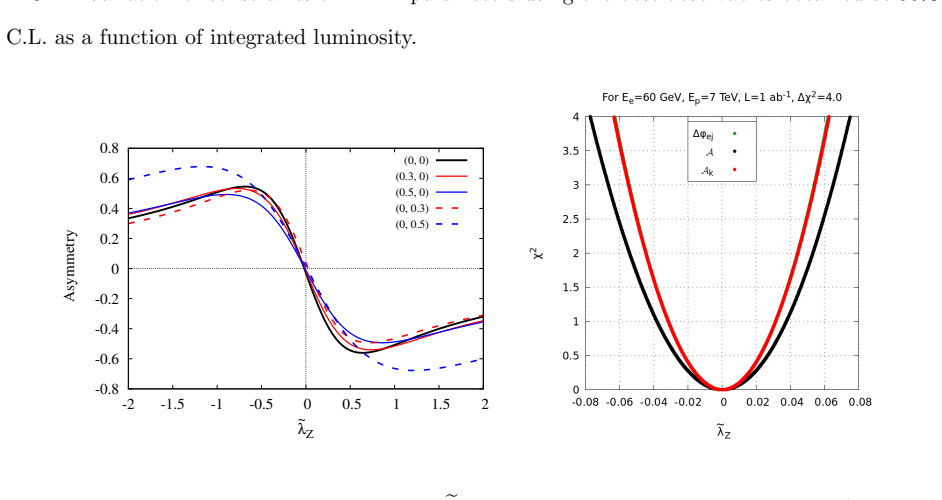
The object that carries the analysis is the signed azimuthal correlation $\Delta\phi_{ej}$, defined with a four-quadrant inverse tangent so it ranges from $-\pi$ to $\pi$, together with the polar angle $\theta_e$ of the scattered electron. The key identity is the interference term $\mathrm{Re}(M^*_{\rm SM}M_{\tilde\lambda_Z}) \propto -\tilde\lambda_Z \sin\Delta\phi_{ej}$, which is odd under $\Delta\phi_{ej}\to -\Delta\phi_{ej}$ and is therefore the only source of sign sensitivity; the CP-even amplitudes are even functions of $\Delta\phi_{ej}$, so the $|\Delta\phi_{ej}|$ distribution cancels the CP-odd linear term. This evenness, taken from earlier work, is what lets a simple asymmetry in $\Delta\phi_{ej}$ serve as a CP-odd observable. The $\theta_e$ distribution does different work: it isolates $\lambda_{2Z}$ because that coupling changes the electron's polar angle while $\lambda_{1Z}$ and $\tilde\lambda_Z$ do not. A binned $\chi^2$ test against the Standard-Model hypothesis converts each distribution into confidence intervals on the couplings.
What would settle it
A Standard-Model-only Monte Carlo sample of $e^- p \to e^- H j$, generated with the paper's selection cuts and including NLO QCD and a parton shower, would settle the evenness premise: if the normalized $\Delta\phi_{ej}$ distribution has a statistically significant asymmetry around zero, then the CP-odd interference is not the only odd term and the asymmetry-based $\tilde\lambda_Z$ bound would be biased.
Extended reading notes
Core claim
The central discovery is that sign information is the missing ingredient. The linear interference between the Standard Model amplitude and the CP-odd coupling is an odd function of $\Delta\phi_{ej}$, proportional to $-\tilde\lambda_Z \sin\Delta\phi_{ej}$, while all CP-even amplitudes are even functions of $\Delta\phi_{ej}$, so the signed distribution develops an asymmetry around $\Delta\phi_{ej}=0$ exactly when $\tilde\lambda_Z$ is nonzero. Taking the absolute value, as in the earlier study, integrates this term away and loses the sign of the CP-odd parameter. The polar angle $\theta_e$ acts as a complementary probe: the $\lambda_{2Z}$ coupling shifts the electron's polar-angle distribution relative to the Standard Model, while $\lambda_{1Z}$ and $\tilde\lambda_Z$ do not. Using binned $\chi^2$ comparisons against the Standard-Model hypothesis at $1\ \mathrm{ab}^{-1}$, the paper finds that $\theta_e$ gives the tightest bound on $\lambda_{2Z}$ and $\Delta\phi_{ej}$ gives the tightest bound on $\tilde\lambda_Z$, improving the previous constraints by 48% and 67%.
Load-bearing premise
The argument assumes that every CP-even contribution to the $\Delta\phi_{ej}$ distribution is an even function of $\Delta\phi_{ej}$, so the linear CP-odd interference is the only term that changes when the sign of $\Delta\phi_{ej}$ is kept; this evenness is taken from earlier vector-boson-fusion studies and is not verified for this neutral-current process after parton showering and detector effects.
Editorial extensions
If this is right
- At $L = 1\ \mathrm{ab}^{-1}$, the strongest constraints from the new observables are $[-0.07, 0.07]$ on $\lambda_{1Z}$ from $\Delta\phi_{ej}$, $[-0.01, 0.01]$ on $\lambda_{2Z}$ from $\theta_e$, and $[-0.07, 0.07]$ on $\tilde\lambda_Z$ from $\Delta\phi_{ej}$; the last two improve on the earlier $|\Delta\phi_{ej}|$ bounds by 48% and 67%.
- The asymmetry $A$ built from event counts on either side of $\Delta\phi_{ej}=0$ constrains $\tilde\lambda_Z$ nearly as well as the full $\Delta\phi_{ej}$ distribution when the CP-even couplings vanish, and it offers a less systematics-sensitive alternative.
- When one CP-even coupling is present, the asymmetry outperforms $\Delta\phi_{ej}$ for $\tilde\lambda_Z$ if $\lambda_{1Z}$ is nonzero, while $\Delta\phi_{ej}$ remains stronger if $\lambda_{2Z}$ is nonzero.
- The same signed-angle construction in the charged-current process $e^- p \to \nu_e H j$ tightens the bound on the CP-odd $HWW$ coupling $\tilde\lambda_W$ by roughly 85%, from $[-0.07, 0.07]$ to $[-0.01, 0.01]$.
- The paper's $\tilde\lambda_Z$ bound from $\Delta\phi_{ej}$ is stronger than its quoted HL-LHC projection, while the $\lambda_{1Z}$ and $\lambda_{2Z}$ bounds remain weaker at the luminosities considered.
Reading between the lines
- A natural extension would be to test the evenness assumption with NLO QCD and parton-shower simulations of the same process; if those generate an odd component in $\Delta\phi_{ej}$, the asymmetry-based CP-odd bound would need a correction.
- The same sign-preserving lab-frame angle could be applied to other neutral-current Higgs-production channels at electron-proton colliders to separate CP-odd from CP-even couplings without needing reconstruction of the Higgs rest frame.
- Combining $\theta_e$ and $\Delta\phi_{ej}$ in a two-dimensional fit could tighten constraints further, since the two observables respond to different couplings and are not fully correlated.
- The asymmetry observable may become the preferred CP-odd probe once realistic systematic uncertainties are included, because it cancels some normalization errors; the paper's quantitative bounds are computed with statistical uncertainties only.
Editorial analysis
A structured set of objections, weighed in public.
Referee Report
Summary. The manuscript studies the neutral-current process e^- p -> e^- H j at the LHeC and proposes the signed azimuthal angle Δφ_ej and the electron polar angle θ_e as new observables for constraining the anomalous HZZ couplings λ1Z, λ2Z, and λ~Z. Using leading-order MadGraph parton-level simulations with NN23LO1 PDFs, kinematic cuts, b-tagging, and energy smearing, the authors perform a χ² analysis at L = 1 ab^-1 and report that θ_e improves the λ2Z bound from [-0.02, 0.02] to [-0.01, 0.01], while signed Δφ_ej improves the λ~Z bound from [-0.22, 0.22] to [-0.07, 0.07] relative to the |Δφ_ej| analysis of Ref. [13]. They also construct a forward-backward asymmetry in Δφ_ej to probe the CP-odd coupling and extend the signed-angle idea to the charged-current process for λ~W.
Significance. If the reported sensitivity holds, the paper gives a useful and concrete observation: in the NC process the sign of Δφ_ej is experimentally accessible, and the signed distribution outperforms the absolute-value distribution for the CP-odd coupling, while θ_e is the best single observable for λ2Z. The comparison with the authors' previous |Δφ| analysis makes the central claim quantitative and easily testable. The analysis is transparent in its use of benchmark couplings and in showing the relevant differential distributions. However, the results are parton-level and statistical-error-only, so the absolute numbers should be read as idealized projections; the relative improvement claim is the main message.
major comments (3)
- [Section III, Eq. (6) and surrounding discussion] The entire λ~Z extraction and the reported 67% improvement rely on the assertion that the SM and CP-even λ1Z/λ2Z contributions to the Δφ_ej distribution are even under Δφ_ej -> -Δφ_ej. This property is stated with references to Refs. [26,41,42] but is not demonstrated for the e-p NC process with the chosen PDFs and cuts. Please provide a direct symmetry argument (e.g., invariance of the unpolarized partonic cross section and of the selection cuts under reflection φ_i -> -φ_i, which flips the sign of Δφ_ej but leaves η and pT unchanged) and verify numerically with the generated events that the SM-only, λ1Z-only, and λ2Z-only Δφ_ej distributions are symmetric within statistics. Also state explicitly whether electron-beam polarization, NLO QCD corrections, or the asymmetric η cuts could break this symmetry, since those effects could bias the asymmetry A defined in Eq. (8).
- [Section IV, Eq. (7)] The statistical uncertainty ΔO_k is not defined precisely enough to reproduce the χ² results. If O_k is the normalized distribution 1/σ dσ/dO shown in Fig. 1, then ΔO_k must be derived from the expected event count N_k = L σ O_k ΔO, and the total cross section after cuts is not given. Please specify how the event counts, luminosity, and bin widths enter Eq. (7), or quote the total cross section used, so that the absolute constraints in Table I and Fig. 3 are reproducible.
- [Section IV, Table I and Section V] Because the quoted limits are at the 1-7% level, a few-percent systematic uncertainty could materially change both the absolute bounds and the claimed improvement factors, since the different observables would not necessarily share the same systematic errors. The manuscript only states that the numbers are expected to change with systematics. Please estimate the impact of a flat systematic uncertainty (for example 5%) on the χ², or at least discuss which sources of systematics cancel in the comparison between |Δφ_ej| and the new observables.
minor comments (4)
- [Section V, Conclusions] The conclusion states that the new limits are [-0.02, 0.02] for λ2Z and [-0.22, 0.22] for λ~Z, but these are the old |Δφ| limits from Table I; the new limits are [-0.01, 0.01] and [-0.07, 0.07]. This reversal should be corrected.
- [Throughout] The notation for the CP-odd coupling is inconsistent: the tilde is lost in many places, so the manuscript alternates between λ~Z, eλZ, and λ~Z. Please use a single notation throughout.
- [Figure 5 caption] The caption refers to left and right panels, but the figure as displayed appears to contain a single panel. Please verify the figure layout and adjust the caption or the figure accordingly.
- [Section II, background discussion] The sentence 'So we do not consider the 3 jet background in our analysis' is confusing because the background list contains e−jjj and e−bbjj, both of which have three jets. Please clarify which process is neglected and justify the neglect with the mistagging rates stated above.
Circularity Check
No significant circularity: the claimed 48-67% improvement is a fresh chi-square comparison of new angular observables, not an input to the analysis.
full rationale
The derivation chain is self-contained: the paper defines a general HZZ vertex, generates parton-level events with MadGraph5, constructs lab-frame angular observables, and computes chi-square distributions under the SM hypothesis. The headline improvement in constraints on lambda2Z and lambda~Z comes from comparing the new observables theta_e and signed Delta_phi_ej with the previously used |Delta_phi_ej| on the same generated samples. This is a genuine comparison of distributions, not a fit that has been renamed a prediction. References to the authors' previous work [13] are used for simulation methodology, benchmark values, and baseline constraints, but the new limits are not extracted from those limits; they are recomputed from the angular distributions. The benchmark values are explicitly stated to be illustrative and not load-bearing. The evenness assumption for CP-even amplitudes in Delta_phi is imported from independent literature [26,41,42] and, while it may be a physics-risk point, it is not a circular reduction to the paper's own inputs. No step in the derivation equates a predicted quantity with a fitted parameter or invokes a uniqueness theorem from the authors' own prior work. Therefore no circularity is exhibited and the paper receives a low score; the only minor reservation is the reliance on the authors' own previous simulation pipeline, which creates a transparency burden rather than a logical circularity.
Assumptions & free parameters
free parameters (3)
- Benchmark anomalous couplings (lambda1Z = +/-0.4, lambda2Z = +/-0.3, lambda~Z = +/-0.5) =
+/-0.4, +/-0.3, +/-0.5 (illustrative only)
- Angular bin width =
9 degrees
- Kinematic selection thresholds =
pT(e) > 20 GeV, pT(b) > 30 GeV, |M_bb - M_H| <= 15 GeV, M_Hj > 300 GeV
assumptions (3)
- domain assumption The HZZ vertex in Eq. (1), with two CP-even and one CP-odd form factor, is the complete general structure relevant for e-p neutral-current production.
- domain assumption All CP-even contributions to Delta-phi_ej are even functions of Delta-phi, so any sign asymmetry is purely from the CP-odd interference.
- domain assumption Parton-level MG5 simulation with NN23LO1 PDF, simple energy smearing, and assumed b-tag and mis-tag rates adequately represents LHeC detector response, and statistical uncertainties are the only errors.
Cite this review
Pith. "Pith review of Role of angular observables in probing non-standard $HZZ$ couplings at an electron-proton collider." pith.science (2026). https://pith.science/paper/Y56SH63Y
@misc{pith2026250602558,
  author       = {Pith},
  title        = {Pith review of: Role of angular observables in probing non-standard $HZZ$ couplings at an electron-proton collider},
  year         = {2026},
  howpublished = {\url{https://pith.science/paper/Y56SH63Y}},
  note         = {Machine review of arXiv:2506.02558}
}
abstract
In this study, we explore various lab-frame angular observables at Large Hadron-electron Collider (LHeC) to test their sensitivity on the most general structure of the Higgs ($H$) to neutral weak boson ($Z$) coupling ($HZZ$) via the process $e^- p \rightarrow e^- H j$ at the center of mass energy $\sqrt{s}~\approx$ 1.3 TeV. The most general Lorentz structure of the $HZZ$ coupling beyond the standard model is composed of two CP-even ($\lambda_{1Z}$ and $\lambda_{2Z}$) and one CP-odd (${\tilde \lambda_Z}$) components. In a previous study, we looked at the absolute value of azimuthal correlation ($|\Delta \phi|$) between the final state electron and the jet to derive constraints on the non-standard $HZZ$ couplings. This choice of observable is motivated by its potential to discriminate between CP-odd and CP-even couplings in the $e^- p \rightarrow \nu_e H j$ process. Since the process $e^- p \rightarrow e^- H j$ has an electron in the final state, one can construct more angular observables. In addition to $|\Delta \phi|$, we identify new angular observables: the sign-sensitive azimuthal correlation ($\Delta \phi$) and the polar angle of the final state electron ($\theta$), suitable for constraining non-standard $HZZ$ coupling. Our analysis shows that these new angles improve the constraints on $\lambda_{2Z}$ and ${\tilde \lambda}_Z$ in the range of 48-67\%. We also study the potential of the asymmetry in $\Delta \phi$ to constrain the parameters corresponding to the CP-odd coupling.
Figures


Figures from the paper (3 more)


Reference graph
Works this paper leans on
-
[13]
Pramod Sharma and Ambresh Shivaji. Probing non-standard HVV (V = W, Z) couplings in single Higgs production at future electron-proton collider. JHEP, 10:108, 2022. 15
work page 2022
-
[1]
Georges Aad et al. Observation of a new particle in the search for the Standard Model Higgs boson with the ATLAS detector at the LHC. Phys. Lett. B, 716:1–29, 2012
work page 2012
-
[2]
Observation of a New Boson at a Mass of 125 GeV with the CMS Experiment at the LHC
Serguei Chatrchyan et al. Observation of a New Boson at a Mass of 125 GeV with the CMS Experiment at the LHC. Phys. Lett. B, 716:30–61, 2012
2012
-
[3]
A portrait of the Higgs boson by the CMS experiment ten years after the discovery
Armen Tumasyan et al. A portrait of the Higgs boson by the CMS experiment ten years after the discovery. Nature, 607(7917):60–68, 2022. [Erratum: Nature 623, (2023)]
work page 2023
-
[4]
A detailed map of Higgs boson interactions by the ATLAS experiment ten years after the discovery
Georges Aad et al. A detailed map of Higgs boson interactions by the ATLAS experiment ten years after the discovery. Nature, 607(7917):52–59, 2022. [Erratum: Nature 612, E24 (2022)]
work page 2022
-
[5]
M. Cepeda et al. Report from Working Group 2: Higgs Physics at the HL-LHC and HE-LHC. CERN Yellow Rep. Monogr., 7:221–584, 2019
work page 2019
-
[6]
P. Agostini et al. The Large Hadron–Electron Collider at the HL-LHC. J. Phys. G, 48(11):110501, 2021
work page 2021
-
[7]
Probing the scalar sector in e+e− → f ¯f h
Kaoru Hagiwara and Mary Louise Stong. Probing the scalar sector in e+e− → f ¯f h. Zeitschrift f¨ ur Physik C Particles and Fields, 62:99–108, 1993
work page 1993
Show all 43 references
-
[8]
Measuring the higgs-vector boson couplings at linear e+e− collider
Sukanta Dutta, Kaoru Hagiwara, and Yu Matsumoto. Measuring the higgs-vector boson couplings at linear e+e− collider. Phys. Rev. D, 78:115016, Dec 2008
2008
-
[9]
Biswal, Rohini M
Sudhansu S. Biswal, Rohini M. Godbole, Bruce Mellado, and Sreerup Raychaudhuri. Az- imuthal Angle Probe of Anomalous HW W Couplings at a High Energy ep Collider. Phys. Rev. Lett., 109:261801, 2012
2012
-
[10]
Phenomenology of the Higgs Effective Lagrangian via FEYNRULES
Adam Alloul, Benjamin Fuks, and Ver´ onica Sanz. Phenomenology of the Higgs Effective Lagrangian via FEYNRULES. JHEP, 04:110, 2014
2014
-
[11]
Cornell, Max Klein, Uta Klein, and Bruce Mellado
Mukesh Kumar, Xifeng Ruan, Rashidul Islam, Alan S. Cornell, Max Klein, Uta Klein, and Bruce Mellado. Probing anomalous couplings using di-Higgs production in electron–proton collisions. Phys. Lett. B, 764:247–253, 2017
2017
-
[12]
A. I. Hern´ andez-Ju´ arez, G. Tavares-Velasco, and A. Fern´ andez-T´ ellez. New evaluation of the HZZ coupling: Direct bounds on anomalous contributions and CP-violating effects via a new asymmetry. Phys. Rev. D, 107(11):115031, 2023
2023
-
[14]
Test of CP invariance in vector-boson fusion production of the Higgs boson in the H → τ τchannel in proton–proton collisions at √s = 13 TeV with the ATLAS detector
Georges Aad et al. Test of CP invariance in vector-boson fusion production of the Higgs boson in the H → τ τchannel in proton–proton collisions at √s = 13 TeV with the ATLAS detector. Phys. Lett. B, 805:135426, 2020
2020
-
[15]
Test of CP-invariance of the Higgs boson in vector-boson fusion production and in its decay into four leptons
Georges Aad et al. Test of CP-invariance of the Higgs boson in vector-boson fusion production and in its decay into four leptons. JHEP, 05:105, 2024
2024
-
[16]
Constraints on anomalous Higgs boson couplings using production and decay information in the four-lepton final state
Albert M Sirunyan et al. Constraints on anomalous Higgs boson couplings using production and decay information in the four-lepton final state. Phys. Lett. B, 775:1–24, 2017
2017
-
[17]
Constraints on anomalous HV V couplings from the production of Higgs bosons decaying to τ lepton pairs
Albert M Sirunyan et al. Constraints on anomalous HV V couplings from the production of Higgs bosons decaying to τ lepton pairs. Phys. Rev. D, 100(11):112002, 2019
2019
-
[18]
Measurements of the Higgs boson width and anomalous HV V couplings from on-shell and off-shell production in the four-lepton final state
Albert M Sirunyan et al. Measurements of the Higgs boson width and anomalous HV V couplings from on-shell and off-shell production in the four-lepton final state. Phys. Rev. D, 99(11):112003, 2019
2019
-
[19]
Constraints on anomalous Higgs boson couplings to vector bosons and fermions in its production and decay using the four-lepton final state
Albert M Sirunyan et al. Constraints on anomalous Higgs boson couplings to vector bosons and fermions in its production and decay using the four-lepton final state. Phys. Rev. D, 104(5):052004, 2021
2021
-
[20]
Constraints on anomalous Higgs boson couplings to vector bosons and fermions from the production of Higgs bosons using the τ τfinal state
Armen Tumasyan et al. Constraints on anomalous Higgs boson couplings to vector bosons and fermions from the production of Higgs bosons using the τ τfinal state. Phys. Rev. D, 108(3):032013, 2023
2023
-
[21]
Constraints on anomalous Higgs boson couplings from its production and decay using the WW channel in proton–proton collisions at √s = 13 TeV
Aram Hayrapetyan et al. Constraints on anomalous Higgs boson couplings from its production and decay using the WW channel in proton–proton collisions at √s = 13 TeV. Eur. Phys. J. C, 84(8):779, 2024
2024
-
[22]
J. L. Abelleira Fernandez et al. A Large Hadron Electron Collider at CERN: Report on the Physics and Design Concepts for Machine and Detector. J. Phys. G, 39:075001, 2012
2012
-
[23]
Alwall, R
J. Alwall, R. Frederix, S. Frixione, V. Hirschi, F. Maltoni, O. Mattelaer, H. S. Shao, T. Stelzer, P. Torrielli, and M. Zaro. The automated computation of tree-level and next-to-leading order differential cross sections, and their matching to parton shower simulations. JHEP, 0...
2014
-
[24]
Tao Han and J. Jiang. CP violating Z Z H coupling at e+e− linear colliders. Phys. Rev. D, 63:096007, 2001
2001
-
[25]
Ishihara, J
Kaoru Hagiwara, S. Ishihara, J. Kamoshita, and Bernd A. Kniehl. Prospects of measuring general Higgs couplings at e+e− linear colliders. Eur. Phys. J. C, 14:457–468, 2000. 16
2000
-
[26]
Biswal, Debajyoti Choudhury, Rohini M
Sudhansu S. Biswal, Debajyoti Choudhury, Rohini M. Godbole, and Mamta. Role of polar- ization in probing anomalous gauge interactions of the Higgs boson. Phys. Rev. D, 79:035012, 2009
2009
-
[27]
Genuine CP-odd Observables at the LHC
Tao Han and Yingchuan Li. Genuine CP-odd Observables at the LHC. Phys. Lett. B, 683:278– 281, 2010
2010
-
[28]
Christensen, Tao Han, and Yingchuan Li
Neil D. Christensen, Tao Han, and Yingchuan Li. Testing CP Violation in ZZH Interactions at the LHC. Phys. Lett. B, 693:28–35, 2010
2010
-
[29]
CP-violating HWW cou- plings at the Large Hadron Collider
Nishita Desai, Dilip Kumar Ghosh, and Biswarup Mukhopadhyaya. CP-violating HWW cou- plings at the Large Hadron Collider. Phys. Rev. D, 83:113004, 2011
2011
-
[30]
Pseu- doscalar top-Higgs coupling: exploration of CP-odd observables to resolve the sign ambiguity
Nicolas Mileo, Ken Kiers, Alejandro Szynkman, Daniel Crane, and Ethan Gegner. Pseu- doscalar top-Higgs coupling: exploration of CP-odd observables to resolve the sign ambiguity. JHEP, 07:056, 2016
2016
-
[31]
Belyaev, R
N. Belyaev, R. Konoplich, and K. Prokofiev. CP Sensitive Observables of a Hypothetical Heavy Spin-0 Particle with the Dominant Photon–Photon Interaction. Phys. Atom. Nucl., 81(6):758–765, 2018
2018
-
[32]
Probing CP -violating Higgs and gauge-boson couplings in the Standard Model effective field theory
Felipe Ferreira, Benjamin Fuks, Ver´ onica Sanz, and Dipan Sengupta. Probing CP -violating Higgs and gauge-boson couplings in the Standard Model effective field theory. Eur. Phys. J. C, 77(10):675, 2017
2017
-
[33]
Sensitivity study of anomalous HZZ cou- plings at a future Higgs factory
Hua-Dong Li, Cai-Dian L¨ u, and Lian-You Shan. Sensitivity study of anomalous HZZ cou- plings at a future Higgs factory. Chin. Phys. C, 43(10):103001, 2019
2019
-
[34]
T-Odd Anomalous Interactions of the Top-Quark at the Large Hadron Collider
Apurba Tiwari and Sudhir Kumar Gupta. T-Odd Anomalous Interactions of the Top-Quark at the Large Hadron Collider. Adv. High Energy Phys., 2021:6676930, 2021
2021
-
[35]
Rindani, and Priyanka Sarmah
Kumar Rao, Saurabh D. Rindani, and Priyanka Sarmah. Probing anomalous gauge-Higgs couplings using Z boson polarization at e+e− colliders. Nucl. Phys. B, 950:114840, 2020
2020
-
[36]
Faroughy, Jernej F
Darius A. Faroughy, Jernej F. Kamenik, Nejc Koˇ snik, and Aleks Smolkoviˇ c. Probing theCP nature of the top quark Yukawa at hadron colliders. JHEP, 02:085, 2020
2020
-
[37]
Machine learning the Higgs boson-top quark CP phase
Rahool Kumar Barman, Dorival Gon¸ calves, and Felix Kling. Machine learning the Higgs boson-top quark CP phase. Phys. Rev. D, 105(3):035023, 2022
2022
-
[38]
Rindani, Priyanka Sarmah, and Balbeer Singh
Kumar Rao, Saurabh D. Rindani, Priyanka Sarmah, and Balbeer Singh. Polarized Z cross sections in Higgsstrahlung for the determination of anomalous ZZH couplings. 2 2022
2022
-
[39]
CP-violation, asymme- 17 tries and interferences in ttϕ
Duarte Azevedo, Rodrigo Capucha, Ant´ onio Onofre, and Rui Santos. CP-violation, asymme- 17 tries and interferences in ttϕ. JHEP, 09:246, 2022
2022
-
[40]
Impact of longitudinally and transversely polarized beams on probing CP-violating HZZ interactions at the ILC
Cheng Li and Gudrid Moortgat-Pick. Impact of longitudinally and transversely polarized beams on probing CP-violating HZZ interactions at the ILC. EPJ Web Conf., 315:01006, 2024
2024
-
[41]
Rainwater, and Dieter Zeppenfeld
Tilman Plehn, David L. Rainwater, and Dieter Zeppenfeld. Determining the Structure of Higgs Couplings at the LHC. Phys. Rev. Lett., 88:051801, 2002
2002
-
[42]
Hankele, G
V. Hankele, G. Klamke, D. Zeppenfeld, and T. Figy. Anomalous Higgs boson couplings in vector boson fusion at the CERN LHC. Phys. Rev. D, 74:095001, 2006
2006
-
[43]
Carloni Calame, Guido Montagna, Oreste Nicrosini, Fulvio Piccinini, and Ambresh Shivaji
Stefano Boselli, Carlo M. Carloni Calame, Guido Montagna, Oreste Nicrosini, Fulvio Piccinini, and Ambresh Shivaji. Higgs decay into four charged leptons in the presence of dimension-six operators. JHEP, 01:096, 2018. 18
2018
Reviewed August 7, 2026 · model on record in the stance chip above.
Discussion (0). Sign in to comment.