REVIEW 3 major objections 5 minor 39 references
Robust Bayesian Decision Making under Adversarial Uncertainty
T0 review · 3 major / 5 minor · reviewed 2026-07-14 · grok-4.5
Pith's one-line read Conventional decision-aware design can lock onto high-confidence but fragile decisions; targeting information about the worst-case robust optimum yields more stable choices under adversarial variation.
desk verdict Clean, usable extension of DEIG to min-over-ε-ball robust decisions; experiments prove the matched threat model well, not the abstract’s broader “hidden effects” claim. read the letter →
The pith
A machine-rendered reading of the paper's core claim, the machinery that carries it, and where it could break.
The reading
What carries the argument
AR-DEIG (Adversarially Robust Decision Expected Information Gain): the acquisition rule that selects the next query by maximising the expected reduction in entropy of the posterior over the robust-optimal decision d*(ξt,ξa;ε)=argmax_d min_{ξ'a∈Aε(ξa)} Ud(ξt,ξ'a). It redefines the quantity of interest from nominal optimality to decision stability under worst-case perturbation inside the ε-ball.
What would settle it
On a held-out test set whose true adversarial variables or true perturbation magnitudes differ from those used during acquisition, check whether AR-DEIG still improves worst-case and CVaR decision quality over ordinary DEIG; if it does not, or if performance collapses once the evaluation ball leaves the design ball, the central claim fails.
Extended reading notes
Core claim
Sequential experimental design should acquire data to reduce uncertainty about the adversarially robust optimal decision rather than the nominal optimum. For a design split into ordinary and adversarial coordinates, the robust decision under budget ε is the action maximising the minimum utility over the closed ball of adversarial perturbations. Conventional decision-aware criteria can converge rapidly to high-confidence yet fragile decisions; the AR-DEIG criterion—expected information gain about the posterior over that robust optimum—yields decisions that remain significantly more stable under adversarial variation of the designated variables.
Load-bearing premise
The decision-maker can correctly name the adversarial variables and choose a fixed perturbation radius that actually covers the relevant real-world failure modes; if the true threats lie outside that ball or in unnamed coordinates, the robust target is misspecified.
Editorial extensions
If this is right
- Decision-aware active learning that ignores adversarial coordinates can produce overconfident, brittle policies that degrade under modest input shifts.
- Explicitly optimising information about the worst-case decision improves mean, worst-case and CVaR performance on both synthetic and real scientific data.
- The same framework recovers ordinary DEIG in the limit as the perturbation radius ε goes to zero.
- Larger ε produces more conservative decisions, which can become overly pessimistic and degrade performance if the budget is misspecified.
- Domain experts who can name the adversarial variables and a plausible ε can use the criterion without changing the underlying Bayesian predictive model.
Reading between the lines
- The same worst-case-over-ball construction can be dropped into other information criteria simply by redefining the quantity of interest as the robust argmax.
- If adversarial variables must be discovered rather than named by experts, an outer sensitivity loop that ranks coordinates by decision-flip frequency would be a natural extension.
- Because the criterion only needs predictive samples under perturbed inputs, it can wrap any black-box Bayesian model without altering the likelihood.
- In sequential medical settings the method implies early queries should deliberately probe regions where treatment rankings reverse under realistic covariate noise.
Editorial analysis
A structured set of objections, weighed in public.
Referee Report
Summary. The paper studies sequential decision-aware experimental design under adversarial uncertainty. It defines a robust decision value V_d(ξ_t, ξ_a; ε) = min_{ξ'_a ∈ A_ε(ξ_a)} U_d(ξ_t, ξ'_a) with A_ε the Euclidean ball of radius ε around known adversarial coordinates, takes the robust-optimal decision d* = argmax_d V_d, and proposes AR-DEIG as expected information gain about the posterior mass on that discrete robust decision (Eqs. 9–12). Propositions 1–2 and Lemma 3.1 follow immediately from set inclusion and the ε o 0 limit. Experiments on 1-D/higher-D synthetic GPs and the OAI osteoarthritis dataset compare AR-DEIG to RS, US, PEIG, TEIG and DEIG, reporting mean/worst-case/CVaR10 under the same ball, decision-flip rates, and recovery of a robust ground-truth decision.
Significance. The work cleanly connects targeted decision-aware active learning (Filstroff et al.) with a min-max robust utility, supplies a principled EIG criterion, elementary but correct supporting propositions, public code, and consistent empirical gains (including lower flip rates) under a correctly specified ball threat model. If domain experts can name the adversarial coordinates and a budget ε, the method is practically useful. The contribution is incremental rather than foundational; its broader claim of reliability under truly hidden or weakly modeled effects is not yet established by the matched train/eval experiments.
major comments (3)
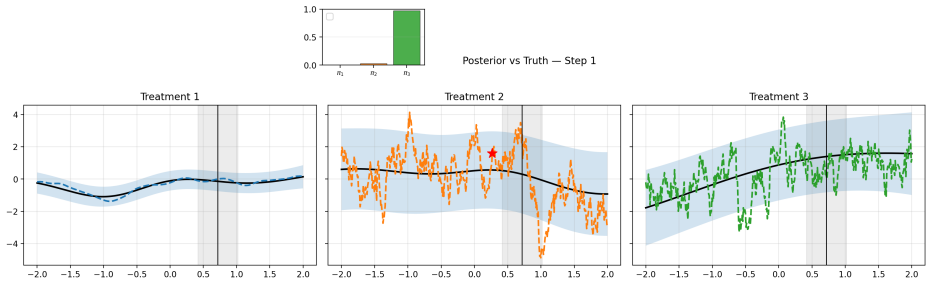
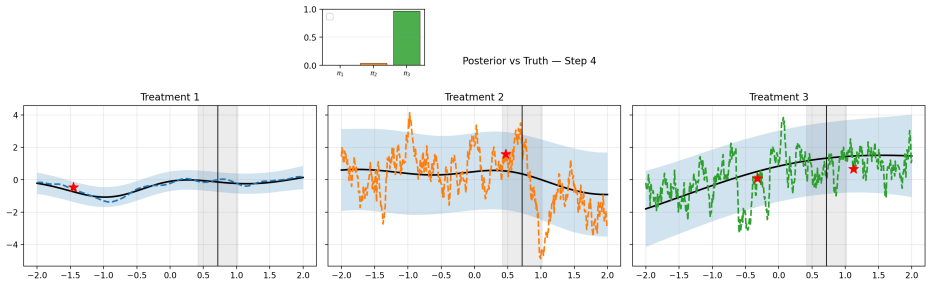
- [Abstract and §3] Abstract and §3: The abstract claims that AR-DEIG yields decisions that are “significantly more stable and reliable under adversarial variation” and against “hidden or weakly modeled effects.” All reported robustness metrics (Figs. 2–3, 7–9; mean/worst-case/CVaR10) and the robust ground-truth used in Figs. 7–8 are obtained by sampling the identical closed ball A_ε that defines V_d and the AR-DEIG target (Eqs. 9–12). Cross-ε (Fig. 4) and large-ε degradation (Fig. 18) remain inside the same family of balls. The experiments therefore establish only that EIG about a correctly specified robust decision improves performance under that model; they do not test unidentified variables, effects outside A_ε, or misspecified ε. Either the abstract language must be aligned with the evaluated threat model or misspecification experiments must be added.
- [§3] §3 (definitions of ξ = (ξ_t, ξ_a), A_ε and U_d = y_d): The framework assumes the decision-maker can identify the adversarial coordinates and a fixed ε such that the relevant worst-case effects lie inside the Euclidean ball, with latent utility set equal to the predictive outcome. The paper notes domain-expert identification but supplies no sensitivity analysis when ξ_a is misspecified, when the true perturbation is non-ball (sparse, distributional, or coupled), or when ε is badly chosen (the degradation at ε = 20 in Fig. 18 already shows over-conservatism). This assumption is load-bearing for the claim of reliability under real-world adversarial variation.
- [§4, Appendix A/B] §4 and Appendix A/B: Computation of the inner min that defines V_d is left unspecified for continuous GPs. In 1-D a grid or dense sampling is feasible; in higher dimensions (20-D experiment, multi-dimensional adversarial subspace in Figs. 7–8) the quality of the min approximation directly affects both the acquisition target and the reported robust ground-truth. Runtime (Table 1) already shows AR-DEIG 1.7–2.4 imes slower than DEIG; without a clear, scalable procedure for the min (and its interaction with the MC/Gauss–Hermite outer expectation) the practicality and reproducibility of the method remain incomplete.
minor comments (5)
- [§2–§3] Notation for the design is overloaded: ξ is used both for the full design and for the controllable part; the split (ξ_t, ξ_a) appears only in §3. A consistent notation table would help.
- [§4] Figs. 2–3, 7–9 captions are long and partially repeat the main text; the green-curve emphasis is helpful but the confidence bands are hard to read in some panels.
- [§3] Lemma 3.1 is essentially immediate from the definitions; it could be stated as a remark rather than a numbered lemma.
- [§5] Related-work discussion of distributionally robust BO and adversarially robust GPs is present but could more sharply contrast the decision-uncertainty target of AR-DEIG with function-level robust optimization.
- [throughout] Minor typos and spacing issues appear throughout (e.g., “BA YESIAN”, “EV ALUA TION”, missing spaces around some equations).
Circularity Check
No significant circularity in the derivation; AR-DEIG is ordinary EIG re-targeted at the posterior over a worst-case decision defined by min over an explicit ball, with propositions following by set inclusion and a trivial limit lemma.
-
self citation load bearing
[Section 3 (after Eq. 8) and Related Work 5.1]
"Our formulation is closely related to the targeted active learning framework of Filstroff et al. [2024], which connects utility modeling with downstream decision-making. We redefine the target of information as a robust decision random variable. ... Targeted active learning [Filstroff et al., 2024] introduces a decision-aware Expected Information Gain (EIG) criterion..."
The non-robust DEIG baseline and the overall decision-as-quantity-of-interest framing are imported from a prior paper sharing senior author Kaski. This is ordinary incremental self-citation rather than a load-bearing uniqueness theorem or an unverified premise that forces the robust claims; the AR-DEIG equations and propositions stand independently once the robust target is defined. Score contribution is therefore only 1.
full rationale
The paper's central construction (Section 3) defines the robust value Vd(ξt,ξa;ε)=min_{ξ'a∈Aε(ξa)} Ud(ξt,ξ'a), the robust decision d*=argmax Vd, the posterior masses πrob_d=P(d=d*|D), and then AR-DEIG as the ordinary expected entropy reduction of that discrete random variable (Eq. 12). This is definitional re-targeting of the DEIG criterion of Filstroff et al. (2024), not a quantity forced by a fitted constant or by self-reference. Proposition 1 and 2 are immediate consequences of the definition of min over nested sets Aε1⊆Aε2; Lemma 3.1 is the elementary limit Aε→{ξa} as ε→0. No parameter is fitted to data and then re-presented as a prediction; the acquisition function itself contains no free parameters beyond the user-chosen ε and the identified coordinates ξa. Self-citation of the DEIG line (and related Kaski-group decision-aware EIG papers) is present and supplies the non-robust baseline, but is not load-bearing for the robust extension: the worst-case utility, the Stackelberg interpretation, and the AR-DEIG formula are written out and proved from first principles inside the manuscript. Empirical claims (mean/worst-case/CVaR, flip rates, recovery of robust ground truth) are experimental comparisons under a matched threat model, not tautological rewrites of the acquisition objective. Hence the derivation chain is self-contained; the only minor circularity-adjacent element is ordinary self-citation of the non-robust precursor, which does not force the robust result.
Assumptions & free parameters
free parameters (3)
- adversarial radius ε =
experiment-specific values e.g. 0.1, 0.3, 0.5, 0.7, 20.0
- GP kernel hyperparameters (lengthscales, ν, variance, noise) =
e.g. ℓsmooth=0.6, ν=5/2 vs ℓrough=0.18, ν=1/2; SE variance/lengthscale sampling rules in §4.3.1
- ridge regularization λ in OAI linear outcome model
assumptions (5)
- standard math Bayesian decision theory: optimal decision maximizes expected utility under the posterior (Berger 2013).
- domain assumption Worst-case effects of unmodeled factors are adequately represented by min over an ℓ-norm ball of radius ε around known adversarial coordinates ξa.
- domain assumption Latent utility of a decision equals the predictive outcome Ud=yd from the outcome model.
- domain assumption Domain experts can identify which variables are adversarial and set a realistic ε.
- standard math As ε→0, Aε collapses to {ξa} so AR-DEIG reduces to DEIG.
invented entities (3)
-
Robust decision value Vd(ξt,ξa;ε)=min_{ξ'a∈Aε} Ud(ξt,ξ'a) and robust-optimal decision d*
-
Drob_best(ξ̃;ε) and posterior masses πrob_d
-
AR-DEIG acquisition criterion
Cite this review
Pith. "Pith review of Robust Bayesian Decision Making under Adversarial Uncertainty." pith.science (2026). https://pith.science/paper/Y5DJ33OI
@misc{pith2026260708590,
  author       = {Pith},
  title        = {Pith review of: Robust Bayesian Decision Making under Adversarial Uncertainty},
  year         = {2026},
  howpublished = {\url{https://pith.science/paper/Y5DJ33OI}},
  note         = {Machine review of arXiv:2607.08590}
}
read the original abstract
Scientific experiments are often designed to maximize information gain, yet in many applications the primary objective is to support reliable downstream decision-making. Existing decision-aware experimental design and active learning methods typically assume well-specified outcome models and implicitly rely on the stability of the optimal decision under real-world perturbations. In practice, however, experimental outcomes are frequently influenced by hidden or weakly modeled effects, which can substantially alter decision optimality and lead to misleading conclusions. We study sequential adversarially robust decision-aware experimental design, where data acquisition has to take into account information gain against plausible worst-case unexpected effects, modeled here as variation in adversarial variables. Building on Bayesian decision theory, we formalize an adversarially robust optimal decision under this setting and derive a principled Bayesian experimental design criterion. The criterion explicitly targets decision stability rather than nominal optimality. Experiments on synthetic and real-world scientific datasets show that conventional decision-aware design can converge rapidly to high confidence yet fragile decisions, while our robustness-aware approach yields decisions that are significantly more stable and reliable under adversarial variation.
Figures


Figures from the paper (35 more)






Reference graph
Works this paper leans on
-
[1]
Optimistic
Bal, Melis Ilayda and Sessa, Pier Giuseppe and Mutny, Mojmir and Krause, Andreas , booktitle=. Optimistic
-
[2]
Adversarially
Bogunovic, Ilija and Scarlett, Jonathan and Jegelka, Stefanie and Cevher, Volkan , journal=. Adversarially
-
[3]
Adversarial
Gloeckler, Manuel and Deistler, Michael and Macke, Jakob H , booktitle=. Adversarial
-
[4]
Distributionally
Kirschner, Johannes and Bogunovic, Ilija and Jegelka, Stefanie and Krause, Andreas , booktitle=. Distributionally. 2020 , organization=
2020
-
[5]
Distributionally
Husain, Hisham and Nguyen, Vu and van den Hengel, Anton , journal=. Distributionally
-
[6]
Rainforth, Tom and Foster, Adam and Ivanova, Desi R and Bickford Smith, Freddie , journal=. Modern
-
[7]
Amortized
Huang, Daolang and Guo, Yujia and Acerbi, Luigi and Kaski, Samuel , journal=. Amortized
-
[8]
Bayesian
Houlsby, Neil and Husz. Bayesian. In Proceedings of the NIPS workshop on Bayesian optimization, experimental design and bandits: Theory and applications , year=
Show all 39 references
-
[9]
Lindley, Dennis V , journal=. On a. 1956 , publisher=
1956
-
[10]
International Conference on Machine Learning , pages=
On nesting monte carlo estimators , author=. International Conference on Machine Learning , pages=. 2018 , organization=
2018
-
[11]
Gaussian
Williams, Christopher KI and Rasmussen, Carl Edward , volume=. Gaussian. 2006 , publisher=
2006
-
[12]
Post-hoc loss-calibration for
Vadera, Meet P and Ghosh, Soumya and Ng, Kenney and Marlin, Benjamin M , booktitle=. Post-hoc loss-calibration for
-
[13]
Statistical
Berger, James O , year=. Statistical
-
[14]
Targeted
Filstroff, Louis and Sundin, Iiris and Mikkola, Petrus and Tiulpin, Aleksei and Kylm. Targeted. Transactions on Machine Learning Research , year=
-
[15]
Advances in neural information processing systems , year=
Analysis of a greedy active learning strategy , author=. Advances in neural information processing systems , year=
-
[16]
Adaptive
Golovin, Daniel and Krause, Andreas , journal=. Adaptive
-
[17]
Sundin, Iiris and Schulam, Peter and Siivola, Eero and Vehtari, Aki and Saria, Suchi and Kaski, Samuel , booktitle=. Active
-
[18]
Approximate inference for the loss-calibrated
Lacoste--Julien, Simon and Husz. Approximate inference for the loss-calibrated. Proceedings of the Fourteenth International Conference on Artificial Intelligence and Statistics , year=
-
[19]
Advances in Neural Information Processing Systems , volume=
Ku. Advances in Neural Information Processing Systems , volume=
-
[20]
Gr. GAME. The Annals of Statistics , year=
-
[21]
Theory of
Von Neumann, John and Morgenstern, Oskar , year=. Theory of
-
[22]
Diagnosis and
Katz, Jeffrey N and Arant, Kaetlyn R and Loeser, Richard F , journal=. Diagnosis and
-
[23]
Go, Jinwoo and Isaac, Tobin , booktitle=. Robust. 2022 , organization=
2022
-
[24]
Foster, Adam and Ivanova, Desi R and Malik, Ilyas and Rainforth, Tom , booktitle=. Deep. 2021 , organization=
2021
-
[25]
Variational
Foster, Adam and Jankowiak, Martin and Bingham, Elias and Horsfall, Paul and Teh, Yee Whye and Rainforth, Thomas and Goodman, Noah , journal=. Variational
-
[26]
Employing
McCallum, Andrew and Nigam, Kamal , booktitle=. Employing
-
[27]
Settles, Burr , year=. Active
-
[28]
James, Frederick , journal=. Monte
-
[29]
Liu, Qing and Pierce, Donald A , journal=. A. 1994 , publisher=
1994
-
[30]
Bayesian
Chaloner, Kathryn and Verdinelli, Isabella , journal=. Bayesian. 1995 , publisher=
1995
-
[31]
Algorithmic
Corbett-Davies, Sam and Pierson, Emma and Feller, Avi and Goel, Sharad and Huq, Aziz , booktitle=. Algorithmic
-
[32]
Ryan, Thomas P and Morgan, JP , journal=. Modern
-
[33]
Bayesian
Cheng, Yi and Shen, Yu , journal=. Bayesian
-
[34]
Fisher, RA , year=. The
-
[35]
Designing
Melendez, JA and Furnstahl, RJ and Grie. Designing. The European Physical Journal A , year=
-
[36]
Inconsistency of
Gr. Inconsistency of. Bayesian Analysis , year=
-
[37]
Shannon, Claude Elwood , journal=. A. 1948 , publisher=
1948
-
[38]
Selecting
Krause, Andreas and McMahan, Brendan and Guestrin, Carlos and Gupta, Anupam , journal=. Selecting
-
[39]
Bica, Ioana and Alaa, Ahmed M and Lambert, Craig and Van Der Schaar, Mihaela , journal=. From. 2021 , publisher=
2021
Reviewed July 14, 2026 · model on record in the stance chip above.
Discussion (0). Continue with ORCID to comment.