REVIEW 5 major objections 5 minor 73 references
Physical Parameters for Stable $f(R)$ Models
T0 review · 5 major / 5 minor · reviewed 2026-08-14 · deepseek-v4-flash
Pith's one-line read Two stable f(R) gravity models take the universe from deceleration to acceleration without a cosmological constant.
desk verdict Routine re-plot of two known f(R) models; the z=0 agreement is installed as initial conditions and the central ODE looks wrong as written. read the letter →
The pith
A machine-rendered reading of the paper's core claim, the machinery that carries it, and where it could break.
The reading
What carries the argument
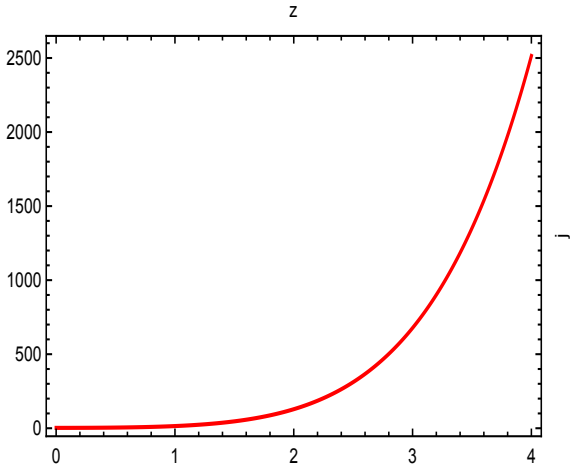
The load-bearing object is Eq. (15), a second-order nonlinear ordinary differential equation for the Hubble parameter $H(z)$: $$\frac{$d^{2}$H}{$dz^{2}$}=-\frac{1}{H}\left(\frac{dH}{dz}\right)^2+\frac{3}{1+z}\frac{dH}{dz}-\frac{3f'\left[(1+z)\frac{dH}{dz}-$H^{2}$\right]+\left(\frac{f}{2}-\rho_{m0}\right)}{18f''$H^{3}$(1+z)^2},$$ with primes denoting derivatives of $f$ with respect to $R$. The equation is assembled from the Friedmann-type equations (8), the Ricci scalar relation (13), and the derivative relation (14), and it is the single formula from which every plotted quantity follows: $q(z)$ via (16), $j(z)$ via (17), $w_{\mathrm{eff}}$ via (18), and the cosmic age via (19). In the second model the constants are fixed to $\mu=1.6$, $R_c=5.7\times10^{-30}$, satisfying the stated stability bounds.
What would settle it
Re-derive Eq. (15) directly from the metric $f(R)$ field equations (6)-(7) by substituting each of the two $f(R)$ forms. If the resulting ODE contains extra terms involving $R f'$, $\ddot R$, or a different combination than the paper's Eq. (15), then the plotted $q(z)$, $j_0$, $H_0$, and ages are not consequences of the stated models. Alternatively, rerun the numerical integration with $\rho_{m0}$ matched to the quoted $H_0=0.07$ GYrs$^{-1}$ and the stated $q_0$, $j_0$; the quoted age values should be reproduced to the reported precision if the claim is right.
Extended reading notes
Core claim
The central claim is that the two $f(R)$ functions studied in this paper reproduce the observed expansion history of the universe. Starting from the $f(R)$ field equations in a flat FRW metric, the paper states a second-order nonlinear ODE, Eq. (15), for $H(z)$ and solves it with present-day initial conditions $q_0=-0.81$ and $j_0=2.16$ taken from observational fits. For the first form, and for the second form with $\mu=1.6$ and $R_c=5.7\times10^{-30}$, the integration yields a high-redshift decelerating phase and a low-redshift accelerating phase, with today's parameters $q_0\approx -0.8$, $j_0$ equal to $2.16$ or $2.43$, and $H_0=0.07$ GYrs$^{-1}$. Evaluating the cosmic age integral at large $z$ gives $12.13$ GYrs for the first model and $15.11$ GYrs for the second, which the authors compare with the observational data cited in [73].
Load-bearing premise
The numerical results rest on Eq. (15) being the correct reduction of the $f(R)$ field equations for these two models, together with a valid numerical value for the present matter density $\rho_{m0}$; the paper states the equation and the initial conditions but does not derive the equation or state the value of $\rho_{m0}$ used.
Editorial extensions
If this is right
- The two models each show a decelerating phase at high redshift and an accelerating phase at low redshift, with $q_0\approx-0.8$ today.
- The jerk parameter today comes out at $2.16$ for the first model and $2.43$ for the second, close to the observed value cited in [72].
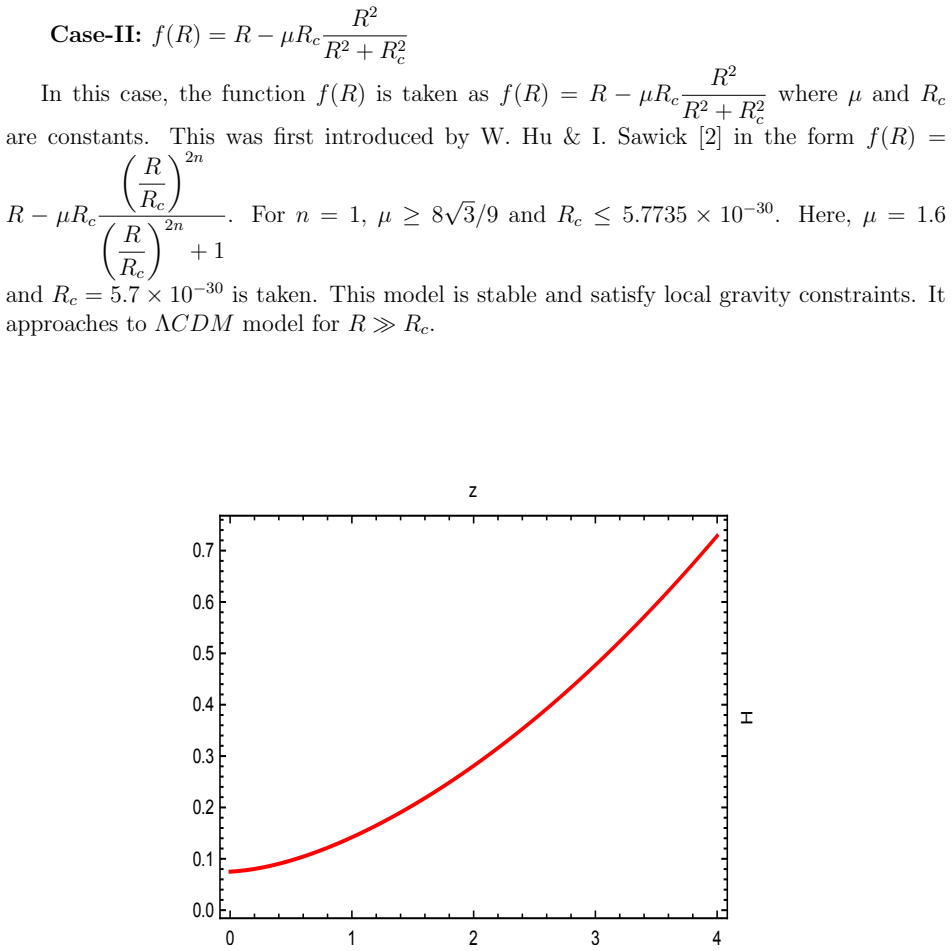
- The Hubble parameter at present is $0.07$ GYrs$^{-1}$, and the age integral converges to $12.13$ GYrs (first model) and $15.11$ GYrs (second model), both compared with the observational data cited in [73].
- The effective equation-of-state parameter ranges between $-0.9$ and $0.3$ (first model) and $-0.3$ and $0.3$ (second model), within current observational bounds.
- Should Eq. (15) be correct, these two stable $f(R)$ forms give a background cosmology that matches observed acceleration with no cosmological constant.
Reading between the lines
- My inference: the same $H(z)$ solutions could be used to compute the Type Ia supernova distance modulus and compare directly with supernova samples; the paper stops at the background parameters, so this is a test it does not run.
- My inference: the 2.98 GYr difference in age between the two models implies measurably different deceleration-to-acceleration transition redshifts; a precise measurement of the transition redshift would discriminate between the two functions.
- My inference: because $\rho_{m0}$ never appears numerically, the results are not yet reproducible; fixing $\rho_{m0}$ from independent cosmological data is the minimal next step needed to make the reported values checkable.
- My inference: the same Eq. (15) machinery could scan the second model's parameter space in $\mu$ and $R_c$, rather than the single point used here, to see which combinations survive the observational bounds.
Signed reviews
Editorial analysis
A structured set of objections, weighed in public.
Referee Report
Summary. The paper studies flat FRW cosmology in two f(R) gravity models, f(R)=R+R^2+1/R and f(R)=R-μR_c R^2/(R^2+R_c^2), and aims to compute the Hubble, deceleration, jerk, matter-density, effective equation-of-state, and age of the universe as functions of redshift. The authors introduce a second-order ODE for H(z) as Eq. (15), integrate it numerically for the two models, and report that the present values q0≈-0.8, j0≈2.16 or 2.43, H0≈0.07 GYrs^-1, and ages 12.13 and 15.11 GYrs are consistent with current observations. The central quantitative claims rest entirely on Eq. (15).
Significance. If Eq. (15) were a correct reduction of the f(R) field equations and the numerical inputs were fully specified, the paper would provide two worked examples of cosmological evolution in viable f(R) models; this would be a modest but useful check. However, the advertised agreement with current data is not obtained as a prediction: q0 and j0 are imposed as initial conditions, and the only dynamical equation is presented without derivation and appears inconsistent with the field equations written in Section 2. As it stands, the paper does not establish that the plotted parameters follow from the stated f(R) models, so its significance is limited to a numerical exercise with no demonstrated connection to the models.
major comments (5)
- [Section 3, Eq. (15)] Eq. (15) is stated without derivation, and I am unable to reproduce it from Eqs. (8), (13), and (14). Substituting R=6H(2H-(1+z)H') and \dot R=6(1+z)H[(1+z)H''-H'] into Eq. (8) gives an equation of the form 18(1+z)^2 H^2 f'' H'' = ρm0(1+z)^3 - f/2 + 3H^2 f' - 3(1+z)HH'f' + 18(1+z)H^2 H'f'', which differs from Eq. (15) in the matter term (ρm0(1+z)^3 versus ρm0), in the f' combination, and in the presence of the H'^2 and H'/(1+z) terms. Since Eq. (15) is the only dynamical input used for all figures, the reported H(z), q(z), j(z), ρm(z), weff(z), and ages do not follow from the stated f(R) field equations.
- [Section 3 and Section 4] The authors state in Section 3 that the present values of the deceleration and jerk parameters are taken to be q0=-0.81 and j0=2.16 from Ref. [72], and then in Section 4 report that q(0) is nearly -0.8 and j(0) is 2.16 (or 2.43) as close to observational values. At z=0, Eq. (16) gives q(0)=-1+H'(0)/H(0), and Eq. (17) gives j(0) in terms of the initial H, H', and H''; hence the z=0 agreement is an identity imposed by the chosen initial conditions, not a prediction of the model.
- [Section 3, after Eq. (15)] The quantity ρm0 appears in Eq. (15) but its numerical value, units, and relation to the matter density parameter Ωm0 are never given. Without this input the integration of Eq. (15) cannot be reproduced or checked. This is not a minor omission because the matter term is central to the evolution of H(z) and to the age integral in Eq. (19).
- [Section 2, Eqs. (13)-(14)] Eq. (14), as printed, is not the direct derivative of Eq. (13). Differentiating R=6H(2H-(1+z)H') with respect to cosmic time gives \dot R=6(1+z)H[(1+z)H''-H'], whereas Eq. (14) contains additional terms proportional to H H'' and (H')^2. This further indicates that the input used to obtain Eq. (15) is not the standard reduction of the f(R) cosmological equations.
- [Section 3 and Figures 1, 7] The text says that the Hubble parameter is scaled by H0 so that its present value is unity, yet Figures 1 and 7 show H(0)≈0.07 and the text states that the present value is 0.07 GYrs^-1. This inconsistency makes it unclear whether the initial condition for Eq. (15) is H(0)=1 or H(0)=0.07, which changes the numerical solution and the derived age.
minor comments (5)
- [Throughout] There are several typographical errors: 'Odintosov' in Refs. [1] and [38], 'Palataini' in the Introduction, 'Eintein-Λ' in the Introduction, and 'verses' in the captions of Figures 1-12; these should be corrected.
- [Section 3, Case II] The parameter constraints 'µ≥ 8√3/9 and Rc≤ 5.7735×10^-30' are stated without a derivation or reference, and the adopted values µ=1.6 and Rc=5.7×10^-30 are not justified in the text.
- [Figures 1-12] The figures lack units and error bars, and the claimed observational values are not marked on the plots, which would make the claimed consistency easier to assess.
- [Section 4] The quoted ages 12.13 GYrs and 15.11 GYrs are presented as derived results, but the description 't tends to 12.13 as z tends to infinity' in the text is confusing because the age is an integral from z=0 to infinity, not a limiting value of t(z) at large z; the notation should be clarified.
- [Introduction] The sentence 'The smallest estimates for its value are of order 55 [59,60]' is unclear; the intended meaning (a discrepancy of order 10^55 relative to naive estimates) should be stated explicitly.
Circularity Check
The quoted present q and j values are the initial conditions the paper says it 'took', so the Section 4 consistency checks are identities; the age and H(z) outputs remain partly model-dependent.
-
fitted input called prediction
[Section 3 (numerical setup), echoed in Section 4]
"To find the numerical plots of these physical parameters, the present values of deceleration parameter and jerk parameter are taken to be equal to -0.81 and 2.16 respectively [72]."
Section 4 then reports: 'At z = 0, it is nearly equal to -0.8, in each case, which is also very much closed to recent experimental value [72].' With H(0)=H0 and H'(0) chosen so that Eq. (16) gives q(0)=-0.81, the plotted q(0) ≈ -0.8 is the imposed initial condition, not a prediction of the f(R) models. The consistency claim is identity by construction.
-
fitted input called prediction
[Section 4 (jerk results), with input fixed in Section 3]
"In the first case, its present values are obtained as 2.16 and in the second case, it is found as 2.43 which is very much closed to the current measured value [72]."
The same Section 3 sentence fixes the present jerk to 2.16 before integration, and Eq. (17) evaluated at z=0 is determined by the z=0 initial data on H (H(0), H'(0), H''(0), or, for the stated second-order ODE, by the chosen ρm0). Reporting j(0)=2.16 for Case I as 'obtained' and then comparing 2.43 against the same input is a restatement of the input, not an independent model prediction.
1 more flagged steps
-
fitted input called prediction
[Section 3 (normalization) and Section 4 (Hubble result)]
"Hubble parameter is scaled as H/H0 so that its value at present is unity. ... its present value is found to be equal to 0.07 GYrs−1 which is consistent with the current observational data [73]."
The normalization enforces H(0)=H0 by definition; the dimensional value 0.07 GYrs^{-1} is the adopted observational scale, not a value produced by integrating the f(R) equations. Presenting it as 'found to be equal' to the WMAP value labels an input as an output, though this is a secondary reporting issue beside the q and j identities.
full rationale
The paper's models and external data (Nojiri-Odintsov and Hu-Sawicki forms, Rapetti et al. values, WMAP H0) are genuine external inputs, and no load-bearing self-citation chain is present. The circularity is localized to the 'present value' consistency claims: q0=-0.81 and j0=2.16 are explicitly stated as taken values, then Section 4 presents them as being close to observational values, so those two checks reduce to the inputs by construction. H0=0.07 is similarly the normalization scale rather than a derived result. The age values (12.13 and 15.11 GYrs), the H(z) curves, and the deceleration-to-acceleration transition retain model-dependent content, assuming Eq. (15) is a correct reduction of Eqs. (8), (13), and (14). The derivation of Eq. (15) is not shown and appears to contain term and matter-scaling discrepancies, and ρm0 is never specified; those are correctness and reproducibility concerns rather than circularity. Overall the central claim is only partially forced, so the appropriate score is 6.
Assumptions & free parameters
free parameters (6)
- q0 (present deceleration parameter) =
-0.81
- j0 (present jerk parameter) =
2.16
- H0 (present Hubble parameter) =
0.07 GYrs^-1
- μ (Hu-Sawicki parameter) =
1.6
- Rc (Hu-Sawicki curvature scale) =
5.7e-30
- ρm0 (present matter density) =
not stated
assumptions (6)
- domain assumption The universe is described by a flat FRW metric
- domain assumption Matter content is pressureless dust with standard conservation
- domain assumption The f(R) field equations as written in Eqs. (6) and (7) are the correct equations of motion
- domain assumption The two f(R) models are stable and pass local gravity and solar system constraints
- ad hoc to paper Eq. (15) correctly reduces Eqs. (8), (13), and (14) to an ODE for H(z)
- domain assumption The observed q0 and j0 from Rapetti et al. [72] are accurate present values
Cite this review
Pith. "Pith review of Physical Parameters for Stable $f(R)$ Models." pith.science (2026). https://pith.science/paper/Y5GM3O3K
@misc{pith2026190804408,
  author       = {Pith},
  title        = {Pith review of: Physical Parameters for Stable $f(R)$ Models},
  year         = {2026},
  howpublished = {\url{https://pith.science/paper/Y5GM3O3K}},
  note         = {Machine review of arXiv:1908.04408}
}
abstract
Nojiri \& Odintsov \cite{noj1} and Hu \& Sawicki \cite{hu} have studied non-linear functions in modified gravity that explain the cosmic acceleration without cosmological constant, fulfil the conditions of local gravity \& stability and pass the solar system tests. In this paper, FRW model, a best fitted and fruitful mathematical model of the physical universe \cite{rob, hub, alph, pen} is studied in the context of these non-linear functions. The cosmological implications such as Hubble parameter, deceleration parameter, jerk parameter, matter density and the effective equation of state parameter of the universe are plotted with respect to redshift. Subsequently, the age of the universe is predicted in $f(R)$ gravity. All are found to represent the features of present phase of the universe.
Figures


Figures from the paper (9 more)




Reference graph
Works this paper leans on
-
[72]
Monthly Notices of the Royal Astronomical Society 375 1510 (2007)
D Rapetti et al. Monthly Notices of the Royal Astronomical Society 375 1510 (2007)
work page 2007
-
[1]
S Nojiri and S D Odintosov Physical Review D 68 123512 (2003)
work page 2003
-
[2]
W Hu and I Sawicki Physical Review D 76 064004 (2007)
work page 2007
-
[3]
H P Robertson Astrophysical Journal 82 248 (1935)
work page 1935
-
[4]
E Hubble Proceedings of the National Academy of Sciences 15 168 (1929)
work page 1929
-
[5]
R A Alpher, H A Bethe and G Gamow Physical Review D 73 80 (1948)
work page 1948
-
[6]
A A Penzias and R W Wilson Astrophysical Journal 142 419 (1965)
work page 1965
-
[7]
Astrophysical Journal 116 1009 (1998)
A G Riess et al. Astrophysical Journal 116 1009 (1998)
work page 1998
Show all 73 references
-
[8]
Astrophysical Journal 517 565 (1999)
S Perlmutter et al. Astrophysical Journal 517 565 (1999)
1999
-
[9]
The Astrophysical Journal Supplement Series 148 1 (2003)
C L Bennet et al. The Astrophysical Journal Supplement Series 148 1 (2003)
2003
-
[10]
Astrophysical Journal 607 665 (2004)
A G Riess et al. Astrophysical Journal 607 665 (2004)
2004
-
[11]
A A Starobinsky Physics Letters B 91 99 (1980)
1980
-
[12]
T Harko et al Physical Review D 84 024020 (2011)
2011
-
[13]
G C Samanta and S N Dhal Int. J. Theor. Phys. 52 1334 (2013)
2013
-
[14]
G C Samanta Int. J. Theor. Phys. 52 2303 (2013)
2013
-
[15]
G C Samanta Int. J. Theor. Phys. 52 2647 (2013)
2013
-
[16]
E Elizalde and S I Vacaru Gen. Relativ. Gravit. 47 64 (2015)
2015
-
[17]
Z Yousaf, M Z Bhatti and U Farwa Mon. Not. R. Astron. Soc. 464 4509 (2017)
2017
-
[18]
T Hussain, M Khurshudyan, S Ahmed and A Z Khurshudyan Int. J. Mod. Phys. D 26 1750155 (2017). 14
2017
-
[19]
H Shabani and A H Ziaie Eur. Phys. J. C 78 397 (2018)
2018
-
[20]
H Azmat, M Zubair and I Noureen Int. J. Mod. Phys. D 27 1750181 (2017)
2017
-
[21]
G C Samanta and R Myrzakulov Chinese J. Phys. 55 1044 (2017)
2017
-
[22]
Naturforsch
G C Samanta, R Myrzakulov and P Shah Z. Naturforsch. A 72 365 (2017)
2017
-
[23]
N Godani Int. J. Geom. Methods Mod. Phys. 16 1950024 (2019)
2019
-
[24]
https://doi.org/10.1007/s12648-018-01363-w
N Godani Indian J Phys (2019). https://doi.org/10.1007/s12648-018-01363-w
2019 doi
-
[25]
Z Yousaf, K Bamba and M Z Bhatti, Phys. Rev. D 93 064059 (2016)
2016
-
[26]
Z Yousaf, K Bamba and M Z Bhatti Phys. Rev. D 93 064059 (2016)
2016
-
[27]
K Bamba, M Ilyas, M Z Bhatti and Z Yousaf Gen. Relativ. Gravit. 49 112 (2017)
2017
-
[28]
Z Yousaf Eur. Phys. J. Plus 132 276 (2017)
2017
-
[29]
Z Yousaf, K Bamba, M Z Bhatti and U Farwa Eur. Phys. J. A 54 122 (2018)
2018
-
[30]
T P Sotiriou Classical Quantum Gravity 23 5117 (2006)
2006
-
[31]
A Ali, R Gannouji, M Sami and A A Sen Physical Review D 81 104029 (2010)
2010
-
[32]
A Ganguly, R Gannouji, R Goswami, and S Ray Physical Review D 89 064019 (2014)
2014
-
[33]
Q G Huang Journal of Cosmology and Astroparticle Physics 35 1402 (2014)
2014
-
[34]
M Sharif and I Nawazish Astrophysics and Space Science 362 30 (2017)
2017
-
[35]
Physics Letters B 766 225 (2017)
S Bahamonde et al. Physics Letters B 766 225 (2017)
2017
-
[36]
A D Felice Living Reviews in Relativity 13 1 (2010)
2010
-
[37]
Physics Reports 692 1 (2017)
S Nojiri et al. Physics Reports 692 1 (2017)
2017
-
[38]
S Nojiri and S D Odintsov International Journal of Geometric Methods in Modern Physics 4 115 (2007)
2007
-
[39]
Physical Review D 89 023518 (2013)
L Sebastiani et al. Physical Review D 89 023518 (2013)
2013
-
[40]
Physical Review D 77 046009 (2008)
G Cognola et al. Physical Review D 77 046009 (2008)
2008
-
[41]
S Thakur and A A Sen Physical Review D 88 044043 (2013)
2013
-
[42]
A Mukherjee and N Banerjee Astrophysics and Space Science 352 893 (2014)
2014
-
[43]
J Guo and A V Frolov Phys. Rev. D 88 124036 (2013)
2013
-
[44]
K Bamba, A N Makarenko, A N Myagky, S Nojiri and S D Odintsov JCAP 01 008 (2014). 15
2014
-
[45]
A R Amani Int. J. Mod. Phys. D 25 1650071 (2016)
2016
-
[46]
M Zubair and G Abbas arXiv:1412.2120v3[physics.gen-ph] (2016)
2016 arXiv
-
[47]
Z Yousaf, K Bamba and M Z Bhatti Phys. Rev. D 95 024024 (2017)
2017
-
[48]
K Bamba, A N Makarenko, A N Myagky, S Nojiri and S D Odintsov Journal of Cos- mology and Astroparticle Physics 1401 008 (2014)
2014
-
[49]
K Bamba, S Nojiri, S D Odintsov and D Saez-Gomez Physics Letters B 730 136 (2014)
2014
-
[50]
K Bamba, S Nojiri, S D Odintsov and D Saez-Gomez Physical Review D 90 124061 (2014)
2014
-
[51]
Z Yousaf, K Bamba and M Zaeem-ul-Haq Bhatti Physical Review D 95 024024 (2017)
2017
-
[52]
S D Odintsov and V K Oikonomou Physical Review D 96 104049 (2017)
2017
-
[53]
S D Odintsov and V K Oikonomou Annals of Physics 388 267 (2018)
2018
-
[54]
S Capozziello, S Nojiri and S D Odintsov Physics Letters B 781 99 (2018)
2018
-
[55]
S D Odintsov and V K Oikonomou Physical Review D 98 024013 (2018)
2018
-
[56]
N Godani and G C Samanta Int. J. Mod. Phys. D 28 1950039 (2018)
2018
-
[57]
G C Samanta, N Godani and K Bamba arXiv:1811.06834v1[gr-qc] (2018)
2018 arXiv
-
[58]
A V Astashenok, K Mosani, S D Odintsov and G C Samanta arXiv:1812.10441[gr-qc] (2019)
2019 arXiv
-
[59]
S M Carroll Living Reviews in Relativity 4 1 (2001)
2001
-
[60]
P J Peebles and B Ratra Reviews of Modern Physics 75 599 (2003)
2003
-
[61]
C Wetterich Nuclear Physics B 302 668 (1988)
1988
-
[62]
B Ratra and P J Peebles Physical Review D 37 3406 (1988)
1988
-
[63]
R R Caldwell, R Dave and P J Steinhardt Physical Review Letters 80 1582 (1998)
1998
-
[64]
C Armendariz-Picon, T Damour and V Mukhanov Physics Letters B 458 209 (1999)
1999
-
[65]
C Armendariz-Picon, V Mukhanov and P J Steinhardt Physical Review Letters 85 4438 (2000)
2000
-
[66]
C Armendariz-Picon, V Mukhanov and P J Steinhardt Physical Review D 63 103510 (2001)
2001
-
[67]
L Mersini, M Bastero-Gil and P Kanti Physical Review D 64 043508 (2001)
2001
-
[68]
Physical Review D 70 043528 (2004)
S M Carroll et al. Physical Review D 70 043528 (2004). 16
2004
-
[69]
A A Starobinsky JETP Letters 86 157 (2007)
2007
-
[70]
S Nojiri and S D Odintsov Phys. Lett. B 657 238 (2007)
2007
-
[71]
S Nojiri and S D Odintsov Phys. Rev. D 77 026007 (2008)
2008
-
[73]
Astrophysical Journal Supplement Series 208 19 (2013)
G Hinshaw et al. Astrophysical Journal Supplement Series 208 19 (2013). 17
2013
Reviewed August 14, 2026 · model on record in the stance chip above.
Discussion (0). Continue with ORCID to comment.