REVIEW 1 minor 1 cited by
Full characterization of informative subsets in Quantum Encrypted Cloning
T0 review · 0 major / 1 minor · reviewed 2026-06-30 · grok-4.3
Pith's one-line read Subsets containing the transformed input qubit in quantum encrypted cloning are fully informative except in two parity cases.
desk verdict This paper finishes the leakage classification for subsets that include the source qubit A in quantum encrypted cloning, adding two parity-based exceptions to the authors' earlier storage-only results. read the letter →
The pith
A machine-rendered reading of the paper's core claim, the machinery that carries it, and where it could break.
The reading
What carries the argument
Purity of the global encoded state together with complementarity between storage-only subsets and subsets containing A, used to classify the reduced state on every H = {A} ∪ C.
What would settle it
Explicitly compute the reduced density matrix on H = {A} ∪ C for odd n, |C| = n, and even q; the claim is falsified if any Bloch-vector component other than y shows dependence on the input state.
Extended reading notes
Core claim
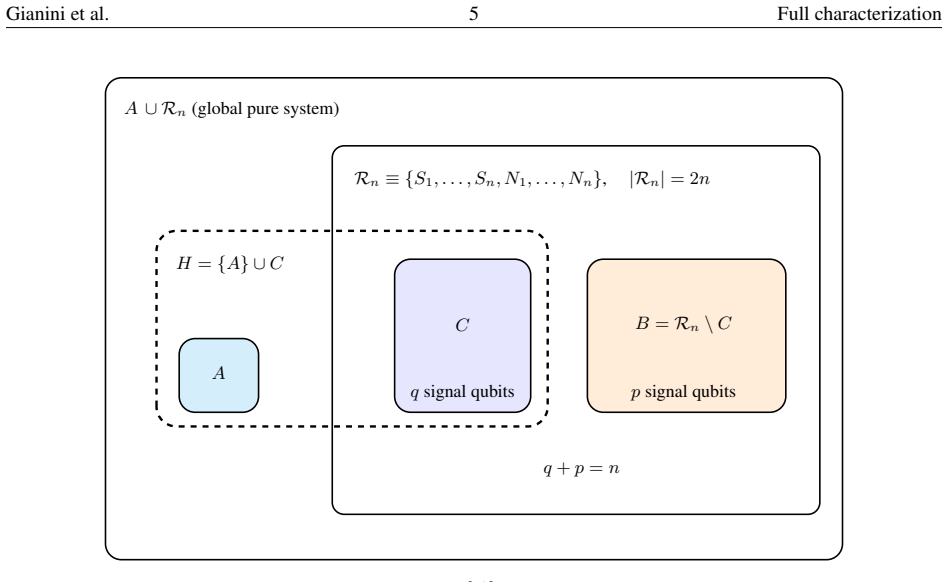
Exploiting the purity of the global encoded state and the complementarity between storage-only subsets and subsets containing A, the subsets of the form H = {A} ∪ C are fully informative in the generic case. Two exceptions arise: if all pairs are incomplete and |C| < n, the reduced state is completely uninformative; if |C| = n, n is odd, and the number q of signal qubits in C is even, the reduced state is partially informative with the residual dependence on the input state confined to the y-component of the Bloch vector. These results provide a complete parity-based characterization of leakage for subsets containing the transformed input qubit.
Load-bearing premise
The global encoded state must be pure and the complementarity relation between storage-only subsets and subsets containing A must hold.
Editorial extensions
If this is right
- The leakage pattern for every subset containing A is now known and governed by parity rules.
- When all pairs are incomplete and |C| < n the reduced state carries no information about the input.
- When |C| = n with n odd and q even the only remaining information resides in the y-component of the Bloch vector.
- The full classification covers both storage-only subsets and subsets that also contain A.
Reading between the lines
- The same purity-plus-complementarity argument might classify leakage in other Pauli-based encoding schemes that preserve global purity.
- Numerical checks for small odd n with even q would directly confirm whether the Bloch-vector restriction holds exactly.
- Protocol designers could deliberately choose n and pair-completeness to force the uninformative or y-only regimes for added security.
Editorial analysis
A structured set of objections, weighed in public.
Referee Report
Summary. The paper claims to fully characterize the informativeness of subsets H = {A} ∪ C in quantum encrypted cloning by exploiting the purity of the global encoded state and complementarity between storage-only subsets and those containing A. It concludes that these subsets are fully informative in the generic case, with two exceptions: (1) if all pairs are incomplete and |C|<n, the reduced state is completely uninformative; (2) if |C|=n, n is odd, and q (number of signal qubits in C) is even, the reduced state is partially informative with residual dependence only on the y-component of the Bloch vector.
Significance. This result completes the classification of leakage patterns in the protocol, providing a parity-based understanding that could inform security considerations in quantum cryptographic schemes involving encrypted cloning. The identification of specific exceptional cases based on parity is a key contribution.
minor comments (1)
- [Abstract] The abstract assumes familiarity with the prior work on storage-only subsets and the basic protocol; a short recap of the setup would improve accessibility.
Simulated Author's Rebuttal
We thank the referee for their careful reading of the manuscript and for the positive assessment, including the accurate summary of our results and the recommendation for minor revision. The referee's description of the full characterization of subsets H = {A} ∪ C, including the two exceptional cases based on parity, correctly reflects the content of the paper. No specific major comments requiring changes were raised.
read point-by-point responses
-
Referee: The paper claims to fully characterize the informativeness of subsets H = {A} ∪ C in quantum encrypted cloning by exploiting the purity of the global encoded state and complementarity between storage-only subsets and those containing A. It concludes that these subsets are fully informative in the generic case, with two exceptions: (1) if all pairs are incomplete and |C|<n, the reduced state is completely uninformative; (2) if |C|=n, n is odd, and q (number of signal qubits in C) is even, the reduced state is partially informative with residual dependence only on the y-component of the Bloch vector.
Authors: We confirm that this is an accurate summary of the manuscript's main results and conclusions. The analysis relies on the purity of the encoded state and the complementarity relations to derive the complete classification, with the two parity-dependent exceptions explicitly identified. revision: no
Circularity Check
No significant circularity; derivation rests on independent physical properties
full rationale
The paper derives the classification of informativeness for subsets H={A}∪C by exploiting the purity of the global encoded state and the complementarity between storage-only subsets and A-inclusive subsets. These are standard quantum-mechanical properties of the protocol, not derived from or equivalent to the authors' prior results on storage-only subsets. The self-citation provides background on the storage-only case but is not load-bearing for the new classification or the stated exceptions (incomplete pairs with |C|<n; or |C|=n, n odd, q even with residual y-Bloch dependence). No equation or step reduces by construction to a fitted parameter, self-definition, or self-citation chain. The result is therefore self-contained against external benchmarks.
Assumptions & free parameters
assumptions (2)
- domain assumption The global encoded state is pure
- domain assumption Complementarity exists between storage-only subsets and subsets containing the transformed source qubit A
Cite this review
Pith. "Pith review of Full characterization of informative subsets in Quantum Encrypted Cloning." pith.science (2026). https://pith.science/paper/Y5JKNSZV
@misc{pith2026260527421,
  author       = {Pith},
  title        = {Pith review of: Full characterization of informative subsets in Quantum Encrypted Cloning},
  year         = {2026},
  howpublished = {\url{https://pith.science/paper/Y5JKNSZV}},
  note         = {Machine review of arXiv:2605.27421}
}
abstract
Quantum encrypted cloning, introduced by Yamaguchi and Kempf, is a Pauli-based protocol that distributes an unknown input qubit into multiple encrypted signal-noise pairs in such a way that redundancy is created without violating the no-cloning theorem, since at most one clone can later be perfectly recovered through an appropriate decoding procedure. In previous work we showed that unauthorized subsets of the storage register are not, in general, completely uninformative, and we identified a parity-dependent leakage pattern. In the present work we extend the analysis to subsets that also include the transformed source qubit A. Exploiting the purity of the global encoded state and the complementarity between storage-only subsets and subsets containing A, we derive a full classification of the informativeness of all sets of the form $H=\{A\}\cup C$. We show that these subsets are fully informative in the generic case. Two exceptions arise. First, if all pairs are incomplete and |C|<n, then the reduced state is completely uninformative. Second, if |C|=n, n is odd, and the number q of signal qubits in C is even, then the reduced state is partially informative. In this latter case, the residual dependence on the input state is confined to the y-component of the Bloch vector. These results provide a complete parity-based characterization of leakage for subsets containing the transformed input qubit.
Figures


Forward citations
Cited by 1 Pith paper
-
Beyond the Canonical Protocol: Quantum Encrypted Cloning from Secret-Sharing Access Structures
Quantum encrypted cloning schemes can be derived from any quantum secret sharing access structure containing a family of qualified sets with a non-qualified common intersection, interpreted as key plus encrypted clones.
Reference graph
Works this paper leans on
-
[1]
Encrypted qubits can be cloned.Physical Review Letters, 136(1):010801, 2026
Koji Yamaguchi and Achim Kempf. Encrypted qubits can be cloned.Physical Review Letters, 136(1):010801, 2026
work page 2026
-
[2]
Koji Yamaguchi, Leon Rullkötter, Ibrahim Shehzad, Sean J Wagner, Christian Tutschku, and Achim Kempf. Experimental demonstration that qubits can be cloned at will, if encrypted with a single-use decryption key.arXiv preprint arXiv:2602.10695, 2026
-
[3]
Cloning Encrypted Quantum States in Arbitrary Dimensions
Filip-Ioan Ceara. Cloning encrypted quantum states in arbitrary dimensions.arXiv preprint arXiv:2604.04888, 2026
work page Pith review arXiv 2026
-
[4]
Encrypted clones can leak: Classification of informative subsets in Quantum Encrypted Cloning
Gabriele Gianini, Omar Hasan, Corrado Mio, Stelvio Cimato, and Ernesto Damiani. Encrypted clones can leak: Classification of informative subsets in quantum encrypted cloning.arXiv preprint arXiv:2604.10155, 2026
work page Pith review arXiv 2026
-
[5]
Classification of informative subsets in quantum encrypted cloning on qudits, 2026
Chen-Ming Bai, Xin-Liang Zhou, and Yu Luo. Classification of informative subsets in quantum encrypted cloning on qudits, 2026
work page 2026
Reviewed June 30, 2026 · model on record in the stance chip above.
Discussion (0). Sign in to comment.