REVIEW 2 major objections 4 minor 114 references
Witnessing non-objectivity in the framework of strong quantum Darwinism
T0 review · 2 major / 4 minor · reviewed 2026-08-14 · deepseek-v4-flash
Pith's one-line read A single comparison of two evolutions lets a photonic experiment witness non-objectivity in strong quantum Darwinism without full state tomography.
desk verdict A useful basis-dependent witness for strong quantum Darwinism with a clean core inequality, but a normalization ambiguity in the objectivity operation needs a patch before this is operational. read the letter →
The pith
A machine-rendered reading of the paper's core claim, the machinery that carries it, and where it could break.
The reading
What carries the argument
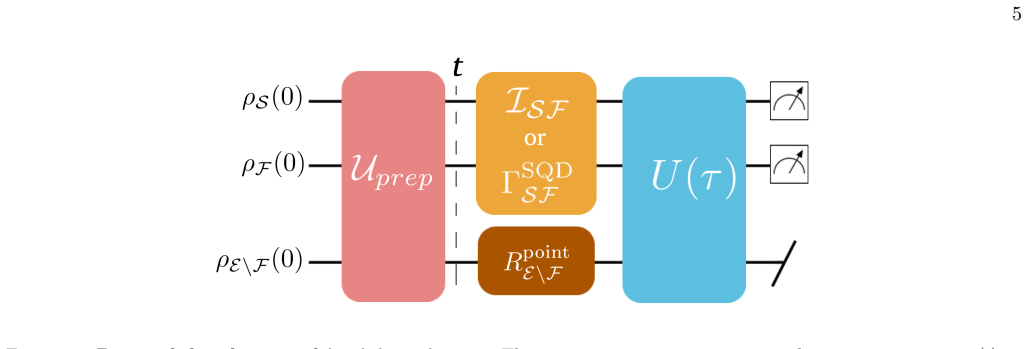
The central object is the objectivity operation $\Gamma^{\mathrm{SQD}}_{SF}(\rho) = \sum_i (|i\rangle\langle i|_S \otimes \Pi_{F|i} \otimes \mathbb{1}_{E\setminus F}) \rho (|i\rangle\langle i|_S \otimes \Pi_{F|i} \otimes \mathbb{1}_{E\setminus F})$, a completely positive map that sends any state into the convex set of states satisfying strong quantum Darwinism in the chosen system basis and environment subspaces. The witness is the absolute difference of two probabilities, one from the untouched evolution and one after applying this operation, with a point channel first deleting correlations with the unaccessed environment: $W_{\mathrm{SQD}}(M_{SE}) = |\mathrm{tr}[ M_{SE} U_\tau ( \rho_{SF}(t) - \Gamma^{\mathrm{SQD}}_{SF}(\rho_{SF}(t)) ) \otimes \rho^{\mathrm{new}}_{E\setminus F} ]|$. The proof of the bound uses the trace-norm variational formula, expressing the supremum over Hermitian operators with norm at most one as exactly $\lVert \rho_{SF}(t) - \Gamma^{\mathrm{SQD}}_{SF}(\rho_{SF}(t)) \rVert_1$; this is what turns the probability difference into a lower bound on the measure.
What would settle it
A decisive check is to take many randomly generated system-fragment states, estimate $M_{\mathrm{SQD}}$ by full state tomography, and run the maximal witness on the same states: the paper's bound predicts the witness never exceeds the measure, so any measured violation of $W_{\mathrm{SQD}} \le M_{\mathrm{SQD}}$ would refute the central claim.
Extended reading notes
Core claim
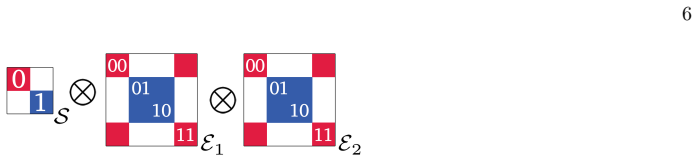
The central claim is that non-objectivity of a system $S$ with respect to an environment fragment $F$, in the framework of strong quantum Darwinism, can be witnessed by a two-branch experiment. In one branch the state $\rho_{SF}(t)$ is left untouched; in the other it is first acted on by a subspace-dependent objectivity operation that dephases the system in a fixed basis and projects each environment subspace into the corresponding objective subspace. After identical unitary evolution and a fixed final measurement, the absolute difference of the two probabilities is the witness $W_{\mathrm{SQD}}$. The paper proves $W_{\mathrm{SQD}}(M_{SE}) \le M_{\mathrm{SQD}}(\rho_{SF}(t))$, where $M_{\mathrm{SQD}}$ is the trace-norm distance from the objective subspace, so any non-zero witness implies non-objectivity relative to the fixed basis and subspaces. The converse is not claimed: a zero reading does not certify full objectivity, because a state objective in another basis can still give a non-zero witness. The scheme is applied to a photonic qubit simulation using parity checks and CNOT gates, and numerical results show it detects non-objectivity under depolarising noise and imperfect gates.
Load-bearing premise
The scheme assumes that a preferred set of system states and a preferred family of environment subspaces are fixed in advance, and it treats 'objective' as meaning 'lying in those subspaces'; a state that is objective in another basis can therefore be reported as non-objective, and a zero witness does not rule out that possibility.
Editorial extensions
If this is right
- A non-zero witness is sufficient to declare the state non-objective relative to the chosen basis and subspaces, without reconstructing the state.
- The photonic scheme's run count scales as $C + C(1/p_{\mathrm{CNOT}})^{2M}$, versus $C\,3^{1+2M}$ for tomography, so the advantage grows with the number of environment photons once $p_{\mathrm{CNOT}}$ is above about $1/3$ (about $0.42$ at the simulated gate fidelity).
- For invariant spectrum broadcast structure, which applies when all subsystem dimensions are equal, the objectivity operation needs no CNOT gates and the witness requires roughly a constant number of runs independent of fragment size.
- The witness gives one combined number for non-objectivity and does not by itself say whether the failure comes from quantum correlations or missing classical correlations; the paper suggests adding a discord witness when the source matters.
- A zero witness is not a certificate of full objectivity, since the scheme is system-basis and environment-subspace dependent.
Reading between the lines
- The two-branch comparison is a general template: any non-objectivity or correlation measure defined as a distance to a convex set could be lower-bounded by the same probability-difference construction, so the scheme may transfer to other convex resource theories with minimal changes.
- Because the witness reports non-objectivity relative to a fixed subspace, using it on a state that is objective in another basis produces a false positive; a practical protocol may need to scan several candidate subspaces or infer the natural objective basis before trusting a non-zero reading.
- The paper's run-count comparison counts only measurement runs and treats the point channel and unitary evolution as deterministic; including state-preparation overheads and CNOT failures will raise the effective resource cost, and the claimed advantage should be re-tested in an end-to-end estimate.
- For invariant spectrum broadcast structure, the CNOT-free scheme suggests an immediate experimental test with a five-photon GHZ state: if the witness remains tight for reduced fragments as the paper's simulations show, it would validate the approach at modest scale.
Signed reviews
Editorial analysis
A structured set of objections, weighed in public.
Referee Report
Summary. This manuscript introduces a subspace-dependent 'objectivity operation' Gamma_SQD and a trace-distance measure M_SQD of non-objectivity, and constructs a witness W_SQD obtained by comparing the evolution of the system-fragment state with and without Gamma_SQD. The central result is the inequality W_SQD <= M_SQD, proven in Eqs. (18)-(23) via trace-norm duality. The paper also proposes a photonic implementation based on CNOT gates and parity checks, reports numerical simulations (including imperfect gates), and gives a scaling argument showing a potential advantage over full tomography. An analogous witness is developed for invariant spectrum broadcast structure in Appendix B.
Significance. The theoretical bound is derived cleanly and the numerical simulations are consistent with the detection claim; the authors also honestly point out limitations (weakness for full-fragment quantum correlations, overshoot under gate errors, basis-dependence). The proposed witness is a potentially useful step toward scalable experimental tests of quantum Darwinism. However, a normalization/postselection issue in the definition of the measure and in the experimental protocol must be resolved before the experimental claim is sound.
major comments (2)
- [Sec. III, Eq. (11)] The objectivity operation Gamma in Eq. (10) is trace-nonincreasing for generic choices of the objective subspaces, because the projectors |i><i|_S x Pi_{F|i} need not sum to the identity on SF. Consequently the claim that max_{rho} M_SQD(rho) = 1 is false. For example, with d_S = d_F = 2 and projectors |0><0|_S x |0><0|_F and |1><1|_S x |1><1|_F, the state rho = |0><0|_S x |+><+|_F gives Gamma(rho) = (1/2)|00><00| and ||rho - Gamma(rho)||_1 = sqrt(5)/2 = 1.118 > 1. This should be corrected by either normalizing Gamma so that it is trace-preserving (e.g., by adding a failure outcome) or by explicitly stating that M_SQD is not normalized and can exceed 1.
- [Sec. IV, Eqs. (15)-(17) and Fig. 4] The witness is defined in terms of unconditional probabilities P1 and PGamma, with PGamma = tr[M_SE U_tau(Gamma(rho_SF(t)) x rho_new)]. The proposed photonic implementation, however, is postselected: only runs in which the parity checks match the system measurement are retained (Fig. 4). If an experimentalist instead estimates the conditional probability PGamma_cond = tr[M_SE U_tau(Gamma(rho) x rho_new)] / Tr[Gamma(rho)], the inequality W <= M can fail, because division by Tr[Gamma(rho)] can amplify the difference. The scaling analysis in Sec. IVD ('in order for there to be a total of C successful runs...') makes clear that the objective branch is treated as conditional. The authors must specify how the unconditional probabilities in Eqs. (15) and (17) are reconstructed from postselected data (e.g., by including failure counts as a null outcome or by multiplying by the success probability), or else provide a modified witness bound valid under postselection.
minor comments (4)
- [Sec. IVC] The sentence 'Fig. 7 shows the presumes a perfect circuit' should read 'Fig. 7 shows the results for a perfect circuit'.
- [Sec. IVD] The expression 'pCNOT & 1/3' should read 'p_CNOT >= 1/3' or 'p_CNOT >~ 1/3'; the ampersand is a typographical artifact.
- [Sec. III, after Eq. (11)] Consider stating explicitly that Gamma is not trace-preserving in general and that M_SQD is therefore not a normalized measure; this would prevent a natural misreading of Fig. 7, where M_SQD is plotted against 1.
- [Sec. IV, Fig. 4 caption] The phrase 'If the objective operation results in a null state, then all measurement outcomes are zero' is only meaningful if the trace-nonincreasing nature of Gamma is understood; please clarify this sentence.
Circularity Check
No circularity: the witness is defined as a comparison with the objectivity operation, and the lower-bound inequality is proven directly.
full rationale
The derivation of the non-objectivity witness is self-contained. The witness W in Eq. (18) is defined as the absolute difference between measurement probabilities with and without the objectivity operation Γ, and the measure M in Eq. (11) is the trace-norm distance to Γ. The bound W ≤ M is then proven in Eqs. (19)–(23) using the dual form of the trace norm, not assumed. The claim that a non-zero witness implies non-objectivity is a direct corollary of this bound, relative to the stated basis and subspaces. The paper's own acknowledgement that the witness is system-basis and environment-subspace dependent is a limitation, not a circularity. The photonic implementation is a proposal with numerical simulations; no parameter is fitted to make the witness agree with the measure, and the scaling comparison in Sec. IVD is an arithmetic count of runs. The main self-citation, Ref. [3], supplies the definition of strong quantum Darwinism as the framework being used, but no load-bearing argument reduces to that citation: the bound and the numerical simulations stand independently. No fitted input is relabelled as a prediction, and no uniqueness theorem is imported to force the choice of operation. The possible normalization issue with the claimed maximum M = 1 for a trace-nonincreasing Γ is a correctness concern, not a circularity.
Assumptions & free parameters
free parameters (2)
- CNOT gate fidelity F_CNOT =
≈0.79
- CNOT success probability p_CNOT =
≥1/(3 F_CNOT) ≈ 0.42
assumptions (4)
- standard math Trace-norm dual variational formula: ||A||_1 = sup_{||B||≤1} |tr[BA]|
- domain assumption The projectors Π_{F|i} define an orthogonal partition of the fragment Hilbert space such that the objectivity operation Γ is a valid quantum operation
- domain assumption Bipartite spectrum broadcast structure characterization of strong quantum Darwinism from Ref. [3] is accepted
- domain assumption Non-demolition parity checks and CNOT gates can be realized in photonic systems via cross-Kerr nonlinearities with sufficient fidelity and success probability
Cite this review
Pith. "Pith review of Witnessing non-objectivity in the framework of strong quantum Darwinism." pith.science (2026). https://pith.science/paper/Y5YWS3K6
@misc{pith2026190808818,
  author       = {Pith},
  title        = {Pith review of: Witnessing non-objectivity in the framework of strong quantum Darwinism},
  year         = {2026},
  howpublished = {\url{https://pith.science/paper/Y5YWS3K6}},
  note         = {Machine review of arXiv:1908.08818}
}
read the original abstract
Quantum Darwinism is a compelling theory that describes the quantum-to classical transition as the emergence of objectivity of quantum systems. Spectrum broadcast structure and strong quantum Darwinism are two extensions of this theory with emphasis on state structure and information respectively. The complete experimental verification of these three frameworks, however, requires quantum state tomography over both the system and accessible environments, thus limiting the feasibility and scalability of experimental tests. Here, we introduce a subspace-dependent objectivity operation and construct a witness that detects non-objectivity by comparing the dynamics of the system-environment state with and without the objectivity operation. We then propose a photonic experimental simulation that implements the witnessing scheme. Our work proposes a route to further experimental exploration of the quantum to classical transition.
Figures

Figures from the paper (8 more)




Reference graph
Works this paper leans on
-
[1]
Preparing the states with some non-objectivity that we wish to witness,
-
[2]
Applying a point channel onE\F,
-
[3]
Applying the objectivity operation onSF, or an identity operation, depending on the run,
-
[4]
The unitary evolution,
-
[5]
7 Figure 4
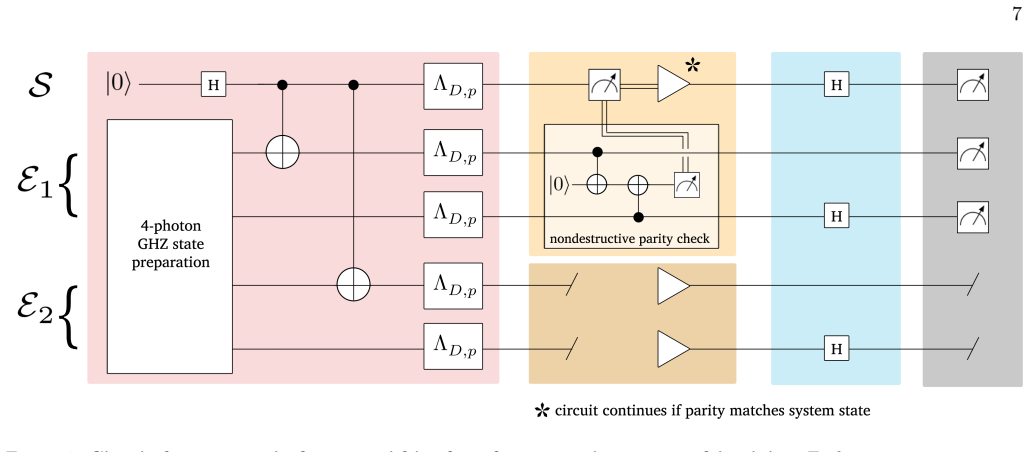
And the final measurement. 7 Figure 4. Circuit for one particular run within the scheme to witness non-objectivity. Each environment consists of two photons. The system-environment is first prepared into the state given in Eq. (24), including 4-photon GHZ state preparation shown in further detail in Fig. 6. In this particular run, we have depolarisation cha...
-
[6]
E. J. O’Reilly and A. Olaya-Castro, Nat. Commun.5, 3012 (2014)
2014
-
[7]
(24) and for the parity measurement for the objective operation, both seen in Fig
Controlled-NOT Operation The experimental procedure uses a number of nondestructive CNOT gates: in the preparation of the initial state in Eq. (24) and for the parity measurement for the objective operation, both seen in Fig. 4. This is also the main limiting factor of the witnessing scheme, and the scalability of the witnessing scheme depends heavily on ...
-
[8]
This is shown in the first left-hand box in Fig
Initial state preparation The system state can be created with a Hadamard H produced with a half wave plate (HWP) at θ = π/2: (|0⟩ +|1⟩)/ √ 2 = H|0⟩. This is shown in the first left-hand box in Fig. 4. We then need to create a four-photon Greenberger-Horne-Zeilinger (GHZ) state on the environment. This procedure is depicted in Fig. 6, and proceeds as follo...
Show all 114 references
-
[9]
(10) can be implemented with a system polarisation measurement and non- destructive parity checks on the environment
Objectivity Operation The objectivity operation from Eq. (10) can be implemented with a system polarisation measurement and non- destructive parity checks on the environment. One possible parity check scheme is shown in Fig. 4, which uses an auxiliary photon and two CNOT opera...
-
[10]
7 shows the presumes a perfect circuit, while Fig
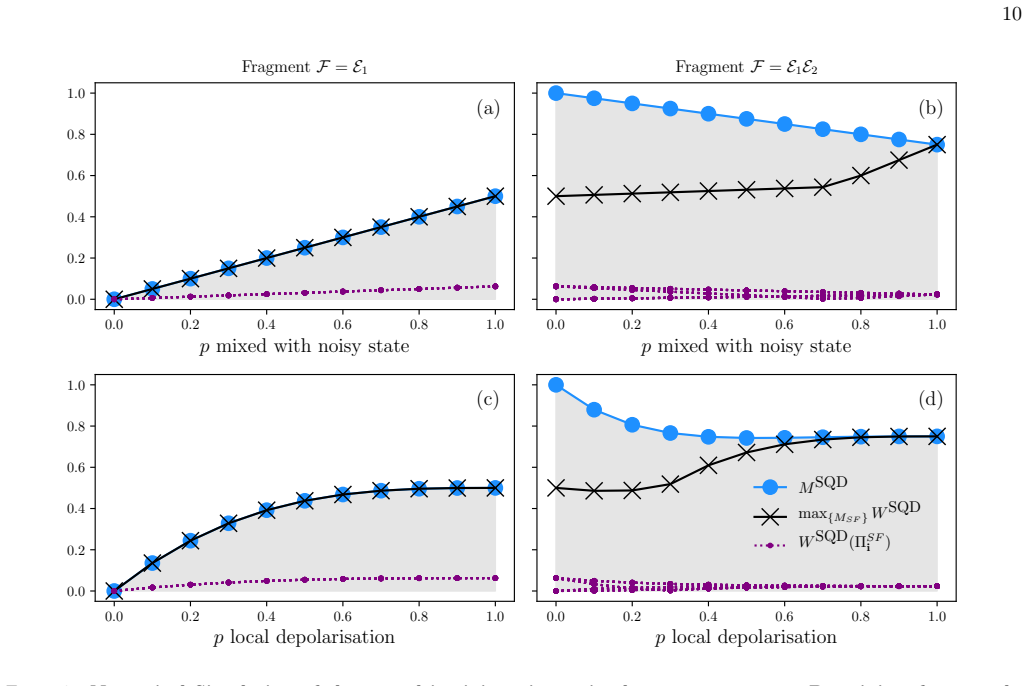
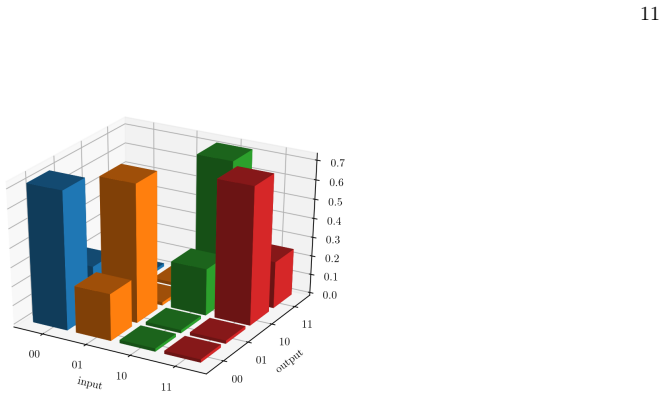
Fig. 7 shows the presumes a perfect circuit, while Fig. 9 considers if the state preparation involved controlled-NOT operations with fidelities of approximately0.79. We find that our witness is able to detect non-objectivity in the cases we considered
-
[11]
This reflects our motivation that only particular measurements are possible, or preferable, in a realistic system
Measurement Operators in the Witness The final measurements of the system and fragment are always in the computational basis. This reflects our motivation that only particular measurements are possible, or preferable, in a realistic system. For a particular projective rank-1 mea...
-
[12]
In particular, we have employed various CNOT operations which can have fidelityF <1
Simulation with operation fidelities and noise In a realistic experiment, gate operations are not perfect. In particular, we have employed various CNOT operations which can have fidelityF <1. To simulate such results, we consider a CNOT gate that behaves imperfectly, with the gi...
-
[13]
ChooseNρ = 500 random initial statesρi distributed close to the ideal state given in Eq. (24)
-
[14]
For eachρi, simulateNc = 1000 stochastic runs of the circuit
-
[15]
For each run, simulate measurement with total photon number picked from a Poisson distribution with mean photon numberNp = 100
-
[16]
For eachρi, average over all measurement outcomes and calculate the optimal witness,max{MSF}W SQD
-
[17]
Thus, the simulation results in Fig
Calculate the average optimal witness over all random initial states. Thus, the simulation results in Fig. 9 have three primary noise sources: the initial imperfect preparation, the nonzero fidelity into the CNOT gates in the objective operation, and measurement noise. We can s...
-
[18]
(B2) The overall witness scheme is identical to that of the strong quantum Darwinism witness scheme in Sec. III. The corresponding non-objectivity witness in this framework is: W ISBS(MSE ) = ⏐⏐⏐tr [ MSEUτ [{ ρSF (t)− ΓISBS SF (ρSF (t)) } ⊗ρnew E\F ]]⏐⏐⏐, (B3) where MSE is a m...
-
[19]
The main departure from the scheme with strong quantum Darwinism is the initial state, and the objectivity operation, shown in Fig
Quantum Photonic Simulation Proposal We take the system as one photon, and consider four environments each comprised of one photon each. The main departure from the scheme with strong quantum Darwinism is the initial state, and the objectivity operation, shown in Fig. 10 (comp...
-
[20]
Similarly, coincident detection in the outputs implies that each both photons areH-polarised orV-polarised, and after renormalising the state, the five-photon GHZ state is made [74]
Then, arrange the path-lengths such that the system photon and the first environment photon arrive at a polarising beam splitter the same time. Similarly, coincident detection in the outputs implies that each both photons areH-polarised orV-polarised, and after renormalising th...
-
[21]
W. H. Zurek, Nat. Phys.5, 181 (2009)
2009
-
[22]
Horodecki, J
R. Horodecki, J. K. Korbicz, and P. Horodecki, Phys. Rev. A91, 032122 (2015)
2015
-
[23]
T. P. Le and A. Olaya-Castro, Phys. Rev. Lett.122, 010403 (2019)
2019
- [24]
-
[25]
Arndt, T
M. Arndt, T. Juffmann, and V. Vedral, HFSP Journal3, 386 (2009)
2009
-
[26]
Pérez, Phys
A. Pérez, Phys. Rev. A81, 052326 (2010)
2010
-
[27]
F. G. S. L. Brandão, M. Piani, and P. Horodecki, Nat. Commun.6, 7908 (2015)
2015
-
[28]
P. A. Knott, T. Tufarelli, M. Piani, and G. Adesso, Phys. Rev. Lett.121, 160401 (2018)
2018
-
[29]
J. K. Korbicz, E. A. Aguilar, P. Ćwikliński, and P. Horodecki, Phys. Rev. A96, 032124 (2017)
2017
- [30]
-
[31]
Balanesković, Eur
N. Balanesković, Eur. Phys. J. D69, 232 (2015)
2015
-
[32]
Balanesković and M
N. Balanesković and M. Mendler, Eur. Phys. J. D70, 177 (2016)
2016
-
[33]
Ollivier, D
H. Ollivier, D. Poulin, and W. H. Zurek, Phys. Rev. Lett.93, 220401 (2004)
2004
-
[34]
Blume-Kohout and W
R. Blume-Kohout and W. H. Zurek, Found. Phys.35, 1857 (2005)
2005
-
[35]
C. J. Riedel, W. H. Zurek, and M. Zwolak, New J. Phys.14, 083010 (2012)
2012
-
[36]
Zwolak, H
M. Zwolak, H. T. Quan, and W. H. Zurek, Phys. Rev. Lett.103, 110402 (2009)
2009
-
[37]
Zwolak, H
M. Zwolak, H. T. Quan, and W. H. Zurek, Phys. Rev. A81, 062110 (2010)
2010
-
[38]
Zwolak, C
M. Zwolak, C. J. Riedel, and W. H. Zurek, Sci. Rep.6, 25277 (2016)
2016
-
[39]
G. L. Giorgi, F. Galve, and R. Zambrini, Phys. Rev. A92, 022105 (2015)
2015
-
[40]
Zwolak, C
M. Zwolak, C. J. Riedel, and W. H. Zurek, Phys. Rev. Lett.112, 140406 (2014)
2014
-
[41]
Zwolak and W
M. Zwolak and W. H. Zurek, Phys. Rev. A95, 030101 (2017)
2017
-
[42]
Lampo, J
A. Lampo, J. Tuziemski, M. Lewenstein, and J. K. Korbicz, Phys. Rev. A96, 012120 (2017)
2017
-
[43]
C. J. Riedel and W. H. Zurek, Phys. Rev. Lett.105, 020404 (2010)
2010
-
[44]
C. J. Riedel and W. H. Zurek, New J. Phys.13, 073038 (2011)
2011
-
[45]
Korbicz, P
J. Korbicz, P. Horodecki, and R. Horodecki, Phys. Rev. Lett.112, 120402 (2014)
2014
-
[46]
D. K. Ferry, R. Akis, and R. Brunner, Phys. Scr.T165, 014010 (2015)
2015
-
[47]
T. P. Le and A. Olaya-Castro, Phys. Rev. A98, 032103 (2018)
2018
-
[48]
J. K. Korbicz and J. Tuziemski, Gen. Relativ. Gravit.49, 152 (2017)
2017
-
[49]
Tuziemski, P
J. Tuziemski, P. Witas, and J. K. Korbicz, Phys. Rev. A97, 012110 (2018)
2018
-
[50]
Blume-Kohout and W
R. Blume-Kohout and W. H. Zurek, Phys. Rev. A73, 062310 (2006)
2006
-
[51]
Roszak and J
K. Roszak and J. K. Korbicz, Phys. Rev. A100, 062127 (2019)
2019
-
[52]
Campbell, B
S. Campbell, B. Çakmak, O. E. Müstecaplıoğlu, M. Paternostro, and B. Vacchini, Phys. Rev. A99, 042103 (2019)
2019
-
[53]
García-Pérez, D
G. García-Pérez, D. A. Chisholm, M. A. C. Rossi, G. M. Palma, and S. Maniscalco, (2019), arXiv:1907.12447
2019 arXiv
-
[54]
Tuziemski, A
J. Tuziemski, A. Lampo, M. Lewenstein, and J. K. Korbicz, Phys. Rev. A99, 022122 (2019)
2019
-
[55]
S. M. Oliveira, A. L. de Paula, and R. C. Drumond, Phys. Rev. A100, 052110 (2019)
2019
-
[56]
Roszak and J
K. Roszak and J. K. Korbicz, Phys. Rev. A101, 052120 (2020)
2020
-
[57]
Milazzo, S
N. Milazzo, S. Lorenzo, M. Paternostro, and G. M. Palma, Phys. Rev. A100, 012101 (2019)
2019
-
[58]
Lorenzo, M
S. Lorenzo, M. Paternostro, and G. M. Palma, Phys. Rev. Research2, 013164 (2020)
2020
-
[59]
T. P. Le, P. Mironowicz, and P. Horodecki, (2020), arXiv:2006.06364v1
2020 arXiv
- [60]
-
[61]
Brunner, R
R. Brunner, R. Akis, D. K. Ferry, F. Kuchar, and R. Meisels, Phys. Rev. Lett.101, 024102 (2008)
2008
-
[62]
A. M. Burke, R. Akis, T. E. Day, G. Speyer, D. K. Ferry, and B. R. Bennett, Phys. Rev. Lett.104, 176801 (2010)
2010
-
[63]
D. K. Ferry, A. M. Burke, R. Akis, R. Brunner, T. E. Day, R. Meisels, F. Kuchar, J. P. Bird, and B. R. Bennett, Semicond. Sci. Technol.26, 043001 (2011)
2011
-
[64]
Brunner, D
R. Brunner, D. K. Ferry, R. Akis, R. Meisels, F. Kuchar, A. M. Burke, and J. P. Bird, J. Phys.: Condens. Matter24, 343202 (2012)
2012
-
[65]
un-accessed
and quantum coherence [66]. We could alternatively use a combination of a discord witness [65, 67–70] combined with a measurement of the classical information. However, unlike the scheme we will introduce below, this will not produce a single witness value for non-objectivity,...
-
[66]
Brunner, R
R. Brunner, R. Akis, R. Meisels, F. Kuchar, and D. Ferry, Physica E42, 1208 (2010)
2010
-
[67]
M. A. Ciampini, G. Pinna, P. Mataloni, and M. Paternostro, Phys. Rev. A98, 020101 (2018)
2018
-
[68]
Chen, H.-S
M.-C. Chen, H.-S. Zhong, Y. Li, D. Wu, X.-L. Wang, L. Li, N.-L. Liu, C.-Y. Lu, and J.-W. Pan, Sci. Bull.64, 580 (2019)
2019
-
[69]
Unden, D
T. Unden, D. Louzon, M. Zwolak, W. Zurek, and F. Jelezko, Phys. Rev. Lett.123, 140402 (2019)
2019
-
[70]
Cramer, M
M. Cramer, M. B. Plenio, S. T. Flammia, R. Somma, D. Gross, S. D. Bartlett, O. Landon-Cardinal, D. Poulin, and Y.-K. Liu, Nat. Commun.1, 149 (2010)
2010
- [71]
-
[72]
J. Haah, A. W. Harrow, Z. Ji, X. Wu, and N. Yu, IEEE Trans. Inf. Theory , 1 (2017)
2017
-
[73]
Aaronson, inACM SIGACT - STOC 2018(ACM Press, 2018) pp
S. Aaronson, inACM SIGACT - STOC 2018(ACM Press, 2018) pp. 325–338
2018
-
[74]
Gühne and G
O. Gühne and G. Tóth, Phys. Rep.474, 1 (2009)
2009
-
[75]
Adesso, T
G. Adesso, T. R. Bromley, and M. Cianciaruso, J. Phys. A: Math. Theor.49, 473001 (2016)
2016
-
[76]
Lewenstein, B
M. Lewenstein, B. Kraus, J. I. Cirac, and P. Horodecki, Phys. Rev. A62, 052310 (2000)
2000
-
[77]
J. S. Bell, Physics1, 195 (1964)
1964
-
[78]
B. M. Terhal, Phys. Lett. A271, 319 (2000)
2000
-
[79]
Henderson and V
L. Henderson and V. Vedral, J. Phys. A: Math. Gen.34, 6899 (2001)
2001
-
[80]
Ollivier and W
H. Ollivier and W. H. Zurek, Phys. Rev. Lett.88, 017901 (2001). 18
2001
-
[81]
Zwolak and W
M. Zwolak and W. H. Zurek, Sci. Rep.3, 1729 (2013)
2013
-
[82]
Egloff, J
D. Egloff, J. M. Matera, T. Theurer, and M. B. Plenio, Phys. Rev. X8, 031005 (2018)
2018
-
[83]
Yadin, J
B. Yadin, J. Ma, D. Girolami, M. Gu, and V. Vedral, Phys. Rev. X6, 041028 (2016)
2016
-
[84]
Streltsov, G
A. Streltsov, G. Adesso, and M. B. Plenio, Rev. Mod. Phys.89, 041003 (2017)
2017
-
[85]
Gessner and H.-P
M. Gessner and H.-P. Breuer, Phys. Rev. A87, 042107 (2013)
2013
-
[86]
G. C. Knee, M. Marcus, L. D. Smith, and A. Datta, Phys. Rev. A98, 052328 (2018)
2018
-
[87]
S. Yu, C. Zhang, Q. Chen, and C. H. Oh, (2011), arXiv:1102.4710v1
2011 arXiv
-
[88]
Rahimi and A
R. Rahimi and A. SaiToh, Phys. Rev. A82, 022314 (2010)
2010
-
[89]
Maziero and R
J. Maziero and R. M. Serra, Int. J. Quant. Inf.10, 1250028 (2012)
2012
-
[90]
Zhang, S
C. Zhang, S. Yu, Q. Chen, and C. H. Oh, Phys. Rev. A84, 032122 (2011)
2011
-
[91]
Gasparoni, J.-W
S. Gasparoni, J.-W. Pan, P. Walther, T. Rudolph, and A. Zeilinger, Phys. Rev. Lett.93, 020504 (2004)
2004
-
[92]
Nemoto and W
K. Nemoto and W. J. Munro, Phys. Rev. Lett.93, 250502 (2004)
2004
-
[93]
Lin and J
Q. Lin and J. Li, Phys. Rev. A79, 022301 (2009)
2009
-
[94]
Zhao, Y.-A
Z. Zhao, Y.-A. Chen, A.-N. Zhang, T. Yang, H. J. Briegel, and J.-W. Pan, Nature430, 54 (2004)
2004
-
[95]
Jeong, J.-C
Y.-C. Jeong, J.-C. Lee, and Y.-H. Kim, Phys. Rev. A87, 014301 (2013)
2013
-
[96]
Zhao, A.-N
Z. Zhao, A.-N. Zhang, Y.-A. Chen, H. Zhang, J.-F. Du, T. Yang, and J.-W. Pan, Phys. Rev. Lett.94, 030501 (2005)
2005
-
[97]
Bao, T.-Y
X.-H. Bao, T.-Y. Chen, Q. Zhang, J. Yang, H. Zhang, T. Yang, and J.-W. Pan, Phys. Rev. Lett.98, 170502 (2007)
2007
-
[98]
Zeuner, A
J. Zeuner, A. N. Sharma, M. Tillmann, R. Heilmann, M. Gräfe, A. Moqanaki, A. Szameit, and P. Walther, npj Quantum Inf. 4, 13 (2018)
2018
-
[99]
He and A
B. He and A. Scherer, Phys. Rev. A85, 033814 (2012)
2012
-
[100]
B. Fan, A. F. Kockum, J. Combes, G. Johansson, I. chun Hoi, C. M. Wilson, P. Delsing, G. J. Milburn, and T. M. Stace, Phys. Rev. Lett.110, 053601 (2013)
2013
-
[101]
Heo, C.-H
J. Heo, C.-H. Hong, H.-J. Yang, J.-P. Hong, and S.-G. Choi, Quantum Inf. Process.16, 110 (2017)
2017
-
[102]
Heo, M.-S
J. Heo, M.-S. Kang, C. H. Hong, J.-P. Hong, and S.-G. Choi, Sci. Rep.8, 13843 (2018)
2018
-
[103]
C. Hong, J. Heo, M.-S. Kang, J. Jang, H.-J. Yang, and D. Kwon, Optics Express27, 31023 (2019)
2019
-
[104]
L. M. K. Vandersypen and I. L. Chuang, Rev. Mod. Phys.76, 1037 (2005)
2005
-
[105]
Laflamme, E
R. Laflamme, E. Knill, D. G. Cory, E. M. Fortunato, T. Havel, C. Miquel, R. Martinez, C. Negrevergne, G. Ortiz, M. A. Pravia, Y. Sharf, S. Sinha, R. Somma, and L. Viola, (2002), quant-ph/0207172v1
2002 arXiv
-
[106]
Lee and A
J.-S. Lee and A. K. Khitrin, Appl. Phys. Lett.89, 074105 (2006)
2006
-
[107]
W. J. Munro, K. Nemoto, and T. P. Spiller, New J. Phys.7, 137 (2005)
2005
-
[108]
Venkataraman, K
V. Venkataraman, K. Saha, and A. L. Gaeta, Nat. Photonics7, 138 (2012)
2012
-
[109]
Tiarks, S
D. Tiarks, S. Schmidt, G. Rempe, and S. Dürr, Sci. Adv.2, e1600036 (2016)
2016
-
[110]
Ramelow, A
S. Ramelow, A. Farsi, Z. Vernon, S. Clemmen, X. Ji, J. Sipe, M. Liscidini, M. Lipson, and A. L. Gaeta, Phys. Rev. Lett. 122, 153906 (2019)
2019
-
[111]
Tiarks, S
D. Tiarks, S. Schmidt-Eberle, T. Stolz, G. Rempe, and S. Dürr, Nat. Phys.15, 124 (2018)
2018
-
[112]
Hacker, S
B. Hacker, S. Welte, G. Rempe, and S. Ritter, Nature536, 193 (2016)
2016
-
[113]
Chitambar and G
E. Chitambar and G. Gour, Rev. Mod. Phys.91, 025001 (2019)
2019
-
[114]
Takagi and B
R. Takagi and B. Regula, Phys. Rev. X9, 031053 (2019)
2019
Reviewed August 14, 2026 · model on record in the stance chip above.
Discussion (0). Continue with ORCID to comment.