REVIEW 4 major objections 5 minor 3 cited by
SAMITE: Position Prompted SAM2 with Calibrated Memory for Visual Object Tracking
T0 review · 4 major / 5 minor · reviewed 2026-08-06 · deepseek-v4-flash
Pith's one-line read A memory-scoring trick lifts zero-shot tracking to 74.9 AUC
desk verdict Solid zero-shot SAM2 tracking paper with real gains, but its 'position-wise' memory score is actually appearance-based — worth serious review, needs a fix and some reporting cleanup. read the letter →
The pith
A machine-rendered reading of the paper's core claim, the machinery that carries it, and where it could break.
The reading
What carries the argument
The load-bearing object is the Prototypical Memory Bank (PMB), which for each frame stores a memory plus a foreground prototype and a background prototype obtained by global average pooling of SAM2 features inside and outside the predicted mask. At frame $t$ it scores each candidate frame $\tau$ as $S_\tau = (1-\alpha)\,S^{\text{feat}}_\tau + \alpha\,S^{\text{pos}}_\tau$, where $S^{\text{feat}}_\tau$ is the cosine similarity of $\tau$'s foreground prototype to the first-frame anchor and $S^{\text{pos}}_\tau$ is the similarity to the previous-frame anchor, with $\alpha=0.3$ and a candidate window of $m=30$ recent frames; the top five candidates plus the two anchors form the seven memories given to SAM2's memory attention. The companion module, the Positional Prompt Generator (PPG), produces a discriminative prior mask from foreground-minus-background prototype similarities, multiplies it by a positional prior mask derived from the previous frame's predicted mask with 2D positional encodings, and feeds the result as a pseudo mask prompt—gated by a cycle-consistent mIoU check with threshold $\beta=0.7$. Together the two modules carry the argument: PMB intercepts error propagation at the memory level, and PPG supplies explicit positional evidence to reject distractors at the prompt level.
What would settle it
Run SAMITE on LaSOT's Fast Motion attribute (53 videos where the target moves more than its own box size between adjacent frames): if its AUC on that subset is statistically indistinguishable from simply using SAM2's default first-frame-plus-six-recent memories, then the position-wise anchor is not doing the claimed work and the method's core premise fails.
Extended reading notes
Core claim
SAMITE's central claim is that SAM2's fixed memory rule (first frame plus six most recent) is the real failure point in foundation-model tracking, and that error propagation can be intercepted by selecting which frames condition the current one. The paper treats each stored frame as having two independent kinds of correctness: feature-wise correctness, measured by cosine similarity between that frame's foreground prototype and the first frame's prototype, and position-wise correctness, measured by similarity to the previous frame's prototype. Frames that score low on either axis—occluded objects have incomplete features, distracted frames put the target in the wrong place—are dropped from the memory bank, while the two anchors are always kept. A second module builds a positional mask prompt by comparing current-frame features with stored foreground/background prototypes, reweighting the result with a position prior from the previous frame, and applies it only when a cycle-consistency check confirms it helps. The result, the paper claims, is a zero-shot tracker that surpasses trained VOT specialists on LaSOT and LaSOText without any VOT fine-tuning.
Load-bearing premise
Everything rests on the heuristic that cosine similarity between the current frame's foreground prototype and two fixed anchors—the first frame and the previous frame—measures both whether the target is correctly recognized and whether it is in the right place, which can fail under fast motion, abrupt appearance drift, or a corrupted previous frame.
Editorial extensions
If this is right
- Frames whose targets are occluded lose feature similarity to the first-frame anchor and are filtered out before their incomplete features can condition later frames.
- Frames where the target jumps to a distractor lose positional similarity to the previous-frame anchor, so that incorrect position is not propagated.
- Because the selection is training-free and prototype-based, the gains transfer across SAM2 sizes T, S, B and L, with the largest relative gains on the smaller models.
- On benchmarks with unseen object categories (LaSOText, GOT-10k), the zero-shot SAMITE surpasses supervised trackers trained on VOT data, e.g., 73.1 vs. 65.5 normalized precision on LaSOText.
- The added cost is linear—$O(2m)$ for memory scoring and $16HW$ for prompt generation—so the method runs at 9.2 FPS on the B variant, comparable to the distractor-aware baseline SAM2.1++.
Reading between the lines
- The same prototype-anchor trick could be lifted to other memory-conditioned video models: any autoregressive segmentation or tracking system could score stored states by consistency with a trusted anchor, without retraining.
- Because the paper's own hyperparameter study shows that enlarging the candidate window hurts on fast-motion videos, an adaptive window sized by estimated motion could be a natural extension beyond the fixed $m=30$.
- The cycle-consistent checking is a generic quality gate: it could be reused to decide when to trust any promptable model's self-generated prompts in other dense-prediction tasks, not just tracking.
Editorial analysis
A structured set of objections, weighed in public.
Referee Report
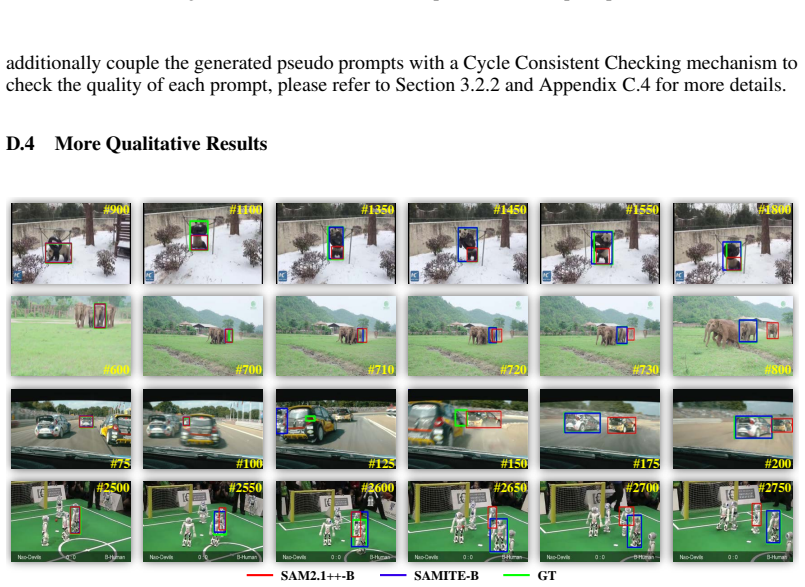
Summary. The paper proposes SAMITE, a zero-shot visual object tracker built on SAM2, which adds two modules: a Prototypical Memory Bank (PMB) and a Positional Prompt Generator (PPG). PMB scores candidate memory frames by cosine similarity between global-average-pooled foreground prototypes and two anchors (frame 1 and frame t-1), selects the top five candidates in addition to the two anchors, and uses these seven memories for memory attention. PPG constructs a discriminative prior mask from foreground/background prototypes, multiplies it by a positional prior derived from the previous frame's mask, averages the resulting prompts over the selected memories, and uses a cycle-consistent check to decide whether to apply the prompt. Experiments are reported on LaSOT, LaSOText, GOT-10k, TrackingNet, NFS, and OTB, with ablations, attribute-level results, model-size comparisons, efficiency numbers, and hyperparameter studies. The headline results include 74.9 AUC on LaSOT and 60.7 AUC on LaSOText, which the paper interprets as evidence that memory calibration and positional prompting intercept occlusion- and distraction-induced error propagation without VOT training.
Significance. If the reported results hold, SAMITE would be a valuable training-free enhancement of SAM2 for visual object tracking, and the memory-calibration idea is worth studying beyond this specific instantiation. The empirical package is extensive: six benchmarks, attribute-wise analysis on LaSOT, scaling across four SAM2 sizes, efficiency measurements, and parameter studies for all three introduced hyperparameters. The robustness of the gains across datasets and across nearby hyperparameter values is a genuine strength, and the paper is not circular in the sense of deriving the result from the result. However, the central conceptual contribution as written is not fully supported: the claimed 'position-wise' correctness score is computed from global-average-pooled appearance features, and the ablation uses an incompletely specified 'tailored' baseline. These issues affect the interpretation of the mechanism and the attribution of the gains, so the current version does not yet establish the paper's conceptual claims at the level of confidence the abstract suggests.
major comments (4)
- [Section 3.2.1, Eq. (4)-(5)] The score called 'position-wise' is the cosine similarity between global-average-pooled foreground prototypes P^FG_tau and P^FG_{t-1}. Global average pooling removes spatial layout, and the paper does not state that the feature map F_t carries positional encodings in this module; hence S^pos_tau measures appearance/temporal consistency, not whether the candidate target lies near the current target. A distractor whose appearance is similar to the previous target can therefore score high, which is exactly the failure mode in Figure 1(b). The t-1 anchor is also used unconditionally even when frame t-1 itself is wrong, with no validity check; Appendix C.4 acknowledges the fast-motion limitation of the candidate window but does not validate the anchor. The claim that PMB quantifies position-wise correctness and intercepts distraction errors is therefore not established by the computation as written. Please reformulate the score using explicit position information, or add a direct evaluation (for example, score distributions conditioned on known position errors or on distractor presence) that demonstrates the position-error-filtering behavior.
- [Section 4.3, Table 3] The 'tailored model' used as the no-PMB/no-PPG baseline is never defined, yet it already achieves 72.1 AUC on LaSOT, compared with 66.0 for the vanilla SAM2.1-B reported in Table 1 and 72.9 for SAM2.1++-B. Without knowing what the tailored model contains (for example, bounding-box prompting details, multi-mask handling, or other implementation choices), the ablation cannot attribute the subsequent gains to PMB and PPG. Please specify the exact configuration of the tailored model and, ideally, include the vanilla SAM2.1-B and SAM2.1++-B rows in the same ablation table so the incremental contributions are interpretable.
- [Table 2] The comparisons on TrackingNet, NFS, and OTB omit SAMURAI-B and SAM2.1++-B, both of which appear in Table 1. The claim in Section 4.2 that SAMITE achieves 'best or tied' results on these benchmarks is therefore not supported by the table as shown. Add the missing baselines so the cross-benchmark claim can be checked directly against the two most relevant SAM2-based competitors.
- [Appendix C.4] The hyperparameters alpha, beta, and m are all tuned on LaSOT, and the reported 74.9 AUC is the best value over the grids (alpha=0.3, m=30, beta=0.7). This is a selection-on-the-test-set issue for the headline LaSOT number. The performance is robust across the grid and the gains persist on other datasets, so the central conclusion remains plausible, but the paper should either validate on a held-out split or explicitly state that the LaSOT margin is partly a grid-selected result.
minor comments (5)
- [Section 3.2.1, Eq. (4)] The normalization operation Norm(.) applied to cosine similarities is not defined; specify the mapping (for example, min-max normalization over the candidate set), because it affects the relative contribution of the feature-wise and position-wise terms in Eq. (5).
- [Section 3.2.2, Eq. (10)-(11)] The positional prior mask uses the previous frame's mask prediction without a validity check; clarify whether the cycle-consistent check gates only the final prompt or also the positional prior input, since a wrong mask at frame t-1 could reinforce an incorrect positional bias.
- [Section 4.3 and Table 5] The attribute-wise results show that SAMITE is worse than SAM2.1++ on View Change (-2.3 AUC) and only slightly better on Fast Motion (+0.8 AUC); the text's characterization of 'particularly good' performance over Table 5 should be qualified to acknowledge these attributes.
- [Appendix A and Abstract] Appendix A states that the code 'will be made public after paper acceptance,' while the abstract and introduction state that code is available at a URL; make the availability status consistent and indicate what the URL currently contains.
- [Section 4.1] There are small typos, including 'm = 30as' (missing space) and 'Appendix C.4..' (doubled period), and the reference to SAM2 using 'multi-head branches [50]' cites SAMURAI rather than the original SAM2 architecture; please correct these editorial issues.
Circularity Check
LaSOT-tuned hyperparameters partly select the headline AUC; no construction-level circularity in the derivation
-
fitted input called prediction
[Section 4.1 Implementation Details; Appendix C.4 Tables 8-10; Table 1]
"we set α = 0.3 in Eq. 5 and m = 30 as the size of reduced candidate set for PMB, and set β = 0.7 as the threshold to use positional mask prompt in PPG, the parameter studies are included in Appendix C.4. ... when α = 0.3, the best performance can be achieved, where the AUC score can be as high as 74.9%"
The hyperparameters α, m, β are selected on the LaSOT test set by argmax: Tables 8-10 show the chosen values each give the best LaSOT AUC (74.9). That same 74.9 is then reported in Table 1 as SAMITE's headline LaSOT result and used to claim it 'can achieve the best performance in most situations.' The headline number is thus partly a product of selection on the same benchmark, making the best-on-LaSOT claim statistically forced rather than an unbiased evaluation of a fixed configuration. The forcing is only partial: the AUC surface is smooth (α=0.1-0.5 gives 74.2-74.9), and untuned gains appear on LaSOText and other datasets, so the central claim retains independent content.
full rationale
The core derivation is not circular: the memory selection and prompt generation are specified by explicit equations (Eqs. 1-13) and the reported gains are benchmark scores against external baselines, not values recovered from the inputs by construction. The one partial circularity is the hyperparameter selection: α, m, β are tuned on the LaSOT test set (Appendix C.4, Tables 8-10), and the resulting 74.9 AUC is presented in Table 1 as the method's headline LaSOT performance, so part of the claimed superiority on LaSOT is a selected maximum rather than an unbiased prediction. This is mitigated by the smoothness of the AUC surface and by untuned gains on LaSOText and other datasets. The PPG follows AENet [46], a self-citation (shared first author and co-authors), but AENet is an externally published, falsifiable method and is a component rather than the load-bearing justification, so it does not raise the score. A separate correctness risk should not be confused with circularity: the 'position-wise' score in Eq. 4 is a cosine similarity between GAP-pooled prototypes (Eq. 2), and global average pooling discards spatial layout, so the claim that it quantifies position-wise accuracy is not established by the computation; this is a mechanistic/falsifiability concern, as echoed by the paper's own Appendix C.4 fast-motion caveat and Appendix E limitations. Verdict: no construction-level circularity; score 4 for the partial test-set-tuning circularity of the headline LaSOT claim.
Assumptions & free parameters
free parameters (3)
- α =
0.3
- m =
30
- β =
0.7
assumptions (5)
- domain assumption The first frame's mask, prompted by ground-truth bounding box, is an accurate feature-wise anchor (Section 3.2.1)
- domain assumption The target object in adjacent frames is spatially close, so frame t-1 is a reliable position-wise anchor (Section 3.2.1, Eq. 4-5)
- ad hoc to paper Cosine similarity between foreground prototypes measures feature-wise and position-wise correctness of a tracked frame (Eq. 4)
- ad hoc to paper Global average pooling over predicted mask yields prototypes representing the target (Eq. 2)
- domain assumption Pretrained SAM2 features transfer to VOT without training (Section 3.1)
Cite this review
Pith. "Pith review of SAMITE: Position Prompted SAM2 with Calibrated Memory for Visual Object Tracking." pith.science (2026). https://pith.science/paper/Y67HDBKL
@misc{pith2026250721732,
  author       = {Pith},
  title        = {Pith review of: SAMITE: Position Prompted SAM2 with Calibrated Memory for Visual Object Tracking},
  year         = {2026},
  howpublished = {\url{https://pith.science/paper/Y67HDBKL}},
  note         = {Machine review of arXiv:2507.21732}
}
read the original abstract
Visual Object Tracking (VOT) is widely used in applications like autonomous driving to continuously track targets in videos. Existing methods can be roughly categorized into template matching and autoregressive methods, where the former usually neglects the temporal dependencies across frames and the latter tends to get biased towards the object categories during training, showing weak generalizability to unseen classes. To address these issues, some methods propose to adapt the video foundation model SAM2 for VOT, where the tracking results of each frame would be encoded as memory for conditioning the rest of frames in an autoregressive manner. Nevertheless, existing methods fail to overcome the challenges of object occlusions and distractions, and do not have any measures to intercept the propagation of tracking errors. To tackle them, we present a SAMITE model, built upon SAM2 with additional modules, including: (1) Prototypical Memory Bank: We propose to quantify the feature-wise and position-wise correctness of each frame's tracking results, and select the best frames to condition subsequent frames. As the features of occluded and distracting objects are feature-wise and position-wise inaccurate, their scores would naturally be lower and thus can be filtered to intercept error propagation; (2) Positional Prompt Generator: To further reduce the impacts of distractors, we propose to generate positional mask prompts to provide explicit positional clues for the target, leading to more accurate tracking. Extensive experiments have been conducted on six benchmarks, showing the superiority of SAMITE. The code is available at https://github.com/Sam1224/SAMITE.
Figures


Figures from the paper (7 more)



Forward citations
Cited by 3 Pith papers
-
Models as Tools: An Agentic Coordination Framework for Unified Multimodal Visual Tracking
ACTrack coordinates a tracker, a segmentation model, and a VLM through event-triggered conflicts, reporting state-of-the-art RGB and multimodal tracking with 30% trainable parameters.
-
SENTRY: SAM2-Enhanced Neighbor-Aware and Temporally Reasoned Memory for Visual Tracking
SENTRY is a plug-and-play module that replaces confidence-based memory writes with neighbor-aware cycle-consistent validation in SAM2 trackers, yielding new zero-shot SOTA results on LaSOT, GOT-10k and other benchmarks.
-
Segment Anything with Motion, Geometry, and Semantic Adaptation for Complex Nonlinear Visual Object Tracking
SAMOSA adapts SAM 2 for complex visual object tracking by integrating explicit nonlinear motion prediction, semantic cues for failure recovery, and geometric constraints for stability, outperforming prior SAM 2-based ...
Reference graph
Works this paper leans on
-
[1]
Artrackv2: Prompting autoregressive tracker where to look and how to describe
Yifan Bai, Zeyang Zhao, Yihong Gong, and Xing Wei. Artrackv2: Prompting autoregressive tracker where to look and how to describe. In Proceedings of the IEEE/CVF conference on computer vision and pattern recognition, pages 19048–19057, 2024
work page 2024
-
[2]
Fully- convolutional siamese networks for object tracking
Luca Bertinetto, Jack Valmadre, Joao F Henriques, Andrea Vedaldi, and Philip HS Torr. Fully- convolutional siamese networks for object tracking. InComputer vision–ECCV 2016 workshops: Amsterdam, the Netherlands, October 8-10 and 15-16, 2016, proceedings, part II 14 , pages 850–865. Springer, 2016
work page 2016
-
[3]
Learning discriminative model prediction for tracking
Goutam Bhat, Martin Danelljan, Luc Van Gool, and Radu Timofte. Learning discriminative model prediction for tracking. In Proceedings of the IEEE/CVF international conference on computer vision, pages 6182–6191, 2019
work page 2019
-
[4]
One-shot video object segmentation
Sergi Caelles, Kevis-Kokitsi Maninis, Jordi Pont-Tuset, Laura Leal-Taixé, Daniel Cremers, and Luc Van Gool. One-shot video object segmentation. In Proceedings of the IEEE conference on computer vision and pattern recognition, pages 221–230, 2017
work page 2017
-
[5]
Hiptrack: Visual tracking with historical prompts
Wenrui Cai, Qingjie Liu, and Yunhong Wang. Hiptrack: Visual tracking with historical prompts. In Proceedings of the IEEE/CVF Conference on Computer Vision and Pattern Recognition , pages 19258–19267, 2024
work page 2024
-
[6]
Robust object modeling for visual tracking
Yidong Cai, Jie Liu, Jie Tang, and Gangshan Wu. Robust object modeling for visual tracking. In Proceedings of the IEEE/CVF international conference on computer vision, pages 9589–9600, 2023
work page 2023
-
[7]
Seqtrack: Sequence to sequence learning for visual object tracking
Xin Chen, Houwen Peng, Dong Wang, Huchuan Lu, and Han Hu. Seqtrack: Sequence to sequence learning for visual object tracking. In Proceedings of the IEEE/CVF conference on computer vision and pattern recognition, pages 14572–14581, 2023
work page 2023
-
[8]
Xin Chen, Bin Yan, Jiawen Zhu, Dong Wang, Xiaoyun Yang, and Huchuan Lu. Transformer tracking. In Proceedings of the IEEE/CVF conference on computer vision and pattern recogni- tion, pages 8126–8135, 2021
work page 2021
Show all 56 references
-
[9]
Siamese box adaptive network for visual tracking
Zedu Chen, Bineng Zhong, Guorong Li, Shengping Zhang, and Rongrong Ji. Siamese box adaptive network for visual tracking. In Proceedings of the IEEE/CVF conference on computer vision and pattern recognition, pages 6668–6677, 2020
2020
-
[10]
Mixformer: End-to-end tracking with iterative mixed attention
Yutao Cui, Cheng Jiang, Limin Wang, and Gangshan Wu. Mixformer: End-to-end tracking with iterative mixed attention. In Proceedings of the IEEE/CVF conference on computer vision and pattern recognition, pages 13608–13618, 2022
2022
-
[11]
Atom: Accurate tracking by overlap maximization
Martin Danelljan, Goutam Bhat, Fahad Shahbaz Khan, and Michael Felsberg. Atom: Accurate tracking by overlap maximization. In Proceedings of the IEEE/CVF conference on computer vision and pattern recognition, pages 4660–4669, 2019
2019
-
[12]
Probabilistic regression for visual tracking
Martin Danelljan, Luc Van Gool, and Radu Timofte. Probabilistic regression for visual tracking. In Proceedings of the IEEE/CVF conference on computer vision and pattern recognition, pages 7183–7192, 2020
2020
-
[13]
Sam2long: Enhancing sam 2 for long video segmentation with a training-free memory tree
Shuangrui Ding, Rui Qian, Xiaoyi Dong, Pan Zhang, Yuhang Zang, Yuhang Cao, Yuwei Guo, Dahua Lin, and Jiaqi Wang. Sam2long: Enhancing sam 2 for long video segmentation with a training-free memory tree. arXiv preprint arXiv:2410.16268, 2024
-
[14]
Large scale interactive motion forecasting for autonomous driving: The waymo open motion dataset
Scott Ettinger, Shuyang Cheng, Benjamin Caine, Chenxi Liu, Hang Zhao, Sabeek Pradhan, Yuning Chai, Ben Sapp, Charles R Qi, Yin Zhou, et al. Large scale interactive motion forecasting for autonomous driving: The waymo open motion dataset. In Proceedings of the IEEE/CVF Internat...
2021
-
[15]
Lasot: A high-quality large-scale single object tracking benchmark
Heng Fan, Hexin Bai, Liting Lin, Fan Yang, Peng Chu, Ge Deng, Sijia Yu, Harshit, Mingzhen Huang, Juehuan Liu, et al. Lasot: A high-quality large-scale single object tracking benchmark. International Journal of Computer Vision, 129:439–461, 2021. 10
2021
-
[16]
Lasot: A high-quality benchmark for large-scale single object tracking
Heng Fan, Liting Lin, Fan Yang, Peng Chu, Ge Deng, Sijia Yu, Hexin Bai, Yong Xu, Chunyuan Liao, and Haibin Ling. Lasot: A high-quality benchmark for large-scale single object tracking. In Proceedings of the IEEE/CVF conference on computer vision and pattern recognition, pages ...
2019
-
[17]
People tracking in surveillance applications
Luis M Fuentes and Sergio A Velastin. People tracking in surveillance applications. Image and Vision Computing, 24(11):1165–1171, 2006
2006
-
[18]
Aiatrack: Attention in attention for transformer visual tracking
Shenyuan Gao, Chunluan Zhou, Chao Ma, Xinggang Wang, and Junsong Yuan. Aiatrack: Attention in attention for transformer visual tracking. In European conference on computer vision, pages 146–164. Springer, 2022
2022
-
[19]
Generalized relation modeling for trans- former tracking
Shenyuan Gao, Chunluan Zhou, and Jun Zhang. Generalized relation modeling for trans- former tracking. In Proceedings of the IEEE/CVF conference on computer vision and pattern recognition, pages 18686–18695, 2023
2023
-
[20]
Graph attention tracking
Dongyan Guo, Yanyan Shao, Ying Cui, Zhenhua Wang, Liyan Zhang, and Chunhua Shen. Graph attention tracking. In Proceedings of the IEEE/CVF conference on computer vision and pattern recognition, pages 9543–9552, 2021
2021
-
[21]
Siamcar: Siamese fully convolutional classification and regression for visual tracking
Dongyan Guo, Jun Wang, Ying Cui, Zhenhua Wang, and Shengyong Chen. Siamcar: Siamese fully convolutional classification and regression for visual tracking. In Proceedings of the IEEE/CVF conference on computer vision and pattern recognition, pages 6269–6277, 2020
2020
-
[22]
Onetracker: Unifying visual object tracking with foundation models and efficient tuning
Lingyi Hong, Shilin Yan, Renrui Zhang, Wanyun Li, Xinyu Zhou, Pinxue Guo, Kaixun Jiang, Yiting Chen, Jinglun Li, Zhaoyu Chen, et al. Onetracker: Unifying visual object tracking with foundation models and efficient tuning. In Proceedings of the IEEE/CVF conference on computer v...
2024
-
[23]
Automatic traffic surveil- lance system for vehicle tracking and classification
Jun-Wei Hsieh, Shih-Hao Yu, Yung-Sheng Chen, and Wen-Fong Hu. Automatic traffic surveil- lance system for vehicle tracking and classification. IEEE Transactions on intelligent trans- portation systems, 7(2):175–187, 2006
2006
-
[24]
Got-10k: A large high-diversity benchmark for generic object tracking in the wild
Lianghua Huang, Xin Zhao, and Kaiqi Huang. Got-10k: A large high-diversity benchmark for generic object tracking in the wild. IEEE transactions on pattern analysis and machine intelligence, 43(5):1562–1577, 2019
2019
-
[25]
A new approach to linear filtering and prediction problems
Rudolph Emil Kalman. A new approach to linear filtering and prediction problems. 1960
1960
-
[26]
Need for speed: A benchmark for higher frame rate object tracking
Hamed Kiani Galoogahi, Ashton Fagg, Chen Huang, Deva Ramanan, and Simon Lucey. Need for speed: A benchmark for higher frame rate object tracking. In Proceedings of the IEEE international conference on computer vision, pages 1125–1134, 2017
2017
-
[27]
Segment anything
Alexander Kirillov, Eric Mintun, Nikhila Ravi, Hanzi Mao, Chloe Rolland, Laura Gustafson, Tete Xiao, Spencer Whitehead, Alexander C Berg, Wan-Yen Lo, et al. Segment anything. In Proceedings of the IEEE/CVF international conference on computer vision, pages 4015–4026, 2023
2023
-
[28]
A review of tracking and trajectory prediction methods for autonomous driving
Florin Leon and Marius Gavrilescu. A review of tracking and trajectory prediction methods for autonomous driving. Mathematics, 9(6):660, 2021
2021
-
[29]
Siamrpn++: Evolution of siamese visual tracking with very deep networks
Bo Li, Wei Wu, Qiang Wang, Fangyi Zhang, Junliang Xing, and Junjie Yan. Siamrpn++: Evolution of siamese visual tracking with very deep networks. In Proceedings of the IEEE/CVF conference on computer vision and pattern recognition, pages 4282–4291, 2019
2019
-
[30]
High performance visual tracking with siamese region proposal network
Bo Li, Junjie Yan, Wei Wu, Zheng Zhu, and Xiaolin Hu. High performance visual tracking with siamese region proposal network. In Proceedings of the IEEE conference on computer vision and pattern recognition, pages 8971–8980, 2018
2018
-
[31]
Tracking meets lora: Faster training, larger model, stronger performance
Liting Lin, Heng Fan, Zhipeng Zhang, Yaowei Wang, Yong Xu, and Haibin Ling. Tracking meets lora: Faster training, larger model, stronger performance. In European Conference on Computer Vision, pages 300–318. Springer, 2024. 11
2024
-
[32]
Swintrack: A simple and strong baseline for transformer tracking
Liting Lin, Heng Fan, Zhipeng Zhang, Yong Xu, and Haibin Ling. Swintrack: A simple and strong baseline for transformer tracking. Advances in Neural Information Processing Systems, 35:16743–16754, 2022
2022
-
[33]
Learning target candidate association to keep track of what not to track
Christoph Mayer, Martin Danelljan, Danda Pani Paudel, and Luc Van Gool. Learning target candidate association to keep track of what not to track. In Proceedings of the IEEE/CVF international conference on computer vision, pages 13444–13454, 2021
2021
-
[34]
Track- ingnet: A large-scale dataset and benchmark for object tracking in the wild
Matthias Muller, Adel Bibi, Silvio Giancola, Salman Alsubaihi, and Bernard Ghanem. Track- ingnet: A large-scale dataset and benchmark for object tracking in the wild. In Proceedings of the European conference on computer vision (ECCV), pages 300–317, 2018
2018
-
[35]
Sam 2: Segment anything in images and videos
Nikhila Ravi, Valentin Gabeur, Yuan-Ting Hu, Ronghang Hu, Chaitanya Ryali, Tengyu Ma, Haitham Khedr, Roman Rädle, Chloe Rolland, Laura Gustafson, et al. Sam 2: Segment anything in images and videos. arXiv preprint arXiv:2408.00714, 2024
2024 arXiv
-
[36]
Explicit visual prompts for visual object tracking
Liangtao Shi, Bineng Zhong, Qihua Liang, Ning Li, Shengping Zhang, and Xianxian Li. Explicit visual prompts for visual object tracking. In Proceedings of the AAAI Conference on Artificial Intelligence, volume 38, pages 4838–4846, 2024
2024
-
[37]
Prior guided feature enrichment network for few-shot segmentation
Zhuotao Tian, Hengshuang Zhao, Michelle Shu, Zhicheng Yang, Ruiyu Li, and Jiaya Jia. Prior guided feature enrichment network for few-shot segmentation. IEEE transactions on pattern analysis and machine intelligence, 44(2):1050–1065, 2020
2020
-
[38]
A distractor-aware memory for visual object tracking with sam2
Jovana Videnovic, Alan Lukezic, and Matej Kristan. A distractor-aware memory for visual object tracking with sam2. arXiv preprint arXiv:2411.17576, 2024
2024 arXiv
-
[39]
Siam r-cnn: Visual tracking by re-detection
Paul V oigtlaender, Jonathon Luiten, Philip HS Torr, and Bastian Leibe. Siam r-cnn: Visual tracking by re-detection. In Proceedings of the IEEE/CVF conference on computer vision and pattern recognition, pages 6578–6588, 2020
2020
-
[40]
Translating math formula images to latex sequences using deep neural networks with sequence-level training, 2019
Zelun Wang and Jyh-Charn Liu. Translating math formula images to latex sequences using deep neural networks with sequence-level training, 2019
2019
-
[41]
Autoregressive vi- sual tracking
Xing Wei, Yifan Bai, Yongchao Zheng, Dahu Shi, and Yihong Gong. Autoregressive vi- sual tracking. In Proceedings of the IEEE/CVF conference on computer vision and pattern recognition, pages 9697–9706, 2023
2023
-
[42]
Online object tracking: A benchmark
Yi Wu, Jongwoo Lim, and Ming-Hsuan Yang. Online object tracking: A benchmark. In Proceedings of the IEEE conference on computer vision and pattern recognition, pages 2411– 2418, 2013
2013
-
[43]
Object tracking benchmark
Yi Wu, Jongwoo Lim, and Ming-Hsuan Yang. Object tracking benchmark. IEEE Transactions on Pattern Analysis and Machine Intelligence, 37(9):1834–1848, 2015
2015
-
[44]
Correlation-aware deep tracking
Fei Xie, Chunyu Wang, Guangting Wang, Yue Cao, Wankou Yang, and Wenjun Zeng. Correlation-aware deep tracking. In Proceedings of the IEEE/CVF conference on computer vision and pattern recognition, pages 8751–8760, 2022
2022
-
[45]
Autoregressive queries for adaptive tracking with spatio-temporal transformers
Jinxia Xie, Bineng Zhong, Zhiyi Mo, Shengping Zhang, Liangtao Shi, Shuxiang Song, and Rongrong Ji. Autoregressive queries for adaptive tracking with spatio-temporal transformers. In Proceedings of the IEEE/CVF Conference on Computer Vision and Pattern Recognition, pages 19300–...
2024
-
[46]
Eliminating feature ambiguity for few-shot segmentation
Qianxiong Xu, Guosheng Lin, Chen Change Loy, Cheng Long, Ziyue Li, and Rui Zhao. Eliminating feature ambiguity for few-shot segmentation. InEuropean Conference on Computer Vision, pages 416–433. Springer, 2024
2024
-
[47]
Siamfc++: Towards robust and accurate visual tracking with target estimation guidelines
Yinda Xu, Zeyu Wang, Zuoxin Li, Ye Yuan, and Gang Yu. Siamfc++: Towards robust and accurate visual tracking with target estimation guidelines. InProceedings of the AAAI conference on artificial intelligence, volume 34, pages 12549–12556, 2020
2020
-
[48]
Learning spatio-temporal transformer for visual tracking
Bin Yan, Houwen Peng, Jianlong Fu, Dong Wang, and Huchuan Lu. Learning spatio-temporal transformer for visual tracking. In Proceedings of the IEEE/CVF international conference on computer vision, pages 10448–10457, 2021. 12
2021
-
[49]
Alpha-refine: Boosting tracking performance by precise bounding box estimation
Bin Yan, Xinyu Zhang, Dong Wang, Huchuan Lu, and Xiaoyun Yang. Alpha-refine: Boosting tracking performance by precise bounding box estimation. In Proceedings of the IEEE/CVF conference on computer vision and pattern recognition, pages 5289–5298, 2021
2021
-
[50]
Samurai: Adapting segment anything model for zero-shot visual tracking with motion-aware memory
Cheng-Yen Yang, Hsiang-Wei Huang, Wenhao Chai, Zhongyu Jiang, and Jenq-Neng Hwang. Samurai: Adapting segment anything model for zero-shot visual tracking with motion-aware memory. arXiv preprint arXiv:2411.11922, 2024
2024 arXiv
-
[51]
Mosam: Motion-guided segment anything model with spatial-temporal memory selection
Qiushi Yang, Yuan Yao, Miaomiao Cui, and Liefeng Bo. Mosam: Motion-guided segment anything model with spatial-temporal memory selection. arXiv preprint arXiv:2505.00739, 2025
2025 arXiv
-
[52]
Joint feature learning and relation modeling for tracking: A one-stream framework
Botao Ye, Hong Chang, Bingpeng Ma, Shiguang Shan, and Xilin Chen. Joint feature learning and relation modeling for tracking: A one-stream framework. In European conference on computer vision, pages 341–357. Springer, 2022
2022
-
[53]
Learn to match: Automatic matching network design for visual tracking
Zhipeng Zhang, Yihao Liu, Xiao Wang, Bing Li, and Weiming Hu. Learn to match: Automatic matching network design for visual tracking. In Proceedings of the IEEE/CVF international conference on computer vision, pages 13339–13348, 2021
2021
-
[54]
Ocean: Object-aware anchor-free tracking
Zhipeng Zhang, Houwen Peng, Jianlong Fu, Bing Li, and Weiming Hu. Ocean: Object-aware anchor-free tracking. In European conference on computer vision, pages 771–787. Springer, 2020
2020
-
[55]
Odtrack: Online dense temporal token learning for visual tracking
Yaozong Zheng, Bineng Zhong, Qihua Liang, Zhiyi Mo, Shengping Zhang, and Xianxian Li. Odtrack: Online dense temporal token learning for visual tracking. In Proceedings of the AAAI conference on artificial intelligence, volume 38, pages 7588–7596, 2024
2024
-
[56]
Detrack: In-model latent denoising learning for visual object tracking
Xinyu Zhou, Jinglun Li, Lingyi Hong, Kaixun Jiang, Pinxue Guo, Weifeng Ge, and Wenqiang Zhang. Detrack: In-model latent denoising learning for visual object tracking. Advances in Neural Information Processing Systems, 37:90579–90599, 2024. 13 A Code The source code is provided...
2024
Reviewed August 6, 2026 · model on record in the stance chip above.
Discussion (0). Sign in to comment.