REVIEW 3 major objections 5 minor 2 cited by
EyecareGPT: Boosting Comprehensive Ophthalmology Understanding with Tailored Dataset, Benchmark and Model
T0 review · 3 major / 5 minor · reviewed 2026-08-16 · deepseek-v4-flash
Pith's one-line read A 3.8B model beats 7B and larger rivals on eye-disease diagnosis.
desk verdict Eyecare-100K is a real contribution, but the SOTA claim rests on a circular benchmark and a suspicious 100% on an overlapping external set — needs major revision, not rejection of the resource. read the letter →
The pith
A machine-rendered reading of the paper's core claim, the machinery that carries it, and where it could break.
The reading
What carries the argument
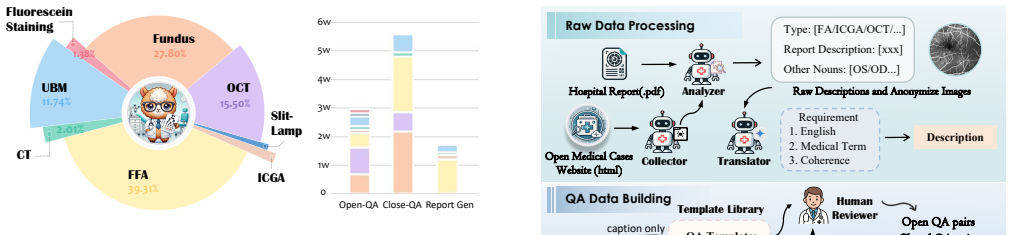
The load-bearing machinery is the Eyecare Kit, a three-part system. Eyecare-100K is built by a multi-agent data engine: an analyzer (Qwen2-VL-2B-OCR) extracts text from PDF reports, a collector pulls public case repositories, a translator (Gemini-2.0-Flash) standardizes medical language, a rewriter (Claude-3.7) transforms descriptions into VQA pairs with three task types, and human reviewers inspect 10% of the output. Eyecare-Bench samples about 15,000 examples from the Eyecare-100K test split and adds a GPT-4-based ten-criteria rubric for report scoring. EyecareGPT itself uses a SigLIP vision encoder with a Layer-wise Dense Connector (LDC) that average-pools shallow and intermediate layer features separately, concatenates them with the final layer's features along the channel dimension, and feeds the fused representation to the LLM; an Adaptive Anyres mechanism partitions high-resolution inputs into four center-symmetric sub-images and concatenates their adaptively pooled features. Training proceeds in three stages on LLaVA and PubMedVision data followed by Eyecare-100K.
What would settle it
Take a set of ophthalmic images from a hospital that contributed none of the Eyecare-100K data, write fresh multiple-choice and open-ended questions with clinician-reviewed answer keys, and run EyecareGPT zero-shot; if its accuracy falls to the 30–60% range of the generalist baselines rather than staying near the reported 80%+, the claim of state-of-the-art generalization is refuted.
Extended reading notes
Core claim
The paper's central discovery, as stated by the authors, is that EyecareGPT achieves state-of-the-art performance across a range of ophthalmic tasks, with a 3.8B variant surpassing all compared baselines on closed QA (84.56% average accuracy), open QA (F1-Bio 90.55), and structured report generation (AccGPT 52.62–58.05% across FA-ICGA, UBM, and CT). It attributes this to the combination of a high-quality, multi-modal ophthalmic instruction dataset (Eyecare-100K), a purpose-built evaluation benchmark (Eyecare-Bench), and architectural changes—the Layer-wise Dense Connector and Adaptive Anyres mechanism—that preserve fine-grained visual details. The authors further report that the gains are large and consistent: closed-QA accuracy rises from 62.30% to 84.56% after fine-tuning on Eyecare-100K, with 100% accuracy on the OmniMedVQA OCT and fundus subtasks; open-QA F1-Bio rises from 64.89 to 90.55; and report-generation accuracy rises from 11.48% to 53.56%.
Load-bearing premise
The results assume that Eyecare-Bench and OmniMedVQA are clean test sets that do not overlap with the Eyecare-100K training data; the paper does not report any de-duplication or overlap analysis, so the high scores may reflect memorized training images or template-matched answers rather than genuine diagnostic generalization.
Editorial extensions
If this is right
- Clinically usable ophthalmic report generation becomes feasible with a ~3.8B open model, potentially lowering deployment costs in eye-care settings.
- Eyecare-100K and Eyecare-Bench would provide a common foundation for training and fairly comparing future ophthalmic LVLMs, including rare-condition coverage.
- The LDC and Adaptive Anyres mechanisms, if validated, generalize as plug-in modules for other fine-grained medical imaging domains such as pathology or dermatology.
- The reported 100% OmniMedVQA scores, if unconfounded, would indicate near-perfect transfer to an external ophthalmic benchmark, a strong stimulus for clinical adoption.
- The ten-criteria GPT-4-based report evaluation could be adopted more widely to align automated assessment with expert clinical judgment.
Reading between the lines
- Given that Eyecare-100K integrates public datasets (ODIR, OCT2017, IDRiD, and others) that are also constituents of OmniMedVQA, the absence of a de-duplication analysis leaves open that the 100% OmniMedVQA accuracy reflects training/test overlap, not generalization.
- Because Eyecare-Bench is sampled from Eyecare-100K's own test split, the 84.56% closed-QA figure primarily measures within-distribution performance and may be inflated by template-generated questions.
- A stronger test of the central claim would be an external evaluation on held-out hospital data and clinician-rated reports; such a test would also settle whether the open-QA and report-generation gains exceed what general-purpose LVLMs achieve with simple prompt tuning.
- If the performance holds up on external data, the Eyecare Kit's recipe—domain-specific dataset, tight benchmark, and resolution-aware architecture—could provide a replicable blueprint for other subspecialty medical LVLMs.
Signed reviews
Editorial analysis
A structured set of objections, weighed in public.
Referee Report
Summary. The paper introduces Eyecare Kit, a three-part contribution to ophthalmic large vision-language modeling: Eyecare-100K, a ~102k-pair visual instruction dataset built from public datasets, hospital data, and public medical case repositories; Eyecare-Bench, a benchmark covering closed QA, open QA, and report generation; and EyecareGPT, a 3.8B/7B LVLM with a SigLIP vision encoder, a layer-wise dense connector (LDC), and an adaptive resolution (AnyRes) mechanism. The authors report state-of-the-art closed-QA accuracy (84.56% average), open-QA F1-Bio (90.55), and report-generation AccGPT (52.62-58.05) after fine-tuning on Eyecare-100K, together with 100% accuracy on the OCT and Fundus subsets of OmniMedVQA.
Significance. If the reported results were obtained under a fair and decontaminated evaluation protocol, the paper would be a significant resource: the dataset addresses a real gap in multimodal ophthalmic instruction data, the benchmark spans three clinically relevant tasks, and the ablations show consistent gains from the proposed architectural components. The release of the dataset, benchmark, and model is a strength. However, the central state-of-the-art claim is not supported by the evidence as presented, because the primary benchmark is an internal split of the training set and the external benchmark may be contaminated by overlapping public training sources; the paper also compares against zero-shot baselines rather than fine-tuned ones. The contribution is potentially valuable, but the evaluation requires substantial revision before the claims can be accepted.
major comments (3)
- [Sec. 6.2, Table 2; Appendix A.3] The OmniMedVQA evaluation is potentially contaminated. Appendix A.3 states that Eyecare-100K training data include ODIR, OCT2017/Kermany, IDRiD, JSIEC, DeepDRiD, OCTID, OCTDL, and ACRIMA, which are also common sources in OmniMedVQA, yet the paper reports no de-duplication or overlap analysis. The 100.00% closed-QA accuracy on the OCT and Fundus subsets is exactly what would be expected if the model memorized the exact images and answer templates during fine-tuning. The authors must provide a hash-based overlap analysis and re-evaluate on a de-duplicated subset, or the OmniMedVQA generalization claim should be withdrawn.
- [Sec. 4 and Sec. 6.2, Table 2] Eyecare-Bench is an in-distribution benchmark by construction: the data instances are drawn from the designated test set of Eyecare-100K, and EyecareGPT is fine-tuned on Eyecare-100K, while all 12 baselines are evaluated zero-shot. The reported comparison therefore conflates the effect of in-distribution fine-tuning with architectural superiority and does not establish state-of-the-art performance. The claims should either be restricted to 'performance after fine-tuning on Eyecare-100K' or the baselines should be fine-tuned under the same protocol. The large gains shown in Fig. 6 before and after fine-tuning (62.30 to 84.56 closed QA; 64.89 to 90.55 F1-Bio; 11.48 to 53.56 AccGPT) are consistent with the test set being drawn from the training distribution.
- [Sec. 4.1, Table 1 and Fig. 7] The claimed high consistency between the GPT-4-based EyeEval rubric and expert physician scoring is supported only by bar charts; no quantitative agreement statistic (e.g., Cohen's kappa, intraclass correlation coefficient, or Pearson correlation with confidence intervals) is reported. Because report generation is one of the three core tasks of the benchmark, a quantitative validation of the rubric is necessary to establish the reliability of the report-generation evaluation.
minor comments (5)
- [Appendix B.1, Tables 10 and 11] The model is referred to as 'Eyexpert-3.8B' in the appendix tables but as 'EyecareGPT-3.8B' in the main text; the naming should be made consistent.
- [References] The Google AI reference for Gemini 2.0 Flash contains placeholder text '????' and should be completed.
- [Sec. 3.2] The human review process reports that 10% of constructed VQA pairs were reviewed by five reviewers, but the inter-reviewer agreement is not reported; a simple agreement statistic would strengthen the data-quality claim.
- [Sec. 5.3, Eq. (6)] The 'predefined threshold' for the adaptive resolution mechanism is not specified, and there is no sensitivity analysis for this hyperparameter; the same applies to the layer split k in Eqs. (3)-(4).
- [Sec. 3.1] The description of the anonymization procedures for hospital data is limited to a single phrase; more detail on institutional review and anonymization would be appropriate for a medical dataset release.
Circularity Check
No significant circularity: the central SOTA claim is an empirical result on a held-out split plus an external benchmark, not a quantity defined in terms of its own inputs.
full rationale
The paper's central claim is empirical rather than derivational: EyecareGPT is fine-tuned on Eyecare-100K and then evaluated on Eyecare-Bench and the external OmniMedVQA benchmark. Eyecare-Bench is explicitly drawn from the designated test set of Eyecare-100K, so it is a held-out split rather than the training set itself; accuracy on that split is not forced to equal any fitted value by construction. The 100% OmniMedVQA scores are suspicious and the absence of any train/test de-duplication is a serious validity threat, but the paper does not provide the internal evidence needed to show that those exact test images or templates appeared in the training data, so this remains a contamination concern rather than a demonstrated circular reduction. The architecture contributions (LDC, Adaptive Anyres) are newly proposed and ablated, not imported from prior work as a load-bearing premise. The only prominent self-citation, HealthGPT, is used as a baseline rather than as justification for the paper's own claims. No equation defines a predicted quantity in terms of a fitted parameter, and no uniqueness theorem or ansatz is smuggled in via citation. The evaluation design raises fairness and generalization questions, but those are correctness risks, not circularity.
Assumptions & free parameters
free parameters (5)
- AnyRes resolution threshold
- Layer split k for LDC
- GPT-4 report rubric weights =
A=1, B=4, C=4, D=6, E=2, F=2, G=2, H=5, I=15 (Table 1)
- Sub-image count =
4
- LoRA rank =
64
assumptions (5)
- domain assumption Ground truth labels in the 13 public datasets, hospital reports, and case libraries are accurate and clinically valid.
- domain assumption The designated test split of Eyecare-100K does not overlap with training images or questions, and no template memorization occurs.
- domain assumption OmniMedVQA is an uncontaminated external benchmark with no image-level overlap with the public datasets used to build Eyecare-100K.
- domain assumption GPT-4 evaluations under the EyeEval rubric correlate with clinician judgment.
- domain assumption LLM-generated VQA pairs preserve the clinical meaning of source reports.
Cite this review
Pith. "Pith review of EyecareGPT: Boosting Comprehensive Ophthalmology Understanding with Tailored Dataset, Benchmark and Model." pith.science (2026). https://pith.science/paper/Y6JXV7JS
@misc{pith2026250413650,
  author       = {Pith},
  title        = {Pith review of: EyecareGPT: Boosting Comprehensive Ophthalmology Understanding with Tailored Dataset, Benchmark and Model},
  year         = {2026},
  howpublished = {\url{https://pith.science/paper/Y6JXV7JS}},
  note         = {Machine review of arXiv:2504.13650}
}
read the original abstract
Medical Large Vision-Language Models (Med-LVLMs) demonstrate significant potential in healthcare, but their reliance on general medical data and coarse-grained global visual understanding limits them in intelligent ophthalmic diagnosis. Currently, intelligent ophthalmic diagnosis faces three major challenges: (i) Data. The lack of deeply annotated, high-quality, multi-modal ophthalmic visual instruction data; (ii) Benchmark. The absence of a comprehensive and systematic benchmark for evaluating diagnostic performance; (iii) Model. The difficulty of adapting holistic visual architectures to fine-grained, region-specific ophthalmic lesion identification. In this paper, we propose the Eyecare Kit, which systematically tackles the aforementioned three key challenges with the tailored dataset, benchmark and model: First, we construct a multi-agent data engine with real-life ophthalmology data to produce Eyecare-100K, a high-quality ophthalmic visual instruction dataset. Subsequently, we design Eyecare-Bench, a benchmark that comprehensively evaluates the overall performance of LVLMs on intelligent ophthalmic diagnosis tasks across multiple dimensions. Finally, we develop the EyecareGPT, optimized for fine-grained ophthalmic visual understanding thoroughly, which incorporates an adaptive resolution mechanism and a layer-wise dense connector. Extensive experimental results indicate that the EyecareGPT achieves state-of-the-art performance in a range of ophthalmic tasks, underscoring its significant potential for the advancement of open research in intelligent ophthalmic diagnosis. Our project is available at https://github.com/DCDmllm/EyecareGPT.
Figures


Figures from the paper (10 more)




Forward citations
Cited by 2 Pith papers
-
Towards Better Dental AI: A Multimodal Benchmark and Instruction Dataset for Panoramic X-ray Analysis
MMOral is a large new dental X-ray instruction dataset and benchmark, but the proposed model's 24.73% improvement is from fine-tuning and then testing on the same data pool.
-
BEnchmarking LLMs for Ophthalmology (BELO) for Ophthalmological Knowledge and Reasoning
BELO is a new ophthalmology benchmark of 900 expert-checked multiple-choice questions with reasoning, used to evaluate six LLMs on accuracy and explanation quality.
Reference graph
Works this paper leans on
-
[1]
Is the eye in this picture diseased?
-
[2]
Nature medicine, 30(10): 2886–2896
Integrated image-based deep learning and language models for primary diabetes care. Nature medicine, 30(10): 2886–2896. Liang, Q.; and Zhang, Y. 2022. Interpretation of Slit Lamp Images of Anterior Segment Diseases. People’s Medical Pub- lishing House Co., Ltd. ISBN 9787117330626. Lin, C.-Y.; and Hovy, E. 2003. Automatic evaluation of sum- maries using n-...
arXiv 2022
-
[3]
Gemini 1.5: Unlocking multimodal understand- ing across millions of tokens of context. arXiv preprint arXiv:2403.05530. Team, G.; Kamath, A.; Ferret, J.; Pathak, S.; Vieillard, N.; Merhej, R.; Perrin, S.; Matejovicova, T.; Ram ´e, A.; Rivi `ere, M.; et al. 2025. Gemma 3 Technical Report. arXiv preprint arXiv:2503.19786. Wang, P.; Bai, S.; Tan, S.; Wang, S...
arXiv 2025
-
[4]
Does this eye image show any signs of abnormalities?
-
[5]
Does the eye shown in the image have any disease?
-
[6]
Is there any sign of illness in the eye in this photo?
-
[7]
Are there any visible abnormalities in the eye image? Positive ¡condition¿:
-
[8]
Does the eye in the image show signs of disease?
Show all 43 references
-
[9]
Is there evidence of a disorder in the eye in this picture?
-
[11]
Yes, the eye in the picture has{condition}
-
[12]
Yes, the image reveals the presence of{condition}in the eye
-
[13]
Yes, the eye shown in this image is impacted by{condition}
-
[14]
Yes, this image depicts an eye presenting{condition}
-
[15]
Yes, the eye in this image shows evidence of{condition}
-
[16]
Negative ¡condition¿:
Yes, the image illustrates an eye with{condition}. Negative ¡condition¿:
-
[17]
No, the eye appears healthy in the image
-
[18]
This image shows that the retina looks normal, with no hemorrhages, exudates or other signs of abnormality
No. This image shows that the retina looks normal, with no hemorrhages, exudates or other signs of abnormality
-
[19]
No, the eye image appears normal
-
[20]
No, the findings from the retinal image suggest a normal and healthy eye
-
[21]
No, there are no indications of disease in the image
-
[22]
No, the retinal image indicates a healthy eye, with no signs of hemorrhages, exudates, or other patho- logical changes
-
[23]
Question2:
No significant abnormalities were detected in the eye image. Question2:
-
[24]
What ocular disease is evident in this image?
-
[25]
What eye condition is visible in this picture?
-
[26]
What condition is affecting the eye shown in the image?
-
[27]
What issue is apparent in the eye shown here?
-
[28]
What is wrong with the eye in the image?
-
[29]
Which disease can be seen in the eye from this picture?
-
[30]
What health issue is present in the eye in this image?
-
[31]
What health concern is evident in the eye in this image?
-
[32]
What problem does the eye shown in the image have? Positive ¡condition¿:
-
[33]
2.{condition}is evident in the eye depicted in the image
The eye in the image exhibits signs of{condition}. 2.{condition}is evident in the eye depicted in the image
-
[34]
The image reveals the presence of{condition}in the eye
-
[35]
In this picture, the eye appears to be affected by{condition}
-
[36]
This image shows an eye with{condition}
-
[37]
7.{condition}is visible in the eye from this picture
The eye in the photograph shows signs of{condition}. 7.{condition}is visible in the eye from this picture. Negative ¡condition¿:
-
[38]
The eye in this image is very healthy
-
[39]
This picture shows a perfectly healthy eye with no signs of disease
-
[40]
The eye depicted in the image is completely healthy, showing no illness
-
[41]
It’s very healthy
There is no indication of disease in the eye shown by this image. It’s very healthy
-
[42]
According to this image, the eye is very healthy and free from any disease
-
[43]
16 Table 10: Other evaluation metrics for the open-ended question answering task in the main experiment
The photo indicates a very healthy eye with no presence of disease. 16 Table 10: Other evaluation metrics for the open-ended question answering task in the main experiment. Model OCT Fundus FA-ICGA CT UBM F1-Rad BLEU-1 BLEU-4 F1-Rad BLEU-1 BLEU-4 F1-Rad BLEU-1 BLEU-4 F1-Rad BL...
-
[2024]
In Proceedings of the IEEE/CVF Conference on Computer Vision and Pattern Recog- nition, 22170–22183
Omnimedvqa: A new large-scale comprehensive eval- uation benchmark for medical lvlm. In Proceedings of the IEEE/CVF Conference on Computer Vision and Pattern Recog- nition, 22170–22183. Hurst, A.; Lerer, A.; Goucher, A. P.; Perelman, A.; Ramesh, A.; Clark, A.; Ostrow, A.; Weli...
2018 arXiv
Reviewed August 16, 2026 · model on record in the stance chip above.
Discussion (0). Continue with ORCID to comment.