REVIEW 3 major objections 5 minor 1 cited by
Clouds of Fluffy Aggregates: How They Form in Exoplanetary Atmospheres and Influence Transmission Spectra
T0 review · 3 major / 5 minor · reviewed 2026-08-14 · deepseek-v4-flash
Pith's one-line read Fluffy, uncompressed mineral aggregates can loft exoplanet clouds far higher than compact spheres and explain GJ1214b's flat transmission spectrum.
desk verdict A credible and useful case that fluffy aggregate clouds can explain high-altitude clouds and flat spectra on GJ1214b, but the GJ1214b conclusion leans on Df=2 and free monomer size more than the validation admits. read the letter →
The pith
A machine-rendered reading of the paper's core claim, the machinery that carries it, and where it could break.
The reading
What carries the argument
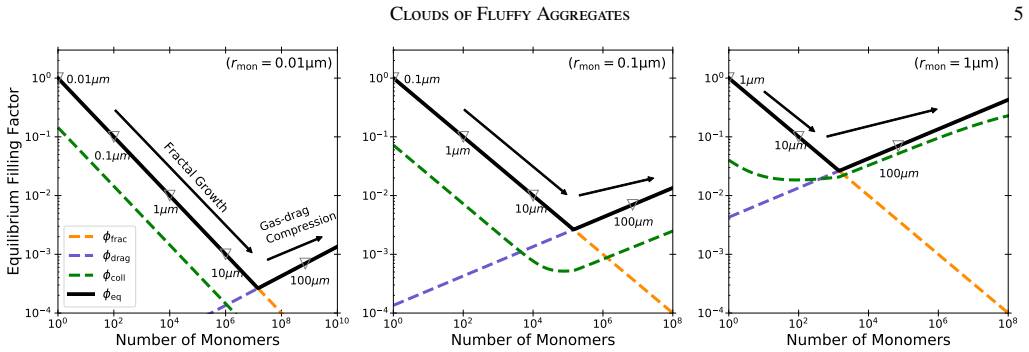
The load-bearing identity is the fractal mass-size relation for aggregate growth, N = k0(ragg/rmon)^Df with Df = 2, which translates into a filling factor phi_frac = $N^{-1}$/2: as an aggregate doubles in monomer number, its radius grows only by a factor of about 1.4, leaving large voids. From this relation, the paper derives an equilibrium filling factor phi_eq = max[phi_frac, phi_drag, phi_coll] by comparing fractal growth with the thresholds for gas-drag compression and collisional compression, and an analytic cloud-top pressure P_top proportional to rmon/(Kz), independent of aggregate size. The companion machinery is the modified mean field theory for aggregate opacity, which yields an intermediate-wavelength scattering law sigma_s proportional to $r_agg^{2}$ $r_mon^{2}$ $lambda^{-2}$ times a logarithmic factor, the source of the $\alpha$ = -2 spectral slope.
What would settle it
A size-resolved microphysical simulation that follows the full particle size distribution and finds aggregate-monomer collisions dominate enough to push the fractal dimension above about 2.3 near the cloud base would contradict the model's high-altitude prediction; likewise, a transmission spectrum of GJ1214b that shows clear molecular features at 1-2 microns or a scattering slope steeper than $lambda^{-2}$ would falsify the fluffy-cloud explanation for its flat spectrum.
Extended reading notes
Core claim
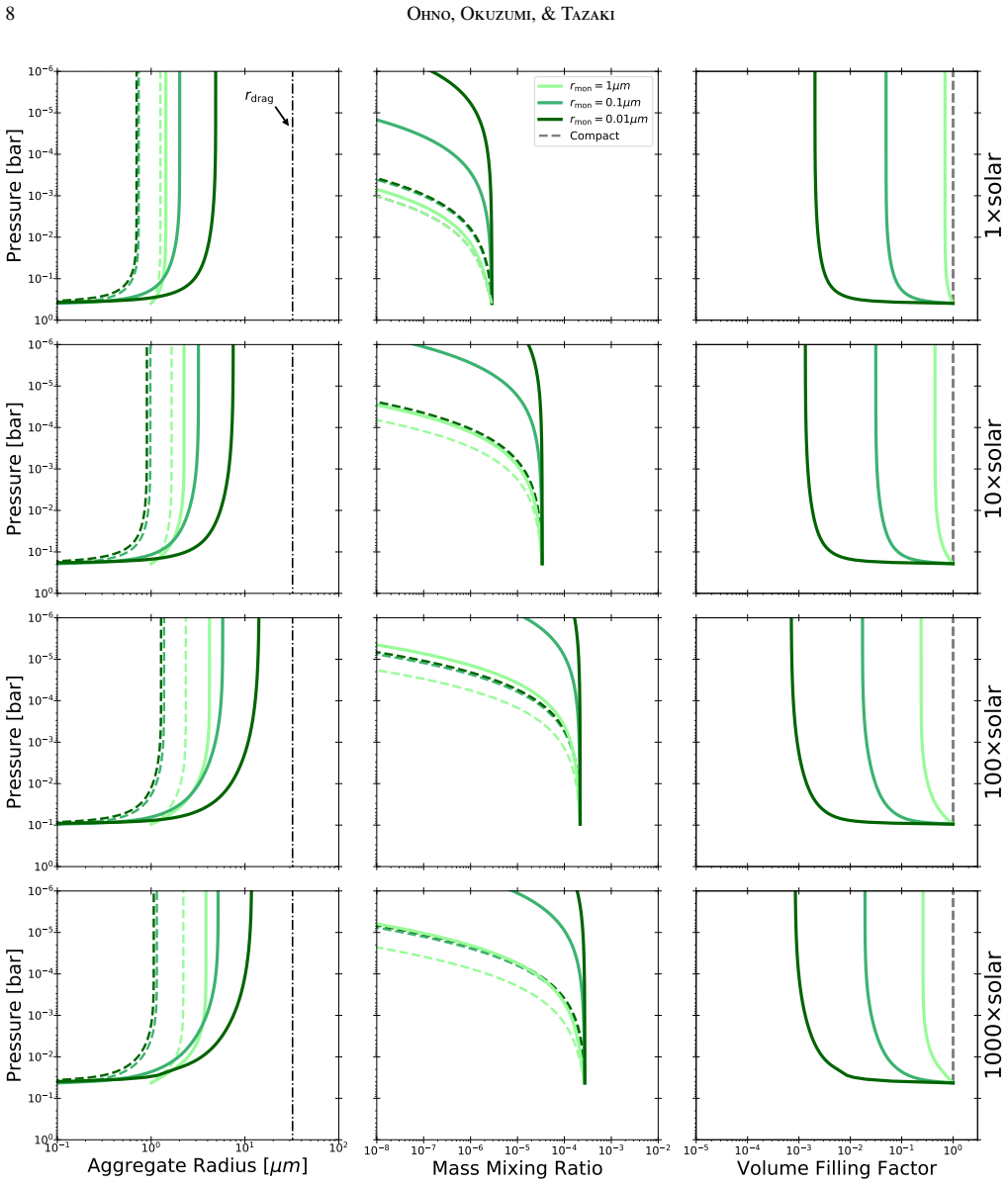
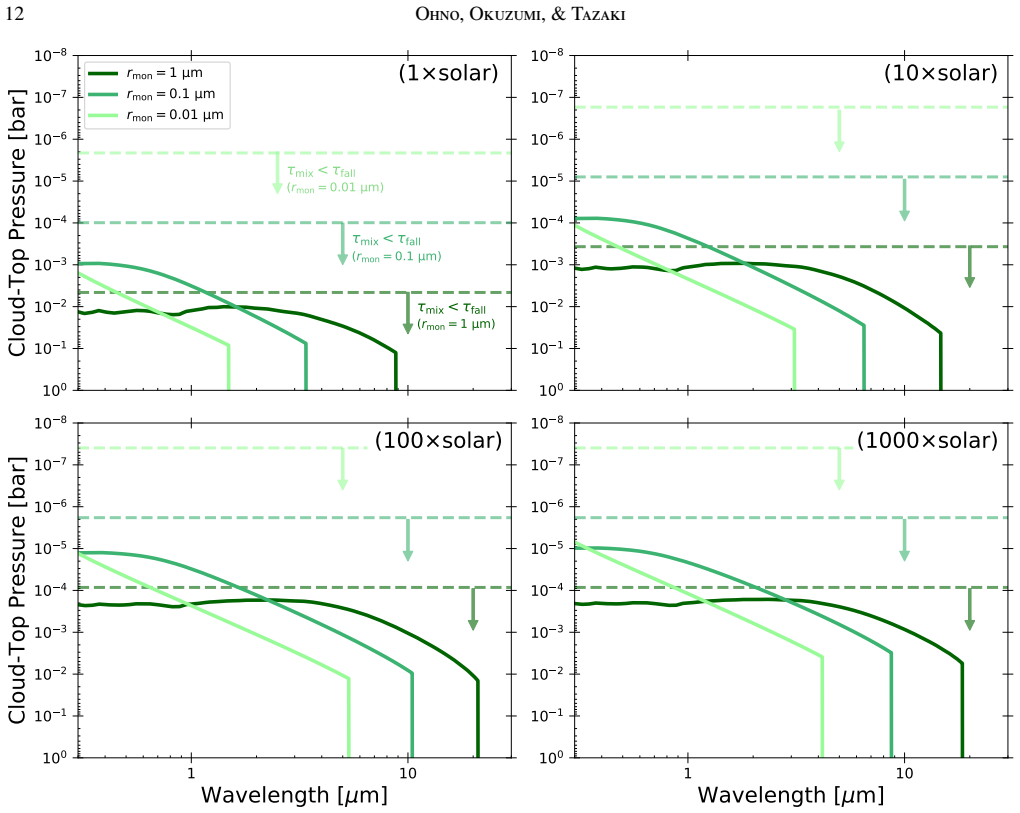
The central claim is that mineral cloud particles in exoplanetary atmospheres grow as low-density fractal aggregates and stay uncompressed through most of the cloud's lifetime, so their aerodynamic behavior is governed by the monomer radius rather than the aggregate radius. With fractal dimension Df = 2, the filling factor falls as $N^{-1}$/2 and the aggregate radius grows only as $N^{1}$/2, leaving a particle that is hundreds to thousands of times less dense than its material. Because such an aggregate settles slowly, the authors find that fluffy-aggregate clouds ascend to much higher altitude than compact-sphere clouds, reaching pressures near $10^{-5}$ bar for high metallicity and submicron monomers. In transmission, these high clouds largely hide molecular features in the visible and near-infrared while producing a spectral slope $\alpha$ = -2 from wavelength-dependent scattering by the aggregate structure. The paper concludes that the flat spectrum of GJ1214b can be explained by such fluffy KCl clouds if the atmospheric metallicity is at least 100 times solar and the monomer size is below 1 micron.
Load-bearing premise
The model's tallest load-bearing assumption is that collisions leave aggregates with the open, roughly two-dimensional structure of fractal dimension 2; if collisions instead pack grains into denser near-spheres, settling speeds up and the high-altitude fluffy cloud disappears, and the paper separately needs monomers smaller than one micron to reproduce GJ1214b.
Editorial extensions
If this is right
- Fluffy mineral clouds will appear at far higher altitude than compact-sphere models predict, so spectral retrievals that assume compact particles will systematically misplace cloud decks.
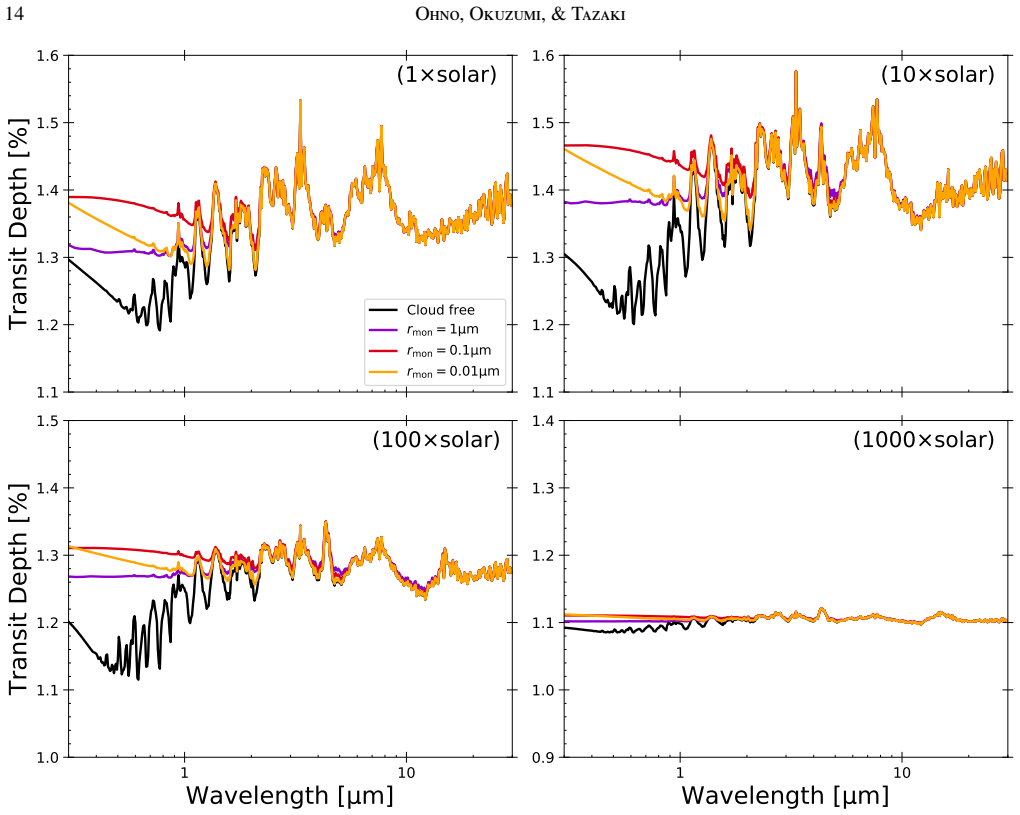
- Transmission spectra of such clouds will be largely featureless shortward of about 2 microns but increasingly transparent at longer wavelengths, making JWST and ARIEL capable of detecting molecular features that HST/WFC3 cannot see.
- A scattering slope of alpha = -2 in the visible or near-infrared can serve as a potential observable signature of fractal cloud aggregates when the atmospheric scale height is known.
- GJ1214b's flat spectrum can be explained without invoking anomalously strong eddy mixing, provided the atmosphere is metal-rich and the condensation nuclei are submicron.
- A high-metallicity atmosphere for GJ1214b, if confirmed, would connect transmission spectra to the planet's gas accretion history and formation pathway.
Reading between the lines
- The same porosity machinery likely applies to photochemical hazes on warm exoplanets, not just KCl clouds, but aerosol charging and Coulomb restructuring could make haze compression much easier than the model assumes.
- The paper's requirement of submicron monomers sits in tension with classical nucleation theory, which predicts roughly 10 micron KCl particles; laboratory measurements of KCl nucleation rates could decide whether the fluffy-cloud scenario is even viable for GJ1214b.
- The alpha = -2 slope may be degenerate with mixtures of small and large compact spheres, so distinguishing fluffy aggregates from compact-particle mixtures will likely require observations that cross the 2 pi r_agg wavelength regime or additional polarization information.
- A direct comparative test would be to observe several super-Earths of similar temperature but different metallicities: if fluffy aggregates dominate, cloud-top altitude should track condensation-nucleus abundance and monomer size more strongly than it tracks eddy mixing strength.
Signed reviews
Editorial analysis
A structured set of objections, weighed in public.
Referee Report
Summary. The paper constructs a porosity evolution model for cloud particle aggregates (CPAs) in exoplanetary atmospheres, coupling fractal growth, gas-drag compression, and collisional compression with a 1D double-moment cloud microphysical model. It applies the model to KCl clouds in a GJ1214b-like atmosphere, computes vertical cloud profiles and transmission spectra, and compares the synthetic spectra with observations. The central claims are that (i) CPAs grow as uncompressed Df≈2 fractal aggregates, (ii) fluffy-aggregate clouds reach much higher altitudes than compact-sphere clouds, with cloud-top pressures near 10^-5 bar for high metallicity and submicron monomers, (iii) the resulting spectra show an aggregate-scattering slope α≈−2 and obscure molecular features, and (iv) the flat observed spectrum of GJ1214b can be reproduced for metallicities ≳100× solar and monomer radii <1 μm.
Significance. If the central assumptions hold, this is a significant contribution: it offers a microphysical mechanism for high-altitude mineral clouds that compact-sphere models failed to produce, and it makes falsifiable predictions (the α=−2 aggregate scattering slope and the reappearance of molecular features at λ≳2 μm) that upcoming JWST/ARIEL observations can test. The analytic compression thresholds (Eqs. 18, 21, 22) and the cloud-top pressure estimate (Eq. 36) are useful parameter-free or nearly parameter-free results. The aggregate opacity treatment uses the MMF theory benchmarked against T-matrix calculations, and the GJ1214b comparison is conducted with published data and a chi-square grid, which is appropriate. The main caveat is that nearly every qualitative result depends on the untested Df=2 growth assumption and on the free submicron monomer size, so the strength of the conclusions currently exceeds the strength of the supporting microphysical calculation.
major comments (3)
- [Section 5.1.1, Eqs. (42)-(44), Figure 10] The Df=2 assumption is load-bearing: Eq. (5) sets the filling factor, Eq. (36) makes the cloud-top pressure independent of aggregate size, and the α=−2 slope in Section 4.1.2 follows from the Df=2 mass–size relation. The validation in Section 5.1.1 does not close the loop. The mass-weighted collision rate in Eq. (42) is evaluated for a Hansen size distribution with a chosen effective variance b, a constant-density collision kernel, and no porosity-dependent aggregate radius; the resulting Df≈1.9–2.1 is then borrowed from Okuzumi et al. (2009) rather than computed with the model's own size and porosity distributions. The kernel is not fed back with the Df it is supposed to justify. A self-consistent, size-resolved growth calculation that evolves both the size distribution and the porosity-dependent collision kernel is needed to rule out monomer-aggregate-dominated growth, which would drive Df toward 3, increase settling velocities, and remove the high-altitude cloud that drives all the paper's spectral conclusions.
- [Section 4.4 and Section 5.1.3] The required monomer radius rmon<1 μm is not an innocuous free parameter. The paper itself notes in Section 4.4 that classical nucleation theory followed by condensation yields KCl particles with effective sizes of roughly 10 μm (citing Gao & Benneke 2018), an order of magnitude above the values that produce acceptable fits to GJ1214b. Since the high cloud deck, the α=−2 slope, and the reduced chi-square improvement all depend on submicron monomers, the agreement with observations is conditional on a nucleation pathway that is not modeled. The manuscript should either provide a quantitative heterogeneous-nucleation or size-reduction argument, present a sensitivity study showing how the fit degrades as rmon approaches 10 μm, or explicitly reframe the GJ1214b comparison as a proof-of-concept with rmon as a free parameter rather than as a predictive explanation.
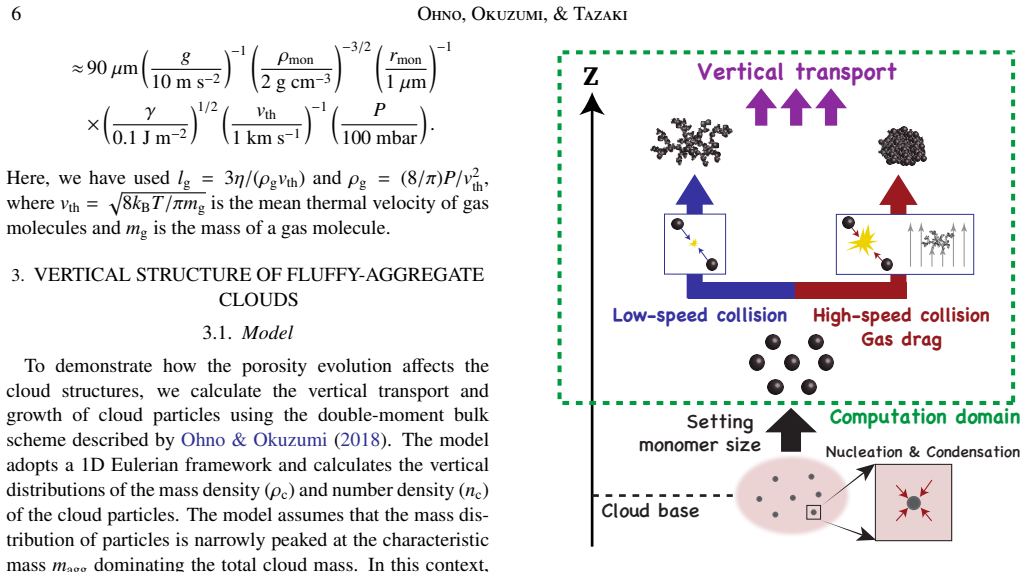
- [Section 3.1, Eqs. (23)-(24), and Section 3.2] The double-moment closure assumes a narrowly peaked mass distribution, and the authors acknowledge in Section 3.2 that the resulting size profile cannot capture the decrease of the mean size caused by removal of the largest particles. This is more than a presentation caveat for the central claim: the effective fractal dimension depends on which collision pairs dominate growth, and the dominant collision pair depends on the full size distribution. The imposed monodisperse closure may bias the model toward aggregate-aggregate collisions and thus toward Df=2. At minimum, the manuscript should quantify the sensitivity of the vertical cloud extent and Ptop to the width of the assumed size distribution, or state explicitly that the central assertion of uncompressed Df=2 growth is established only in the monodisperse limit.
minor comments (5)
- [Figure 3 caption] The caption says 'The top, middle, and bottom rows' but the figure has four rows (1×, 10×, 100×, and 1000× solar); please update the caption.
- [Section 3.2] There are typos in this section: 'the could scale height' should be 'the cloud scale height', and 'cluod' should be 'cloud'.
- [Section 4.3, Eq. (41)] The numerical prefactor in Eq. (41) should be derived explicitly; the relation between the transit-depth slope S, the pressure scale height H, and the opacity power-law index α involves a geometric factor that the text invokes rather than proves. This does not affect the qualitative conclusions but should be checked for consistency.
- [Section 5.2] The text contains the typo 'runnaway gas accretion'; it should read 'runaway gas accretion'.
- [Figure 9 caption] The caption contains the typo 'chi-squred'; it should be 'chi-squared'.
Circularity Check
No significant circularity: the Df=2 fractal-growth assumption is a stated physical input supported by external simulations, and the GJ1214b comparison is a forward-model fit, not a prediction forced by construction.
full rationale
The paper's central mechanism—fluffy, uncompressed aggregates reaching high altitude—follows from the explicitly stated Df=2 fractal-growth assumption (Equation 5), which is an input assumption rather than a quantity derived from the paper's own output. The cloud-top pressure expression (Equation 36) is derived from that assumption plus settling physics, so it is a consequence, not a disguised restatement of the input. The alpha=-2 scattering slope is taken from the analytic result of Berry & Percival (1986) and implemented through MMF theory validated against T-matrix calculations (Tazaki & Tanaka 2018); it is not fitted to the target spectrum. The GJ1214b comparison is a forward model with free parameters (metallicity, monomer size, reference radius) and is explicitly presented as a fit with reduced chi-square values, not as a prediction obtained by inverting observed data through the model. The authors' self-citations—Okuzumi et al. (2009) for Df in aggregate collisions, Kataoka et al. (2013a,b) for compression, and Tazaki & Tanaka (2018) for aggregate optics—are supporting external simulations or calculations whose assumptions and outputs do not include the target conclusion of this paper. Section 5.1.1's validation of Df=2 uses a mass-weighted collision-rate calculation and cites Okuzumi et al. (2009) for the resulting fractal dimension; while this validation is not a fully self-consistent size-resolved growth calculation, that is a model caveat rather than circularity, and the paper itself flags the unknown CPA size distribution as a limitation. The acknowledged monomer-size discrepancy with classical nucleation theory is likewise a stated limitation, not a circular step. No equation in the paper reduces by construction to its own input, and no fitted parameter is renamed as a prediction.
Assumptions & free parameters
free parameters (5)
- monomer radius r_mon =
0.01-1 um; best fit near 0.3 um for GJ1214b
- atmospheric metallicity =
1-1000x solar; best fit >=100x solar
- reference transit radius R0 =
2-3 Earth radii
- critical rolling displacement xi_crit =
2 A (0.2 nm)
- settling velocity width factor epsilon =
0.5
assumptions (8)
- domain assumption Aggregate growth occurs by equal-mass collisions giving fractal dimension Df=2 and prefactor k0=1
- domain assumption Compression laws of Wada et al. (2008) and Kataoka et al. (2013b) apply to KCl aggregates in exoplanetary atmospheres
- domain assumption Aerodynamic radius of an aggregate equals its characteristic radius
- domain assumption All condensable KCl vapor is instantly incorporated into monomers at the cloud base
- domain assumption Cloud particle size distribution is narrowly peaked (double-moment closure)
- domain assumption Vertical transport is 1D eddy diffusion with Kz from Charnay et al. (2015a)
- domain assumption MMF theory accurately computes aggregate opacities
- standard math Gas opacities from TEA thermochemical equilibrium and HITRAN2016 line lists
Cite this review
Pith. "Pith review of Clouds of Fluffy Aggregates: How They Form in Exoplanetary Atmospheres and Influence Transmission Spectra." pith.science (2026). https://pith.science/paper/Y6QLVUNA
@misc{pith2026190802201,
  author       = {Pith},
  title        = {Pith review of: Clouds of Fluffy Aggregates: How They Form in Exoplanetary Atmospheres and Influence Transmission Spectra},
  year         = {2026},
  howpublished = {\url{https://pith.science/paper/Y6QLVUNA}},
  note         = {Machine review of arXiv:1908.02201}
}
abstract
Transmission spectrum surveys have suggested the ubiquity of high-altitude clouds in exoplanetary atmospheres. Theoretical studies have investigated the formation processes of the high-altitude clouds; however, cloud particles have been commonly approximated as compact spheres, which is not always true for solid mineral particles that likely constitute exoplanetary clouds. Here, we investigate how the porosity of cloud particles evolve in exoplanetary atmospheres and influence the cloud vertical profiles. We first construct a porosity evolution model that takes into account the fractal aggregation and the compression of cloud particle aggregates. Using a cloud microphysical model coupled with the porosity model, we demonstrate that the particle internal density can significantly decrease during the cloud formation. As a result, fluffy-aggregate clouds ascend to altitude much higher than that for compact-sphere clouds assumed so far. We also examine how the fluffy-aggregate clouds affect transmission spectra. We find that the clouds largely obscure the molecular features and produce a spectral slope originated by the scattering properties of aggregates. Finally, we compare the synthetic spectra with the observations of GJ1214 b and find that its flat spectrum could be explained if the atmospheric metallicity is sufficiently high ($\ge100\times$ solar) and the monomer size is sufficiently small ($r_{\rm mon}<1~{\rm {\mu}m}$). The high-metallicity atmosphere may offer the clues to explore the gas accretion processes onto past GJ1214b.
Figures
Figures from the paper (9 more)




Forward citations
Cited by 1 Pith paper
-
Geometrical structure and thermal conductivity of dust aggregates formed via ballistic cluster-cluster aggregation
For ballistic cluster-cluster aggregates, the gyration radius grows as N^0.53 and the graph geodesic radius as N^0.71, and these exponents explain the observed phi^2 scaling of thermal conductivity and phi^3 scaling o...
Reference graph
Works this paper leans on
-
[1]
Adams, D., Gao, P., de Pater, I., & Morley, C. V . 2019, ApJ, 874, 61
2019
-
[2]
2016, ApJL, 832, L19
Arakawa, S., & Nakamoto, T. 2016, ApJL, 832, L19
2016
-
[3]
Arakawa, S., Takemoto, M., & Nakamoto, T. 2019, arXiv e-prints, arXiv:1908.03125
work page Pith review arXiv 2019
-
[4]
J., & Scott, P
Asplund, M., Grevesse, N., Sauval, A. J., & Scott, P. 2009, ARA&A, 47, 481
2009
-
[5]
K., Aigrain, S., Irwin, P
Barstow, J. K., Aigrain, S., Irwin, P. G. J., & Sing, D. K. 2017, ApJ, 834, 50
2017
-
[6]
E., Mandell, A., Pontoppidan, K., et al
Batalha, N. E., Mandell, A., Pontoppidan, K., et al. 2017, PASP, 129, 064501 Clouds of Fluffy Aggregates 21
2017
-
[7]
Batygin, K., & Stevenson, D. J. 2010, ApJL, 714, L238
2010
-
[8]
L., Miller-Ricci Kempton, E., & Homeier, D
Bean, J. L., Miller-Ricci Kempton, E., & Homeier, D. 2010, Nature, 468, 669
2010
Show all 133 references
-
[9]
L., D´esert, J.-M., Kabath, P., et al
Bean, J. L., D´esert, J.-M., Kabath, P., et al. 2011, ApJ, 743, 92
2011
-
[10]
A., Lothringer, J., et al
Benneke, B., Knutson, H. A., Lothringer, J., et al. 2019, Nature Astronomy, 361
2019
-
[11]
V ., & Percival, I
Berry, M. V ., & Percival, I. C. 1986, Optica Acta, 33, 577
1986
-
[12]
K., Charbonneau, D., D´esert, J.-M., et al
Berta, Z. K., Charbonneau, D., D´esert, J.-M., et al. 2012, ApJ, 747, 35
2012
-
[13]
Blecic, J., Harrington, J., & Bowman, M. O. 2016, ApJS, 225, 4
2016
-
[14]
2000, Icarus, 143, 138
Blum, J., & Wurm, G. 2000, Icarus, 143, 138
2000
-
[15]
1996, Icarus, 124, 441
Blum, J., Wurm, G., Kempf, S., & Henning, T. 1996, Icarus, 124, 441
1996
-
[16]
F., & Huffman, D
Bohren, C. F., & Huffman, D. R. 1983, Absorption and scattering of light by small particles
1983
-
[17]
Brown, T. M. 2001, ApJ, 553, 1006
2001
-
[18]
A., Winn, J
Carter, J. A., Winn, J. N., Holman, M. J., et al. 2011, ApJ, 730, 82
2011
-
[19]
K., Irwin, J., et al
Charbonneau, D., Berta, Z. K., Irwin, J., et al. 2009, Nature, 462, 891
2009
-
[20]
2015b, ApJL, 813, L1 Col´on, K
Charnay, B., Meadows, V ., Misra, A., Leconte, J., & Arney, G. 2015b, ApJL, 813, L1 Col´on, K. D., & Gaidos, E. 2013, ApJ, 776, 49
2013
-
[21]
2011, ApJ, 736, 78 Crossfield, I
Croll, B., Albert, L., Jayawardhana, R., et al. 2011, ApJ, 736, 78 Crossfield, I. J. M., & Kreidberg, L. 2017, AJ, 154, 261 de Mooij, E. J. W., Brogi, M., de Kok, R. J., et al. 2012, A&A, 538, A46 D´esert, J.-M., Bean, J., Miller-Ricci Kempton, E., et al. 2011, ApJ, 731, L40
2011
-
[22]
Dominik, C., & Tielens, A. G. G. M. 1995, Philosophical
1995
-
[23]
1997, ApJ, 480, 647
Magazine, Part A, 72, 783 —. 1997, ApJ, 480, 647
1997
-
[24]
V ., Jord´an, A., et al
Espinoza, N., Rackham, B. V ., Jord´an, A., et al. 2019, MNRAS, 482, 2065
2019
-
[25]
M., Sing, D
Evans, T. M., Sing, D. K., Goyal, J. M., et al. 2018, AJ, 156, 283
2018
-
[26]
Ford, I. J. 1997, PhRvE, 56, 5615
1997
-
[27]
J., Mordasini, C., Nettelmann, N., et al
Fortney, J. J., Mordasini, C., Nettelmann, N., et al. 2013, ApJ, 775, 80
2013
-
[28]
J., Sudarsky, D., Hubeny, I., et al
Fortney, J. J., Sudarsky, D., Hubeny, I., et al. 2003, ApJ, 589, 615
2003
-
[29]
2014, Nature, 513, 526
Fraine, J., Deming, D., Benneke, B., et al. 2014, Nature, 513, 526
2014
-
[30]
D., Deming, D., Gillon, M., et al
Fraine, J. D., Deming, D., Gillon, M., et al. 2013, ApJ, 765, 127
2013
-
[31]
S., Lustig-Yaeger, J., Fortney, J
Freedman, R. S., Lustig-Yaeger, J., Fortney, J. J., et al. 2014, ApJS, 214, 25
2014
-
[32]
S., Marley, M
Freedman, R. S., Marley, M. S., & Lodders, K. 2008, ApJS, 174, 504
2008
-
[33]
R., Roller, C., Lopes, E., et al
Gamache, R. R., Roller, C., Lopes, E., et al. 2017, Journal of Quantitative Spectroscopy and Radiative Transfer, 203, 70
2017
-
[34]
2018, ApJ, 863, 165
Gao, P., & Benneke, B. 2018, ApJ, 863, 165
2018
-
[35]
S., & Ackerman, A
Gao, P., Marley, M. S., & Ackerman, A. S. 2018, ApJ, 855, 86
2018
-
[36]
Gharib-Nezhad, E., & Line, M. R. 2019, ApJ, 872, 27
2019
-
[37]
2014, A&A, 563, A21
Gillon, M., Demory, B.-O., Madhusudhan, N., et al. 2014, A&A, 563, A21
2014
-
[38]
2010, A&A, 520, A27
Guillot, T. 2010, A&A, 520, A27
2010
-
[39]
Guillot, T., Ida, S., & Ormel, C. W. 2014, A&A, 572, A72
2014
-
[40]
Hansen, J. E. 1971, Journal of Atmospheric Sciences, 28, 1400
1971
-
[41]
M., Lewis, N
He, C., H¨orst, S. M., Lewis, N. K., et al. 2018a, arXiv e-prints, arXiv:1812.06957 —. 2018b, AJ, 156, 38
-
[42]
1999, Physical Review Letters, 83, 3328
Heim, L.-O., Blum, J., Preuss, M., & Butt, H.-J. 1999, Physical Review Letters, 83, 3328
1999
-
[43]
2013, Philosophical Transactions of the Royal Society of London Series A, 371, 20110581
Helling, C., & Fomins, A. 2013, Philosophical Transactions of the Royal Society of London Series A, 371, 20110581
2013
-
[44]
2017, A&A, 603, A123
Helling, C., Tootill, D., Woitke, P., & Lee, G. 2017, A&A, 603, A123
2017
-
[45]
2008, A&A, 485, 547
Helling, C., Woitke, P., & Thi, W.-F. 2008, A&A, 485, 547
2008
-
[46]
2019, arXiv e-prints, arXiv:1906.08127
Helling, C., Iro, N., Corrales, L., et al. 2019, arXiv e-prints, arXiv:1906.08127
2019 arXiv
-
[47]
2017, MNRAS, 470, 2972
Heng, K., & Kitzmann, D. 2017, MNRAS, 470, 2972
2017
-
[48]
2011, MNRAS, 416, 1419 H¨orst, S
Hori, Y ., & Ikoma, M. 2011, MNRAS, 416, 1419 H¨orst, S. M., He, C., Lewis, N. K., et al. 2018, Nature Astronomy, 2, 303
2011
-
[49]
Hunter, J. D. 2007, Computing in Science and Engineering, 9, 90
2007
-
[50]
2012, ApJ, 753, 66
Ikoma, M., & Hori, Y . 2012, ApJ, 753, 66
2012
-
[51]
Jacobson, M. Z. 2005, Fundamentals of Atmospheric Modeling, 828
2005
-
[52]
2014, A&A, 568, A42
Kataoka, A., Okuzumi, S., Tanaka, H., & Nomura, H. 2014, A&A, 568, A42
2014
-
[53]
P., Lewis, N
Kataria, T., Showman, A. P., Lewis, N. K., et al. 2013, ApJ, 767, 76
2013
-
[54]
2019, ApJ, 876, L5
Kawashima, Y ., Hu, R., & Ikoma, M. 2019, ApJ, 876, L5
2019
-
[55]
2018, ApJ, 853, 7 —
Kawashima, Y ., & Ikoma, M. 2018, ApJ, 853, 7 —. 2019, ApJ, 877, 109
2018
-
[56]
2018, MNRAS, 475, 94
Kitzmann, D., & Heng, K. 2018, MNRAS, 475, 94
2018
-
[57]
D., Showman, A
Komacek, T. D., Showman, A. P., & Parmentier, V . 2019, arXiv e-prints, arXiv:1904.09676
2019 arXiv
-
[58]
Stevenson, K. B. 2018, ApJL, 858, L6 22 O hno, Okuzumi, & Tazaki
2018
-
[59]
L., D´esert, J.-M., et al
Kreidberg, L., Bean, J. L., D´esert, J.-M., et al. 2014, Nature, 505, 69
2014
-
[60]
R., Bean, J
Kreidberg, L., Line, M. R., Bean, J. L., et al. 2015, ApJ, 814, 66
2015
-
[61]
1997, JQSRT, 57, 819
Kuntz, M. 1997, JQSRT, 57, 819
1997
-
[62]
2018, MNRAS, 479, 635
Kurokawa, H., & Tanigawa, T. 2018, MNRAS, 479, 635
2018
-
[63]
2019, A&A, 623, A179
Kuwahara, A., Kurokawa, H., & Ida, S. 2019, A&A, 623, A179
2019
-
[64]
2014, A&A, 572, A35
Lambrechts, M., Johansen, A., & Morbidelli, A. 2014, A&A, 572, A35
2014
-
[65]
2017, A&A, 606, A146
Lambrechts, M., & Lega, E. 2017, A&A, 606, A146
2017
-
[66]
Showman, A. P. 2019, arXiv e-prints, arXiv:1905.02976
2019 arXiv
-
[67]
2011, ApJ, 728, 80
Lavvas, P., Sander, M., Kraft, M., & Imanaka, H. 2011, ApJ, 728, 80
2011
-
[68]
V ., & Griffith, C
Lavvas, P., Yelle, R. V ., & Griffith, C. A. 2010, Icarus, 210, 832
2010
-
[69]
J., & Chiang, E
Lee, E. J., & Chiang, E. 2016, ApJ, 817, 90
2016
-
[70]
J., Chiang, E., & Ormel, C
Lee, E. J., Chiang, E., & Ormel, C. W. 2014, ApJ, 797, 95
2014
-
[71]
2016, A&A, 594, A48
Lee, G., Dobbs-Dixon, I., Helling, C., Bognar, K., & Woitke, P. 2016, A&A, 594, A48
2016
-
[72]
Lee, G., Helling, C., Giles, H., & Bromley, S. T. 2015, A&A, 575, A11
2015
-
[73]
Lee, G. K. H., Blecic, J., & Helling, C. 2018, A&A, 614, A126
2018
-
[74]
K., Parmentier, V ., Kataria, T., et al
Lewis, N. K., Parmentier, V ., Kataria, T., et al. 2017, arXiv e-prints, arXiv:1706.00466
2017 arXiv
-
[75]
R., & Parmentier, V
Line, M. R., & Parmentier, V . 2016, ApJ, 820, 78
2016
-
[76]
J., Manners, J., et al
Lines, S., Mayne, N. J., Manners, J., et al. 2019, MNRAS, 488, 1332
2019
-
[77]
J., Boutle, I
Lines, S., Mayne, N. J., Boutle, I. A., et al. 2018, A&A, 615, A97
2018
-
[78]
D., Benneke, B., Crossfield, I
Lothringer, J. D., Benneke, B., Crossfield, I. J. M., et al. 2018, AJ, 155, 66
2018
-
[79]
J., & Madhusudhan, N
MacDonald, R. J., & Madhusudhan, N. 2019, MNRAS, 486, 1292
2019
-
[80]
M., et al
Malik, M., Kitzmann, D., Mendonc ¸a, J. M., et al. 2019, AJ, 157, 170
2019
-
[81]
S., Ackerman, A
Marley, M. S., Ackerman, A. S., Cuzzi, J. N., & Kitzmann, D. 2013, Clouds and Hazes in Exoplanet Atmospheres, ed. S. J
2013
-
[82]
Mbarek, R., & Kempton, E. M. R. 2016, ApJ, 827, 121
2016
-
[83]
1991, Reviews of Geophysics, 29, 317
Meakin, P. 1991, Reviews of Geophysics, 29, 317
1991
-
[84]
2006, A&A, 452, 701
Minato, T., K¨ohler, M., Kimura, H., Mann, I., & Yamamoto, T. 2006, A&A, 452, 701
2006
-
[85]
V ., Fortney, J
Morley, C. V ., Fortney, J. J., Kempton, E. M.-R., et al. 2013, ApJ, 775, 33
2013
-
[86]
V ., Fortney, J
Morley, C. V ., Fortney, J. J., Marley, M. S., et al. 2012, ApJ, 756, 172 —. 2015, ApJ, 815, 110
2012
-
[87]
V ., Knutson, H., Line, M., et al
Morley, C. V ., Knutson, H., Line, M., et al. 2017, AJ, 153, 86
2017
-
[88]
I., Line, M
Moses, J. I., Line, M. R., Visscher, C., et al. 2013, ApJ, 777, 34
2013
-
[89]
2012, A&A, 544, A41
Murgas, F., Pall´e, E., Cabrera-Lavers, A., et al. 2012, A&A, 544, A41
2012
-
[90]
2018, ApJ, 867, 127
Ogihara, M., & Hori, Y . 2018, ApJ, 867, 127
2018
-
[91]
2017, ApJ, 835, 261 —
Ohno, K., & Okuzumi, S. 2017, ApJ, 835, 261 —. 2018, ApJ, 859, 34
2017
-
[92]
2019, ApJ, 874, 1
Ohno, K., & Zhang, X. 2019, ApJ, 874, 1
2019
-
[93]
2009, ApJ, 698, 1122
Okuzumi, S. 2009, ApJ, 698, 1122
2009
-
[94]
2009, ApJ, 707, 1247
Okuzumi, S., Tanaka, H., & Sakagami, M.-a. 2009, ApJ, 707, 1247
2009
-
[95]
2003, Journal of Aerosol Science, 34, 383
Onischuk, A., di Stasio, S., Karasev, V ., et al. 2003, Journal of Aerosol Science, 34, 383
2003
-
[96]
W., & Min, M
Ormel, C. W., & Min, M. 2019, A&A, 622, A121
2019
-
[97]
W., Shi, J.-M., & Kuiper, R
Ormel, C. W., Shi, J.-M., & Kuiper, R. 2015, MNRAS, 447, 3512
2015
-
[98]
Palik, E. D. 1985, Handbook of optical constants of solids
1985
-
[99]
P., & Lian, Y
Parmentier, V ., Showman, A. P., & Lian, Y . 2013, A&A, 558, A91
2013
-
[100]
2006, Icarus, 182, 274 —
Paszun, D., & Dominik, C. 2006, Icarus, 182, 274 —. 2009, A&A, 507, 1023
2006
-
[101]
2017, MNRAS, 471, 4355
Pinhas, A., & Madhusudhan, N. 2017, MNRAS, 471, 4355
2017
-
[102]
2019, MNRAS, 482, 1485
Pinhas, A., Madhusudhan, N., Gandhi, S., & MacDonald, R. 2019, MNRAS, 482, 1485
2019
-
[103]
2018, ApJ, 860, 18
Powell, D., Zhang, X., Gao, P., & Parmentier, V . 2018, ApJ, 860, 18
2018
-
[104]
2017, ApJ, 834, 151
Rackham, B., Espinoza, N., Apai, D., et al. 2017, ApJ, 834, 151
2017
-
[105]
Rodrigues, P. C. R., & Silva Fernandes, F. M. S. 2007, The Journal of Chemical Physics, 126, 024503
2007
-
[106]
2019, ApJ, 872, 1
Roman, M., & Rauscher, E. 2019, ApJ, 872, 1
2019
-
[107]
Rossow, W. B. 1978, Icarus, 36, 1
1978
-
[108]
S., Rinsland, C
Rothman, L. S., Rinsland, C. P., Goldman, A., et al. 1998, JQSRT, 60, 665
1998
-
[109]
2004, JQSRT, 86, 231
Ruyten, W. 2004, JQSRT, 86, 231
2004
-
[110]
2019, Icarus, 317, 48
Sakuraba, H., Kurokawa, H., & Genda, H. 2019, Icarus, 317, 48
2019
-
[111]
2016, A&A, 589, A15
Sato, T., Okuzumi, S., & Ida, S. 2016, A&A, 589, A15
2016
-
[112]
Seager, S., & Sasselov, D. D. 2000, ApJ, 537, 916
2000
-
[113]
2012, Atmospheric Chemistry and Physics: From Air Pollution to Climate Change (Wiley)
Seinfeld, J., & Pandis, S. 2012, Atmospheric Chemistry and Physics: From Air Pollution to Climate Change (Wiley)
2012
-
[114]
M., & Burrows, A
Sharp, C. M., & Burrows, A. 2007, ApJS, 168, 140
2007
-
[115]
K., Fortney, J
Sing, D. K., Fortney, J. J., Nikolov, N., et al. 2016, Nature, 529, 59
2016
-
[116]
2008, ApJ, 684, 1310
Suyama, T., Wada, K., & Tanaka, H. 2008, ApJ, 684, 1310
2008
-
[117]
2012, ApJ, 753, 115
Suyama, T., Wada, K., Tanaka, H., & Okuzumi, S. 2012, ApJ, 753, 115
2012
-
[118]
K., Tanaka, H., Yamamoto, T., & Kawamura, K
Tanaka, K. K., Tanaka, H., Yamamoto, T., & Kawamura, K. 2011, JChPh, 134, 204313
2011
-
[119]
2007, ApJ, 667, 557
Tanigawa, T., & Ikoma, M. 2007, ApJ, 667, 557
2007
-
[120]
2016, ApJ, 823, 48
Tanigawa, T., & Tanaka, H. 2016, ApJ, 823, 48
2016
-
[121]
2018, ApJ, 860, 79
Tazaki, R., & Tanaka, H. 2018, ApJ, 860, 79
2018
-
[122]
2016, ApJ, 823, 70
Tazaki, R., Tanaka, H., Okuzumi, S., Kataoka, A., & Nomura, H. 2016, ApJ, 823, 70
2016
-
[123]
2018, Atoms, 6, 26
Tennyson, J., & Yurchenko, S. 2018, Atoms, 6, 26
2018
-
[124]
2016, in Proc
Tinetti, G., Drossart, P., Eccleston, P., et al. 2016, in Proc. SPIE, V ol. 9904, Space Telescopes and Instrumentation 2016: Optical, Infrared, and Millimeter Wave, 99041X
2016
-
[125]
2016, A&A, 596, A90 Clouds of Fluffy Aggregates 23
Venturini, J., Alibert, Y ., & Benz, W. 2016, A&A, 596, A90 Clouds of Fluffy Aggregates 23
2016
-
[126]
2015, A&A, 576, A114
Venturini, J., Alibert, Y ., Benz, W., & Ikoma, M. 2015, A&A, 576, A114
2015
-
[127]
2017, ApJ, 848, 95
Venturini, J., & Helled, R. 2017, ApJ, 848, 95
2017
-
[128]
2007, ApJ, 661, 320 —
Wada, K., Tanaka, H., Suyama, T., Kimura, H., & Yamamoto, T. 2007, ApJ, 661, 320 —. 2008, ApJ, 677, 1296
2007
-
[129]
R., Sing, D
Wakeford, H. R., Sing, D. K., Kataria, T., et al. 2017, Science, 356, 628
2017
-
[130]
Westwood, A. R. C., & Hitch, T. T. 1963, Journal of Applied Physics, 34, 3085
1963
-
[131]
2003, A&A, 399, 297
Woitke, P., & Helling, C. 2003, A&A, 399, 297
2003
-
[132]
T., & Toon, O
Wolf, E. T., & Toon, O. B. 2010, Science, 328, 1266
2010
-
[133]
M., He, C., McGuiggan, P., & Bridges, N
Yu, X., H¨orst, S. M., He, C., McGuiggan, P., & Bridges, N. T. 2017, Journal of Geophysical Research (Planets), 122, 2610
2017
Reviewed August 14, 2026 · model on record in the stance chip above.
Discussion (0). Continue with ORCID to comment.