REVIEW 3 major objections 4 minor 81 references
Chemical abundances and small-scale gas kinematics in the local star-forming galaxy NGC 2366
T0 review · 3 major / 4 minor · reviewed 2026-08-06 · deepseek-v4-flash
Pith's one-line read The starburst region Mrk 71 in NGC 2366 is richer in oxygen than the rest of the galaxy, a result the paper attributes to metal enrichment by the central cluster's outflow.
desk verdict Solid, honest survey paper with genuinely new Te abundances and kinematic candidates, but the Mrk 71 enrichment claim is weakened by an aperture-selection effect the authors do not quantify. read the letter →
The pith
A machine-rendered reading of the paper's core claim, the machinery that carries it, and where it could break.
The reading
What carries the argument
The argument rests on the 'direct' electron-temperature method: detecting the auroral line [O iii] λ4363 in each region's integrated spectrum, deriving Te in the doubly ionized zone, and converting line fluxes to O/H with standard two-zone nebular relations (with a fixed Te(O+) relation for singly ionized oxygen). The kinematic classification uses an I–σ diagram built from Fabry-Perot Hα maps, which separates quiescent HII regions from diffuse gas, bubbles, and compact high-energy sources based on surface brightness and intrinsic velocity dispersion. The combination allows the authors to connect localized kinematic perturbations to candidate stars and remnants and to restrict abundance measurements to photoionized regions.
What would settle it
An integral-field map of NGC 2366 at roughly 30-pc resolution that measures Te and O/H in every HII region, with Mrk 71 resolved into knot A and the outflow cone, would settle the claim: if the apparent oxygen excess disappears when regions are compared at matched ionization parameter and Te sampling, the enrichment is a slit-selection artifact; if the excess persists with a radial peak near the cluster, outflow enrichment is confirmed. Searching for enhanced alpha-element abundances in the enriched gas would further distinguish supernova ejecta from photoionization biases.
Extended reading notes
Core claim
Using auroral-line electron temperatures measured from the [O iii] λ4363 line, the authors determine 12+log(O/H) for 15 HII regions in NGC 2366. Mrk 71 stands out: its central knot (region 65) has 7.83, the outflow and surrounding regions reach 7.90–8.02, while most other regions including NGC 2363 lie at 7.6–7.8. Within Mrk 71 the abundances and electron temperatures vary steeply along the slit (Te from about 13,500 K to 18,300 K), so the region is not chemically homogeneous. The paper rejects the earlier claim of a flat abundance gradient across the galaxy, attributing the discrepancy to the insensitivity and contamination problems of the earlier photometric calibrations, and interprets the localized oxygen excess as metal enrichment by the kiloparsec-scale outflow from the super star cluster at Mrk 71's center.
Load-bearing premise
The abundance comparison assumes that the electron temperature measured from the [O III] 4363 line in a restricted integration window along each slit is representative of the whole HII region, and that the 15 regions with detected auroral lines fairly represent the galaxy's baseline metallicity.
Editorial extensions
If this is right
- If Mrk 71's oxygen excess is real enrichment from the outflow, then star clusters can locally raise the metallicity of the ISM in dwarf galaxies on roughly hundred-parsec scales, making chemical inhomogeneity a common feature rather than a rarity.
- The previously claimed flat radial gradient in NGC 2366 (Roy et al. 1996) is replaced by a non-uniform abundance floor of 12+log(O/H) ≈ 7.6–8.0, so future abundance studies of this galaxy must account for local scatter.
- The new Wolf–Rayet candidate S1, identified by its triple-component Hα profile and He ii λ4686 emission, together with the new SNR candidates S2 and S11 and the confirmed candidate S3, adds to the census of mechanical feedback sources in the galaxy.
- The similarity to the outflow-enriched galaxy J1044+0353 suggests that outflow-driven enrichment may be a general feature of compact starbursts, including Green Pea analogues.
Reading between the lines
- A natural test: high-spatial-resolution integral-field maps of Mrk 71 that resolve knot A and the outflow cone could show whether the high O/H traces the outflow's metal-loaded gas as a spatial gradient falling with distance from the cluster, or instead mirrors the ionization structure; if the latter, part of the excess could be an excitation artifact.
- The same method applied to other Green Pea analogues with known outflows could establish whether local metal enrichment near starbursts is a common precursor to the escaping Lyman continuum that Green Peas exhibit.
- Because strong-line calibrations are calibrated on homogeneous HII regions, small-scale inhomogeneity of the type reported here could bias S-calibration or O3N2 estimates; the paper's S-calibration agrees with its Te values, but in more extreme cases the bias could be larger.
- The absence of a clear N/O gradient between Mrk 71 and the rest of the galaxy may constrain the enrichment source: if oxygen was supplied by recent core-collapse supernovae, nitrogen might not yet have risen; this could be tested by comparing alpha-element abundances in the enriched gas.
Signed reviews
Editorial analysis
A structured set of objections, weighed in public.
Referee Report
Summary. The paper presents new SCORPIO-2 Fabry-Perot interferometry and long-slit spectroscopy of the nearby dwarf galaxy NGC 2366, together with narrow-band imaging. It identifies 20 regions with elevated H-alpha velocity dispersion, classifies several as new Wolf-Rayet or supernova remnant candidates, and derives electron temperatures and oxygen/nitrogen abundances for 15 H ii regions using the direct Te method, supplemented by the S-calibration for additional regions. The central claim is that Mrk 71 and its associated outflow are more oxygen-rich than the other H ii regions in the galaxy, with 12+log(O/H) ranging from about 7.6 to 8.0, and that this difference, together with local spatial variations, indicates metal enrichment of the ISM by the outflow from the super star cluster in Mrk 71.
Significance. If the central claim holds, the paper provides direct evidence for small-scale chemical inhomogeneity and localized metal enrichment by stellar feedback in a dwarf galaxy, which is relevant to models of chemical evolution that assume instantaneous and homogeneous mixing. The paper's strengths include the homogeneous long-slit dataset, direct Te-based abundances for 15 regions, Monte Carlo random uncertainties, and the combination of kinematic and chemical diagnostics to identify new SNR and WR candidates. However, the significance of the abundance result is conditional on ruling out aperture-selection and other systematic biases in the Te measurements; the current analysis does not yet establish the claimed Mrk 71 enrichment as intrinsic.
major comments (3)
- [Section 3.4] The Te for each region is measured from the area where [O III] lambda4363 is detected above 3-sigma per pixel, and this Te is then assumed to represent the entire O2+ zone. For faint comparison regions (1, 2, 61, 63, 69, and the NGC 2363 components), this sub-aperture selects the hottest, highest-ionization gas, biasing Te high and O/H low, while Mrk 71, being much brighter, is integrated over a larger and less extreme fraction of its volume. The paper provides no test of the sensitivity of Te and 12+log(O/H) to the integration aperture, and the Monte Carlo errors in Table 3 propagate only line-flux noise. Given the paper's own caveat in Section 3.3 that the slits cross only the outskirts of regions 1, 44, 45, and 63, the Mrk 71 versus rest-of-galaxy contrast could be produced by the measurement procedure rather than by true enrichment. Please re-derive the abundances using a homogeneous aperture definition, for example matching S/N or physical radius, and report the resulting contrast.
- [Section 4.2 and Table 3] The spatial abundance pattern does not cleanly match the proposed outflow enrichment. The highest oxygen abundance in the Mrk 71 complex, 12+log(O/H) = 8.02, is in region 65C, which Section 3.3 places further than the outflow area, whereas region 65B at the outflow tip has 7.90 and the central knot A (region 65) has 7.83. If metals are being transported by the outflow, the peak enrichment would be expected in or immediately downstream of the detected cone, not beyond it. The authors should address this tension, for example by discussing projection effects or an alternative geometry, or by explicitly stating that the enrichment pattern is not spatially correlated with the outflow.
- [Section 3.4 and Table 3] No systematic error budget is given for the Te method. The calculation fixes ne = 30 cm^-3 for all non-Mrk 71 regions, adopts the empirical relation Te(O+) = 0.7 Te(O2+) + 3000 K, and uses the Fitzpatrick (1999) reddening law without varying these choices. The claimed 0.1-0.4 dex excess of Mrk 71 relative to the rest of the galaxy is small compared to the plausible range of such systematics, so the quoted uncertainties substantially understate the error budget. Please provide systematic-error estimates, or show explicitly that the Mrk 71 versus rest-of-galaxy contrast is insensitive to each of these assumptions.
minor comments (4)
- [Section 3.4] The sentence describing the density measurement, 'based on [S ii] lambda6731/[S ii] lambda6731 ratio', should read '[S ii] lambda6717/[S ii] lambda6731' or '[S ii] 6717/6731' to be meaningful.
- [Section 4.3] The phrase 'Broad outflow component remain over-resolved in our FPI data' should be 'remains over-resolved' or, more clearly, 'was not resolved' to convey the intended meaning.
- [Figure 6 caption] The caption says 'The bottom panels (j,k,i) show...' but the panels are labelled j, k, and l; this should be corrected to '(j,k,l)'.
- [Table A1] The region labels '57PA=87' and '57PA=32' are confusing; the authors should use distinct names for the two spectra of region 57, for example '57 (PA=87)' and '57 (PA=32)', to match the text.
Circularity Check
No significant circularity: the Te-based abundances are outputs of measured line ratios, not fitted inputs; the enrichment claim is an interpretation, and the self-citations are not load-bearing.
full rationale
The paper's central abundance result is derived from independently measured emission-line fluxes: electron temperatures come from the [O III] λ4363/λ5007 ratio via pyneb, and oxygen abundances follow from the temperature plus [O II] and [O III] line ratios. These quantities are not supplied into the derivation as assumed values; they are produced by it. The claim that Mrk 71 is more oxygen-rich than the other H II regions is a comparison of these independently derived outputs, not a recovered input. The self-citations in the paper (Moiseev 2002; Moiseev & Egorov 2008; Egorov et al. 2018, 2021, 2023; Yarovova et al. 2023) concern data reduction and the I-sigma classification scheme, none of which is used to define or force the abundance values. The stated caveat that slits cross only the outskirts of regions 1, 44, 45, and 63, and the 3σ-window integration for [O III] λ4363, are potential systematic and aperture-selection limitations; they may bias the comparison, but they do not make the derivation circular, because the comparison regions' abundances are not constructed from Mrk 71's abundance or from a parameter fitted to it. No equation in the paper reduces a predicted quantity to an input by construction, and no load-bearing premise is established solely by a self-citation.
Assumptions & free parameters
free parameters (1)
- Fixed electron density for low-density HII regions =
30 cm^-3 (assumed, not fitted)
assumptions (5)
- domain assumption The electron temperature of the O2+ zone, measured from [O III] 4363/5007, can be converted to the O+ zone temperature with T_e(O+) = 0.7 T_e(O2+) + 3000 K.
- domain assumption The Balmer decrement reddening correction, using the Fitzpatrick (1999) curve and negligible underlying stellar absorption, is adequate for all regions.
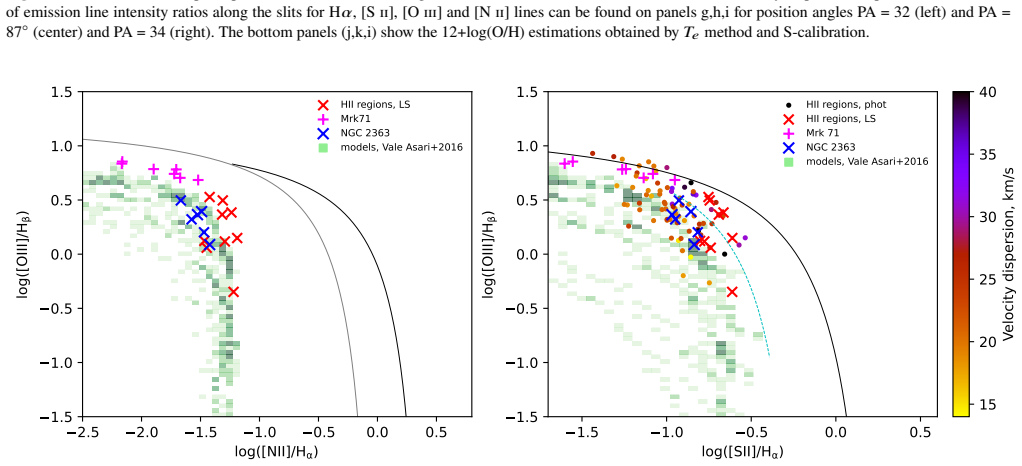
- domain assumption The line ratios from the selected HII regions are dominated by photoionization, so shocks and DIG do not significantly bias the Te-based abundances.
- domain assumption The 15 regions with [O III] 4363 detections from three slit positions are representative enough to compare Mrk 71 with the rest of NGC 2366.
- domain assumption Standard pyneb atomic data and the Pilyugin & Grebel (2016) S-calibration are applicable at NGC 2366's metallicity.
Cite this review
Pith. "Pith review of Chemical abundances and small-scale gas kinematics in the local star-forming galaxy NGC 2366." pith.science (2026). https://pith.science/paper/Y6U4DL5F
@misc{pith2026250708651,
  author       = {Pith},
  title        = {Pith review of: Chemical abundances and small-scale gas kinematics in the local star-forming galaxy NGC 2366},
  year         = {2026},
  howpublished = {\url{https://pith.science/paper/Y6U4DL5F}},
  note         = {Machine review of arXiv:2507.08651}
}
read the original abstract
We present a detailed spectroscopic study of ionised gas in the nearby (~3.3Mpc) dwarf galaxy NGC 2366, a local analogue of Green Pea galaxies, based on observations with the SCORPIO-2 instrument at the Russian 6-m BTA telescope. Using scanning Fabry-Perot interferometry and long-slit spectroscopy, we examine the gas kinematics, excitation mechanisms, and chemical abundances across the disc of NGC 2366, including its prominent starburst region Mrk 71 and the companion region NGC 2363. We identified 20 regions with locally elevated Ha velocity dispersion, only four of which correspond to known high-energy sources. We argue that one of the remaining objects can be a previously unidentified Wolf-Rayet star and two - supernova remnants. For 15 HII regions, we measure electron temperatures, oxygen and nitrogen abundances via the `direct' Te method, with 12 + log(O/H) ranging from 7.6 to 8.0 in most of the regions. We show that Mrk 71 has higher oxygen abundance compared to the other \HII regions in the galaxy, contrary to the previous indirect estimates suggesting flat gradient throughout the galaxy. Together with the localized spatial variations of metallicity in the area, it is indicative of metal enrichment by the outflow from the super star cluster in the centre of Mrk 71.
Figures


Figures from the paper (5 more)



Reference graph
Works this paper leans on
-
[1]
, " * write output.state after.block = add.period write newline
ENTRY address archiveprefix author booktitle chapter edition editor howpublished institution eprint journal key month note number organization pages publisher school series title type volume year label extra.label sort.label short.list INTEGERS output.state before.all mid.sentence after.sentence after.block FUNCTION init.state.consts #0 'before.all := #1 ...
-
[2]
write newline
" write newline "" before.all 'output.state := FUNCTION n.dashify 't := "" t empty not t #1 #1 substring "-" = t #1 #2 substring "--" = not "--" * t #2 global.max substring 't := t #1 #1 substring "-" = "-" * t #2 global.max substring 't := while if t #1 #1 substring * t #2 global.max substring 't := if while FUNCTION word.in bbl.in " " * FUNCTION format....
-
[3]
van Dyk S. D., Puche D., Wong T., 1998, AJ, 116, 2341. doi:10.1086/300584 @ARTICLE Vucetic2019, author = Vu c eti \'c , M. M. and Oni \'c , D. and Petrov , N. and \'C iprijanovi \'c , A. and Pavlovi \'c , M. Z. , title = " Optical Observations of the Nearby Galaxy NGC 2366 Through Narrowband H\_alpha and [SII] Filters. Supernova Remnants Status ", journal...
work page Pith review arXiv 1998
-
[4]
Afanasiev V. L., Moiseev A. V., 2011, Baltic Astronomy, http://adsabs.harvard.edu/abs/2011BaltA..20..363A 20, 363
work page 2011
-
[5]
Aparicio A., et al., 1995, @doi [ ] 10.1086/117509 , https://ui.adsabs.harvard.edu/abs/1995AJ....110..212A 110, 212
-
[6]
Astropy Collaboration et al., 2013, @doi [ ] 10.1051/0004-6361/201322068 , http://adsabs.harvard.edu/abs/2013A
-
[7]
Astropy Collaboration et al., 2018, @doi [ ] 10.3847/1538-3881/aabc4f , https://ui.adsabs.harvard.edu/abs/2018AJ....156..123A 156, 123
-
[8]
Baldwin J. A., Phillips M. M., Terlevich R., 1981, @doi [ ] 10.1086/130766 , http://adsabs.harvard.edu/abs/1981PASP...93....5B 93, 5
doi:10.1086/130766 1981
Show all 81 references
-
[9]
C., Robert C., Krongold Y., 2009, @doi [ ] 10.1051/0004-6361/200811132 , https://ui.adsabs.harvard.edu/abs/2009A&A...500..817B 500, 817
Binette L., Drissen L., Ubeda L., Raga A. C., Robert C., Krongold Y., 2009, @doi [ ] 10.1051/0004-6361/200811132 , https://ui.adsabs.harvard.edu/abs/2009A&A...500..817B 500, 817
2009 doi
-
[10]
Chen Y., et al., 2023, @doi [Nature Astronomy] 10.1038/s41550-023-01953-7 , https://ui.adsabs.harvard.edu/abs/2023NatAs...7..771C 7, 771
2023 doi
-
[11]
M., 2009, @doi [ ] 10.1088/0004-6256/137/4/3869 , https://ui.adsabs.harvard.edu/abs/2009AJ....137.3869C 137, 3869
Chomiuk L., Wilcots E. M., 2009, @doi [ ] 10.1088/0004-6256/137/4/3869 , https://ui.adsabs.harvard.edu/abs/2009AJ....137.3869C 137, 3869
2009 doi
-
[12]
J., 2022, @doi [ ] 10.3847/1538-3881/ac4498 , https://ui.adsabs.harvard.edu/abs/2022AJ....163...97D 163, 97
Davidge T. J., 2022, @doi [ ] 10.3847/1538-3881/ac4498 , https://ui.adsabs.harvard.edu/abs/2022AJ....163...97D 163, 97
2022 doi
-
[13]
Dey A., et al., 2019, @doi [ ] 10.3847/1538-3881/ab089d , https://ui.adsabs.harvard.edu/abs/2019AJ....157..168D 157, 168
2019 doi
-
[14]
Drissen L., Roy J.-R., Robert C., 1997, @doi [ ] 10.1086/310417 , https://ui.adsabs.harvard.edu/abs/1997ApJ...474L..35D 474, L35
1997 doi
-
[15]
Drissen L., Roy J.-R., Robert C., Devost D., Doyon R., 2000, @doi [ ] 10.1086/301204 , https://ui.adsabs.harvard.edu/abs/2000AJ....119..688D 119, 688
2000 doi
-
[16]
A., Smith L
Drissen L., Crowther P. A., Smith L. J., Robert C., Roy J.-R., Hillier D. J., 2001, @doi [ ] 10.1086/318264 , https://ui.adsabs.harvard.edu/abs/2001ApJ...546..484D 546, 484
2001 doi
-
[17]
V., Lozinskaya T
Egorov O. V., Lozinskaya T. A., Moiseev A. V., Smirnov-Pinchukov G. V., 2018, @doi [ ] 10.1093/mnras/sty1158 , https://ui.adsabs.harvard.edu/abs/2018MNRAS.478.3386E 478, 3386
2018 doi
-
[18]
V., Lozinskaya T
Egorov O. V., Lozinskaya T. A., Vasiliev K. I., Yarovova A. D., Gerasimov I. S., Kreckel K., Moiseev A. V., 2021, @doi [ ] 10.1093/mnras/stab2710 , https://ui.adsabs.harvard.edu/abs/2021MNRAS.508.2650E 508, 2650
2021 doi
-
[19]
V., et al., 2023, @doi [ ] 10.1051/0004-6361/202346919 , https://ui.adsabs.harvard.edu/abs/2023A&A...678A.153E 678, A153
Egorov O. V., et al., 2023, @doi [ ] 10.1051/0004-6361/202346919 , https://ui.adsabs.harvard.edu/abs/2023A&A...678A.153E 678, A153
2023 doi
-
[20]
N., Aktekin E., 2021, @doi [ ] 10.1016/j.newast.2020.101492 , https://ui.adsabs.harvard.edu/abs/2021NewA...8301492E 83, 101492
Ercan E. N., Aktekin E., 2021, @doi [ ] 10.1016/j.newast.2020.101492 , https://ui.adsabs.harvard.edu/abs/2021NewA...8301492E 83, 101492
2021
-
[21]
Esteban C., Bresolin F., Peimbert M., Garc \' a-Rojas J., Peimbert A., Mesa-Delgado A., 2009, @doi [ ] 10.1088/0004-637X/700/1/654 , https://ui.adsabs.harvard.edu/abs/2009ApJ...700..654E 700, 654
2009 doi
-
[22]
M., Rodr \' guez M
Feinstein C., Baume G., Vergne M. M., Rodr \' guez M. J., 2024, @doi [ ] 10.1093/mnras/stae2028 , https://ui.adsabs.harvard.edu/abs/2024MNRAS.533.4300F 533, 4300
2024 doi
-
[23]
L., 1999, @doi [ ] 10.1086/316293 , https://ui.adsabs.harvard.edu/abs/1999PASP..111...63F 111, 63
Fitzpatrick E. L., 1999, @doi [ ] 10.1086/316293 , https://ui.adsabs.harvard.edu/abs/1999PASP..111...63F 111, 63
1999 doi
-
[24]
R., 1992, @doi [ ] 10.1086/116146 , https://ui.adsabs.harvard.edu/abs/1992AJ....103.1330G 103, 1330
Garnett D. R., 1992, @doi [ ] 10.1086/116146 , https://ui.adsabs.harvard.edu/abs/1992AJ....103.1330G 103, 1330
1992 doi
-
[25]
S., Egorov O
Gerasimov I. S., Egorov O. V., Lozinskaya T. A., Moiseev A. V., Oparin D. V., 2022, @doi [ ] 10.1093/mnras/stac3002 , https://ui.adsabs.harvard.edu/abs/2022MNRAS.517.4968G 517, 4968
2022 doi
-
[26]
S., Egorov O
Gerasimov I. S., Egorov O. V., Moiseev A. V., Kniazev A. Y., Lozinskaya T. A., Egorova E. S., 2024, @doi [ ] 10.1093/mnras/stae462 , https://ui.adsabs.harvard.edu/abs/2024MNRAS.529.1138G 529, 1138
2024 doi
-
[27]
M., et al., 1994, @doi [ ] 10.1086/174992 , https://ui.adsabs.harvard.edu/abs/1994ApJ...437..239G 437, 239
Gonzalez-Delgado R. M., et al., 1994, @doi [ ] 10.1086/174992 , https://ui.adsabs.harvard.edu/abs/1994ApJ...437..239G 437, 239
1994 doi
-
[28]
Gutkin J., Charlot S., Bruzual G., 2016, @doi [ ] 10.1093/mnras/stw1716 , https://ui.adsabs.harvard.edu/abs/2016MNRAS.462.1757G 462, 1757
2016 doi
-
[29]
A., Elmegreen B
Hunter D. A., Elmegreen B. G., van Woerden H., 2001, @doi [ ] 10.1086/321611 , https://ui.adsabs.harvard.edu/abs/2001ApJ...556..773H 556, 773
2001 doi
-
[30]
A., Elmegreen B
Hunter D. A., Elmegreen B. G., Ludka B. C., 2010, @doi [ ] 10.1088/0004-6256/139/2/447 , https://ui.adsabs.harvard.edu/abs/2010AJ....139..447H 139, 447
2010 doi
-
[31]
A., et al., 2012, @doi [ ] 10.1088/0004-6256/144/5/134 , https://ui.adsabs.harvard.edu/abs/2012AJ....144..134H 144, 134
Hunter D. A., et al., 2012, @doi [ ] 10.1088/0004-6256/144/5/134 , https://ui.adsabs.harvard.edu/abs/2012AJ....144..134H 144, 134
2012 doi
-
[32]
A., Elmegreen B
Hunter D. A., Elmegreen B. G., Madden S. C., 2024, @doi [ ] 10.1146/annurev-astro-052722-104109 , https://ui.adsabs.harvard.edu/abs/2024ARA&A..62..113H 62, 113
2024 doi
-
[33]
I., Thuan T
Izotov Y. I., Thuan T. X., 2011, @doi [ ] 10.1088/0004-637X/734/2/82 , https://ui.adsabs.harvard.edu/abs/2011ApJ...734...82I 734, 82
2011 doi
-
[34]
I., Stasi \'n ska G., Meynet G., Guseva N
Izotov Y. I., Stasi \'n ska G., Meynet G., Guseva N. G., Thuan T. X., 2006, @doi [ ] 10.1051/0004-6361:20053763 , https://ui.adsabs.harvard.edu/abs/2006A&A...448..955I 448, 955
2006 doi
-
[35]
L., Auger M., Aloisi A., Calzetti D., Kewley L., 2016, @doi [ ] 10.3847/0004-637X/816/1/40 , https://ui.adsabs.harvard.edu/abs/2016ApJ...816...40J 816, 40
James B. L., Auger M., Aloisi A., Calzetti D., Kewley L., 2016, @doi [ ] 10.3847/0004-637X/816/1/40 , https://ui.adsabs.harvard.edu/abs/2016ApJ...816...40J 816, 40
2016 doi
-
[36]
L., Kumari N., Emerick A., Koposov S
James B. L., Kumari N., Emerick A., Koposov S. E., McQuinn K. B. W., Stark D. P., Belokurov V., Maiolino R., 2020, @doi [ ] 10.1093/mnras/staa1280 , https://ui.adsabs.harvard.edu/abs/2020MNRAS.495.2564J 495, 2564
2020 doi
-
[37]
Kaaret P., Prestwich A., 2024, @doi [ ] 10.3847/1538-4357/ad4ed0 , https://ui.adsabs.harvard.edu/abs/2024ApJ...968...36K 968, 36
2024 doi
-
[38]
Y., Chilingarian I
Katkov I. Y., Chilingarian I. V., 2011, in Evans I. N., Accomazzi A., Mink D. J., Rots A. H., eds, Astronomical Society of the Pacific Conference Series Vol. 442, Astronomical Data Analysis Software and Systems XX. p. 143 ( @eprint arXiv 1012.4125 ), @doi 10.48550/arXiv.1012.4125
-
[39]
Kauffmann G., et al., 2003, @doi [ ] 10.1111/j.1365-2966.2003.07154.x , http://adsabs.harvard.edu/abs/2003MNRAS.346.1055K 346, 1055
2003
-
[40]
J., Dopita M
Kewley L. J., Dopita M. A., 2002, @doi [ ] 10.1086/341326 , https://ui.adsabs.harvard.edu/abs/2002ApJS..142...35K 142, 35
2002 doi
-
[41]
J., Dopita M
Kewley L. J., Dopita M. A., Sutherland R. S., Heisler C. A., Trevena J., 2001, @doi [ ] 10.1086/321545 , http://adsabs.harvard.edu/abs/2001ApJ...556..121K 556, 121
2001 doi
-
[42]
J., Nicholls D
Kewley L. J., Nicholls D. C., Sutherland R. S., 2019, @doi [ ] 10.1146/annurev-astro-081817-051832 , https://ui.adsabs.harvard.edu/abs/2019ARA&A..57..511K 57, 511
2019 doi
-
[43]
S., Krumholz M
Komarova L., Oey M. S., Krumholz M. R., Silich S., Kumari N., James B. L., 2021, @doi [ ] 10.3847/2041-8213/ac2c09 , https://ui.adsabs.harvard.edu/abs/2021ApJ...920L..46K 920, L46
2021 doi
-
[44]
R., et al., 2014, in Beuther H., Klessen R
Krumholz M. R., et al., 2014, in Beuther H., Klessen R. S., Dullemond C. P., Henning T., eds, Protostars and Planets VI. p. 243 ( @eprint arXiv 1401.2473 ), @doi 10.2458/azu\_uapress\_9780816531240-ch011
2014 arXiv
-
[45]
A., 2015, @doi [ ] 10.1051/0004-6361/201323152 , https://ui.adsabs.harvard.edu/abs/2015A&A...573A..42L 573, A42
Luridiana V., Morisset C., Shaw R. A., 2015, @doi [ ] 10.1051/0004-6361/201323152 , https://ui.adsabs.harvard.edu/abs/2015A&A...573A..42L 573, A42
2015 doi
-
[46]
A., et al., 2013, @doi [ ] 10.1051/0004-6361/201321956 , https://ui.adsabs.harvard.edu/abs/2013A&A...559A.114M 559, A114
Marino R. A., et al., 2013, @doi [ ] 10.1051/0004-6361/201321956 , https://ui.adsabs.harvard.edu/abs/2013A&A...559A.114M 559, A114
2013 doi
-
[47]
L., Peng Z., Li Y., 2024, @doi [ ] 10.3847/1538-4357/ad34ac , https://ui.adsabs.harvard.edu/abs/2024ApJ...966..190M 966, 190
Martin C. L., Peng Z., Li Y., 2024, @doi [ ] 10.3847/1538-4357/ad34ac , https://ui.adsabs.harvard.edu/abs/2024ApJ...966..190M 966, 190
2024 doi
-
[48]
McQuinn K. B. W., et al., 2010, @doi [ ] 10.1088/0004-637X/721/1/297 , https://ui.adsabs.harvard.edu/abs/2010ApJ...721..297M 721, 297
2010 doi
-
[49]
E., Esteban C., Garc \' a-Rojas J., Kreckel K., Peimbert M., 2024, @doi [Nature Astronomy] 10.1038/s41550-024-02198-8 , https://ui.adsabs.harvard.edu/abs/2024NatAs...8..275M 8, 275
M \'e ndez-Delgado J. E., Esteban C., Garc \' a-Rojas J., Kreckel K., Peimbert M., 2024, @doi [Nature Astronomy] 10.1038/s41550-024-02198-8 , https://ui.adsabs.harvard.edu/abs/2024NatAs...8..275M 8, 275
2024 doi
-
[50]
S., Jaskot A
Micheva G., Oey M. S., Jaskot A. E., James B. L., 2017, @doi [ ] 10.3847/1538-4357/aa830b , https://ui.adsabs.harvard.edu/abs/2017ApJ...845..165M 845, 165
2017 doi
-
[51]
M., \"O stlin G., Girichidis P., 2019, @doi [ ] 10.1051/0004-6361/201834838 , https://ui.adsabs.harvard.edu/abs/2019A&A...623A.145M 623, A145
Micheva G., Christian Herenz E., Roth M. M., \"O stlin G., Girichidis P., 2019, @doi [ ] 10.1051/0004-6361/201834838 , https://ui.adsabs.harvard.edu/abs/2019A&A...623A.145M 623, A145
2019 doi
-
[52]
V., 2002, Bulletin of the Special Astrophysics Observatory, http://adsabs.harvard.edu/abs/2002BSAO...54...74M 54, 74
Moiseev A. V., 2002, Bulletin of the Special Astrophysics Observatory, http://adsabs.harvard.edu/abs/2002BSAO...54...74M 54, 74
2002
-
[53]
V., 2021, @doi [Astrophysical Bulletin] 10.1134/S1990341321030081 , https://ui.adsabs.harvard.edu/abs/2021AstBu..76..316M 76, 316
Moiseev A. V., 2021, @doi [Astrophysical Bulletin] 10.1134/S1990341321030081 , https://ui.adsabs.harvard.edu/abs/2021AstBu..76..316M 76, 316
2021 doi
-
[54]
V., Egorov O
Moiseev A. V., Egorov O. V., 2008, @doi [Astrophysical Bulletin] 10.1134/S1990341308020089 , http://adsabs.harvard.edu/abs/2008AstBu..63..181M 63, 181
2008 doi
-
[55]
V., Lozinskaya T
Moiseev A. V., Lozinskaya T. A., 2012, , 423, 1831
2012
-
[56]
O., Terlevich R., 1996, @doi [ ] 10.1086/118129 , https://ui.adsabs.harvard.edu/abs/1996AJ....112.1636M 112, 1636
Munoz-Tunon C., Tenorio-Tagle G., Castaneda H. O., Terlevich R., 1996, @doi [ ] 10.1086/118129 , https://ui.adsabs.harvard.edu/abs/1996AJ....112.1636M 112, 1636
1996 doi
- [57]
-
[58]
S., Herrera C
Oey M. S., Herrera C. N., Silich S., Reiter M., James B. L., Jaskot A. E., Micheva G., 2017, @doi [ ] 10.3847/2041-8213/aa9215 , https://ui.adsabs.harvard.edu/abs/2017ApJ...849L...1O 849, L1
2017 doi
-
[59]
S., et al., 2023, @doi [ ] 10.3847/2041-8213/ad07dd , https://ui.adsabs.harvard.edu/abs/2023ApJ...958L..10O 958, L10
Oey M. S., et al., 2023, @doi [ ] 10.3847/2041-8213/ad07dd , https://ui.adsabs.harvard.edu/abs/2023ApJ...958L..10O 958, L10
2023 doi
-
[60]
Ouchi M., et al., 2009, @doi [ ] 10.1088/0004-637X/706/2/1136 , https://ui.adsabs.harvard.edu/abs/2009ApJ...706.1136O 706, 1136
2009 doi
-
[61]
L., Thibodeaux P., Zhang J., Hu W., Li Y., 2023, @doi [ ] 10.3847/1538-4357/ace9c0 , https://ui.adsabs.harvard.edu/abs/2023ApJ...954..214P 954, 214
Peng Z., Martin C. L., Thibodeaux P., Zhang J., Hu W., Li Y., 2023, @doi [ ] 10.3847/1538-4357/ace9c0 , https://ui.adsabs.harvard.edu/abs/2023ApJ...954..214P 954, 214
2023 doi
-
[62]
S., Grebel E
Pilyugin L. S., Grebel E. K., 2016, @doi [ ] 10.1093/mnras/stw238 , https://ui.adsabs.harvard.edu/abs/2016MNRAS.457.3678P 457, 3678
2016 doi
-
[63]
Roy J.-R., Boulesteix J., Joncas G., Grundseth B., 1991, @doi [ ] 10.1086/169609 , https://ui.adsabs.harvard.edu/abs/1991ApJ...367..141R 367, 141
1991 doi
-
[64]
L., Dufour R
Roy J.-R., Aube M., McCall M. L., Dufour R. J., 1992, @doi [ ] 10.1086/171035 , https://ui.adsabs.harvard.edu/abs/1992ApJ...386..498R 386, 498
1992 doi
-
[65]
Roy J.-R., Belley J., Dutil Y., Martin P., 1996, @doi [ ] 10.1086/176968 , https://ui.adsabs.harvard.edu/abs/1996ApJ...460..284R 460, 284
1996 doi
-
[66]
K., 2024, @doi [ ] 10.1146/annurev-astro-071221-052651 , https://ui.adsabs.harvard.edu/abs/2024ARA&A..62..369S 62, 369
Schinnerer E., Leroy A. K., 2024, @doi [ ] 10.1146/annurev-astro-071221-052651 , https://ui.adsabs.harvard.edu/abs/2024ARA&A..62..369S 62, 369
2024 doi
-
[67]
I., Yakunin I
Shatsky N., et al., 2020, in Romanyuk I. I., Yakunin I. A., Valeev A. F., Kudryavtsev D. O., eds, Ground-Based Astronomy in Russia. 21st Century. pp 127--132 ( @eprint arXiv 2010.10850 ), @doi 10.26119/978-5-6045062-0-2_2020_127
2020 arXiv
-
[68]
J., et al., 2023, @doi [ ] 10.3847/1538-4357/ad00b4 , https://ui.adsabs.harvard.edu/abs/2023ApJ...958..194S 958, 194
Smith L. J., et al., 2023, @doi [ ] 10.3847/1538-4357/ad00b4 , https://ui.adsabs.harvard.edu/abs/2023ApJ...958..194S 958, 194
2023 doi
-
[69]
X., Bauer F
Thuan T. X., Bauer F. E., Izotov Y. I., 2014, @doi [ ] 10.1093/mnras/stu716 , https://ui.adsabs.harvard.edu/abs/2014MNRAS.441.1841T 441, 1841
2014 doi
-
[70]
G., McQuade K., 1995, @doi [ ] 10.1086/117637 , https://ui.adsabs.harvard.edu/abs/1995AJ....110.1640T 110, 1640
Tolstoy E., Saha A., Hoessel J. G., McQuade K., 1995, @doi [ ] 10.1086/117637 , https://ui.adsabs.harvard.edu/abs/1995AJ....110.1640T 110, 1640
1995 doi
-
[71]
G., Smith L., Leitherer C., 2024, in American Astronomical Society Meeting Abstracts
Troshynski S., Oey M., Castro N., Bruzual-A. G., Smith L., Leitherer C., 2024, in American Astronomical Society Meeting Abstracts. p. 406.04
2024
-
[72]
B., et al., 2013, @doi [ ] 10.1088/0004-6256/146/4/86 , https://ui.adsabs.harvard.edu/abs/2013AJ....146...86T 146, 86
Tully R. B., et al., 2013, @doi [ ] 10.1088/0004-6256/146/4/86 , https://ui.adsabs.harvard.edu/abs/2013AJ....146...86T 146, 86
2013 doi
-
[73]
Vale Asari N., Stasi \'n ska G., Morisset C., Cid Fernandes R., 2016, @doi [ ] 10.1093/mnras/stw971 , https://ui.adsabs.harvard.edu/abs/2016MNRAS.460.1739V 460, 1739
2016 doi
-
[74]
E., 1987, @doi [ ] 10.1086/191166 , https://ui.adsabs.harvard.edu/abs/1987ApJS...63..295V 63, 295
Veilleux S., Osterbrock D. E., 1987, @doi [ ] 10.1086/191166 , https://ui.adsabs.harvard.edu/abs/1987ApJS...63..295V 63, 295
1987 doi
-
[75]
M., Oni \'c D., Petrov N., \'C iprijanovi \'c A., Pavlovi \'c M
Vu c eti \'c M. M., Oni \'c D., Petrov N., \'C iprijanovi \'c A., Pavlovi \'c M. Z., 2019, @doi [Serbian Astronomical Journal] 10.2298/SAJ190131003V , https://ui.adsabs.harvard.edu/abs/2019SerAJ.198...13V 198, 13
2019 doi
-
[76]
R., Skillman E
Weisz D. R., Skillman E. D., Cannon J. M., Dolphin A. E., Kennicutt Robert C. J., Lee J., Walter F., 2008, @doi [ ] 10.1086/592323 , https://ui.adsabs.harvard.edu/abs/2008ApJ...689..160W 689, 160
2008 doi
-
[77]
D., Sramek R
Yang H., Skillman E. D., Sramek R. A., 1994, @doi [ ] 10.1086/116885 , https://ui.adsabs.harvard.edu/abs/1994AJ....107..651Y 107, 651
1994 doi
-
[78]
D., Egorov O
Yarovova A. D., Egorov O. V., Moiseev A. V., Maryeva O. V., 2023, @doi [ ] 10.1093/mnras/stac2949 , https://ui.adsabs.harvard.edu/abs/2023MNRAS.518.2256Y 518, 2256
2023 doi
-
[79]
J., Weis K., Dettmar R
van Eymeren J., Bomans D. J., Weis K., Dettmar R. J., 2007, @doi [ ] 10.1051/0004-6361:20077335 , https://ui.adsabs.harvard.edu/abs/2007A&A...474...67V 474, 67
2007 doi
-
[80]
J., Bomans D
van Eymeren J., Marcelin M., Koribalski B., Dettmar R. J., Bomans D. J., Gach J. L., Balard P., 2009, @doi [ ] 10.1051/0004-6361:200809585 , https://ui.adsabs.harvard.edu/abs/2009A&A...493..511V 493, 511
2009 doi
-
[81]
write newline
" write newline "" before.all 'output.state := FUNCTION fin.entry write newline FUNCTION new.block output.state before.all = 'skip after.block 'output.state := if FUNCTION new.sentence output.state after.block = 'skip output.state before.all = 'skip after.sentence 'output.stat...
Reviewed August 6, 2026 · model on record in the stance chip above.
Discussion (0). Continue with ORCID to comment.