REVIEW 3 major objections 5 minor 48 references
Charge Carrier Mobilities in gamma-Graphynes: A computational approach
T0 review · 3 major / 5 minor · reviewed 2026-08-07 · deepseek-v4-flash
Pith's one-line read The paper claims that a density-functional tight-binding (DFTB) workflow, implemented in the DFTBephy package, can compute electron-phonon couplings and phonon-limited charge carrier mobilities for gamma-graphyne and gamma-graphdiyne at a…
desk verdict A competent application of the authors' own DFTBephy code to graphynes, but the quantitative accuracy claim is under-supported because the electron-phonon matrix elements are never validated against DFT. read the letter →
The pith
A machine-rendered reading of the paper's core claim, the machinery that carries it, and where it could break.
The reading
What carries the argument
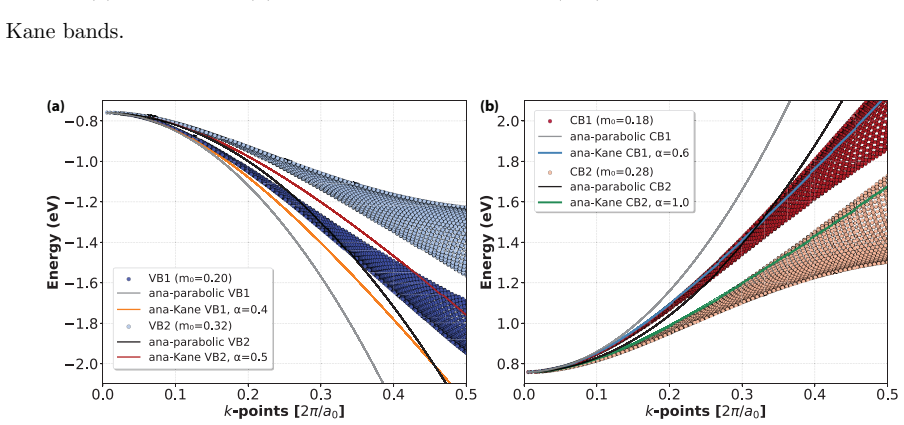
The central machinery is the DFTBephy workflow, which builds electron-phonon coupling matrix elements from finite-difference gradients of the real-space Hamiltonian and overlap matrices with respect to atomic displacements, Fourier-transforms them, and combines them with phonon eigenvectors from Phonopy. The coupling matrix elements then feed the self-energy relaxation-time approximation (SERTA) scattering rate, Eqs. (6)-(7), and the Boltzmann conductivity formula, Eq. (8). A secondary piece is the Kane-band model, a non-parabolic dispersion correction parameterized by an alpha value per band, which is used for analytical mobility estimates.
What would settle it
A DFT-based electron-phonon coupling calculation for the valence and conduction band edges of graphyne, compared head-to-head with the DFTB matrix elements, would confirm or refute this premise; if the resulting SERTA mobilities differ by more than a factor of two, the DFTB assumption fails.
Extended reading notes
Core claim
On its own terms, the paper establishes that the DFTBephy workflow, using the mio-1-1 parameter set without self-consistent charges, yields quantitatively reliable electron-phonon couplings for gamma-graphynes. The central quantitative results are SERTA relaxation times of 0.63 ps for holes and 1.69 ps for electrons in graphyne, and 0.04 ps and 0.14 ps in graphdiyne, giving room-temperature mobilities of about $3.5 \times 10^3$ cm$^2$/Vs (holes) and $9.6 \times 10^3$ cm$^2$/Vs (electrons) in graphyne, and about $4.9 \times 10^2$ and $7.4 \times 10^2$ cm$^2$/Vs in graphdiyne. The paper also finds that for holes, acoustic phonon scattering dominates near the band edge, while for electrons optical phonon scattering is roughly three times stronger in graphyne. It further claims that the Kane-band analytical model with an energy-dependent relaxation time reproduces the SERTA trend better than parabolic or constant-relaxation approximations.
Load-bearing premise
The calculation assumes the mio-1-1 DFTB parameter set, without self-consistent charges, reproduces the electron-phonon matrix elements of graphynes quantitatively, an assumption the paper tests only indirectly through structural, phonon, and band-edge benchmarks and through mobility comparisons that disagree wildly for graphdiyne.
Editorial extensions
If this is right
- Graphyne's phonon-limited electron mobility reaches about $10^4$ cm$^2$/Vs at 300 K, between graphene and MoS2, making the material a plausible 2D transistor channel.
- Graphdiyne's mobility, around $10^2$ cm$^2$/Vs, is comparable to MoS2, so its larger pores and lower stiffness do not push transport into a useless range.
- In graphyne, optical phonon scattering is the dominant electron-scattering channel, so engineering that stiffens optical modes (e.g., strain or isotope substitution) could raise electron mobility.
- The DFTB workflow makes electron-phonon coupling calculations tractable for large-unit-cell 2D carbon allotropes, where conventional DFT-based EPC is computationally prohibitive.
- The Kane-band model with energy-dependent relaxation times tracks SERTA more closely than constant relaxation time, so it can serve as a low-cost screening tool for carrier-density-dependent mobility.
Reading between the lines
- If a DFT-based EPC benchmark were run for graphyne, it would settle whether mio-1-1's electron-phonon matrix elements are quantitative; the paper's own benchmarks cover geometry, phonons, and band edges but not EPC itself.
- Assuming the DFTB couplings are accurate, the two-to-three-order-of-magnitude gap with the graphdiyne literature (Ref. [34]) indicates those earlier deformation-potential estimates overestimate mobility by omitting full phonon scattering.
- The same workflow should transfer to other sp/sp2 carbon allotropes and large-unit-cell covalent organic frameworks, enabling high-throughput screening of phonon-limited transport.
- Because DFTB band gaps here are about 1 eV larger than PBE, a hybrid-functional or GW correction could shift carrier densities and scattering phase space; testing this would reveal how sensitive the reported mobilities are to the gap error.
Editorial analysis
A structured set of objections, weighed in public.
Referee Report
Summary. The paper presents a density-functional tight-binding (DFTB) based workflow, implemented in the DFTBephy package, for computing electron-phonon couplings (EPCs) and phonon-limited charge carrier mobilities in two γ-graphyne polymorphs, graphyne (GY) and graphdiyne (GDY). The authors benchmark DFTB against DFT-PBE for lattice constants, elastic moduli, phonon dispersions, and band structures; they then compute relaxation times within the self-energy relaxation-time approximation (SERTA) and mobilities within SERTA, the constant relaxation-time approximation (CRTA), and analytical parabolic- and Kane-band models. They report SERTA relaxation times of 0.63 ps (holes) and 1.69 ps (electrons) for GY, and 0.04 ps and 0.14 ps for GDY, with mobilities of order 10^3–10^4 cm2/Vs for GY and 10^2 cm2/Vs for GDY. The central claim is that the DFTB approach is both computationally efficient and quantitatively accurate for EPC and transport in these materials.
Significance. If the reported mobilities are correct, the paper would demonstrate that a tight-binding-based workflow can replace computationally expensive DFT-based EPC calculations for large 2D carbon allotropes, substantially lowering the cost of transport predictions for materials with large unit cells. The paper is commendable for using a reproducible, open-source workflow and for providing access to the data via Zenodo. The benchmarks for structural, elastic, and phonon properties are useful in their own right. However, the transport-level claim of 'accurate' is not yet established: the EPC matrix elements are never compared against a DFT reference, and the GDY mobilities differ from prior DFT-based calculations by two to three orders of magnitude. The significance of the paper therefore hinges on whether this validation gap can be closed.
major comments (3)
- [Section III, Fig. 3–5 and Table I]
- [Section II.B and II.E; Table I]
- [Section III (Electronic structure) and Table II (SI)]
minor comments (5)
- [Abstract and title]
- [Section II.D, Eq. (10)]
- [Section II.E, computational details]
- [Section III, scattering rates]
- [Section III, mobilities]
Circularity Check
No significant circularity: SERTA mobilities are computed from DFTB EPC matrix elements, not fitted to the reported values; the analytical CRTA/Kane comparisons are explicitly calibrated to SERTA and are not presented as independent predictions.
full rationale
The central SERTA mobilities are not circular. Equation (5) computes the electron-phonon coupling from DFTB Hamiltonian/overlap gradients and phonon eigenvectors; equation (7) converts those couplings into scattering rates; equation (8) integrates velocities and relaxation times to obtain mobilities. No parameter is fitted to the reported relaxation times or mobilities. The DFTB structural, phonon, and electronic benchmarks against DFT (Figs. 3-5) are independent checks, and the graphyne literature comparison (Ref. [36]) is an external comparison. The graphdiyne discrepancy with Ref. [34] is an acknowledged disagreement attributed by the authors to the zeroth-order deformation-potential method in that reference, not an input to the present calculation. The analytical parabolic and Kane-band mobilities do use effective masses and non-parabolicity parameters fitted to the DFTB band structure, and the CRTA/parabolic/Kane effective relaxation times in Table I are explicitly defined as ratios of SERTA mobilities to the other models' mobilities; those comparisons are calibrated rather than independent, but they are clearly labeled as such and are not used to generate the SERTA results. The only self-citation is Ref. [20] for the DFTBephy code and derivation details; it is not invoked as a uniqueness theorem or as the sole justification for any physical result, and the core equations are stated in the paper. Therefore no load-bearing circular step is present.
Assumptions & free parameters
free parameters (6)
- Kane non-parabolicity parameter alpha (GY holes) =
0.6 /eV
- Kane non-parabolicity parameter alpha (GY electrons) =
1.0 /eV
- Kane non-parabolicity parameters alpha1, alpha2 (GDY holes) =
0.4 /eV, 0.5 /eV
- Kane non-parabolicity parameters alpha1, alpha2 (GDY electrons) =
0.6 /eV, 1.0 /eV
- Effective masses for analytical models =
DFTB values from Table II (e.g., GY me = 0.24-0.30 m0, mh = 0.26-0.32 m0)
- Gaussian smearing width for EPC delta functions =
not stated
assumptions (5)
- domain assumption The mio-1-1 Slater-Koster parameter set, used without self-consistent charges, yields quantitatively accurate electron-phonon matrix elements for graphynes.
- domain assumption Harmonic phonons obtained from small-displacement force constants describe the vibrational modes relevant to scattering.
- standard math Fermi-Dirac and Bose-Einstein occupations with chemical potential at band edges at 300 K govern scattering.
- domain assumption Gaussian smearing of constant width is an adequate replacement for the delta functions in Eq. (7) at the used k/q mesh.
- domain assumption Isolated monolayer with 15 A vacuum spacing approximates the experimental environment.
Cite this review
Pith. "Pith review of Charge Carrier Mobilities in gamma-Graphynes: A computational approach." pith.science (2026). https://pith.science/paper/Y72E7CKK
@misc{pith2026250521234,
  author       = {Pith},
  title        = {Pith review of: Charge Carrier Mobilities in gamma-Graphynes: A computational approach},
  year         = {2026},
  howpublished = {\url{https://pith.science/paper/Y72E7CKK}},
  note         = {Machine review of arXiv:2505.21234}
}
abstract
Graphynes, a class of two-dimensional carbon allotropes, exhibit exceptional electronic properties, similar to graphene, but with intrinsic band gaps, making them promising for semiconducting applications. The incorporation of acetylene linkages allows for systematic modulation of their properties. However, the theoretical characterization of graphynes remains computationally demanding, particularly for electron-phonon coupling (EPC) analyses. Here, we employ the density functional tight binding method within the DFTBephy framework, providing an efficient and accurate approach for computing EPC and transport properties. We investigate the structural, mechanical, electronic, and transport properties of graphynes, comparing transport calculations using the constant relaxation-time approximation and the self-energy relaxation-time approximation (SERTA) alongside analytical models based on parabolic- and Kane-band approximations. For graphyne, the SERTA relaxation time is 0.63 (1.69) ps for holes (electrons). In graphdiyne, the relaxation time is 0.04 (0.14) ps for holes (electrons). While the hole mobilities in graphyne are on the order of 10$^3$ cm$^2/$Vs, the electron mobilities reach up to 10$^4$ cm$^2/$Vs. In graphdiyne, the mobility values for both types of charge carriers are on the order of 10$^2$ cm$^2/$Vs. The phonon-limited mobilities at room temperature in graphyne fall between those of graphene and MoS$_2$, while in graphdiyne, they are comparable to those of MoS$_2$.
Figures


Figures from the paper (11 more)




Reference graph
Works this paper leans on
-
[36]
J. Xi, D. Wang, Y. Yi, and Z. Shuai, Electron-phonon couplings and carrier mobility in gra- phynes sheet calculated using the Wannier-interpolation approach, The Journal of Chemical Physics 141, 034704 (2014)
work page 2014
-
[1]
F. Diederich and M. Kivala, All-carbon scaffolds by rational design, Advanced Materials 22, 803 (2010)
work page 2010
-
[2]
Hirsch, The era of carbon allotropes, Nature Materials 9, 868–871 (2010)
A. Hirsch, The era of carbon allotropes, Nature Materials 9, 868–871 (2010). 17
work page 2010
-
[3]
F. Withers, M. Dubois, and A. K. Savchenko, Electron properties of fluorinated single-layer graphene transistors, Phys. Rev. B 82, 073403 (2010)
work page 2010
-
[4]
R. H. Baughman, H. Eckhardt, and M. Kertesz, Structure-property predictions for new planar forms of carbon: Layered phases containing sp2 and sp atoms, The Journal of Chemical Physics 87, 6687 (1987)
work page 1987
-
[6]
H. Sevin¸ cli and C. Sevik, Electronic, phononic, and thermoelectric properties of graphyne sheets, Applied Physics Letters 105, 223108 (2014)
work page 2014
-
[7]
C. S. Diercks and O. M. Yaghi, The atom, the molecule, and the covalent organic framework, Science 355, eaal1585 (2017)
work page 2017
-
[8]
W. R. D. John W. Colson, Rationally synthesized two-dimensional polymers, Nature Chem- istry 5, 453 (2013)
work page 2013
Show all 48 references
-
[9]
Ria˜ no, K
A. Ria˜ no, K. Struty´ nski, M. Liu, C. T. Stoppiello, B. Lerma-Berlanga, A. Saeki, C. Mart´ ı- Gastaldo, A. N. Khlobystov, G. Valenti, F. Paolucci, M. Melle-Franco, and A. Mateo-Alonso, An expanded 2d fused aromatic network with 90-ring hexagons, Angewandte Chemie Inter- nati...
2022
-
[10]
Ivanovskii, Graphynes and graphdyines, Progress in Solid State Chemistry 41, 1 (2013)
A. Ivanovskii, Graphynes and graphdyines, Progress in Solid State Chemistry 41, 1 (2013)
2013
-
[11]
Narang, D
G. Narang, D. Bansal, S. Joarder, P. Singh, L. Kumar, V. Mishra, S. Singh, K. Tumba, and K. Kumari, A review on the synthesis, properties, and applications of graphynes, FlatChem 40, 100517 (2023)
2023
-
[12]
Zhang, X
H. Zhang, X. He, M. Zhao, M. Zhang, L. Zhao, X. Feng, and Y. Luo, Tunable hydrogen separation in sp–sp2 hybridized carbon membranes: A first-principles prediction, The Journal of Physical Chemistry C 116, 16634 (2012)
2012
-
[13]
J. Kou, X. Zhou, H. Lu, F. Wu, and J. Fan, Graphyne as the membrane for water desalination, Nanoscale 6, 1865 – 1870 (2014)
2014
-
[14]
Zhang and X
L. Zhang and X. Wang, Mechanisms of graphyne-enabled cholesterol extraction from protein clusters, RSC Advances 5, 11776 – 11785 (2015)
2015
-
[15]
Ponc´ e, W
S. Ponc´ e, W. Li, S. Reichardt, and F. Giustino, First-principles calculations of charge carrier mobility and conductivity in bulk semiconductors and two-dimensional materials, Reports on Progress in Physics 83, 036501 (2020). 18
2020
-
[17]
Porezag, T
D. Porezag, T. Frauenheim, T. K¨ ohler, G. Seifert, and R. Kaschner, Construction of tight- binding-like potentials on the basis of density-functional theory: Application to carbon, Phys. Rev. B 51, 12947 (1995)
1995
-
[18]
L. M. Sandonas, H. Sevin¸ cli, R. Gutierrez, and G. Cuniberti, First-principle-based phonon transport properties of nanoscale graphene grain boundaries, Advanced Science 5, 1700365 (2018), https://advanced.onlinelibrary.wiley.com/doi/pdf/10.1002/advs.201700365
2018 doi
-
[19]
E. Jin, M. Asada, Q. Xu, S. Dalapati, M. A. Addicoat, M. A. Brady, H. Xu, T. Nakamura, T. Heine, Q. Chen, and D. Jiang, Two-dimensional sp2 carbon-conjugated covalent organic frameworks, Science 357, 673 (2017)
2017
-
[20]
A. Croy, E. Unsal, R. Biele, and A. Pecchia, Dftbephy: A dftb-based approach for elec- tron–phonon coupling calculations, J Comput Electron 22, 1231 (2023)
2023
-
[22]
Togo and I
A. Togo and I. Tanaka, First principles phonon calculations in materials science, Scripta Materialia 108, 1 (2015)
2015
-
[23]
A. Togo, L. Chaput, T. Tadano, and I. Tanaka, Implementation strategies in phonopy and phono3py, Journal of Physics: Condensed Matter 35, 353001 (2023)
2023
-
[25]
Rudderham and J
C. Rudderham and J. Maassen, Analysis of simple scattering models on the thermoelectric performance of analytical electron dispersions, Journal of Applied Physics 127, 065105 (2020). 19
2020
-
[27]
Kresse and J
G. Kresse and J. Hafner, Ab initio molecular dynamics for liquid metals, Phys. Rev. B 47, 558 (1993)
1993
-
[28]
Kresse and J
G. Kresse and J. Furthm¨ uller, Efficient iterative schemes for ab initio total-energy calculations using a plane-wave basis set, Phys. Rev. B 54, 11169 (1996)
1996
-
[29]
J. P. Perdew, K. Burke, and M. Ernzerhof, Generalized gradient approximation made simple, Phys. Rev. Lett. 77, 3865 (1996)
1996
-
[30]
L. Wei, G. Liu, and G. Zhang, Density functional theory study on electrical properties of graphyne propane under tension and compression deformation, Materials Research Express 7, 015032 (2020)
2020
-
[31]
A. Croy, A. Raptakis, D. Bodesheim, A. Dianat, and G. Cuniberti, Toward coarse-grained elasticity of single-layer covalent organic frameworks, The Journal of Physical Chemistry C 126, 18943 (2022)
2022
-
[32]
S. W. Cranford, D. B. Brommer, and M. J. Buehler, Extended graphynes: simple scaling laws for stiffness, strength and fracture, Nanoscale 4, 7797 (2012)
2012
-
[33]
J. P. Perdew, W. Yang, K. Burke, Z. Yang, E. K. U. Gross, M. Scheffler, G. E. Scuseria, T. M. Henderson, I. Y. Zhang, A. Ruzsinszky, H. Peng, J. Sun, E. Trushin, and A. G¨ orling, Under- standing band gaps of solids in generalized kohn–sham theory, Proceedings of the National ...
2017
-
[35]
L. D. Whalley, effmass: An effective mass package (2018)
2018
-
[37]
Srinivasu and S
K. Srinivasu and S. K. Ghosh, Graphyne and graphdiyne: Promising materials for nano- electronics and energy storage applications, The Journal of Physical Chemistry C 116, 5951 (2012). 20
2012
-
[38]
S. Wu, Y. Yuan, D. Cho, J. Y. Lee, and B. Kang, Chiral γ-graphyne nanotubes with almost equivalent bandgaps, The Journal of Chemical Physics 150, 054706 (2019)
2019
-
[39]
X. Chen, P. Gao, L. Guo, and S. Zhang, Graphdiyne as a promising material for detecting amino acids, Scientific Reports 5, 16720 (2015)
2015
-
[40]
Gunst, T
T. Gunst, T. Markussen, K. Stokbro, and M. Brandbyge, First-principles method for electron- phonon coupling and electron mobility: Applications to two-dimensional materials, Phys. Rev. B 93, 035414 (2016)
2016
-
[41]
Kaasbjerg, K
K. Kaasbjerg, K. S. Thygesen, and K. W. Jacobsen, Phonon-limited mobility in n-type single- layer mos2 from first principles, Phys. Rev. B 85, 115317 (2012)
2012
-
[42]
E. H. Hwang and S. Das Sarma, Acoustic phonon scattering limited carrier mobility in two- dimensional extrinsic graphene, Phys. Rev. B 77, 115449 (2008). 21 Supplementary Information for Charge Carrier Mobilities in γ-Graphynes: A computational approach Elif Unsal∗ Institute f...
2008 arXiv
-
[43]
A. R. Puigdollers, G. Alonso, and P. Gamallo, First-principles study of structural, elastic and electronic properties of α-, β- and γ-graphyne, Carbon 96, 879 (2016)
2016
-
[44]
M. Long, L. Tang, D. Wang, Y. Li, and Z. Shuai, Electronic structure and carrier mobility in graphdiyne sheet and nanoribbons: Theoretical predictions, ACS Nano 5, 2593 (2011), pMID: 21443198
2011
-
[45]
Hourahine, B
B. Hourahine, B. Aradi, V. Blum, F. Bonaf´ e, A. Buccheri, C. Camacho, C. Cevallos, M. Y. Deshaye, T. Dumitric˘ a, A. Dominguez, S. Ehlert, M. Elstner, T. van der Heide, J. Hermann, S. Irle, J. J. Kranz, C. K¨ ohler, T. Kowalczyk, T. Kubaˇ r, I. S. Lee, V. Lutsker, R. J. Maure...
2020
-
[46]
M. Gaus, A. Goez, and M. Elstner, Parametrization and benchmark of dftb3 for organic molecules, Journal of Chemical Theory and Computation 9, 338 (2013), pMID: 26589037
2013
-
[47]
M. Gaus, X. Lu, M. Elstner, and Q. Cui, Parameterization of dftb3/3ob for sulfur and phos- phorus for chemical and biological applications, Journal of Chemical Theory and Computation 10, 1518 (2014), pMID: 24803865
2014
-
[48]
Elstner, D
M. Elstner, D. Porezag, G. Jungnickel, J. Elsner, M. Haugk, T. Frauenheim, S. Suhai, and G. Seifert, Self-consistent-charge density-functional tight-binding method for simulations of complex materials properties, Phys. Rev. B 58, 7260 (1998)
1998
-
[49]
V. Q. Vuong, J. Akkarapattiakal Kuriappan, M. Kubillus, J. J. Kranz, T. Mast, T. A. Niehaus, S. Irle, and M. Elstner, Parametrization and benchmark of long-range corrected dftb2 for organic molecules, Journal of Chemical Theory and Computation 14, 115 (2018), pMID: 29232515
2018
-
[50]
Lukose, A
B. Lukose, A. Kuc, J. Frenzel, and T. Heine, On the reticular construction concept of covalent organic frameworks, Beilstein J. Nanotechnol. 1, 60 (2010)
2010
-
[51]
Ponc´ e, W
S. Ponc´ e, W. Li, S. Reichardt, and F. Giustino, First-principles calculations of charge carrier mobility and conductivity in bulk semiconductors and two-dimensional materials, Reports on 13 Progress in Physics 83, 036501 (2020)
2020
-
[52]
L. D. Whalley, J. M. Frost, B. J. Morgan, and A. Walsh, Impact of nonparabolic electronic band structure on the optical and transport properties of photovoltaic materials, Phys. Rev. B 99, 085207 (2019)
2019
-
[53]
Rudderham and J
C. Rudderham and J. Maassen, Analysis of simple scattering models on the thermoelectric performance of analytical electron dispersions, Journal of Applied Physics 127, 065105 (2020)
2020
-
[54]
Lundstrom, Fundamentals of Carrier Transport , 2nd ed
M. Lundstrom, Fundamentals of Carrier Transport , 2nd ed. (Cambridge University Press,
Reviewed August 7, 2026 · model on record in the stance chip above.
Discussion (0). Sign in to comment.