REVIEW 3 major objections 5 minor 81 references
A Population Balance Model for Large Eddy Simulation of Polydisperse Droplet Evolution
T0 review · 3 major / 5 minor · reviewed 2026-08-14 · deepseek-v4-flash
Pith's one-line read A breakup model extends droplet-size prediction into the viscous range and matches jet-in-crossflow data.
desk verdict The viscous-range kernel extension and LES-PBE application are genuinely new and useful; the validation is shape-only and the SGS closure is untested, but the paper deserves review. read the letter →
The pith
A machine-rendered reading of the paper's core claim, the machinery that carries it, and where it could break.
The reading
What carries the argument
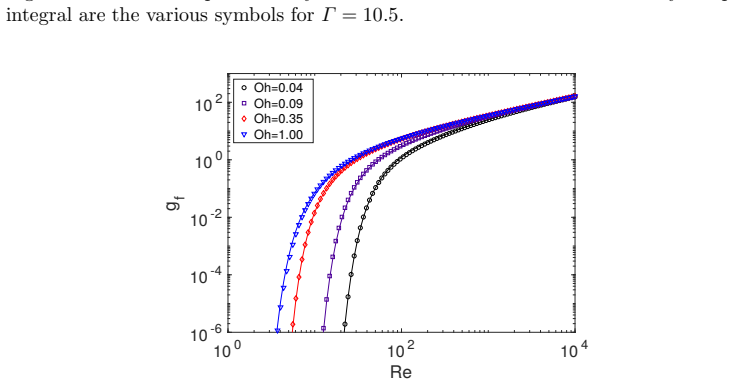
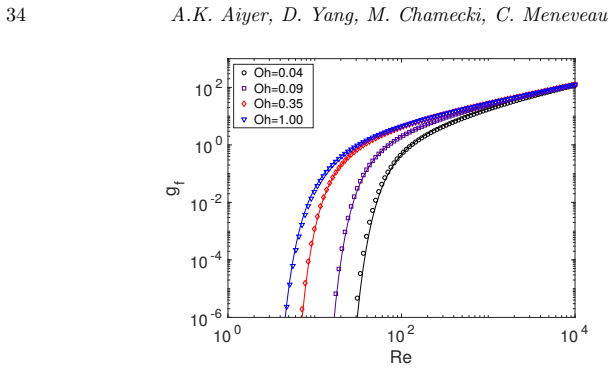
The central object is the breakup frequency integral g(di) = K ∫ π/4(di+de)^2 u_e(de) Ω(di,de) dn_e(de), evaluated with droplet-eddy collisions treated kinetically. The key extension is replacing the inertial-range eddy velocity with the Batchelor structure function S2(r) = C2 $ε^{{2/3}}$ $r^{{2/3}}$ [1 + (r/(γ2 η))^{-2}]^{-2/3}, which transitions smoothly to the viscous range; the parameter γ2 = (15 C2)^{3/4} ≈ 13 sets the crossover scale. A fast analytic fit for the integral makes the breakup rate cheap enough to evaluate at every LES grid point and timestep.
What would settle it
Run the same LES breakup model at a much finer grid resolution (or in a DNS-resolved setting) for the identical jet-in-crossflow case and compare the predicted size distributions; if the coarse-grid and fine-grid results diverge by more than the reported experimental scatter, the subgrid closure and the fitted K* are not transferable across resolutions.
Extended reading notes
Core claim
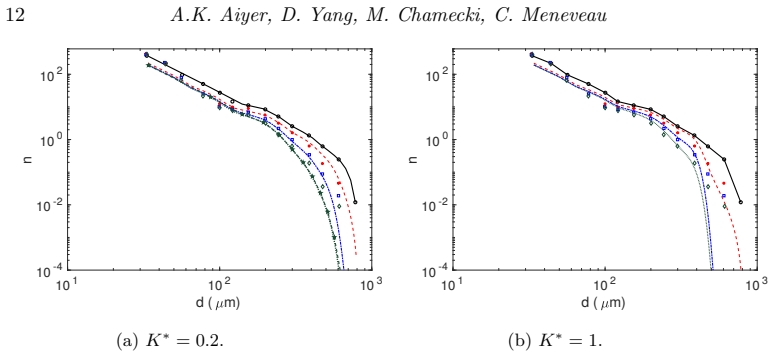
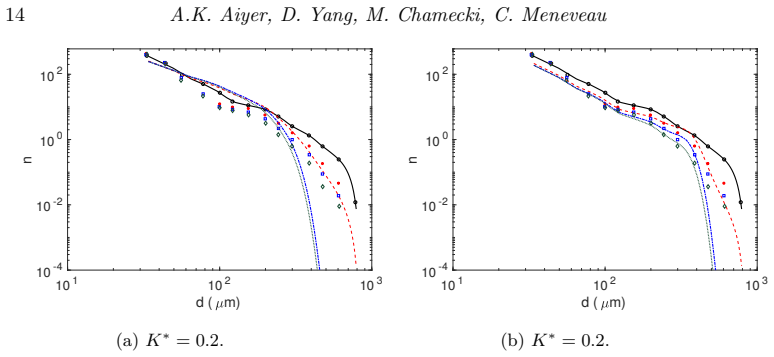
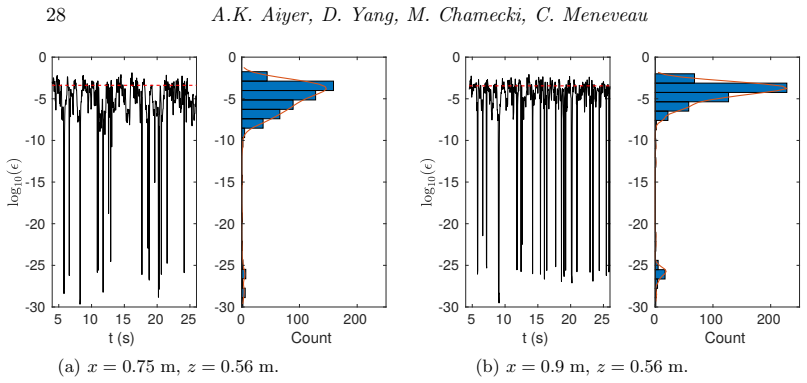
The paper claims that turbulent breakup of droplets in the viscous range, where the Kolmogorov scale is larger than the droplet, can be captured with a single breakup-frequency model that smoothly blends inertial and viscous scalings. Using a Batchelor blending function for the eddy velocity, the breakup frequency becomes a function of a local Reynolds number, Ohnesorge number, and density-viscosity ratio, with one fitted constant K* = 0.2 tuned on a breaking-wave experiment. Applied to a three-dimensional LES of a jet in crossflow with 15 droplet size bins, the model reproduces the measured relative size distribution and reveals that the Sauter mean diameter and total surface area fluctuate strongly and non-Gaussianly in time and space.
Load-bearing premise
The paper assumes that subgrid fluctuations of dissipation rate and droplet concentration are uncorrelated, so the filtered breakup source can be computed from filtered quantities alone; if these correlations matter at high Reynolds numbers, the predicted breakup rates will be biased.
Editorial extensions
If this is right
- The LES model can predict polydisperse droplet transport and breakup in flows where the Kolmogorov scale exceeds the droplet size, which earlier inertial-range-only models overestimate.
- The fitted constant K* = 0.2 transfers from a breaking-wave experiment to a round jet and then to a jet in crossflow, suggesting the breakup kernel is flow-independent to first order.
- LES outputs yield temporal and spatial statistics of droplet surface area and Sauter mean diameter, quantities that control biodegradation rates and optical properties of oil plumes.
- The model's insensitivity to the assumed initial droplet injection size (monodisperse vs bidisperse) suggests far-field size distributions are set by breakup dynamics rather than nozzle details.
Reading between the lines
- If the subgrid closure holds, the same kernel could be applied to bubble plumes and spray atomization downstream of primary breakup, where coalescence remains negligible.
- The fitted K* may absorb the uncertainty in the upper integration cutoff and daughter-size probability; a systematic study varying both could separate physical breakup physics from closure tuning.
- The strong non-Gaussian variability of d32 and total surface area implies that single-point mean predictions of oil fate may understate the risk of locally high surface area available for biodegradation.
Signed reviews
Editorial analysis
A structured set of objections, weighed in public.
Referee Report
Summary. This paper develops a population balance model for polydisperse droplet evolution in an LES framework. The breakup frequency is modeled as a droplet–eddy collision integral with a Batchelor structure function that smoothly bridges inertial and viscous ranges, and is parameterized by algebraic fits. The one free constant K* is calibrated against the Li et al. (2017) breaking-wave experiment, tested against Eastwood et al. (2004) jet data, and used in a 3D LES of a jet in crossflow. The LES predictions are compared with Murphy et al. (2016) data using volume-normalized relative size/volume distributions. The paper also reports intermittency statistics of Sauter mean diameter, total surface area, and breakup source terms.
Significance. The viscous-range extension via a structure function is a useful physical improvement over standard inertial-range kernels, and the algebraic fits make LES application affordable. The paper is honest about limitations: it notes the subgrid-closure assumption, the limited statistical convergence of Murphy et al., and tests sensitivity to the injection distribution and daughter-probability model. If the remaining validation issues are resolved, the model would be a practical tool for oil-spill and spray applications, where polydisperse droplet evolution matters. The current evidence supports the relative-shape predictions in the specific Murphy et al. configuration, but not yet a generally transferable quantitative prediction.
major comments (3)
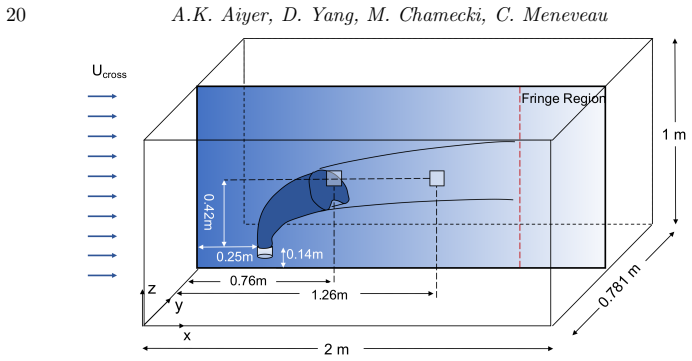
- [§4.1, Eq. (4.3)] The closure \widetilde{g n}\approx\tilde{g}\tilde{n} and g(\epsilon)\approx g(\tilde{\epsilon}) is load-bearing, since the grid scale is 5.2 mm while \eta\approx 13–60 \mu m (§4.3), so breakup rates are set by unresolved eddies. The breakup frequency depends nonlinearly on \epsilon via Eqs. (2.17)–(2.18), and Fig. 17 shows grid-scale \epsilon varying over orders of magnitude, so Jensen-type bias is expected. The 1D calibrations (§3.1, §3.2) use mean or parameterized dissipation and do not exercise this closure. Because no grid-resolution or SGS-model sensitivity is reported, the LES comparisons in Figs. 11–13 cannot yet be regarded as a clean test of the model; the authors should quantify the closure error or at least demonstrate resolution insensitivity.
- [§3.2, Fig. 6] The claim that K*=0.2 is robust is weakened by the Eastwood comparison: for heptane and 10 cSt silicone oil the model with K*=0.2 overpredicts decay, and K*=0.1 and 0.15 are needed. Since no parameter dependence is identified, the fitted constant is not shown to be transferable across fluids. Please either explain why these discrepancies are within model uncertainty or restrict the transferability claim and assess the impact on the Murphy comparison in §4.
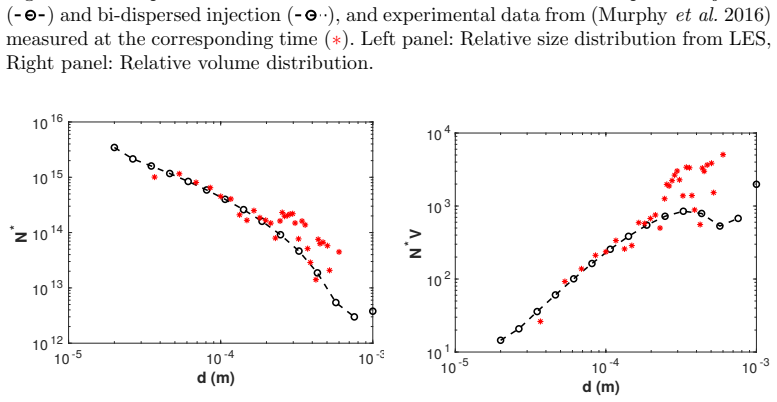
- [§4.3, Figs. 11–13] The total oil concentrations differ between simulation and experiment by factors of 1.4 and 3.7, and the comparisons are normalized by total volume concentration. Therefore the abstract's claim of 'good agreement for the relative size distribution' is accurate only for the shape, not the absolute concentration. The model also predicts absolute concentration, so this discrepancy is a substantive part of the validation and should be discussed quantitatively (e.g., statistical convergence of Murphy et al., measurement volume, effective injection in Appendix B) rather than only used to justify a shape-only comparison.
minor comments (5)
- [Figure 13 caption] The caption states the comparison is 'at x = 1.3 m', but the text describes the total size distribution over the window x = 0.76–1.66 m; please align the caption with the text.
- [Eqs. (2.20)–(2.21)] Using the symbol e both as Euler's number and as the coefficient e(y) in the fit is confusing; consider renaming the coefficient (for example, f or h).
- [Eq. (3.4)] The error measure E uses the squared logarithmic difference but does not state whether absolute values or signed differences are intended; please clarify.
- [Appendix A] The notation log10[-c(y)] = ... is unusual because c(y) appears in the fit G = a x^b + c x^d - e; please clarify the signs and the domain of validity of the fit.
- [Acknowledgements heading] The word 'Acknowledegements' is misspelled; it should be 'Acknowledgements'.
Circularity Check
No significant circularity: K* is fitted to an external breaking-wave experiment and the LES size-distribution comparison is an out-of-sample relative-shape prediction.
full rationale
The paper's central claim is that a population balance breakup model with one fitted constant K*=0.2 predicts relative droplet size distributions in an LES of a jet in crossflow. The constant is calibrated in §3.1 against the Li et al. (2017) breaking-wave experiment by minimizing the error measure E in Eq. (3.4) within a 1D vertical-diffusion model, and then used without refitting in the Eastwood et al. comparison (§3.2) and the Murphy et al. LES (§4). The Murphy et al. comparison therefore tests the model's shape prediction outside the calibration dataset; nothing in the fit fixes the shape of the normalized size distribution N_i* at x=0.76–1.66 m. The normalization of both experiment and simulation by total volume in Eq. (4.8) weakens the comparison but does not make it an identity, since the relative bin-to-bin shape is still produced by the coupled transport and breakup dynamics. The §4.1 closure ∼gn≈g̃ñ and g(ε)≈g(ε̃) is an acknowledged approximation explicitly flagged by the authors as needing further subgrid modeling at very high Reynolds numbers; that is a robustness/correctness limitation, not a circular step. The Appendix A fits are algebraic surrogates for numerical evaluation of the authors' own integral (A 1), used for computational speed; fitting a fast formula to one's own model is not importing the target result. Eσ in Eq. (2.13) is computed from the same formation-energy and daughter-probability model, but this is internal consistency among model components, not a derivation of a prediction from itself. Self-citations to Yang et al. (2014, 2015, 2016) and Bou-Zeid et al. (2005) concern the LES code, SGS model, and droplet velocity expansion; they are infrastructure citations and are not load-bearing for the breakup-model claim. The Eastwood et al. comparison showing that K*=0.2 is suboptimal for heptane and 10cSt silicone oil is reported by the authors themselves (§3.2) and indicates transferability risk, but that is a model-adequacy issue, not circularity. On the supplied evidence, there is no step in which a 'prediction' or 'first-principles result' is equivalent by construction to its input data or to a self-citation chain.
Assumptions & free parameters
free parameters (5)
- K* =
0.2
- kD =
0.3
- dmin =
1 µm
- alpha =
approx 2
- breakup-integral fit coefficients (A3) =
Tables 4-5
assumptions (6)
- domain assumption K41 inertial-range scaling and the second-order structure function S2(r) with C2=2.1 and gamma2=13
- ad hoc to paper Droplets and eddies interact as in kinetic theory of gases, with a sharp cutoff at eddy size equal to droplet size
- domain assumption Daughter size distribution follows the Tsouris and Tavlarides energy-based U-shaped model, with volume conservation by complementary bins
- domain assumption Dispersed phase volume fraction is low enough to neglect coalescence and treat droplets as spherical active scalars
- ad hoc to paper Subgrid closure \widetilde{g n}≈\tilde{g}\tilde{n} and g(\tilde{ε}) for the filtered breakup source
- domain assumption Ferry and Balachandar expansion valid for grid Stokes number St_delta << 1
Cite this review
Pith. "Pith review of A Population Balance Model for Large Eddy Simulation of Polydisperse Droplet Evolution." pith.science (2026). https://pith.science/paper/Y77CJH2P
@misc{pith2026190802397,
  author       = {Pith},
  title        = {Pith review of: A Population Balance Model for Large Eddy Simulation of Polydisperse Droplet Evolution},
  year         = {2026},
  howpublished = {\url{https://pith.science/paper/Y77CJH2P}},
  note         = {Machine review of arXiv:1908.02397}
}
abstract
In the context of many applications of turbulent multi-phase flows, knowledge of the dispersed phase size distribution and its evolution is critical to predicting important macroscopic features. We use a population dynamics model for polydisperse droplet distributions specifically adapted to a LES framework including a model for droplet breakup due to turbulence, neglecting coalescence. Following earlier methods used in the Reynolds averaged Navier--Stokes framework, the droplet breakup due to turbulent fluctuations is modelled by treating droplet-eddy collisions as in kinetic theory of gases. In order to also model smaller droplets comparable to or smaller than the Kolmogorov scale we extend the breakup kernels using a structure function model that smoothly transitions from the inertial to the viscous range. The model includes a dimensionless coefficient that is fitted by comparing predictions in a one-dimensional version of the model with a laboratory experiment of oil droplet breakup below breaking waves. After initial comparisons of the one-dimensional model to measurements of oil droplets in an axisymmetric jet, it is then applied in a three-dimensional LES of a jet in crossflow with large oil droplets of a single size being released at the source of the jet. We model the concentration fields using $N_d =15$ bins of discrete droplet sizes and solve scalar transport equations for each bin. The resulting droplet size distributions are compared with published experimental data, and good agreement for the relative size distribution is obtained. The LES results also enable us to quantify size distribution variability. We find that the probability distribution functions of key quantities such as the total surface area and the Sauter mean diameter of oil droplets are highly variable, some displaying strong non-Gaussian intermittent behavior.
Figures


Figures from the paper (22 more)









Reference graph
Works this paper leans on
-
[1]
, " * write output.state after.block = add.period write newline
ENTRY address author booktitle chapter edition editor howpublished institution journal key month note number organization pages publisher school series title type volume year eprint label extra.label sort.label short.list INTEGERS output.state before.all mid.sentence after.sentence after.block FUNCTION init.state.consts #0 'before.all := #1 'mid.sentence ...
-
[2]
write newline
" write newline "" before.all 'output.state := FUNCTION n.dashify 't := "" t empty not t #1 #1 substring "-" = t #1 #2 substring "--" = not "--" * t #2 global.max substring 't := t #1 #1 substring "-" = "-" * t #2 global.max substring 't := while if t #1 #1 substring * t #2 global.max substring 't := if while FUNCTION word.in bbl.in capitalize " " * FUNCT...
-
[3]
Albertson, J. D. & Parlange, M. B. 1999 Surface length scales and shear stress: Implications for land-atmosphere interaction over complex terrain . Water Resour. Res. 35 (7), 2121--2132
work page 1999
-
[4]
1981 Two Phase Flows in Chemical Engineering
Azbel , D. 1981 Two Phase Flows in Chemical Engineering . Cambridge University Press
work page 1981
-
[5]
Bandara, U. C. & Yapa, P. D. 2011 Bubble sizes, breakup, and coalescence in deepwater gas/oil plumes . J. Hydraul. Eng. 137 (7), 729--738
work page 2011
-
[6]
Batchelor, G. K. 1951 Pressure fluctuations in isotropic turbulence . Proc. Cambr. Phil. Soc. 47 (July 1950), 359--374
work page 1951
-
[7]
Bossard, J.A. & Peck, R.E. 1996 Droplet sie distribution effects in spray combustion . Symposium (International) on Combustion 26 (1), 1671 -- 1677
work page 1996
-
[8]
Bou-Zeid, E. , Meneveau, C. & Parlange, M. 2005 A scale-dependent Lagrangian dynamic model for large eddy simulation of complex turbulent flows . Phys. Fluids 17 (2), 025105
work page 2005
Show all 81 references
-
[9]
Brandvik, P. J. , Johansen, . , Leirvik, F. , Farooq, U. & Daling, P. S. 2013 Droplet breakup in subsurface oil releases - Part 1: Experimental study of droplet breakup and effectiveness of dispersant injection . Mar. Pollut. Bull. 73 (1), 319--326
2013
-
[10]
Calabrese, R. V. , Wang, C. Y. & Bryner, N. P. 1986 Drop breakup in turbulent stirred tank contactors. Part I: Effect of Dispersed-Phase Viscosity . AlChE J. 32 (4), 677--681
1986
-
[11]
, Meneveau, C
Chamecki, M. , Meneveau, C. & Parlange, M. B. 2008 A hybrid spectral/finite-volume algorithm for large-eddy simulation of scalars in the atmospheric boundary layer . Boundary Layer Meteorol. 128 (3), 473--484
2008
-
[12]
& James, M
Chatzi, E. & James, M. L. 1987 Analysis of Interactions for Liquid—Liquid Dispersions in Agitated Vessels . Ind. Eng. Chem. Res. 26 (11), 2263--2267
1987
-
[13]
, Yang, D
Chen, B. , Yang, D. , Meneveau, C. & Chamecki, M. 2018 Numerical study of the effects of chemical dispersant on oil transport from an idealized underwater blowout . Phys. Rev. Fluids 3 , 083801
2018
-
[14]
& Karagozian, A
Cortelezzi, L. & Karagozian, A. R. 2001 On the formation of the counter-rotating vortex pair in transverse jets . J. Fluid Mech. 446 , 347--373
2001
-
[15]
Coulaloglou, C. A. & Tavlarides, L. L. 1977 Description of interaction processes in agitated liquid-liquid dispersions . Chem. Eng. Sci. 32 (11), 1289--1297
1977
-
[16]
, Moureau, V
Desjardins, O. , Moureau, V. & Pitsch, H. 2008 An accurate conservative level set/ghost fluid method for simulating turbulent atomization . J. Comput. Phys. 227 (18), 8395 -- 8416
2008
-
[17]
, Luret, G
Duret, B. , Luret, G. , Reveillon, J. , Menard, T. , Berlemont, A. & Demoulin, F.X. 2012 Dns analysis of turbulent mixing in two-phase flows . Int. J. Multiphase Flow 40 , 93 -- 105
2012
-
[18]
Eastwood, C. D. , Armi, L. & Lasheras, J. C. 2004 The breakup of immiscible fluids in turbulent flows . J. Fluid Mech. 502 , 309–333
2004
-
[19]
& Balachandar, S
Ferry, J. & Balachandar, S. 2001 A fast eulerian method for disperse two-phase flow . Int. J. Multiphase Flow 27 (7), 1199 -- 1226
2001
-
[20]
Gaskell, P. H. & Lau, A. K C 1988 Curvature compensated convective transport: SMART, A new boundedness preserving transport algorithm . Int. J. Numer. Methods Fluids 8 (6), 617--641
1988
-
[21]
, Malkiel, E
Gopalan , B. , Malkiel, E. & Katz, J. 2008 Experimental investigation of turbulent diffusion of slightly buoyant droplets in locally isotropic turbulence . Phys. Fluids 20 (9), 095102
2008
-
[22]
& Herrmann, M
Gorokhovski, M. & Herrmann, M. 2008 Modeling primary atomization . Annu. Rev. Fluid Mech. 40 (1), 343--366
2008
-
[23]
2010 Detailed numerical simulations of the primary atomization of a turbulent liquid jet in crossflow
Herrmann, M. 2010 Detailed numerical simulations of the primary atomization of a turbulent liquid jet in crossflow . J. Eng. Gas Turbines Power 132 (6)
2010
-
[24]
2013 A sub-grid surface dynamics model for sub-filter surface tension induced interface dynamics
Herrmann, M. 2013 A sub-grid surface dynamics model for sub-filter surface tension induced interface dynamics . Computers and Fluids 87 , 92--101
2013
-
[25]
Hinze, J. O. 1955 Fundamentals of the hydrodynamic mechanism of splitting in dispersion processes . AlChE J. 1 (3), 289--295
1955
-
[26]
& Katz, S
Hulburt, H.M. & Katz, S. 1964 Some problems in particle technology . Chem. Eng. Sci. 19 (8), 555--574
1964
-
[27]
Hussein, H. J. , Capp, S. P. & George, W. K. 1994 Velocity measurements in a high-Reynolds number, momentum-conserving, axisymmetric, turbulent jet . J. Fluid Mech. 258 (1994), 31--75
1994
-
[28]
Igel, A. L. & van den Heever, S. C. 2016 The Importance of the Shape of Cloud Droplet Size Distributions in Shallow Cumulus Clouds. Part I: Bin Microphysics Simulations . J. Atmos. Sci. pp. JAS--D--15--0382.1
2016
-
[29]
Jakobsen, H. A. 2014 The Population Balance Equation\/ , pp. 937--1003 . Cham: Springer International Publishing
2014
-
[30]
, Brandvik, P
Johansen, . , Brandvik, P. J. & Farooq, U. 2013 Droplet breakup in subsea oil releases - Part 2: Predictions of droplet size distributions with and without injection of chemical dispersants . Mar. Pollut. Bull. 73 (1), 327--335
2013
-
[31]
& Meneveau, C
Johnson, P.L. & Meneveau, C. 2018 Predicting viscous-range velocity gradient dynamics in large-eddy simulations of turbulence . Journal of Fluid Mechanics 837 , 80--114
2018
-
[32]
Kolmogorov, A N 1949 On the breakage of drops in a turbulent flow. Dokl. Akad. Nauk SSSR 66 , 825--828
1949
-
[33]
, Aoki, M
Konno, M. , Aoki, M. & Saito, S. 1982 Scale effect on breakup process in liquid-liquid agitated tanks . J. Chem. Eng. Jpn. 16 , 312--319
1982
-
[34]
, Peglow, M
Kumar, J. , Peglow, M. , Warnecke, G. , Heinrich, S. & M \" o rl, L. 2006 Improved accuracy and convergence of discretized population balance for aggregation: The cell average technique . Chem. Eng. Sci. 61 (10), 3327--3342
2006
-
[35]
& Ramakrishna, D
Kumar, S. & Ramakrishna, D. 1996 On the solution of population balance equations by discretization -I. A fixed pivot technique . Chem. Eng. Sci. 51 (8), 1311--1332
1996
-
[36]
Lasheras, J. C. , Eastwood, C. , Mart \' i nez-Baz \' a n, C. & Montaes, J. L. 2002 A review of statistical models for the break-up an immiscible fluid immersed into a fully developed turbulent flow . Int. J. Multiphase Flow 28 (2), 247--278
2002
-
[37]
& Mewes, D
Lehr, F. & Mewes, D. 1999 A transport equation for the interfacial area density applied to bubble columns . Chem. Eng. Sci. 56 , 1159--1166
1999
-
[38]
, Miller, J
Li, C. , Miller, J. , Wang, J. , Koley, S. S. & Katz, J. 2017 Size distribution and dispersion of droplets generated by impingement of breaking waves on oil slicks . J. Geophys. Res. Oceans 122 (10), 7938--7957
2017
-
[39]
& Lucas, D
Liao, Y. & Lucas, D. 2009 A literature review of theoretical models for drop and bubble breakup in turbulent dispersions . Chem. Eng. Sci. 64 (15), 3389--3406
2009
-
[40]
Liu, Y. G. , You, L. G. , Yang, W. N. & Liu, F. 1995 On the Size Distribution of Cloud Droplets . Atmos. Res. 35 (2-4), 201--216
1995
-
[41]
& Svendsen, H
Luo, H. & Svendsen, H. F. 1996 Theoretical model for drop and bubble breakup in turbulent dispersions . AICHE J 42 (5), 1225--1233
1996
-
[42]
, David, R
Marchal, P. , David, R. , Klein, J. P. & Villermaux, J. 1988 Crystallization and precipitation engineering-I. An efficient method for solving population balance in crystallization with agglomeration . Chem. Eng. Sci. 43 (1), 59--67
1988
-
[43]
, Deane, G
Mart \' i nez-Baz \' a n , Rodr \' i guez-rodr \' i guez, J. , Deane, G. B. , Monta \ n \' e s, J. L. & Lasheras, J. C. 2010 Considerations on bubble fragmentation models . J. Fluid Mech. 661 , 159–177
2010
-
[44]
, Monta \ n \' e s, J
Mart \' i nez-Baz \' a n, C. , Monta \ n \' e s, J. L. & Lasheras, J. C. 1999 a\/ On the breakup of an air bubble injected into a fully developed turbulent flow. part 1. breakup frequency . J. Fluid Mech. 401 , 157--182
1999
-
[45]
, Monta \ n \' e s, J
Mart \' i nez-Baz \' a n, C. , Monta \ n \' e s, J. L. & Lasheras, J. C. 1999 b\/ On the breakup of an air bubble injected into a fully developed turbulent flow. part 2. size pdf of the resulting daughter bubbles . J. Fluid Mech. 401 , 183–207
1999
-
[46]
, Xue, X
Murphy, D W. , Xue, X. , Sampath, K. & Katz, J. 2016 Crude oil jets in crossflow: Effects of dispersant concentration on plume behavior . J. Geophys. Res. Oceans 121 (6), 4264--4281
2016
-
[47]
, Gupta, J
Narsimhan, G. , Gupta, J. P. & Ramkrishna, D. 1979 A model for transitional breakage probability of droplets in agitated lean liquid-liquid dispersions . Chem. Eng. Sci. 34 (2), 257--265
1979
-
[48]
, Ramkrishna, D
Narsimhan, G. , Ramkrishna, D. & Gupta, J. P. 1980 Analysis of drop size distributions in lean liquid-liquid dispersions . AlChE J. 26 (6), 991--1000
1980
-
[49]
, Kronenburg, A
Neuber, G. , Kronenburg, A. , Stein, O. T. & Cleary, M. J. 2017 MMC-LES modelling of droplet nucleation and growth in turbulent jets . Chem. Eng. Sci. 167 , 204--218
2017
-
[50]
Nissanka, I. D. & Yapa, P. D. 2016 Calculation of oil droplet size distribution in an underwater oil well blowout . Journal of Hydraulic Research 54 (3), 307--320
2016
-
[51]
Nissanka, I. D. & Yapa, P. D. 2018 Calculation of oil droplet size distribution in ocean oil spills: A review . Mar. Pollut. Bull. 135 , 723 -- 734
2018
-
[52]
North, E. W. , Adams, E. E. , Thessen, A. E. , Schlag, Z. , He, R. , Socolofsky, S. A. , Masutani, S. M. & Peckham, S. D. 2015 The influence of droplet size and biodegradation on the transport of subsurface oil droplets during the Deepwater Horizon spill: A model sensitivity s...
2015
-
[53]
, Thornock, J
Pedel, J. , Thornock, J. N. , Smith, S. T. & Smith, P. J. 2014 Large eddy simulation of polydisperse particles in turbulent coaxial jets using the direct quadrature method of moments . Int. J. Multiphase Flow 63 , 23--38
2014
-
[54]
Cambridge: Cambridge Univ
Pope, S B 2011 Turbulent flows \/ . Cambridge: Cambridge Univ. Press
2011
-
[55]
, Meneveau, C
Port \' e -Agel, F. , Meneveau, C. & Parlange, M. B. 2000 A scale-dependent dynamic model for large-eddy simulation: application to a neutral atmospheric boundary layer . J. Fluid Mech. 415 , 261--284
2000
-
[56]
Prince, M. J. & Blanch, H. W. 1990 Bubble Coalescence and Break-up in Air-Sparged Bubble Columns . AlChE J. 36 (10), 1485--1499
1990
-
[57]
1985 The status of population balances
Ramkrishna, D. 1985 The status of population balances . Rev. Chem. Eng. 3 (1), 49--95
1985
-
[58]
Randolph, A. D. 1964 A population balance for countable entities . Can. J. Chem. Eng. 42 (6), 280--281
1964
-
[59]
, Cleary, M
Salehi, F. , Cleary, M. J. & Masri, A. R. 2017 Population balance equation for turbulent polydispersed inertial droplets and particles . J. Fluid Mech. 831 , 719--742
2017
-
[60]
, Ramkrishna, D
Sathyagal, A.N. , Ramkrishna, D. & Narsimhan, G. 1996 Droplet breakage in stirred dispersions. breakage functions from experimental drop-size distributions . Chem. Eng. Sci. 51 (9), 1377 -- 1391
1996
-
[61]
& Yamamoto, K
Sato, Y. & Yamamoto, K. 1987 Lagrangian measurement of fluid-particle motion in an isotropic turbulent field . J. Fluid Mech. 175 , 183–199
1987
-
[62]
ICLASS 2012, 12th Triennial Int
Seubert, N , Kronenburg, A , Stein, O T , Ge, Y & Cleary, M J 2012 Large Eddy Simulation-Probability Density Function modelling of nucleation and condensation of DBP droplets in a turbulent jet . ICLASS 2012, 12th Triennial Int. Conference on Liquid Atomization and Spray Syste...
2012
-
[63]
& Rigopoulos, S
Sewerin, F. & Rigopoulos, S. 2017 An LES-PBE-PDF approach for modeling particle formation in turbulent reacting flows . Phys. Fluids 29 (10)
2017
-
[64]
, Sollum, E
Skartlien, R. , Sollum, E. & Schumann, H. 2013 Droplet size distributions in turbulent emulsions: Breakup criteria and surfactant effects from direct numerical simulations . J. Chem. Phys. 139 (17), 174901
2013
-
[65]
1963 General Circulation Experiments With the Primitive Equations
Smagorinsky, J. 1963 General Circulation Experiments With the Primitive Equations . Monthly Weather Review 91 (3), 99--164
1963
-
[66]
Smoluchowski , M. V. 1916 Drei Vortrage uber Diffusion, Brownsche Bewegung und Koagulation von Kolloidteilchen . Zeitschrift fur Physik 17 , 557--585
1916
-
[67]
& Jakobsen, H
Solsvik, J. & Jakobsen, H. A. 2016 Development of Fluid Particle Breakup and Coalescence Closure Models for the Complete Energy Spectrum of Isotropic Turbulence . Ind. Eng. Chem. Res. 55 (5), 1449--1460
2016
-
[68]
, Maa , S
Solsvik, J. , Maa , S. & Jakobsen, H. A. 2016 Definition of the Single Drop Breakup Event . Ind. Eng. Chem. Res. 55 (10), 2872--2882
2016
-
[69]
Tseng, Y. H. , Meneveau, C. & Parlange, M. B. 2006 Modeling flow around bluff bodies and predicting urban dispersion using large eddy simulation . Environ. Sci. Technol. 40 (8), 2653--2662
2006
-
[70]
& Tavlarides, L
Tsouris, C. & Tavlarides, L. L. 1994 Breakage and coalescence models for drops in turbulent dispersions . AlChE J. 40 (3), 395--406
1994
-
[71]
& Wang, J
Wang, T. & Wang, J. 2007 Numerical simulations of gas-liquid mass transfer in bubble columns with a CFD-PBM coupled model . Chem. Eng. Sci. 62 (24), 7107--7118
2007
-
[72]
& Antonia, R
Xu, G. & Antonia, R. 2002 Effect of different initial conditions on a turbulent round free jet . Exp. Fluids 33 (5), 677--683
2002
-
[73]
, Chen, B
Yang, D. , Chen, B. , Chamecki, M. & Meneveau, C. 2015 Oil plumes and dispersion in langmuir, upper-ocean turbulence: Large-eddy simulations and k-profile parameterization . J. Geophys. Res. Oceans 120 (7), 4729--4759
2015
-
[74]
, Chen, B
Yang, D. , Chen, B. , Socolofsky, S. A. , Chamecki, M. & Meneveau, C. 2016 Large-eddy simulation and parameterization of buoyant plume dynamics in stratified flow . J. Fluid Mech. 794 , 798--833
2016
-
[75]
, Meneveau, C
Yang, D. , Meneveau, C. & Shen, L. 2014 Effect of downwind swells on offshore wind energy harvesting – A large-eddy simulation study . Renewable Energy 70 , 11--23
2014
-
[76]
, Boufadel, M C
Zhao, L. , Boufadel, M C. , Socolofsky, S A. , Adams, E. , King, T. & Lee, K. 2014 a\/ Evolution of droplets in subsea oil and gas blowouts: Development and validation of the numerical model VDROP-J . Mar. Pollut. Bull. 83 (1), 58 -- 69
2014
-
[77]
, Shaffer, F
Zhao, L. , Shaffer, F. , Robinson, B. , King, T. , D’Ambrose, C. , Pan, Z. , Gao, F. , Miller, R. S. , Conmy, R. N. & Boufadel, M. C. 2016 Underwater oil jet: Hydrodynamics and droplet size distribution . Chem. Eng. J. 299 , 292 -- 303
2016
-
[78]
, Torlapati, J
Zhao, L. , Torlapati, J. , Boufadel, M C. , King, T. , Robinson, B. & Lee, K. 2014 b\/ VDROP : A comprehensive model for droplet formation of oils and gases in liquids - incorporation of the interfacial tension and droplet viscosity . Chem. Eng. J. 253 , 93 -- 106
2014
-
[79]
@esa (Ref
\@ifclassloaded aguplus natbib The aguplus class already includes natbib coding, so you should not add it explicitly Type <Return> for now, but then later remove the command natbib from the document \@ifclassloaded nlinproc natbib The nlinproc class already includes natbib cod...
-
[80]
@stdbsttrue NAT@ctr \@lbibitem[ NAT@ctr ] \@lbibitem[#1]#2 \@extra@b@citeb \@ifundefined br@#2\@extra@b@citeb \@namedef br@#2 \@nameuse br@#2\@extra@b@citeb \@ifundefined b@#2\@extra@b@citeb @num @parse #2 [ @natanchorstart #2\@extra@b@citeb \@biblabel @num @natanchorend] @ifc...
-
[81]
A fast Eulerian method for disperse two-phase flow
@open @close @open @close and [1] URL: #1 \@ifundefined chapter * \@mkboth \@ifundefined NAT@sectionbib * \@mkboth * \@mkboth\@gobbletwo \@ifclassloaded amsart * \@ifclassloaded amsbook * \@ifundefined bib@heading @heading NAT@ctr thebibliography [1] @ \@biblabel NAT@ctr \@bib...
1996
Reviewed August 14, 2026 · model on record in the stance chip above.
Discussion (0). Continue with ORCID to comment.