REVIEW 4 major objections 5 minor 36 references
A Unified Framework for UAV-Based Free-Space Quantum Links: Beam Shaping and Adaptive Field-of-View Control
T0 review · 4 major / 5 minor · reviewed 2026-08-06 · deepseek-v4-flash
Pith's one-line read UAV-to-ground quantum links need sub-10 cm beams and micro-radian tracking to exceed 2 Mbps key rates with QBER below 0.001; the paper's grid-based photon-capture model stays accurate where the classical wide-beam approximation fails.
desk verdict Useful, correct fix to the wide-beam pointing-error model for narrow-beam UAV quantum links, but the headline key rates are raw click rates, not QKD key rates. read the letter →
The pith
A machine-rendered reading of the paper's core claim, the machinery that carries it, and where it could break.
The reading
What carries the argument
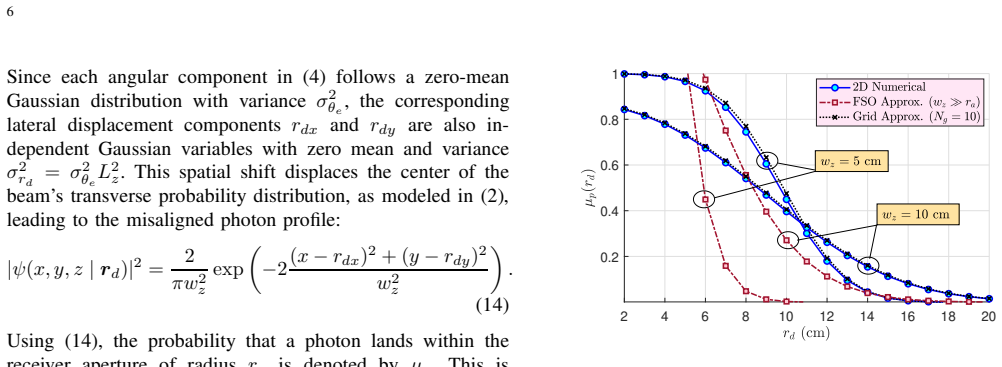
The load-bearing object is the grid-based photon capture approximation (Proposition 1). For a Gaussian single-photon probability density and a circular receiver aperture of radius $r_a$, the exact capture probability is a two-dimensional integral over the aperture; the grid scheme splits the aperture into $N_g$ segments of width $\Delta x=2r_a/N_g$, evaluates the Gaussian at each segment center $x_i$, and folds the segment's vertical extent into the coefficient $c_i = (2\Delta x/\sqrt{2\pi} w_z)\,\mathrm{erf}(\sqrt{2/w_z^2}\sqrt{r_a^2-x_i^2})$. This turns the capture probability into a sum of one-dimensional Gaussian terms that remain accurate when the beam waist $w_z$ is comparable to or smaller than the aperture, which is precisely the regime where the classical wide-beam formula $\mu_p(r_d)\approx (2r_a^2/w_z^2)\exp(-2\|r_d\|^2/w_z^2)$ fails. The capture probability then enters the end-to-end mean detected photon count $\mu_q = \mu_t \eta_{atm} \mu_d \mu_p(r_d) \eta_{turb} \mu_{FoV}$, with $\mu_{FoV}$ a Bernoulli visibility factor determined by the receiver's angular acceptance cone. Averaging over the Rayleigh-distributed beam displacement $r_d$ and the Gamma-Gamma turbulence $\eta_{turb}$ reduces the key rate and QBER to single one-dimensional integrals, which is what makes the framework tractable enough for system-level optimization.
What would settle it
A direct check is to rerun the paper's own parameter set through a complete BB84-style protocol that discards roughly half the accepted detections for basis sifting, rejects background-only slots, and applies a decoy-state security analysis; if the resulting secret key rate no longer reaches the Mbps range or the QBER exceeds the protocol threshold, the central performance claim fails as stated. A complementary experimental test would measure the raw single-photon detection rate and QBER on a 1 km UAV-to-ground link with 50 micro-radian transmitter tracking error, beam waist 5–10 cm, and background radiance $10^{-6}$ W/m²/sr/nm, and compare the measured values with Propositions 4 and 5.
Extended reading notes
Core claim
The central claim, stated in the paper's own terms, is that 'the wide-beam approximation in [24] becomes invalid' for UAV-to-ground quantum links, and that replacing that approximation is required to design links that actually work. The paper derives a grid-based approximation for the photon capture probability $\mu_p(r_d)$ that divides the receiver aperture into $N_g$ equal strips and represents each strip's contribution as a weighted Gaussian, so that $\mu_p(r_d) \approx \sum_{i=1}^{N_g} c_i \exp(-2(x_i-r_d)^2/w_z^2)$, with coefficients $c_i$ containing an error function; with $N_g=10$ it tracks exact numerical integration. This capture probability feeds a Poisson model for detected photons per quantum slot, and the paper's Propositions 2–5 produce one-dimensional integral expressions for the probability of detecting at least one photon, the raw key rate $R_{key}=R_q P(n_{\mathrm{eff}}=1)$, and the QBER. The headline quantitative results are that for 50 micro-radian transmitter tracking error the raw key rate surpasses 2 Mbps and QBER drops below $10^{-3}$, while for 2 milliradian tracking error the key rate falls below 100 kbps and QBER exceeds $10^{-1}$, and that the receiver field of view must be tuned as a trade-off between signal capture and background rejection.
Load-bearing premise
The load-bearing premise is that every time slot in which exactly one photon is detected counts as a valid raw key bit, even when that photon is stray background light, and no fraction of detections is set aside for the sender-receiver basis comparison that real quantum protocols perform; if those real-protocol steps are included, the reported key rates would fall.
Editorial extensions
If this is right
- Existing UAV-QKD analyses that use the wide-beam pointing-error model of [24] should be re-examined, because the approximation is inaccurate for the sub-10 cm beam waists the paper identifies as optimal.
- Link designers should treat receiver field of view as an adaptive parameter: wider FoV raises key rate under low background light, while narrower FoV is needed to keep QBER acceptable under daylight.
- The analytical framework enables fast joint optimization of beam waist, tracking precision, photon emission rate, and FoV without full Monte Carlo simulation.
- Milliradian-level tracking, which is acceptable for classical FSO links, makes UAV-to-ground QKD unusable in this model; micro-radian tracking is necessary.
- The same modeling approach applies with minor modifications to ground-to-UAV and terrestrial short-range free-space QKD, as the paper states in its conclusion.
Reading between the lines
- A full protocol-level analysis with basis sifting and decoy states would likely reduce the quoted Mbps figures by a factor of two or more, and possibly much more, because the paper's raw-key definition counts background-only slots as key bits; this is an inference from the paper's Appendix D, not its stated conclusion.
- The grid-based aperture model could be combined with an online estimator of background radiance and pointing-error variance to close the loop on FoV control; the paper proposes adaptive FoV tuning but does not specify a control algorithm.
- For very strong turbulence or non-Gaussian beam distortions, the Gamma-Gamma and Gaussian-beam assumptions may need re-examination, so the quantitative predictions are safest in the moderate-turbulence regime the paper assumes.
- A natural next step is to extend the framework to entangled-photon UAV links, where two correlated channels must be modeled jointly and background rejection matters even more; the paper mentions entanglement as future work.
Signed reviews
Editorial analysis
A structured set of objections, weighed in public.
Referee Report
Summary. The paper presents an analytical framework for UAV-to-ground free-space quantum links, replacing the wide-beam Farid-Hranilovic pointing-error formula with a grid-based discretization of the exact Gaussian aperture-capture integral. It derives approximate closed-form expressions for single-photon detection probability, a quantity it calls the quantum key generation rate, and QBER, including transmitter-side FSM jitter, receiver angle-of-arrival misalignment, Gamma-Gamma turbulence, atmospheric attenuation, detector efficiency, FoV filtering, and background Poisson noise. The analytical results are validated against numerical integration of the exact integral and against Monte Carlo simulation over 10^6 time slots. The key design conclusions are that optimal beam waists lie below roughly 10 cm, that tracking precision must be at the microradian level, and that the receiver FoV must balance background rejection against misalignment tolerance; the paper reports Mbps-level key rates and QBER below 10^-3 for optimized parameters.
Significance. If accepted as a channel-capture model, the paper's grid-based approximation is a useful and credible contribution: the wide-beam approximation of Ref. [24] genuinely becomes inaccurate when the spot size is comparable to or smaller than the aperture, and the proposed discretization is shown to match the exact numerical integral and Monte Carlo with no fitted parameters. The paper also correctly identifies a real system-level trade-off between FoV, background noise, and receiver misalignment. However, the significance of the reported QKD performance numbers is currently compromised by the raw-click-rate definition of the key rate, by an algebraic inconsistency in the central formula, and by an unjustified linearization in the derivation of the detection probability. Until these are corrected, the abstract's 'secure QKD' and 'Mbps-level key rates' claims are not supported by the manuscript as written.
major comments (4)
- [Appendix D, Eqs. (24)-(25), Fig. 4] The quantity called Rkey is not a QKD sifted or secret key rate. Appendix D explicitly defines a raw key bit as any slot with exactly one detected photon 'regardless of its source,' and State 2 (nq=0, nb=1) contributes PS2=μ_b e^{-μ_b}[1-∫P(nq≥1|rd)f_rd(rd)drd]. Eq. (24) also contains no factor of 1/2 for BB84 basis sifting. A background-only detection carries no information about the transmitted bit and would enter a QKD protocol only as an error, not as a valid key bit; the >2 Mbps value in Fig. 4(a) and the abstract's 'Mbps-level key rates' are therefore detector click rates, not secure key rates. The QBER expression in Eq. (26) likewise counts only State 2 as erroneous and omits basis-mismatch errors and multi-photon weak-coherent-pulse events. The performance claims need to be re-derived with a protocol-level model, including sifting, error correction and privacy amplification, and ideally decoy-state and finite-size analysis, before they can be reported as secure QKD rates.
- [Eq. (25) versus Eqs. (43)-(45)] There is an algebraic inconsistency in the central key-rate formula. From Appendix D, PS1=e^{-μ_b}S and PS3=(1/2)μ_b e^{-μ_b}S, where S denotes the integral over rd, so the coefficient multiplying S should be e^{-μ_b}(1+μ_b/2). Equation (25), however, contains e^{-μ_b}-(1/2)μ_b e^{-μ_b}, i.e., e^{-μ_b}(1-μ_b/2). The sign should be corrected, and the QBER expression in Eq. (26) should be checked against the corrected denominator. Although the discrepancy is numerically small when μ_b≪1, the formula as printed is not the sum of the three stated disjoint events.
- [Appendix C, Eqs. (22)-(23)] The linearization e^{-z cpt μ_p} ≈ 1 - z cpt μ_p is applied after a change of variable in which z ranges over (0,∞), not only over small arguments. For z > 1/(cpt μ_p) the approximation becomes negative and does not approximate the exponential. The agreement with Monte Carlo in Fig. 3 is encouraging for the tested parameter range, but the derivation does not establish the conditions under which Proposition 3 remains accurate. The authors should either state and justify the low-transmissivity regime in which this approximation is valid or use the exact moment expression.
- [Eq. (26), Proposition 5] The QBER definition considers only background-only slots as erroneous and assumes that State 1 and State 3 are error-free. In a polarization-encoded BB84 system, basis mismatch alone produces errors in a substantial fraction of sifted slots unless reconciliation is accounted for, and detector dark counts and multi-photon pulses also contribute. As written, Proposition 5 is not a QBER in the protocol sense and cannot be used to infer QKD security thresholds. This quantity should be either relabeled as a background-error indicator or extended to the full detection statistics.
minor comments (5)
- [Section III, Propositions 2-3] The symbol cpt is used in Propositions 2 and 3 before it is defined; it is first introduced in Appendix B. Define cpt = μ_t η_atm μ_d before Eq. (20).
- [Table II and Section IV] Table II sweeps wz directly, but Eq. (3) relates the received beam radius to the transmitter waist w0 and distance Lz. Clarify whether w0 is the optimized quantity and wz is computed from it, or whether the simulations independently set the spot radius at the receiver.
- [Title and Section IV] The title and abstract promise 'adaptive FoV tuning strategies,' but Section IV only studies the FoV trade-off; there is no concrete adaptive algorithm or control law. Either add such a strategy or soften the claim.
- [Appendix D] The notation n_t for the number of transmitted photons and n_tot for the total number of detected photons is easy to confuse; use distinct symbols such as n_sig and n_tot.
- [References] Reference [18] is cited as a TechRxiv preprint; if a peer-reviewed version exists, it should be cited instead of or in addition to the preprint.
Circularity Check
No significant circularity; the grid-based capture model is validated against the exact integral and Monte Carlo, and the performance metrics follow from stated model assumptions.
full rationale
The derivation chain is self-contained. The paper's central modeling contribution, the grid-based approximation in Proposition 1, is derived from the exact two-dimensional aperture integral (15) and validated against that integral and against Monte Carlo simulation (Figs. 2 and 3), rather than fitted to the target key-rate or QBER results. Propositions 2 and 3 follow from the stated conditional Poisson model, Gamma-Gamma turbulence statistics, and the Gaussian/Rayleigh pointing-error models, and Propositions 4 and 5 are explicit algebraic evaluations of the slot-level photon-counting scenarios defined in Appendices D and E. The claimed invalidity of the wide-beam approximation (16) is demonstrated by comparing it with the exact integral, not assumed. Self-citations (e.g., [25], [26], [34], [35]) are used as standard FSO context or baseline models and are not load-bearing for the core derivation. The raw-key-rate and QBER definitions in Eqs. (24)-(26) may be debatable as QKD protocol metrics (background-only slots are counted as key bits and no basis-sifting factor is applied), but that is a modeling/security-correctness concern, not a circular reduction: the reported numbers are outputs of the paper's stated definitions, not inputs that were fitted or assumed in order to produce the claimed results.
Assumptions & free parameters
free parameters (4)
- Effective per-pulse path efficiency cpt = mu_t * eta_atm * mu_d =
0.12 (Table II: mu_t=0.5, eta_atm=0.4, mu_d=0.6)
- Transmitter FSM tracking error sigma_theta_e =
50 microrad (baseline; swept 50 microrad to 2 mrad)
- Receiver angular misalignment sigma_AoA =
50 microrad (baseline; swept 50 to 200 microrad)
- Gamma-Gamma turbulence shape parameters alpha, beta =
2.1, 1.8
assumptions (5)
- standard math Single-photon transverse position follows a Gaussian beam probability distribution with waist wz (Eq. 2).
- domain assumption Atmospheric turbulence transmissivity follows a Gamma-Gamma distribution with alpha=2.1 and beta=1.8.
- ad hoc to paper Receiver acceptance is binary: any arrival angle within theta_FOV is accepted with probability one, any outside with probability zero (Eq. 12).
- ad hoc to paper Detected photons in each time slot follow a Poisson distribution via independent thinning, and the raw key bit rate counts any slot with exactly one detected photon, including background-only slots, with no basis sifting.
- ad hoc to paper The derivation approximates 1 - exp(-z * cpt * mu_p) by z * cpt * mu_p for small arguments (Appendix C).
Cite this review
Pith. "Pith review of A Unified Framework for UAV-Based Free-Space Quantum Links: Beam Shaping and Adaptive Field-of-View Control." pith.science (2026). https://pith.science/paper/Y7G3DZP5
@misc{pith2026250620336,
  author       = {Pith},
  title        = {Pith review of: A Unified Framework for UAV-Based Free-Space Quantum Links: Beam Shaping and Adaptive Field-of-View Control},
  year         = {2026},
  howpublished = {\url{https://pith.science/paper/Y7G3DZP5}},
  note         = {Machine review of arXiv:2506.20336}
}
abstract
This paper develops a comprehensive analytical framework for modeling and performance evaluation of unmanned aerial vehicles (UAVs)-to-ground quantum communication links, incorporating key physical impairments such as beam divergence, pointing errors at both transmitter and receiver, atmospheric attenuation, turbulence-induced fading, narrow field-of-view (FoV) filtering, and background photon noise. To overcome the limitations of conventional wide-beam assumptions, we introduce a grid-based approximation for photon capture probability that remains accurate under tightly focused beams. Analytical expressions are derived for the quantum key generation rate and quantum bit error rate (QBER), enabling fast and reliable system-level evaluation. Our results reveal that secure quantum key distribution (QKD) over UAV-based free-space optical (FSO) links requires beam waists below 10 cm and sub-milliradian tracking precision to achieve Mbps-level key rates and QBER below $10^{-3}$. Additionally, we highlight the critical role of receiver FoV in balancing background noise rejection and misalignment tolerance, and propose adaptive FoV tuning strategies under varying illumination and alignment conditions. The proposed framework provides a tractable and accurate tool for the design, optimization, and deployment of next-generation airborne quantum communication systems.
Figures


Figures from the paper (2 more)


Reference graph
Works this paper leans on
-
[24]
Outage capacity optimiz ation for free-space optical links with pointing errors,
A. A. Farid and S. Hranilovic, “Outage capacity optimiz ation for free-space optical links with pointing errors,” Journal of Lightwave technology, vol. 25, no. 7, pp. 1702–1710, 2007
2007
-
[1]
Cryptography in post Quantum computing era,
N. Sood, “Cryptography in post Quantum computing era,” Available at SSRN 4705470 , 2024
work page 2024
-
[2]
Quantum computers and algorithms: a threat to classical cr yptographic systems,
J. J. Tom, N. P . Anebo, B. A. Onyekwelu, A. Wilfred, and R. E yo, “Quantum computers and algorithms: a threat to classical cr yptographic systems,” Int. J. Eng. Adv. Technol , vol. 12, no. 5, pp. 25–38, 2023
work page 2023
-
[3]
Experimental quantum key distribution certified by Bell’s theorem,
D. P . Nadlinger, P . Drmota, B. C. Nichol, G. Araneda, D. Ma in, R. Srinivas, D. M. Lucas, C. J. Ballance, K. Ivanov, E.-Z. Tan et al. , “Experimental quantum key distribution certified by Bell’s theorem,” Nature, vol. 607, no. 7920, pp. 682–686, 2022
work page 2022
-
[4]
Secret key rate over multiple relays in quan tum key dis- tribution for cyber–physical systems,
P .-Y . Kong, “Secret key rate over multiple relays in quan tum key dis- tribution for cyber–physical systems,” IEEE Transactions on Industrial Informatics, 2024
work page 2024
-
[5]
Unmanned aerial vehicle as encry ption key distributor for secure communications in smart grid,
P .-Y . Kong and Y . Wang, “Unmanned aerial vehicle as encry ption key distributor for secure communications in smart grid,” IEEE Internet of Things Journal, vol. 10, no. 8, pp. 6849–6858, 2022
work page 2022
-
[6]
Low size, weight and power quantum key distribution system for small f orm unmanned aerial vehicles,
C. Quintana, P . Sibson, G. Erry, Y . Thueux, E. Kingston, T . Ismail, G. Faulkner, J. Kennard, K. Gebremicael, C. Clark et al. , “Low size, weight and power quantum key distribution system for small f orm unmanned aerial vehicles,” in Free-Space Laser Communications XXXI , vol. 10910. SPIE, 2019, pp. 240–246
-
[7]
Quantum internet in the sky: V ision, challenges, solutions, and future directions,
P . V . Trinh and S. Sugiura, “Quantum internet in the sky: V ision, challenges, solutions, and future directions,” IEEE Communications Magazine, vol. 62, no. 10, pp. 62–68, 2024
work page 2024
Show all 36 references
-
[8]
Towards Quan tum SAGINs Harnessing Optical RISs: Applications, Advances, a nd the Road Ahead,
P . V . Trinh, S. Sugiura, C. Xu, and L. Hanzo, “Towards Quan tum SAGINs Harnessing Optical RISs: Applications, Advances, a nd the Road Ahead,” IEEE Network , 2025. 13
2025
-
[9]
Quantum cryptography-as-a-service fo r secure UA V communication: applications, challenges, and case study,
V . K. Ralegankar, J. Bagul, B. Thakkar, R. Gupta, S. Tanwa r, G. Sharma, and I. E. Davidson, “Quantum cryptography-as-a-service fo r secure UA V communication: applications, challenges, and case study, ” Ieee Access , vol. 10, pp. 1475–1492, 2021
2021
-
[10]
Survey of promising technologies f or quantum drones and networks,
A. Kumar, S. Bhatia, K. Kaushik, S. M. Gandhi, S. G. Devi, D. A. D. J. Pacheco, and A. Mashat, “Survey of promising technologies f or quantum drones and networks,” Ieee Access , vol. 9, pp. 125 868–125 911, 2021
2021
-
[11]
QKD-based Secure Communicat ion for UA V,
Z. Gao, W. Fan, and R. Luo, “QKD-based Secure Communicat ion for UA V,” in 2023 24st Asia-Pacific Network Operations and Management Symposium (APNOMS) . IEEE, 2023, pp. 107–112
2023
-
[12]
Quantu m com- munication in weakly turbulent channels: Error analysis an d capacity bounds,
S. R. Kondamuri, N. K. Kundu, and A. Ghanshyala, “Quantu m com- munication in weakly turbulent channels: Error analysis an d capacity bounds,” IEEE Wireless Communications Letters , 2024
2024
-
[13]
Performance analysis of classical data transmission over a quantum channel in the pr esence of atmospheric turbulence,
C. Waghmare, A. Kothari, and P . K. Sharma, “Performance analysis of classical data transmission over a quantum channel in the pr esence of atmospheric turbulence,” IEEE Communications Letters , vol. 27, no. 8, pp. 2127–2131, 2023
2023
-
[14]
Blind reconciliation with protograph ldpc code extension for fso -based satellite qkd systems,
C. T. Nguyen, H. D. Le, V . V . Mai, P . V . Trinh, and A. T. Pham , “Blind reconciliation with protograph ldpc code extension for fso -based satellite qkd systems,” in 2024 14th International Symposium on Communication Systems, Networks and Digital Signal Processing (CSNDSP) ...
2024
-
[15]
Optical RIS s improve the secret key rate of free-space QKD in HAP-to-UA V scenario s,
P . V . Trinh, S. Sugiura, C. Xu, and L. Hanzo, “Optical RIS s improve the secret key rate of free-space QKD in HAP-to-UA V scenario s,” IEEE Journal on Selected Areas in Communications , 2025
2025
-
[16]
Quantum advant age of binary discrete modulations for space channels,
A. V´ azquez-Castro and B. Samandarov, “Quantum advant age of binary discrete modulations for space channels,” IEEE Wireless Communica- tions Letters , vol. 12, no. 5, pp. 903–906, 2023
2023
-
[17]
A Hybrid Noise Approach to Modelling of Free-Space Satellite Quantum Communication Channel for Continuous-V ariable QKD,
M. Chakraborty, A. Mukherjee, I. Krikidis, A. Nag, and S . Chandra, “A Hybrid Noise Approach to Modelling of Free-Space Satellite Quantum Communication Channel for Continuous-V ariable QKD,” IEEE Trans- actions on Green Communications and Networking , 2025
2025
-
[18]
On the impact of track- ing inaccuracy in space-based quantum key distribution: A s tochastic geometric approach,
M. T. Dabiri, M. Hasna, S. Althunibat et al. , “On the impact of track- ing inaccuracy in space-based quantum key distribution: A s tochastic geometric approach,” TechRxiv preprint, May 2025
2025
-
[19]
Reliability and s ecurity analysis of an entanglement-based QKD protocol in a dynamic ground-t o- UA V FSO communications system,
N. Alshaer, A. Moawad, and T. Ismail, “Reliability and s ecurity analysis of an entanglement-based QKD protocol in a dynamic ground-t o- UA V FSO communications system,” IEEE Access , vol. 9, pp. 168 052– 168 067, 2021
2021
-
[20]
Performance evaluation and s ecurity analysis of UA V -based FSO/CV -QKD system employing DP-QPSK/CD,
N. Alshaer and T. Ismail, “Performance evaluation and s ecurity analysis of UA V -based FSO/CV -QKD system employing DP-QPSK/CD,” IEEE Photonics Journal, vol. 14, no. 3, pp. 1–11, 2022
2022
-
[21]
UA V -Assisted Quantum Key Distribution for Secure Com- munications with Resource Limited Devices,
P .-Y . Kong, “UA V -Assisted Quantum Key Distribution for Secure Com- munications with Resource Limited Devices,” IEEE Transactions on V ehicular Technology, 2024
2024
-
[22]
Airbo rne quantum key distribution: a review,
Y . Xue, W. Chen, S. Wang, Z. Yin, L. Shi, and Z. Han, “Airbo rne quantum key distribution: a review,” Chinese Optics Letters , vol. 19, no. 12, p. 122702, 2021
2021
-
[23]
A unified MGF-based performance analysis of quan- tum communications over turbulence channels with pointing errors,
Y . H. Al-Badarneh, O. S. Badarneh, M. K. Alshawaqfeh, T. M. Khattab, and M. O. Hasna, “A unified MGF-based performance analysis of quan- tum communications over turbulence channels with pointing errors,” IEEE Wireless Communications Letters , 2025
2025
-
[25]
Tractab le optical channel modeling between UA Vs,
M. T. Dabiri, S. M. S. Sadough, and I. S. Ansari, “Tractab le optical channel modeling between UA Vs,” IEEE Transactions on V ehicular Technology, vol. 68, no. 12, pp. 11 543–11 550, 2019
2019
-
[26]
Optimal placement of U A V - assisted free-space optical communication systems with DF relaying,
M. T. Dabiri and S. M. S. Sadough, “Optimal placement of U A V - assisted free-space optical communication systems with DF relaying,” IEEE Communications Letters , vol. 24, no. 1, pp. 155–158, 2019
2019
-
[27]
Security bounds for decoy-state quantum key distribution with arbitrary photon-number statistics,
G. Foletto, F. Picciariello, C. Agnesi, P . Villoresi, a nd G. V allone, “Security bounds for decoy-state quantum key distribution with arbitrary photon-number statistics,” Physical Review A, vol. 105, no. 1, p. 012603, 2022
2022
-
[28]
Gaussian, hermite-gau ssian, and laguerre-gaussian beams: A primer,
F. Pampaloni and J. Enderlein, “Gaussian, hermite-gau ssian, and laguerre-gaussian beams: A primer,” arXiv preprint physics/0410021 , 2004
2004 arXiv
-
[29]
CRC press, 2019
Optical wireless communications: system and channel model ling with Matlab®. CRC press, 2019
2019
-
[30]
A Novel MRR-UA V -Based Relay W ith Optical Network Coding: A Comparative Study With Optical IR S and Conventional UA V Relaying,
M. T. Dabiri and M. Hasna, “A Novel MRR-UA V -Based Relay W ith Optical Network Coding: A Comparative Study With Optical IR S and Conventional UA V Relaying,” IEEE Journal on Selected Areas in Communications, vol. 43, no. 5, pp. 1607–1620, 2025
2025
-
[31]
Characte ristics of non- line-of-sight polarization ultraviolet communication ch annels,
H. Zhang, H. Yin, H. Jia, S. Chang, and J. Y ang, “Characte ristics of non- line-of-sight polarization ultraviolet communication ch annels,” Applied optics, vol. 51, no. 35, pp. 8366–8372, 2012
2012
-
[32]
L. C. Andrews and R. L. Phillips, Laser Beam Propagation through Random Media . SPIE Press, 2005
2005
-
[33]
Photon-counting statistics-based support vec tor machine with multi-mode photon illumination for quantum imaging,
J.-W. Kim, J.-S. Cho, C. Sacarelo, N. D. F. Fitri, J.-S. H wang, and J.- K. K. Rhee, “Photon-counting statistics-based support vec tor machine with multi-mode photon illumination for quantum imaging,” Scientific Reports, vol. 12, no. 1, p. 16594, 2022
2022
-
[34]
Chann el modeling and parameter optimization for hovering UA V -based free-sp ace optical links,
M. T. Dabiri, S. M. S. Sadough, and M. A. Khalighi, “Chann el modeling and parameter optimization for hovering UA V -based free-sp ace optical links,” IEEE Journal on Selected Areas in Communications , vol. 36, no. 9, pp. 2104–2113, 2018
2018
-
[35]
Mo dulating retroreflector-based satellite-to-ground optical commun ications: Acqui- sition, sensing and positioning,
M. T. Dabiri, M. Hasna, S. Althunibat, and K. Qaraqe, “Mo dulating retroreflector-based satellite-to-ground optical commun ications: Acqui- sition, sensing and positioning,” IEEE Transactions on Communications, 2024
2024
-
[36]
I. S. Gradshteyn and I. M. Ryzhik, Table of Integrals, Series, and Products, 7th ed., A. Jeffrey and D. Zwillinger, Eds. Academic Press, 2007
2007
Reviewed August 6, 2026 · model on record in the stance chip above.
Discussion (0). Continue with ORCID to comment.