REVIEW 3 major objections 4 minor 50 references
Error formulae for the energy-dependent cross-spectrum
T0 review · 3 major / 4 minor · reviewed 2026-08-14 · deepseek-v4-flash
Pith's one-line read The standard error bars used for energy-dependent X-ray cross-spectra are too large, and this paper derives the correct analytic replacements.
desk verdict Useful and mostly correct fix for an over-fitting bug in X-ray spectral-timing, but the modulus/phase formulas overclaim 'any coherence' — they are high-coherence approximations. read the letter →
The pith
A machine-rendered reading of the paper's core claim, the machinery that carries it, and where it could break.
The reading
What carries the argument
The central object is the energy-dependent cross-spectrum with a common reference band, modeled as complex Gaussian Fourier transforms with additive, uncorrelated noise. The argument splits the variance into a 'k variance' over frequency realizations and an 'n variance' over energy channels; in the energy-dependent limit, the shared reference band contributes zero n-variance to the real and imaginary parts, while subject-band and noise terms contribute $1/(2N)$ variances. This reduction makes the new errors on the real, imaginary, and modulus parts identical, and it sets the phase-error and rms-error formulae. The broad-reference-band correction subtracts the subject band's own Poisson noise contribution from the cross-spectrum.
What would settle it
Simulate light curves with log-normal, non-Gaussian flux variability, apply equations (18), (19), and (22) with the same N=500 averaging, and check whether 1-sigma error bars bracket the true model in about 68 percent of energy channels and whether the reduced chi-squared distribution matches the theoretical chi-squared with Ne-1 degrees of freedom; systematic deviations would show that the Gaussian assumption is load-bearing.
Extended reading notes
Core claim
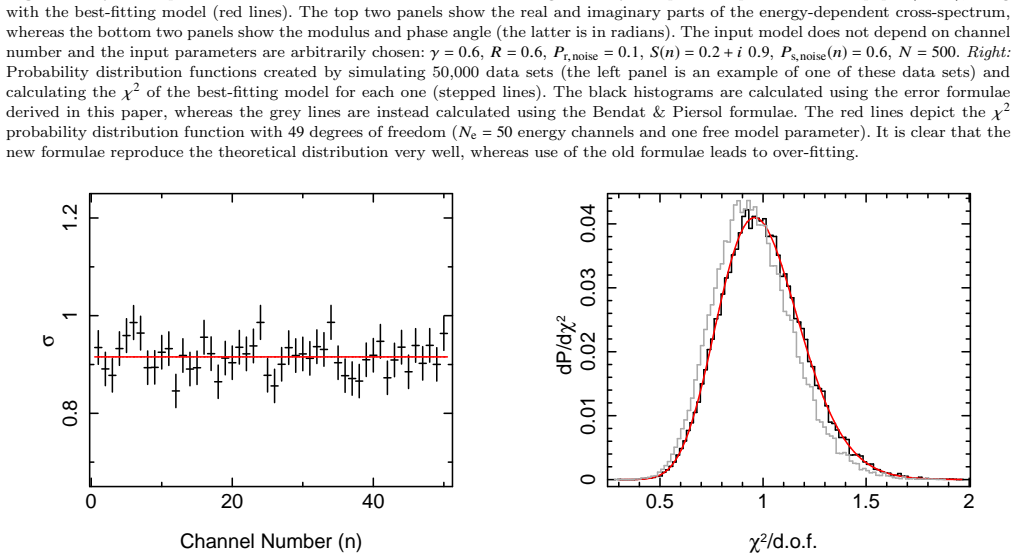
The central claim is that equations (18), (19), and (22) give the correct 1-sigma errors for the energy-dependent cross-spectrum and rms spectrum, in the limit where averaged Fourier estimates are Gaussian. The key is that the same reference band appears in every subject-band cross-spectrum, and that subject bands are correlated with one another, so reference-band and shared-signal fluctuations act as a common systematic rather than independent scatter. Consequently, fitting the correct model with these errors yields reduced chi-squared with expectation value unity, whereas Bendat & Piersol (2010) errors yield over-fitting. The formulae also handle a broad reference band built from the sum of subject bands by subtracting a small noise term, eliminating the need to excise the current subject band from the reference.
Load-bearing premise
The formulae assume that the measured Fourier transforms behave like complex Gaussian random variables with signal and noise adding independently, and that averages over at least about 40 realizations are Gaussian; real variability from accreting sources is known to be log-normal and non-linear.
Editorial extensions
If this is right
- Energy-dependent spectral-timing fits that use the new uncertainties will no longer be systematically over-fit: the expected reduced chi-squared for a correct model is unity, not below it.
- A broad reference band formed by summing all subject bands can be used directly by subtracting the subject band's own Poisson noise contribution; the common practice of excising the subject band from the reference is unnecessary.
- For rms spectra, the formula interpolates between the old single-band error at $γ=0$ and a corrected $γ=1$ limit that differs from a commonly quoted version by a factor $√2$.
- The example fit to Cygnus X-1 with the reltrans reverberation model moves from reduced chi-squared 0.76 to 42.9/36, with best-fit parameters consistent within 1 sigma.
- The new formulae also improve the expected sensitivity of X-ray polarimetry-timing searches for quasi-periodic oscillations in polarization degree and angle.
Reading between the lines
- If the Gaussian-plus-uncorrelated-noise model is adequate, the same variance-splitting argument should apply to other correlated Fourier statistics, such as energy-dependent covariance spectra, by simple rescaling; the paper already gives the rescaling for complex covariance.
- The formulae expose a clean separation between statistical scatter among energy channels and a normalization systematic coming from the shared reference band, which matters when model normalizations are tied across frequency ranges.
- A natural stress test is to apply the formulae to simulated log-normal, non-linear variability; if coverage departs from nominal, the Gaussian assumption would need a multiplicative correction or a different noise model.
- The new understanding of which fluctuations are systematic rather than statistical could sharpen frequentist model comparison in multi-band timing fits, not just single-model chi-squared.
Signed reviews
Editorial analysis
A structured set of objections, weighed in public.
Referee Report
Summary. The paper presents analytic error formulae for the energy-dependent cross-spectrum (real part, imaginary part, modulus, phase) and for the rms spectrum, explicitly accounting for the use of a common reference band and for correlations between subject bands. The central claim is that equations (18), (19) and (22) give correct 1σ uncertainties for any intrinsic coherence, in contrast to the Bendat & Piersol (2010) formulae, which overestimate errors in the energy-dependent limit and cause overfitting. The paper validates the formulae with 50,000 Monte Carlo realizations under a Gaussian signal-plus-noise model, demonstrates the method on RXTE Cygnus X-1 data, discusses the optimal reference band and the bias correction for coherence, and provides a Fortran implementation.
Significance. If the real/imag and rms formulae are correct, they fill a practical gap: fitting energy-dependent timing spectra is increasingly common, and the paper correctly identifies why single-spectrum error bars cause overfitting. The Monte Carlo validation is extensive, the observational fit is consistent, the correction to the Uttley et al. (2014) rms error formula is valuable, and the treatment of broad reference bands is elegant. The main weakness is that the modulus and phase formulae are derived from a small-scatter linearization that fails at low intrinsic coherence, while the paper claims validity for any coherence; this needs to be fixed before publication.
major comments (3)
- [§4.2, Eq. (18)] The equality d|G| = dRe = dIm is derived from concentric circular error contours, which is only an approximation for a Gaussian cloud that does not contain the origin. Under the paper's own model with γ = 0, G̃ is a zero-mean complex Gaussian and |G̃| has a Rayleigh distribution with standard deviation ≈ 0.655 σ, where σ = dRe from Eq. (18); equation (18) therefore overestimates the modulus error by roughly a factor 1.5, and a constant-modulus fit to 50 channels would yield reduced χ² ≈ 0.43 rather than 1. The Section 3 simulation uses γ = 0.6 with |G|/σ ≈ 27, so it does not probe this regime, and the claim that the formulae are valid 'for any value of intrinsic coherence' (abstract and conclusions) is thus not supported.
- [§4.2, Eq. (19)] The phase error diverges as γ → 0 because the denominator |G̃|² − b̃² tends to zero, whereas the true phase distribution under the Gaussian model tends to a uniform distribution on [0, 2π), for which a linear 1σ error is not meaningful. Equation (44), taken from Bendat & Piersol, is a small-angle linearization and is not valid when the Gaussian cloud contains the origin; the paper should either restrict Eq. (19) to |G|/dRe ≫ 1 or provide a proper wrapped/Rician treatment.
- [§4.2, around Eq. (46)] The assertion that the 'other 35 terms' have zero k covariance does not follow from the fact that the total k covariance equals the first term's contribution; the remaining terms could cancel. Since the conclusion Cov_n{Re[G̃], Im[G̃]} = 0 rests on this shortcut, the derivation needs a direct evaluation or an explicit symmetry argument for the cross terms.
minor comments (4)
- [Abstract and Section 7] The phrase 'valid for any value of intrinsic coherence' should be qualified, since the modulus and phase formulae are only demonstrated for high coherence; the real/imag and rms formulae appear more general.
- [Section 3] Please report the ratio |G|/σ for the simulated and observed data; without this, the reader cannot easily see that the validation is confined to the high-coherence, high-signal-to-noise regime.
- [Section 5] There are two typos: 'This is not indented as a means' should be 'intended', and 'logarithmicaly' should be 'logarithmically'.
- [Section 2.4] It would help to state explicitly that d|G| in Eq. (18) is a large-|G|/σ approximation rather than an exact equality for all coherence values.
Circularity Check
No circularity found: the new error formulae are derived from an explicit Gaussian signal-plus-noise model and validated against the external chi-square distribution, with no fitted parameters presented as predictions.
full rationale
The derivation chain in Section 4 is self-contained. Starting from the explicit generative model in equations (23) and (24), the paper expands the estimated cross-spectrum real and imaginary parts, computes the n-variance of each term from standard Gaussian sampling statistics (equations 37-42), sums them to obtain equation (43), and rearranges to get equation (18). The phase and rms formulae (19) and (22) follow from the same variance bookkeeping. No parameter is fit to a data subset and no fitted quantity is renamed as a prediction; the formulae are expressed directly in terms of the estimated power spectra, coherence, and noise levels. The Monte Carlo verification uses the same Gaussian model, so it is an in-sample check, but it is not circular because the error formulae are not used to generate the simulated data; the chi-square histograms are compared with the theoretical chi-square distribution with 49 degrees of freedom, which is an external benchmark. The paper's self-citations (e.g., reltrans in Section 5 and the discussion in Section 6.2) are applications or context, not load-bearing premises of the derivation. The passage in Section 6.2 noting that reference-band uncertainty is treated as a systematic rather than statistical error is a stated limitation, not a circular step; similarly, the skeptical concern that the modulus/phase formula may fail at low intrinsic coherence is a possible correctness issue in a nonlinear regime, not a reduction of the claimed result to its inputs. Overall, the central claim is independently derived and does not assume the target error formulas.
Assumptions & free parameters
assumptions (5)
- domain assumption Fourier transforms of the observed light curves are modeled as complex Gaussian signal plus uncorrelated Gaussian noise (equations 23 and 24).
- domain assumption For N at least 40 realizations, the estimated cross-spectral quantities are Gaussian distributed (Huppenkothen and Bachetti 2018).
- domain assumption The underlying power spectra, coherence, and phase lags are stationary over the observation time T.
- domain assumption Signal and noise contributions are completely uncorrelated with one another.
- domain assumption When the reference band is the sum of subject bands, the noise contribution is accounted for by subtracting the term N(k,n) derived in Section 2.2 (equations 6 to 11).
Cite this review
Pith. "Pith review of Error formulae for the energy-dependent cross-spectrum." pith.science (2026). https://pith.science/paper/Y7LFAJOF
@misc{pith2026190901385,
  author       = {Pith},
  title        = {Pith review of: Error formulae for the energy-dependent cross-spectrum},
  year         = {2026},
  howpublished = {\url{https://pith.science/paper/Y7LFAJOF}},
  note         = {Machine review of arXiv:1909.01385}
}
read the original abstract
I present analytic error formulae for the energy-dependent cross-spectrum and rms spectrum, which are Fourier statistics widely used to probe the rapid X-ray variability observed from accreting compact objects. The new formulae cover the modulus, phase, real and imaginary parts of the cross-spectrum, and are valid for any value of intrinsic coherence between variability in different energy bands. I show that existing error formulae (including that for the phase lag), which are valid for a single cross-spectrum or power spectrum, lead to over-fitting when applied to the energy-dependent cross-spectrum - which consists of cross-spectra between individual energy channels and a common reference band. I also introduce an optimal, unbiased way to define the reference band and an accurate way to calculate the intrinsic coherence between energy bands. I find that the traditional use of the old formulae has likely had a rather benign impact on the literature, but recommend the use of the new formulae in future wherever appropriate, since they are more accurate and are no harder to implement than existing error estimates. A code to implement the new error formulae on observational data is available online.
Figures


Figures from the paper (2 more)


Reference graph
Works this paper leans on
-
[1]
Arnaud K. A., 1996, in G. H. Jacoby & J. Barnes ed., Astronomical Society of the Pacific Conference Series Vol. 101, Astronomical Data Analysis Software and Systems V. pp 17--+
work page 1996
-
[2]
Axelsson M., Done C., 2018, @doi [ ] 10.1093/mnras/sty1801 , http://adsabs.harvard.edu/abs/2018MNRAS.480..751A 480, 751
-
[3]
Axelsson M., Hjalmarsdotter L., Done C., 2013, @doi [ ] 10.1093/mnras/stt315 , http://adsabs.harvard.edu/abs/2013MNRAS.431.1987A 431, 1987
-
[4]
Axelsson M., Done C., Hjalmarsdotter L., 2014, @doi [ ] 10.1093/mnras/stt2236 , http://adsabs.harvard.edu/abs/2014MNRAS.438..657A 438, 657
-
[5]
S., 1955, An introduction to stochastic processes
Bartlett M. S., 1955, An introduction to stochastic processes . Cambridge University Press, 1955
work page 1955
-
[6]
S., Piersol A
Bendat J. S., Piersol A. G., 2010, Random Data: Analysis and measurement procedures; 4th edition . Wiley, 2010
2010
-
[7]
Bult P., 2017, @doi [ ] 10.3847/1538-4357/aa607f , http://adsabs.harvard.edu/abs/2017ApJ...837...61B 837, 61
-
[8]
M., Zoghbi A., Reynolds C., Fabian A
Cackett E. M., Zoghbi A., Reynolds C., Fabian A. C., Kara E., Uttley P., Wilkins D. R., 2014, @doi [ ] 10.1093/mnras/stt2424 , http://adsabs.harvard.edu/abs/2014MNRAS.438.2980C 438, 2980
Show all 50 references
-
[9]
J., Kara E., 2016, @doi [ ] 10.1093/mnras/stw1105 , http://adsabs.harvard.edu/abs/2016MNRAS.460.3076C 460, 3076
Chainakun P., Young A. J., Kara E., 2016, @doi [ ] 10.1093/mnras/stw1105 , http://adsabs.harvard.edu/abs/2016MNRAS.460.3076C 460, 3076
2016 doi
-
[10]
De Marco B., Ponti G., 2016, preprint, http://adsabs.harvard.edu/abs/2016arXiv160500765D ( @eprint arXiv 1605.00765 )
2016 arXiv
-
[11]
M., Fabian A
De Marco B., Ponti G., Cappi M., Dadina M., Uttley P., Cackett E. M., Fabian A. C., Miniutti G., 2013, @doi [ ] 10.1093/mnras/stt339 , http://adsabs.harvard.edu/abs/2013MNRAS.431.2441D 431, 2441
2013 doi
-
[12]
De Marco B., et al., 2017, @doi [ ] 10.1093/mnras/stx1649 , http://adsabs.harvard.edu/abs/2017MNRAS.471.1475D 471, 1475
2017 doi
-
[13]
C., et al., 2009, @doi [ ] 10.1038/nature08007 , http://adsabs.harvard.edu/abs/2009Natur.459..540F 459, 540
Fabian A. C., et al., 2009, @doi [ ] 10.1038/nature08007 , http://adsabs.harvard.edu/abs/2009Natur.459..540F 459, 540
2009 doi
-
[14]
Gilfanov M., Churazov E., Revnivtsev M., 2000, @doi [ ] 10.1046/j.1365-8711.2000.03686.x , http://adsabs.harvard.edu/abs/2000MNRAS.316..923G 316, 923
2000
-
[15]
Huppenkothen D., Bachetti M., 2018, @doi [ ] 10.3847/1538-4365/aabe38 , http://adsabs.harvard.edu/abs/2018ApJS..236...13H 236, 13
2018 doi
-
[17]
R., Maccarone T
Ingram A. R., Maccarone T. J., 2017, @doi [ ] 10.1093/mnras/stx1881 , http://adsabs.harvard.edu/abs/2017MNRAS.471.4206I 471, 4206
2017 doi
-
[18]
Ingram A., van der Klis M. v. d., 2013, @doi [ ] 10.1093/mnras/stt1107 , http://adsabs.harvard.edu/abs/2013MNRAS.434.1476I 434, 1476
2013 doi
-
[19]
Ingram A., van der Klis M., Middleton M., Done C., Altamirano D., Heil L., Uttley P., Axelsson M., 2016, @doi [ ] 10.1093/mnras/stw1245 , http://adsabs.harvard.edu/abs/2016MNRAS.461.1967I 461, 1967
2016 doi
-
[20]
A., 2019, arXiv e-prints, https://ui.adsabs.harvard.edu/abs/2019arXiv190608310I p
Ingram A., Mastroserio G., Dauser T., Hovenkamp P., van der Klis M., Garc \' a J. A., 2019, arXiv e-prints, https://ui.adsabs.harvard.edu/abs/2019arXiv190608310I p. arXiv:1906.08310
2019 arXiv
-
[21]
C., Cackett E
Kara E., Fabian A. C., Cackett E. M., Uttley P., Wilkins D. R., Zoghbi A., 2013, @doi [ ] 10.1093/mnras/stt1055 , http://adsabs.harvard.edu/abs/2013MNRAS.434.1129K 434, 1129
2013 doi
-
[22]
N., Fabian A
Kara E., Alston W. N., Fabian A. C., Cackett E. M., Uttley P., Reynolds C. S., Zoghbi A., 2016, @doi [ ] 10.1093/mnras/stw1695 , http://adsabs.harvard.edu/abs/2016MNRAS.462..511K 462, 511
2016 doi
-
[23]
Kara E., et al., 2019, @doi [ ] 10.1038/s41586-018-0803-x , http://adsabs.harvard.edu/abs/2019Natur.565..198K 565, 198
2019 doi
-
[24]
Kotov O., Churazov E., Gilfanov M., 2001, @doi [ ] 10.1046/j.1365-8711.2001.04769.x , http://adsabs.harvard.edu/abs/2001MNRAS.327..799K 327, 799
2001
-
[25]
E., 1997, @doi [ ] 10.1093/mnras/292.3.679 , http://adsabs.harvard.edu/abs/1997MNRAS.292..679L 292, 679
Lyubarskii Y. E., 1997, @doi [ ] 10.1093/mnras/292.3.679 , http://adsabs.harvard.edu/abs/1997MNRAS.292..679L 292, 679
1997 doi
-
[26]
J., Uttley P., van der Klis M., Wijnands R
Maccarone T. J., Uttley P., van der Klis M., Wijnands R. A. D., Coppi P. S., 2011, @doi [ ] 10.1111/j.1365-2966.2011.18273.x , http://adsabs.harvard.edu/abs/2011MNRAS.413.1819M 413, 1819
2011
-
[27]
D., Done C., 2018, preprint, http://adsabs.harvard.edu/abs/2018arXiv180304811M ( @eprint arXiv 1803.04811 )
Mahmoud R. D., Done C., 2018, preprint, http://adsabs.harvard.edu/abs/2018arXiv180304811M ( @eprint arXiv 1803.04811 )
2018 arXiv
-
[28]
Mastroserio G., Ingram A., van der Klis M., 2018, @doi [ ] 10.1093/mnras/sty075 , http://adsabs.harvard.edu/abs/2018MNRAS.475.4027M 475, 4027
2018 doi
-
[29]
arXiv:1906.08266
Mastroserio G., Ingram A., van der Klis M., 2019, arXiv e-prints, https://ui.adsabs.harvard.edu/abs/2019arXiv190608266M p. arXiv:1906.08266
2019 arXiv
-
[30]
M., Koerding E., Knigge C., Uttley P., Fender R
McHardy I. M., Koerding E., Knigge C., Uttley P., Fender R. P., 2006, @doi [ ] 10.1038/nature05389 , http://adsabs.harvard.edu/abs/2006Natur.444..730M 444, 730
2006 doi
-
[31]
A., Vaughan B
Nowak M. A., Vaughan B. A., Wilms J., Dove J. B., Begelman M. C., 1999, @doi [ ] 10.1086/306610 , http://ads.nao.ac.jp/abs/1999ApJ...510..874N 510, 874
1999 doi
-
[32]
Peille P., Barret D., Uttley P., 2015, @doi [ ] 10.1088/0004-637X/811/2/109 , http://adsabs.harvard.edu/abs/2015ApJ...811..109P 811, 109
2015 doi
-
[33]
Rapisarda S., Ingram A., Kalamkar M., van der Klis M., 2016, @doi [ ] 10.1093/mnras/stw1878 , http://adsabs.harvard.edu/abs/2016MNRAS.462.4078R 462, 4078
2016 doi
-
[34]
Rapisarda S., Ingram A., van der Klis M., 2017a, @doi [ ] 10.1093/mnras/stx991 , http://adsabs.harvard.edu/abs/2017MNRAS.469.2011R 469, 2011
2011 doi
-
[35]
Rapisarda S., Ingram A., van der Klis M., 2017b, @doi [ ] 10.1093/mnras/stx2110 , http://adsabs.harvard.edu/abs/2017MNRAS.472.3821R 472, 3821
-
[36]
Revnivtsev M., Gilfanov M., Churazov E., 1999, , http://adsabs.harvard.edu/abs/1999A
1999
-
[37]
Timmer J., Koenig M., 1995, , http://adsabs.harvard.edu/abs/1995A
1995
-
[38]
M., Vaughan S., 2005, @doi [ ] 10.1111/j.1365-2966.2005.08886.x , http://adsabs.harvard.edu/abs/2005MNRAS.359..345U 359, 345
Uttley P., McHardy I. M., Vaughan S., 2005, @doi [ ] 10.1111/j.1365-2966.2005.08886.x , http://adsabs.harvard.edu/abs/2005MNRAS.359..345U 359, 345
2005
-
[39]
M., Fabian A
Uttley P., Cackett E. M., Fabian A. C., Kara E., Wilkins D. R., 2014, @doi [ ] 10.1007/s00159-014-0072-0 , http://adsabs.harvard.edu/abs/2014A
2014 doi
-
[40]
A., Nowak M
Vaughan B. A., Nowak M. A., 1997, @doi [ ] 10.1086/310430 , http://adsabs.harvard.edu/abs/1997ApJ...474L..43V 474, L43
1997 doi
-
[41]
S., Uttley P., 2003, @doi [ ] 10.1046/j.1365-2966.2003.07042.x , http://ads.nao.ac.jp/abs/2003MNRAS.345.1271V 345, 1271
Vaughan S., Edelson R., Warwick R. S., Uttley P., 2003, @doi [ ] 10.1046/j.1365-2966.2003.07042.x , http://ads.nao.ac.jp/abs/2003MNRAS.345.1271V 345, 1271
2003
-
[42]
C., et al., 2016, in Society of Photo-Optical Instrumentation Engineers (SPIE) Conference Series
Weisskopf M. C., et al., 2016, in Society of Photo-Optical Instrumentation Engineers (SPIE) Conference Series. p. 990517, @doi 10.1117/12.2235240
2016 doi
-
[43]
Wilkinson T., 2011, PhD thesis, University of Southampton
2011
-
[44]
Wilkinson T., Uttley P., 2009, @doi [ ] 10.1111/j.1365-2966.2009.15008.x , http://ads.nao.ac.jp/abs/2009MNRAS.397..666W 397, 666
2009
-
[45]
Wilms J., Allen A., McCray R., 2000, @doi [ ] 10.1086/317016 , http://adsabs.harvard.edu/abs/2000ApJ...542..914W 542, 914
2000 doi
-
[46]
H., Morgan E
Zhang W., Jahoda K., Swank J. H., Morgan E. H., Giles A. B., 1995, @doi [ ] 10.1086/176111 , http://adsabs.harvard.edu/abs/1995ApJ...449..930Z 449, 930
1995 doi
-
[47]
C., Reynolds C
Zoghbi A., Fabian A. C., Reynolds C. S., Cackett E. M., 2012, @doi [ ] 10.1111/j.1365-2966.2012.20587.x , http://adsabs.harvard.edu/abs/2012MNRAS.422..129Z 422, 129
2012
-
[48]
van der Klis M., 1989, in \"O gelman H., van den Heuvel E. P. J., eds, NATO Advanced Science Institutes (ASI) Series C Vol. 262, NATO Advanced Science Institutes (ASI) Series C. p. 27
1989
-
[49]
van der Klis M., 2006, @doi [Advances in Space Research] 10.1016/j.asr.2005.11.026 , http://adsabs.harvard.edu/abs/2006AdSpR..38.2675V 38, 2675
2006 doi
-
[50]
van der Klis M., Hasinger G., Stella L., Langmeier A., van Paradijs J., Lewin W. H. G., 1987, @doi [ ] 10.1086/184946 , http://adsabs.harvard.edu/abs/1987ApJ...319L..13V 319, L13
1987 doi
-
[51]
write newline
" write newline "" before.all 'output.state := FUNCTION fin.entry write newline FUNCTION new.block output.state before.all = 'skip after.block 'output.state := if FUNCTION new.sentence output.state after.block = 'skip output.state before.all = 'skip after.sentence 'output.stat...
Reviewed August 14, 2026 · model on record in the stance chip above.
Discussion (0). Continue with ORCID to comment.