REVIEW 4 major objections 5 minor 25 references
Cutting Sequence Diffuser: Sim-to-Real Transferable Planning for Object Shaping by Grinding
T0 review · 4 major / 5 minor · reviewed 2026-08-11 · deepseek-v4-flash
Pith's one-line read This paper claims that a grinding robot can learn to shape objects from pure geometric simulation, provided each cut removes only a small volume, and that a diffusion model can plan those long cutting sequences quickly enough for real use.
desk verdict Good engineering paper with a clean idea and real-robot results, but the current experiments do not isolate the small-removal-volume mechanism that is supposed to close the sim-to-real gap. read the letter →
The pith
A machine-rendered reading of the paper's core claim, the machinery that carries it, and where it could break.
The reading
What carries the argument
The load-bearing object is the constrained action space defined by Eq. (8). Every sampled action must remove no more than $\epsilon_{\rm vol}$ volume per step and must not overcut the reference shape by more than $d_{\rm vol}$, which keeps each transition within the regime where grinding resistance is small enough for the geometric cutting model to hold. On top of this, a diffusion model is trained over latent shape features obtained from a PointNet-based VAE, and during deployment it plans with two-step guidance: a full-task-horizon trajectory is generated first to supply intermediate shape targets, then shorter-horizon guided denoising replans against those targets, preventing large-volume compensating cuts.
What would settle it
A reader could test the central claim by running the same CSD policies on a material or belt condition where measured single-pass grinding force is not linear in removal volume (for example, a worn belt or a much harder workpiece) and checking whether shape error degrades relative to CSA-MBRL. A second test is to repeat the real robot experiment with an uncalibrated sim-to-real coordinate frame; if shape error rises sharply, the calibration step, rather than the small-volume constraint, is carrying the transfer.
Extended reading notes
Core claim
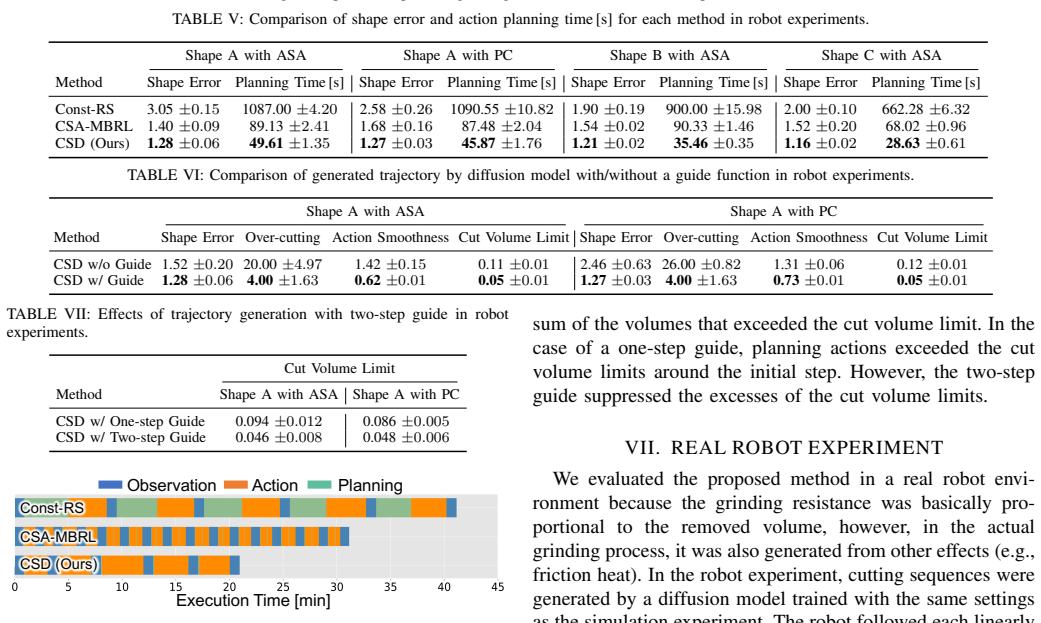
The central claim is that constraining each grinding action to a small removal volume, as in Eq. (8a) with $f_{\rm col}(s_t,a_t)\le\epsilon_{\rm vol}$, makes the real grinding process behave like the Geometric-Cutting Model used in simulation. Under this constraint, the shape transition is approximately a geometric splitting by a cutting surface, so the simulator's algebraic operations predict real shape changes well enough that a diffusion model trained only on simulated data can plan actions for a real robot. The paper reports that CSD achieves final shape error comparable to CSA-MBRL, which learns from real data, across two materials and three target shapes, while reducing action planning time to tens of seconds and lowering over-cutting and per-step volume violations when guided by the designed cost functions.
Load-bearing premise
The load-bearing premise is that grinding resistance is proportional to removal volume and that keeping each step's removal volume below a threshold makes the geometric cutting simulation accurate enough for the real robot, belt, and materials; the paper also notes that shape coordinate differences between simulation and reality were calibrated in advance, and that calibration is not specified.
Editorial extensions
If this is right
- A grinding robot can be set up for a new material or target shape using only simulation data, avoiding irreversible and costly real-world data collection.
- The diffusion planner's long-horizon sequences reduce the need for frequent shape observations, cutting total task execution time compared with the real-data baseline.
- Cost-guided denoising measurably improves over-cutting, action smoothness, and per-step volume limit violations over unguided generation.
- The two-step guide suppresses the large single-step cuts that would otherwise appear when the planning horizon is shorter than the task horizon.
Reading between the lines
- If the volume-proportional resistance assumption is what makes this work, the same small-step constraint could extend to other irreversible removal processes such as milling or filing, where a geometric cutting approximation is plausible.
- The paper discloses that shape coordinate differences between simulation and reality were calibrated in advance; a natural follow-up is to measure how much of the transfer accuracy survives without that calibration.
- A sharper test of the theory would be to estimate $\epsilon_{\rm vol}$ from a one-step real grinding force measurement and compare shape error across materials, rather than fixing the threshold once.
- For worn belts or very hard workpieces, the linear resistance law likely degrades, so re-tuning the cut-volume-limit cost or adding force feedback would become necessary.
Signed reviews
Editorial analysis
A structured set of objections, weighed in public.
Referee Report
Summary. The paper proposes Cutting Sequence Diffuser (CSD), a diffusion-based trajectory planner for robotic belt grinding. Training data are collected in a geometric cutting simulator under a small per-step removal volume constraint (Eq. 8), point-cloud shapes are compressed by a VAE, and an H-step action sequence is generated by guided diffusion with a two-step guidance procedure, executed closed-loop in M-step blocks. The method is evaluated in simulation and on a real grinding cell with ASA and PC materials and three target shapes, comparing shape error and planning time against Const-RS and CSA-MBRL. The main claim is that constraining per-step removal volume reduces grinding resistance and thereby makes a purely geometric simulation model sufficient for sim-to-real transfer without real-robot data.
Significance. If the central claim were established, the paper would make a useful practical contribution: sim-only training for an irreversible process in which real data collection is expensive, combined with fast long-horizon planning and demonstration on a real robot. The real-robot experiments across two materials and three shapes, the inclusion of CSA-MBRL (a real-data baseline) as a comparison, and the honest discussion of limitations are strengths. However, the mechanism behind the alleged sim-to-real transfer is not isolated by the reported experiments: closed-loop replanning and a pre-calibration step are confounded with the small-removal-volume constraint, no real-robot ablation varies the threshold epsilon_vol, and several load-bearing experimental details are missing. The paper is therefore currently a promising feasibility study rather than a fully supported demonstration of its stated causal claim.
major comments (4)
- [§IV.A, §IV.B, §VII, Table V] The central causal claim—that the small-removal-volume constraint in Eq. (8a) is what makes the geometric cutting model accurate enough for zero-real-data transfer—is not isolated by the reported experiments. Deployment in §IV.A replans every M=32 steps from the current observed point cloud, so each closed-loop segment can correct accumulated geometric-model error regardless of epsilon_vol. Section VII adds that "shape coordinate error between the simulation and the real world was calibrated in advance," but the content, magnitude, and necessity of this calibration are not disclosed. No real-robot experiment varies epsilon_vol, and no experiment compares open-loop (M=T) execution with closed-loop execution. Table V is therefore consistent with the claim but does not demonstrate it. I request a real-robot ablation varying epsilon_vol (for example, 0.25, 0.5, 1.0, 2.0) under otherwise identical replanning, an open-loop variant, and a full disclosure of the calibration procedure and its parameters.
- [§VI.A] The virtual grinding resistance model used in the simulation experiment is not specified quantitatively. The text states that shape deformation due to grinding resistance "was reproduced as the deviation of the cutting surface" and that the model depends on robot action and removal volume, but no equation, parameter values, or validation against real grinding data are given. Since the simulation results are used to support the sim-to-real transfer claim, the fidelity of this resistance model is load-bearing. Please provide the complete model, report how its parameters were chosen, and state whether any calibration against real measurements was performed.
- [§IV.D and §VI.C] Key hyperparameters and algorithmic details needed for reproducibility are missing. The cost weights lambda and lambda_k in §IV.D are never reported, nor is the cut-volume threshold delta_vol in Eq. (11); §VI.C gives epsilon_vol=1.0 and d_vol=0.3 but not delta_vol or the cost weights. In addition, the two-step guidance in §IV.D requires generating a trajectory over the full task horizon (T=160) at t=0, while the diffusion model is trained with H=32; the text does not explain how a model trained for length-32 sequences is used to generate a 160-step trajectory. Please report all hyperparameters in the paper or a stable appendix and clarify the full-horizon generation procedure.
- [Table V and §VII.A] The real-robot comparison is statistically thin: each condition in Table V has only three trials, and no significance tests are reported. With n=3, the claimed equivalence between CSD and CSA-MBRL is fragile (for example, Shape C with ASA: CSD 1.16±0.02 versus CSA-MBRL 1.52±0.20). Please provide per-trial data or additional trials, and report an appropriate statistical comparison or explicitly temper the equivalence claim.
minor comments (5)
- [Eq. (12)] The action smoothness cost contains a subscript typo: in the condition for d_len, "a^j_{j+1}" should be "a^j_{l+1}", and the index j in the denominator should be l. Please correct this.
- [Table VI] In the robot experiments, the over-cutting value for "CSD w/ Guide" is identical (4.00±1.63) for Shape A with ASA and Shape A with PC, despite different action-smoothness and cut-volume-limit values. This looks like a copy-paste error or a reporting inconsistency; please verify and correct the table.
- [Eq. (6)] The notation pθ(τ_{i-1}|τ_i,O=1) in Eq. (6) is inconsistent with the unconditional pθ defined in Eqs. (3)–(4); the conditional distribution should be written with a separate symbol (for example, p~_θ) or the conditioning should be introduced explicitly.
- [§VII.A] CSA-MBRL uses T=30, H=5, M=1 in the real experiments and T=40 in simulation, while CSD uses T=160, H=32, M=32; the planning-time comparison in Table V should be accompanied by a clarification of whether replanning frequency and observation cadence are comparable, since these directly affect wall-clock time.
- [§IV.D and Eq. (9)] The state constraint cost is written as a Dirac penalty with -∞, but the implementation replaces the state with the constraint value; please clarify how the -∞ is handled numerically and how the replacement interacts with the diffusion denoising updates.
Circularity Check
No significant circularity: the sim-to-real claim is validated by external real-robot measurements; the only self-citation (GCM formulation, Eq. 1) is non-load-bearing.
full rationale
The derivation chain is self-contained. The central premise, that constraining per-step removal volume reduces removal resistance and thereby the reality gap, is imported from external grinding-force theory [3] (F_t = ηV_t/S_g, Sec. III-A.1), not derived from the paper's own outputs, and is then tested against an external benchmark: the real robot, which does not implement the paper's simulation assumptions. The diffusion planner is trained only on geometric cutting simulation data (Sec. IV-B, VI-C), and the real-robot shape errors (Table V) are genuine out-of-sample measurements, not reconstructions of training inputs or of the small-removal constraint. The GCM (Eq. 1) is the only element cited to the authors' prior work [2], but it is defined in place as geometric collision-based splitting and its adequacy is validated empirically in this paper, so that self-citation is not load-bearing. No fitted parameter is renamed as a prediction; no uniqueness theorem is imported; and the cost-guided sampling (Eqs. 6-7) follows the standard diffuser framework [8], enforcing the same volume constraint used in data collection, which is methodological consistency rather than a re-derivation of the result. Two reviewer concerns are genuine but are not circularity: (i) deployment replans every M=32 steps from the observed point cloud (Sec. IV-A), so closed-loop correction may absorb GCM error, and (ii) Sec. VII discloses that 'shape coordinate error between the simulation and the real world was calibrated in advance,' an unquantified corrective step. These confounds weaken the causal attribution of the transfer to the ε_vol constraint, a correctness/ablation concern, but they do not make any equation or prediction reduce to its own input. The acknowledged limitation in Sec. VIII (trajectories sometimes include no-removal actions) likewise concerns performance, not circularity.
Assumptions & free parameters
free parameters (4)
- epsilon_vol =
1.0
- d_vol =
0.3
- delta_vol =
not specified
- cost_weights_lambda =
not specified
assumptions (4)
- domain assumption Grinding resistance is proportional to removal volume and inversely proportional to belt speed (Ft = eta Vt / Sg).
- domain assumption Geometric Cutting Model (GCM) accurately describes shape transition when removal volume per step is sufficiently small.
- domain assumption Point cloud shapes can be compressed into 64-d latent features by a PointNet VAE without losing information needed for planning.
- standard math Diffusion models with guided sampling can plan long-horizon trajectories conditioned on costs.
Cite this review
Pith. "Pith review of Cutting Sequence Diffuser: Sim-to-Real Transferable Planning for Object Shaping by Grinding." pith.science (2026). https://pith.science/paper/Y7LTFXZX
@misc{pith2026241214417,
  author       = {Pith},
  title        = {Pith review of: Cutting Sequence Diffuser: Sim-to-Real Transferable Planning for Object Shaping by Grinding},
  year         = {2026},
  howpublished = {\url{https://pith.science/paper/Y7LTFXZX}},
  note         = {Machine review of arXiv:2412.14417}
}
read the original abstract
Automating object shaping by grinding with a robot is a crucial industrial process that involves removing material with a rotating grinding belt. This process generates removal resistance depending on such process conditions as material type, removal volume, and robot grinding posture, all of which complicate the analytical modeling of shape transitions. Additionally, a data-driven approach based on real-world data is challenging due to high data collection costs and the irreversible nature of the process. This paper proposes a Cutting Sequence Diffuser (CSD) for object shaping by grinding. The CSD, which only requires simple simulation data for model learning, offers an efficient way to plan long-horizon action sequences transferable to the real world. Our method designs a smooth action space with constrained small removal volumes to suppress the complexity of the shape transitions caused by removal resistance, thus reducing the reality gap in simulations. Moreover, by using a diffusion model to generate long-horizon action sequences, our approach reduces the planning time and allows for grinding the target shape while adhering to the constraints of a small removal volume per step. Through evaluations in both simulation and real robot experiments, we confirmed that our CSD was effective for grinding to different materials and various target shapes in a short time.
Figures


Figures from the paper (4 more)


Reference graph
Works this paper leans on
-
[1]
Modeling of deformable objects for robotic manipulation: A tutorial and review,
V . E. Arriola-Rios, P. Guler, F. Ficuciello, D. Kragic, B. Siciliano, and J. L. Wyatt, “Modeling of deformable objects for robotic manipulation: A tutorial and review,”Frontiers in Robotics and AI, vol. 7, p. 82, 2020
2020
-
[2]
Learning to shape by grinding: Cutting-surface-aware model-based reinforcement learning,
T. Hachimine, J. Morimoto, and T. Matsubara, “Learning to shape by grinding: Cutting-surface-aware model-based reinforcement learning,” IEEE Robotics and Automation Letters, vol. 8, pp. 6235–6242, 2023
work page 2023
-
[3]
Modeling and experimental study of grinding forces in surface grinding,
J. Tang, J. Du, and Y . Chen, “Modeling and experimental study of grinding forces in surface grinding,”Journal of Materials Processing Technology, vol. 209, pp. 2847–2854, 2009
work page 2009
-
[4]
Deep unsupervised learning using nonequilibrium thermodynamics,
J. Sohl-Dickstein, E. Weiss, N. Maheswaranathan, and S. Ganguli, “Deep unsupervised learning using nonequilibrium thermodynamics,” inInt. Conf. on Machine Learning, pp. 2256–2265, 2015
work page 2015
-
[5]
Denoising diffusion probabilistic mod- els,
J. Ho, A. Jain, and P. Abbeel, “Denoising diffusion probabilistic mod- els,” inAdvances in Neural Information Processing Systems, vol. 33, pp. 6840–6851, 2020
work page 2020
-
[6]
Diffusion models beat gans on image synthesis,
P. Dhariwal and A. Nichol, “Diffusion models beat gans on image synthesis,” inAdvances in Neural Information Processing Systems, vol. 34, pp. 8780–8794, 2021
work page 2021
-
[7]
Motion plan- ning diffusion: Learning and planning of robot motions with diffusion models,
J. Carvalho, A. T. Le, M. Baierl, D. Koert, and J. Peters, “Motion plan- ning diffusion: Learning and planning of robot motions with diffusion models,” inIEEE/RSJ Int. Conf. on Intelli. Robots and Sys., pp. 1916– 1923, 2023
work page 1916
-
[8]
Planning with diffusion for flexible behavior synthesis,
M. Janner, Y . Du, J. Tenenbaum, and S. Levine, “Planning with diffusion for flexible behavior synthesis,” inInt. Conf. on Machine Learning, vol. 162, pp. 9902–9915, 2022
work page 2022
Show all 25 references
-
[9]
Deformable elasto-plastic object shaping using an elastic hand and model-based reinforcement learning,
C. Matl and R. Bajcsy, “Deformable elasto-plastic object shaping using an elastic hand and model-based reinforcement learning,” inIEEE/RSJ Int. Conf. on Intelli. Robots and Sys., pp. 3955–3962, 2021
2021
-
[10]
Gpu-accelerated robotic simulation for distributed reinforce- ment learning,
J. Liang, V . Makoviychuk, A. Handa, N. Chentanez, M. Macklin, and D. Fox, “Gpu-accelerated robotic simulation for distributed reinforce- ment learning,” inConf. on Robot Learning, pp. 270–282, 2018
2018
-
[11]
Plasticinelab: A soft-body manipulation benchmark with differentiable physics,
Z. Huang, Y . Hu, T. Du, S. Zhou, H. Su, J. Tenenbaum, and C. Gan, “Plasticinelab: A soft-body manipulation benchmark with differentiable physics,” inInt. Conf. on Learning Representations, 2021
2021
-
[12]
Sliceit!–a dual simulator framework for learning robot food slicing,
C. C. Beltran-Hernandez, N. Erbetti, and M. Hamaya, “Sliceit!–a dual simulator framework for learning robot food slicing,” inIEEE Int. Conf. on Robot. and Autom., pp. 4296–4302, 2024
2024
-
[13]
Disect: A differentiable simulation engine for autonomous robotic cutting,
E. Heiden, M. Macklin, Y . S. Narang, D. Fox, A. Garg, and F. Ramos, “Disect: A differentiable simulation engine for autonomous robotic cutting,” inRobotics: Science and Systems, 2021
2021
-
[14]
Slicedit: Zero-shot video editing with text-to-image dif- fusion models using spatio-temporal slices,
N. Cohen, V . Kulikov, M. Kleiner, I. Huberman-Spiegelglas, and T. Michaeli, “Slicedit: Zero-shot video editing with text-to-image dif- fusion models using spatio-temporal slices,” inInt. Conf. on Machine Learning, vol. 235, pp. 9109–9137, 2024
2024
-
[15]
Generative skill chaining: Long-horizon skill planning with diffusion models,
U. Mishra, S. Xue, Y . Chen, and D. Xu, “Generative skill chaining: Long-horizon skill planning with diffusion models,” inConf. on Robot Learning, pp. 2905–2925, 2023
2023
-
[16]
Diffusion policy: Visuomotor policy learning via action diffusion,
C. Chi, S. Feng, Y . Du, Z. Xu, E. Cousineau, B. Burchfiel, and S. Song, “Diffusion policy: Visuomotor policy learning via action diffusion,” in Robotics: Science and Systems, 2023
2023
-
[17]
Universal manipulation interface: In-the-wild robot teach- ing without in-the-wild robots,
C. Chi, Z. Xu, C. Pan, E. Cousineau, B. Burchfiel, S. Feng, R. Tedrake, and S. Song, “Universal manipulation interface: In-the-wild robot teach- ing without in-the-wild robots,” inRobotics: Science and Systems, 2024
2024
-
[18]
A contact model based on denoising diffusion to learn variable impedance control for contact-rich manipulation,
M. Okada, M. Komatsu, and T. Taniguchi, “A contact model based on denoising diffusion to learn variable impedance control for contact-rich manipulation,”IEEE/RSJ Int. Conf. on Intelli. Robots and Sys, 2024
2024
-
[19]
Se (3)-diffusionfields: Learning smooth cost functions for joint grasp and motion optimization through diffusion,
J. Urain, N. Funk, J. Peters, and G. Chalvatzaki, “Se (3)-diffusionfields: Learning smooth cost functions for joint grasp and motion optimization through diffusion,” inIEEE Int. Conf. on Robot. and Autom., pp. 5923– 5930, 2023
2023
-
[20]
Neural network dynamics for model-based deep reinforcement learning with model-free fine-tuning,
A. Nagabandi, G. Kahn, R. S. Fearing, and S. Levine, “Neural network dynamics for model-based deep reinforcement learning with model-free fine-tuning,” inIEEE Int. Conf. on Robot. and Autom., pp. 7559–7566, 2018
2018
-
[21]
Open3D: A modern library for 3D data processing,
Q. Zhou, J. Park, and V . Koltun, “Open3D: A modern library for 3D data processing,” inarXiv:1801.09847, 2018
2018 arXiv
-
[22]
PyVista: 3d plotting and mesh analysis through a streamlined interface for the visualization toolkit (VTK),
C. B. Sullivan and A. Kaszynski, “PyVista: 3d plotting and mesh analysis through a streamlined interface for the visualization toolkit (VTK),” Journal of Open Source Software, vol. 4, p. 1450, 2019
2019
-
[23]
Learning sampling distributions for robot motion planning,
B. Ichter, J. Harrison, and M. Pavone, “Learning sampling distributions for robot motion planning,” inIEEE Int. Conf. on Robot. and Autom, pp. 7087–7094, 2018
2018
-
[24]
Pointnet: Deep learning on point sets for 3d classification and segmentation,
C. R. Qi, H. Su, K. Mo, and L. J. Guibas, “Pointnet: Deep learning on point sets for 3d classification and segmentation,” inConf. on Computer Vision and Pattern Recognition, pp. 652–660, 2017
2017
-
[25]
Point-set distances for learning representations of 3d point clouds,
T. Nguyen, Q. Pham, T. Le, T. Pham, N. Ho, and B. Hua, “Point-set distances for learning representations of 3d point clouds,” inInt. Conf. on Computer Vision, pp. 10458–10467, 2021
2021
Reviewed August 11, 2026 · model on record in the stance chip above.
Discussion (0). Continue with ORCID to comment.