REVIEW 3 major objections 4 minor 300 references
Higher-Order Corrections to Higgs Boson Amplitudes with Full Quark Mass Dependence in Quantum Chromodynamics
T0 review · 3 major / 4 minor · reviewed 2026-08-14 · deepseek-v4-flash
Pith's one-line read This thesis claims that higher-order Higgs-boson amplitudes with full quark-mass dependence can be computed, including elliptic two-loop master integrals for Higgs-plus-jet production via matched series expansions derived from…
desk verdict A thesis with two solid, cross-checked results and one interesting but evidentially incomplete claim about evaluating elliptic master integrals via matched series expansions. read the letter →
The pith
A machine-rendered reading of the paper's core claim, the machinery that carries it, and where it could break.
The reading
What carries the argument
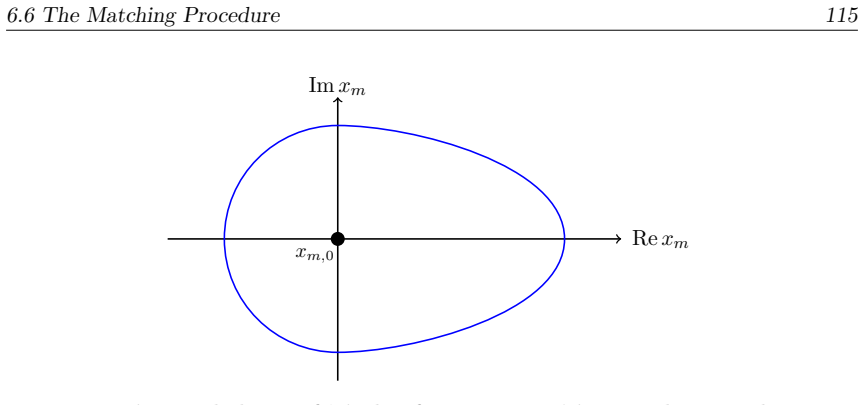
The load-bearing mechanism is the series-expansion-from-differential-equations method presented in Chapter 6. A multi-scale problem is reduced to a single variable by a one-dimensional parametrization of the phase space; the differential equations for the master integrals are solved as series around their singular points, using homogeneous and particular solutions of second-order ordinary differential equations for the elliptic sectors; and a matching procedure joins these expansions through overlapping convergence regions, with boundary conditions fixed by regularity at pseudo-thresholds. The non-elliptic sectors are handled through canonical differential equations in d-log form, while the planar elliptic sector A6,215 is carried by the second-order equations whose homogeneous solutions are elliptic functions.
What would settle it
Compute one of the planar elliptic master integrals at a dense grid of physical phase-space points using an independent numerical method, such as sector decomposition of the Feynman-parameter representation, and compare with the matched-series evaluation; any disagreement beyond the stated truncation error would falsify the claim of full physical-region coverage.
Extended reading notes
Core claim
The central discovery claimed is that full quark-mass dependence does not block higher-order Higgs amplitudes: the three-loop Hb bbar form factor is obtained in massless QCD with its infrared poles matching the factorization prediction; the two-loop H→Zγ amplitude is obtained analytically in terms of multiple polylogarithms with full quark-mass dependence; and the planar master integrals for two-loop Higgs-plus-jet production, including the elliptic sectors, are evaluated by a one-dimensional parametrization of the phase space, series expansions around singular points of the differential equations, and a matching procedure whose overlapping radii of convergence cover the physical region. The thesis claims the resulting numerical evaluation is fast and reliable, and that the two-loop Higgs-plus-jet scattering amplitude can be expressed in terms of these planar master integrals together with the non-planar ones.
Load-bearing premise
The load-bearing premise is that the series expansions around the singular points of the differential equations can be matched so that their combined radii of convergence cover every point of the physical phase space; if some region is left uncovered, the numerical evaluation of the elliptic master integrals and thus of the two-loop Higgs-plus-jet amplitude would be unreliable.
Editorial extensions
If this is right
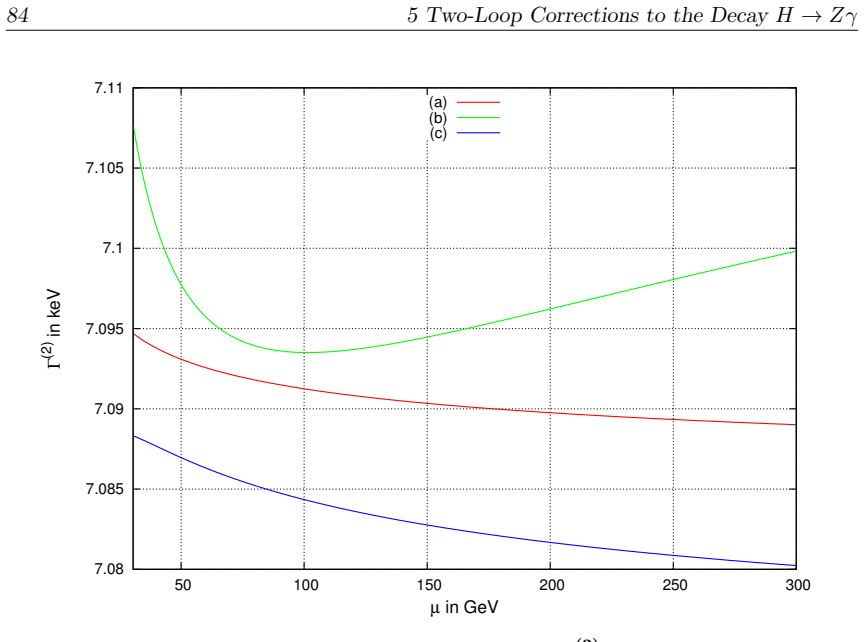
- The analytic two-loop H→Zγ result confirms the earlier numerical computation and allows a direct study of renormalization-scheme and scale dependence of the decay width.
- The three-loop Hb bbar form factor supplies a core ingredient for third-order QCD corrections to Higgs production in bottom-quark fusion and to the H→bbar decay rate.
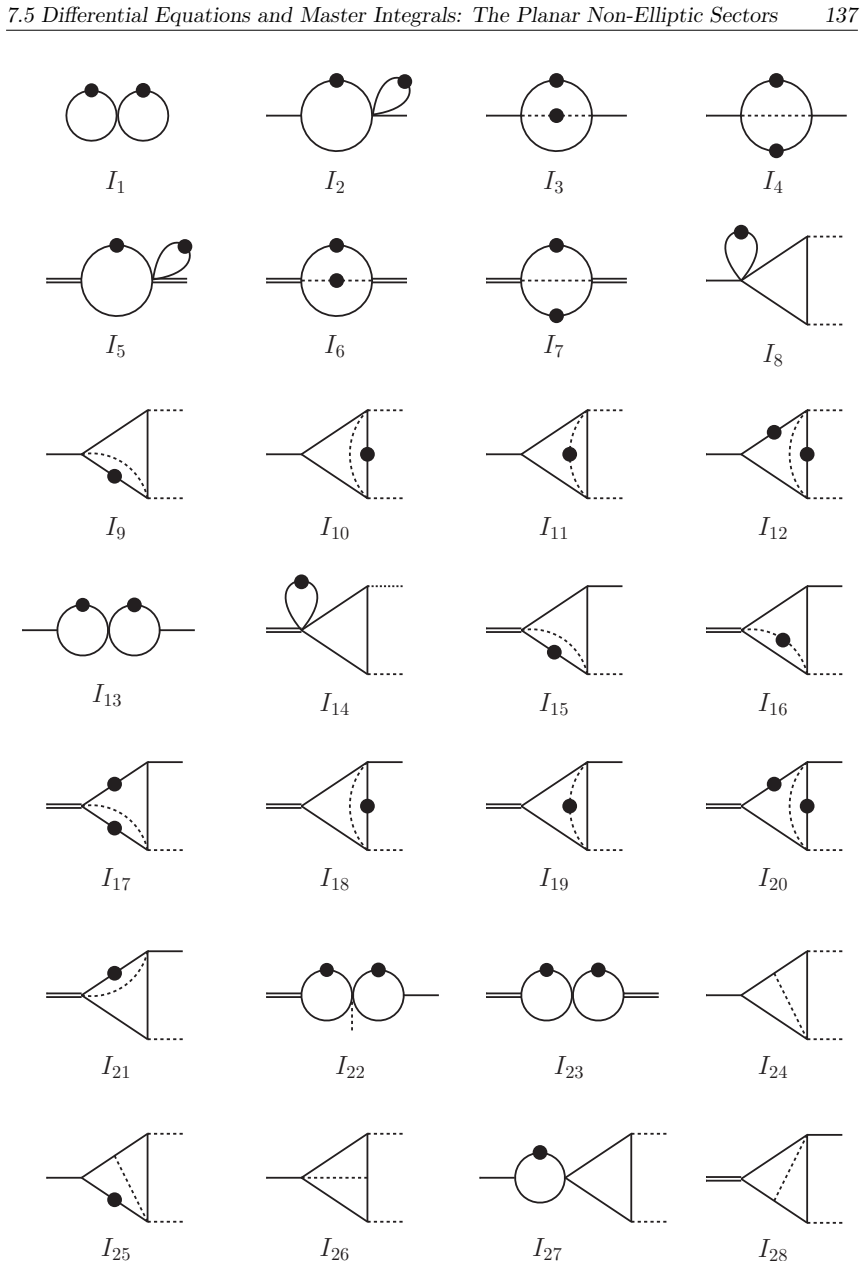
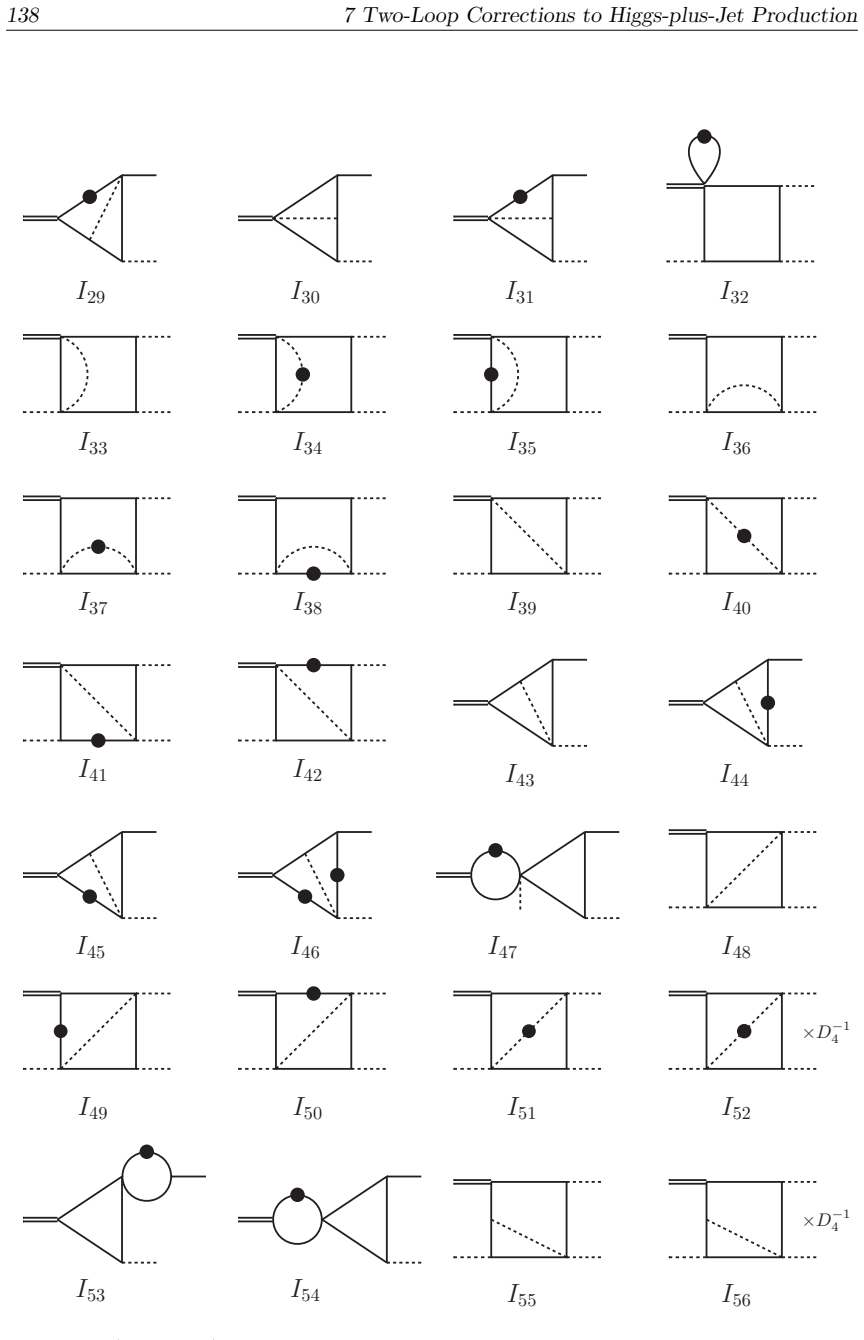
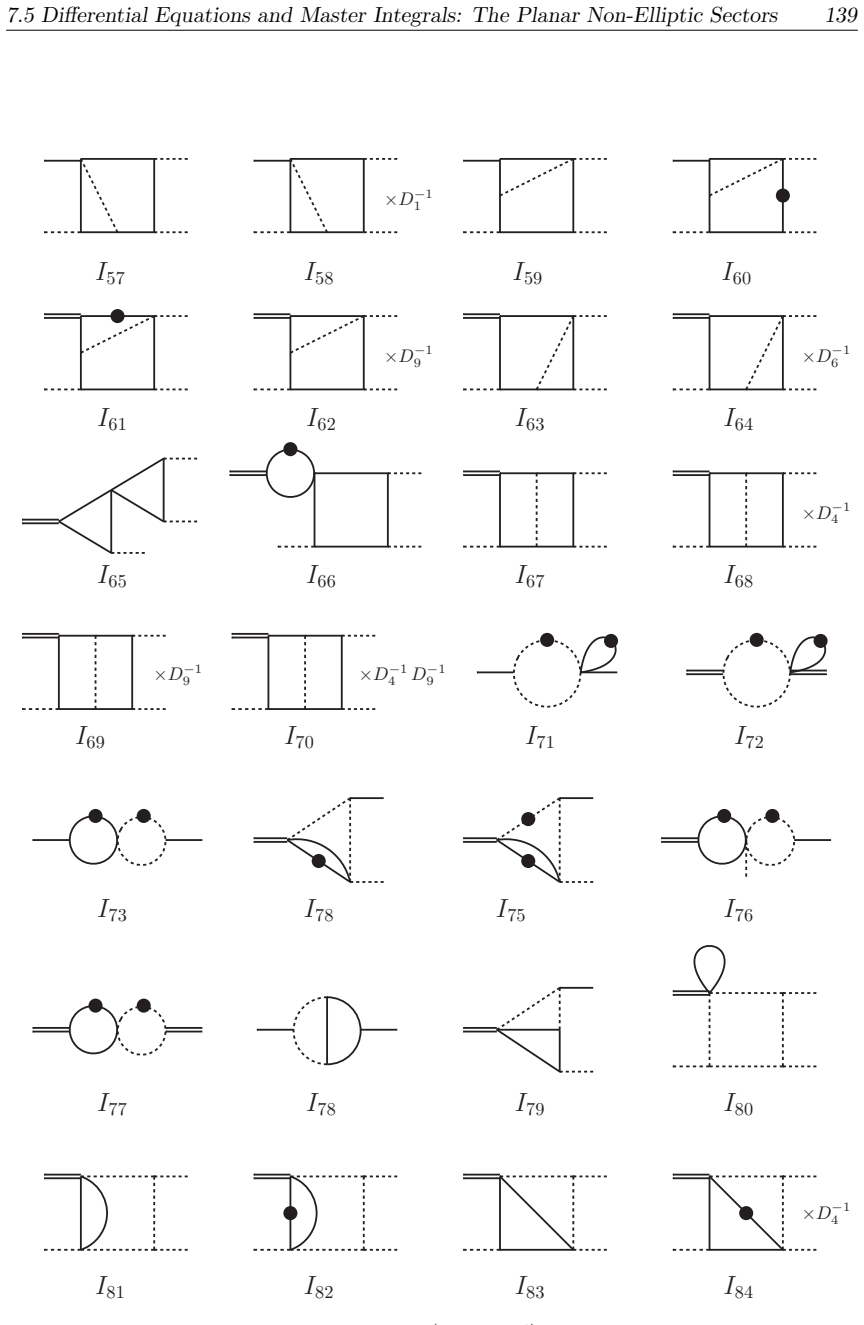
- The matched-series method evaluates the planar two-loop master integrals for Higgs-plus-jet production with full quark mass dependence in the physical region, including elliptic multi-scale integrals, in a fast and reliable way.
- Because the quark mass is retained, the two-loop Higgs-plus-jet amplitude can be trusted at high Higgs transverse momentum, where the infinite-top-mass effective theory is not appropriate.
Reading between the lines
- (Editor's inference) If the matching procedure carries over to the non-planar sectors, the full NLO Higgs-plus-jet amplitude with exact top-mass dependence becomes numerically tractable, and the main remaining bottleneck would be computational, not conceptual.
- (Editor's inference) The one-dimensional parametrization suggests a direct independent test: compare the matched-series values of the elliptic master integrals at selected physical points against a completely different numerical technique; the thesis's internal consistency checks are necessary but not sufficient.
- (Editor's inference) The single-logarithmic small-mass behaviour of H→Zγ, in contrast to the double logarithms in H→γγ, points to a structural feature of the Z-boson coupling that could be studied separately, since the thesis reports it but does not explain it.
Editorial analysis
A structured set of objections, weighed in public.
Referee Report
Summary. This thesis-style manuscript presents three higher-order QCD calculations involving Higgs bosons and heavy-quark loops. Chapter 3 derives the three-loop QCD corrections to the Hb bbar form factor in the massless limit and verifies the infrared pole structure against known factorization formulae. Chapter 5 computes the two-loop QCD corrections to H->Z gamma with full quark mass dependence, analytically confirming earlier purely numerical results obtained with on-shell renormalization. Chapters 6 and 7 develop and apply a method to evaluate planar two-loop master integrals for Higgs-plus-jet production with full quark mass dependence, using series expansions derived from differential equations because the master integrals involve elliptic structures. The abstract claims that these elliptic integrals can be evaluated numerically in a fast and reliable way by matching multiple series expansions over the physical phase space.
Significance. If the matched-series method works as claimed, it represents a significant technical advance: exact top-quark-mass dependence for the two-loop Higgs-plus-jet amplitude is a recognized high-priority target, and a practical method for elliptic multi-scale master integrals would have broader applicability. The H->Z gamma analytic computation and the three-loop form factor provide strong internal consistency checks: the former reproduces known numerics from Ref. [252], and the latter matches the predicted infrared pole structure (Section 3.4, Eqs. (3.17)-(3.19)). The method introduces no fitted parameters; the only free choices are the renormalization scale and the series truncation order. However, the central new claim—the fast and reliable numerical evaluation of the elliptic master integrals—is not verifiable from the text supplied for review, because the numerical validation sections are absent.
major comments (3)
- [Sections 7.9.1-7.9.4 (with 6.5-6.6 and 7.5.5, 7.6.5)] The load-bearing claim that the planar two-loop master integrals for Higgs-plus-jet production, including the elliptic sectors A6,215 and A7,247, can be evaluated 'in a fast and reliable way' by matched series expansions is not supported by the evidence in the available manuscript. The table of contents lists the numerical checks (degree of the series expansions, timings, relative deviation, truncation error), but the supplied text truncates before these sections, so no convergence radii, overlap tests, or accuracy numbers are shown. This is not a cosmetic issue: the matching procedure in Sections 6.5-6.6 connects local series solutions only where their convergence disks overlap, and the claimed coverage of the whole physical phase space requires numerical demonstration. Please provide the missing validation or state explicitly that it is deferred to a separate publication.
- [Sections 6.6.1 and 7.5.2] The partitioning of the phase space through singular points is asserted to give overlapping intervals covering the full physical region, but the argument is incomplete. A local series around a singular point lambda_0 has radius of convergence limited by the nearest other singularity in the lambda-plane; as the auxiliary kinematic invariants x, z, h defined in Eq. (4.15) approach thresholds, two singular points can coalesce and shrink the convergence disk to zero. The manuscript does not provide a bound on the distances between adjacent expansion centers relative to these radii, nor an explicit scan of the (x, z, h) parameter region near thresholds. I request either a proof of gap-free coverage or a numerical demonstration (for example, a grid scan of relative deviations) for the elliptic sectors.
- [Sections 5.4-5.5 and 7.6-7.10] The text supplied for review ends during Section 5.3 and does not include the announced Sections 5.4 (numerical results), 6, 7.6-7.10, or the appendices. Consequently, the claimed computation of the two-loop amplitude in terms of master integrals (Section 7.3.2), the treatment of the elliptic sectors A6,215 and A7,247 (Sections 7.6-7.7), and the numerical checks (Section 7.9) cannot be checked. If this manuscript is intended for journal publication, the complete derivations and validation must be included; a thesis may be a self-contained document, but the submitted excerpt is not.
minor comments (4)
- [Section 2.1.1] The sentence discussing the Lorentz structure of the external momenta contains the duplicated article in 'the the Lorentz structure'; this should be corrected.
- [Section 4.4.3] The word 'tapole' appears in the text and should read 'tadpole'.
- [Eqs. (3.14)-(3.16)] The three-loop form factor expressions are long; an electronic ancillary file with the Laurent coefficients in machine-readable form would substantially aid verification and reuse.
- [References] The bibliography is not included in the supplied text, so citations such as [252] cannot be resolved; please ensure the complete reference list is part of any revised submission.
Circularity Check
No significant circularity: the derivations are self-contained QCD calculations checked against independent infrared factorization and earlier numerical results.
full rationale
The thesis derives its results from standard QCD Feynman rules, integration-by-parts reduction, and differential equations, with no fitted parameter renamed as a prediction. The three-loop H b bbar form factor is obtained by reducing 244 diagrams to 22 known master integrals (Section 3.3.3) and is checked against the universal infrared pole structure predicted from factorization (Section 3.4, Eqs. (3.17)-(3.19)); this is an external consistency check, not an input. The two-loop H to Z gamma amplitude is computed analytically from canonical differential equations and explicitly stated to confirm earlier purely numerical results (Chapter 5 introduction and Section 5.1), providing independent grounding rather than circularity. The Higgs-plus-jet planar master integrals are computed by series expansions derived from differential equations (Chapter 6, Sections 6.4-6.6), with the matching procedure covering phase space via overlapping intervals and subsequently checked through relative deviation and truncation error (Sections 7.9.3-7.9.4). No equation is defined in terms of the quantity it is said to predict, and no load-bearing argument reduces to a self-citation chain. The author's prior publications are cited for components of the calculation, but these components are either independently derived in the thesis or checked against external results; this is standard scholarly practice and not circular. The skeptic concern about the convergence of the matched series expansions is a verifiability issue about omitted numerical checks, not a circularity of the derivation chain. Accordingly, the circularity score is 0.
Assumptions & free parameters
free parameters (2)
- Renormalization scale mu =
m_H = 125.09 GeV
- Series expansion truncation order (number of terms) =
not specified in available text (set to achieve target precision)
assumptions (6)
- domain assumption Standard Model of particle physics with QCD as the gauge theory of strong interactions
- standard math Dimensional regularization in D = 4 - 2 epsilon dimensions correctly isolates UV and IR divergences
- domain assumption Vanishing bottom quark mass in the H b bbar form factor (m_b^2/m_H^2 is about 10^-3)
- domain assumption The top quark contribution dominates H to Z gamma and H plus jet amplitudes; light quarks are neglected or treated separately
- ad hoc to paper The series expansions in the one-dimensional parametrization converge and can be matched across singular points to cover the physical phase space
- domain assumption The planar master integrals with elliptic structures cannot be expressed in terms of multiple polylogarithms and require the new series-expansion treatment
Cite this review
Pith. "Pith review of Higher-Order Corrections to Higgs Boson Amplitudes with Full Quark Mass Dependence in Quantum Chromodynamics." pith.science (2026). https://pith.science/paper/Y7SU7VEV
@misc{pith2026190809932,
  author       = {Pith},
  title        = {Pith review of: Higher-Order Corrections to Higgs Boson Amplitudes with Full Quark Mass Dependence in Quantum Chromodynamics},
  year         = {2026},
  howpublished = {\url{https://pith.science/paper/Y7SU7VEV}},
  note         = {Machine review of arXiv:1908.09932}
}
abstract
In this thesis, higher-order corrections to the perturbative expansions of scattering amplitudes involving the Higgs boson in the framework of Quantum Chromodynamics are evaluated, where we focus on processes that are mediated through heavy-quark loops. First, we derive the third-order corrections to the form factor describing the Yukawa coupling of a Higgs boson to a pair of bottom quarks. Furthermore, we compute the two-loop corrections to the $H\to Z\,\gamma$ decay width by retaining the full dependence on the internal quark mass. Finally, we describe the calculation of the planar Master Integrals relevant to the two-loop amplitude for Higgs-plus-jet production with full quark mass dependence. We accomplish this by establishing a method to derive series expansions from differential equations, since the set of Master Integrals involves elliptic structures.
Figures


Figures from the paper (28 more)











Reference graph
Works this paper leans on
-
[252]
QCD corrections to the H Z gamma coupling,
M. Spira, A. Djouadi, and P. M. Zerwas, “QCD corrections to the H Z gamma coupling,” Phys. Lett. B276 (1992) 350–353
1992
-
[1]
Berry, Paul Dirac: The Purest Soul in Physics , vol
M. Berry, Paul Dirac: The Purest Soul in Physics , vol. 22. Physics World, 1998
1998
-
[2]
The Mysteries of Mass,
G. Kane, “The Mysteries of Mass,” Scientific American 15 (2006) 32–39
2006
-
[3]
High-Energy Inelastic e−p Scattering at 6◦ and 10◦,
E. D. Bloom, D. Coward, H. DeStaebler, J. Drees, G. Miller, et al., “High-Energy Inelastic e−p Scattering at 6◦ and 10◦,” Phys.Rev.Lett. 23 (1969) 930–934
1969
-
[4]
Observed Behavior of Highly Inelastic Electron-Proton Scattering,
M. Breidenbach, J. I. Friedman, H. W. Kendall, E. D. Bloom, D. Coward, et al., “Observed Behavior of Highly Inelastic Electron-Proton Scattering,” Phys.Rev.Lett. 23 (1969) 935–939
1969
-
[5]
Observation of a Dimuon Resonance at 9.5 GeV in 400 GeV Proton-Nucleus Collisions,
S. Herb, D. Hom, L. Lederman, J. Sens, H. Snyder, et al., “Observation of a Dimuon Resonance at 9.5 GeV in 400 GeV Proton-Nucleus Collisions,” Phys.Rev.Lett. 39 (1977) 252–255
1977
-
[6]
Observation of Top Quark Production in ¯pp Collisions,
CDF Collaboration, F. Abe et al., “Observation of Top Quark Production in ¯pp Collisions,” Phys.Rev.Lett. 74 (1995) 2626–2631, arXiv:hep-ex/9503002 [hep-ex]
arXiv 1995
-
[7]
Search for High Mass Top Quark Production in p¯p Collisions at√s = 1.8 TeV,
D0 Collaboration, S. Abachi et al., “Search for High Mass Top Quark Production in p¯p Collisions at√s = 1.8 TeV,” Phys.Rev.Lett. 74 (1995) 2422–2426, arXiv:hep-ex/9411001 [hep-ex]
arXiv 1995
Show all 300 references
-
[8]
Observation of Tau Neutrino Interactions,
DONUT Collaboration, K. Kodama et al., “Observation of Tau Neutrino Interactions,” Phys.Lett. B504 (2001) 218–224, arXiv:hep-ex/0012035 [hep-ex]
2001 arXiv
-
[9]
Observation of a new particle in the search for the Standard Model Higgs boson with the ATLAS detector at the LHC,
ATLAS, G. Aad et al., “Observation of a new particle in the search for the Standard Model Higgs boson with the ATLAS detector at the LHC,” Phys. Lett. B716 (2012) 1–29, arXiv:1207.7214 [hep-ex]
2012 arXiv
-
[10]
Observation of a new boson at a mass of 125 GeV with the CMS experiment at the LHC,
CMS, S. Chatrchyan et al., “Observation of a new boson at a mass of 125 GeV with the CMS experiment at the LHC,” Phys. Lett. B716 (2012) 30–61, arXiv:1207.7235 [hep-ex]
2012 arXiv
-
[11]
Review of Particle Physics,
Particle Data Group, C. Patrignani et al., “Review of Particle Physics,” Chin. Phys. C40 no. 10, (2016) 100001
2016
-
[12]
Mass singularities of feynman amplitudes,
T. Kinoshita, “Mass singularities of feynman amplitudes,” Journal of Mathematical Physics 3 no. 4, (1962) 650–677
1962
-
[13]
Degenerate systems and mass singularities,
T. D. Lee and M. Nauenberg, “Degenerate systems and mass singularities,” Phys. Rev. 133 (1964) B1549–B1562
1964
-
[14]
A new method for real radiation at NNLO,
C. Anastasiou, K. Melnikov, and F. Petriello, “A new method for real radiation at NNLO,” Phys. Rev. D69 (2004) 076010, arXiv:hep-ph/0311311 [hep-ph]
2004 arXiv
-
[15]
Numerical evaluation of phase space integrals by sector decomposition,
T. Binoth and G. Heinrich, “Numerical evaluation of phase space integrals by sector decomposition,” Nucl. Phys. B693 (2004) 134–148, arXiv:hep-ph/0402265 [hep-ph]. 195 196 Bibliography
2004 arXiv
-
[16]
An NNLO subtraction formalism in hadron collisions and its application to Higgs boson production at the LHC,
S. Catani and M. Grazzini, “An NNLO subtraction formalism in hadron collisions and its application to Higgs boson production at the LHC,” Phys. Rev. Lett. 98 (2007) 222002, arXiv:hep-ph/0703012 [hep-ph]
2007 arXiv
-
[17]
Antenna subtraction at NNLO,
A. Gehrmann-De Ridder, T. Gehrmann, and E. W. N. Glover, “Antenna subtraction at NNLO,” JHEP 09 (2005) 056, arXiv:hep-ph/0505111 [hep-ph]
2005 arXiv
-
[18]
Gluon-gluon antenna functions from Higgs boson decay,
A. Gehrmann-De Ridder, T. Gehrmann, and E. W. N. Glover, “Gluon-gluon antenna functions from Higgs boson decay,” Phys. Lett. B612 (2005) 49–60, arXiv:hep-ph/0502110 [hep-ph]
2005 arXiv
-
[19]
Quark-gluon antenna functions from neutralino decay,
A. Gehrmann-De Ridder, T. Gehrmann, and E. W. N. Glover, “Quark-gluon antenna functions from neutralino decay,” Phys. Lett. B612 (2005) 36–48, arXiv:hep-ph/0501291 [hep-ph]
2005 arXiv
-
[20]
Infrared Structure at NNLO Using Antenna Subtraction,
J. Currie, E. W. N. Glover, and S. Wells, “Infrared Structure at NNLO Using Antenna Subtraction,” JHEP 04 (2013) 066, arXiv:1301.4693 [hep-ph]
2013 arXiv
-
[21]
A novel subtraction scheme for double-real radiation at NNLO,
M. Czakon, “A novel subtraction scheme for double-real radiation at NNLO,” Phys. Lett. B693 (2010) 259–268, arXiv:1005.0274 [hep-ph]
2010 arXiv
-
[22]
A subtraction scheme for NNLO computations,
R. Boughezal, K. Melnikov, and F. Petriello, “A subtraction scheme for NNLO computations,” Phys. Rev. D85 (2012) 034025, arXiv:1111.7041 [hep-ph]
2012 arXiv
-
[23]
W -boson production in association with a jet at next-to-next-to-leading order in perturbative QCD,
R. Boughezal, C. Focke, X. Liu, and F. Petriello, “ W -boson production in association with a jet at next-to-next-to-leading order in perturbative QCD,” Phys. Rev. Lett. 115 no. 6, (2015) 062002, arXiv:1504.02131 [hep-ph]
2015 arXiv
-
[24]
N-jettiness soft function at next-to-next-to-leading order,
R. Boughezal, X. Liu, and F. Petriello, “ N-jettiness soft function at next-to-next-to-leading order,” Phys. Rev. D91 no. 9, (2015) 094035, arXiv:1504.02540 [hep-ph]
2015 arXiv
-
[25]
N-jettiness Subtractions for NNLO QCD Calculations,
J. Gaunt, M. Stahlhofen, F. J. Tackmann, and J. R. Walsh, “N-jettiness Subtractions for NNLO QCD Calculations,” JHEP 09 (2015) 058, arXiv:1505.04794 [hep-ph]
2015 arXiv
-
[26]
A Subtraction scheme for computing QCD jet cross sections at NNLO: Integrating the subtraction terms. I.,
G. Somogyi and Z. Trocsanyi, “A Subtraction scheme for computing QCD jet cross sections at NNLO: Integrating the subtraction terms. I.,” JHEP 08 (2008) 042, arXiv:0807.0509 [hep-ph]
2008 arXiv
-
[27]
Jet production in the CoLoRFulNNLO method: event shapes in electron-positron collisions,
V. Del Duca, C. Duhr, A. Kardos, G. Somogyi, Z. Sz˝ or, Z. Tr´ ocs´ anyi, and Z. Tulip´ ant, “Jet production in the CoLoRFulNNLO method: event shapes in electron-positron collisions,” Phys. Rev. D94 no. 7, (2016) 074019, arXiv:1606.03453 [hep-ph]
2016 arXiv
-
[28]
The Hb¯b form factor to three loops in QCD,
T. Gehrmann and D. Kara, “The Hb¯b form factor to three loops in QCD,” JHEP 09 (2014) 174, arXiv:1407.8114 [hep-ph]
2014 arXiv
-
[29]
The rare decay H→Zγ in perturbative QCD,
T. Gehrmann, S. Guns, and D. Kara, “The rare decay H→Zγ in perturbative QCD,” JHEP 09 (2015) 038, arXiv:1505.00561 [hep-ph]
2015 arXiv
-
[30]
Next-to-leading order QCD corrections to the decay width H→Zγ ,
R. Bonciani, V. Del Duca, H. Frellesvig, J. M. Henn, F. Moriello, and V. A. Smirnov, “Next-to-leading order QCD corrections to the decay width H→Zγ ,” JHEP 08 (2015) 108, arXiv:1505.00567 [hep-ph]
2015 arXiv
-
[31]
The two-loop helicity amplitudes for qq′→V1V2→ 4 leptons,
T. Gehrmann, A. von Manteuffel, and L. Tancredi, “The two-loop helicity amplitudes for qq′→V1V2→ 4 leptons,” JHEP 09 (2015) 128, arXiv:1503.04812 [hep-ph]
2015 arXiv
-
[32]
The two-loop helicity amplitudes for gg→V1V2→ 4 leptons,
A. von Manteuffel and L. Tancredi, “The two-loop helicity amplitudes for gg→V1V2→ 4 leptons,” JHEP 06 (2015) 197, arXiv:1503.08835 [hep-ph] . 196 Bibliography 197
2015 arXiv
-
[33]
ZZ production at the LHC: fiducial cross sections and distributions in NNLO QCD,
M. Grazzini, S. Kallweit, and D. Rathlev, “ZZ production at the LHC: fiducial cross sections and distributions in NNLO QCD,” Phys. Lett. B750 (2015) 407–410, arXiv:1507.06257 [hep-ph]
2015 arXiv
-
[34]
W±Z production at hadron colliders in NNLO QCD,
M. Grazzini, S. Kallweit, D. Rathlev, and M. Wiesemann, “ W±Z production at hadron colliders in NNLO QCD,” Phys. Lett. B761 (2016) 179–183, arXiv:1604.08576 [hep-ph]
2016 arXiv
-
[35]
W +W− production at the LHC: fiducial cross sections and distributions in NNLO QCD,
M. Grazzini, S. Kallweit, S. Pozzorini, D. Rathlev, and M. Wiesemann, “ W +W− production at the LHC: fiducial cross sections and distributions in NNLO QCD,” JHEP 08 (2016) 140, arXiv:1605.02716 [hep-ph]
2016 arXiv
-
[36]
W±Z production at the LHC: fiducial cross sections and distributions in NNLO QCD,
M. Grazzini, S. Kallweit, D. Rathlev, and M. Wiesemann, “ W±Z production at the LHC: fiducial cross sections and distributions in NNLO QCD,” JHEP 05 (2017) 139, arXiv:1703.09065 [hep-ph]
2017 arXiv
-
[37]
Two-loop helicity amplitudes for the production of two off-shell electroweak bosons in quark-antiquark collisions,
F. Caola, J. M. Henn, K. Melnikov, A. V. Smirnov, and V. A. Smirnov, “Two-loop helicity amplitudes for the production of two off-shell electroweak bosons in quark-antiquark collisions,” JHEP 11 (2014) 041, arXiv:1408.6409 [hep-ph]
2014 arXiv
-
[38]
Two-loop helicity amplitudes for the production of two off-shell electroweak bosons in gluon fusion,
F. Caola, J. M. Henn, K. Melnikov, A. V. Smirnov, and V. A. Smirnov, “Two-loop helicity amplitudes for the production of two off-shell electroweak bosons in gluon fusion,” JHEP 06 (2015) 129, arXiv:1503.08759 [hep-ph]
2015 arXiv
-
[39]
QCD corrections to ZZ production in gluon fusion at the LHC,
F. Caola, K. Melnikov, R. R ¨ontsch, and L. Tancredi, “QCD corrections to ZZ production in gluon fusion at the LHC,” Phys. Rev. D92 no. 9, (2015) 094028, arXiv:1509.06734 [hep-ph]
2015 arXiv
-
[40]
QCD corrections to W +W− production through gluon fusion,
F. Caola, K. Melnikov, R. R ¨ontsch, and L. Tancredi, “QCD corrections to W +W− production through gluon fusion,” Phys. Lett. B754 (2016) 275–280, arXiv:1511.08617 [hep-ph]
2016 arXiv
-
[41]
Higgs Boson Pair Production in Gluon Fusion at Next-to-Leading Order with Full Top-Quark Mass Dependence,
S. Borowka, N. Greiner, G. Heinrich, S. Jones, M. Kerner, J. Schlenk, U. Schubert, and T. Zirke, “Higgs Boson Pair Production in Gluon Fusion at Next-to-Leading Order with Full Top-Quark Mass Dependence,” Phys. Rev. Lett. 117 no. 1, (2016) 012001, arXiv:1604.06447 [hep-ph] . [...
2016 arXiv
-
[42]
Full top quark mass dependence in Higgs boson pair production at NLO,
S. Borowka, N. Greiner, G. Heinrich, S. P. Jones, M. Kerner, J. Schlenk, and T. Zirke, “Full top quark mass dependence in Higgs boson pair production at NLO,” JHEP 10 (2016) 107, arXiv:1608.04798 [hep-ph]
2016 arXiv
-
[43]
NLO QCD corrections to Higgs boson plus jet production with full top-quark mass dependence,
S. P. Jones, M. Kerner, and G. Luisoni, “NLO QCD corrections to Higgs boson plus jet production with full top-quark mass dependence,” arXiv:1802.00349 [hep-ph]
-
[44]
Peskin and V
M. Peskin and V. Schroeder, An Introduction to Quantum Field Theory . Westview Press, 1995
1995
-
[45]
QCD and collider physics,
R. K. Ellis, W. J. Stirling, and B. R. Webber, “QCD and collider physics,” Camb. Monogr. Part. Phys. Nucl. Phys. Cosmol. 8 (1996) 1–435
1996
-
[46]
Collins, Foundations of perturbative QCD
J. Collins, Foundations of perturbative QCD. Cambridge University Press, 2013. http://www.cambridge.org/de/knowledge/isbn/item5756723
2013
-
[47]
Dissertori, I
G. Dissertori, I. Knowles, and M. Schmelling, Quantum Chromodynamics: High Energy Experiments and Theory . International series of monographs on physics. Clarendon Press, 2003. https://books.google.ch/books?id=_rqDQgAACAAJ. 197 198 Bibliography
2003
-
[48]
Symmetries of baryons and mesons,
M. Gell-Mann, “Symmetries of baryons and mesons,” Phys. Rev. 125 (1962) 1067–1084
1962
-
[49]
The Abelian Higgs-Kibble Model. Unitarity of the S Operator,
C. Becchi, A. Rouet, and R. Stora, “The Abelian Higgs-Kibble Model. Unitarity of the S Operator,” Phys. Lett. 52B (1974) 344–346
1974
-
[50]
Renormalization of the Abelian Higgs-Kibble Model,
C. Becchi, A. Rouet, and R. Stora, “Renormalization of the Abelian Higgs-Kibble Model,” Commun. Math. Phys. 42 (1975) 127–162
1975
-
[51]
Renormalization of Gauge Theories,
C. Becchi, A. Rouet, and R. Stora, “Renormalization of Gauge Theories,” Annals Phys. 98 (1976) 287–321
1976
-
[52]
Gauge Invariance in Field Theory and Statistical Physics in Operator Formalism,
I. V. Tyutin, “Gauge Invariance in Field Theory and Statistical Physics in Operator Formalism,” arXiv:0812.0580 [hep-th]
-
[53]
Ward Identities and Charge Renormalization of the Yang-Mills Field,
J. C. Taylor, “Ward Identities and Charge Renormalization of the Yang-Mills Field,” Nucl. Phys. B33 (1971) 436–444
1971
-
[54]
Ward Identities in Gauge Theories,
A. A. Slavnov, “Ward Identities in Gauge Theories,” Theor. Math. Phys. 10 (1972) 99–107. [Teor. Mat. Fiz.10,153(1972)]
1972
-
[55]
The renormalizability of vector meson interactions,
S. L. Glashow, “The renormalizability of vector meson interactions,” Nucl. Phys. 10 (1959) 107–117
1959
-
[56]
Weak and electromagnetic interactions,
A. Salam and J. C. Ward, “Weak and electromagnetic interactions,” Nuovo Cim. 11 (1959) 568–577
1959
-
[57]
A Model of Leptons,
S. Weinberg, “A Model of Leptons,” Phys. Rev. Lett. 19 (1967) 1264–1266
1967
-
[58]
One loop n point gauge theory amplitudes, unitarity and collinear limits,
Z. Bern, L. J. Dixon, D. C. Dunbar, and D. A. Kosower, “One loop n point gauge theory amplitudes, unitarity and collinear limits,” Nucl. Phys. B425 (1994) 217–260, arXiv:hep-ph/9403226 [hep-ph]
1994 arXiv
-
[59]
Regularization and Renormalization of Gauge Fields,
G. ’t Hooft and M. J. G. Veltman, “Regularization and Renormalization of Gauge Fields,” Nucl. Phys. B44 (1972) 189–213
1972
-
[60]
Collins and J
J. Collins and J. Collins, Renormalization: An Introduction to Renormalization, the Renormalization Group and the Operator-Product Expansion . AN INTRODUCTION TO RENORMALIZATION, THE RENORMALIZATION GROUP AND THE OPERATOR-PRODUCT EXPANSION. Cambridge University Press, 1984. ht...
1984
-
[61]
Weinberg, The quantum theory of fields
S. Weinberg, The quantum theory of fields. Vol. 2: Modern applications . Cambridge University Press, 2013
2013
-
[62]
Renormalization of the Wilson Loops Beyond the Leading Order,
G. P. Korchemsky and A. V. Radyushkin, “Renormalization of the Wilson Loops Beyond the Leading Order,” Nucl. Phys. B283 (1987) 342–364
1987
-
[63]
Sudakov Form-factor in QCD,
G. P. Korchemsky, “Sudakov Form-factor in QCD,” Phys. Lett. B220 (1989) 629–634
1989
-
[64]
On lightlike Wilson loops,
I. A. Korchemskaya and G. P. Korchemsky, “On lightlike Wilson loops,” Phys. Lett. B287 (1992) 169–175
1992
-
[65]
A General algorithm for calculating jet cross-sections in NLO QCD,
S. Catani and M. H. Seymour, “A General algorithm for calculating jet cross-sections in NLO QCD,” Nucl. Phys. B485 (1997) 291–419, arXiv:hep-ph/9605323 [hep-ph] . [Erratum: Nucl. Phys.B510,503(1998)]
1997 arXiv
-
[66]
Four-Loop Nonplanar Cusp Anomalous Dimension in N=4 Supersymmetric Yang-Mills Theory,
R. H. Boels, T. Huber, and G. Yang, “Four-Loop Nonplanar Cusp Anomalous Dimension in N=4 Supersymmetric Yang-Mills Theory,” Phys. Rev. Lett. 119 no. 20, (2017) 201601, arXiv:1705.03444 [hep-th] . 198 Bibliography 199
2017 arXiv
-
[67]
Three-loop corrections to the soft anomalous dimension in multileg scattering,
O. Almelid, C. Duhr, and E. Gardi, “Three-loop corrections to the soft anomalous dimension in multileg scattering,” Phys. Rev. Lett. 117 no. 17, (2016) 172002, arXiv:1507.00047 [hep-ph]
2016 arXiv
-
[68]
On the Structure of Infrared Singularities of Gauge-Theory Amplitudes,
T. Becher and M. Neubert, “On the Structure of Infrared Singularities of Gauge-Theory Amplitudes,” JHEP 06 (2009) 081, arXiv:0903.1126 [hep-ph] . [Erratum: JHEP11,024(2013)]
2009 arXiv
-
[69]
Bootstrapping the QCD soft anomalous dimension,
O. Almelid, C. Duhr, E. Gardi, A. McLeod, and C. D. White, “Bootstrapping the QCD soft anomalous dimension,” JHEP 09 (2017) 073, arXiv:1706.10162 [hep-ph]
2017 arXiv
-
[70]
Ultraviolet Behavior of Nonabelian Gauge Theories,
D. J. Gross and F. Wilczek, “Ultraviolet Behavior of Nonabelian Gauge Theories,” Phys. Rev. Lett. 30 (1973) 1343–1346
1973
-
[71]
Reliable Perturbative Results for Strong Interactions?,
H. D. Politzer, “Reliable Perturbative Results for Strong Interactions?,” Phys. Rev. Lett. 30 (1973) 1346–1349
1973
-
[72]
Asymptotic Behavior of Nonabelian Gauge Theories to Two Loop Order,
W. E. Caswell, “Asymptotic Behavior of Nonabelian Gauge Theories to Two Loop Order,” Phys. Rev. Lett. 33 (1974) 244
1974
-
[73]
Two Loop Diagrams in Yang-Mills Theory,
D. R. T. Jones, “Two Loop Diagrams in Yang-Mills Theory,” Nucl. Phys. B75 (1974) 531
1974
-
[74]
Two Loop Renormalization of the QCD in an Arbitrary Gauge,
E. Egorian and O. V. Tarasov, “Two Loop Renormalization of the QCD in an Arbitrary Gauge,” Teor. Mat. Fiz. 41 (1979) 26–32. [Theor. Math. Phys.41,863(1979)]
1979
-
[75]
The Gell-Mann-Low Function of QCD in the Three Loop Approximation,
O. V. Tarasov, A. A. Vladimirov, and A. Yu. Zharkov, “The Gell-Mann-Low Function of QCD in the Three Loop Approximation,” Phys. Lett. 93B (1980) 429–432
1980
-
[76]
The Three loop QCD Beta function and anomalous dimensions,
S. A. Larin and J. A. M. Vermaseren, “The Three loop QCD Beta function and anomalous dimensions,” Phys. Lett. B303 (1993) 334–336, arXiv:hep-ph/9302208 [hep-ph]
1993 arXiv
-
[77]
Dimensional regularization and the renormalization group,
G. ’t Hooft, “Dimensional regularization and the renormalization group,” Nucl. Phys. B61 (1973) 455–468
1973
-
[78]
Deep Inelastic Scattering Beyond the Leading Order in Asymptotically Free Gauge Theories,
W. A. Bardeen, A. J. Buras, D. W. Duke, and T. Muta, “Deep Inelastic Scattering Beyond the Leading Order in Asymptotically Free Gauge Theories,” Phys. Rev. D18 (1978) 3998
1978
-
[79]
The four loop quark mass anomalous dimension and the invariant quark mass,
J. A. M. Vermaseren, S. A. Larin, and T. van Ritbergen, “The four loop quark mass anomalous dimension and the invariant quark mass,” Phys. Lett. B405 (1997) 327–333, arXiv:hep-ph/9703284 [hep-ph]
1997 arXiv
-
[80]
Quark mass anomalous dimension to O (alpha-s**4),
K. G. Chetyrkin, “Quark mass anomalous dimension to O (alpha-s**4),” Phys. Lett. B404 (1997) 161–165, arXiv:hep-ph/9703278 [hep-ph]
1997 arXiv
-
[81]
The Four-loop QCD beta-function and anomalous dimensions,
M. Czakon, “The Four-loop QCD beta-function and anomalous dimensions,” Nucl. Phys. B710 (2005) 485–498, arXiv:hep-ph/0411261 [hep-ph]
2005 arXiv
-
[82]
Higgs boson production in bottom quark fusion at next-to-next-to leading order,
R. V. Harlander and W. B. Kilgore, “Higgs boson production in bottom quark fusion at next-to-next-to leading order,” Phys. Rev. D68 (2003) 013001, arXiv:hep-ph/0304035 [hep-ph]
2003 arXiv
-
[83]
Factorization and Momentum-Space Resummation in Deep-Inelastic Scattering,
T. Becher, M. Neubert, and B. D. Pecjak, “Factorization and Momentum-Space Resummation in Deep-Inelastic Scattering,” JHEP 01 (2007) 076, arXiv:hep-ph/0607228 [hep-ph] . 199 200 Bibliography
2007 arXiv
-
[84]
The Quark form-factor at higher orders,
S. Moch, J. A. M. Vermaseren, and A. Vogt, “The Quark form-factor at higher orders,” JHEP 08 (2005) 049, arXiv:hep-ph/0507039 [hep-ph]
2005 arXiv
-
[85]
Two-loop QCD corrections to the heavy quark form-factors: The Vector contributions,
W. Bernreuther, R. Bonciani, T. Gehrmann, R. Heinesch, T. Leineweber, P. Mastrolia, and E. Remiddi, “Two-loop QCD corrections to the heavy quark form-factors: The Vector contributions,” Nucl. Phys. B706 (2005) 245–324, arXiv:hep-ph/0406046 [hep-ph]
2005 arXiv
-
[86]
The Three loop relation between the MS-bar and the pole quark masses,
K. Melnikov and T. v. Ritbergen, “The Three loop relation between the MS-bar and the pole quark masses,” Phys. Lett. B482 (2000) 99–108, arXiv:hep-ph/9912391 [hep-ph]
2000 arXiv
-
[87]
The Relation between the MS-bar and the on-shell quark mass at order alpha(s)**3,
K. G. Chetyrkin and M. Steinhauser, “The Relation between the MS-bar and the on-shell quark mass at order alpha(s)**3,” Nucl. Phys. B573 (2000) 617–651, arXiv:hep-ph/9911434 [hep-ph]
2000 arXiv
-
[88]
Bottom quark mass and alpha-s from the upsilon system,
M. Jamin and A. Pich, “Bottom quark mass and alpha-s from the upsilon system,” Nucl. Phys. B507 (1997) 334–352, arXiv:hep-ph/9702276 [hep-ph]
1997 arXiv
-
[89]
Low-Energy Manifestations of Heavy Particles: Application to the Neutral Current,
J. C. Collins, F. Wilczek, and A. Zee, “Low-Energy Manifestations of Heavy Particles: Application to the Neutral Current,” Phys. Rev. D18 (1978) 242
1978
-
[90]
Helicity Amplitudes for Multiple Bremsstrahlung in Massless Nonabelian Gauge Theories,
Z. Xu, D.-H. Zhang, and L. Chang, “Helicity Amplitudes for Multiple Bremsstrahlung in Massless Nonabelian Gauge Theories,” Nucl. Phys. B291 (1987) 392–428
1987
-
[91]
Radiative Corrections to Muon Pair and Quark Pair Production in electron-Positron Collisions in the Z(0) Region,
F. A. Berends, R. Kleiss, and S. Jadach, “Radiative Corrections to Muon Pair and Quark Pair Production in electron-Positron Collisions in the Z(0) Region,” Nucl. Phys. B202 (1982) 63–88
1982
-
[92]
Multiple Bremsstrahlung in Gauge Theories at High-energies. 3. Finite Mass Effects in Collinear Photon Bremsstrahlung,
CALKUL, F. A. Berends, R. Kleiss, P. de Causmaecker, R. Gastmans, W. Troost, and T. T. Wu, “Multiple Bremsstrahlung in Gauge Theories at High-energies. 3. Finite Mass Effects in Collinear Photon Bremsstrahlung,” Nucl. Phys. B239 (1984) 382–394
1984
-
[93]
Calculating scattering amplitudes efficiently,
L. J. Dixon, “Calculating scattering amplitudes efficiently,” in QCD and beyond. Proceedings, Theoretical Advanced Study Institute in Elementary Particle Physics, TASI-95, Boulder, USA, June 4-30, 1995 , pp. 539–584. 1996. arXiv:hep-ph/9601359 [hep-ph] . http://www-public.slac.s...
1995 arXiv
-
[94]
Two-Loop QCD Corrections to the Helicity Amplitudes for H→ 3 partons,
T. Gehrmann, M. Jaquier, E. W. N. Glover, and A. Koukoutsakis, “Two-Loop QCD Corrections to the Helicity Amplitudes for H→ 3 partons,” JHEP 02 (2012) 056, arXiv:1112.3554 [hep-ph]
2012 arXiv
-
[95]
The Number of Master Integrals Is Finite,
A. Smirnov and A. Petukhov, “The Number of Master Integrals Is Finite,” Lett.Math.Phys. 97 (2011) 37–44, arXiv:1004.4199 [hep-th]
2011 arXiv
-
[96]
Feynman Diagrams and Differential Equations,
M. Argeri and P. Mastrolia, “Feynman Diagrams and Differential Equations,” Int. J. Mod. Phys. A22 (2007) 4375–4436, arXiv:0707.4037 [hep-ph]
2007 arXiv
-
[97]
Integration by Parts: The Algorithm to Calculate β Functions in Four Loops,
K. Chetyrkin and F. Tkachov, “Integration by Parts: The Algorithm to Calculate β Functions in Four Loops,” Nucl.Phys. B192 (1981) 159–204
1981
-
[98]
Applied asymptotic expansions in momenta and masses,
V. A. Smirnov, “Applied asymptotic expansions in momenta and masses,” Springer Tracts Mod. Phys. 177 (2002) 1–262
2002
-
[99]
Smirnov, Feynman Integral Calculus
V. Smirnov, Feynman Integral Calculus. Springer, 2006. 200 Bibliography 201
2006
-
[100]
Group structure of the integration-by-part identities and its application to the reduction of multiloop integrals,
R. N. Lee, “Group structure of the integration-by-part identities and its application to the reduction of multiloop integrals,” JHEP 07 (2008) 031, arXiv:0804.3008 [hep-ph]
2008 arXiv
-
[101]
Reduze 2 - Distributed Feynman Integral Reduction,
A. von Manteuffel and C. Studerus, “Reduze 2 - Distributed Feynman Integral Reduction,” arXiv:1201.4330 [hep-ph]
-
[102]
The Analytical value of the electron (g-2) at order alpha**3 in QED,
S. Laporta and E. Remiddi, “The Analytical value of the electron (g-2) at order alpha**3 in QED,” Phys. Lett. B379 (1996) 283–291, arXiv:hep-ph/9602417 [hep-ph]
1996 arXiv
-
[103]
High precision calculation of multiloop Feynman integrals by difference equations,
S. Laporta, “High precision calculation of multiloop Feynman integrals by difference equations,” Int. J. Mod. Phys. A15 (2000) 5087–5159, arXiv:hep-ph/0102033 [hep-ph]
2000 arXiv
-
[104]
Finding Linear Dependencies in Integration-By-Parts Equations: A Monte Carlo Approach,
P. Kant, “Finding Linear Dependencies in Integration-By-Parts Equations: A Monte Carlo Approach,” Comput. Phys. Commun. 185 (2014) 1473–1476, arXiv:1309.7287 [hep-ph]
2014 arXiv
-
[105]
A novel approach to integration by parts reduction,
A. von Manteuffel and R. M. Schabinger, “A novel approach to integration by parts reduction,” Phys. Lett. B744 (2015) 101–104, arXiv:1406.4513 [hep-ph]
2015 arXiv
-
[106]
Automatic Feynman graph generation,
P. Nogueira, “Automatic Feynman graph generation,” J. Comput. Phys. 105 (1993) 279–289
1993
-
[107]
FORM version 4.2,
B. Ruijl, T. Ueda, and J. Vermaseren, “FORM version 4.2,” arXiv:1707.06453 [hep-ph]
-
[108]
LiteRed 1.4: a powerful tool for reduction of multiloop integrals,
R. N. Lee, “LiteRed 1.4: a powerful tool for reduction of multiloop integrals,” J. Phys. Conf. Ser. 523 (2014) 012059, arXiv:1310.1145 [hep-ph]
2014 arXiv
-
[109]
FIRE5: a C++ implementation of Feynman Integral REduction,
A. V. Smirnov, “FIRE5: a C++ implementation of Feynman Integral REduction,” Comput. Phys. Commun. 189 (2015) 182–191, arXiv:1408.2372 [hep-ph]
2015 arXiv
-
[110]
Kira - A Feynman Integral Reduction Program,
P. Maierhoefer, J. Usovitsch, and P. Uwer, “Kira - A Feynman Integral Reduction Program,” arXiv:1705.05610 [hep-ph]
-
[111]
Crusher
P. Marquard, “Crusher.” Private communication
-
[112]
Automatic integral reduction for higher order perturbative calculations,
C. Anastasiou and A. Lazopoulos, “Automatic integral reduction for higher order perturbative calculations,” JHEP 07 (2004) 046, arXiv:hep-ph/0404258 [hep-ph]
2004 arXiv
-
[113]
Computer Algebra System Fermat
R. H. Lewis, “Computer Algebra System Fermat.” http://home.bway.net/lewis/
-
[114]
JaxoDraw: A Graphical user interface for drawing Feynman diagrams,
D. Binosi and L. Theussl, “JaxoDraw: A Graphical user interface for drawing Feynman diagrams,” Comput. Phys. Commun. 161 (2004) 76–86, arXiv:hep-ph/0309015 [hep-ph]
2004 arXiv
-
[115]
JaxoDraw: A Graphical user interface for drawing Feynman diagrams. Version 2.0 release notes,
D. Binosi, J. Collins, C. Kaufhold, and L. Theussl, “JaxoDraw: A Graphical user interface for drawing Feynman diagrams. Version 2.0 release notes,” Comput. Phys. Commun. 180 (2009) 1709–1715, arXiv:0811.4113 [hep-ph]
2009 arXiv
-
[116]
Quark and gluon form factors to three loops,
P. A. Baikov, K. G. Chetyrkin, A. V. Smirnov, V. A. Smirnov, and M. Steinhauser, “Quark and gluon form factors to three loops,” Phys. Rev. Lett. 102 (2009) 212002, arXiv:0902.3519 [hep-ph]
2009 arXiv
-
[117]
Calculation of the quark and gluon form factors to three loops in QCD,
T. Gehrmann, E. W. N. Glover, T. Huber, N. Ikizlerli, and C. Studerus, “Calculation of the quark and gluon form factors to three loops in QCD,” JHEP 06 (2010) 094, arXiv:1004.3653 [hep-ph] . 201 202 Bibliography
2010 arXiv
-
[118]
The quark and gluon form factors to three loops in QCD through to O(ϵ2),
T. Gehrmann, E. W. N. Glover, T. Huber, N. Ikizlerli, and C. Studerus, “The quark and gluon form factors to three loops in QCD through to O(ϵ2),” JHEP 11 (2010) 102, arXiv:1010.4478 [hep-ph]
2010
-
[119]
Measurements of the Higgs boson
P. Meridiani, “Measurements of the Higgs boson.” Talk given at the EPS Conference on High Energy Physics in Venice, Italy, on July 10, 2017
2017
-
[120]
Fully differential Higgs boson production and the di-photon signal through next-to-next-to-leading order,
C. Anastasiou, K. Melnikov, and F. Petriello, “Fully differential Higgs boson production and the di-photon signal through next-to-next-to-leading order,” Nucl. Phys. B724 (2005) 197–246, arXiv:hep-ph/0501130 [hep-ph]
2005 arXiv
-
[121]
NNLO predictions for the Higgs boson signal in the H — > WW —> lnu lnu and H —> ZZ —> 4l decay channels,
M. Grazzini, “NNLO predictions for the Higgs boson signal in the H — > WW —> lnu lnu and H —> ZZ —> 4l decay channels,” JHEP 02 (2008) 043, arXiv:0801.3232 [hep-ph]
2008 arXiv
-
[122]
The fully differential hadronic production of a Higgs boson via bottom quark fusion at NNLO,
S. B ¨uhler, F. Herzog, A. Lazopoulos, and R. M ¨uller, “The fully differential hadronic production of a Higgs boson via bottom quark fusion at NNLO,” JHEP 07 (2012) 115, arXiv:1204.4415 [hep-ph]
2012 arXiv
-
[123]
Associated WH production at hadron colliders: a fully exclusive QCD calculation at NNLO,
G. Ferrera, M. Grazzini, and F. Tramontano, “Associated WH production at hadron colliders: a fully exclusive QCD calculation at NNLO,” Phys. Rev. Lett. 107 (2011) 152003, arXiv:1107.1164 [hep-ph]
2011 arXiv
-
[124]
Higher-order QCD effects for associated WH production and decay at the LHC,
G. Ferrera, M. Grazzini, and F. Tramontano, “Higher-order QCD effects for associated WH production and decay at the LHC,” JHEP 04 (2014) 039, arXiv:1312.1669 [hep-ph]
2014 arXiv
-
[125]
Fully Differential Vector-Boson-Fusion Higgs Production at Next-to-Next-to-Leading Order,
M. Cacciari, F. A. Dreyer, A. Karlberg, G. P. Salam, and G. Zanderighi, “Fully Differential Vector-Boson-Fusion Higgs Production at Next-to-Next-to-Leading Order,” Phys. Rev. Lett. 115 no. 8, (2015) 082002, arXiv:1506.02660 [hep-ph]
2015 arXiv
-
[126]
Second-order QCD effects in Higgs boson production through vector boson fusion,
J. Cruz-Martinez, T. Gehrmann, E. W. N. Glover, and A. Huss, “Second-order QCD effects in Higgs boson production through vector boson fusion,” arXiv:1802.02445 [hep-ph]
-
[127]
NLO QCD corrections to t anti-t H production in hadron collisions,
W. Beenakker, S. Dittmaier, M. Kramer, B. Plumper, M. Spira, and P. M. Zerwas, “NLO QCD corrections to t anti-t H production in hadron collisions,” Nucl. Phys. B653 (2003) 151–203, arXiv:hep-ph/0211352 [hep-ph]
2003 arXiv
-
[128]
Associated Higgs production with top quarks at the large hadron collider: NLO QCD corrections,
S. Dawson, C. Jackson, L. H. Orr, L. Reina, and D. Wackeroth, “Associated Higgs production with top quarks at the large hadron collider: NLO QCD corrections,” Phys. Rev. D68 (2003) 034022, arXiv:hep-ph/0305087 [hep-ph]
2003 arXiv
-
[129]
Scalar and pseudoscalar Higgs production in association with a top–antitop pair,
R. Frederix, S. Frixione, V. Hirschi, F. Maltoni, R. Pittau, and P. Torrielli, “Scalar and pseudoscalar Higgs production in association with a top–antitop pair,” Phys. Lett. B701 (2011) 427–433, arXiv:1104.5613 [hep-ph]
2011 arXiv
-
[130]
Hadronic Higgs decay to order alpha-s**4,
K. G. Chetyrkin, B. A. Kniehl, and M. Steinhauser, “Hadronic Higgs decay to order alpha-s**4,” Phys. Rev. Lett. 79 (1997) 353–356, arXiv:hep-ph/9705240 [hep-ph]
1997 arXiv
-
[131]
Scalar correlator at O(alpha(s)**4), Higgs decay into b-quarks and bounds on the light quark masses,
P. A. Baikov, K. G. Chetyrkin, and J. H. Kuhn, “Scalar correlator at O(alpha(s)**4), Higgs decay into b-quarks and bounds on the light quark masses,” Phys. Rev. Lett. 96 (2006) 012003, arXiv:hep-ph/0511063 [hep-ph]
2006 arXiv
-
[132]
The fully differential decay rate of a Higgs boson to bottom-quarks at NNLO in QCD,
C. Anastasiou, F. Herzog, and A. Lazopoulos, “The fully differential decay rate of a Higgs boson to bottom-quarks at NNLO in QCD,” JHEP 03 (2012) 035, arXiv:1110.2368 [hep-ph] . 202 Bibliography 203
2012 arXiv
-
[133]
Associated ZH production at hadron colliders: the fully differential NNLO QCD calculation,
G. Ferrera, M. Grazzini, and F. Tramontano, “Associated ZH production at hadron colliders: the fully differential NNLO QCD calculation,” Phys. Lett. B740 (2015) 51–55, arXiv:1407.4747 [hep-ph]
2015 arXiv
-
[134]
Associated production of a Higgs boson decaying into bottom quarks at the LHC in full NNLO QCD,
G. Ferrera, G. Somogyi, and F. Tramontano, “Associated production of a Higgs boson decaying into bottom quarks at the LHC in full NNLO QCD,” arXiv:1705.10304 [hep-ph]
-
[135]
NNLO QCD corrections to associated WH production and H→b¯b decay,
F. Caola, G. Luisoni, K. Melnikov, and R. R ¨ontsch, “NNLO QCD corrections to associated WH production and H→b¯b decay,” arXiv:1712.06954 [hep-ph]
-
[136]
Higgs radiation off bottom quarks at the Tevatron and the CERN LHC,
S. Dittmaier, M. Kr ¨amer, and M. Spira, “Higgs radiation off bottom quarks at the Tevatron and the CERN LHC,” Phys. Rev. D70 (2004) 074010, arXiv:hep-ph/0309204 [hep-ph]
2004 arXiv
-
[137]
Exclusive Higgs boson production with bottom quarks at hadron colliders,
S. Dawson, C. B. Jackson, L. Reina, and D. Wackeroth, “Exclusive Higgs boson production with bottom quarks at hadron colliders,” Phys. Rev. D69 (2004) 074027, arXiv:hep-ph/0311067 [hep-ph]
2004 arXiv
-
[138]
Higgs production in association with bottom quarks,
M. Wiesemann, R. Frederix, S. Frixione, V. Hirschi, F. Maltoni, and P. Torrielli, “Higgs production in association with bottom quarks,” JHEP 02 (2015) 132, arXiv:1409.5301 [hep-ph]
2015 arXiv
-
[139]
Higgs production in bottom quark annihilation: Transverse momentum distribution at NNLO+NNLL,
R. V. Harlander, A. Tripathi, and M. Wiesemann, “Higgs production in bottom quark annihilation: Transverse momentum distribution at NNLO+NNLL,” Phys. Rev. D90 no. 1, (2014) 015017, arXiv:1403.7196 [hep-ph]
2014 arXiv
-
[140]
Higgs plus jet production in bottom quark annihilation at next-to-leading order,
R. V. Harlander, K. J. Ozeren, and M. Wiesemann, “Higgs plus jet production in bottom quark annihilation at next-to-leading order,” Phys. Lett. B693 (2010) 269–273, arXiv:1007.5411 [hep-ph]
2010 arXiv
-
[141]
Jet-veto in bottom-quark induced Higgs production at next-to-next-to-leading order,
R. Harlander and M. Wiesemann, “Jet-veto in bottom-quark induced Higgs production at next-to-next-to-leading order,” JHEP 04 (2012) 066, arXiv:1111.2182 [hep-ph]
2012 arXiv
-
[142]
Higher-order threshold effects to inclusive processes in QCD,
V. Ravindran, “Higher-order threshold effects to inclusive processes in QCD,” Nucl. Phys. B752 (2006) 173–196, arXiv:hep-ph/0603041 [hep-ph]
2006 arXiv
-
[143]
Decays of scalar and pseudoscalar Higgs bosons into fermions: Two-loop QCD corrections to the Higgs-quark-antiquark amplitude,
W. Bernreuther, R. Bonciani, T. Gehrmann, R. Heinesch, P. Mastrolia, and E. Remiddi, “Decays of scalar and pseudoscalar Higgs bosons into fermions: Two-loop QCD corrections to the Higgs-quark-antiquark amplitude,” Phys. Rev. D72 (2005) 096002, arXiv:hep-ph/0508254 [hep-ph]
2005 arXiv
-
[144]
Two-loop QCD corrections to Higgs →b +b +g amplitude,
T. Ahmed, M. Mahakhud, P. Mathews, N. Rana, and V. Ravindran, “Two-loop QCD corrections to Higgs →b +b +g amplitude,” JHEP 08 (2014) 075, arXiv:1405.2324 [hep-ph]
2014 arXiv
-
[145]
The Singular behavior of QCD amplitudes at two loop order,
S. Catani, “The Singular behavior of QCD amplitudes at two loop order,” Phys. Lett. B427 (1998) 161–171, arXiv:hep-ph/9802439 [hep-ph]
1998 arXiv
-
[146]
Multiloop amplitudes and resummation,
G. F. Sterman and M. E. Tejeda-Yeomans, “Multiloop amplitudes and resummation,” Phys. Lett. B552 (2003) 48–56, arXiv:hep-ph/0210130 [hep-ph]
2003 arXiv
-
[147]
Infrared singularities of scattering amplitudes in perturbative QCD,
T. Becher and M. Neubert, “Infrared singularities of scattering amplitudes in perturbative QCD,” Phys. Rev. Lett. 102 (2009) 162001, arXiv:0901.0722 [hep-ph]. [Erratum: Phys. Rev. Lett.111,no.19,199905(2013)]
2009 arXiv
-
[148]
Factorization constraints for soft anomalous dimensions in QCD scattering amplitudes,
E. Gardi and L. Magnea, “Factorization constraints for soft anomalous dimensions in QCD scattering amplitudes,” JHEP 03 (2009) 079, arXiv:0901.1091 [hep-ph] . 203 204 Bibliography
2009 arXiv
-
[149]
Soft triple-real radiation for Higgs production at N3LO,
C. Anastasiou, C. Duhr, F. Dulat, and B. Mistlberger, “Soft triple-real radiation for Higgs production at N3LO,” JHEP 07 (2013) 003, arXiv:1302.4379 [hep-ph]
2013 arXiv
-
[150]
The two-loop soft current in dimensional regularization,
C. Duhr and T. Gehrmann, “The two-loop soft current in dimensional regularization,” Phys. Lett. B727 (2013) 452–455, arXiv:1309.4393 [hep-ph]
2013 arXiv
-
[151]
Single soft gluon emission at two loops,
Y. Li and H. X. Zhu, “Single soft gluon emission at two loops,” JHEP 11 (2013) 080, arXiv:1309.4391 [hep-ph]
2013 arXiv
-
[152]
Real-virtual contributions to the inclusive Higgs cross-section at N 3LO,
C. Anastasiou, C. Duhr, F. Dulat, F. Herzog, and B. Mistlberger, “Real-virtual contributions to the inclusive Higgs cross-section at N 3LO,” JHEP 12 (2013) 088, arXiv:1311.1425 [hep-ph]
2013 arXiv
-
[153]
N 3LO Higgs boson and Drell-Yan production at threshold: The one-loop two-emission contribution,
Y. Li, A. von Manteuffel, R. M. Schabinger, and H. X. Zhu, “N 3LO Higgs boson and Drell-Yan production at threshold: The one-loop two-emission contribution,” Phys. Rev. D90 no. 5, (2014) 053006, arXiv:1404.5839 [hep-ph]
2014 arXiv
-
[154]
Adequate bases of phase space master integrals for gg→ h at NNLO and beyond,
M. H ¨oschele, J. Hoff, and T. Ueda, “Adequate bases of phase space master integrals for gg→ h at NNLO and beyond,” JHEP 09 (2014) 116, arXiv:1407.4049 [hep-ph]
2014 arXiv
-
[155]
Higgs boson gluon–fusion production at threshold in N 3LO QCD,
C. Anastasiou, C. Duhr, F. Dulat, E. Furlan, T. Gehrmann, F. Herzog, and B. Mistlberger, “Higgs boson gluon–fusion production at threshold in N 3LO QCD,” Phys. Lett. B737 (2014) 325–328, arXiv:1403.4616 [hep-ph]
2014 arXiv
-
[156]
Higgs Boson Production at Hadron Colliders at N3LO in QCD,
B. Mistlberger, “Higgs Boson Production at Hadron Colliders at N3LO in QCD,” arXiv:1802.00833 [hep-ph]
-
[157]
Drell-Yan Production at Threshold to Third Order in QCD,
T. Ahmed, M. Mahakhud, N. Rana, and V. Ravindran, “Drell-Yan Production at Threshold to Third Order in QCD,” Phys. Rev. Lett. 113 no. 11, (2014) 112002, arXiv:1404.0366 [hep-ph]
2014 arXiv
-
[158]
Threshold resummation at N 3LL accuracy and soft-virtual cross sections at N 3LO,
S. Catani, L. Cieri, D. de Florian, G. Ferrera, and M. Grazzini, “Threshold resummation at N 3LL accuracy and soft-virtual cross sections at N 3LO,” Nucl. Phys. B888 (2014) 75–91, arXiv:1405.4827 [hep-ph]
2014 arXiv
-
[159]
Higgs boson production through b¯b annihilation at threshold in N 3LO QCD,
T. Ahmed, N. Rana, and V. Ravindran, “Higgs boson production through b¯b annihilation at threshold in N 3LO QCD,” JHEP 10 (2014) 139, arXiv:1408.0787 [hep-ph]
2014 arXiv
-
[160]
Two-loop quark and gluon form-factors in dimensional regularisation,
T. Gehrmann, T. Huber, and D. Maitre, “Two-loop quark and gluon form-factors in dimensional regularisation,” Phys. Lett. B622 (2005) 295–302, arXiv:hep-ph/0507061 [hep-ph]
2005 arXiv
-
[161]
Master integrals for massless three-loop form-factors: One-loop and two-loop insertions,
T. Gehrmann, G. Heinrich, T. Huber, and C. Studerus, “Master integrals for massless three-loop form-factors: One-loop and two-loop insertions,” Phys. Lett. B640 (2006) 252–259, arXiv:hep-ph/0607185 [hep-ph]
2006 arXiv
-
[162]
Master integrals for fermionic contributions to massless three-loop form-factors,
G. Heinrich, T. Huber, and D. Maitre, “Master integrals for fermionic contributions to massless three-loop form-factors,” Phys. Lett. B662 (2008) 344–352, arXiv:0711.3590 [hep-ph]
2008 arXiv
-
[163]
Nine-Propagator Master Integrals for Massless Three-Loop Form Factors,
G. Heinrich, T. Huber, D. A. Kosower, and V. A. Smirnov, “Nine-Propagator Master Integrals for Massless Three-Loop Form Factors,” Phys. Lett. B678 (2009) 359–366, arXiv:0902.3512 [hep-ph]
2009 arXiv
-
[164]
Analytic Results for Massless Three-Loop Form Factors,
R. N. Lee, A. V. Smirnov, and V. A. Smirnov, “Analytic Results for Massless Three-Loop Form Factors,” JHEP 04 (2010) 020, arXiv:1001.2887 [hep-ph] . 204 Bibliography 205
2010 arXiv
-
[165]
Loopedia, a Database for Loop Integrals,
C. Bogner, S. Borowka, T. Hahn, G. Heinrich, S. P. Jones, M. Kerner, A. von Manteuffel, M. Michel, E. Panzer, and V. Papara, “Loopedia, a Database for Loop Integrals,” arXiv:1709.01266 [hep-ph]
-
[166]
Proof of the bogoliubov-parasiuk theorem on renormalization,
K. Hepp, “Proof of the bogoliubov-parasiuk theorem on renormalization,” Communications in Mathematical Physics 2 no. 1, (Dec, 1966) 301–326. https://doi.org/10.1007/BF01773358
1966 doi
-
[167]
High-energy approximation of one loop Feynman integrals,
M. Roth and A. Denner, “High-energy approximation of one loop Feynman integrals,” Nucl. Phys. B479 (1996) 495–514, arXiv:hep-ph/9605420 [hep-ph]
1996 arXiv
-
[168]
An automatized algorithm to compute infrared divergent multiloop integrals,
T. Binoth and G. Heinrich, “An automatized algorithm to compute infrared divergent multiloop integrals,” Nucl. Phys. B585 (2000) 741–759, arXiv:hep-ph/0004013 [hep-ph]
2000 arXiv
-
[169]
Sector Decomposition,
G. Heinrich, “Sector Decomposition,” Int. J. Mod. Phys. A23 (2008) 1457–1486, arXiv:0803.4177 [hep-ph]
2008 arXiv
-
[170]
SecDec-3.0: numerical evaluation of multi-scale integrals beyond one loop,
S. Borowka, G. Heinrich, S. P. Jones, M. Kerner, J. Schlenk, and T. Zirke, “SecDec-3.0: numerical evaluation of multi-scale integrals beyond one loop,” Comput. Phys. Commun. 196 (2015) 470–491, arXiv:1502.06595 [hep-ph]
2015 arXiv
-
[171]
pySecDec: a toolbox for the numerical evaluation of multi-scale integrals,
S. Borowka, G. Heinrich, S. Jahn, S. P. Jones, M. Kerner, J. Schlenk, and T. Zirke, “pySecDec: a toolbox for the numerical evaluation of multi-scale integrals,” Comput. Phys. Commun. 222 (2018) 313–326, arXiv:1703.09692 [hep-ph]
2018 arXiv
-
[172]
FIESTA4: Optimized Feynman integral calculations with GPU support,
A. V. Smirnov, “FIESTA4: Optimized Feynman integral calculations with GPU support,” Comput. Phys. Commun. 204 (2016) 189–199, arXiv:1511.03614 [hep-ph]
2016 arXiv
-
[173]
Total Top-Quark Pair-Production Cross Section at Hadron Colliders Through O(α 4 S ),
M. Czakon, P. Fiedler, and A. Mitov, “Total Top-Quark Pair-Production Cross Section at Hadron Colliders Through O(α 4 S ),” Phys. Rev. Lett. 110 (2013) 252004, arXiv:1303.6254 [hep-ph]
2013 arXiv
-
[174]
A quasi-finite basis for multi-loop Feynman integrals,
A. von Manteuffel, E. Panzer, and R. M. Schabinger, “A quasi-finite basis for multi-loop Feynman integrals,” JHEP 02 (2015) 120, arXiv:1411.7392 [hep-ph]
2015 arXiv
-
[175]
On the Computation of Form Factors in Massless QCD with Finite Master Integrals,
A. von Manteuffel, E. Panzer, and R. M. Schabinger, “On the Computation of Form Factors in Massless QCD with Finite Master Integrals,” Phys. Rev. D93 no. 12, (2016) 125014, arXiv:1510.06758 [hep-ph]
2016 arXiv
-
[176]
Numerical Multi-Loop Calculations via Finite Integrals and One-Mass EW-QCD Drell-Yan Master Integrals,
A. von Manteuffel and R. M. Schabinger, “Numerical Multi-Loop Calculations via Finite Integrals and One-Mass EW-QCD Drell-Yan Master Integrals,” JHEP 04 (2017) 129, arXiv:1701.06583 [hep-ph]
2017 arXiv
-
[177]
Dispersion Relations for Feynman Graphs,
E. Remiddi, “Dispersion Relations for Feynman Graphs,” Helv. Phys. Acta 54 (1982) 364
1982
-
[178]
Progress in the analytical evaluation of the electron (g-2) in QED: The Scalar part of the triple cross graphs,
S. Laporta and E. Remiddi, “Progress in the analytical evaluation of the electron (g-2) in QED: The Scalar part of the triple cross graphs,” Phys. Lett. B356 (1995) 390–397
1995
-
[179]
Singularities and discontinuities of Feynman amplitudes,
R. E. Cutkosky, “Singularities and discontinuities of Feynman amplitudes,” J. Math. Phys. 1 (1960) 429–433
1960
-
[180]
Unitarity and causality in a renormalizable field theory with unstable particles,
M. J. G. Veltman, “Unitarity and causality in a renormalizable field theory with unstable particles,” Physica 29 (1963) 186–207
1963
-
[181]
Analytical result for dimensionally regularized massless on shell double box,
V. A. Smirnov, “Analytical result for dimensionally regularized massless on shell double box,” Phys. Lett. B460 (1999) 397–404, arXiv:hep-ph/9905323 [hep-ph] . 205 206 Bibliography
1999 arXiv
-
[182]
Nonplanar massless two loop Feynman diagrams with four on-shell legs,
J. B. Tausk, “Nonplanar massless two loop Feynman diagrams with four on-shell legs,” Phys. Lett. B469 (1999) 225–234, arXiv:hep-ph/9909506 [hep-ph]
1999 arXiv
-
[183]
Scalar one loop integrals using the negative dimension approach,
C. Anastasiou, E. W. N. Glover, and C. Oleari, “Scalar one loop integrals using the negative dimension approach,” Nucl. Phys. B572 (2000) 307–360, arXiv:hep-ph/9907494 [hep-ph]
2000 arXiv
-
[184]
The Massless higher-loop two-point function,
F. Brown, “The Massless higher-loop two-point function,” Commun. Math. Phys. 287 (2009) 925–958, arXiv:0804.1660 [math.AG]
2009 arXiv
-
[185]
Three-mass triangle integrals and single-valued polylogarithms,
F. Chavez and C. Duhr, “Three-mass triangle integrals and single-valued polylogarithms,” JHEP 11 (2012) 114, arXiv:1209.2722 [hep-ph]
2012 arXiv
-
[186]
Algorithms for the symbolic integration of hyperlogarithms with applications to Feynman integrals,
E. Panzer, “Algorithms for the symbolic integration of hyperlogarithms with applications to Feynman integrals,” Comput. Phys. Commun. 188 (2015) 148–166, arXiv:1403.3385 [hep-th]
2015 arXiv
-
[187]
Differential equations method: New technique for massive Feynman diagrams calculation,
A. V. Kotikov, “Differential equations method: New technique for massive Feynman diagrams calculation,” Phys. Lett. B254 (1991) 158–164
1991
-
[188]
Differential equations for Feynman graph amplitudes,
E. Remiddi, “Differential equations for Feynman graph amplitudes,” Nuovo Cim. A110 (1997) 1435–1452, arXiv:hep-th/9711188 [hep-th]
1997 arXiv
-
[189]
Master equations for master amplitudes,
M. Caffo, H. Czyz, S. Laporta, and E. Remiddi, “Master equations for master amplitudes,” Acta Phys. Polon. B29 (1998) 2627–2635, arXiv:hep-th/9807119 [hep-th]
1998 arXiv
-
[190]
The Master differential equations for the two loop sunrise selfmass amplitudes,
M. Caffo, H. Czyz, S. Laporta, and E. Remiddi, “The Master differential equations for the two loop sunrise selfmass amplitudes,” Nuovo Cim. A111 (1998) 365–389, arXiv:hep-th/9805118 [hep-th]
1998 arXiv
-
[191]
Differential equations for two loop four point functions,
T. Gehrmann and E. Remiddi, “Differential equations for two loop four point functions,” Nucl. Phys. B580 (2000) 485–518, arXiv:hep-ph/9912329 [hep-ph]
2000 arXiv
-
[192]
Two loop master integrals for gamma* — > 3 jets: The Planar topologies,
T. Gehrmann and E. Remiddi, “Two loop master integrals for gamma* — > 3 jets: The Planar topologies,” Nucl. Phys. B601 (2001) 248–286, arXiv:hep-ph/0008287 [hep-ph]
2001 arXiv
-
[193]
Two loop master integrals for gamma* – > 3 jets: The Nonplanar topologies,
T. Gehrmann and E. Remiddi, “Two loop master integrals for gamma* – > 3 jets: The Nonplanar topologies,” Nucl. Phys. B601 (2001) 287–317, arXiv:hep-ph/0101124 [hep-ph]
2001 arXiv
-
[194]
Connection between Feynman integrals having different values of the space-time dimension,
O. V. Tarasov, “Connection between Feynman integrals having different values of the space-time dimension,” Phys. Rev. D54 (1996) 6479–6490, arXiv:hep-th/9606018 [hep-th]
1996 arXiv
-
[195]
Space-time dimensionality D as complex variable: Calculating loop integrals using dimensional recurrence relation and analytical properties with respect to D,
R. N. Lee, “Space-time dimensionality D as complex variable: Calculating loop integrals using dimensional recurrence relation and analytical properties with respect to D,” Nucl. Phys. B830 (2010) 474–492, arXiv:0911.0252 [hep-ph]
2010 arXiv
-
[196]
V. A. Smirnov, Analytic tools for Feynman integrals , vol. 250. Springer, 2012
2012
-
[197]
The four-loop cusp anomalous dimension in N = 4 super Yang-Mills and analytic integration techniques for Wilson line integrals,
J. M. Henn and T. Huber, “The four-loop cusp anomalous dimension in N = 4 super Yang-Mills and analytic integration techniques for Wilson line integrals,” JHEP 09 (2013) 147, arXiv:1304.6418 [hep-th]
2013 arXiv
-
[198]
Iterative structure of finite loop integrals,
S. Caron-Huot and J. M. Henn, “Iterative structure of finite loop integrals,” JHEP 06 (2014) 114, arXiv:1404.2922 [hep-th]
2014 arXiv
-
[199]
Integration by parts identities in integer numbers of dimensions. A criterion for decoupling systems of differential equations,
L. Tancredi, “Integration by parts identities in integer numbers of dimensions. A criterion for decoupling systems of differential equations,” Nucl. Phys. B901 (2015) 282–317, arXiv:1509.03330 [hep-ph] . 206 Bibliography 207
2015 arXiv
-
[200]
Simplifying Differential Equations for Multiscale Feynman Integrals beyond Multiple Polylogarithms,
L. Adams, E. Chaubey, and S. Weinzierl, “Simplifying Differential Equations for Multiscale Feynman Integrals beyond Multiple Polylogarithms,” Phys. Rev. Lett. 118 no. 14, (2017) 141602, arXiv:1702.04279 [hep-ph]
2017 arXiv
-
[201]
The Property of maximal transcendentality in the N=4 Supersymmetric Yang-Mills,
A. V. Kotikov, “The Property of maximal transcendentality in the N=4 Supersymmetric Yang-Mills,” in In *Diakonov, D. (ed.): Subtleties in quantum field theory* 150-174, pp. 150–174. 2010. arXiv:1005.5029 [hep-th] . https://inspirehep.net/record/856436/files/arXiv:1005.5029.pdf
2010 arXiv
-
[202]
Multiloop integrals in dimensional regularization made simple,
J. M. Henn, “Multiloop integrals in dimensional regularization made simple,” Phys. Rev. Lett. 110 (2013) 251601, arXiv:1304.1806 [hep-th]
2013 arXiv
-
[203]
Iterated path integrals,
K.-T. Chen, “Iterated path integrals,” Bull. Am. Math. Soc. 83 (1977) 831–879
1977
-
[204]
Normalized Fuchsian form on Riemann sphere and differential equations for multiloop integrals,
R. N. Lee and A. A. Pomeransky, “Normalized Fuchsian form on Riemann sphere and differential equations for multiloop integrals,” arXiv:1707.07856 [hep-th]
-
[205]
Lectures on differential equations for Feynman integrals,
J. M. Henn, “Lectures on differential equations for Feynman integrals,” J. Phys. A48 (2015) 153001, arXiv:1412.2296 [hep-ph]
2015 arXiv
-
[206]
Sharpening The Leading Singularity,
F. Cachazo, “Sharpening The Leading Singularity,” arXiv:0803.1988 [hep-th]
1988 arXiv
-
[207]
Local Integrals for Planar Scattering Amplitudes,
N. Arkani-Hamed, J. L. Bourjaily, F. Cachazo, and J. Trnka, “Local Integrals for Planar Scattering Amplitudes,” JHEP 06 (2012) 125, arXiv:1012.6032 [hep-th]
2012 arXiv
-
[208]
Reducing differential equations for multiloop master integrals,
R. N. Lee, “Reducing differential equations for multiloop master integrals,” JHEP 04 (2015) 108, arXiv:1411.0911 [hep-ph]
2015 arXiv
-
[209]
Fuchsia and master integrals for splitting functions from differential equations in QCD,
O. Gituliar and V. Magerya, “Fuchsia and master integrals for splitting functions from differential equations in QCD,” PoS LL2016 (2016) 030, arXiv:1607.00759 [hep-ph]
2016 arXiv
-
[210]
Fuchsia: a tool for reducing differential equations for Feynman master integrals to epsilon form,
O. Gituliar and V. Magerya, “Fuchsia: a tool for reducing differential equations for Feynman master integrals to epsilon form,” Comput. Phys. Commun. 219 (2017) 329–338, arXiv:1701.04269 [hep-ph]
2017 arXiv
-
[211]
epsilon: A tool to find a canonical basis of master integrals,
M. Prausa, “epsilon: A tool to find a canonical basis of master integrals,” Comput. Phys. Commun. 219 (2017) 361–376, arXiv:1701.00725 [hep-ph]
2017 arXiv
-
[212]
Calculating Three Loop Ladder and V-Topologies for Massive Operator Matrix Elements by Computer Algebra,
J. Ablinger, A. Behring, J. Bl ¨umlein, A. De Freitas, A. von Manteuffel, and C. Schneider, “Calculating Three Loop Ladder and V-Topologies for Massive Operator Matrix Elements by Computer Algebra,” Comput. Phys. Commun. 202 (2016) 33–112, arXiv:1509.08324 [hep-ph]
2016 arXiv
-
[213]
Transforming differential equations of multi-loop Feynman integrals into canonical form,
C. Meyer, “Transforming differential equations of multi-loop Feynman integrals into canonical form,” JHEP 04 (2017) 006, arXiv:1611.01087 [hep-ph]
2017 arXiv
-
[214]
Algorithmic transformation of multi-loop master integrals to a canonical basis with CANONICA,
C. Meyer, “Algorithmic transformation of multi-loop master integrals to a canonical basis with CANONICA,” Comput. Phys. Commun. 222 (2018) 295–312, arXiv:1705.06252 [hep-ph]
2018 arXiv
-
[215]
Magnus and Dyson Series for Master Integrals,
M. Argeri, S. Di Vita, P. Mastrolia, E. Mirabella, J. Schlenk, U. Schubert, and L. Tancredi, “Magnus and Dyson Series for Master Integrals,” JHEP 03 (2014) 082, arXiv:1401.2979 [hep-ph]
2014 arXiv
-
[216]
The two-loop master integrals for qq→VV ,
T. Gehrmann, A. von Manteuffel, L. Tancredi, and E. Weihs, “The two-loop master integrals for qq→VV ,” JHEP 06 (2014) 032, arXiv:1404.4853 [hep-ph]
2014 arXiv
-
[217]
The ε-form of the differential equations for Feynman integrals in the elliptic case,
L. Adams and S. Weinzierl, “The ε-form of the differential equations for Feynman integrals in the elliptic case,” arXiv:1802.05020 [hep-ph] . 207 208 Bibliography
-
[218]
¨Uber die Transzendenten, welche aus wiederholten Integrationen rationaler Formeln entstehen,
E. E. Kummer, “ ¨Uber die Transzendenten, welche aus wiederholten Integrationen rationaler Formeln entstehen,” J. Reine Angew. Math. 21 (1840) 74–90
-
[219]
Sur les groupes des ´ equations lin´ eaires,
H. Poincar´ e, “Sur les groupes des ´ equations lin´ eaires,”Acta Mathematica 4 (1883) 215
-
[220]
Multiple polylogarithms, cyclotomy and modular complexes,
A. B. Goncharov, “Multiple polylogarithms, cyclotomy and modular complexes,” Math. Res. Lett. 5 (1998) 497–516, arXiv:1105.2076 [math.AG]
1998 arXiv
-
[221]
Der eulersche dilogarithmus und seine verallgemeinerungen: eine monographie,
N. Nielsen, “Der eulersche dilogarithmus und seine verallgemeinerungen: eine monographie,” Nova Acta. Abh. der Kaiserl. Leop.-Carol. Deutschen Akademie der Naturforscher 90 (1909) 121–212
1909
-
[222]
Harmonic polylogarithms,
E. Remiddi and J. A. M. Vermaseren, “Harmonic polylogarithms,” Int. J. Mod. Phys. A15 (2000) 725–754, arXiv:hep-ph/9905237 [hep-ph]
2000 arXiv
-
[223]
Numerical evaluation of harmonic polylogarithms,
T. Gehrmann and E. Remiddi, “Numerical evaluation of harmonic polylogarithms,” Comput. Phys. Commun. 141 (2001) 296–312, arXiv:hep-ph/0107173 [hep-ph]
2001 arXiv
-
[224]
Numerical evaluation of two-dimensional harmonic polylogarithms,
T. Gehrmann and E. Remiddi, “Numerical evaluation of two-dimensional harmonic polylogarithms,” Comput. Phys. Commun. 144 (2002) 200–223, arXiv:hep-ph/0111255 [hep-ph]
2002 arXiv
-
[225]
Numerical evaluation of multiple polylogarithms,
J. Vollinga and S. Weinzierl, “Numerical evaluation of multiple polylogarithms,” Comput. Phys. Commun. 167 (2005) 177, arXiv:hep-ph/0410259 [hep-ph]
2005 arXiv
-
[226]
HPL, a mathematica implementation of the harmonic polylogarithms,
D. Maitre, “HPL, a mathematica implementation of the harmonic polylogarithms,” Comput. Phys. Commun. 174 (2006) 222–240, arXiv:hep-ph/0507152 [hep-ph]
2006 arXiv
-
[227]
Extension of HPL to complex arguments,
D. Maitre, “Extension of HPL to complex arguments,” Comput. Phys. Commun. 183 (2012) 846, arXiv:hep-ph/0703052 [hep-ph]
2012 arXiv
-
[228]
CHAPLIN - Complex Harmonic Polylogarithms in Fortran,
S. Buehler and C. Duhr, “CHAPLIN - Complex Harmonic Polylogarithms in Fortran,”Comput. Phys. Commun. 185 (2014) 2703–2713, arXiv:1106.5739 [hep-ph]
2014 arXiv
-
[229]
Zagier, Polylogarithms, Dedekind Zeta Functions, and the Algebraic K-Theory of Fields
D. Zagier, Polylogarithms, Dedekind Zeta Functions, and the Algebraic K-Theory of Fields. Birkh ¨auser Boston, Boston, MA, 1991
1991
-
[230]
Geometry of configurations, polylogarithms and motivic cohomology,
A. Goncharov, “Geometry of configurations, polylogarithms and motivic cohomology,”Adv. Math. 114 (1995) 197–318
1995
-
[231]
Multiple polylogarithms and mixed Tate motives,
A. B. Goncharov, “Multiple polylogarithms and mixed Tate motives,” arXiv:math/0103059 [math.AG]
-
[232]
Galois symmetries of fundamental groupoids and noncommutative geometry,
A. B. Goncharov, “Galois symmetries of fundamental groupoids and noncommutative geometry,” Duke Math. J. 128 (2005) 209, arXiv:math/0208144 [math.AG]
2005 arXiv
-
[233]
Classical Polylogarithms for Amplitudes and Wilson Loops,
A. B. Goncharov, M. Spradlin, C. Vergu, and A. Volovich, “Classical Polylogarithms for Amplitudes and Wilson Loops,” Phys. Rev. Lett. 105 (2010) 151605, arXiv:1006.5703 [hep-th]
2010 arXiv
-
[234]
From polygons and symbols to polylogarithmic functions,
C. Duhr, H. Gangl, and J. R. Rhodes, “From polygons and symbols to polylogarithmic functions,” JHEP 10 (2012) 075, arXiv:1110.0458 [math-ph]
2012 arXiv
-
[235]
Hopf algebras, coproducts and symbols: an application to Higgs boson amplitudes,
C. Duhr, “Hopf algebras, coproducts and symbols: an application to Higgs boson amplitudes,” JHEP 08 (2012) 043, arXiv:1203.0454 [hep-ph]
2012 arXiv
-
[236]
On the reduction of generalized polylogarithms to Lin and Li2,2 and on the evaluation thereof,
H. Frellesvig, D. Tommasini, and C. Wever, “On the reduction of generalized polylogarithms to Lin and Li2,2 and on the evaluation thereof,” JHEP 03 (2016) 189, arXiv:1601.02649 [hep-ph] . 208 Bibliography 209
2016 arXiv
-
[237]
The Complete Two-Loop Integrated Jet Thrust Distribution In Soft-Collinear Effective Theory,
A. von Manteuffel, R. M. Schabinger, and H. X. Zhu, “The Complete Two-Loop Integrated Jet Thrust Distribution In Soft-Collinear Effective Theory,” JHEP 03 (2014) 139, arXiv:1309.3560 [hep-ph]
2014 arXiv
-
[238]
Two-loop master integrals for q¯q→VV : the planar topologies,
T. Gehrmann, L. Tancredi, and E. Weihs, “Two-loop master integrals for q¯q→VV : the planar topologies,” JHEP 08 (2013) 070, arXiv:1306.6344
2013 arXiv
-
[239]
Weihs, Dark Higgs studies and Diboson production at the Large Hadron Collider
E. Weihs, Dark Higgs studies and Diboson production at the Large Hadron Collider . PhD thesis, University of Zurich, August, 2013
2013
-
[240]
Introduction to the GiNaC framework for symbolic computation within the C++ programming language,
C. W. Bauer, A. Frink, and R. Kreckel, “Introduction to the GiNaC framework for symbolic computation within the C++ programming language,” J. Symb. Comput. 33 (2000) 1, arXiv:cs/0004015 [cs-sc]
2000 arXiv
-
[241]
Asymptotic expansion of Feynman integrals near threshold,
M. Beneke and V. A. Smirnov, “Asymptotic expansion of Feynman integrals near threshold,” Nucl. Phys. B522 (1998) 321–344, arXiv:hep-ph/9711391 [hep-ph]
1998 arXiv
-
[242]
Automatic computation of Feynman diagrams,
R. Harlander and M. Steinhauser, “Automatic computation of Feynman diagrams,” Prog. Part. Nucl. Phys. 43 (1999) 167–228, arXiv:hep-ph/9812357 [hep-ph]
1999 arXiv
-
[243]
Asymptotic expansions: Methods and applications,
R. Harlander, “Asymptotic expansions: Methods and applications,” Acta Phys. Polon. B30 (1999) 3443–3462, arXiv:hep-ph/9910496 [hep-ph]
1999 arXiv
-
[244]
A Phenomenological Profile of the Higgs Boson,
J. R. Ellis, M. K. Gaillard, and D. V. Nanopoulos, “A Phenomenological Profile of the Higgs Boson,” Nucl. Phys. B106 (1976) 292
1976
-
[245]
Higgs Particle Production by Z —> H Gamma,
R. N. Cahn, M. S. Chanowitz, and N. Fleishon, “Higgs Particle Production by Z —> H Gamma,” Phys. Lett. 82B (1979) 113–116
1979
-
[246]
Induced Higgs Couplings to Neutral Bosons in e+e− Collisions,
L. Bergstrom and G. Hulth, “Induced Higgs Couplings to Neutral Bosons in e+e− Collisions,” Nucl. Phys. B259 (1985) 137–155. [Erratum: Nucl. Phys.B276,744(1986)]
1985
-
[247]
Measurement of Higgs boson production in the diphoton decay channel in pp collisions at center-of-mass energies of 7 and 8 TeV with the ATLAS detector,
ATLAS, G. Aad et al., “Measurement of Higgs boson production in the diphoton decay channel in pp collisions at center-of-mass energies of 7 and 8 TeV with the ATLAS detector,” Phys. Rev. D90 no. 11, (2014) 112015, arXiv:1408.7084 [hep-ex]
2014 arXiv
-
[248]
Observation of the diphoton decay of the Higgs boson and measurement of its properties,
CMS, V. Khachatryan et al., “Observation of the diphoton decay of the Higgs boson and measurement of its properties,” Eur. Phys. J. C74 no. 10, (2014) 3076, arXiv:1407.0558 [hep-ex]
2014 arXiv
-
[249]
Search for Higgs boson decays to a photon and a Z boson in pp collisions at √s=7 and 8 TeV with the ATLAS detector,
ATLAS, G. Aad et al., “Search for Higgs boson decays to a photon and a Z boson in pp collisions at √s=7 and 8 TeV with the ATLAS detector,” Phys. Lett. B732 (2014) 8–27, arXiv:1402.3051 [hep-ex]
2014 arXiv
-
[250]
Search for a Higgs boson decaying into a Z and a photon in pp collisions at sqrt(s) = 7 and 8 TeV,
CMS, S. Chatrchyan et al., “Search for a Higgs boson decaying into a Z and a photon in pp collisions at sqrt(s) = 7 and 8 TeV,” Phys. Lett. B726 (2013) 587–609, arXiv:1307.5515 [hep-ex]
2013 arXiv
-
[251]
Higgs Boson Production and Decay: Dalitz Sector,
G. Passarino, “Higgs Boson Production and Decay: Dalitz Sector,” Phys. Lett. B727 (2013) 424–431, arXiv:1308.0422 [hep-ph]
2013 arXiv
-
[253]
Standard Model Higgs-Boson Branching Ratios with Uncertainties,
A. Denner, S. Heinemeyer, I. Puljak, D. Rebuzzi, and M. Spira, “Standard Model Higgs-Boson Branching Ratios with Uncertainties,” Eur. Phys. J. C71 (2011) 1753, arXiv:1107.5909 [hep-ph] . 209 210 Bibliography
2011 arXiv
-
[254]
Handbook of LHC Higgs Cross Sections: 2. Differential Distributions,
S. Dittmaier et al., “Handbook of LHC Higgs Cross Sections: 2. Differential Distributions,” arXiv:1201.3084 [hep-ph]
-
[255]
Handbook of LHC Higgs Cross Sections: 3. Higgs Properties,
LHC Higgs Cross Section Working Group, J. R. Andersen et al., “Handbook of LHC Higgs Cross Sections: 3. Higgs Properties,” arXiv:1307.1347 [hep-ph]
-
[256]
The Anatomy of electro-weak symmetry breaking. I: The Higgs boson in the standard model,
A. Djouadi, “The Anatomy of electro-weak symmetry breaking. I: The Higgs boson in the standard model,” Phys. Rept. 457 (2008) 1–216, arXiv:hep-ph/0503172 [hep-ph]
2008 arXiv
-
[257]
Integration of the two-loop Master Integrals to the decay rate H→Zγ in terms of classical polylogarithms
A. von Manteuffel, “Integration of the two-loop Master Integrals to the decay rate H→Zγ in terms of classical polylogarithms.” Private communication
-
[258]
Higgs boson production at the LHC,
M. Spira, A. Djouadi, D. Graudenz, and P. M. Zerwas, “Higgs boson production at the LHC,” Nucl. Phys. B453 (1995) 17–82, arXiv:hep-ph/9504378 [hep-ph]
1995 arXiv
-
[259]
On the Resummation of large QCD logarithms in Higgs —> gamma gamma decay,
R. Akhoury, H. Wang, and O. I. Yakovlev, “On the Resummation of large QCD logarithms in Higgs —> gamma gamma decay,” Phys. Rev. D64 (2001) 113008, arXiv:hep-ph/0102105 [hep-ph]
2001 arXiv
-
[260]
Scalar One-Loop Integrals,
G. ’t Hooft and M. Veltman, “Scalar One-Loop Integrals,” Nucl.Phys. B153 (1979) 365–401
1979
-
[261]
Review of Particle Physics,
Particle Data Group, K. A. Olive et al., “Review of Particle Physics,” Chin. Phys. C38 (2014) 090001
2014
-
[262]
RunDec: A Mathematica package for running and decoupling of the strong coupling and quark masses,
K. G. Chetyrkin, J. H. Kuhn, and M. Steinhauser, “RunDec: A Mathematica package for running and decoupling of the strong coupling and quark masses,” Comput. Phys. Commun. 133 (2000) 43–65, arXiv:hep-ph/0004189 [hep-ph]
2000 arXiv
-
[263]
Integration of a planar two-loop box appearing in Higgs-plus-jet production with full quark mass dependence in terms of classical polylogarithms
A. von Manteuffel, “Integration of a planar two-loop box appearing in Higgs-plus-jet production with full quark mass dependence in terms of classical polylogarithms.” Private communication
-
[264]
Two-loop planar master integrals for Higgs→ 3 partons with full heavy-quark mass dependence,
R. Bonciani, V. Del Duca, H. Frellesvig, J. M. Henn, F. Moriello, and V. A. Smirnov, “Two-loop planar master integrals for Higgs→ 3 partons with full heavy-quark mass dependence,” JHEP 12 (2016) 096, arXiv:1609.06685 [hep-ph]
2016 arXiv
-
[265]
¨Uber die numerische Aufl ¨osung von Differentialgleichungen,
C. Runge, “ ¨Uber die numerische Aufl ¨osung von Differentialgleichungen,” Mathematische Annalen 46 no. 2, (June, 1895) 167–178
-
[266]
Beitrag zur n ¨aherungsweisen Integration totaler Differentialgleichungen,
M. W. Kutta, “Beitrag zur n ¨aherungsweisen Integration totaler Differentialgleichungen,”Zeitschrift f¨ur Mathematik und Physik 46 (1901) 435–453
1901
-
[267]
Virtual amplitudes and threshold behaviour of hadronic top-quark pair-production cross sections,
P. B ¨arnreuther, M. Czakon, and P. Fiedler, “Virtual amplitudes and threshold behaviour of hadronic top-quark pair-production cross sections,” JHEP 02 (2014) 078, arXiv:1312.6279 [hep-ph]
2014 arXiv
-
[268]
Numerical integration of planar two-loop Master Integrals required for the NLO corrections to Higgs-plus-jet production with full quark mass dependence through Runge-Kutta methods
J. Hoff and P. Marquard, “Numerical integration of planar two-loop Master Integrals required for the NLO corrections to Higgs-plus-jet production with full quark mass dependence through Runge-Kutta methods.” Private communication
-
[269]
The Master two loop two point function: The General case,
D. Kreimer, “The Master two loop two point function: The General case,” Phys. Lett. B273 (1991) 277–281
1991
-
[270]
Closed expressions for specific massive multiloop selfenergy integrals,
F. A. Berends, M. Buza, M. Bohm, and R. Scharf, “Closed expressions for specific massive multiloop selfenergy integrals,” Z. Phys. C63 (1994) 227–234
1994
-
[271]
On the numerical evaluation of scalar two loop selfenergy diagrams,
F. A. Berends and J. B. Tausk, “On the numerical evaluation of scalar two loop selfenergy diagrams,” Nucl. Phys. B421 (1994) 456–470. 210 Bibliography 211
1994
-
[272]
Calculation of two-loop self-energies in the electroweak Standard Model,
S. Bauberger, M. B ¨ohm, G. Weiglein, F. A. Berends, and M. Buza, “Calculation of two-loop self-energies in the electroweak Standard Model,” Nucl. Phys. Proc. Suppl. 37B no. 2, (1994) 95–114, arXiv:hep-ph/9406404 [hep-ph]
1994 arXiv
-
[273]
Analytical and numerical methods for massive two loop selfenergy diagrams,
S. Bauberger, F. A. Berends, M. Bohm, and M. Buza, “Analytical and numerical methods for massive two loop selfenergy diagrams,” Nucl. Phys. B434 (1995) 383–407, arXiv:hep-ph/9409388 [hep-ph]
1995 arXiv
-
[274]
Analytic treatment of the two loop equal mass sunrise graph,
S. Laporta and E. Remiddi, “Analytic treatment of the two loop equal mass sunrise graph,” Nucl. Phys. B704 (2005) 349–386, arXiv:hep-ph/0406160 [hep-ph]
2005 arXiv
-
[275]
Hypergeometric representation of the two-loop equal mass sunrise diagram,
O. V. Tarasov, “Hypergeometric representation of the two-loop equal mass sunrise diagram,” Phys. Lett. B638 (2006) 195–201, arXiv:hep-ph/0603227 [hep-ph]
2006 arXiv
-
[276]
The two-loop sunrise graph with arbitrary masses,
L. Adams, C. Bogner, and S. Weinzierl, “The two-loop sunrise graph with arbitrary masses,” J. Math. Phys. 54 (2013) 052303, arXiv:1302.7004 [hep-ph]
2013 arXiv
-
[277]
Schouten identities for Feynman graph amplitudes; The Master Integrals for the two-loop massive sunrise graph,
E. Remiddi and L. Tancredi, “Schouten identities for Feynman graph amplitudes; The Master Integrals for the two-loop massive sunrise graph,” Nucl. Phys. B880 (2014) 343–377, arXiv:1311.3342 [hep-ph]
2014 arXiv
-
[278]
A Second-Order Differential Equation for the Two-Loop Sunrise Graph with Arbitrary Masses,
S. M ¨uller-Stach, S. Weinzierl, and R. Zayadeh, “A Second-Order Differential Equation for the Two-Loop Sunrise Graph with Arbitrary Masses,” Commun. Num. Theor. Phys. 6 (2012) 203–222, arXiv:1112.4360 [hep-ph]
2012 arXiv
-
[279]
The elliptic dilogarithm for the sunset graph,
S. Bloch and P. Vanhove, “The elliptic dilogarithm for the sunset graph,” J. Number Theor. 148 (2015) 328–364, arXiv:1309.5865 [hep-th]
2015 arXiv
-
[280]
The two-loop sunrise graph in two space-time dimensions with arbitrary masses in terms of elliptic dilogarithms,
L. Adams, C. Bogner, and S. Weinzierl, “The two-loop sunrise graph in two space-time dimensions with arbitrary masses in terms of elliptic dilogarithms,” J. Math. Phys. 55 no. 10, (2014) 102301, arXiv:1405.5640 [hep-ph]
2014 arXiv
-
[281]
Differential equations and dispersion relations for Feynman amplitudes. The two-loop massive sunrise and the kite integral,
E. Remiddi and L. Tancredi, “Differential equations and dispersion relations for Feynman amplitudes. The two-loop massive sunrise and the kite integral,” Nucl. Phys. B907 (2016) 400–444, arXiv:1602.01481 [hep-ph]
2016 arXiv
-
[282]
The kite integral to all orders in terms of elliptic polylogarithms,
L. Adams, C. Bogner, A. Schweitzer, and S. Weinzierl, “The kite integral to all orders in terms of elliptic polylogarithms,” J. Math. Phys. 57 no. 12, (2016) 122302, arXiv:1607.01571 [hep-ph]
2016 arXiv
-
[283]
Multiple Elliptic Polylogarithms,
F. C. Brown and A. Levin, “Multiple Elliptic Polylogarithms,” arXiv:arXiv:1110.6917 [math]
-
[284]
The two-loop sunrise integral around four space-time dimensions and generalisations of the Clausen and Glaisher functions towards the elliptic case,
L. Adams, C. Bogner, and S. Weinzierl, “The two-loop sunrise integral around four space-time dimensions and generalisations of the Clausen and Glaisher functions towards the elliptic case,” J. Math. Phys. 56 no. 7, (2015) 072303, arXiv:1504.03255 [hep-ph]
2015 arXiv
-
[285]
The iterated structure of the all-order result for the two-loop sunrise integral,
L. Adams, C. Bogner, and S. Weinzierl, “The iterated structure of the all-order result for the two-loop sunrise integral,” J. Math. Phys. 57 no. 3, (2016) 032304, arXiv:1512.05630 [hep-ph]
2016 arXiv
-
[286]
An Elliptic Generalization of Multiple Polylogarithms,
E. Remiddi and L. Tancredi, “An Elliptic Generalization of Multiple Polylogarithms,” Nucl. Phys. B925 (2017) 212–251, arXiv:1709.03622 [hep-ph]
2017 arXiv
-
[287]
Elliptic polylogarithms and iterated integrals on elliptic curves I: general formalism,
J. Broedel, C. Duhr, F. Dulat, and L. Tancredi, “Elliptic polylogarithms and iterated integrals on elliptic curves I: general formalism,” arXiv:1712.07089 [hep-th]. 211 212 Bibliography
-
[288]
Elliptic polylogarithms and iterated integrals on elliptic curves II: an application to the sunrise integral,
J. Broedel, C. Duhr, F. Dulat, and L. Tancredi, “Elliptic polylogarithms and iterated integrals on elliptic curves II: an application to the sunrise integral,” arXiv:1712.07095 [hep-ph]
-
[289]
Elliptic multiple zeta values and one-loop superstring amplitudes,
J. Broedel, C. R. Mafra, N. Matthes, and O. Schlotterer, “Elliptic multiple zeta values and one-loop superstring amplitudes,” JHEP 07 (2015) 112, arXiv:1412.5535 [hep-th]
2015 arXiv
-
[290]
Relations between elliptic multiple zeta values and a special derivation algebra,
J. Broedel, N. Matthes, and O. Schlotterer, “Relations between elliptic multiple zeta values and a special derivation algebra,” J. Phys. A49 no. 15, (2016) 155203, arXiv:1507.02254 [hep-th]
2016 arXiv
-
[291]
Twisted elliptic multiple zeta values and non-planar one-loop open-string amplitudes,
J. Broedel, N. Matthes, G. Richter, and O. Schlotterer, “Twisted elliptic multiple zeta values and non-planar one-loop open-string amplitudes,” arXiv:1704.03449 [hep-th]
-
[292]
Feynman integrals and iterated integrals of modular forms,
L. Adams and S. Weinzierl, “Feynman integrals and iterated integrals of modular forms,” arXiv:1704.08895 [hep-ph]
-
[293]
On the maximal cut of Feynman integrals and the solution of their differential equations,
A. Primo and L. Tancredi, “On the maximal cut of Feynman integrals and the solution of their differential equations,” Nucl. Phys. B916 (2017) 94–116, arXiv:1610.08397 [hep-ph]
2017 arXiv
-
[294]
Maximal cuts and differential equations for Feynman integrals. An application to the three-loop massive banana graph,
A. Primo and L. Tancredi, “Maximal cuts and differential equations for Feynman integrals. An application to the three-loop massive banana graph,” Nucl. Phys. B921 (2017) 316–356, arXiv:1704.05465 [hep-ph]
2017 arXiv
-
[295]
Cuts of Feynman Integrals in Baikov representation,
H. Frellesvig and C. G. Papadopoulos, “Cuts of Feynman Integrals in Baikov representation,” JHEP 04 (2017) 083, arXiv:1701.07356 [hep-ph]
2017 arXiv
-
[296]
Baikov-Lee Representations Of Cut Feynman Integrals,
M. Harley, F. Moriello, and R. M. Schabinger, “Baikov-Lee Representations Of Cut Feynman Integrals,” JHEP 06 (2017) 049, arXiv:1705.03478 [hep-ph]
2017 arXiv
-
[297]
All orders structure and efficient computation of linearly reducible elliptic Feynman integrals,
M. Hidding and F. Moriello, “All orders structure and efficient computation of linearly reducible elliptic Feynman integrals,” arXiv:1712.04441 [hep-ph]
-
[298]
Analytic continuation and numerical evaluation of the kite integral and the equal mass sunrise integral,
C. Bogner, A. Schweitzer, and S. Weinzierl, “Analytic continuation and numerical evaluation of the kite integral and the equal mass sunrise integral,” Nucl. Phys. B922 (2017) 528–550, arXiv:1705.08952 [hep-ph]
2017 arXiv
-
[299]
A non-planar two-loop three-point function beyond multiple polylogarithms,
A. von Manteuffel and L. Tancredi, “A non-planar two-loop three-point function beyond multiple polylogarithms,” JHEP 06 (2017) 127, arXiv:1701.05905 [hep-ph]
2017 arXiv
-
[300]
Analytic continuation of massless two loop four point functions,
T. Gehrmann and E. Remiddi, “Analytic continuation of massless two loop four point functions,” Nucl. Phys. B640 (2002) 379–411, arXiv:hep-ph/0207020 [hep-ph]
2002 arXiv
Reviewed August 14, 2026 · model on record in the stance chip above.
Discussion (0). Continue with ORCID to comment.