Universal Stability of Ga Split Vacancies across α-, β-, and kappa-Ga2O3 Polymorphs: A Machine-Learning Accelerated Study
Pith reviewed 2026-06-29 10:52 UTC · model grok-4.3
The pith
Split Ga vacancies are the ground-state defect across β-, α-, and κ-Ga2O3 polymorphs.
A machine-rendered reading of the paper's core claim, the machinery that carries it, and where it could break.
Core claim
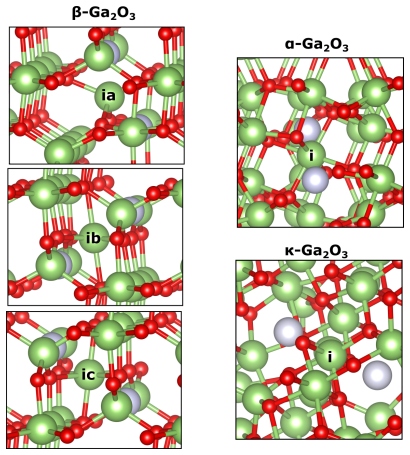
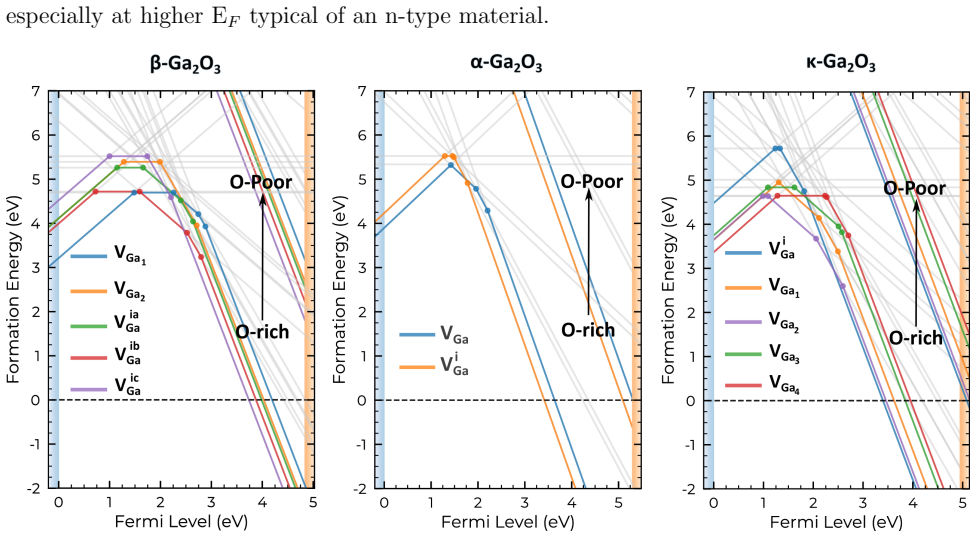
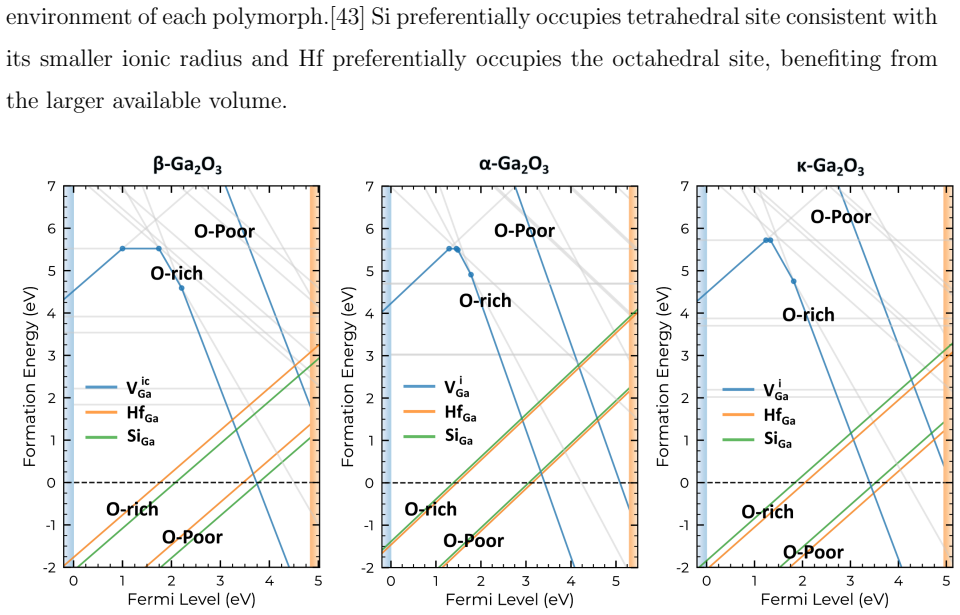
We find that split vacancies are the ground-state vacancy for all studied polymorphs (β, α, and κ). Split vacancies are more stable than simple vacancies by ~0.75 eV (β), ~0.41 eV (α), and ~0.14 eV (κ). MLIPs correctly identified the specific split-vacancy ground states and yielded an energetic ordering of symmetry-inequivalent defect configurations in excellent agreement with HSE06 results. While Hf and Si show low formation energy and act as shallow donors, especially under oxygen-poor conditions, their efficiency is limited by split-vacancy compensation. The growth under oxygen-poor conditions is a universal requirement to suppress these defects and achieve high n-type conductivity across
What carries the argument
Machine learning interatomic potentials that locate non-local split-vacancy reconstructions, followed by HSE06 hybrid DFT to compute formation energies across oxygen chemical potentials.
If this is right
- Split vacancies are the dominant native acceptor in β-, α-, and κ-Ga2O3.
- Hf_Ga and Si_Ga act as shallow donors but remain limited by compensation from split vacancies.
- Oxygen-poor growth conditions are required to minimize split-vacancy formation and reach high n-type conductivity in any polymorph.
- MLIPs reproduce the HSE06 ordering of defect configurations with high fidelity.
Where Pith is reading between the lines
- Strategies to control conductivity by growth atmosphere may transfer directly between the three polymorphs.
- The same MLIP-plus-DFT workflow could map defect compensation in other wide-gap oxides that host complex reconstructions.
- Quantitative doping windows for each polymorph could be extracted by combining the reported formation energies with explicit Fermi-level calculations.
Load-bearing premise
The machine learning interatomic potentials locate the true lowest-energy split-vacancy structures in the alpha and kappa phases without missing any lower-energy arrangements that HSE06 would find.
What would settle it
A complete HSE06 scan of all Ga-vacancy configurations in the alpha or kappa phase that returns a structure lower in energy than the reported split vacancy.
Figures
read the original abstract
Split Ga vacancies are the dominant native acceptor in $\beta$-$Ga_2O_3$; however, their role in $\alpha$ and $\kappa$ phases has been largely overlooked or assumed to be unfavorable. A detailed understanding of these defects is critical for tailoring the electrical conductivity and optical properties and optimising $Ga_2O_3$-based devices. In this work, we used machine learning interatomic potentials (MLIPs) to accelerate the discovery of non-local defect reconstructions, followed by HSE06 hybrid DFT to accurately quantify defect properties of single vacancy $V_{\text{Ga}}$, split vacancy $V_{\text{Ga}}^{\text{i}}$ and substitutional donors ($\mathrm{Hf_{Ga}}$ and $\mathrm{Si_{Ga}}$) across a wide range of experimentally relevant conditions for the oxygen chemical potential. We find that split vacancies are the ground-state vacancy for all studied polymorphs ($\beta$, $\alpha$, and $\kappa$). Split vacancies are more stable than simple vacancies by ~0.75 eV ($\beta$), ~0.41 eV ($\alpha$), and ~0.14 eV ($\kappa$). Notably, MLIPs correctly identified the specific split-vacancy ground states and yielded an energetic ordering of symmetry-inequivalent defect configurations in excellent agreement with HSE06 results. While Hf and Si show low formation energy and act as shallow donors, especially under oxygen-poor conditions, their efficiency is limited by split-vacancy compensation. The growth under oxygen-poor conditions is a universal requirement to suppress these defects and achieve high n-type conductivity across the $Ga_2O_3$ polymorph.
Editorial analysis
A structured set of objections, weighed in public.
Referee Report
Summary. The manuscript uses machine-learning interatomic potentials (MLIPs) to screen non-local defect reconstructions in Ga2O3 polymorphs, followed by HSE06 hybrid DFT to compute formation energies of simple Ga vacancies (V_Ga), split vacancies (V_Ga^i), and substitutional donors (Hf_Ga, Si_Ga). It reports that split vacancies are the ground-state configuration in β-, α-, and κ-Ga2O3, more stable than simple vacancies by ~0.75 eV, ~0.41 eV, and ~0.14 eV respectively, and concludes that oxygen-poor growth is required to suppress compensation across all phases.
Significance. If the central ordering holds, the work establishes a universal preference for split Ga vacancies as native acceptors across the three polymorphs, with direct implications for n-type doping strategies. The MLIP-accelerated screening of non-local reconstructions, validated by HSE06 energetic ordering, is a methodological strength that enables broader exploration than pure DFT would allow.
major comments (2)
- [Methods] Methods: The training data, active-learning protocol, and coverage of non-local Ga displacements for the MLIPs are unspecified. This is load-bearing for the claim that MLIPs located the global minima for α and κ phases (where fewer benchmarks exist), as the reported 0.41 eV and 0.14 eV advantages could reflect incomplete sampling rather than true ground states.
- [Results] Results (energetic ordering): The text states 'excellent agreement' between MLIP screening and HSE06 for symmetry-inequivalent configurations, but supplies no error bars, MAE values, or full validation tables. Without these, the quantitative stability differences (especially the small 0.14 eV margin in κ) cannot be assessed for robustness against possible missed lower-energy reconstructions.
Simulated Author's Rebuttal
We thank the referee for their thorough review and valuable feedback on our manuscript. The comments correctly identify areas where additional methodological details and quantitative validation would strengthen the presentation. We address each major comment below and will incorporate revisions to improve clarity and robustness.
read point-by-point responses
-
Referee: [Methods] Methods: The training data, active-learning protocol, and coverage of non-local Ga displacements for the MLIPs are unspecified. This is load-bearing for the claim that MLIPs located the global minima for α and κ phases (where fewer benchmarks exist), as the reported 0.41 eV and 0.14 eV advantages could reflect incomplete sampling rather than true ground states.
Authors: We agree that the Methods section would benefit from greater explicitness on these points to support the claims for α and κ phases. In the revised manuscript, we will expand the Methods to include: (i) a summary of the training dataset (bulk, defect, and surface configurations from DFT, with emphasis on split-vacancy and non-local Ga displacement structures), (ii) the active-learning protocol (including uncertainty sampling and iteration counts), and (iii) a description or table of how non-local reconstructions were sampled and validated. These additions will be placed in the main text or a new SI section, directly addressing the concern about potential incomplete sampling. revision: yes
-
Referee: [Results] Results (energetic ordering): The text states 'excellent agreement' between MLIP screening and HSE06 for symmetry-inequivalent configurations, but supplies no error bars, MAE values, or full validation tables. Without these, the quantitative stability differences (especially the small 0.14 eV margin in κ) cannot be assessed for robustness against possible missed lower-energy reconstructions.
Authors: We concur that quantitative validation metrics are needed to allow readers to evaluate the robustness of the reported energy differences, particularly the smaller margin in κ-Ga2O3. In the revision, we will add a validation table (main text or SI) reporting MAE and maximum errors between MLIP-predicted and HSE06 formation energies for all symmetry-inequivalent configurations screened in each polymorph. We will also include error bars on the MLIP energies where relevant and briefly discuss additional checks performed to confirm no lower-energy reconstructions were missed for the κ phase. This will make the 'excellent agreement' statement quantitative and address the concern about the 0.14 eV difference. revision: yes
Circularity Check
No significant circularity; MLIP screening validated by independent HSE06
full rationale
The paper's central result (split-vacancy ground states across polymorphs with specific energy differences) is obtained from HSE06 hybrid DFT formation energies computed on configurations first screened by MLIP. The abstract explicitly states that MLIP results are cross-checked against HSE06 for ordering agreement, with no indication that any reported energy difference or stability ordering is obtained by fitting or by construction from the MLIP itself. No self-citations, ansatzes, or uniqueness theorems are invoked in the provided text to justify the key claims. The derivation chain therefore remains self-contained against external first-principles benchmarks.
Axiom & Free-Parameter Ledger
axioms (1)
- domain assumption HSE06 hybrid functional yields reliable defect formation energies and charge-transition levels in Ga2O3
Reference graph
Works this paper leans on
-
[1]
J. B. Varley, B. Shen, and M. Higashiwaki, Wide bandgap semiconductor materials and de- vices, Journal of Applied Physics131(2022)
2022
-
[2]
Galazka, K
Z. Galazka, K. Irmscher, R. Uecker, R. Bertram, M. Pietsch, A. Kwasniewski, M. Naumann, T. Schulz, R. Schewski, D. Klimm, and M. Bickermann, On the bulkβ-Ga 2O3 single crystals grown by the Czochralski method, Journal of Crystal Growth404, 184 (2014)
2014
-
[3]
M. J. Tadjer, Toward gallium oxide power electronics, Science378, 724 (2022), https://www.science.org/doi/pdf/10.1126/science.add2713
-
[4]
Higashiwaki, A
M. Higashiwaki, A. Kuramata, H. Murakami, and Y. Kumagai, State-of-the-art technologies of gallium oxide power devices, Journal of Physics D: Applied Physics50, 333002 (2017)
2017
-
[5]
Pearton, J
S. Pearton, J. Yang, P. H. Cary, F. Ren, J. Kim, M. J. Tadjer, and M. A. Mastro, A review ofGa 2O3 materials, processing, and devices, Applied Physics Reviews5(2018)
2018
-
[6]
Higashiwaki, H
M. Higashiwaki, H. Murakami, Y. Kumagai, and A. Kuramata, Current status ofGa2O3 power devices, Japanese Journal of Applied Physics55, 1202A1 (2016)
2016
-
[7]
Safieddine, F
F. Safieddine, F. E. H. Hassan, and M. Kazan, Comparative study of the fundamental prop- erties ofGa 2O3 polymorphs, Journal of Solid State Chemistry312, 123272 (2022)
2022
-
[8]
Kobayashi, T
T. Kobayashi, T. Gake, Y. Kumagai, F. Oba, and Y.-i. Matsushita, Energetics and electronic structure of native point defects inα-Ga 2O3, Applied Physics Express12, 091001 (2019). 13
2019
-
[9]
V. D. Wheeler, N. Nepal, D. R. Boris, S. B. Qadri, L. O. Nyakiti, A. Lang, A. Koehler, G. Foster, S. G. Walton, C. R. Eddy Jr,et al., Phase control of crystallineGa 2O3 films by plasma-enhanced atomic layer deposition, Chemistry of Materials32, 1140 (2020)
2020
-
[10]
Roberts, P
J. Roberts, P. Chalker, B. Ding, R. Oliver, J. Gibbon, L. Jones, V. Dhanak, L. Phillips, J. Major, and F.-P. Massabuau, Low temperature growth and optical properties ofα-Ga 2O3 deposited on sapphire by plasma enhanced atomic layer deposition, Journal of Crystal Growth 528, 125254 (2019)
2019
-
[11]
Nicol, Y
D. Nicol, Y. Oshima, J. Roberts, L. Penman, D. Cameron, P. Chalker, R. Martin, and F.-P. Massabuau, Hydrogen-related 3.8 ev uv luminescence inα-Ga 2O3, Applied Physics Letters 122(2023)
2023
-
[12]
T. Ma, X. Chen, F. Ren, S. Zhu, S. Gu, R. Zhang, Y. Zheng, and J. Ye, Heteroepitaxial growth of thickα-Ga 2O3 film on sapphire (0001) by mist-cvd technique, Journal of Semiconductors 40, 012804 (2019)
2019
-
[13]
Seacat, J
S. Seacat, J. L. Lyons, and H. Peelaers, Orthorhombic alloys ofGa 2O3 andAl 2O3, Applied physics letters116(2020)
2020
-
[14]
M. B. Maccioni and V. Fiorentini, Phase diagram and polarization of stable phases of (Ga1- xInx) 2O3, Applied physics express9, 041102 (2016)
2016
-
[15]
J. Kim, D. Tahara, Y. Miura, and B. G. Kim, First-principle calculations of electronic struc- tures and polar properties of (κ,ε)-Ga 2O3, Applied Physics Express11, 061101 (2018)
2018
-
[16]
Shinohara and S
D. Shinohara and S. Fujita, Heteroepitaxy of corundum-structuredα-Ga 2O3 thin films on α-al2o3 substrates by ultrasonic mist chemical vapor deposition, Japanese Journal of Applied Physics47, 7311 (2008)
2008
-
[17]
Kaneko, S
K. Kaneko, S. Fujita, and T. Hitora, A power device material of corundum-structuredα-Ga2O3 fabricated by mist epitaxy®technique, Japanese Journal of Applied Physics57, 02CB18 (2018)
2018
-
[18]
G. T. Dang, T. Kawaharamura, M. Furuta, and M. W. Allen, Mist-cvd grown sn-dopedα- Ga2O3 mesfets, IEEE Transactions on Electron Devices62, 3640 (2015)
2015
-
[19]
I. Cora, F. Mezzadri, F. Boschi, M. Bosi, M. ˇCaploviˇ cov´ a, G. Calestani, I. D´ odony, B. P´ ecz, and R. Fornari, The real structure ofε-Ga 2O3 and its relation toκ-phase, CrystEngComm 19, 1509 (2017). 14
2017
-
[20]
Ranga, S
P. Ranga, S. B. Cho, R. Mishra, and S. Krishnamoorthy, Highly tunable, polarization- engineered two-dimensional electron gas inε-AlGaO3/ε-ga2o3 heterostructures, Applied Physics Express13, 061009 (2020)
2020
-
[21]
S. B. Cho and R. Mishra, Epitaxial engineering of polarε-Ga 2O3 for tunable two-dimensional electron gas at the heterointerface, Applied Physics Letters112(2018)
2018
-
[22]
J. B. Varley, H. Peelaers, A. Janotti, and C. G. Van de Walle, Hydrogenated cation vacancies in semiconducting oxides, Journal of Physics: Condensed Matter23, 334212 (2011)
2011
-
[23]
Karjalainen, I
A. Karjalainen, I. Makkonen, J. Etula, K. Goto, H. Murakami, Y. Kumagai, and F. Tuomisto, Split ga vacancies in n-type and semi-insulatingβ-Ga 2O3 single crystals, Applied Physics Letters118(2021)
2021
-
[24]
Tuomisto, Ga vacancies inβ-Ga 2O3: split or not?, Japanese Journal of Applied Physics 62, SF0802 (2023)
F. Tuomisto, Ga vacancies inβ-Ga 2O3: split or not?, Japanese Journal of Applied Physics 62, SF0802 (2023)
2023
-
[25]
A. Y. Polyakov, V. I. Nikolaev, I. N. Meshkov, K. Siemek, P. B. Lagov, E. B. Yakimov, A. I. Pechnikov, O. S. Orlov, A. A. Sidorin, S. I. Stepanov,et al., Point defect creation by proton and carbon irradiation ofα-ga2o3, Journal of Applied Physics132(2022)
2022
-
[26]
Mu and C
S. Mu and C. G. Van de Walle, Phase stability of (al x ga 1- x) 2 o 3 polymorphs: A first- principles study, Physical Review Materials6, 104601 (2022)
2022
-
[27]
Kresse and J
G. Kresse and J. Furthm¨ uller, Efficient iterative schemes for ab initio total-energy calcula- tions using a plane-wave basis set, Physical Review B54, 11169 (1996), publisher: American Physical Society
1996
-
[28]
Kresse and J
G. Kresse and J. Furthm¨ uller, Efficiency of ab-initio total energy calculations for metals and semiconductors using a plane-wave basis set, Computational materials science6, 15 (1996)
1996
-
[29]
Kresse and J
G. Kresse and J. Hafner, Ab initio molecular dynamics for liquid metals, Physical review B 47, 558 (1993)
1993
-
[30]
P. E. Bl¨ ochl, Projector augmented-wave method, Physical Review B50, 17953 (1994), pub- lisher: American Physical Society
1994
-
[31]
J. Heyd, G. E. Scuseria, and M. Ernzerhof, Hybrid functionals based on a screened Coulomb potential, The Journal of Chemical Physics118, 8207 (2003), https://pubs.aip.org/aip/jcp/article-pdf/118/18/8207/10847843/8207 1 online.pdf
2003
-
[32]
A. V. Krukau, O. A. Vydrov, A. F. Izmaylov, and G. E. Scuseria, Influence of the exchange screening parameter on the performance of screened hybrid functionals, The Journal of Chem- 15 ical Physics125, 224106 (2006)
2006
-
[33]
P. E. Bl¨ ochl, Improved tetrahedron method for brillouin-zone integrations, Physical Review B49, 16223 (1994)
1994
-
[34]
S. R. Kavanagh, A. G. Squires, A. Nicolson, I. Mosquera-Lois, A. M. Ganose, B. Zhu, K. Brlec, A. Walsh, and D. O. Scanlon, doped: Python toolkit for robust and repeatable charged defect supercell calculations, Journal of Open Source Software9, 6433 (2024)
2024
-
[35]
S. R. Kavanagh, Identifying split vacancy defects with machine-learned foundation models and electrostatics, Journal of Physics: Energy7, 045002 (2025)
2025
-
[36]
S. P. Ong, W. D. Richards, A. Jain, G. Hautier, M. Kocher, S. Cholia, D. Gunter, V. L. Chevrier, K. A. Persson, and G. Ceder, Python materials genomics (pymatgen): A robust, open-source python library for materials analysis, Computational Materials Science68, 314 (2013)
2013
-
[37]
A. Y. Toukmaji and J. A. Board Jr, Ewald summation techniques in perspective: a survey, Computer physics communications95, 73 (1996)
1996
-
[38]
Batatia, D
I. Batatia, D. P. Kovacs, G. Simm, C. Ortner, and G. Cs´ anyi, Mace: Higher order equivari- ant message passing neural networks for fast and accurate force fields, Advances in neural information processing systems35, 11423 (2022)
2022
-
[39]
A foundation model for atomistic materials chemistry
I. Batatia, P. Benner, Y. Chiang, A. M. Elena, D. P. Kov´ acs, J. Riebesell, X. R. Advin- cula, M. Asta, M. Avaylon, W. J. Baldwin, F. Berger, N. Bernstein, A. Bhowmik, F. Bigi, S. M. Blau, V. C˘ arare, M. Ceriotti, S. Chong, J. P. Darby, S. De, F. D. Pia, V. L. Deringer, R. Elijoˇ sius, Z. El-Machachi, F. Falcioni, E. Fako, A. C. Ferrari, J. L. A. Gardne...
work page internal anchor Pith review Pith/arXiv arXiv 2025
-
[40]
C. G. Van de Walle and J. Neugebauer, First-principles calculations for defects and impurities: Applications to III-nitrides, Journal of Applied Physics95, 3851 (2004)
2004
-
[41]
Kumagai and F
Y. Kumagai and F. Oba, Electrostatics-based finite-size corrections for first-principles point defect calculations, Phys. Rev. B89, 195205 (2014), publisher: American Physical Society
2014
-
[42]
Freysoldt, J
C. Freysoldt, J. Neugebauer, and C. G. Van de Walle, Fully Ab Initio Finite-Size Corrections for Charged-Defect Supercell Calculations, Phys. Rev. Lett.102, 016402 (2009), publisher: American Physical Society
2009
-
[43]
M. A. Fadla, M. Gr¨ uning, and L. Stella, Tailoring the electronic properties of monoclinic (in x al 1- x) 2 o 3 alloys via substitutional donors and acceptors, Physical Review Materials9, 105002 (2025)
2025
-
[44]
A. M. Ganose, A. J. Jackson, and D. O. Scanlon, sumo: Command-line tools for plotting and analysis of periodic* ab initio* calculations, Journal of Open Source Software3, 717 (2018)
2018
-
[45]
Ahmadi and Y
E. Ahmadi and Y. Oshima, Materials issues and devices ofα-andβ-ga2o3, Journal of Applied Physics126(2019)
2019
-
[46]
Kneiß, A
M. Kneiß, A. Hassa, D. Splith, C. Sturm, H. Von Wenckstern, T. Schultz, N. Koch, M. Lorenz, and M. Grundmann, Tin-assisted heteroepitaxial pld-growth ofκ-ga2o3 thin films with high crystalline quality, Apl Materials7(2019)
2019
-
[47]
Marezio and J
M. Marezio and J. Remeika, Bond lengths in theα-ga 2 o 3 structure and the high-pressure phase of ga 2-x fe x o 3, Journal of Chemical Physics46, 1862 (1967)
1967
-
[48]
˚Ahman, G
J. ˚Ahman, G. Svensson, and J. Albertsson, A reinvestigation ofβ-gallium oxide, Crystal Structure Communications52, 1336 (1996)
1996
-
[49]
J. B. Varley, H. Peelaers, A. Janotti, and C. G. V. d. Walle, Hydrogenated cation vacancies in semiconducting oxides, Journal of Physics: Condensed Matter23, 334212 (2011)
2011
-
[50]
W. B. Fowler, M. Stavola, A. Venzie, and A. Portoff, Metastable structures of cation vacancies in semiconducting oxides, Journal of Applied Physics135(2024)
2024
-
[51]
Mazzolini, J
P. Mazzolini, J. B. Varley, A. Parisini, A. Sacchi, M. Pavesi, A. Bosio, M. Bosi, L. Seravalli, B. M. Janzen, M. N. Marggraf,et al., Engineering shallow and deep level defects inκ-ga2o3 thin films: comparing metal-organic vapour phase epitaxy to molecular beam epitaxy and the effect of annealing treatments, Materials Today Physics45, 101463 (2024). 17
2024
discussion (0)
Sign in with ORCID, Apple, or X to comment. Anyone can read and Pith papers without signing in.