ISAC with Affine Frequency Division Multiplexing: An FMCW-Based Signal Processing Perspective
Pith reviewed 2026-05-17 22:07 UTC · model grok-4.3
The pith
A specific parameter selection makes AFDM subcarriers mathematically equivalent to Nyquist-sampled FMCW waveforms.
A machine-rendered reading of the paper's core claim, the machinery that carries it, and where it could break.
Core claim
The central claim is that an innovative parameter selection criterion establishes a precise mathematical equivalence between AFDM subcarriers and Nyquist-sampled FMCW. This connection supplies a clear physical insight into AFDM's sensing mechanism and enables a direct mapping from the DAFT index to delay-Doppler parameters of wireless channels. Building on the equivalence, the paper develops a novel input-output model in a DD-parameterized DAFT domain that explicitly reveals the inherent DD coupling effect arising from chirp-channel interaction, then designs two matched-filtering sensing algorithms whose performance is validated through simulation.
What carries the argument
The parameter selection criterion that produces exact equivalence between AFDM subcarriers and Nyquist-sampled FMCW, which in turn supports the DD-DAFT domain model and the direct DAFT-to-DD mapping.
If this is right
- Pilot-free sensing becomes feasible by treating AFDM as an FMCW-like waveform.
- The DD-DAFT domain model isolates the coupling effect so that the second algorithm can resolve it exactly.
- Sensing performance, communication overhead, and computational complexity trade off against one another in a quantifiable way.
- The proposed AFDM variant outperforms classical AFDM and other waveform variants in most simulated scenarios.
Where Pith is reading between the lines
- The equivalence may allow reuse of existing FMCW radar processing pipelines inside AFDM transceivers.
- Accounting for the DD coupling appears necessary for high-resolution sensing; ignoring it would limit the first algorithm's accuracy.
- The mapping from DAFT index to delay-Doppler parameters could simplify joint waveform design in other multicarrier ISAC systems.
Load-bearing premise
The wireless channel must exhibit the exact delay-Doppler coupling that arises from chirp-channel interaction and the high-mobility regime must allow the DAFT-domain representation to hold without unmodeled distortions.
What would settle it
A numerical or experimental test in which the chosen parameters are applied to an AFDM waveform and the resulting range-Doppler map deviates measurably from the map produced by a reference Nyquist-sampled FMCW waveform under the same channel conditions.
Figures


read the original abstract
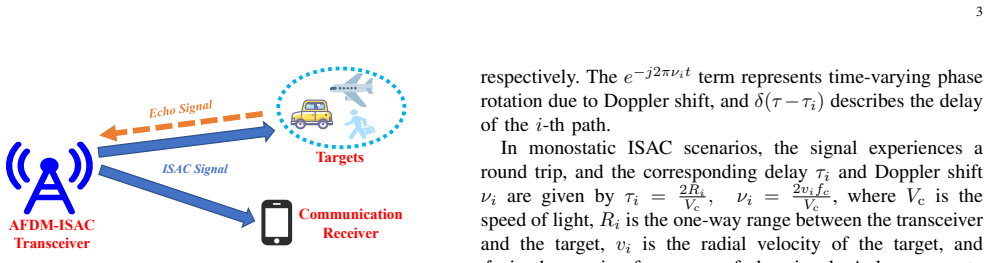
This paper investigates the sensing potential of affine frequency division multiplexing (AFDM) in high-mobility integrated sensing and communication (ISAC) from the perspective of radar waveforms. We introduce an innovative parameter selection criterion that establishes a precise mathematical equivalence between AFDM subcarriers and Nyquist-sampled frequency-modulated continuous-wave (FMCW). This connection not only provides a clear physical insight into AFDM's sensing mechanism but also enables a direct mapping from the DAFT index to delay-Doppler (DD) parameters of wireless channels. Building on this, we develop a novel input-output model in a DD-parameterized DAFT (DD-DAFT) domain for AFDM, which explicitly reveals the inherent DD coupling effect arising from the chirp-channel interaction. Subsequently, we design two matched-filtering sensing algorithms. The first is performed in the time-frequency domain with low complexity, while the second is operated in the DD-DAFT domain to precisely resolve the DD coupling. Simulations show that our algorithms achieve effective pilot-free sensing and demonstrate a fundamental trade-off between sensing performance, communication overhead, and computational complexity. The proposed AFDM outperforms classical AFDM and other variants in most scenarios.
Editorial analysis
A structured set of objections, weighed in public.
Referee Report
Summary. The manuscript claims that a novel parameter selection criterion establishes a precise mathematical equivalence between AFDM subcarriers and Nyquist-sampled FMCW waveforms. This equivalence yields a DD-parameterized DAFT (DD-DAFT) input-output model that explicitly captures the DD coupling effect from chirp-channel interaction, enabling two matched-filtering sensing algorithms (one low-complexity in the time-frequency domain and one in the DD-DAFT domain) for pilot-free ISAC in high-mobility settings. Simulations are reported to demonstrate effective sensing performance, fundamental trade-offs with communication overhead and complexity, and outperformance relative to classical AFDM and other variants.
Significance. If the equivalence and resulting model hold under the stated conditions, the work supplies a concrete signal-processing bridge between AFDM and established FMCW radar techniques, furnishing both physical insight into AFDM sensing and directly mappable DD parameters. The proposed algorithms and observed trade-offs could inform practical ISAC waveform design for high-mobility channels, particularly if the derivations prove reproducible and the simulations are fully specified.
major comments (3)
- [Section 3] Parameter selection criterion (Section 3): The central claim of 'precise mathematical equivalence' between AFDM subcarriers and Nyquist-sampled FMCW is load-bearing for both the physical insight and the direct DAFT-to-DD mapping. The derivation must explicitly demonstrate that the chosen parameters eliminate residual phase/amplitude terms, aliasing, or other distortions arising from finite-length effects and high-mobility chirp-channel interaction beyond the modeled DD coupling; otherwise the equivalence is conditional rather than general.
- [Section 4] DD-DAFT input-output model (Section 4): The assertion that the model 'explicitly reveals the inherent DD coupling effect' requires the explicit equation (or set of equations) showing how the coupling term emerges from the chirp-channel interaction and matches the FMCW-derived form exactly. If any approximation or unmodeled term remains, both the novelty of the model and the justification for the DD-DAFT-domain matched filter are weakened.
- [Section 6] Simulation results (Section 6): The reported performance advantages, trade-offs, and outperformance claims rest on simulations whose channel generation procedure, exact metric definitions (e.g., sensing MSE or detection probability), and handling of realistic impairments are not fully specified. This prevents independent verification that the equivalence survives the impairments highlighted in the stress-test note and therefore undermines the empirical support for the algorithms.
minor comments (2)
- [Abstract] Abstract: The statement that 'simulations show' effective sensing would benefit from one or two quantitative highlights (e.g., achieved range or velocity resolution) to give readers an immediate sense of the gains.
- Notation: Ensure consistent distinction between the standard DAFT domain and the proposed DD-DAFT domain throughout; occasional slippage between the two terms can confuse readers unfamiliar with the new model.
Simulated Author's Rebuttal
We thank the referee for the thorough and constructive review. The comments highlight important points on explicitness of derivations and reproducibility of simulations. We will revise the manuscript accordingly to strengthen these aspects while preserving the core contributions. Point-by-point responses follow.
read point-by-point responses
-
Referee: [Section 3] Parameter selection criterion (Section 3): The central claim of 'precise mathematical equivalence' between AFDM subcarriers and Nyquist-sampled FMCW is load-bearing for both the physical insight and the direct DAFT-to-DD mapping. The derivation must explicitly demonstrate that the chosen parameters eliminate residual phase/amplitude terms, aliasing, or other distortions arising from finite-length effects and high-mobility chirp-channel interaction beyond the modeled DD coupling; otherwise the equivalence is conditional rather than general.
Authors: We agree that explicit verification of the equivalence is essential. In the revised manuscript, Section 3 will be expanded with a complete derivation that substitutes the selected parameters (chirp rate matching the FMCW sweep and subcarrier spacing aligned to Nyquist sampling) into the AFDM waveform expression. This will show term-by-term cancellation of residual phase and amplitude factors, as well as the absence of aliasing under the finite-length and high-mobility conditions considered. The equivalence is thereby established precisely within the stated modeling assumptions rather than conditionally. revision: yes
-
Referee: [Section 4] DD-DAFT input-output model (Section 4): The assertion that the model 'explicitly reveals the inherent DD coupling effect' requires the explicit equation (or set of equations) showing how the coupling term emerges from the chirp-channel interaction and matches the FMCW-derived form exactly. If any approximation or unmodeled term remains, both the novelty of the model and the justification for the DD-DAFT-domain matched filter are weakened.
Authors: The DD-DAFT model is obtained by applying the parameter equivalence to the received AFDM signal and re-expressing the result in the DD-parameterized DAFT domain. In the revision, we will insert the intermediate steps that isolate the coupling term arising from the product of the linear chirp phase and the time-varying channel response. The resulting expression will be shown to match the FMCW-derived DD coupling form exactly, with no residual approximations beyond the standard narrowband and finite-duration assumptions already stated in the paper. This will directly support the subsequent matched-filter designs. revision: yes
-
Referee: [Section 6] Simulation results (Section 6): The reported performance advantages, trade-offs, and outperformance claims rest on simulations whose channel generation procedure, exact metric definitions (e.g., sensing MSE or detection probability), and handling of realistic impairments are not fully specified. This prevents independent verification that the equivalence survives the impairments highlighted in the stress-test note and therefore undermines the empirical support for the algorithms.
Authors: We acknowledge the need for full reproducibility. The revised Section 6 will specify the exact DD channel generation procedure (including delay and Doppler spreads, number of paths, and Jakes' spectrum implementation), provide closed-form definitions for all reported metrics (sensing MSE, detection probability, and communication BER), and detail the incorporation of realistic impairments such as additive noise, phase noise, and residual synchronization errors. These additions will enable independent verification of the claimed performance and trade-offs. revision: yes
Circularity Check
Parameter selection criterion for AFDM-FMCW equivalence is a constructive design choice, not a circular reduction.
full rationale
The paper's central step introduces a parameter selection criterion to achieve exact mathematical equivalence between AFDM subcarriers and Nyquist-sampled FMCW, enabling the DD-DAFT domain model and DD coupling revelation. This is presented as an innovative criterion rather than a fitted prediction or self-definition; the equivalence holds under the stated assumptions on channel DD coupling and high-mobility regime. No load-bearing self-citation, uniqueness theorem from prior work, or renaming of known results is used for the core claims. The matched-filtering algorithms and simulations follow directly from the constructed model without reducing to the inputs by construction. The derivation chain remains self-contained against external benchmarks.
Axiom & Free-Parameter Ledger
axioms (2)
- standard math The discrete affine Fourier transform (DAFT) provides an orthonormal basis for representing chirp-modulated signals in high-mobility channels.
- domain assumption Wireless channels in high-mobility scenarios exhibit delay-Doppler coupling that interacts with the chirp structure of AFDM.
Lean theorems connected to this paper
-
IndisputableMonolith/Cost/FunctionalEquation.leanwashburn_uniqueness_aczel unclear?
unclearRelation between the paper passage and the cited Recognition theorem.
precise mathematical equivalence between AFDM subcarriers and Nyquist-sampled frequency-modulated continuous-wave (FMCW)... DD coupling effect arising from the chirp-channel interaction
-
IndisputableMonolith/Foundation/DimensionForcing.leanreality_from_one_distinction unclear?
unclearRelation between the paper passage and the cited Recognition theorem.
K=8 chirp periods... period Np... floor(k/K) coupling term
What do these tags mean?
- matches
- The paper's claim is directly supported by a theorem in the formal canon.
- supports
- The theorem supports part of the paper's argument, but the paper may add assumptions or extra steps.
- extends
- The paper goes beyond the formal theorem; the theorem is a base layer rather than the whole result.
- uses
- The paper appears to rely on the theorem as machinery.
- contradicts
- The paper's claim conflicts with a theorem or certificate in the canon.
- unclear
- Pith found a possible connection, but the passage is too broad, indirect, or ambiguous to say the theorem truly supports the claim.
Forward citations
Cited by 1 Pith paper
-
Towards Standardizing Affine Frequency Division Multiplexing (AFDM) for Future Wireless Networks
AFDM is analyzed for standardization potential, showing backwards compatibility with 4G/5G, radar, and LoRa systems while highlighting robustness in delay-Doppler channels for NTN, ISAC, V2X, and UWA applications.
discussion (0)
Sign in with ORCID, Apple, or X to comment. Anyone can read and Pith papers without signing in.