Equivariant Interpolations in Topological Holography
Pith reviewed 2026-06-25 22:47 UTC · model grok-4.3
The pith
Equivariant Gromov-Witten theories on P1 x C2 interpolate between points with holographic duals including the symmetric orbifold of the equivariant plane.
A machine-rendered reading of the paper's core claim, the machinery that carries it, and where it could break.
Core claim
The full equivariant correspondence between the Gromov-Witten theory on P1 x C2 and the symmetric orbifold of the equivariant plane can be embedded in string theory. On the boundary side of that correspondence, the scaling limit from the equivariant to the ordinary cohomology ring for the Hilbert scheme of points on the plane is analyzed in terms of Jack symmetric polynomials, with explicit computation of several structure constants exhibiting positivity and integrality properties.
What carries the argument
The three equivariant parameters associated to rotations of the sphere and the two planes, which define a space where known duals sit at specific points allowing interpolations.
If this is right
- At large equivariant parameter the model is dominated by pure topological gravity theories at the two fixed points.
- At small equivariant parameter the theory is equivalent to the grand canonical Hurwitz theory.
- The deformation provides a solvable analogue for the interpolation in the transposition coupling in the moduli space of the AdS3/CFT2 duality.
- The boundary analysis yields structure constants with positivity and integrality in the equivariant cohomology ring.
Where Pith is reading between the lines
- The positivity properties of the structure constants may indicate an underlying combinatorial or representation-theoretic structure in the Hilbert scheme cohomology.
- Embedding the correspondence in string theory suggests that similar interpolations could be explored in other topological string models or higher-dimensional holography setups.
- Continuous variation in the parameter space might reveal phase transitions or critical points between different dual descriptions.
Load-bearing premise
That specific points in the three-dimensional equivariant parameter space have the stated known holographic duals so that continuous interpolation between them is physically and mathematically meaningful.
What would settle it
A calculation demonstrating that the interpolated theory between the known points does not match the expected symmetric orbifold dual, or that the Jack polynomial structure constants lose positivity in the scaling limit.
Figures

read the original abstract
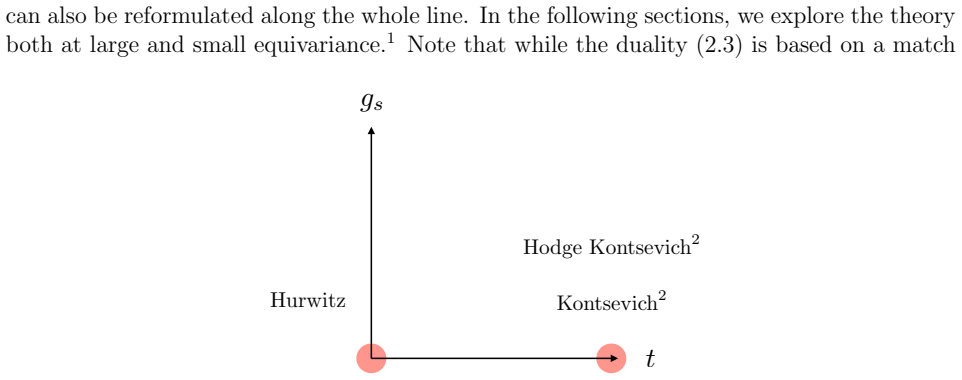
We revisit equivariant Gromov-Witten theories on P1 and on P1 x C2. One can introduce three equivariant parameters associated to rotations of the sphere as well as the two planes. A number of points in the parameter space have known holographic duals. These include the symmetric orbifold point dual to the AdS3 x S3 x C2 string theory at string scale radius of curvature, the grand canonical Hurwitz theory and the product of two Kontsevich models. Within this framework, we discuss interpolations in the equivariant parameters. Firstly, we move between the small and large equivariant parameter regimes in Gromov-Witten theory on P1. At large equivariant parameter, the model is dominated by the pure topological gravity theories at the two fixed points while at small equivariant parameter the theory is equivalent to the grand canonical Hurwitz theory. The deformation is a solvable analogue for the interpolation in the transposition coupling in the moduli space of the AdS3/CFT2 duality. Moreover, we propose that the full equivariant correspondence between the Gromov-Witten theory on P1 x C2 and the symmetric orbifold of the equivariant plane can be embedded in string theory. On the boundary side of that correspondence, we analyze the scaling limit from the equivariant to the ordinary cohomology ring for the Hilbert scheme of points on the plane in terms of Jack symmetric polynomials. We explicitly compute several structure constants of the equivariant cohomology ring and point out their intriguing positivity and integrality properties.
Editorial analysis
A structured set of objections, weighed in public.
Referee Report
Summary. The manuscript proposes embedding the full equivariant Gromov-Witten theory on P1 x C2 / symmetric orbifold of the equivariant plane correspondence into string theory by continuous interpolation among three points in a three-dimensional equivariant parameter space (symmetric orbifold dual to AdS3 x S3 x C2 at string-scale radius, grand canonical Hurwitz theory, and product of two Kontsevich models). It analyzes the deformation between small and large equivariant parameter regimes in GW theory on P1 as a solvable analogue of transposition coupling interpolation, and on the boundary side examines the scaling limit from equivariant to ordinary cohomology of the Hilbert scheme via Jack symmetric polynomials, explicitly computing several structure constants that exhibit positivity and integrality.
Significance. If the assumed dual identifications at the interpolation points are valid and the continuous deformation is physically meaningful, the proposal would realize the equivariant correspondence within a string theory framework and supply new algebraic data on the boundary via the Jack polynomial analysis. The explicit structure constant computations and their positivity/integrality properties constitute an independent mathematical contribution to the study of equivariant cohomology rings, even if the holographic embedding remains conjectural.
major comments (2)
- [Abstract] Abstract: The central claim that the full equivariant correspondence 'can be embedded in string theory' is defined by interpolating among points asserted to have 'known holographic duals'; the manuscript provides no derivation, error estimate, or independent check of these dual identifications (symmetric orbifold, grand canonical Hurwitz, Kontsevich product), rendering the physical meaningfulness of the continuous interpolation dependent on external assumptions rather than an internal construction.
- [Abstract] Abstract and boundary analysis section: The scaling limit from equivariant to ordinary cohomology ring is analyzed via Jack symmetric polynomials with explicit structure constants, but the manuscript supplies no verification that these constants survive the limit or match known ordinary cohomology data, which is load-bearing for the claim that the boundary side furnishes a controlled interpolation.
Simulated Author's Rebuttal
We thank the referee for the careful reading and constructive comments on our manuscript. We address the two major comments point by point below, indicating planned revisions where appropriate.
read point-by-point responses
-
Referee: [Abstract] Abstract: The central claim that the full equivariant correspondence 'can be embedded in string theory' is defined by interpolating among points asserted to have 'known holographic duals'; the manuscript provides no derivation, error estimate, or independent check of these dual identifications (symmetric orbifold, grand canonical Hurwitz, Kontsevich product), rendering the physical meaningfulness of the continuous interpolation dependent on external assumptions rather than an internal construction.
Authors: We agree that the dual identifications at the special points (symmetric orbifold, grand canonical Hurwitz theory, and product of Kontsevich models) are taken from the existing literature rather than re-derived or independently verified in this work. The manuscript's contribution is the proposal of a continuous interpolation in the three-dimensional equivariant parameter space connecting these points, together with the solvable deformation analysis in GW theory on P1. We will revise the abstract and add a clarifying paragraph in the introduction to state explicitly that the embedding is conjectural, that the duals rely on prior results (with citations), and that no new derivation or error estimate is provided here as it lies outside the present scope. revision: yes
-
Referee: [Abstract] Abstract and boundary analysis section: The scaling limit from equivariant to ordinary cohomology ring is analyzed via Jack symmetric polynomials with explicit structure constants, but the manuscript supplies no verification that these constants survive the limit or match known ordinary cohomology data, which is load-bearing for the claim that the boundary side furnishes a controlled interpolation.
Authors: The Jack polynomial framework is introduced precisely because the Jack parameter controls the interpolation between equivariant and ordinary cohomology, with the ordinary case recovered at a specific value where Jack polynomials reduce to Schur polynomials. The explicit structure constant computations and their positivity/integrality are new results at finite equivariant parameter. We acknowledge that the manuscript does not include an explicit verification that the computed constants match known ordinary cohomology data after the limit. We will add a discussion in the boundary analysis section explaining the expected reduction via the Jack-to-Schur limit and referencing the relevant ordinary cohomology literature; we will also include a brief illustrative check for at least one low-degree structure constant if it can be computed concisely. revision: partial
Circularity Check
No significant circularity; proposal builds on external known duals with independent boundary computations
full rationale
The paper identifies three points in equivariant parameter space as having known holographic duals (symmetric orbifold, grand canonical Hurwitz, product of Kontsevich models) and proposes continuous interpolations between them, including a scaling limit analyzed via Jack symmetric polynomials. Explicit structure constants are computed on the boundary side and shown to have positivity and integrality. These steps do not reduce by construction to the inputs; the dual identifications are treated as external starting points, and the new content consists of the interpolation proposal plus independent ring computations. No self-definitional equations, fitted predictions, or load-bearing self-citations are exhibited in the provided text.
Axiom & Free-Parameter Ledger
free parameters (1)
- three equivariant parameters
axioms (2)
- domain assumption Certain discrete points in the three-parameter space have known holographic duals (symmetric orbifold, grand canonical Hurwitz, product of two Kontsevich models).
- domain assumption Equivariant Gromov-Witten theory on P1 and P1 x C2 admits continuous deformations in the equivariant parameters.
Reference graph
Works this paper leans on
-
[1]
Dimensional reduction in quantum gravity,
G. ’t Hooft, “Dimensional reduction in quantum gravity,” Conf. Proc. C930308(1993), 284-296 [arXiv:gr-qc/9310026 [gr-qc]]
Pith/arXiv arXiv 1993
-
[2]
L. Susskind, “The World as a hologram,” J. Math. Phys.36(1995), 6377-6396 doi:10.1063/1.531249 [arXiv:hep-th/9409089 [hep-th]]
work page internal anchor Pith review Pith/arXiv arXiv doi:10.1063/1.531249 1995
-
[3]
The LargeNlimit of superconformal field theories and supergravity,
J. M. Maldacena, “The LargeNlimit of superconformal field theories and supergravity,” Adv. Theor. Math. Phys.2(1998), 231-252 doi:10.4310/ATMP.1998.v2.n2.a1 [arXiv:hep- th/9711200 [hep-th]]
-
[4]
Deriving the AdS 3/CFT2 correspon- dence,
L. Eberhardt, M. R. Gaberdiel and R. Gopakumar, “Deriving the AdS 3/CFT2 correspon- dence,” JHEP02(2020), 136 doi:10.1007/JHEP02(2020)136 [arXiv:1911.00378 [hep-th]]
-
[5]
The Topological Symmetric Orbifold,
S. Li and J. Troost, “The Topological Symmetric Orbifold,” JHEP10(2020), 201 doi:10.1007/JHEP10(2020)201 [arXiv:2006.09346 [hep-th]]
-
[6]
The crepant resolution conjecture,
J. Bryan, T. Graber, “The crepant resolution conjecture,” In Proc. Sympos. Pure Math (Vol. 80, pp. 23-42) (2009). 37 λ1;λ 2 andλ 3 5 4,1 3,2 5 ; 5 24γ4 + 46γ3 +54γ2 + 16γ+ 8 24γ4 + 52γ3 +56γ2 + 28γ 24γ4 + 48γ3 + 48γ2 + 24γ 5 ; 4,1 30γ3 + 35γ2 + 35γ 24γ3 + 36γ2 + 24γ+ 12 30γ3 + 42γ2 + 24γ+ 12 5 ; 3,2 20γ3 + 20γ2 + 20γ 20γ3 + 28γ2 + 16γ+ 8 18γ3 + 24γ2 + 12γ...
2009
-
[7]
The local Gromov-Witten theory of curves,
J. Bryan, R. Pandharipande, “The local Gromov-Witten theory of curves,” Journal of the American Mathematical Society, 21(1) (2008), 101-136
2008
-
[8]
Quantum cohomology of the Hilbert scheme of points in the plane,
A. Okounkov, R. Pandharipande, “Quantum cohomology of the Hilbert scheme of points in the plane,” Inventiones mathematicae, 179(3), 523-557 (2010)
2010
-
[9]
Gromov-Witten theory, Hurwitz theory, and completed cycles
A. Okounkov and R. Pandharipande, “Gromov-Witten theory, Hurwitz theory, and completed cycles,” Ann. Math.163(2006), 517-560 doi:10.4007/annals.2006.163.517 [arXiv:math/0204305 [math]]
work page internal anchor Pith review Pith/arXiv arXiv doi:10.4007/annals.2006.163.517 2006
-
[10]
The Equivariant Gromov-Witten theory of P1,
A. Okounkov and R. Pandharipande, “The Equivariant Gromov-Witten theory of P1,” [arXiv:math/0207233 [math.AG]]
-
[11]
Virasoro constraints for target curves,
A. Okounkov and R. Pandharipande, “Virasoro constraints for target curves,” [arXiv: math/0308097 [math.AG]]
-
[12]
Symmetric groups and the cup product on the cohomology of Hilbert schemes,
M. Lehn, C. Sorger, “Symmetric groups and the cup product on the cohomology of Hilbert schemes,” Duke Mathematical Journal, 110(2), 345-357 (2001)
2001
-
[13]
The chiral ring of a symmetric orbifold and its large N limit,
S. K. Ashok and J. Troost, “The chiral ring of a symmetric orbifold and its large N limit,” JHEP08(2023), 004 doi:10.1007/JHEP08(2023)004 [arXiv:2303.09308 [hep-th]]
-
[14]
Extremal Correlators and Hurwitz Numbers in Symmetric Product Orbifolds
A. Pakman, L. Rastelli and S. S. Razamat, “Extremal Correlators and Hurwitz Num- bers in Symmetric Product Orbifolds,” Phys. Rev. D80(2009), 086009 doi:10.1103/- PhysRevD.80.086009 [arXiv:0905.3451 [hep-th]]
work page internal anchor Pith review Pith/arXiv arXiv doi:10.1103/- 2009
-
[15]
Worldsheet correlators in AdS(3)/CFT(2)
M. R. Gaberdiel and I. Kirsch, “Worldsheet correlators in AdS(3)/CFT(2),” JHEP04 (2007), 050 doi:10.1088/1126-6708/2007/04/050 [arXiv:hep-th/0703001 [hep-th]]
work page internal anchor Pith review Pith/arXiv arXiv doi:10.1088/1126-6708/2007/04/050 2007
-
[16]
Exact chiral ring of AdS(3) / CFT(2),
A. Dabholkar and A. Pakman, “Exact chiral ring of AdS(3) / CFT(2),” Adv. Theor. Math. Phys.13(2009) no.2, 409-462 doi:10.4310/ATMP.2009.v13.n2.a2 [arXiv:hep- th/0703022 [hep-th]]
-
[17]
Seiberg-Witten prepotential from instanton counting,
N. A. Nekrasov, “Seiberg-Witten prepotential from instanton counting,” Adv. Theor. Math. Phys.7(2003) no.5, 831-864 doi:10.4310/ATMP.2003.v7.n5.a4 [arXiv:hep-th/- 0206161 [hep-th]]
-
[18]
The Omega Deformation, Branes, Integrability, and Liouville Theory
N. Nekrasov and E. Witten, “The Omega Deformation, Branes, Integrability, and Li- ouville Theory,” JHEP09(2010), 092 doi:10.1007/JHEP09(2010)092 [arXiv:1002.0888 [hep-th]]
work page internal anchor Pith review Pith/arXiv arXiv doi:10.1007/jhep09(2010)092 2010
-
[19]
Black Holes, q-Deformed 2d Yang-Mills, and Non-perturbative Topological Strings
M. Aganagic, H. Ooguri, N. Saulina and C. Vafa, “Black holes, q-deformed 2d Yang- Mills, and non-perturbative topological strings,” Nucl. Phys. B715(2005), 304-348 doi:10.1016/j.nuclphysb.2005.02.035 [arXiv:hep-th/0411280 [hep-th]]
work page internal anchor Pith review Pith/arXiv arXiv doi:10.1016/j.nuclphysb.2005.02.035 2005
-
[20]
Symmetric group gauge theories and simple gauge/string dualities,
L. Benizri and J. Troost, “Symmetric group gauge theories and simple gauge/string dualities,” J. Phys. A57(2024) no.50, 505401 doi:10.1088/1751-8121/ad92ce [arXiv:- 2404.12543 [hep-th]]. 40
-
[21]
A perturbative CFT dual for pure NS–NS AdS 3 strings,
L. Eberhardt, “A perturbative CFT dual for pure NS–NS AdS 3 strings,” J. Phys. A55 (2022) no.6, 064001 doi:10.1088/1751-8121/ac47b2 [arXiv:2110.07535 [hep-th]]
-
[22]
J. Troost, “The Open/Closed Gromov-Witten/Hurwitz Correspondence and Localized World Sheets for Completed Cycles,” J. Phys. A: Math. Theor. https://doi.org/10.1088/1751-8121/ae7f53, [arXiv:2602.12786 [hep-th]]
-
[23]
On the Structure of the Topological Phase of Two-dimensional Gravity,
E. Witten, “On the Structure of the Topological Phase of Two-dimensional Gravity,” Nucl. Phys. B340(1990), 281-332 doi:10.1016/0550-3213(90)90449-N
-
[24]
Hodge integrals and Gromov-Witten theory,
C.Faber and R.Pandharipande, “Hodge integrals and Gromov-Witten theory,” Inven- tiones mathematicae139(2000) no.1, 173-199 doi:10.1007/s002229900028 [arXiv:math/- 9810173 [math.AG]]
-
[25]
Elliptic Genera of Symmetric Products and Second Quantized Strings
R. Dijkgraaf, G. Moore, E. Verlinde and H. Verlinde, “Elliptic genera of symmetric products and second quantized strings,” Commun. Math. Phys.185(1997), 197-209 doi:10.1007/s002200050087 [arXiv:hep-th/9608096 [hep-th]]
work page internal anchor Pith review Pith/arXiv arXiv doi:10.1007/s002200050087 1997
-
[26]
The uses of random partitions,
A. Okounkov, “The uses of random partitions,” In XIVth International Congress on Mathematical Physics (pp. 379-403) (2006)
2006
-
[27]
Finalizing the proof of AGT relations with the help of the generalized Jack polynomials
A. Morozov and A. Smirnov, “Towards the Proof of AGT Relations with the Help of the Generalized Jack Polynomials,” Lett. Math. Phys.104(2014) no.5, 585-612 doi:10.1007/s11005-014-0681-6 [arXiv:1307.2576 [hep-th]]
work page internal anchor Pith review Pith/arXiv arXiv doi:10.1007/s11005-014-0681-6 2014
-
[28]
Algebraic families on an algebraic surface,
J. Fogarty, “Algebraic families on an algebraic surface,” American Journal of Mathemat- ics, 90(2), 511-521 (1968)
1968
-
[29]
Constraints on Supersymmetry Breaking,
E. Witten, “Constraints on Supersymmetry Breaking,” Nucl. Phys. B202(1982), 253 doi:10.1016/0550-3213(82)90071-2
-
[30]
Supersymmetry and Morse theory,
E. Witten, “Supersymmetry and Morse theory,” J. Diff. Geom.17(1982) no.4, 661-692
1982
-
[31]
The Calculus of Variations in the Large,
M. Morse, “The Calculus of Variations in the Large,” American Mathematical Society Colloquium Publication. Vol. 18. New York (1934)
1934
-
[32]
Lectures on Hilbert schemes of points on surfaces,
H. Nakajima, “Lectures on Hilbert schemes of points on surfaces,” (No. 18). American Mathematical Soc. (1999)
1999
-
[33]
On the homology of the Hilbert scheme of points in the plane,
G. Ellingsrud, S. Strømme, “On the homology of the Hilbert scheme of points in the plane,” Invent. Math. 87 (1987), 343-3
1987
-
[34]
Jack polynomials and Hilbert schemes of points on surfaces,
H. Nakajima, “Jack polynomials and Hilbert schemes of points on surfaces,” arXiv preprint alg-geom/9610021
-
[35]
Sur l’anneau de cohomologie du sch´ ema de Hilbert de C2,
E. Vasserot, “Sur l’anneau de cohomologie du sch´ ema de Hilbert de C2,” Comptes Rendus de l’Acad´ emie des Sciences-Series I-Mathematics, 332(1), 7-12 (2001)
2001
-
[36]
The cohomology rings of Hilbert schemes via Jack polynomi- als,
W. Li, Z. Qin, W. Wang, “The cohomology rings of Hilbert schemes via Jack polynomi- als,” arXiv preprint math/0411255. 41
-
[37]
More lectures on Hilbert schemes of points on surfaces,
H. Nakajima, “More lectures on Hilbert schemes of points on surfaces,” arXiv preprint arXiv:1401.6782
-
[38]
The Moment Map and Equivariant Cohomology,
M. Atiyah and R. Bott. “The Moment Map and Equivariant Cohomology,” Topology 23.1(1984), 1-28
1984
-
[39]
Symmetric functions and Hall polynomials,
I. Macdonald, “Symmetric functions and Hall polynomials,” Oxford university press (1998)
1998
-
[40]
Instantons and affine algebras I: the Hilbert scheme and vertex opera- tors,
I. Grojnowski, “Instantons and affine algebras I: the Hilbert scheme and vertex opera- tors,” arXiv preprint alg-geom/9506020
-
[41]
Some combinatorial aspects of the spectra of normally distributed random matrices,
P. Hanlon, R. Stanley, J. Stembridge, “Some combinatorial aspects of the spectra of normally distributed random matrices,” Contemp. Math, 138, 151-174 (1992)
1992
-
[42]
Theory of Groups of Finite Order,
W. Burnside, “Theory of Groups of Finite Order,” 2nd Edition, Dover Publications, 1955
1955
-
[43]
Vertex representations via finite groups and the McKay correspondence,
I. Frenkel, N. Jing, W. Wang, “Vertex representations via finite groups and the McKay correspondence,” International Mathematics Research Notices, 2000(4), 195-222 (2000)
2000
-
[44]
The centres of symmetric group rings,
H. Farahat, G. Higman, “The centres of symmetric group rings,” Proceedings of the Royal Society of London. Series A. Mathematical and Physical Sciences, 250(1261), 212- 221 (1959)
1959
-
[45]
Connection coefficients, matchings, maps and combinatorial conjectures for Jack symmetric functions,
I. Goulden and D. Jackson, “Connection coefficients, matchings, maps and combinatorial conjectures for Jack symmetric functions,” Transactions of the American Mathematical Society 348.3 (1996): 873-892
1996
-
[46]
The algebra of conjugacy classes in symmetric groups and partial permutations,
V. Ivanov, S. Kerov, “The algebra of conjugacy classes in symmetric groups and partial permutations,” Journal of Mathematical Sciences 107.5, 4212-4230 (2001)
2001
-
[47]
The Farahat–Higman ring of wreath products and Hilbert schemes,
W. Wang, “The Farahat–Higman ring of wreath products and Hilbert schemes,” Ad- vances in Mathematics, 187(2), 417-446 (2004)
2004
-
[48]
Gaussian fluctuations of Young diagrams and structure constants of Jack characters,
M. Do lega, V. F´ eray, “Gaussian fluctuations of Young diagrams and structure constants of Jack characters,” Duke Mathematical Journal, 165(7), 1193-1282 (2016)
2016
-
[49]
Polynomial properties of Jack connection coefficients and generalization of a result by D´ enes,
E. Vassilieva, “Polynomial properties of Jack connection coefficients and generalization of a result by D´ enes,” Journal of Algebraic Combinatorics, 42(1), 51-71 (2015)
2015
-
[50]
Integrality in the Matching-Jack conjecture and the Farahat-Higman alge- bra,
H. Ben Dali, “Integrality in the Matching-Jack conjecture and the Farahat-Higman alge- bra,” arXiv:2203.14879
-
[51]
The top-degree part in the Matchings-Jack Conjecture,
A. Burchardt, “The top-degree part in the Matchings-Jack Conjecture,” arXiv preprint arXiv:1803.09330
-
[52]
Structure constants of Jack characters,
A. Burchardt, “Structure constants of Jack characters,” PhD dissertation, Adam Mick- iewicz University, Poznan 2018
2018
-
[53]
Structure coefficients for Jack characters: approximate factorization prop- erty,
P. Sniady, “Structure coefficients for Jack characters: approximate factorization prop- erty,” arXiv preprint arXiv:1603.04268. 42
-
[54]
Virasoro algebra and wreath product convolution,
I. Frenkel, W. Wang, “Virasoro algebra and wreath product convolution,” Journal of Algebra, 242(2), 656-671 (2001)
2001
-
[55]
Chiral Deformations of Conformal Field Theories
R. Dijkgraaf, “Chiral deformations of conformal field theories,” Nucl. Phys. B493(1997), 588-612 doi:10.1016/S0550-3213(97)00153-3 [arXiv:hep-th/9609022 [hep-th]]
work page internal anchor Pith review Pith/arXiv arXiv doi:10.1016/s0550-3213(97)00153-3 1997
-
[56]
Conformal field theory techniques in large N Yang-Mills theory,
M. Douglas, “Conformal field theory techniques in large N Yang-Mills theory,” [arXiv:hep- th/9311130 [hep-th]]
-
[57]
Symmetrical Functions and Macdonald’s Result for Top Connex- ion Coefficients in the Symmetrical Group,
I. Goulden, D. Jackson, “Symmetrical Functions and Macdonald’s Result for Top Connex- ion Coefficients in the Symmetrical Group,” Journal of Algebra, 166(2), 364-378 (1994)
1994
-
[58]
The Mathematica Package Symmetric Functions by Per Alexandersson, downloaded from the URL https://github.com/PerAlexandersson/Mathematica-packages on 22/11/2025. 43
2025
discussion (0)
Sign in with ORCID, Apple, or X to comment. Anyone can read and Pith papers without signing in.