Fully Oblivious Differential Privacy for Frequency Estimation in the Augmented Shuffle Model with Trusted Processors
Pith reviewed 2026-06-27 16:11 UTC · model grok-4.3
The pith
Fully oblivious differential privacy strengthens DP against TEE side-channel attacks via memory-size obfuscation in the augmented shuffle model.
A machine-rendered reading of the paper's core claim, the machinery that carries it, and where it could break.
Core claim
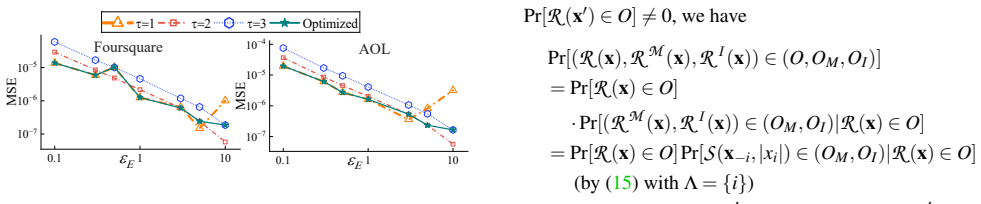
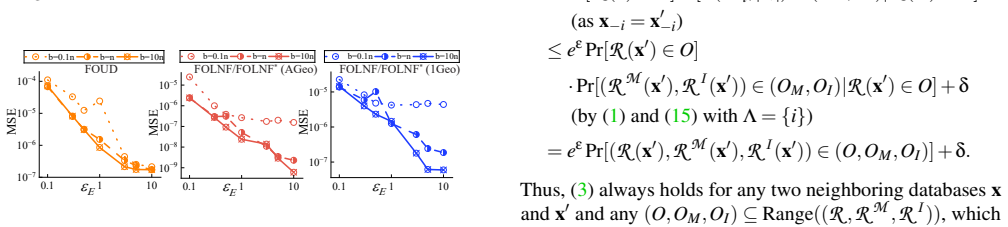
We introduce FODP, which strengthens DP to prevent various TEE side-channel attacks based on external/internal memory access patterns and control flows. We propose a general framework for FODP algorithms based on memory-size obfuscation and three concrete algorithms within it. We also improve the efficiency of our algorithms by using the count-min sketch and optimizing the number of hashes. We evaluate our algorithms on Intel SGX and demonstrate their effectiveness through comparisons with nine baselines.
What carries the argument
memory-size obfuscation framework for FODP algorithms that hides access patterns and control flows inside TEEs
If this is right
- Frequency estimation in the augmented shuffle model can achieve its accuracy benefits under stronger privacy that resists both collusion and TEE side channels.
- The shuffler can be made to follow the protocol without relying on external trust assumptions beyond the TEE.
- Count-min sketch optimizations preserve the FODP guarantees while reducing runtime and memory overhead.
- The same memory-size obfuscation approach can support multiple concrete algorithms within one framework.
Where Pith is reading between the lines
- The FODP framework could be adapted to other data-collection tasks that use shuffling or sampling, such as heavy-hitters or distribution estimation.
- Similar obfuscation methods might strengthen privacy in additional hardware settings where control flow and memory traces are observable.
Load-bearing premise
Placing the shuffler inside a TEE with memory-size obfuscation is enough to force it to follow the augmented shuffle protocol, prevent collusion with the data collector, and block side-channel leaks on memory access and control flow.
What would settle it
An experiment in which a side-channel attacker extracts user data or protocol deviations from the TEE implementation despite memory-size obfuscation, or in which the shuffler is shown to collude or deviate while still appearing to run the obfuscated code.
Figures







read the original abstract
In the shuffle model of DP (Differential Privacy), a shuffler randomly permutes users' data to achieve high accuracy and privacy. Recent studies show that most existing shuffle protocols are vulnerable to collusion attacks by the data collector and users. They address this issue by introducing the augmented shuffle model that incorporates random sampling and dummy data addition into the shuffler. However, it remains open how to ensure the shuffler follows the protocol and does not collude with the data collector in this model. We address this trust issue by thoroughly exploring the augmented shuffle model with TEEs (Trusted Execution Environments). We first introduce a new privacy notion, FODP (Fully Oblivious DP), which strengthens DP to prevent various TEE side-channel attacks based on external/internal memory access patterns and control flows. We propose a general framework for FODP algorithms based on memory-size obfuscation and three concrete algorithms within it. We also improve the efficiency of our algorithms by using the count-min sketch and optimizing the number of hashes. We evaluate our algorithms on Intel SGX and demonstrate their effectiveness through comparisons with nine baselines.
Editorial analysis
A structured set of objections, weighed in public.
Referee Report
Summary. The paper addresses trust issues in the augmented shuffle model of differential privacy by incorporating Trusted Execution Environments (TEEs). It introduces a new privacy notion called Fully Oblivious Differential Privacy (FODP) that strengthens standard DP to resist TEE side-channel attacks based on memory access patterns and control flows. The authors propose a general framework for FODP algorithms relying on memory-size obfuscation, instantiate it with three concrete algorithms for frequency estimation, optimize them via count-min sketches and hash tuning, and evaluate the resulting constructions on Intel SGX against nine baselines.
Significance. If the formal definitions, security proofs, and experimental claims hold, the work would supply a concrete method for realizing the augmented shuffle model inside TEEs while mitigating both collusion and side-channel leakage, thereby closing an open gap between theoretical shuffle-model DP and practical deployment.
major comments (2)
- [Abstract] The central security claim—that memory-size obfuscation inside a TEE suffices to enforce protocol compliance and block collusion with the data collector—rests on an unevaluated modeling assumption whose load-bearing status cannot be assessed from the abstract alone; a concrete reduction or game-based argument is required.
- [Abstract] Soundness of the three concrete algorithms and the count-min-sketch optimization cannot be verified because no definitions, pseudocode, or proof sketches appear in the provided material; the evaluation on SGX is therefore not yet connected to any stated theorem.
minor comments (1)
- [Abstract] The abstract states that nine baselines are compared but does not name them or indicate which metrics are reported.
Simulated Author's Rebuttal
We appreciate the referee's feedback on our work. We believe the full manuscript addresses the concerns raised, as the abstract necessarily omits detailed proofs. Below we respond to each major comment.
read point-by-point responses
-
Referee: [Abstract] The central security claim—that memory-size obfuscation inside a TEE suffices to enforce protocol compliance and block collusion with the data collector—rests on an unevaluated modeling assumption whose load-bearing status cannot be assessed from the abstract alone; a concrete reduction or game-based argument is required.
Authors: The full paper formalizes this in Section 3 with the FODP definition, which is a game-based notion strengthening DP against side-channel attacks. Section 4 presents the memory-size obfuscation framework and provides a reduction showing that if the TEE enforces oblivious memory access (modeled as a standard assumption on TEEs), then the protocol compliance is enforced and collusion is prevented, reducing to standard DP. The modeling assumption is the standard one for TEEs providing secure execution, which is evaluated via the security proof. revision: no
-
Referee: [Abstract] Soundness of the three concrete algorithms and the count-min-sketch optimization cannot be verified because no definitions, pseudocode, or proof sketches appear in the provided material; the evaluation on SGX is therefore not yet connected to any stated theorem.
Authors: The material provided to the referee appears to have been limited to the abstract. The complete manuscript includes: formal definitions of FODP and the framework in Sections 3 and 4; pseudocode for the three algorithms (Basic, Optimized, and Sketch-based) in Section 5; proof sketches and full proofs in the appendix connecting to Theorem 5.1 which bounds the privacy loss. The SGX evaluation in Section 6 demonstrates the practical performance while the theorems establish the theoretical guarantees. revision: no
Circularity Check
No significant circularity
full rationale
The paper introduces a new privacy notion (FODP) and a general framework based on memory-size obfuscation for algorithms in the augmented shuffle model with TEEs, along with three concrete algorithms, count-min sketch optimizations, and an SGX evaluation. No equations, fitted parameters, predictions, or self-citations are shown that reduce any central claim to its own inputs by construction. The contributions are definitional and constructive proposals whose validity rests on the new definitions and empirical comparisons rather than any self-referential reduction.
Axiom & Free-Parameter Ledger
Reference graph
Works this paper leans on
-
[1]
https://crysp.uwater loo.ca/software/obliv/, 2023
Fully oblivious algorithms. https://crysp.uwater loo.ca/software/obliv/, 2023
2023
-
[2]
http s://amzscout.net/blog/amazon-statistics/ , 2024
Amazon statistics: Key numbers and fun facts. http s://amzscout.net/blog/amazon-statistics/ , 2024
2024
-
[3]
https://transparency.meta.com/repo rts/community-standards-enforcement/fake-a ccounts/, 2025
Community standards enforcement report: Fake ac- counts. https://transparency.meta.com/repo rts/community-standards-enforcement/fake-a ccounts/, 2025
2025
-
[4]
https://www.clickguard.com/blog/ twitter-spam-bots/, 2025
Twitter spam bots: How they hurt users, brands, and advertisers. https://www.clickguard.com/blog/ twitter-spam-bots/, 2025
2025
-
[5]
https://learn.microsof t.com/en-us/azure/virtual-machines/, 2026
Virtual machines in azure. https://learn.microsof t.com/en-us/azure/virtual-machines/, 2026
2026
-
[6]
Allen, B
J. Allen, B. Ding, J. Kulkarni, H. Nori, O. Ohrimenko, and S. Yekhanin. An algorithmic framework for differ- entially private data analysis on trusted processors. In Proc. NeurIPS’19, pages 13657–13664, 2019
2019
-
[7]
Anati, S
I. Anati, S. Gueron, S. Johnson, and V . Scarlata. Inno- vative technology for CPU based attestation and sealing. InProc. HASP’13, pages 1–7, 2013
2013
-
[8]
Arratia and L
R. Arratia and L. Gordon. Tutorial on large deviations for the binomial distribution.Bulletin of Mathematical Biology, 51(1):125–131, 1989
1989
-
[9]
Asharov, I
G. Asharov, I. Komargodski, W.-K. Lin, K. Nayak, E. Pe- serico, and E. Shi. OptORAMa: Optimal oblivious RAM.Journal of the ACM, 70(1):1–70, 2022
2022
-
[10]
Athanasiou, K
A. Athanasiou, K. Chatzikokolakis, and C. Palamidessi. Enhancing metric privacy with a shuffler.PoPETs, 2025(2):650–679, 2025
2025
-
[11]
Balcer and A
V . Balcer and A. Cheu. Separating local & shuffled differential privacy via histograms. InProc. ITC’20, pages 1–14, 2020
2020
-
[12]
Balcer and S
V . Balcer and S. Vadhan. Differential privacy on fi- nite computers.Journal of Privacy and Confidentiality, 9(2):1–46, 2019
2019
-
[13]
Balle, G
B. Balle, G. Barthe, and M. Gaboardi. Privacy amplifi- cation by subsampling: Tight analyses via couplings and divergences. InProc. NeurIPS’18, pages 6280–6290, 2018
2018
-
[14]
Balle, J
B. Balle, J. Bell, A. Gascon, and K. Nissim. The privacy blanket of the shuffle model. InProc. CRYPTO’19, pages 638–667, 2019
2019
-
[15]
Baruchin
R. Baruchin. Musk v. Twitter: Read CNN’s article on Cyabra’s analysis. https://cyabra.com/press-r elease/in-the-news/musk-v-twitter-read-cnn s-article-on-cyabras-analysis/, 2022
2022
-
[16]
Beimel, K
A. Beimel, K. Nissim, and E. Omri. Distributed private data analysis: Simultaneously solving how and what. In Proc. CRYPTO’08, pages 451–468, 2008
2008
-
[17]
J. Bell, A. Gascon, B. Ghazi, R. Kumar, P. Manurangsi, M. Raykova, and P. Schoppmann. Distributed, private, sparse histograms in the two-server model. InProc. CCS’22, pages 307–321, 2022
2022
-
[18]
Bittau, U
A. Bittau, U. Erlingsson, P. Maniatis, I. Mironov, A. Raghunathan, D. Lie, M. Rudominer, U. Kode, J. Tinnes, and B. Seefeld. PROCHLO: Strong privacy for analytics in the crowd. InProc. SOSP’17, pages 441–459, 2017
2017
-
[19]
J. V . Bulck, N. Weichbrodt, R. Kapitza, F. Piessens, and R. Strackx. Telling your secrets without page faults: Stealthy page table-based attacks on enclaved execution. InProc. USENIX Security’17, pages 1041–1056, 2017
2017
-
[20]
M. Bun, K. Nissim, and U. Stemmer. Simultaneous pri- vate learning of multiple concepts.Journal of Machine Learning Research, 20(94):1–34, 2019
2019
-
[21]
X. Cao, J. Jia, and N. Z. Gong. Data poisoning attacks to local differential privacy protocols. InProc. USENIX Security’21, pages 947–964, 2021
2021
-
[22]
T.-H. H. Chan, K.-M. Chung, B. M. Maggs, and E. Shi. Foundations of differentially oblivious algorithms. In Proc. SODA’19, pages 2448–2467, 2019
2019
-
[23]
A. Cheu, A. Smith, and J. Ullman. Manipulation attacks in local differential privacy. InProc. S&P’21, pages 883–900, 2021
2021
-
[24]
Cheu and M
A. Cheu and M. Zhilyaev. Differentially private his- tograms in the shuffle model from fake users. InProc. S&P’22, pages 440–457, 2022
2022
-
[25]
Cormode and S
G. Cormode and S. Muthukrishnan. An improved data stream summary: The count-min sketch and its applica- tions.Journal of Algorithms, 55(1):58–75, 2005
2005
-
[26]
J. C. Duchi, M. I. Jordan, and M. J. Wainwright. Local privacy and statistical minimax rates. InProc. FOCS’13, pages 429–438, 2013
2013
-
[27]
Dwork, F
C. Dwork, F. McSherry, K. Nissim, and A. Smith. Cali- brating noise to sensitivity in private data analysis. In Proc. TCC’06, pages 265–284, 2006
2006
-
[28]
Dwork and A
C. Dwork and A. Roth.The Algorithmic Foundations of Differential Privacy. Now Publishers, 2014
2014
-
[29]
Erlingsson, V
U. Erlingsson, V . Feldman, I. Mironov, A. Raghunathan, and K. Talwar. Amplification by shuffling: from local to central differential privacy via anonymity. InProc. SODA’19, pages 2468–2479, 2019
2019
-
[30]
Fang and K
J. Fang and K. Yi. Counting subgraphs under shuffle differential privacy. InProc. CCS’25, pages 2369–2383, 2025
2025
-
[31]
Feldman, A
V . Feldman, A. McMillan, and K. Talwar. Stronger privacy amplification by shuffling for rényi and approx- imate differential privacy. InProc. SODA’23, pages 4966–4981, 2023
2023
-
[32]
Fredman and D
M. Fredman and D. Willard. Blasting through the in- formation theoretic barrier with fusion trees. InProc. STOC’90, pages 1–7, 1990
1990
-
[33]
Ghazi, N
B. Ghazi, N. Golowich, R. Kumar, R. Pagh, and A. Vel- ingker. On the power of multiple anonymous messages: Frequency estimation and selection in the shuffle model of differential privacy. InProc. EUROCRYPT’21, pages 463–488, 2021
2021
-
[34]
Ghazi, R
B. Ghazi, R. Kumar, P. Manurangsi, and R. Pagh. Pri- vate counting from anonymous messages: Near-optimal accuracy with vanishing communication overhead. In Proc. ICML’20, pages 3505–3514, 2020
2020
-
[35]
Ghosh, T
A. Ghosh, T. Roughgarden, and M. Sundararajan. Uni- versally utility-maximizing privacy mechanisms.SIAM Journal on Computing, 41(6):1673–1693, 2012
2012
-
[36]
Girgis, D
A. Girgis, D. Data, S. Diggavi, P. Kairouz, and A. T. Suresh. Shuffled model of differential privacy in feder- ated learning. InProc. AISTATS’21, pages 2521–2529, 2021
2021
-
[37]
Haeberlen, B
A. Haeberlen, B. C. Pierce, and A. Narayan. Differential privacy under fire. InProc. USENIX Security’11, pages 1–15, 2011
2011
-
[38]
Harrison and P
C. Harrison and P. Manurangsi. Infinitely divisible noise for differential privacy: Nearly optimal error in the high εregime. InProc. FORC’25, pages 12:1–12:24, 2025
2025
-
[39]
Imola, T
J. Imola, T. Murakami, and K. Chaudhuri. Differen- tially private triangle and 4-cycle counting in the shuffle model. InProc. CCS’22, pages 1505–1518, 2022
2022
-
[40]
J. Jin, E. McMurtry, B. I. P. Rubinstein, and O. Ohri- menko. Are we there yet? Timing and floating-point attacks on differential privacy systems. InProc. S&P’22, pages 473–488, 2022
2022
-
[41]
Kairouz, K
P. Kairouz, K. Bonawitz, and D. Ramage. Discrete distribution estimation under local privacy. InProc. ICML’16, pages 2436–2444, 2016
2016
-
[42]
Kairouz, S
P. Kairouz, S. Oh, and P. Viswanath. The composition theorem for differential privacy. InProc. ICML’15, pages 1376–1385, 2015
2015
-
[43]
Kaluža, V
B. Kaluža, V . Mirchevska, E. Dovgan, M. Luštrek, and M. Gams. An agent-based approach to care in indepen- dent living. InProc. AmI’10, pages 177–186, 2010
2010
-
[44]
Karmakar, S
A. Karmakar, S. S. Roy, O. Reparaz, F. Vercauteren, and I. Verbauwhede. Constant-time discrete gaussian sampling.IEEE Trans. Computers, 67(11):1561–1571, 2018
2018
-
[45]
S. P. Kasivisiwanathan and A. Smith. On the ‘semantics’ of differential privacy: A bayesian formulation.Journal of Privacy and Confidentiality, 6(1):1–16, 2014
2014
-
[46]
S. P. Kasiviswanathan, H. K. Lee, K. Nissim, and S. Raskhodnikova. What can we learn privately? In Proc. FOCS’08, pages 531–540, 2008
2008
-
[47]
C. J. Lebeda and L. Retschmeier. The correlated Gaus- sian sparse histogram mechanism. InProc. FORC’25, pages 23:1–23:20, 2025
2025
-
[48]
D. Lee. Building trusted execution environments. Tech- nical Report EECS-2022-96, EECS Department, Uni- versity of California, Berkeley, 2022
2022
-
[49]
D. Lee, D. Jung, I. T. Fang, C.-C. Tsai, and R. A. Popa. An off-chip attack on hardware enclaves via the memory bus. InProc. USENIX Security’20, pages 487–504, 2020
2020
-
[50]
Lee, M.-W
S. Lee, M.-W. Shih, P. Gera, T. Kim, and H. Kim. In- ferring fine-grained control flow inside SGX enclaves with branch shadowing. InProceedings of the 26th USENIX Security Symposium (USENIX Security’17), pages 557–574, 2017
2017
-
[51]
S. V . Lekshmi and S. Sebastian. A skewed general- ized discrete laplace distribution.International Journal of Mathematics and Statistics Invention, 2(3):95–102, 2014
2014
-
[52]
N. Li, M. Lyu, and D. Su.Differential Privacy: From Theory to Practice. Morgan & Claypool Publishers, 2016
2016
-
[53]
N. Li, W. Qardaji, and D. Su. On sampling, anonymiza- tion, and differential privacy or, k-anonymization meets differential privacy. InProc. ASIACCS’12, pages 1–11, 2012
2012
-
[54]
X. Li, N. Li, W. Sun, N. Z. Gong, and H. Li. Fine-grained poisoning attack to local differential privacy protocols for mean and variance estimation. InProc. USENIX Security’23, pages 1739–1756, 2023
2023
-
[55]
R. Liu, Y . Cao, H. Chen, R. Guo, and M. Yoshikawa. FLAME: Differentially private federated learning in the shuffle model. InProc. AAAI’21, pages 8688–8696, 2021
2021
-
[56]
Q. Luo, Y . Wang, and K. Yi. Frequency estimation in the shuffle model with almost a single message. InProc. CCS’22, pages 2219–2232, 2022
2022
-
[57]
Mitzenmacher and E
M. Mitzenmacher and E. Upfal.Probability and Com- puting: Randomization and Probabilistic Techniques in Algorithms and Data Analysis. Cambridge University Press, 2017
2017
-
[58]
Moghimi, J
D. Moghimi, J. V . Bulck, N. Heninger, F. Piessens, and B. Sunar. Copycat: Controlled instruction-level attacks on enclaves. InProc. USENIX Security’20, pages 469– 486, 2020
2020
-
[59]
S. Morgan. 2025 cybersecurity almanac: 100 facts, figures, predictions and statistics. https://cybersec urityventures.com/cybersecurity-almanac-2 025/, 2025
2025
-
[60]
Murakami, Y
T. Murakami, Y . Sei, and R. Eriguchi. Augmented shuf- fle protocols for accurate and robust frequency estima- tion under differential privacy. InProc. S&P’25, pages 3892–3911, 2025
2025
-
[61]
Murakami, Y
T. Murakami, Y . Sei, and R. Eriguchi. Augmented shuf- fle differential privacy protocols for large-domain cat- egorical and key-value data. InProc. NDSS’26, pages 1–20, 2026
2026
-
[62]
K. P. Murphy.Machine Learning: A Probabilistic Per- spective. The MIT Press, 2012
2012
-
[63]
L. H. X. Ng and K. M. Carley. A global comparison of social media bot and human characteristics.Scientific Reports, 15(10973):1–18, 2025
2025
-
[64]
N. Ngai, I. Demertzis, J. G. Chamani, and D. Papadopou- los. Distributed & scalable oblivious sorting and shuf- fling. InProc. S&P’24, pages 4277–4295, 2024
2024
-
[65]
Ohrimenko, M
O. Ohrimenko, M. T. Goodrich, R. Tamassia, and E. Up- fal. The Melbourne shuffle: Improving oblivious storage in the cloud. InProc. ICALP’14, pages 556–567, 2014
2014
-
[66]
G. Pass, A. Chowdhury, and C. Torgeson. A picture of search. InProc. InfoScale’06, pages 1–7, 2006
2006
-
[67]
S. Ruggles, S. Flood, M. Sobek, D. Backman, A. Chen, G. Cooper, S. Richards, R. Rogers, and M. Schouweiler. IPUMS USA: Version 14.0 [dataset]. https://doi.or g/10.18128/D010.V14.0, 2023
-
[68]
S. Sasy, A. Johnson, and I. Goldberg. Fast fully oblivious compaction and shuffling. InProc. CCS’22, pages 2565– 2579, 2022
2022
-
[69]
S. Sasy, A. Johnson, and I. Goldberg. Waks-on/waks-off: Fast oblivious offline/online shuffling and sorting with waksman networks. InProc. CCS’23, pages 3328–3342, 2023
2023
-
[70]
Shepherd and K
C. Shepherd and K. Markantonakis.Trusted Execution Environments. Springer, 2024
2024
-
[71]
Stefanov, M
E. Stefanov, M. van Dijk, E. Shi, C. Fletcher, L. Ren, X. Yu, and S. Devadas. Path ORAM: An extremely simple oblivious RAM protocol.Journal of the ACM, 65(4):1–26, 2018
2018
-
[72]
Thomas, D
K. Thomas, D. McCoy, C. Grier, A. Kolcz, and V . Pax- son. Trafficking fraudulent accounts: The role of the underground market in twitter spam and abuse. InProc. USENIX Security’13, pages 195–210, 2013
2013
-
[73]
S. Wagh, X. He, A. Machanavajjhala, and P. Mittal. DP- cryptography: Marrying differential privacy and cryp- tography in emerging applications.Communications of the ACM, 64(2):84–93, 2021
2021
-
[74]
S. Wang, J. Li, C. Dong, J. Li, Z. Zhou, and D. Wang. Side-channel attacks and new principles in the shuffle model of differential privacy.IEEE Trans. Information Forensics and Security, 20:6515–6528, 2025
2025
-
[75]
T. Wang, J. Blocki, N. Li, and S. Jha. Locally differ- entially private protocols for frequency estimation. In Proc. USENIX Security’17, pages 729–745, 2017
2017
-
[76]
T. Wang, B. Ding, M. Xu, Z. Huang, C. Hong, J. Zhou, N. Li, and S. Jha. Improving utility and security of the shuffler-based differential privacy.Proceedings of the VLDB Endowment, 13(13):3545–3558, 2020
2020
-
[77]
D. Yang, D. Zhang, and B. Qu. Participatory cultural mapping based on collective behavior data in location based social network.ACM Trans. Intelligent Systems and Technology, 7(3):30:1–30:23, 2016. A Details of Existing Shuffle Protocols and Ro- bustness against Collusion with Users A.1 Privacy Amplification Results Below, we present state-of-the-art priv...
2016
discussion (0)
Sign in with ORCID, Apple, or X to comment. Anyone can read and Pith papers without signing in.