REVIEW 4 major objections 5 minor 130 references
GoStop: Reinforcement Learning for Adaptive Temporal Aggregation in Event-Based Feature Tracking
T0 review · 4 major / 5 minor · reviewed 2026-08-01 · deepseek-v4-flash
Pith's one-line read An RL agent that chooses when to run the tracker beats fixed event windows for event-camera feature tracking.
desk verdict A useful, mostly solid method paper with a real circularity problem: reward hyperparameters are tuned on DEFT, the same benchmark used for the headline gains, and the 'consistently outperforms' claim is contradicted by Table 2. read the letter →
The pith
A machine-rendered reading of the paper's core claim, the machinery that carries it, and where it could break.
The reading
What carries the argument
The adaptive temporal agent: a small CNN+MLP policy mapping the current event representation inside a patch, concatenated with the accumulation length, to a binary go/stop action. It is trained by PPO with a reward that penalizes tracking error at 'stop' actions, scaled by accumulated event count, plus a penalty lambda to discourage over-inference. The critic is given privileged training-only information (ground-truth motion, occlusion, remaining sequence length) to stabilize value estimation.
What would settle it
Hold out a new dataset with motion even faster than DEFT and fix the reward constants by training-set validation only; if the reported gains shrink to the level of the Kalman-filter baseline, the advantage is test-set tuned. Alternatively, track a point that moves more than one patch size within a single 'go' run and check whether the tracker can re-acquire it after the stop action.
Extended reading notes
Core claim
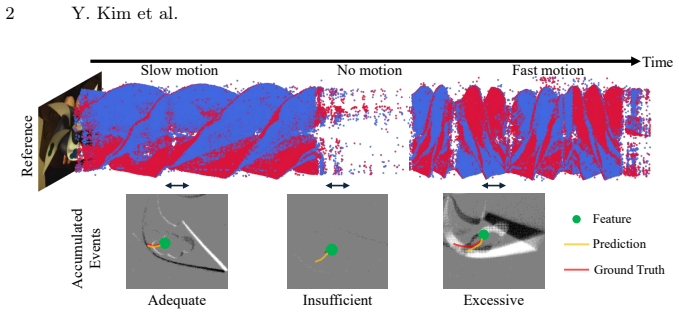
The central claim is that adaptive temporal aggregation, framed as a sequential decision problem, replaces fixed heuristic accumulation rules in event-based feature tracking. The agent observes the accumulated event pattern in a patch plus the current window length, and chooses either to keep accumulating ('go') or to run tracker inference ('stop'); a reward based on the resulting tracking error and a penalty on excessive inference trains the policy with PPO. The paper reports that this module, applied without changing the underlying trackers, improves average Feature Age from 0.086 to 0.465 for one tracker and from 0.378 to 0.642 for the other on the new DEFT dataset, and improves both on c
Load-bearing premise
The policy's only view is the raw event pattern in a small patch around the last estimate plus the current wait time, and its reward constants were tuned on the evaluation dataset; if a fast-moving feature leaves the patch while the agent is accumulating, or if deployment motion statistics differ from training, the agent has no signal to recover.
Editorial extensions
If this is right
- Fixed heuristic event windows become a removable bottleneck: the same accumulated-event representation can be fed to the tracker at adaptively chosen times.
- The RL module is plug-and-play: it can be attached to existing tracking networks without retraining them, with negligible cost (~0.4 ms per decision).
- Accuracy/efficiency trade-off is learned rather than hand-set: the penalty term automatically balances more frequent inference (accuracy) against less frequent inference (speed).
- Robustness to abrupt motion improves, suggesting that event cameras' asynchronous nature can be exploited for online tracking beyond fixed frame rates.
Reading between the lines
- The same go/stop formulation could be applied to other event-stream tasks with a similar accuracy-versus-latency trade-off, such as event-based object detection or odometry, where the 'inference moment' is currently fixed by a frame timer.
- The DEFT dataset's abrupt motion profiles could become a standard robustness probe for any event tracker, not just those with adaptive windows.
- The success of privileged information in the critic hints that RL control of perception may need access to ground-truth difficulty during training; a testable extension is whether a self-supervised difficulty estimate could replace ground-truth motion/occlusion labels.
Editorial analysis
A structured set of objections, weighed in public.
Referee Report
Summary. The paper proposes GoStop, an RL-based controller that adaptively decides when to accumulate event data ('go') or to trigger tracking inference ('stop') for event-based feature tracking. The policy is a lightweight CNN+MLP trained with PPO using a reward based on tracking error, with privileged ground-truth information provided only to the critic. The method is evaluated as a plug-in on Deep-EV-Tracker and BlinkTrack, on the newly introduced DEFT dataset and on the established EC and EDS benchmarks. The authors report large gains on DEFT, positive average gains on EC/EDS, and introduce a new dynamic event-based tracking dataset.
Significance. If the empirical claims are robust, this is a useful contribution: it is one of the first works to formulate event accumulation for feature tracking as a sequential decision problem, it demonstrates substantial gains when plugged into two recent trackers, and it releases code and a new dynamic dataset. The reported policy overhead is small (about 0.4 ms per decision versus 5.3 ms for the tracker), and the supplementary experiments across event representations support generality. However, the strength of the claims currently outruns the evidence in several specific ways detailed below.
major comments (4)
- [§5.3, Table 2; Abstract] The abstract and conclusion state that the method 'consistently outperforms' heuristic/fixed-window approaches. This is contradicted by the EC row of Table 2: BT+Ours yields FA 0.819 and EFA 0.811 versus BT's 0.833 and 0.819, i.e., a clear degradation on a standard benchmark. Please restrict the claim to averages or to DEFT, or analyze when adaptive stopping hurts under near-uniform motion.
- [§5.1, Eq. (2); §5.4, Table 4] The reward hyperparameters λ=0.2, the threshold 0.6, and L_j=2·l_j are selected by experiments on DEFT (Table 4 varies λ on DEFT), and the headline results in Table 1 are measured on the same DEFT benchmark. Because DEFT is introduced in this paper and no separate validation/test split is described, the DEFT gains are not an independent test of generalization. Please select hyperparameters on a held-out split (or on MultiTrack) and then report test results once; also report the sensitivity of EC/EDS performance to λ.
- [§5.1; Tables 1–7] No variance or multiple-seed results are reported for the RL policy. PPO is stochastic and the reward function contains free constants, so a single training run can be misleading. Please report mean ± std over at least three seeds for the final method and for the ablations, and indicate whether the gains are statistically significant.
- [§5.2, Table 1 caption] The Table 1 caption states 'All methods use only event data,' but BlinkTrack (ref. [82]) is originally an event+image tracker. If an event-only variant is evaluated, this must be stated explicitly and the baseline numbers for BT must be regenerated with that variant; otherwise the comparison to the official BlinkTrack is unfair and the plug-and-play claim is unclear. Please clarify the exact input modality and configuration used for both baselines and the proposed integration.
minor comments (5)
- [§3.2, Eq. (2)] The notation L_j is used in the reward but not defined until Section 5.1. Define L_j and l_j in the methodology, and specify the units of the normalized error e_i (patch dimension P).
- [§3.2, §5.1] Please describe the episode termination condition and whether a stop is forced at the end of the clipped 95-event-frame sequence. Since the reward for 'go' is identically zero, the finite-horizon behavior is important for understanding the training objective.
- [Table 7] The runtime rows are difficult to parse, especially for the count-based strategies and the 'Ours' column. Label each row with the corresponding slicing strategy and report the exact runtime for the adaptive policy separately from the tracker runtime.
- [§1, §2] The claim of introducing RL to event-based feature tracking 'for the first time' is strong given prior RL-based tracking works cited later in the paper. Please soften or carefully delimit the novelty claim.
- [Supplementary, Table 2] When comparing different event representations, clarify whether the BlinkTrack baseline is retrained for each representation and whether the same pretrained tracker is used for the proposed method. Otherwise the gains may reflect representation-specific retraining.
Circularity Check
Adaptive-aggregation result is independently trained on MultiTrack, but the reward constants (λ=0.2, threshold 0.6) are selected on the same DEFT benchmark used for the headline gains.
-
fitted input called prediction
[Sec. 3.2 Eq. (2); Sec. 5.1 Implementation Details; Sec. 5.4 Table 4 vs. Sec. 5.3 Table 1]
"In Eq. (2), we set λ=0.2 for reward function and Lj = 2·l j. ... Action Penalty Analysis. We conduct experiments on the action penalty coefficient λ in Eq. (2) ... As shown in Table 4, without the penalty term, the agent tends to overuse the stop action ... In particular, setting λ=0.2 achieves a favorable trade-off. ... The proposed adaptive temporal agent improves robustness ... increasing FA and EFA by 0.379 and 0.375 on average."
The stop-action penalty λ and the reward threshold 0.6 are free hyperparameters. Table 4 explicitly selects λ=0.2 by running the full agent on DEFT (FA 0.307 at λ=0 → 0.642 at λ=0.2), and Table 1 then reports the 'improvement' over the base tracker on that same DEFT set. The headline claim that adaptive RL aggregation is better than fixed windows on DEFT is therefore partly a comparison against a configuration tuned on the evaluation set itself; the 'prediction' is not independent of the benchmark it evaluates.
full rationale
The paper's central mechanism — an RL agent trained with PPO on MultiTrack with frozen pretrained trackers — is not circular by construction: the learned policy is an actual function of event states, evaluated on held-out DEFT/EC/EDS. No equation-level identity forces the agent's go/stop behavior or the resulting FA/EFA numbers. The main circularity concern is test-set-driven hyperparameter selection: the reward threshold 0.6 and the stop penalty λ=0.2 in Eq. (2) are validated and chosen on DEFT (Sec. 5.4, Table 4), and the same DEFT set produces the headline gains (Sec. 5.3, Table 1). This is a statistical/validation leak, not a definitional equivalence: the fitted λ could have been chosen on a development split, and the EC/EDS results (Table 2) provide some independent support. A second non-load-bearing factor is that the framework is integrated only into trackers from prior work [65,82] with the agent trained on MultiTrack [82], so the contribution is an empirical plug-in rather than a derivation of tracking ability from first principles. No 'uniqueness theorem' is invoked, and I find no self-citation chain that is load-bearing. Score 5 reflects partial circularity: the DEFT-based headline is not fully independent of its tuned hyperparameters, while the core learned adaptivity remains externally trained.
Assumptions & free parameters
free parameters (5)
- Action penalty lambda =
0.2
- Reward error threshold in Eq. 2 =
0.6
- Reward scale L_j =
2 * l_j
- Base accumulation unit Delta t =
0.005 s
- Discount factor gamma =
0.9
assumptions (6)
- domain assumption Event accumulation sufficiency is the main controllable failure factor in dynamic-motion tracking.
- domain assumption The local patch state transfers across datasets.
- domain assumption Ground-truth tracking error is a valid reward signal.
- standard math The RL formulation is a valid MDP with stationary rewards and PPO/GAE apply.
- domain assumption FA/EFA metrics capture tracking quality.
- domain assumption DEFT ground-truth annotations at 25 Hz are accurate.
invented entities (2)
-
GoStop adaptive temporal agent (policy network)
-
DEFT dataset
independent evidence
Cite this review
Pith. "Pith review of GoStop: Reinforcement Learning for Adaptive Temporal Aggregation in Event-Based Feature Tracking." pith.science (2026). https://pith.science/paper/YAR35E5M
@misc{pith2026260715699,
  author       = {Pith},
  title        = {Pith review of: GoStop: Reinforcement Learning for Adaptive Temporal Aggregation in Event-Based Feature Tracking},
  year         = {2026},
  howpublished = {\url{https://pith.science/paper/YAR35E5M}},
  note         = {Machine review of arXiv:2607.15699}
}
read the original abstract
Feature tracking plays a fundamental role in understanding scene motion and supports various downstream tasks. Event cameras, with their high temporal resolution and asynchronous sensing, enable low-latency and motion-robust perception, making them well-suited for feature tracking under fast and non-linear motion. However, existing event-based feature tracking methods rely on fixed heuristic rules based on hand-tuning for event accumulation. Such strategies fail to adapt to diverse motion dynamics, leading to degraded performance under abrupt motion changes or low-motion scenarios. In this paper, we model event accumulation as a sequential decision-making problem and introduce reinforcement learning (RL) framework to adaptively control the accumulation process for online event-based feature tracking. Our approach trains a RL agent that decides whether to continue accumulating events or to perform tracking inference based on motion cues. The proposed adaptive temporal agent enables dynamic adaptation to varying motion patterns without relying on hand-crafted rules. Furthermore, we introduce a Dynamic Event-based Tracking (DEFT) dataset with dynamic motion distributions to evaluate the robustness of the feature tracking. Extensive experiments demonstrate that integrating our plug-and-play framework to existing feature tracking methods consistently outperforms heuristic-based approaches, improving robustness under dynamic motion while offering a better balance between tracking accuracy and efficiency. Our project codes and datasets are available at https://github.com/kmax2001/GoSTOP
Figures


Figures from the paper (9 more)


Reference graph
Works this paper leans on
-
[82]
Proceedings of the Computer Vision and Pattern Recognition Conference , pages=
Asynchronous collaborative graph representation for frames and events , author=. Proceedings of the Computer Vision and Pattern Recognition Conference , pages=
-
[1]
2016 IEEE/RSJ International Conference on Intelligent Robots and Systems (IROS) , pages=
Low-latency visual odometry using event-based feature tracks , author=. 2016 IEEE/RSJ International Conference on Intelligent Robots and Systems (IROS) , pages=. 2016 , organization=
2016
-
[2]
2017 IEEE International Conference on Robotics and Automation (ICRA) , pages=
Event-based feature tracking with probabilistic data association , author=. 2017 IEEE International Conference on Robotics and Automation (ICRA) , pages=. 2017 , organization=
2017
-
[3]
Advances in Neural Information Processing Systems , volume=
A benchmark dataset for event-guided human pose estimation and tracking in extreme conditions , author=. Advances in Neural Information Processing Systems , volume=
-
[4]
31st British Machine Vision Virtual Conference (BMVC 2020) , pages=
Haste: multi-hypothesis asynchronous speeded-up tracking of events , author=. 31st British Machine Vision Virtual Conference (BMVC 2020) , pages=. 2020 , organization=
2020
-
[5]
Proceedings of the IEEE/CVF Conference on Computer Vision and Pattern Recognition , pages=
Data-driven feature tracking for event cameras , author=. Proceedings of the IEEE/CVF Conference on Computer Vision and Pattern Recognition , pages=
-
[6]
Proceedings of the IEEE/CVF International Conference on Computer Vision , pages=
BlinkTrack: Feature Tracking over 80 FPS via Events and Images , author=. Proceedings of the IEEE/CVF International Conference on Computer Vision , pages=
-
[7]
European conference on computer vision , pages=
Pixelwise view selection for unstructured multi-view stereo , author=. European conference on computer vision , pages=. 2016 , organization=
2016
Show all 130 references
-
[8]
Proceedings of the IEEE/CVF Conference on Computer Vision and Pattern Recognition , pages=
Leap-vo: Long-term effective any point tracking for visual odometry , author=. Proceedings of the IEEE/CVF Conference on Computer Vision and Pattern Recognition , pages=
-
[9]
2024 IEEE International Conference on Robotics and Automation (ICRA) , pages=
Robotap: Tracking arbitrary points for few-shot visual imitation , author=. 2024 IEEE International Conference on Robotics and Automation (ICRA) , pages=. 2024 , organization=
2024
-
[10]
Advances in Neural Information Processing Systems , volume=
Tap-vid: A benchmark for tracking any point in a video , author=. Advances in Neural Information Processing Systems , volume=
-
[11]
European Conference on Computer Vision , pages=
Particle video revisited: Tracking through occlusions using point trajectories , author=. European Conference on Computer Vision , pages=. 2022 , organization=
2022
-
[12]
IEEE transactions on pattern analysis and machine intelligence , volume=
Event-based vision: A survey , author=. IEEE transactions on pattern analysis and machine intelligence , volume=. 2020 , publisher=
2020
-
[13]
European conference on computer vision , pages=
Recent event camera innovations: A survey , author=. European conference on computer vision , pages=. 2024 , organization=
2024
-
[14]
Proceedings of the IEEE/CVF Conference on Computer Vision and Pattern Recognition , pages=
3d feature tracking via event camera , author=. Proceedings of the IEEE/CVF Conference on Computer Vision and Pattern Recognition , pages=
-
[15]
Proceedings of the European Conference on Computer Vision (ECCV) , pages=
Asynchronous, photometric feature tracking using events and frames , author=. Proceedings of the European Conference on Computer Vision (ECCV) , pages=
-
[16]
International Journal of Computer Vision , volume=
EKLT: Asynchronous photometric feature tracking using events and frames , author=. International Journal of Computer Vision , volume=. 2020 , publisher=
2020
-
[17]
IEEE Transactions on Pattern Analysis and Machine Intelligence , volume=
Data-driven feature tracking for event cameras with and without frames , author=. IEEE Transactions on Pattern Analysis and Machine Intelligence , volume=. 2025 , publisher=
2025
-
[18]
Proceedings of the Computer Vision and Pattern Recognition Conference , pages=
ETAP: Event-based Tracking of Any Point , author=. Proceedings of the Computer Vision and Pattern Recognition Conference , pages=
-
[19]
nature , volume=
Human-level control through deep reinforcement learning , author=. nature , volume=. 2015 , publisher=
2015
-
[20]
arXiv preprint arXiv:1707.06347 , year=
Proximal policy optimization algorithms , author=. arXiv preprint arXiv:1707.06347 , year=
-
[21]
International conference on machine learning , pages=
Soft actor-critic: Off-policy maximum entropy deep reinforcement learning with a stochastic actor , author=. International conference on machine learning , pages=. 2018 , organization=
2018
-
[22]
International conference on machine learning , pages=
Trust region policy optimization , author=. International conference on machine learning , pages=. 2015 , organization=
2015
-
[23]
The International journal of robotics research , volume=
The event-camera dataset and simulator: Event-based data for pose estimation, visual odometry, and SLAM , author=. The International journal of robotics research , volume=. 2017 , publisher=
2017
-
[24]
Proceedings of the IEEE/CVF Conference on Computer Vision and Pattern Recognition , pages=
Event-aided direct sparse odometry , author=. Proceedings of the IEEE/CVF Conference on Computer Vision and Pattern Recognition , pages=
-
[25]
Advances in Neural Information Processing Systems , volume=
Context-PIPs: persistent independent particles demands spatial context features , author=. Advances in Neural Information Processing Systems , volume=
-
[26]
European conference on computer vision , pages=
Cotracker: It is better to track together , author=. European conference on computer vision , pages=. 2024 , organization=
2024
-
[27]
Proceedings of the IEEE/CVF International Conference on Computer Vision , pages=
Cotracker3: Simpler and better point tracking by pseudo-labelling real videos , author=. Proceedings of the IEEE/CVF International Conference on Computer Vision , pages=
-
[28]
2018 International Conference on 3D Vision (3DV) , pages=
ACE: An efficient asynchronous corner tracker for event cameras , author=. 2018 International Conference on 3D Vision (3DV) , pages=. 2018 , organization=
2018
-
[29]
arXiv preprint arXiv:2107.04536 , year=
Event-based feature tracking in continuous time with sliding window optimization , author=. arXiv preprint arXiv:2107.04536 , year=
-
[30]
Authorea Preprints , year=
An event-by-event feature detection and tracking invariant to motion direction and velocity , author=. Authorea Preprints , year=
-
[31]
2022 IEEE/RSJ International Conference on Intelligent Robots and Systems (IROS) , pages=
ecdt: Event clustering for simultaneous feature detection and tracking , author=. 2022 IEEE/RSJ International Conference on Intelligent Robots and Systems (IROS) , pages=. 2022 , organization=
2022
-
[32]
Robust feature tracking in dvs event stream using b
Seok, Hochang and Lim, Jongwoo , booktitle=. Robust feature tracking in dvs event stream using b
-
[33]
arXiv preprint arXiv:2307.10593 , year=
Event blob tracking: An asynchronous real-time algorithm , author=. arXiv preprint arXiv:2307.10593 , year=
-
[34]
Proceedings of the IEEE/CVF conference on computer vision and pattern recognition , pages=
Leod: Label-efficient object detection for event cameras , author=. Proceedings of the IEEE/CVF conference on computer vision and pattern recognition , pages=
-
[35]
Proceedings of the IEEE/CVF conference on computer vision and pattern recognition , pages=
Recurrent vision transformers for object detection with event cameras , author=. Proceedings of the IEEE/CVF conference on computer vision and pattern recognition , pages=
-
[36]
Proceedings of the IEEE/CVF international conference on computer vision , pages=
N-imagenet: Towards robust, fine-grained object recognition with event cameras , author=. Proceedings of the IEEE/CVF international conference on computer vision , pages=
-
[37]
Proceedings of the IEEE/CVF Conference on Computer Vision and Pattern Recognition , pages=
Hierarchical neural memory network for low latency event processing , author=. Proceedings of the IEEE/CVF Conference on Computer Vision and Pattern Recognition , pages=
-
[38]
IEEE Transactions on Pattern Analysis and Machine Intelligence , year=
Event-based stereo depth estimation: A survey , author=. IEEE Transactions on Pattern Analysis and Machine Intelligence , year=
-
[39]
Proceedings of the IEEE/CVF conference on computer vision and pattern recognition , pages=
Stereo depth from events cameras: Concentrate and focus on the future , author=. Proceedings of the IEEE/CVF conference on computer vision and pattern recognition , pages=
-
[40]
arXiv preprint arXiv:2208.04511 , year=
Object detection with deep reinforcement learning , author=. arXiv preprint arXiv:2208.04511 , year=
-
[41]
International conference on machine learning , pages=
End-to-end active object tracking via reinforcement learning , author=. International conference on machine learning , pages=. 2018 , organization=
2018
-
[42]
Conference on robot learning , pages=
Reinforcement learning of active vision for manipulating objects under occlusions , author=. Conference on robot learning , pages=. 2018 , organization=
2018
-
[43]
Proceedings of the IEEE international conference on computer vision , pages=
Active object localization with deep reinforcement learning , author=. Proceedings of the IEEE international conference on computer vision , pages=
-
[44]
Advances in Neural Information Processing Systems , volume=
Active vision reinforcement learning under limited visual observability , author=. Advances in Neural Information Processing Systems , volume=
-
[45]
European Conference on Computer Vision
Nico Messikommer* and Giovanni Cioffi* and Mathias Gehrig and Davide Scaramuzza , title =. European Conference on Computer Vision. (ECCV) , year =
-
[46]
International Conference on Machine Learning , year=
Interactive Object Placement with Reinforcement Learning , author=. International Conference on Machine Learning , year=
-
[47]
2024 IEEE/CVF Conference on Computer Vision and Pattern Recognition (CVPR) , year=
Learning to Control Camera Exposure via Reinforcement Learning , author=. 2024 IEEE/CVF Conference on Computer Vision and Pattern Recognition (CVPR) , year=
2024
-
[48]
Journal of machine learning research , volume=
Stable-baselines3: Reliable reinforcement learning implementations , author=. Journal of machine learning research , volume=
-
[49]
IEEE Journal of Solid-State Circuits , volume=
A 240 180 130 db 3 s latency global shutter spatiotemporal vision sensor , author=. IEEE Journal of Solid-State Circuits , volume=. 2014 , publisher=
2014
-
[50]
arXiv preprint arXiv:1803.08375 , year=
Deep learning using rectified linear units (relu) , author=. arXiv preprint arXiv:1803.08375 , year=
-
[51]
IEEE transactions on pattern analysis and machine intelligence , volume=
Hots: a hierarchy of event-based time-surfaces for pattern recognition , author=. IEEE transactions on pattern analysis and machine intelligence , volume=. 2016 , publisher=
2016
-
[52]
Transactions of the association for computational linguistics , volume=
From image descriptions to visual denotations: New similarity metrics for semantic inference over event descriptions , author=. Transactions of the association for computational linguistics , volume=
-
[53]
Proceedings of the AAAI Conference on Artificial Intelligence , volume=
Better and faster: Adaptive event conversion for event-based object detection , author=. Proceedings of the AAAI Conference on Artificial Intelligence , volume=
-
[54]
Advances in Neural Information Processing Systems , volume=
Spiking neural network as adaptive event stream slicer , author=. Advances in Neural Information Processing Systems , volume=
-
[55]
2022 International Conference on Robotics and Automation (ICRA) , pages=
Google scanned objects: A high-quality dataset of 3d scanned household items , author=. 2022 International Conference on Robotics and Automation (ICRA) , pages=. 2022 , organization=
2022
-
[56]
European Conference on Computer Vision , pages=
Dvs-voltmeter: Stochastic process-based event simulator for dynamic vision sensors , author=. European Conference on Computer Vision , pages=. 2022 , organization=
2022
-
[57]
A new approach to linear filtering and prediction problems , author=
-
[58]
Proceedings of the IEEE/CVF Conference on Computer Vision and Pattern Recognition , pages=
Event-based high dynamic range image and very high frame rate video generation using conditional generative adversarial networks , author=. Proceedings of the IEEE/CVF Conference on Computer Vision and Pattern Recognition , pages=
-
[59]
Advances in neural information processing systems , volume=
Policy gradient methods for reinforcement learning with function approximation , author=. Advances in neural information processing systems , volume=
-
[60]
Proceedings of the IEEE/CVF Conference on Computer Vision and Pattern Recognition , pages=
Pfrl: Pose-free reinforcement learning for 6d pose estimation , author=. Proceedings of the IEEE/CVF Conference on Computer Vision and Pattern Recognition , pages=
-
[61]
arXiv preprint arXiv:2512.01188 , year=
Real-World Reinforcement Learning of Active Perception Behaviors , author=. arXiv preprint arXiv:2512.01188 , year=
-
[62]
2020 IEEE International Conference on Robotics and Automation (ICRA) , pages=
Object finding in cluttered scenes using interactive perception , author=. 2020 IEEE International Conference on Robotics and Automation (ICRA) , pages=. 2020 , organization=
2020
-
[63]
2024 IEEE/RSJ International Conference on Intelligent Robots and Systems (IROS) , pages=
Reinforcement learning for active search and grasp in clutter , author=. 2024 IEEE/RSJ International Conference on Intelligent Robots and Systems (IROS) , pages=. 2024 , organization=
2024
-
[64]
Neural networks , volume=
A new learning paradigm: Learning using privileged information , author=. Neural networks , volume=. 2009 , publisher=
2009
-
[65]
arXiv preprint arXiv:2306.11488 , year=
Informed POMDP: Leveraging additional information in model-based RL , author=. arXiv preprint arXiv:2306.11488 , year=
-
[66]
arXiv preprint arXiv:2405.14853 , year=
Privileged sensing scaffolds reinforcement learning , author=. arXiv preprint arXiv:2405.14853 , year=
-
[67]
Conference on Robot Learning , pages=
Attention-privileged reinforcement learning , author=. Conference on Robot Learning , pages=. 2021 , organization=
2021
-
[68]
arXiv preprint arXiv:1710.06542 , year=
Asymmetric actor critic for image-based robot learning , author=. arXiv preprint arXiv:1710.06542 , year=
-
[69]
Science robotics , volume=
Learning quadrupedal locomotion over challenging terrain , author=. Science robotics , volume=. 2020 , publisher=
2020
-
[70]
Machine learning proceedings 1990 , pages=
Active perception and reinforcement learning , author=. Machine learning proceedings 1990 , pages=. 1990 , publisher=
1990
-
[71]
Transactions on Machine Learning Research , year=
Learning to look by self-prediction , author=. Transactions on Machine Learning Research , year=
-
[72]
Advances in Neural Information Processing Systems , volume=
Pre-trained image encoder for generalizable visual reinforcement learning , author=. Advances in Neural Information Processing Systems , volume=
-
[73]
International Conference on Machine Learning , pages=
Reinforcement learning with action-free pre-training from videos , author=. International Conference on Machine Learning , pages=. 2022 , organization=
2022
-
[74]
The 8th Conference on Robot Learning , year=
Visual Whole-Body Control for Legged Loco-Manipulation , author=. The 8th Conference on Robot Learning , year=
-
[75]
European Conference on Computer Vision , pages=
Pre-trained visual dynamics representations for efficient policy learning , author=. European Conference on Computer Vision , pages=. 2024 , organization=
2024
-
[76]
Proceedings of the IEEE/CVF Conference on Computer Vision and Pattern Recognition , pages=
Efficient event-based object detection: a hybrid neural network with spatial and temporal attention , author=. Proceedings of the IEEE/CVF Conference on Computer Vision and Pattern Recognition , pages=
-
[77]
Advances in Neural Information Processing Systems , volume=
Ef-3dgs: Event-aided free-trajectory 3d gaussian splatting , author=. Advances in Neural Information Processing Systems , volume=
-
[78]
Proceedings of the IEEE/CVF Conference on Computer Vision and Pattern Recognition , pages=
Graph Neural Network Combining Event Stream and Periodic Aggregation for Low-Latency Event-based Vision , author=. Proceedings of the IEEE/CVF Conference on Computer Vision and Pattern Recognition , pages=
-
[79]
Proceedings of the Computer Vision and Pattern Recognition Conference , pages=
Unified Reconstruction of Static and Dynamic Scenes from Events , author=. Proceedings of the Computer Vision and Pattern Recognition Conference , pages=
-
[80]
Proceedings of the IEEE/CVF Conference on Computer Vision and Pattern Recognition , pages=
Inceventgs: Pose-free gaussian splatting from a single event camera , author=. Proceedings of the IEEE/CVF Conference on Computer Vision and Pattern Recognition , pages=
-
[81]
Proceedings of the Computer Vision and Pattern Recognition Conference , pages=
Eventsplat: 3d gaussian splatting from moving event cameras for real-time rendering , author=. Proceedings of the Computer Vision and Pattern Recognition Conference , pages=
-
[83]
Proceedings of the Computer Vision and Pattern Recognition Conference , pages=
TimeTracker: Event-based Continuous Point Tracking for Video Frame Interpolation with Non-linear Motion , author=. Proceedings of the Computer Vision and Pattern Recognition Conference , pages=
-
[84]
arXiv preprint arXiv:2410.15392 , year=
Ef-3dgs: Event-aided free-trajectory 3d gaussian splatting , author=. arXiv preprint arXiv:2410.15392 , year=
-
[85]
arXiv preprint arXiv:2505.13279 , year=
Event-driven dynamic scene depth completion , author=. arXiv preprint arXiv:2505.13279 , year=
-
[86]
Advances in Neural Information Processing Systems , volume=
E-moflow: Learning egomotion and optical flow from event data via implicit regularization , author=. Advances in Neural Information Processing Systems , volume=
-
[87]
Rethinking Scale-Aware Temporal Encoding for Event-based Object Detection , author=
-
[88]
Advances in Neural Information Processing Systems , volume=
Flexevent: towards flexible event-frame object detection at varying operational frequencies , author=. Advances in Neural Information Processing Systems , volume=
-
[89]
arXiv preprint arXiv:2205.03467 , year=
Evimo2: an event camera dataset for motion segmentation, optical flow, structure from motion, and visual inertial odometry in indoor scenes with monocular or stereo algorithms , author=. arXiv preprint arXiv:2205.03467 , year=
-
[90]
Proceedings of the Computer Vision and Pattern Recognition Conference , pages=
Event-based continuous color video decompression from single frames , author=. Proceedings of the Computer Vision and Pattern Recognition Conference , pages=
-
[91]
Proceedings of the IEEE/CVF International Conference on Computer Vision , pages=
EventUPS: Uncalibrated Photometric Stereo Using an Event Camera , author=. Proceedings of the IEEE/CVF International Conference on Computer Vision , pages=
-
[92]
Proceedings of the IEEE/CVF International Conference on Computer Vision , pages=
Depth Any Event Stream: Enhancing Event-based Monocular Depth Estimation via Dense-to-Sparse Distillation , author=. Proceedings of the IEEE/CVF International Conference on Computer Vision , pages=
-
[93]
Proceedings of the IEEE/CVF International Conference on Computer Vision , pages=
Evagaussians: Event stream assisted gaussian splatting from blurry images , author=. Proceedings of the IEEE/CVF International Conference on Computer Vision , pages=
-
[94]
Proceedings of the IEEE/CVF International Conference on Computer Vision , pages=
Depth AnyEvent: A Cross-Modal Distillation Paradigm for Event-Based Monocular Depth Estimation , author=. Proceedings of the IEEE/CVF International Conference on Computer Vision , pages=
-
[95]
Proceedings of the IEEE/CVF International Conference on Computer Vision , pages=
MATE: Motion-Augmented Temporal Consistency for Event-based Point Tracking , author=. Proceedings of the IEEE/CVF International Conference on Computer Vision , pages=
-
[96]
Proceedings of the IEEE/CVF International Conference on Computer Vision , pages=
Event-aided Dense and Continuous Point Tracking: Everywhere and Anytime , author=. Proceedings of the IEEE/CVF International Conference on Computer Vision , pages=
-
[97]
arXiv preprint arXiv:1506.02438 , year=
High-dimensional continuous control using generalized advantage estimation , author=. arXiv preprint arXiv:1506.02438 , year=
-
[98]
Proceedings of the IEEE/CVF Conference on Computer Vision and Pattern Recognition , pages=
Efficient meshflow and optical flow estimation from event cameras , author=. Proceedings of the IEEE/CVF Conference on Computer Vision and Pattern Recognition , pages=
-
[99]
Proceedings of the IEEE/CVF conference on computer vision and pattern recognition , pages=
Scene adaptive sparse transformer for event-based object detection , author=. Proceedings of the IEEE/CVF conference on computer vision and pattern recognition , pages=
-
[100]
Proceedings of the IEEE/CVF Conference on Computer Vision and Pattern Recognition , pages=
Eventdance: Unsupervised source-free cross-modal adaptation for event-based object recognition , author=. Proceedings of the IEEE/CVF Conference on Computer Vision and Pattern Recognition , pages=
-
[101]
Proceedings of the IEEE/CVF Conference on Computer Vision and Pattern Recognition , pages=
Exact: Language-guided conceptual reasoning and uncertainty estimation for event-based action recognition and more , author=. Proceedings of the IEEE/CVF Conference on Computer Vision and Pattern Recognition , pages=
-
[102]
Proceedings of the IEEE/CVF Conference on Computer Vision and Pattern Recognition , pages=
Eventps: Real-time photometric stereo using an event camera , author=. Proceedings of the IEEE/CVF Conference on Computer Vision and Pattern Recognition , pages=
-
[103]
Proceedings of the IEEE/CVF Conference on Computer Vision and Pattern Recognition , pages=
Event stream-based visual object tracking: A high-resolution benchmark dataset and a novel baseline , author=. Proceedings of the IEEE/CVF Conference on Computer Vision and Pattern Recognition , pages=
-
[104]
European Conference on Computer Vision , pages=
Temporal event stereo via joint learning with stereoscopic flow , author=. European Conference on Computer Vision , pages=. 2024 , organization=
2024
-
[105]
Advances in Neural Information Processing Systems , volume=
Event-3dgs: Event-based 3d reconstruction using 3d gaussian splatting , author=. Advances in Neural Information Processing Systems , volume=
-
[106]
European Conference on Computer Vision , pages=
Reinforcement learning meets visual odometry , author=. European Conference on Computer Vision , pages=. 2024 , organization=
2024
-
[107]
Proceedings of the IEEE conference on computer vision and pattern recognition , pages=
Deep residual learning for image recognition , author=. Proceedings of the IEEE conference on computer vision and pattern recognition , pages=
-
[108]
Proceedings of the IEEE conference on computer vision and pattern recognition , pages=
Reinforcement learning for visual object detection , author=. Proceedings of the IEEE conference on computer vision and pattern recognition , pages=
-
[109]
arXiv preprint arXiv:1701.08936 , year=
Deep reinforcement learning for visual object tracking in videos , author=. arXiv preprint arXiv:1701.08936 , year=
-
[110]
Proceedings of the IEEE conference on computer vision and pattern recognition , pages=
Seednet: Automatic seed generation with deep reinforcement learning for robust interactive segmentation , author=. Proceedings of the IEEE conference on computer vision and pattern recognition , pages=
-
[111]
2020 , eprint=
Active Reinforcement Learning: Observing Rewards at a Cost , author=. 2020 , eprint=
2020
-
[112]
arXiv preprint arXiv:2301.09544 , year=
Learning to view: Decision transformers for active object detection , author=. arXiv preprint arXiv:2301.09544 , year=
-
[113]
Proceedings of the IEEE/CVF conference on computer vision and pattern recognition , pages=
Frame-event alignment and fusion network for high frame rate tracking , author=. Proceedings of the IEEE/CVF conference on computer vision and pattern recognition , pages=
-
[114]
Proceedings of the IEEE/CVF conference on computer vision and pattern recognition , pages=
Unsupervised event-based learning of optical flow, depth, and egomotion , author=. Proceedings of the IEEE/CVF conference on computer vision and pattern recognition , pages=
-
[115]
Proceedings of the IEEE/CVF Conference on Computer Vision and Pattern Recognition , pages=
Learning adaptive dense event stereo from the image domain , author=. Proceedings of the IEEE/CVF Conference on Computer Vision and Pattern Recognition , pages=
-
[116]
Proceedings of the IEEE/CVF International Conference on Computer Vision , pages=
Label-free event-based object recognition via joint learning with image reconstruction from events , author=. Proceedings of the IEEE/CVF International Conference on Computer Vision , pages=
-
[117]
Proceedings of the IEEE/CVF Conference on Computer Vision and Pattern Recognition , pages=
Ev-tta: Test-time adaptation for event-based object recognition , author=. Proceedings of the IEEE/CVF Conference on Computer Vision and Pattern Recognition , pages=
-
[118]
Proceedings of the IEEE/CVF conference on computer vision and pattern recognition , pages=
Discrete time convolution for fast event-based stereo , author=. Proceedings of the IEEE/CVF conference on computer vision and pattern recognition , pages=
-
[119]
Proceedings of the IEEE/CVF conference on computer vision and pattern recognition , pages=
E2 (go) motion: Motion augmented event stream for egocentric action recognition , author=. Proceedings of the IEEE/CVF conference on computer vision and pattern recognition , pages=
-
[120]
Proceedings of the IEEE/CVF conference on Computer Vision and Pattern Recognition , pages=
Spiking transformers for event-based single object tracking , author=. Proceedings of the IEEE/CVF conference on Computer Vision and Pattern Recognition , pages=
-
[121]
Proceedings of the IEEE conference on computer vision and pattern recognition , pages=
Event-based vision meets deep learning on steering prediction for self-driving cars , author=. Proceedings of the IEEE conference on computer vision and pattern recognition , pages=
-
[122]
Proceedings of the IEEE/CVF Conference on Computer Vision and Pattern Recognition , pages=
Speed invariant time surface for learning to detect corner points with event-based cameras , author=. Proceedings of the IEEE/CVF Conference on Computer Vision and Pattern Recognition , pages=
-
[123]
Proceedings of the IEEE/CVF International Conference on Computer Vision , pages=
From chaos comes order: Ordering event representations for object recognition and detection , author=. Proceedings of the IEEE/CVF International Conference on Computer Vision , pages=
-
[124]
Proceedings of the AAAI Conference on Artificial Intelligence , volume=
Eventpillars: Pillar-based efficient representations for event data , author=. Proceedings of the AAAI Conference on Artificial Intelligence , volume=
-
[125]
International Journal of Computer Vision , volume=
METS: Motion-Encoded Time-Surface for Event-Based High-Speed Pose Tracking , author=. International Journal of Computer Vision , volume=. 2025 , publisher=
2025
-
[126]
arXiv preprint arXiv:1412.6980 , year=
Adam: A method for stochastic optimization , author=. arXiv preprint arXiv:1412.6980 , year=
-
[127]
Proceedings of the Computer Vision and Pattern Recognition Conference , pages=
Ev-3dod: Pushing the temporal boundaries of 3d object detection with event cameras , author=. Proceedings of the Computer Vision and Pattern Recognition Conference , pages=
-
[128]
Proceedings of the IEEE/CVF Conference on Computer Vision and Pattern Recognition , pages=
Event6D: Event-based Novel Object 6D Pose Tracking , author=. Proceedings of the IEEE/CVF Conference on Computer Vision and Pattern Recognition , pages=
-
[129]
Proceedings of the IEEE/CVF International Conference on Computer Vision , pages=
From Sharp to Blur: Unsupervised Domain Adaptation for 2D Human Pose Estimation Under Extreme Motion Blur Using Event Cameras , author=. Proceedings of the IEEE/CVF International Conference on Computer Vision , pages=
-
[130]
Proceedings of the IEEE/CVF International Conference on Computer Vision , pages=
Unleashing the Temporal Potential of Stereo Event Cameras for Continuous-Time 3D Object Detection , author=. Proceedings of the IEEE/CVF International Conference on Computer Vision , pages=
Reviewed August 1, 2026 · model on record in the stance chip above.
Discussion (0). Sign in to comment.