REVIEW 4 major objections 7 minor 34 references
FedCCL: Federated Clustered Continual Learning Framework for Privacy-focused Energy Forecasting
T0 review · 4 major / 7 minor · reviewed 2026-08-16 · deepseek-v4-flash
Pith's one-line read Pre-training clustering plus asynchronous federated updates lets solar forecasting stay accurate while data stays on devices.
desk verdict A credible integrative FL-for-energy paper whose headline onboarding benefit rests on optimistic held-out site selection; the within-population numbers and public code make it worth a close look despite the overstated generalization claim. read the letter →
The pith
A machine-rendered reading of the paper's core claim, the machinery that carries it, and where it could break.
The reading
What carries the argument
The load-bearing mechanism is a three-tier model topology: a global model that pools knowledge across all clients, cluster models specialized by pre-training clusters, and local models that personalize on each device. Cluster membership is fixed before training by DBSCAN on static client characteristics, here geographic coordinates and panel orientation, so a new client can be matched to a cluster immediately without its data ever leaving the device. Training proceeds asynchronously through an adapted FedAvg: clients pull the current global and cluster models, train locally, and push update deltas; the server locks a model during aggregation and performs layer-wise weighted averaging proportional to each client's sample counts, while regularization from the continual-learning literature limits catastrophic forgetting when new updates arrive.
What would settle it
Run FedCCL on the same dataset with held-out test sites chosen uniformly at random or deliberately away from cluster centroids, and measure day-ahead energy error before any local training; if the degradation is materially larger than 0.14 percentage points, the Predict & Evolve generalization claim is not population-independent as stated.
Extended reading notes
Core claim
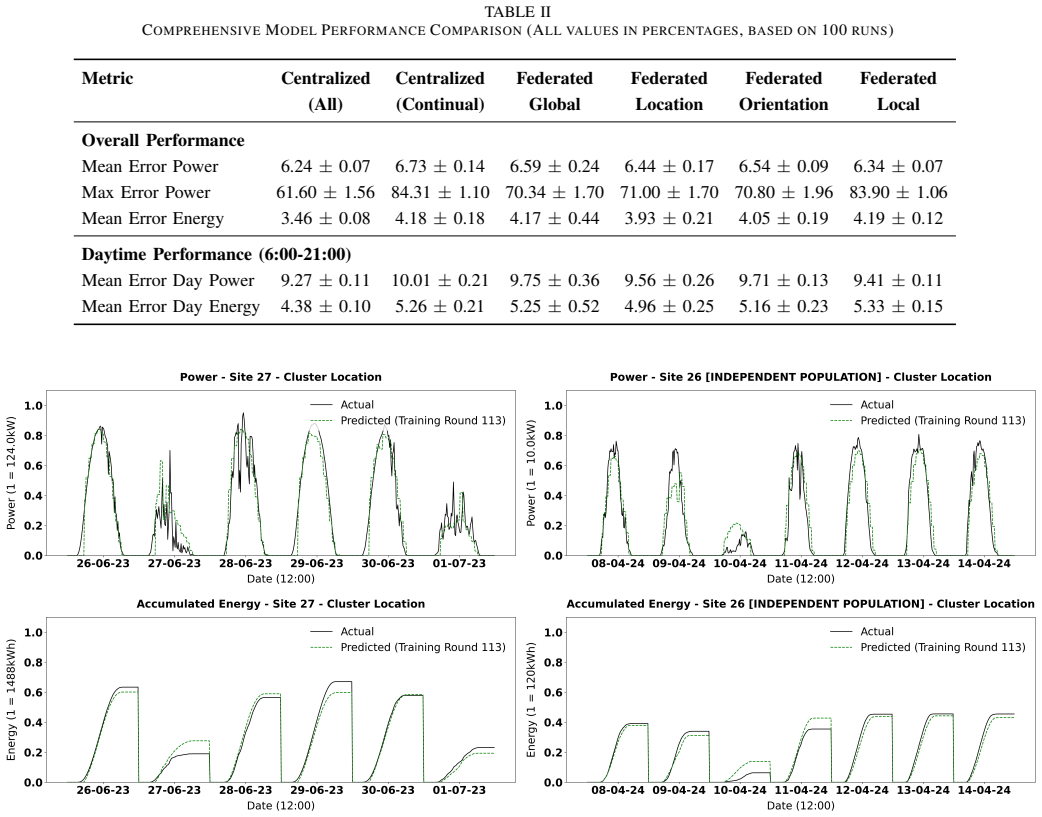
FedCCL's central discovery claim is that deciding cluster membership before training, rather than discovering clusters during or after training, removes the main obstacle to immediate model specialization in federated learning. In the authors' terms, the framework provides a Predict & Evolve capability: a new client is assigned to a pre-computed cluster from its static characteristics, receives that cluster's specialized model at once, and only later contributes updates of its own. The case study's headline numbers are a 6.44% mean power error and 3.93% mean energy error for location-based clusters, versus 6.73% and 4.18% for the CentralizedContinual baseline and 6.24% and 3.46% for the fully centralized baseline. On a population-independent evaluation where test installations are the sites nearest each cluster's centroid, the location cluster model shows 6.58% power error, a 0.14 percentage point degradation, while orientation-based clustering degrades by 2.59 percentage points; the paper concludes that location is the stronger specialization signal.
Load-bearing premise
The population-independent claim assumes that held-out test sites, selected as the installations nearest each cluster's centroid, represent arbitrary new clients joining later.
Editorial extensions
If this is right
- A new client can begin forecasting from a specialized cluster model immediately upon joining, with no waiting for a clustering phase or for enough local data.
- Clients can train and submit updates at their own pace; the server's model locking and sample-weighted aggregation absorb disconnections and slow participants without blocking the federation.
- Location-based clustering generalizes to unseen sites far better than orientation-based clustering in this dataset, so choosing the right static grouping signal is decisive.
- FedCCL's energy error of 3.93% beats the centralized continual baseline of 4.18%, meaning privacy-preserving distributed training can exceed a centrally trained model that sees data progressively.
- Because energy errors are systematically lower than power errors, day-ahead cumulative planning inherits the most accurate signal.
Reading between the lines
- The 0.14-point degradation is measured on centroid-nearest held-out sites, so real deployments with a wider geographic spread of new clients would likely show larger errors until those clients contribute local updates.
- Combining multiple static traits, such as assigning clients to overlapping location and orientation clusters, could yield better specialization than either clustering axis alone, but the paper evaluates each axis separately.
- The same pre-training clustering plus asynchronous FedAvg recipe should transfer to other forecasting or sensing domains whose participants have stable organizational attributes that correlate with data distribution, such as buildings, fleets, or hospital wards.
- A direct runtime comparison against dynamic clustered FL under continuous client churn, measuring wall-clock time to reach a target error and total communication volume, would quantify the coordination savings the paper claims qualitatively.
Signed reviews
Editorial analysis
A structured set of objections, weighed in public.
Referee Report
Summary. The paper proposes FedCCL, a federated learning framework that clusters clients by static properties (geographic location or panel orientation) using DBSCAN before training, then trains a three-tier hierarchy of models (global, cluster-specific, and local) with an asynchronous FedAvg variant. The framework's 'Predict & Evolve' mechanism is intended to let new clients immediately use a specialized cluster model without retraining. The authors evaluate on solar forecasting for PV installations in central Europe, reporting that location-based clustering achieves 6.44% (±0.17%) mean power error and 3.93% (±0.21%) mean energy error, and that held-out 'independent' sites show only a 0.14 percentage point degradation for the location model. The paper claims this demonstrates near-centralized accuracy with privacy and easy onboarding of new clients.
Significance. If the claims held, the paper would make a useful practical contribution: static pre-clustering avoids the cost of dynamic clustered FL, asynchronous updates accommodate heterogeneous client availability, and the hierarchical model store could accelerate onboarding of new clients. The public release of code and data, the use of a real-world dataset, and the reporting of 100-run means with standard deviations are strengths. However, the headline generalization result is not yet supported by the evaluation design, so the practical value of the 'Predict & Evolve' contribution is currently uncertain.
major comments (4)
- [IV-E, Figure 2] The population-independent evaluation selects held-out test sites as the installations closest to each cluster's centroid (Section IV-E and Figure 2). These sites are by construction the most typical members of their clusters, so the reported 0.14 percentage point degradation for the location model measures performance on an optimistic subsample and does not generalize to arbitrary new installations, which may be at cluster boundaries, in noise, or between clusters. The orientation model degrades by 2.59 percentage points under the same protocol, indicating that minimal degradation is not a general property of the framework but is specific to the location clustering and to this favorable test-site selection. Please evaluate held-out sites sampled uniformly from each cluster (or from the cluster boundary) and report the full distribution of degradation.
- [IV, Table II] Table II reports 100-run means with standard deviations but no significance tests. Many of the paper's central comparisons are small relative to the reported variability (e.g., Location 6.44 ± 0.17 vs. Global 6.59 ± 0.24; Location 6.44 ± 0.17 vs. CentralizedAll 6.24 ± 0.07). Without paired significance tests or confidence intervals, the claims that FedCCL 'achieves superior accuracy' over the baselines are not statistically supported. Please add appropriate tests (e.g., bootstrap or Wilcoxon signed-rank over the 100 runs) for the key comparisons.
- [II, IV-E, VI] The inference model selection is not specified. The framework trains global, cluster, and local models, and Section IV-E evaluates 'independent sites', but it is never stated which of these models is used to produce predictions for a new or held-out site. Section VI explicitly lists 'defining definite criteria which model to use in the inference phase' as future work. Without specifying the inference rule, the independent-site results are not reproducible and the Predict & Evolve contribution is incompletely defined. Please state exactly which model was used for the held-out predictions and justify the choice.
- [Abstract] The abstract claims 'superior accuracy compared to both traditional asynchronous Federated Learning and centralized approaches', but Table II shows that the CentralizedAll baseline has lower mean power error (6.24%) than every federated model, including the Location model (6.44%). The body correctly reports that location clustering outperforms only the CentralizedContinual baseline (by 0.29 percentage points). The abstract's claim is overstated and should be corrected to match the reported results.
minor comments (7)
- [II-C (Algorithm 1)] Line 2 of Algorithm 1 reads 'Initialize local model an set of cluster keys client clusters', which appears to intend 'and a set of cluster keys'; please fix the typo and clarify the data structure.
- [II-D (Algorithm 2)] Algorithm 2 returns the new update without aggregation when the round difference is exactly 1 (lines 1-2). This means a single client's update completely overwrites the server model in sequential-update cases; the rationale for this design and its effect on convergence are not discussed.
- [IV-A] It is unclear whether the 80-20 training-testing split is at the site level or the time-series level, and how the 'independent sites' of Section IV-E relate to the general split. Please clarify the experimental protocol.
- [IV-B] The energy error normalizes by kWp × 12 hours, treating 12 hours at rated capacity as the theoretical daily maximum; please justify this constant or cite a standard for it.
- [Figure 2] Because the coordinates are hidden for privacy, the figure cannot be used to verify that the red-cross test sites are indeed the closest to each cluster centroid; consider displaying anonymized or jittered coordinates so the selection is auditable.
- [V] The related work section contains incomplete sentences (e.g., 'Load forecasting was addressed several times. [20]–[22]'), which should be rewritten for readability.
- [IV-G] Section IV-G states 'minimal degradation (< 0.15 percentage points)', which is inconsistent with the 0.14 percentage point figure reported elsewhere; please use one consistent value.
Circularity Check
No constructional circularity; the 0.14 pp generalization claim raises external-validity concerns, not derivation circularity.
full rationale
The paper contains no algebraic derivation whose output is equivalent to its inputs. Its central claims are empirical: a federated clustering framework using DBSCAN on static features and asynchronous FedAvg is evaluated on photovoltaic forecasting data. The location-based cluster model's 3.93% energy error and the 0.14 percentage point population-independent degradation are measurements, not quantities forced by construction. The one self-citation, [4] (Gajanin et al., including Nastic), supports only the general statement that federated learning faces heterogeneous-device challenges and is not load-bearing for any specific result. The closest issue is the evaluation design in Section III and Figure 2, where the held-out 'independent sites' are selected as the installations closest to each cluster's centroid; this makes the 0.14 pp number optimistic and limits how well it generalizes to arbitrary new installations. However, that is an evaluation-selection bias and an external-validity concern, not a case where the prediction reduces by construction to a fitted parameter or a self-citation chain. The accuracy claims are also benchmarked against centralized baselines, providing independent checks on the main results. Accordingly, no significant circularity is present.
Assumptions & free parameters
free parameters (3)
- DBSCAN epsilon and min_samples
- Panel orientation cluster assignment
- LSTM architecture and training hyperparameters
assumptions (3)
- domain assumption Geographic location is a stable proxy for the solar production distribution of a site.
- domain assumption The held-out test sites, which are closest to cluster centroids, represent the population of future new clients.
- standard math DBSCAN, FedAvg weighted aggregation, and LSTM backpropagation operate correctly as described in the cited literature.
Cite this review
Pith. "Pith review of FedCCL: Federated Clustered Continual Learning Framework for Privacy-focused Energy Forecasting." pith.science (2026). https://pith.science/paper/YBC7LJPP
@misc{pith2026250420282,
  author       = {Pith},
  title        = {Pith review of: FedCCL: Federated Clustered Continual Learning Framework for Privacy-focused Energy Forecasting},
  year         = {2026},
  howpublished = {\url{https://pith.science/paper/YBC7LJPP}},
  note         = {Machine review of arXiv:2504.20282}
}
read the original abstract
Privacy-preserving distributed model training is crucial for modern machine learning applications, yet existing Federated Learning approaches struggle with heterogeneous data distributions and varying computational capabilities. Traditional solutions either treat all participants uniformly or require costly dynamic clustering during training, leading to reduced efficiency and delayed model specialization. We present FedCCL (Federated Clustered Continual Learning), a framework specifically designed for environments with static organizational characteristics but dynamic client availability. By combining static pre-training clustering with an adapted asynchronous FedAvg algorithm, FedCCL enables new clients to immediately profit from specialized models without prior exposure to their data distribution, while maintaining reduced coordination overhead and resilience to client disconnections. Our approach implements an asynchronous Federated Learning protocol with a three-tier model topology - global, cluster-specific, and local models - that efficiently manages knowledge sharing across heterogeneous participants. Evaluation using photovoltaic installations across central Europe demonstrates that FedCCL's location-based clustering achieves an energy prediction error of 3.93% (+-0.21%), while maintaining data privacy and showing that the framework maintains stability for population-independent deployments, with 0.14 percentage point degradation in performance for new installations. The results demonstrate that FedCCL offers an effective framework for privacy-preserving distributed learning, maintaining high accuracy and adaptability even with dynamic participant populations.
Figures


Reference graph
Works this paper leans on
-
[1]
Federated Machine Learning: Concept and Applications,
Q. Yang, Y . Liu, T. Chen, and Y . Tong, “Federated Machine Learning: Concept and Applications,” ACM Trans. Intell. Syst. Technol., vol. 10, no. 2, pp. 1–19, Mar. 2019. [Online]. Available: https://dl.acm.org/doi/10.1145/3298981
doi:10.1145/3298981 2019
-
[2]
Federated Optimization: Distributed Machine Learning for On- Device Intelligence,
J. Kone ˇcn´y, H. B. McMahan, D. Ramage, and P. Richt ´arik, “Federated Optimization: Distributed Machine Learning for On- Device Intelligence,” 2016, version Number: 1. [Online]. Available: https://arxiv.org/abs/1610.02527
arXiv 2016
-
[3]
Asynchronous federated learning on heterogeneous devices: A survey,
C. Xu, Y . Qu, Y . Xiang, and L. Gao, “Asynchronous federated learning on heterogeneous devices: A survey,” Computer Science Review, vol. 50, p. 100595, Nov. 2023. [Online]. Available: https://linkinghub.elsevier.com/retrieve/pii/S157401372300062X
work page 2023
-
[4]
Towards adap- tive asynchronous federated learning for human activity recognition,
R. Gajanin, A. Danilenka, A. Morichetta, and S. Nastic, “Towards adap- tive asynchronous federated learning for human activity recognition,” in Proceedings of the 14th International Conference on the Internet of Things (IoT 2024) . New York, NY , USA: Association for Computing Machinery, 2024
work page 2024
-
[5]
Federated Learning: Opportunities and Challenges,
P. M. Mammen, “Federated Learning: Opportunities and Challenges,” 2021, version Number: 1. [Online]. Available: https://arxiv.org/abs/ 2101.05428
arXiv 2021
-
[6]
Federated learning: Applications, challenges and future directions,
S. Bharati, M. R. H. Mondal, P. Podder, and V . S. Prasath, “Federated learning: Applications, challenges and future directions,” HIS, vol. 18, no. 1-2, pp. 19–35, May 2022. [Online]. Available: https://journals.sagepub.com/doi/full/10.3233/HIS-220006
-
[7]
Communication-Efficient Learning of Deep Networks from Decentralized Data,
H. Brendan McMahan, H. B. McMahan, Eider B Moore, E. Moore, Daniel Ramage, D. Ramage, Seth Hampson, S. Hampson, Blaise Ag¨uera y Arcas, and B. Aguera y Arcas, “Communication-Efficient Learning of Deep Networks from Decentralized Data,” arXiv: Learn- ing, Feb. 2016, aRXIV ID: 1602.05629 MAG ID: 2950745363 S2ID: d1dbf643447405984eeef098b1b320dee0b3b8a7
arXiv 2016
-
[8]
Asynchronous federated opti- mization,
Cong Xie, C. Xie, Oluwasanmi Koyejo, O. Koyejo, S. Koyejo, Indranil Gupta, and I. Gupta, “Asynchronous federated opti- mization,” arXiv: Distributed, Parallel, and Cluster Computing , Mar. 2019, aRXIV ID: 1903.03934 MAG ID: 2921434559 S2ID: 8f6602b6ebe2962dacf0b563e73852183e628ddf
arXiv 2019
Show all 34 references
-
[9]
Asynchronous Online Federated Learning for Edge Devices with Non-IID Data,
Y . Chen, Y . Ning, M. Slawski, and H. Rangwala, “Asynchronous Online Federated Learning for Edge Devices with Non-IID Data,” in 2020 IEEE International Conference on Big Data (Big Data) . Atlanta, GA, USA: IEEE, Dec. 2020, pp. 15–24. [Online]. Available: https://ieeexplore.ie...
2020
-
[10]
Clustered Federated Learning in Heterogeneous Environment,
Y . Yan, X. Tong, and S. Wang, “Clustered Federated Learning in Heterogeneous Environment,” IEEE Trans. Neural Netw. Learning Syst., vol. 35, no. 9, pp. 12 796–12 809, Sep. 2024. [Online]. Available: https://ieeexplore.ieee.org/document/10106044/
2024
-
[11]
FedClust: Optimizing Federated Learning on Non-IID Data Through Weight-Driven Client Clustering,
Md Sirajul Islam, Simin Javaherian, Fei Xu, Xu Yuan, Li Chen, and Nianfeng Tzeng, “FedClust: Optimizing Federated Learning on Non-IID Data Through Weight-Driven Client Clustering,” IEEE International Symposium on Parallel & Distributed Processing, Workshops and Phd Forum , 202...
2024 arXiv
-
[12]
Deep learning models for solar irradiance forecasting: A comprehensive review,
P. Kumari and D. Toshniwal, “Deep learning models for solar irradiance forecasting: A comprehensive review,” Journal of Cleaner Production, vol. 318, p. 128566, Oct. 2021. [Online]. Available: https://linkinghub.elsevier.com/retrieve/pii/S0959652621027736
2021
-
[13]
Hourly day-ahead solar irradiance prediction using weather forecasts by LSTM,
X. Qing and Y . Niu, “Hourly day-ahead solar irradiance prediction using weather forecasts by LSTM,” Energy, vol. 148, pp. 461–468, Apr. 2018. [Online]. Available: https://linkinghub.elsevier.com/retrieve/ pii/S0360544218302056
2018
-
[14]
Deep Learning Models for PV Power Forecasting: Review,
J. Yu, X. Li, L. Yang, L. Li, Z. Huang, K. Shen, X. Yang, X. Yang, Z. Xu, D. Zhang, and S. Du, “Deep Learning Models for PV Power Forecasting: Review,” Energies, vol. 17, no. 16, p. 3973, Aug. 2024. [Online]. Available: https://www.mdpi.com/1996-1073/17/16/3973
2024
-
[15]
Federated Learning for Short-term Residential Load Forecasting,
Christopher Briggs, C. C. Briggs, Zhong Fan, Zhong Fan, Peter Andras, and P´eter Andr´as, “Federated Learning for Short-term Residential Load Forecasting,” IEEE open access journal of power and energy , pp. 1– 1, Jan. 2022, aRXIV ID: 2105.13325 MAG ID: 4295308572 S2ID: 3bdf502...
2022 arXiv
-
[16]
Fuzzy Clustered Federated Learning Algorithm for Solar Power Generation Forecasting,
E. Yoo, H. Ko, and S. Pack, “Fuzzy Clustered Federated Learning Algorithm for Solar Power Generation Forecasting,” IEEE Trans. Emerg. Topics Comput. , vol. 10, no. 4, pp. 2092–2098, Oct. 2022. [Online]. Available: https://ieeexplore.ieee.org/document/9687124/
2022
-
[17]
Deep learning based forecasting of photovoltaic power generation by incorporating domain knowledge,
X. Luo, D. Zhang, and X. Zhu, “Deep learning based forecasting of photovoltaic power generation by incorporating domain knowledge,” Energy, vol. 225, p. 120240, Jun. 2021. [Online]. Available: https://linkinghub.elsevier.com/retrieve/pii/S0360544221004898
2021
-
[18]
Long Short-Term Memory,
S. Hochreiter and J. Schmidhuber, “Long Short-Term Memory,” Neural Computation, vol. 9, no. 8, pp. 1735–1780, Nov. 1997. [Online]. Available: https://direct.mit.edu/neco/article/9/8/1735-1780/6109
1997
-
[19]
A Simplified LSTM Neural Networks for One Day-Ahead Solar Power Forecasting,
C.-H. Liu, J.-C. Gu, and M.-T. Yang, “A Simplified LSTM Neural Networks for One Day-Ahead Solar Power Forecasting,” IEEE Access , vol. 9, pp. 17 174–17 195, 2021. [Online]. Available: https://ieeexplore.ieee.org/document/9333638/
2021
-
[20]
Federated Learning based Energy Demand Prediction with Clustered Aggregation,
Y . L. Tun, K. Thar, C. M. Thwal, and C. S. Hong, “Federated Learning based Energy Demand Prediction with Clustered Aggregation,” in 2021 IEEE International Conference on Big Data and Smart Computing (BigComp). Jeju Island, Korea (South): IEEE, Jan. 2021, pp. 164–167. [Online]...
2021
-
[21]
Energy Demand Prediction with Federated Learning for Electric Vehicle Networks,
Y . M. Saputra, D. T. Hoang, D. N. Nguyen, E. Dutkiewicz, M. D. Mueck, and S. Srikanteswara, “Energy Demand Prediction with Federated Learning for Electric Vehicle Networks,” 2019, version Number: 1. [Online]. Available: https://arxiv.org/abs/1909.00907
2019 arXiv
-
[22]
Advancing Electric Load Forecasting: Leveraging Federated Learning for Distributed, Non-Stationary, and Discontinuous Time Series,
L. Richter, S. Lenk, and P. Bretschneider, “Advancing Electric Load Forecasting: Leveraging Federated Learning for Distributed, Non-Stationary, and Discontinuous Time Series,” Smart Cities , vol. 7, no. 4, pp. 2065–2093, Jul. 2024. [Online]. Available: https://www.mdpi.com/262...
2024
-
[23]
Clustered Federated Learning: Model-Agnostic Distributed Multitask Optimization Under Privacy Constraints,
Felix Sattler, F. Sattler, Klaus-Robert M ¨uller, K.-R. M ¨uller, Wojciech Samek, and W. Samek, “Clustered Federated Learning: Model-Agnostic Distributed Multitask Optimization Under Privacy Constraints,” IEEE Transactions on Neural Networks , vol. 32, no. 8, pp. 3710–3722, 20...
2020
-
[24]
An Efficient Framework for Clustered Federated Learning,
A. Ghosh, J. Chung, D. Yin, and K. Ramchandran, “An Efficient Framework for Clustered Federated Learning,” IEEE Trans. Inform. Theory, vol. 68, no. 12, pp. 8076–8091, Dec. 2022. [Online]. Available: https://ieeexplore.ieee.org/document/9832954/
2022
-
[25]
A density-based algorithm for discovering clusters a density-based algorithm for discovering clus- ters in large spatial databases with noise,
Martin Ester, M. Ester, Hans-Peter Kriegel, H.-P. Kriegel, J ¨org Sander, J. Sander, Xiaowei Xu, and X. Xu, “A density-based algorithm for discovering clusters a density-based algorithm for discovering clus- ters in large spatial databases with noise,” Knowledge Discovery and ...
1996
-
[26]
Incremental generalization for mining in a data warehousing environment,
M. Ester and R. Wittmann, “Incremental generalization for mining in a data warehousing environment,” in Advances in Database Technology — EDBT’98 , G. Goos, J. Hartmanis, J. Van Leeuwen, H.-J. Schek, G. Alonso, F. Saltor, and I. Ramos, Eds. Berlin, Heidelberg: Springer Berlin ...
1998 doi
-
[27]
Overcoming catastrophic forgetting in neural networks,
J. Kirkpatrick, R. Pascanu, N. Rabinowitz, J. Veness, G. Desjardins, A. A. Rusu, K. Milan, J. Quan, T. Ramalho, A. Grabska-Barwinska, D. Hassabis, C. Clopath, D. Kumaran, and R. Hadsell, “Overcoming catastrophic forgetting in neural networks,” Proc. Natl. Acad. Sci. U.S.A., vo...
2017 doi
-
[28]
Investigating the Power of LSTM-Based Models in Solar Energy Forecasting,
N. L. M. Jailani, J. K. Dhanasegaran, G. Alkawsi, A. A. Alkahtani, C. C. Phing, Y . Baashar, L. F. Capretz, A. Q. Al-Shetwi, and S. K. Tiong, “Investigating the Power of LSTM-Based Models in Solar Energy Forecasting,” Processes, vol. 11, no. 5, p. 1382, May 2023. [Online]. Ava...
2023
-
[29]
Convolutional and LSTM Neural Networks for Solar Power Forecasting,
G. Fungtammasan and I. Koprinska, “Convolutional and LSTM Neural Networks for Solar Power Forecasting,” in 2023 International Joint Conference on Neural Networks (IJCNN) . Gold Coast, Australia: IEEE, Jun. 2023, pp. 1–7. [Online]. Available: https: //ieeexplore.ieee.org/docume...
2023
-
[30]
Accurate photovoltaic power forecasting models using deep LSTM-RNN,
M. Abdel-Nasser and K. Mahmoud, “Accurate photovoltaic power forecasting models using deep LSTM-RNN,” Neural Comput & Applic, vol. 31, no. 7, pp. 2727–2740, Jul. 2019. [Online]. Available: http://link.springer.com/10.1007/s00521-017-3225-z
2019 doi
-
[31]
Probabilistic LSTM-Autoencoder Based Hour-Ahead Solar Power Forecasting Model for Intra-Day Electricity Market Participation: A Polish Case Study,
V . Suresh, F. Aksan, P. Janik, T. Sikorski, and B. S. Revathi, “Probabilistic LSTM-Autoencoder Based Hour-Ahead Solar Power Forecasting Model for Intra-Day Electricity Market Participation: A Polish Case Study,” IEEE Access, vol. 10, pp. 110 628–110 638, 2022. [Online]. Avail...
2022
-
[32]
Energy Prediction using Fed- erated Learning,
Meghana Bharadwaj and Sanjana Sarda, “Energy Prediction using Fed- erated Learning,” arXiv.org, Jan. 2023, aRXIV ID: 2301.09165 MAG ID: 4317940348 S2ID: be20ab605bacc726d85b3a6b3b56230a7e7b077a
2023 arXiv
-
[33]
A solar forecasting framework based on federated learning and distributed computing,
H. Wen, Y . Du, E. G. Lim, H. Wen, K. Yan, X. Li, and L. Jiang, “A solar forecasting framework based on federated learning and distributed computing,” Building and Environment, vol. 225, p. 109556, Nov. 2022. [Online]. Available: https://linkinghub.elsevier.com/retrieve/ pii/S...
2022
-
[34]
Short-Term Energy Consumption Forecasting at the Edge: A Federated Learning Approach,
M. Savi and F. Olivadese, “Short-Term Energy Consumption Forecasting at the Edge: A Federated Learning Approach,” IEEE Access, vol. 9, pp. 95 949–95 969, 2021. [Online]. Available: https: //ieeexplore.ieee.org/document/9469923/
2021
Reviewed August 16, 2026 · model on record in the stance chip above.
Discussion (0). Continue with ORCID to comment.