REVIEW 3 major objections 5 minor 106 references
Horizonless star based on regular black hole with finite radius and its observational signatures
T0 review · 3 major / 5 minor · reviewed 2026-08-15 · deepseek-v4-flash
Pith's one-line read Horizonless star emits echo trains and chaotic photon rings
desk verdict A coherent new gravastar template with useful photon-ring and echo predictions, but the imaginary sound speed in the crust and missing radial stability analysis undercut the claim that the object is viable. read the letter →
The pith
A machine-rendered reading of the paper's core claim, the machinery that carries it, and where it could break.
The reading
What carries the argument
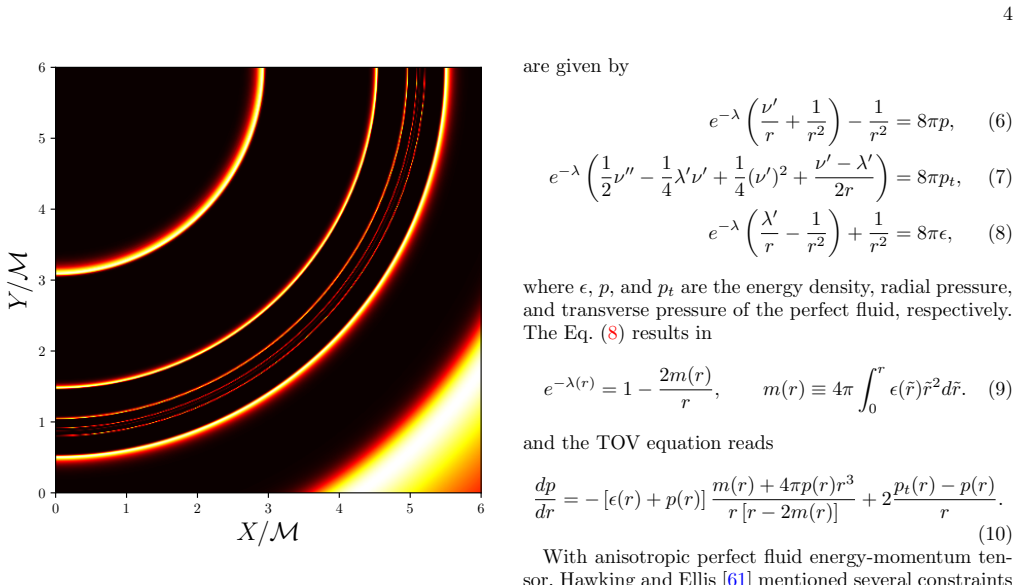
The central object is the finite-radius Hayward metric, whose energy density is the Hayward profile multiplied by a Tolman-like cutoff $1-(r/R)^n$, so the mass function is continuous up to the surface and matches Schwarzschild outside. The carrying mechanism is the equation-of-state ansatz $\bar p(y) = -\bar\epsilon(y)[1-F(y)\Theta(x-1)]$ with $F(y) = T(y)[1+a(\bar\epsilon/\bar\epsilon_0)^{\gamma-1}]$ and a tanh activation $T(y)$, which deforms the de Sitter core into a gravastar-like pressure profile while preserving regularity at the center and a smooth surface. The dimensionless ratio $x=\alpha/\alpha_c$ controls the size of the negative-pressure core; it also sets the threshold $x_m$ at which a marginally stable photon sphere appears, and hence which combination of the two observational signatures, chaotic photon rings or echo trains, is present.
What would settle it
Vary $\omega$, $\sigma_t$, $a$, and $\gamma$ within the conditions of Table II, or use a different smooth function $F(y)$ satisfying those conditions; if chaotic minor photon rings or gravitational echo trains disappear for some $x>x_m$, those signatures are artifacts of the specific ansatz rather than generic properties. Observationally, a next-generation very-long-baseline image of an ultracompact candidate that resolves the photon-ring region and shows no minor rings between the first two major rings would contradict the claimed image signature, as would a post-merger ringdown with no echo train for a configuration with $x>x_m$.
Extended reading notes
Core claim
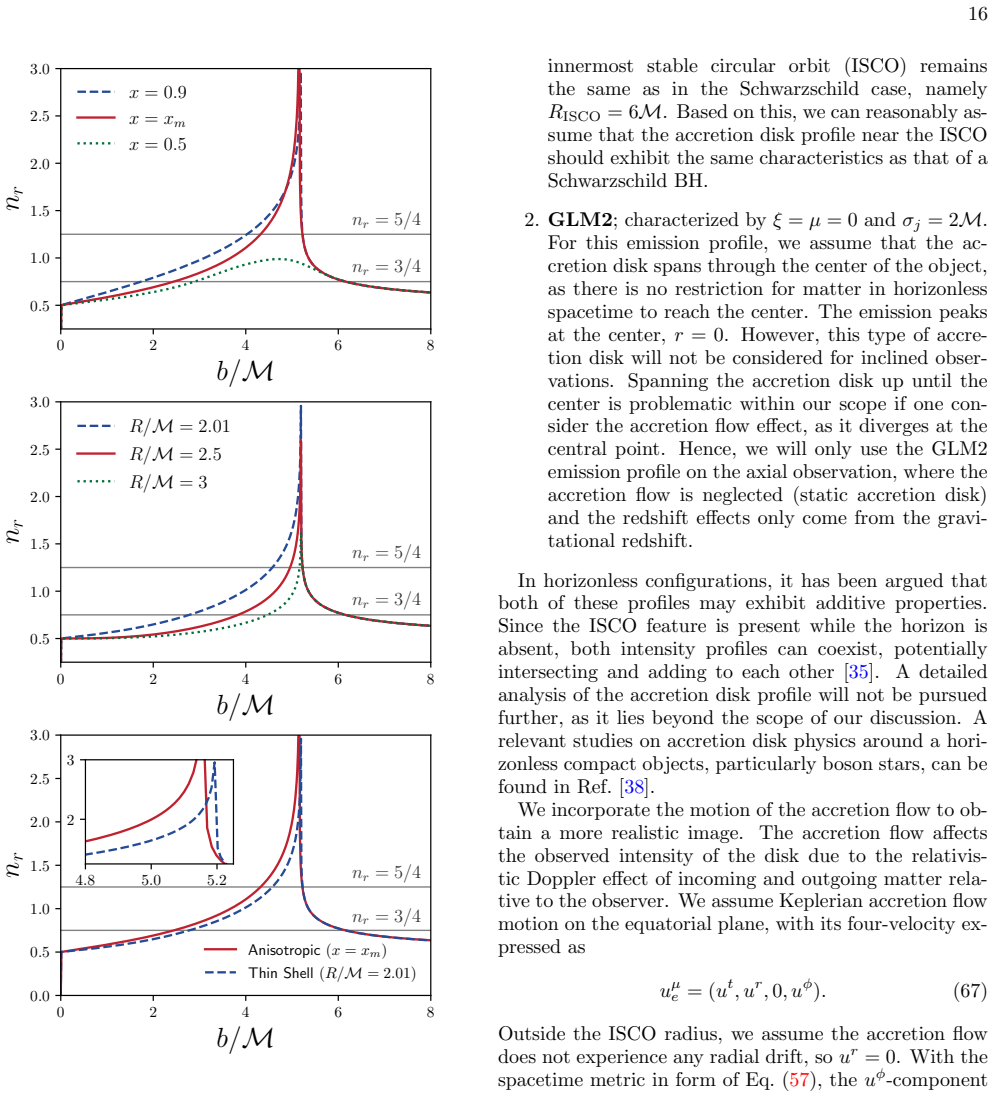
The paper's claim is that the horizonless branch of a modified Hayward regular black hole, once completed with a phenomenologically chosen anisotropic equation of state, forms a class of ultracompact star whose exterior is Schwarzschild, whose interior has a de Sitter core plus a positive-pressure crust and atmosphere, and whose observables differ from both black holes and thin-shell gravastars. Concretely, for $\bar R = 1.1$ and $1.5$ and the compactness parameter $x=\alpha/\alpha_c$, the photon-sphere threshold is $x_m \approx 0.654$–$0.656$; for $x > x_m$ the ray-traced images show chaotic minor photon rings between the first two major rings, and numerically evolved axial perturbations produce echo trains. At $x=x_m$ the potential well is too shallow to trap modes and no echoes appear. The paper also claims that approaching horizon formation forces a violation of the dominant energy condition in the transverse pressure, and that at the extremal configuration the time metric component freezes below $y_c$, mimicking a frozen star.
Load-bearing premise
The entire pressure profile, the dominant-energy-condition violation, the photon-sphere threshold $x_m$, and the echo behaviour follow from the hand-picked function $F(y)$; if a different allowed $F(y)$ changes or removes the signatures, the paper's predictions rest on that un-derived choice.
Editorial extensions
If this is right
- For objects with $x > x_m$ and a transparent interior, the optical appearance is a set of photon rings rather than a shadow, with chaotic minor rings between the first and second major rings.
- Gravitational-wave echoes appear only when the effective potential has a sufficiently deep well, namely $x > x_m$; at the marginally stable photon-sphere threshold no echo trains exist.
- An anisotropic gravastar approaching horizon formation must violate the dominant energy condition, giving a concrete finite-radius realization of the earlier polarisation argument.
- Reproducing the 72 Hz echo frequency reported from GW170817 requires an $\ell$ of roughly $10^5$ m and an object mass of about $115.7\,M_\odot$, a requirement the paper treats as disfavouring the model.
- A limiting choice of the same parameters recovers the thin-shell gravastar model, and in that limit the transverse pressure violates the weak energy condition at the surface.
Reading between the lines
- A parameter scan over the free constants in $F(y)$ would show whether the chaotic rings and echo trains are generic properties of this gravastar completion or specific to the tanh choice.
- Applying the same cutoff-plus-ansatz construction to other regular black hole densities, such as a Bardeen-like profile, would test whether the threshold $x_m$ and its two signatures survive changes in the core profile.
- Because the predicted echo time is set by the integral of $\sqrt{-g_{rr}/g_{tt}}$ from the center to the photon sphere, future broadband gravitational-wave searches are effectively measuring this time-delay integral and would fix the combination of $x$ and $\ell$.
- The imaging prediction assumes light passes through the interior without interacting; if the positive-pressure atmosphere radiates, the central brightness pattern could change and the chaotic rings might be washed out.
Signed reviews
Editorial analysis
A structured set of objections, weighed in public.
Referee Report
Summary. The paper constructs a horizonless star by modifying the Hayward regular black hole with a finite-radius cutoff and by proposing a phenomenological anisotropic equation-of-state ansatz. It then solves the TOV equations to obtain pressure profiles, metric functions, and energy conditions, and uses the resulting spacetime to compute photon geodesics, ray-traced images with GLM1/GLM2 accretion disks, axial Regge-Wheeler potentials, quasinormal modes, and time-domain echo solutions. The central claims are that (i) configurations with photon spheres (x > x_m) produce chaotic minor photon rings between the first two major rings, and (ii) gravitational echo trains exist for x > x_m. A match to the 72 Hz GW170817 echo candidate is reported but requires ℓ ~ 1.5 × 10^5 m and a stellar mass of about 116 solar masses.
Significance. If the model is dynamically stable and the signatures are robust, this would be a useful new example of a horizonless compact object whose optical and gravitational-wave signatures differ from both black holes and thin-shell gravastars. The paper's forward calculations are explicit and benchmarked against the Schwarzschild photon-sphere results and against thin-shell gravastar images, and the statement that near-horizon configurations violate the dominant energy condition is a concrete, checkable result. The main reservations are that the equation of state is an ad hoc phenomenological ansatz, that the crust has imaginary sound speed, and that no radial stability analysis is given; these issues currently leave the 'viable' part of the central claim unproven.
major comments (3)
- [Sec. IV, Figs. 5-6 and text after Eq. (40)] The model has a crust region where d pbar/d ebar < 0, i.e. an imaginary adiabatic sound speed; this is visible in the bottom row of Fig. 6 and acknowledged in the discussion following Eq. (40). Because the paper's central claim is that this is a viable horizonless star, the absence of a radial (l=0) stability analysis is load-bearing: the axial Regge-Wheeler evolution in Sec. VI involves only toroidal fluid displacements and cannot detect radial collapse modes. I request either a linear radial-stability analysis (polar l=0, or at minimum a Chandrasekhar-style variational argument) or a substantial restriction of the viability claim, since an unstable configuration would not provide a physically realizable background for the ray-traced images and echo waveforms.
- [Sec. IV C, Eq. (47)] The entire construction rests on the phenomenological ansatz F(y) = T(y)[1 + a(epsilon/epsilon0)^(gamma-1)], with omega, sigma_t, a, and gamma selected by hand to enforce gravastar boundary conditions via Eqs. (49)-(52). The resulting predictions - the threshold x_m, the chaotic minor photon rings, the potential-well depth, and the echo threshold - are all contingent on this particular functional choice, and the paper gives no sensitivity analysis or microphysical derivation. The earlier model in Ref. [29] already shows that a different F(y) changes the signatures; I ask the authors to either scan the allowed parameter region and quantify how x_m, ring structure, and echo existence vary, or explicitly frame all predictions as properties of this particular ansatz rather than of the class of horizonless Hayward stars.
- [Sec. VI C, Eqs. (97)-(101)] The '72 Hz can be achieved' statement is presented as an observational match, but it is a parameter inversion: Eqs. (100)-(101) simply solve for ℓ such that f_echo = 1/(2 tau_echo) equals the GW170817 candidate value, and the resulting ℓ ~ 1.5 × 10^5 m and M ~ 116 M_sun are consequences of that choice. Moreover, tau_echo in Eq. (97) is defined as a null travel time from r=0 to r=3M, which is not obviously the inter-echo interval extracted from the time-domain solutions in Figs. 21-22. The identification should either be justified, or the text should present this as a calibration of ℓ rather than a prediction.
minor comments (5)
- [Sec. VI opening] The text twice refers to the 'Reggae-Wheeler' equation; this should be Regge-Wheeler.
- [Fig. 5 caption] The caption says 'with Rbar = 1.1 and Rbar = 1.1'; the second radius should presumably be Rbar = 1.5.
- [Table III] Table III is difficult to read: the n and omega columns are duplicated and some rows mix l=2 and l=3 values; please reformat into separate blocks with clear columns.
- [Sec. V B and Figs. 13-14] The paper repeatedly states that light does not interact with the interior, but the GLM2 disk extends to the center and rays are traced through the interior; please clarify whether interior absorption/emission is neglected and how this is consistent with the stated assumption.
- [Sec. VII, first paragraph] The discussion says the deviation is 'proportional to a tangential function'; the function used in Sec. IV is a hyperbolic tangent, not a tangent, so the wording should be corrected.
Circularity Check
Minor fitted-input inversion: the 72 Hz echo 'match' is solved from the free scale ℓ; central photon-ring and echo-train predictions are forward computations, not circular.
-
fitted input called prediction
[Abstract; Sec. VI C, Eqs. (97)-(101)]
"By comparing the echo time with the GW170817 observation, we find that a frequency of 72 Hz can be achieved, albeit at the cost of requiring a relatively high value of ℓ."
Eq. (97) defines τecho = ∫ sqrt(-g_rr/g_tt) dr = ℓ τ̃, and the text sets f_echo = 1/(2τecho). Inserting the target '72 Hz' and solving for ℓ yields ℓ_{R̄=1.1}=1.51×10^5 m and ℓ_{R̄=1.5}=1.33×10^5 m, which is exactly the inversion f_echo = 1/(2ℓ τ̃). The frequency is therefore an input fitted to GW170817, not an output of the model; '72 Hz can be achieved' is equivalent to choosing ℓ = 1/(2×72 Hz×τ̃). The paper frames this transparently as requiring a large ℓ, so the circularity is mild and non-load-bearing for the central imaging and echo-train results.
full rationale
No significant circularity in the main derivation chain. The modified Hayward metric (Sec. III) is fixed by the chosen energy-density profile and the EoS ansatz F(y) (Eq. 47); the photon-sphere threshold x_m, the chaotic minor photon rings, and the echo trains are then computed forward from this metric via the effective potential (Eq. 60) and the time-dependent Regge-Wheeler equation (Eq. 84), with external checks against the Schwarzschild photon sphere and the thin-shell gravastar images of Ref. [35]. The straight-photon-path feature is re-derived analytically (Eqs. 62-64) rather than imported. The DEC-violation statement is broad (the paper itself notes F ∝ 1-2m/y would avoid it, Sec. IV A), but that is a model-dependence and correctness caveat, not an input-output inversion. Self-citations to [29] and [76] provide background and prior motivation; the claimed features are recomputed here, so they are not load-bearing. The only reduction-by-construction found is the 72 Hz echo comparison: f_echo = 1/(2ℓ τ̃) is inverted to solve for ℓ from the target frequency, so '72 Hz can be achieved' is a fitted constraint rather than a prediction; the paper presents it transparently as a requirement of large ℓ. Accordingly, the circularity score is 2.
Assumptions & free parameters
free parameters (9)
- n =
3 (fixed)
- σs =
1e-3 (fixed)
- ω =
0.7 R̄ (chosen)
- σt =
0.15 (chosen)
- a =
Determined by Eq. (52)
- γ =
>1 (not specified)
- x =
varied {0.3, 0.5, 0.9, 1.0, 1.1}
- R̄ =
1.1 and 1.5 (chosen)
- ℓ =
1.51e5 m (R̄=1.1) or 1.33e5 m (R̄=1.5) for 72 Hz
assumptions (7)
- standard math General relativity with anisotropic perfect fluid source
- domain assumption Hayward-type regular black hole energy density template
- ad hoc to paper The EoS ansatz p̄(y) = -ε̄(y)[1 - F(y)Θ(x-1)] with the tanh form of F(y)
- domain assumption Smooth matching to Schwarzschild exterior with Φ(R)=0
- domain assumption Photons do not interact with the star's interior and the accretion disk is thin
- standard math WKB/Bohr-Sommerfeld approximation for quasinormal modes
- domain assumption Axial perturbations reduce to a single Regge-Wheeler master equation with potential Eq. (85)
Cite this review
Pith. "Pith review of Horizonless star based on regular black hole with finite radius and its observational signatures." pith.science (2026). https://pith.science/paper/YBJXBJO7
@misc{pith2026250818072,
  author       = {Pith},
  title        = {Pith review of: Horizonless star based on regular black hole with finite radius and its observational signatures},
  year         = {2026},
  howpublished = {\url{https://pith.science/paper/YBJXBJO7}},
  note         = {Machine review of arXiv:2508.18072}
}
abstract
The horizonless configuration of regular black holes has recently attracted attention as a model for ultracompact stars. In this paper, we propose a new class of regular black hole models sourced by a de Sitter vacuum with a finite radius. We focus on studying its horizonless configuration, which is modified into an anisotropic gravastar by proposing an ansatz of equation of states. We confirm that an anisotropic gravastar approaching horizon formation must violate the dominant energy condition. We also found that the proposed object has an effectively similar structure as a frozen star on the time geometry at the extremal configuration. From the proposed model, we investigate the photon geodesics inside the object and predict the optical appearance of the object surrounded by a thin accretion disk. Our imaging results indicate that, assuming light does not interact with the object's interior, its optical appearance differs from that of a thin-shell gravastar. ``Chaotic" photon ring merges for $x>x_{m}$, where $x_{m}$ represents the minimum value required for the photon sphere to exist. In addition to its optical appearance, we investigate the axial gravitational perturbations emitted by this horizonless star. Notably, echo trains are found to exist for $x>x_{m}$, as determined by numerically solving the time-dependent Regge-Wheeler equation. By comparing the echo time with the GW170817 observation, we find that a frequency of 72 Hz can be achieved, albeit at the cost of requiring a relatively high value of $\ell$.
Figures


Figures from the paper (16 more)




Reference graph
Works this paper leans on
-
[76]
R. Brustein, A. J. M. Medved and T. Simhon, “Black holes as frozen stars,” Phys. Rev. D 105, 024019 (2022), arXiv:2109.10017 [gr-qc]
arXiv 2022
-
[29]
Gravastar in the framework of Loop Quantum Cosmology,
S. Ghosh, R. Sengupta and M. Kalam, “Gravastar in the framework of Loop Quantum Cosmology,” Eur. Phys. J. Plus 139, 465 (2024), arXiv:2311.00692 [gr-qc]
arXiv 2024
-
[1]
We fixn = 3 and σs = 10−3 for the sake of simplic- ity
Anisotropic gravastar solution In this section, we discuss the results and implementa- tions of the energy condition constraints to the proposed EoS. We fixn = 3 and σs = 10−3 for the sake of simplic- ity. Since ω significantly determines the transition point, it makes sense to instead adjust ¯ω = ω/ ¯R, so that the transition point is relative to the sur...
-
[2]
(47), that is T (y) = 1 2 1 + tanh y−αω ασt , (54) and setting a = 1, γ = 1, ω → ¯R α, σ t→ 0
Relation with thin-shell gravastar The interesting feature of this particular form of EoS is that one can approach the original thin-shell gravastar model; that is, by using ¯ϵ(y) = ¯ϵ0 = 3 8π α ¯R3 (constant), 0≤r≤ ¯R (53) with a slightly different form ofT (y) from Eq. (47), that is T (y) = 1 2 1 + tanh y−αω ασt , (54) and setting a = 1, γ = 1, ω → ¯R α...
-
[3]
This type of accretion disk assumes that the emission peaks and stops near the ISCO radius
GLM1; characterized by ξ = −2, µ = RISCO , and σj =M/4, with RISCO is the radius of the innermost stable circular orbit (ISCO) for a mas- sive particle. This type of accretion disk assumes that the emission peaks and stops near the ISCO radius. This model is considered because any mas- sive particle will eventually fall towards the center if it passes wit...
-
[4]
GLM2; characterized by ξ =µ = 0 and σj = 2M. For this emission profile, we assume that the ac- cretion disk spans through the center of the object, as there is no restriction for matter in horizonless spacetime to reach the center. The emission peaks at the center, r = 0. However, this type of accre- tion disk will not be considered for inclined obser- va...
-
[5]
Axial observation For the axial observation, we first generate and ana- lyze the thin-shell gravastar model based on our pressure Accretion disk plane Inclined observer Axial observer Object’s ‘surface’ θi Viewing range Initial position Screen Field of View Screen distance r0 FIG. 11. Two-dimensional illustration of axial and inclined observations, with r...
-
[6]
The accretion flow and redshift effects are taken into account to how it influence the appearence of the inner photon rings
Inclined observation Here, we generate the images with inclined observa- tion with inclination angle of 17◦ and 60◦. The accretion flow and redshift effects are taken into account to how it influence the appearence of the inner photon rings. We show our generated images in Fig. 15. The photon rings still appears brightly at low inclination angle with a no...
Show all 106 references
-
[7]
New type of regular black holes and particle - like solutions from NED,
A. Burinskii and S. R. Hildebrandt, “New type of regular black holes and particle - like solutions from NED,”Phys. Rev. D 65, 104017 (2002), arXiv:hep-th/0202066 [hep- th]
2002 arXiv
-
[8]
Towards a non- singular paradigm of black hole physics,
R. Carballo-Rubio, F. Di Filippo, S. Liberati, M. Visser, J. Arrechea, C. Barcel´ o, A. Bonanno, J. Borissova, V. Boyanov and V. Cardoso, et al. “Towards a non- singular paradigm of black hole physics,” JCAP 05, 003 (2025), arXiv:2501.05505 [gr-qc]
2025 arXiv
-
[9]
Gravitational collapse: The role of general relativity,
R. Penrose, “Gravitational collapse: The role of general relativity,” Riv. Nuovo Cim. 1, 252 (1969)
1969
-
[10]
Regular Black Holes: A Short Topic Review,
C. Lan, H. Yang, Y. Guo and Y. G. Miao, “Regular Black Holes: A Short Topic Review,” Int. J. Theor. Phys. 62, 202 (2023), arXiv:2303.11696 [gr-qc]
2023 arXiv
-
[11]
The Bardeen model as a nonlinear magnetic monopole,
E. Ayon-Beato and A. Garcia, “The Bardeen model as a nonlinear magnetic monopole,” Phys. Lett. B 493, 149 (2000), arXiv:gr-qc/0009077 [gr-qc]
2000 arXiv
-
[12]
Regular black hole in general relativity coupled to nonlinear electrodynamics,
E. Ayon-Beato and A. Garcia, “Regular black hole in general relativity coupled to nonlinear electrodynamics,” Phys. Rev. Lett. 80, 5056 (1998), arXiv:gr-qc/9911046 [gr-qc]
1998 arXiv
-
[13]
Regular magnetic black holes and monopoles from nonlinear electrodynamics,
K. A. Bronnikov, “Regular magnetic black holes and monopoles from nonlinear electrodynamics,” Phys. Rev. D 63, 044005 (2001), arXiv:gr-qc/0006014 [gr-qc]
2001 arXiv
-
[14]
Black holes in asymptotically safe gravity and beyond,
A. Eichhorn and A. Held, “Black holes in asymptotically safe gravity and beyond,” in Regular Black Holes, edited by C. Bambi (2023), arXiv:2212.09495 [gr-qc]
2023 arXiv
-
[15]
Field sources for Simpson-Visser spacetimes,
K. A. Bronnikov and R. K. Walia, “Field sources for Simpson-Visser spacetimes,” Phys. Rev. D 105, 044039 (2022), arXiv:2112.13198 [gr-qc]
2022 arXiv
-
[16]
Formation and evaporation of regu- lar black holes,
S. A. Hayward, “Formation and evaporation of regu- lar black holes,” Phys. Rev. Lett. 96, 031103 (2006), arXiv:gr-qc/0506126 [gr-qc]
2006 arXiv
-
[17]
Effective models of nonsingular quantum black holes,
M. Cadoni, M. Oi and A. P. Sanna, “Effective models of nonsingular quantum black holes,” Phys. Rev. D 106, 024030 (2022), arXiv:2204.09444 [gr-qc]
2022 arXiv
-
[18]
Are nonsingular black holes with super-Planckian hair ruled out by S2 star data?,
M. Cadoni, M. De Laurentis, I. De Martino, R. Della Monica, M. Oi and A. P. Sanna, “Are nonsingular black holes with super-Planckian hair ruled out by S2 star data?,” Phys. Rev. D 107, 044038 (2023), arXiv:2211.11585 [gr-qc]
2023 arXiv
-
[19]
How strings can explain regular black holes,
P. Nicolini, “How strings can explain regular black holes,” in Regular Black Holes, edited by C. Bambi (2023), arXiv:2306.01480 [gr-qc]
2023 arXiv
-
[20]
Regular black holes from Loop Quantum Gravity,
A. Ashtekar, J. Olmedo and P. Singh, “Regular black holes from Loop Quantum Gravity,” in Regular Black Holes, edited by C. Bambi (2023), arXiv:2301.01309 [gr- qc]
2023 arXiv
-
[21]
Charged gravastars with conformal motion in the Finslerian space-time,
T. Sanjay, S. K. Narasimhamurthy, Z. Nekouee and H. M. Manjunatha, “Charged gravastars with conformal motion in the Finslerian space-time,” Eur. Phys. J. C 84, 393 (2024)
2024
-
[22]
A connection between regular black holes and horizonless ultracompact stars,
R. Carballo-Rubio, F. Di Filippo, S. Liberati and M. Visser, “A connection between regular black holes and horizonless ultracompact stars,” JHEP 08, 046 (2023), arXiv:2211.05817 [gr-qc]
2023 arXiv
-
[23]
Testing the nature of dark com- pact objects: a status report,
V. Cardoso and P. Pani, “Testing the nature of dark com- pact objects: a status report,” Living Rev. Rel. 22, 4 (2019), arXiv:1904.05363 [gr-qc]
2019 arXiv
-
[24]
Gravitational Condensate Stars: An Alternative to Black Holes,
P. O. Mazur and E. Mottola, “Gravitational Condensate Stars: An Alternative to Black Holes,” Universe 9, 88 (2023), arXiv:gr-qc/0109035 [gr-qc]
2023 arXiv
-
[25]
Gravastars must have anisotropic pressures,
C. Cattoen, T. Faber and M. Visser, “Gravastars must have anisotropic pressures,” Class. Quant. Grav. 22, 29 4189 (2005), arXiv:gr-qc/0505137 [gr-qc]
2005 arXiv
-
[26]
Gravastar solutions with continuous pressures and equation of state,
A. DeBenedictis, D. Horvat, S. Ilijic, S. Kloster and K. S. Viswanathan, “Gravastar solutions with continuous pressures and equation of state,” Class. Quant. Grav. 23, 2303 (2006), arXiv:gr-qc/0511097 [gr-qc]
2006 arXiv
-
[27]
Dynamical gravastars,
S. L. Adler, “Dynamical gravastars,” Phys. Rev. D 106, 104061 (2022), arXiv:2209.02537 [gr-qc]
2022 arXiv
-
[28]
Nested solutions of grav- itational condensate stars,
D. Jampolski and L. Rezzolla, “Nested solutions of grav- itational condensate stars,” Class. Quant. Grav. 41, 065014 (2024), arXiv:2310.13946 [gr-qc]
2024 arXiv
-
[30]
On the quantum gravastar,
R. Moti and A. Shojai, “On the quantum gravastar,” Int. J. Mod. Phys. D 31, 2250067 (2022), arXiv:2111.14639 [gr-qc]
2022 arXiv
-
[31]
Charged gravas- tars in modified Gauss–Bonnet gravity,
M. Z. Bhatti, Z. Yousaf and T. Ashraf, “Charged gravas- tars in modified Gauss–Bonnet gravity,”Mod. Phys. Lett. A 36, 2150233 (2021)
2021
-
[32]
Slowly ro- tating gravastars,
P. Beltracchi, P. Gondolo and E. Mottola, “Slowly ro- tating gravastars,” Phys. Rev. D 105, 024002 (2022), arXiv:2107.00762 [gr-qc]
2022 arXiv
-
[33]
Electrically charged gravastar configurations,
D. Horvat, S. Ilijic and A. Marunovic, “Electrically charged gravastar configurations,” Class. Quant. Grav. 26, 025003 (2009), arXiv:0807.2051 [gr-qc]
2009 arXiv
-
[34]
Gravastars and Black Holes of Anisotropic Dark Energy,
R. Chan, M. F. A. da Silva and P. Rocha, “Gravastars and Black Holes of Anisotropic Dark Energy,” Gen. Rel. Grav. 43, 2223 (2011), arXiv:1009.4403 [gr-qc]
2011 arXiv
-
[35]
Observational imprints of gravastars from accretion disks and hot spots,
J. L. Rosa, D. S. J. Cordeiro, C. F. B. Macedo and F. S. N. Lobo, “Observational imprints of gravastars from accretion disks and hot spots,” Phys. Rev. D 109, 084002 (2024), arXiv:2401.07766 [gr-qc]
2024 arXiv
-
[36]
Anisotropic gravastar as horizonless regular black hole spacetime and its images illuminated by thin accretion disk,
M. F. Fauzi, H. S. Ramadhan and A. Sulaksono, “Anisotropic gravastar as horizonless regular black hole spacetime and its images illuminated by thin accretion disk,” Eur. Phys. J. C 84, 1145 (2024), arXiv:2411.12358 [gr-qc]
2024 arXiv
-
[37]
First M87 Event Horizon Telescope Results. I. The Shadow of the Supermassive Black Hole,
K. Akiyama et al. [Event Horizon Telescope], “First M87 Event Horizon Telescope Results. I. The Shadow of the Supermassive Black Hole,” Astrophys. J. Lett. 875, L1 (2019), arXiv:1906.11238 [astro-ph.GA]
2019 arXiv
-
[38]
The per- sistent shadow of the supermassive black hole of M 87. I. Observations, calibration, imaging, and analysis,
K. Akiyama et al. [Event Horizon Telescope], “The per- sistent shadow of the supermassive black hole of M 87. I. Observations, calibration, imaging, and analysis,” As- tron. Astrophys. 681, A79 (2024)
2024
-
[39]
First Sagittarius A* Event Horizon Telescope Results. I. The Shadow of the Supermassive Black Hole in the Center of the Milky Way,
K. Akiyama et al. [Event Horizon Telescope], “First Sagittarius A* Event Horizon Telescope Results. I. The Shadow of the Supermassive Black Hole in the Center of the Milky Way,” Astrophys. J. Lett. 930, L12 (2022), arXiv:2311.08680 [astro-ph.HE]
2022 arXiv
-
[40]
Horizonless Space- times As Seen by Present and Next-generation Event Horizon Telescope Arrays,
A. Eichhorn, R. Gold and A. Held, “Horizonless Space- times As Seen by Present and Next-generation Event Horizon Telescope Arrays,” Astrophys. J. 950, 117 (2023), arXiv:2205.14883 [astro-ph.HE]
2023 arXiv
-
[41]
Imaging a semiclassical horizonless compact object with strong redshift,
C. Y. Chen and Y. Yokokura, “Imaging a semiclassical horizonless compact object with strong redshift,” Phys. Rev. D 109, 104058 (2024), arXiv:2403.09388 [gr-qc]
2024 arXiv
-
[42]
Observation of Gravitational Waves from Two Neutron Star–Black Hole Coalescences,
R. Abbott et al. [LIGO Scientific, KAGRA and VIRGO], “Observation of Gravitational Waves from Two Neutron Star–Black Hole Coalescences,” Astrophys. J. Lett. 915, L5 (2021), arXiv:2106.15163 [astro-ph.HE]
2021 arXiv
-
[43]
Observational properties of relativistic fluid spheres with thin accretion disks,
J. L. Rosa, “Observational properties of relativistic fluid spheres with thin accretion disks,” Phys. Rev. D 107, 084048 (2023), arXiv:2302.11915 [gr-qc]
2023 arXiv
-
[44]
Imaging compact boson stars with hot spots and thin accretion disks,
J. L. Rosa, C. F. B. Macedo and D. Rubiera-Garcia, “Imaging compact boson stars with hot spots and thin accretion disks,” Phys. Rev. D 108, 044021 (2023), arXiv:2303.17296 [gr-qc]
2023 arXiv
-
[45]
Accretion disks and relativistic line broadening in boson star spacetimes,
J. L. Rosa, J. Pelle and D. P´ erez, “Accretion disks and relativistic line broadening in boson star spacetimes,” Phys. Rev. D 110, 084068 (2024), arXiv:2403.11540 [gr- qc]
2024 arXiv
-
[46]
Multiring images of thin accretion disk of a regular naked compact object,
M. Guerrero, G. J. Olmo, D. Rubiera-Garcia and D. S´ aez- Chill´ on G´ omez, “Multiring images of thin accretion disk of a regular naked compact object,” Phys. Rev. D 106, 044070 (2022), arXiv:2205.12147 [gr-qc]
2022 arXiv
-
[47]
Ob- servation of Gravitational Waves from a Binary Black Hole Merger,
B. P. Abbott et al. [LIGO Scientific and Virgo], “Ob- servation of Gravitational Waves from a Binary Black Hole Merger,” Phys. Rev. Lett. 116, 061102 (2016), arXiv:1602.03837 [gr-qc]
2016 arXiv
-
[48]
GW170817: Observation of Gravitational Waves from a Binary Neutron Star Inspiral,
B. P. Abbott et al. [LIGO Scientific and Virgo], “GW170817: Observation of Gravitational Waves from a Binary Neutron Star Inspiral,” Phys. Rev. Lett. 119, 161101 (2017), arXiv:1710.05832 [gr-qc]
2017 arXiv
-
[49]
Anisotropic Tolman VII so- lution by gravitational decoupling,
S. Hensh and Z. Stuchl´ ık, “Anisotropic Tolman VII so- lution by gravitational decoupling,” Eur. Phys. J. C 79, 834 (2019), arXiv:1906.08368 [gr-qc]
2019 arXiv
-
[50]
Non-Radial Oscillations of Stars in Gen- eral Relativity: A Scattering Problem
Ferrari, V., “Non-Radial Oscillations of Stars in Gen- eral Relativity: A Scattering Problem”, Philos. Trans. R. Soc. Lond. Ser. A 340, 423 (1992)
1992
-
[51]
On gravitational echoes from ultracompact exotic stars,
A. Urbano and H. Veerm¨ ae, “On gravitational echoes from ultracompact exotic stars,” JCAP 04, 011 (2019), arXiv:1810.07137 [gr-qc]
2019 arXiv
-
[52]
Static solutions of Einstein’s field equa- tions for spheres of fluid,
R. C. Tolman, “Static solutions of Einstein’s field equa- tions for spheres of fluid,” Phys. Rev. 55, 364 (1939)
1939
-
[53]
Neutron star structure and the equation of state,
J. M. Lattimer and M. Prakash, “Neutron star structure and the equation of state,”Astrophys. J. 550, 426 (2001), arXiv:astro-ph/0002232 [astro-ph]
2001 arXiv
-
[54]
Possible Phys- ical Realizations of the Tolman VII solution,
A. M. Raghoonundun and D. W. Hobill, “Possible Phys- ical Realizations of the Tolman VII solution,” Phys. Rev. D 92, 124005 (2015), arXiv:1506.05813 [gr-qc]
2015 arXiv
-
[55]
The Ge- ometrical Structure of the Tolman VII solution,
A. M. Raghoonundun and D. W. Hobill, “The Ge- ometrical Structure of the Tolman VII solution,” arXiv:1601.06337 [gr-qc]
-
[56]
r modes in the Tolman VII so- lution,
N. Neary and K. Lake, “r modes in the Tolman VII so- lution,” arXiv:gr-qc/0106056 [gr-qc]
-
[57]
Neutrino trapping in extremely compact Tolman VII spacetimes,
Z. Stuchl´ ık, J. Hlad´ ık, J. Vrba and C. Posada, “Neutrino trapping in extremely compact Tolman VII spacetimes,” Eur. Phys. J. C 81, 529 (2021), arXiv:2106.05750 [gr-qc]
2021 arXiv
-
[58]
Trapping of null geodesics in slowly rotating extremely compact Tolman VII spacetimes,
Z. Stuchl´ ık and J. Vrba, “Trapping of null geodesics in slowly rotating extremely compact Tolman VII spacetimes,” Eur. Phys. J. Plus 136, 977 (2021), arXiv:2108.09466 [gr-qc]
2021 arXiv
-
[59]
Dynamical stabil- ity of the modified Tolman VII solution,
C. Posada, J. Hlad´ ık and Z. Stuchl´ ık, “Dynamical stabil- ity of the modified Tolman VII solution,” Phys. Rev. D 103, 104067 (2021), arXiv:2103.12867 [gr-qc]
2021 arXiv
-
[60]
Slowly rotating Tolman VII solution,
C. Posada and Z. Stuchl´ ık, “Slowly rotating Tolman VII solution,” Class. Quant. Grav. 40, 135009 (2023), arXiv:2301.06960 [gr-qc]
2023 arXiv
-
[61]
Universality in quasi- normal modes of neutron stars,
L. K. Tsui and P. T. Leung, “Universality in quasi- normal modes of neutron stars,” Mon. Not. Roy. Astron. Soc. 357, 1029 (2005), arXiv:gr-qc/0412024 [gr-qc]
2005 arXiv
-
[62]
The Tolman VII so- lution, trapped null orbits and W modes,
N. Neary, M. Ishak and K. Lake, “The Tolman VII so- lution, trapped null orbits and W modes,” Phys. Rev. D 64, 084001 (2001), arXiv:gr-qc/0104002 [gr-qc]. 30
2001 arXiv
-
[63]
Energy conditions and their cosmological implications,
M. Visser and C. Barcelo, “Energy conditions and their cosmological implications,” COSMO-99 , 98 (2000), arXiv:gr-qc/0001099 [gr-qc]
2000 arXiv
-
[64]
Improved Analytic Modeling of Neutron Star Interiors,
N. Jiang and K. Yagi, “Improved Analytic Modeling of Neutron Star Interiors,” Phys. Rev. D 99, 124029 (2019), arXiv:1904.05954 [gr-qc]
2019 arXiv
-
[65]
New interior model of neutron stars,
C. Posada, J. Hlad´ ık and Z. Stuchl´ ık, “New interior model of neutron stars,” Phys. Rev. D 105, 104020 (2022), arXiv:2201.05209 [gr-qc]
2022 arXiv
-
[66]
Ultracompact object within a nonlocal Tolman VII model,
B. N. Jayawiguna, I. Prasetyo, A. Sulaksono and H. S. Ramadhan, “Ultracompact object within a nonlocal Tolman VII model,” Phys. Rev. D 106, 104020 (2022)
2022
-
[67]
Gravitational per- turbation in nonlocal modified Tolman VII model,
B. N. Jayawiguna and P. Burikham, “Gravitational per- turbation in nonlocal modified Tolman VII model,” Eur. Phys. J. C 84, 226 (2024), arXiv:2304.14035 [gr-qc]
2024 arXiv
-
[68]
S. W. Hawking and G. F. R. Ellis, The Large Scale Struc- ture of Space-Time, (Cambridge University Press, Cam- bridge, 2023)
2023
-
[69]
A Primer on Energy Conditions,
E. Curiel, “A Primer on Energy Conditions,” Einstein Stud. 13, 43, (2017), arXiv:1405.0403 [physics.hist-ph]
2017 arXiv
-
[70]
Frozen stars: Black hole mimickers sourced by a string fluid,
R. Brustein and A. J. M. Medved, “Frozen stars: Black hole mimickers sourced by a string fluid,” Phys. Rev. D 110, 104004 (2024), arXiv:2404.15985 [hep-th]
2024 arXiv
-
[71]
On Anisotropic Dark Energy Stars,
R. Chan, M. F. A. da Silva and J. F. Villas da Rocha, “On Anisotropic Dark Energy Stars,” Mod. Phys. Lett. A 24, 1137 (2009), arXiv:0803.2508 [gr-qc]
2009 arXiv
-
[72]
Regular black holes with stable cores,
A. Bonnano, A.-P. Khosravi, and F. Sauressig, “Regular black holes with stable cores,” Phys. Rev. D 103, 124027 (2021), arXiv:2209.10612 [gr-qc]
2021 arXiv
-
[73]
Renormalization group im- proved black hole space-times,
A. Bonanno and M. Reuter, “Renormalization group im- proved black hole space-times,” Phys. Rev. D 62, 043008 (2000), arXiv:hep-th/0002196 [hep-th]
2000 arXiv
-
[74]
Dynamical renormalization of black- hole spacetimes,
A. Platania, “Dynamical renormalization of black- hole spacetimes,” Eur. Phys. J. C 79, 470 (2019), arXiv:1903.10411 [gr-qc]
2019 arXiv
-
[75]
Quantum gravity lights up spinning black holes,
A. Eichhorn and A. Held, “Quantum gravity lights up spinning black holes,” JCAP 01, 032 (2023), arXiv:2206.11152 [gr-qc]
2023 arXiv
-
[77]
Accretion disk for regular black holes with sub- Planckian curvature,
W. Zeng, Y. Ling, Q. Q. Jiang and G. P. Li, “Accretion disk for regular black holes with sub- Planckian curvature,” Phys. Rev. D 108, 104072 (2023), arXiv:2308.00976 [gr-qc]
2023 arXiv
-
[78]
Ther- modynamics of frozen stars,
R. Brustein, A. J. M. Medved and T. Simhon, “Ther- modynamics of frozen stars,” Phys. Rev. D 110, 024066 (2024), arXiv:2310.11572 [gr-qc]
2024 arXiv
-
[79]
De- frosting frozen stars: Spectrum of internal fluid modes,
R. Brustein, A. J. M. Medved and T. Shindelman, “De- frosting frozen stars: Spectrum of internal fluid modes,” Phys. Rev. D 108, 044058 (2023), arXiv:2304.04984 [gr- qc]
2023 arXiv
-
[80]
De- frosting frozen stars: Spectrum of nonradial oscillations,
R. Brustein, A. J. M. Medved and T. Shindelman, “De- frosting frozen stars: Spectrum of nonradial oscillations,” Phys. Rev. D 110, 124067 (2024), arXiv:2410.00493 [gr- qc]
2024 arXiv
-
[81]
Formation of dark energy stars,
P. Beltracchi and P. Gondolo, “Formation of dark energy stars,” Phys. Rev. D 99, 044037 (2019), arXiv:1810.12400 [gr-qc]
2019 arXiv
-
[82]
Light- Ring Stability for Ultracompact Objects,
P. V. P. Cunha, E. Berti and C. A. R. Herdeiro, “Light- Ring Stability for Ultracompact Objects,” Phys. Rev. Lett. 119, 251102 (2017), arXiv:1708.04211 [gr-qc]
2017 arXiv
-
[83]
Shadow images of regular black hole with finite boundary,
M. F. Fauzi, H. S. Ramadhan and A. Sulaksono, “Shadow images of regular black hole with finite boundary,” arXiv:2411.16241 [gr-qc]
-
[84]
Gravitational waves from the inspiral of a compact object into a massive, axisymmetric body with arbitrary multipole moments,
F. D. Ryan, “Gravitational waves from the inspiral of a compact object into a massive, axisymmetric body with arbitrary multipole moments,” Phys. Rev. D 52, 5707 (1995)
1995
-
[85]
Images from disk and spherical accretions of hairy Schwarzschild black holes,
Y. Meng, X. M. Kuang, X. J. Wang, B. Wang and J. P. Wu, “Images from disk and spherical accretions of hairy Schwarzschild black holes,” Phys. Rev. D 108, 064013 (2023), arXiv:2306.10459 [gr-qc]
2023 arXiv
-
[86]
The shape of the black hole photon ring: A precise test of strong-field general relativity,
S. E. Gralla, A. Lupsasca and D. P. Marrone, “The shape of the black hole photon ring: A precise test of strong-field general relativity,”Phys. Rev. D 102, 124004 (2020), arXiv:2008.03879 [gr-qc]
2020 arXiv
-
[87]
Optical appearance of a thin-shell wormhole with a Hayward profile,
S. Guo, G. R. Li and E. W. Liang, “Optical appearance of a thin-shell wormhole with a Hayward profile,” Eur. Phys. J. C 83, no.7, 663 (2023), arXiv:2210.03010 [gr- qc]
2023 arXiv
-
[88]
Images and photon ring signatures of thick disks around black holes,
F. H. Vincent, S. E. Gralla, A. Lupsasca and M. Wiel- gus, “Images and photon ring signatures of thick disks around black holes,” Astron. Astrophys. 667, A170 (2022), arXiv:2206.12066 [astro-ph.HE]
2022 arXiv
-
[89]
Photon rings as tests for alter- native spherically symmetric geometries with thin ac- cretion disks,
L. F. D. da Silva, F. S. N. Lobo, G. J. Olmo and D. Rubiera-Garcia, “Photon rings as tests for alter- native spherically symmetric geometries with thin ac- cretion disks,” Phys. Rev. D 108, 084055 (2023), arXiv:2307.06778 [gr-qc]
2023 arXiv
-
[90]
Investigating shadow images and rings of the charged Horndeski black hole illuminated by vari- ous thin accretions,
X. J. Gao, T. T. Sui, X. X. Zeng, Y. S. An and Y. P. Hu, “Investigating shadow images and rings of the charged Horndeski black hole illuminated by vari- ous thin accretions,” Eur. Phys. J. C 83, 1052 (2023), arXiv:2311.11780 [gr-qc]
2023 arXiv
-
[91]
Axial modes for relativistic stars,
K. D. Kokkotas, “Axial modes for relativistic stars,” Mon. Not. Roy. Astron. Soc. 268, 1015 (1994)
1994
-
[92]
Black Hole Images as Tests of General Relativity: Effects of Plasma Physics,
F. Ozel, D. Psaltis and Z. Younsi, “Black Hole Images as Tests of General Relativity: Effects of Plasma Physics,” Astrophys. J. 941, 88 (2022), arXiv:2111.01123 [astro- ph.HE]
2022 arXiv
-
[93]
OSIRIS: a new code for ray tracing around compact objects,
V. C. J. M., A. V. J. A., F. D. Lora-Clavijo, O. M. Pi- mentel and O. V. J. E, “OSIRIS: a new code for ray tracing around compact objects,” Eur. Phys. J. C 82, 103 (2022), arXiv:2202.00086 [gr-qc]
2022 arXiv
-
[94]
Shadow and deflec- tion angle of asymptotic, magnetically-charged, non- singular black hole,
Y. Kumaran and A. ¨Ovg¨ un, “Shadow and deflec- tion angle of asymptotic, magnetically-charged, non- singular black hole,” Eur. Phys. J. C 83, 812 (2023), arXiv:2306.04705 [gr-qc]
2023 arXiv
-
[95]
Chandrasekhar, The mathematical theory of black holes, (The University of Chicago, Chicago, 1984)
S. Chandrasekhar, The mathematical theory of black holes, (The University of Chicago, Chicago, 1984)
1984
-
[96]
On the oscillation spectra of ultracompact stars,
Y. Kojima, N. Andersson and K. D. Kokkotas, “On the oscillation spectra of ultracompact stars,” Proc. Roy. Soc. Lond. A 451, 341 (1995), arXiv:gr-qc/9503012 [gr- qc]
1995 arXiv
-
[97]
On the oscillation spectra of ultracompact stars: An Extensive survey of gravitational wave modes,
N. Andersson, Y. Kojima and K. D. Kokkotas, “On the oscillation spectra of ultracompact stars: An Extensive survey of gravitational wave modes,” Astrophys. J. 462, 855 (1996), arXiv:gr-qc/9512048 [gr-qc]
1996 arXiv
-
[98]
Gravitational-wave signatures of exotic compact objects and of quantum corrections at the horizon scale,
V. Cardoso, S. Hopper, C. F. B. Macedo, C. Palen- zuela and P. Pani, “Gravitational-wave signatures of exotic compact objects and of quantum corrections at the horizon scale,” Phys. Rev. D 94, 084031 (2016), arXiv:1608.08637 [gr-qc]
2016 arXiv
-
[99]
In GW170817, the event shows that the stellar can have the frequency around 72 Hz with a 4.2σ significant level [99]
is given byfecho = 1/2τecho. In GW170817, the event shows that the stellar can have the frequency around 72 Hz with a 4.2σ significant level [99]. In our case the echo time shifted to the dimensionless form ˜τ≡τecho/ℓ, (98) with this value at hand, the dimensionless frequency ...
2024
-
[100]
W-modes: A New family of normal modes of pulsating relativistic stars,
K. D. Kokkotas and B. F. Schutz, “W-modes: A New family of normal modes of pulsating relativistic stars,” Mon. Not. Roy. Astron. Soc. 255, 119 (1992)
1992
-
[101]
Nonradial os- cillations of neutron stars: A New branch of strongly 31 damped normal modes,
M. Leins, H. P. Nollert and M. H. Soffel, “Nonradial os- cillations of neutron stars: A New branch of strongly 31 damped normal modes,” Phys. Rev. D 48, 3467 (1993)
1993
-
[102]
A Semi-analytic Study of Axial Perturbations of Ultra Compact Stars,
S. H. V¨ olkel and K. D. Kokkotas, “A Semi-analytic Study of Axial Perturbations of Ultra Compact Stars,” Class. Quant. Grav. 34, 125006 (2017), arXiv:1703.08156 [gr- qc]
2017 arXiv
-
[103]
Quantiza- tion rules for quasistationary states,
V. S. Popov, V. D. Mur, and A. V. Sergeev, “Quantiza- tion rules for quasistationary states,” Phys. Lett. A 157, 185 (1991)
1991
-
[104]
B. M. Karnakov and V. P. Krainov,WKB Approximation in Atomic Physics (Springer-Verlag Berlin, Heidelberg, 2013)
2013
-
[105]
Abramowitz and I
M. Abramowitz and I. A. Stegun, Handbook of Mathe- matical Functions with Formulas, Graphs, and Mathe- matical Tables (Dover Publications, New York, 1964)
1964
-
[106]
Gravitational wave echoes from strange stars,
M. Mannarelli and F. Tonelli, “Gravitational wave echoes from strange stars,” Phys. Rev. D 97, 123010 (2018), arXiv:1805.02278 [gr-qc]
2018 arXiv
Reviewed August 15, 2026 · model on record in the stance chip above.
Discussion (0). Continue with ORCID to comment.