REVIEW 2 major objections 3 minor 2 cited by
Test fields cannot destroy extremal de Sitter black holes
T0 review · 2 major / 3 minor · reviewed 2026-08-14 · deepseek-v4-flash
Pith's one-line read This paper proves that test fields satisfying the null energy condition cannot overcharge or overspin an extremal Kerr-Newman-de Sitter black hole.
desk verdict A solid and genuinely useful extension of the no-destruction theorem to Kerr-Newman–de Sitter, but the uniqueness proof for the energy Killing field is explicitly incomplete and the stated theorem overreaches as written. read the letter →
The pith
A machine-rendered reading of the paper's core claim, the machinery that carries it, and where it could break.
The reading
What carries the argument
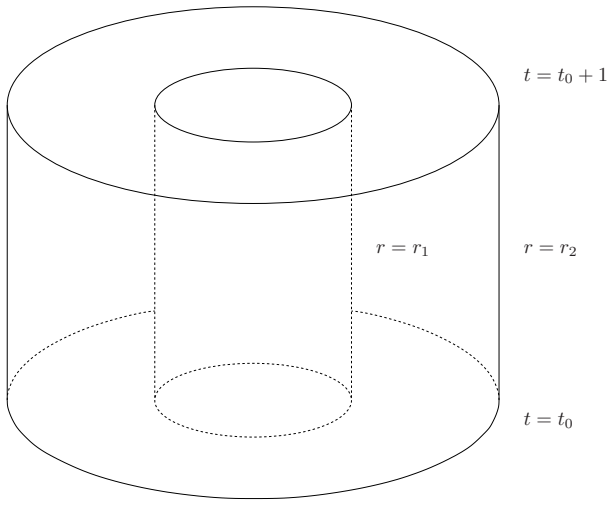
The load-bearing object is the interpolation metric: take the Kerr-Newman-(A)dS metric and let $m=m(r)$, $q=q(r)$ pass smoothly from $(m_1,q_1)$ to $(m_2,q_2)$ between two radii. The Einstein equations then define the energy-momentum tensor of the interpolating (unphysical) field, and the radial integration identity $A(r)-B'(r)=1/\Xi^2$ turns the energy flux computed with $K$ into $\Delta M=(m_2-m_1)/\Xi^2$. The companion linearized argument uses the divergence theorem on a hollow cylinder to show that all test fields share the model field's energy, and the uniqueness argument constrains any other Killing candidate $K+\varepsilon Y$ by requiring $\gamma(1-\varepsilon a)=1$, then setting $\varepsilon_0=\varepsilon_1=0$ by a power series in $a$.
What would settle it
Compute the coefficients $\varepsilon_n$ for $n\ge 2$ in the uniqueness expansion; if any is nonzero, $K$ is not the unique energy-defining Killing field and the application of the general theorem needs re-examination. Alternatively, exhibit a test field satisfying the null energy condition at the horizon that takes an extremal Kerr-Newman-de Sitter black hole to a configuration beyond extremality, which would directly falsify the no-destruction claim.
Extended reading notes
Core claim
The central claim is that in a Kerr-Newman-de Sitter background with rotation parameter $a$ and cosmological scale $l$, the timelike Killing vector field $K=\partial_t+(a/l^2)\partial_\varphi$ is the correct generator of energy for test fields, and that with this definition the horizon generator is $K+\Omega_H \partial_\varphi$. The proof uses an interpolation metric in which the mass parameter $m$ and charge parameter $q$ vary with the radial coordinate between two Kerr-Newman-(A)dS solutions; the Einstein equations fix the energy-momentum tensor of the interpolating field, and identities such as $A(r)-B'(r)=1/\Xi^2$ convert the energy integral into exactly the physical mass difference $M_2-M_1$. A linearized argument shows the same energy is obtained for any test-field configuration, and a power-series check on candidate Killing fields $\tilde K=\gamma(K+\varepsilon Y)$ yields $\varepsilon_0=\varepsilon_1=0$, so $K$ is unique at leading order. Applying the earlier general theorem, an extremal Kerr-Newman-de Sitter black hole that absorbs energy, angular momentum and charge from such test fields ends up either subextremal or extremal, never with a naked singularity.
Load-bearing premise
The argument assumes that $K$ is the unique timelike Killing field defining energy: the authors show the first two power-series coefficients of any alternative vanish, but they do not compute the higher-order coefficients, so a nonzero higher-order coefficient would undermine uniqueness.
Editorial extensions
If this is right
- In asymptotically de Sitter black-hole spacetimes, test-field energies should be computed with $K=\partial_t+(a/l^2)\partial_\varphi$; using a different stationary Killing field generally gives the wrong energy and can lead to false cosmic-censorship-violation claims.
- Extremal Kerr-Newman-de Sitter black holes are protected against test-field destruction: any absorption obeying the null energy condition at the horizon leaves the spacetime subextremal or extremal.
- The same interpolation technique confirms the energy Killing field used earlier for the anti-de Sitter case, $K=\partial_t-(a/l^2)\partial_\varphi$.
- A finite-energy condition at infinity is essential: the no-destruction theorem applies to test fields satisfying the stated boundary conditions, not to fields with unbounded energy.
- The result extends the original gedanken-experiment no-go to backgrounds with a positive cosmological constant, removing the need for an ADM mass.
Reading between the lines
- If the higher-order coefficients $\varepsilon_n$ for $n\ge 2$ are computed and found to vanish, $K$ is the unique energy-defining Killing field; if one is nonzero, the physical-mass interpretation would need revisiting.
- The interpolation construction suggests a route to a quasilocal mass for asymptotically de Sitter spacetimes: integrate the same energy flux up to the cosmological horizon rather than to infinity.
- The same technique could be applied to near-extremal de Sitter black holes using second-order variations, paralleling the quasi-extremal analysis, to see whether the subextremal fallback persists.
- A numerical experiment with finite-energy wave packets in extremal Kerr-Newman-de Sitter could map the boundary of the allowed parameter changes, making the theorem's inequality explicit.
Signed reviews
Editorial analysis
A structured set of objections, weighed in public.
Referee Report
Summary. The paper addresses the choice of timelike Killing vector field for defining the energy of test fields in Kerr-Newman-de Sitter spacetime. In Sections 2 and 3 the authors interpolate between two Kerr-(A)dS or Kerr-Newman-(A)dS metrics by promoting the mass parameter m (and, in Section 3, the charge parameter q) to functions of the radial coordinate, compute the effective energy-momentum tensor from the Einstein equations, and show that for the Killing vector K = X + (a/l^2)Y in the dS case (and K = X - (a/l^2)Y in AdS) the integrated energy and angular momentum equal the differences of the physical mass and angular momentum. Section 4 uses a divergence-theorem argument to extend this result from the special interpolating linearized solution to arbitrary linearized solutions. Section 5 attempts to prove uniqueness of K among Killing fields of the form K̃ = γ(K + εY), deriving the condition γ(1 - εa) = 1 and using a power-series expansion in a to show that the first two coefficients ε0 and ε1 vanish; the authors explicitly state that higher coefficients have not been computed. Section 6 then invokes Theorem 4.1 of the authors' earlier paper [25] to conclude that test fields cannot destroy extremal Kerr-Newman-dS black holes.
Significance. If the uniqueness step were completed, the paper would close a significant gap in the weak cosmic censorship literature for asymptotically de Sitter black holes, where there is no ADM mass and the choice of energy-defining Killing field is otherwise ambiguous. The interpolation identities (17), (23), (37), and (48) are explicit and verifiable, and the divergence-theorem argument in Section 4 is an elegant method for passing from a special linearized solution to arbitrary test fields. The final no-destruction statement is not simply a restatement of [25], because identifying the physical mass variation with the energy computed using K is a necessary nontrivial input. However, the central claim is currently conditional on an omitted piece of the uniqueness proof.
major comments (2)
- [Section 5, Eqs. (52)–(60)] The uniqueness proof establishes only that ε0 = ε1 = 0 in the expansion ε(a) = Σ ε_n a^n. The authors state in Section 5 that they 'have not computed the higher order coefficients ε_n with n ≥ 2, but we expect them to also vanish.' This is an explicit gap: a nonzero ε2 would yield another Killing field K̃ = (K + εY)/(1 - εa) that also reproduces E = ΔM on the constructed interpolating family, so K would not be established as 'the' energy-defining Killing field. Since the application of Theorem 4.1 of [25] in Section 6 depends on identifying the physical energy with K, the main theorem remains conditional. The authors should either compute the higher-order coefficients or provide a structural argument showing that only the first two coefficients can be nonzero.
- [Section 5, restriction to q1 = q2 = 0] The uniqueness calculation is performed only in the uncharged Kerr-(A)dS case, whereas Theorem 6.1 concerns Kerr-Newman-dS black holes. The paper does not explain why the charged case reduces to the uncharged one, nor does it rule out an ε that depends on the charge parameter in addition to a. To support the claimed uniqueness of K in the charged setting, the authors should either extend the computation to nonzero fixed charge or give a clear argument that the charge terms cannot affect the relevant coefficients of ε.
minor comments (3)
- [Section 2, Eq. (25)] The formula E + ωL = (1 + ωa)ΔM appears to conflict with the definition L = -∫ T_μν Y^μ N^ν dV_3 in Eq. (18), which gives ∫ T(K + ωY)N = E - ωL = (1 - ωa)ΔM. The conclusion ω = 0 is unchanged, but the sign should be corrected for consistency with Eq. (53).
- [Section 4, Eqs. (50)–(51)] The hypotheses on the arbitrary linearized metric (vanishing for r ≤ r1 and matching the final KN solution for r ≥ r2) are stated at the beginning of the section but should be repeated in the divergence-theorem paragraph, since the independence of the lateral boundary integrals relies on these assumptions.
- [General] The text contains several typographical artifacts, such as 'Kerr-Newm an' in the abstract and unusual spacing in some displayed equations; a careful proofreading pass is needed.
Circularity Check
No circularity: the Killing field is verified against the independent mass difference; the Section 5 gap and [25] citation are proof/citation issues, not circular.
full rationale
The derivation is self-contained in the relevant sense. Sections 2–3 construct an explicit interpolating spacetime with m(r) and q(r), compute T^{μν} from the Einstein equations, and verify by direct integration and identities (e.g., B''(r)=A'(r), A(r)-B'(r)=1/Ξ^2) that the integral of the energy flux with K equals the independently defined physical mass difference ΔM = M2 - M1 (Eqs. (17), (37)). The Killing vector K is not fitted to ΔM; it is checked against it. Section 4 extends this to arbitrary linearized perturbations by a divergence-theorem argument rather than assuming the conclusion. Section 5 does contain an acknowledged omitted proof: after deriving γ(1-εa)=1 for any alternative K̃=γ(K+εY), the authors say 'we have not computed the higher order coefficients ε_n with n ≥ 2, but we expect them to also vanish.' That is a real gap in the uniqueness claim, but it is a gap in the proof, not a circular reduction of the conclusion to its inputs. The final theorem relies on Theorem 4.1 of [25], a previously published theorem by two of the same authors; this is an external cited result with its own proof, not a self-referential restatement of the present construction. No fitted parameter is renamed as a prediction, and no ansatz is smuggled in merely by citation. Therefore the circularity score is 0.
Assumptions & free parameters
assumptions (5)
- domain assumption M = m/Ξ^2, J = ma/Ξ^2, Q = q/Ξ are the physical mass, angular momentum, and charge in Kerr-Newman-(A)dS spacetimes
- domain assumption The energy of the interpolating field is defined as M2 - M1
- domain assumption Theorem 4.1 of [25] applies to extremal Kerr-Newman-dS once the correct energy Killing field is chosen
- ad hoc to paper ε(a) is analytic and the power series expansion in a can be truncated for the uniqueness argument
- domain assumption Test fields satisfy the null energy condition at the event horizon
Cite this review
Pith. "Pith review of Test fields cannot destroy extremal de Sitter black holes." pith.science (2026). https://pith.science/paper/YBQHSZA5
@misc{pith2026190809854,
  author       = {Pith},
  title        = {Pith review of: Test fields cannot destroy extremal de Sitter black holes},
  year         = {2026},
  howpublished = {\url{https://pith.science/paper/YBQHSZA5}},
  note         = {Machine review of arXiv:1908.09854}
}
read the original abstract
We determine the timelike Killing vector field that gives the correct definition of energy for test fields propagating in a Kerr-Newman-de Sitter spacetime, and use this result to prove that test fields cannot destroy extremal Kerr-Newman-de Sitter black holes.
Figures


Forward citations
Cited by 2 Pith papers
-
Weak Cosmic Censorship with spinning particles in Kerr-(A)dS spacetimes
Extremal Kerr-de Sitter black holes cannot be overspun by spinning test particles, and apparent Kerr-anti-de Sitter overspinning configurations are eliminated once the particle's finite size is respected.
-
Six-dimensional Myers-Perry rotating black hole cannot be overspun
A six-dimensional rotating black hole with two spins cannot be overspun by test particle accretion, so weak cosmic censorship holds for this case.
Reference graph
Works this paper leans on
-
[25]
J. Nat´ ario, L. Queimada and R. Vicente, Test fields cannot destroy extremal black holes , Class. Quant. Grav. 33 (2016), 175002
work page 2016
-
[1]
Wald, Gedanken experiments to destroy a black hole , Ann
R. Wald, Gedanken experiments to destroy a black hole , Ann. of Phys. 83 (1974), 548–556
work page 1974
-
[2]
Penrose, Gravitational collapse: the role of general relativity , Riv
R. Penrose, Gravitational collapse: the role of general relativity , Riv. Nuovo Cim. 1 (1969), 252–276
work page 1969
-
[3]
Wald, Gravitational collapse and cosmic censorship , arXiv:gr-qc/9710068 (1997)
R. Wald, Gravitational collapse and cosmic censorship , arXiv:gr-qc/9710068 (1997)
arXiv 1997
-
[4]
K. Tod, F. de Felice and M. Calvani, Spinning test particles in the field of a black hole , Nuovo Cim. B 34 (1976), 365–379
work page 1976
-
[5]
Needham, Cosmic censorship and test particles , Phys
T. Needham, Cosmic censorship and test particles , Phys. Rev. D 22 (1980), 791–796
work page 1980
-
[6]
Semiz, Dyonic Kerr-Newman black holes, complex scalar field and cos mic censorship , Gen
I. Semiz, Dyonic Kerr-Newman black holes, complex scalar field and cos mic censorship , Gen. Rel. Grav. 43 (2011), 833–846
work page 2011
-
[7]
G. Toth, Test of the weak cosmic censorship conjecture with a charged scalar field and dyonic KerrNewman black holes , Gen. Rel. Grav. 44 (2015), 2019–2035
work page 2015
Show all 38 references
-
[8]
Duztas and I
K. Duztas and I. Semiz, Cosmic censorship, black holes and integer-spin test fields , Phys. Rev. D 88 (2013), 064043
2013
-
[9]
Duztas, Electromagnetic field and cosmic censorship , Gen
K. Duztas, Electromagnetic field and cosmic censorship , Gen. Rel. Grav. 46 (2014), 1709
2014
-
[10]
Bouhmadi-Lopez, V
M. Bouhmadi-Lopez, V. Cardoso, A. Nerozzi and J. Rocha, Black holes die hard: can one spin-up a black hole past extremality? , Phys. Rev. D 81 (2010), 084051
2010
-
[11]
Revelar and I
K. Revelar and I. Vega, Overcharging higher-dimensional black holes with point pa rticles, Phys. Rev. D 96 (2017) 064010
2017
-
[12]
J. An, J. Shan, H. Zhang and S. Zhao, 5 -dimensional Myers-Perry Black Holes Cannot be Over-spun by Gedanken Experiments , Phys. Rev. D 97 (2018) 104007
2018
-
[13]
Gwak and B
B. Gwak and B. Lee, Cosmic censorship of rotating Anti-de Sitter black hole , JCAP 02 (2016) 015
2016
-
[14]
Rocha and R
J. Rocha and R. Santarelli, Flowing along the edge: spinning up black holes in AdS spacet imes with test particles , Phys. Rev. D 89 (2014), 064065
2014
-
[15]
Gwak, Weak cosmic censorship conjecture in Kerr-(anti-)de Sitte r black hole with scalar field , JHEP 1809 (2018) 081
B. Gwak, Weak cosmic censorship conjecture in Kerr-(anti-)de Sitte r black hole with scalar field , JHEP 1809 (2018) 081
2018
-
[16]
Hubeny, Overcharging a black hole and cosmic censorship , Phys
V. Hubeny, Overcharging a black hole and cosmic censorship , Phys. Rev. D 59 (1999), 064013
1999
-
[17]
Matsas and A
G. Matsas and A. Silva, Overspinning a nearly extreme charged black hole via a quant um tun- neling process, Phys. Rev. Lett. 99 (2007), 181301. 12
2007
-
[18]
Jacobson and T
T. Jacobson and T. Sotiriou, Over-spinning a black hole with a test body , Phys. Rev. Lett. 103 (2009), 141101
2009
-
[19]
Saa and R
A. Saa and R. Santarelli, Destroying a near-extremal Kerr-Newman black hole , Phys. Rev. D 84 (2011), 027501
2011
-
[20]
Hod, Weak cosmic censorship: as strong as ever , Phys
S. Hod, Weak cosmic censorship: as strong as ever , Phys. Rev. Lett. 100 (2008), 121101
2008
-
[21]
Barausse, V
E. Barausse, V. Cardoso and G. Khanna, Test bodies and naked singularities: is the self-Force the cosmic censor? , Phys. Rev. Lett. 105 (2010) 261102
2010
-
[22]
Zimmerman, I
P. Zimmerman, I. Vega, E. Poisson and R. Haas, Self-force as a cosmic censor , Phys. Rev. D 87 (2013) 041501(R)
2013
-
[23]
Shaymatov, M
S. Shaymatov, M. Patil, B. Ahmedov and P. Joshi, Destroying a near-extremal Kerr black hole with a charged particle: can a test magnetic field serve as a co smic censor? , Phys. Rev. D 91 (2015) 064025
2015
-
[24]
Colleoni, L
M. Colleoni, L. Barack, A. Shah and M. van de Meent, Self-force as a cosmic censor in the Kerr overspinning problem, Phys. Rev. D 92 (2015) 084044
2015
-
[26]
Sorce and R
J. Sorce and R. Wald, Gedanken Experiments to Destroy a Black Hole II: Kerr-Newma n Black Holes Cannot be Over-Charged or Over-Spun , Phys. Rev. D 96 (2017) 104014
2017
-
[27]
Wang, The Mass of Asymptotically Hyperbolic Manifolds , J
X. Wang, The Mass of Asymptotically Hyperbolic Manifolds , J. Differ. Geom. 57 (2001) 273-299
2001
-
[28]
Chrusciel and G
P. Chrusciel and G. Nagy, The mass of spacelike hypersurfaces in asymptotically anti -de Sitter space-times, Adv. Theor. Math. Phys. 5 (2002) 697-754
2002
-
[29]
Olea, Mass, angular momentum and thermodynamics in four-dimensi onal Kerr-AdS black holes, J
R. Olea, Mass, angular momentum and thermodynamics in four-dimensi onal Kerr-AdS black holes, J. High Energy Phys., JHEP06(2005)
2005
-
[30]
McInnes and Y
B. McInnes and Y. Ong, A Note on Physical Mass and the Thermodynamics of AdS-Kerr Bl ack Holes, JCAP 11 (2015) 004
2015
-
[31]
Kastor and J
D. Kastor and J. Traschen, A positive energy theorem for asymptotically de Sitter spac etimes, Class. Quant. Grav. 19 (2002) 5901-5920
2002
-
[32]
M. Luo, N. Xie and X. Zhang, Positive mass theorems for asymptotically de Sitter spacet imes, Nucl. Phys. B 825 (2010) 98-118
2010
-
[33]
Misner, K
C. Misner, K. Thorne and J. A. Wheeler, Gravitation, Freeman, 1973
1973
-
[34]
Wald, General relativity, University of Chicago Press, 1984
R. Wald, General relativity, University of Chicago Press, 1984
1984
-
[35]
Caldarelli, G
M. Caldarelli, G. Cognola and D. Klemm, Thermodynamics of Kerr-Newman-AdS black holes and conformal field theories , Class. Quant. Grav. 17 (2000), 399–420
2000
-
[36]
Gwak, Thermodynamics and Cosmic Censorship Conjecture in Kerr-N ewman-de Sitter Black Hole, Entropy 20 (2018) 855
B. Gwak, Thermodynamics and Cosmic Censorship Conjecture in Kerr-N ewman-de Sitter Black Hole, Entropy 20 (2018) 855
2018
-
[37]
Dolan, D
B. Dolan, D. Kastor, D. Kubiznak, R. Mann and J. Traschen, Thermodynamic Volumes and Isoperimetric Inequalities for de Sitter Black Holes , Phys. Rev. D 87 (2013) 104017
2013
-
[38]
Kubiznak and F
D. Kubiznak and F. Simovic, Thermodynamics of horizons: de Sitter black holes and reent rant phase transitions , Class. Quant. Grav. 33 (2016) 245001. 13
2016
Reviewed August 14, 2026 · model on record in the stance chip above.
Discussion (0). Continue with ORCID to comment.