REVIEW 3 major objections 4 minor 38 references
CESRec claims that injecting a user's conversational feedback into their historical interaction sequence as a pseudo-sequence consistently improves sequential recommenders across datasets and metrics.
Reviewed by Pith at T0; open to challenge. T0 means a machine referee read the full paper against a public rubric. the ladder, T0–T4 →
T0 review · deepseek-v4-flash
2026-08-04 19:13 UTC pith:YBTUVFOA
load-bearing objection Sensible framework and public code, but the evaluation leaks the target item into the conversational feedback, so the reported gains don't support the central claim. the 3 major comments →
CESRec: Constructing Pseudo Interactions for Sequential Recommendation via Conversational Feedback
The pith
A machine-rendered reading of the paper's core claim, the machinery that carries it, and where it could break.
Core claim
Conversational feedback can be converted into sequence edits that any sequential recommender can consume. The Constructor, a fine-tuned LLM, takes the user's masked historical sequence and their feedback, and outputs a pseudo-sequence with items contradicting the stated preference replaced by items consistent with it. The dual-alignment masking step first projects LLM item embeddings into the recommender's collaborative embedding space via a trainable adapter (MSE-aligned), then masks the items with the lowest cosine similarity to the mean user embedding, removing noise before editing. Feeding this pseudo-sequence to the base SRS yields consistent improvements across all tested models and da
What carries the argument
Pseudo-interaction sequence construction: a fine-tuned LLM (the Constructor) receives the user's historical sequence (after masking) plus their natural-language feedback, and outputs a revised sequence where disliked items are replaced by preferred ones. Supporting it is dual-alignment outlier masking, which adapts LLM semantic embeddings into the recommender's collaborative embedding space and masks low-similarity items. The pseudo-sequence is a drop-in replacement for the original history, so the base sequential recommender is used unchanged.
Load-bearing premise
The evaluation assumes the simulated user feedback describes the target item's attributes without revealing the target itself, so that the pseudo-sequence built from that feedback does not simply leak the answer through the back door.
What would settle it
Run the same pipeline with a user simulator that has no access to the target item's attributes (only generic dialogue), and compare HR/NDCG; if CESRec's gains disappear, the original improvements came from target leakage rather than genuine preference capture.
If this is right
- If correct, any sequential recommender can be made conversational without retraining, just by preprocessing the input sequence with feedback.
- The pseudo-sequence construction implies that recommendations will reflect the most recent preference shift even when the historical sequence is long.
- Masking outliers via semantic-collaborative alignment suggests that noise in user history can be filtered without losing collaborative signal.
- The method is agnostic to the LLM backbone; smaller models give smaller but still positive gains, enabling deployment under resource constraints.
- Multiple rounds of feedback monotonically improve performance, suggesting an interactive loop is beneficial.
Where Pith is reading between the lines
- The reported gains may partly reflect the user simulator being given descriptive information about the target item; a stronger test would use feedback that deliberately contradicts target attributes to separate genuine preference modeling from attribute copying.
- Because the Constructor is trained on replacement pairs derived from the same simulator, the method's ceiling may be tied to simulator realism; an evaluation with real human dialogues would clarify this.
- The dual-alignment masking step could generalize to other sequence-editing tasks (e.g., session-based recommendation or query rewriting) where semantic outliers should be demoted.
- One could test whether the improvements persist when the target item is removed from the candidate set, verifying that ranking gains are not driven by the pseudo-sequence memorizing the target.
Editorial analysis
A structured set of objections, weighed in public.
Referee Report
Summary. The paper proposes CESRec, a framework that augments sequential recommendation systems (SRS) with conversational feedback. CESRec has two main components: (i) semantic pseudo-interaction construction, which uses an LLM-based constructor to refine a user's historical interaction sequence based on natural-language feedback, and (ii) dual-alignment outlier-item masking, which identifies and masks items that deviate from a user's core preferences using hybrid semantic-collaborative embeddings. The authors report extensive experiments on Video Games, Toys, and MovieLens, claiming that CESRec consistently improves strong SRS baselines (SASRec, LLaRA, Recformer) across HR and NDCG metrics.
Significance. The proposed idea of injecting conversational feedback into sequential recommenders in a model-agnostic way is interesting and, if validated, could be practically useful. The paper includes experiments with multiple LLM backbones, ablations, and a code release. However, the central empirical claim is undermined by the evaluation protocol: the user simulator is given descriptive information about the target item, and the resulting feedback is used to construct the pseudo-sequence that is then used to predict that same target item. This creates a circularity that can trivially inflate the reported gains. Because the paper's main contributions are empirically demonstrated, the validity of the experiments is load-bearing. As submitted, the evidence does not support the claim that CESRec captures real-time preferences rather than exploiting target-derived feedback.
major comments (3)
- [Appendix 8.2, Eq. (6)] The user simulator is explicitly prompted with "information about your <target item>" and asked to generate feedback. This feedback (Eq. 6) is then used in Eqs. (7)-(9) to construct the pseudo-interaction sequence that is fed to the SRS to predict that very target item. Because the feedback is a function of the target item's attributes, the constructor can insert items semantically close to the target into the historical sequence, mechanically increasing HR/NDCG. The statement that the simulator is "not directly exposed to the target item itself" does not mitigate this: descriptive attributes are sufficient to convey the target's identity. This confound affects all main results in Table 2, the ablations in Table 3, the backbone comparison in Table 4, and the interaction-count analysis in Figure 4. To support the paper's central claim, the evaluation must generate feedback without access
- [Section 4.3, Eq. (8)] The constructor's training data is constructed by sampling "Outlier Items" and using the target item as the ground truth; the feedback is "derived from the transition between the Outlier Items and the target item." This means the constructor is explicitly trained to map target-derived feedback to target-like replacements. This is not itself circular during training, but it compounds the evaluation leak: at test time the feedback is also generated from the target item, so the entire pipeline is trained and evaluated with access to the answer. The paper should clarify whether the test-time feedback is independent of the target item, and if not, it should explain why the reported improvements are not a direct consequence of target-derived information.
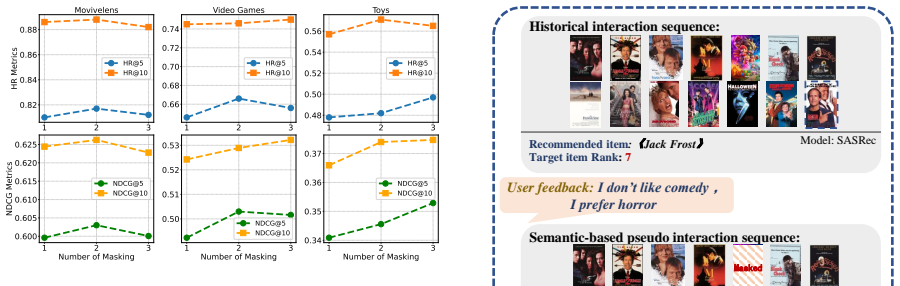
- [Section 5.2 vs Section 6.6] Section 5.2 states "we mask one item in three datasets," but Section 6.6 reports that for MovieLens and Video Games the model achieves optimal performance when the number of masked items is set to 2 (Figure 5). This contradiction makes the exact configuration of the main results ambiguous and hurts reproducibility. The authors should specify which masking count is used for each reported result and reconcile the discrepancy.
minor comments (4)
- [Section 4.1] The phrase "ConversationEnhancedSequentialRecommendation" is missing spaces; it should be "Conversation Enhanced Sequential Recommendation".
- [Section 4.2, Eq. (5)] The notation I(u)' in Eq. (5) lists masked items with hats, but the text says these items are "masked from the user interaction sequence." It is unclear whether masked items are removed entirely or replaced with a special token. Please clarify the exact sequence representation after masking.
- [Section 5.2] For the LLaRA baseline, the original ranking method is replaced with cosine similarity between item embeddings and output embeddings, citing Wang et al. (2024). This modification could change LLaRA's performance relative to its original design. The paper should justify that this is a fair comparison or report both variants.
- [Section 6.7] The case study states "User core preference: comedy; horror" but then shows feedback "I don't like comedy, I prefer horror." This is internally confusing. Clarify the user's actual preferences and how the feedback is generated for this example.
Circularity Check
Evaluation feedback is generated from target-item attributes (Eq. 6) and then used to build the pseudo-sequence that predicts the same target (Eqs. 7–9), so the reported gains are inflated by label leakage rather than demonstrating preference capture.
specific steps
-
self definitional
[Appendix 8.2 (User Simulation); Section 4.3, Eqs. (6)–(9)]
"To mitigate potential data leakage, the user simulator is not directly exposed to the target item itself; instead, it receives only descriptive information about the target item. The user simulator is prompted to provide feedback as follows: "You are a user interacting with a recommender system. Based on the information about your <target item> and the <recommended item> provided by the recommender, give feedback to the recommender.""
Equation (6) defines feedback = User-Interaction(v_rec, Attr_target), where Attr_target are attributes of the target item. Equation (7) constructs I_pseudo(u) from this feedback, and Eq. (9) runs SRS(I_pseudo(u)) to predict v_{N+1}, i.e., the same target item whose attributes generated the feedback. Withholding only the item ID/title does not prevent leakage: descriptive attributes identify or emulate the target, so the feedback can encode the answer and the constructor can place target-like items into the history. The gains in Tables 2–5 and Figure 4 are therefore inflated by construction, not evidence that CESRec captures real-time preferences.
full rationale
The pseudo-sequence construction itself is a legitimate supervised pipeline if feedback is truly independent of the target label. However, in the evaluation protocol the feedback is generated from the target item's attributes (Eq. 6), and that same feedback is the input used to build the sequence that predicts the target (Eqs. 7–9). This makes the evaluation self-referential: the 'real-time preference' signal is derived from the ground-truth item, so improved HR/NDCG reflect label leakage rather than genuine elicitation of user interests. The claim in Section 6.1 that CESRec 'enable[s] recommendation models to more effectively capture users' real-time preferences' is not supported by the current protocol. The constructor's training data also uses the target item as ground truth with feedback derived from the transition toward that target, compounding the issue. There is no independent benchmark or non-leaking feedback experiment offered. A revised evaluation with independently elicited feedback (or with the target attributes withheld from the simulator) could test the method fairly, but as reported the central experimental result reduces to the target item's attributes being fed back into the recommender. This is not a mathematical identity, so score is 7 rather than 8–10, but the circularity affects all main results.
Axiom & Free-Parameter Ledger
free parameters (1)
- number of masked outlier items k =
1 (per Section 5.2); Figure 5 suggests 2 is optimal for MovieLens/Video Games
axioms (5)
- domain assumption LLM-derived semantic embeddings preserve item preference similarity
- domain assumption Simulated feedback conditioned on target-item descriptions is a faithful proxy for real user feedback
- domain assumption The frozen SRS remains valid on pseudo-interaction sequences it was not trained on
- domain assumption Mean pooling of hybrid embeddings produces a valid user representation
- ad hoc to paper Randomly sampled outliers plus target-derived feedback produce valid training supervision for the constructor
Cite this review
Pith. "Pith review of CESRec: Constructing Pseudo Interactions for Sequential Recommendation via Conversational Feedback." pith.science (2026). https://pith.science/paper/YBTUVFOA
@misc{pith2026250909342,
  author       = {Pith},
  title        = {Pith review of: CESRec: Constructing Pseudo Interactions for Sequential Recommendation via Conversational Feedback},
  year         = {2026},
  howpublished = {\url{https://pith.science/paper/YBTUVFOA}},
  note         = {Machine review of arXiv:2509.09342}
}
read the original abstract
Sequential Recommendation Systems (SRS) have become essential in many real-world applications. However, existing SRS methods often rely on collaborative filtering signals and fail to capture real-time user preferences, while Conversational Recommendation Systems (CRS) excel at eliciting immediate interests through natural language interactions but neglect historical behavior. To bridge this gap, we propose CESRec, a novel framework that integrates the long-term preference modeling of SRS with the real-time preference elicitation of CRS. We introduce semantic-based pseudo interaction construction, which dynamically updates users'historical interaction sequences by analyzing conversational feedback, generating a pseudo-interaction sequence that seamlessly combines long-term and real-time preferences. Additionally, we reduce the impact of outliers in historical items that deviate from users'core preferences by proposing dual alignment outlier items masking, which identifies and masks such items using semantic-collaborative aligned representations. Extensive experiments demonstrate that CESRec achieves state-of-the-art performance by boosting strong SRS models, validating its effectiveness in integrating conversational feedback into SRS.
Figures




Reference graph
Works this paper leans on
-
[1]
online" 'onlinestring :=
ENTRY address archivePrefix author booktitle chapter edition editor eid eprint eprinttype howpublished institution journal key month note number organization pages publisher school series title type volume year doi pubmed url lastchecked label extra.label sort.label short.list INTEGERS output.state before.all mid.sentence after.sentence after.block STRING...
-
[2]
write newline
" write newline "" before.all 'output.state := FUNCTION n.dashify 't := "" t empty not t #1 #1 substring "-" = t #1 #2 substring "--" = not "--" * t #2 global.max substring 't := t #1 #1 substring "-" = "-" * t #2 global.max substring 't := while if t #1 #1 substring * t #2 global.max substring 't := if while FUNCTION word.in bbl.in capitalize " " * FUNCT...
-
[3]
Keqin Bao, Jizhi Zhang, Yang Zhang, Wenjie Wang, Fuli Feng, and Xiangnan He. 2023. Tallrec: An effective and efficient tuning framework to align large language model with recommendation. In Proceedings of the 17th ACM Conference on Recommender Systems, pages 1007--1014
2023
-
[4]
Sunhao Dai, Ninglu Shao, Haiyuan Zhao, Weijie Yu, Zihua Si, Chen Xu, Zhongxiang Sun, Xiao Zhang, and Jun Xu. 2023. Uncovering chatgpt’s capabilities in recommender systems. In Proceedings of the 17th ACM Conference on Recommender Systems, pages 1126--1132
2023
-
[5]
Abhimanyu Dubey, Abhinav Jauhri, Abhinav Pandey, Abhishek Kadian, Ahmad Al-Dahle, Aiesha Letman, Akhil Mathur, Alan Schelten, Amy Yang, Angela Fan, et al. 2024. The llama 3 herd of models. arXiv preprint arXiv:2407.21783
Pith/arXiv arXiv 2024
-
[6]
Hui Fang, Danning Zhang, Yiheng Shu, and Guibing Guo. 2020. Deep learning for sequential recommendation: Algorithms, influential factors, and evaluations. ACM Transactions on Information Systems (TOIS), 39(1):1--42
2020
-
[7]
Jiabao Fang, Shen Gao, Pengjie Ren, Xiuying Chen, Suzan Verberne, and Zhaochun Ren. 2024. A multi-agent conversational recommender system. arXiv preprint arXiv:2402.01135
Pith/arXiv arXiv 2024
-
[8]
Yue Feng, Shuchang Liu, Zhenghai Xue, Qingpeng Cai, Lantao Hu, Peng Jiang, Kun Gai, and Fei Sun. 2023. A large language model enhanced conversational recommender system. arXiv preprint arXiv:2308.06212
Pith/arXiv arXiv 2023
-
[9]
Luke Friedman, Sameer Ahuja, David Allen, Zhenning Tan, Hakim Sidahmed, Changbo Long, Jun Xie, Gabriel Schubiner, Ajay Patel, Harsh Lara, et al. 2023. Leveraging large language models in conversational recommender systems. arXiv preprint arXiv:2305.07961
Pith/arXiv arXiv 2023
-
[10]
Shijie Geng, Shuchang Liu, Zuohui Fu, Yingqiang Ge, and Yongfeng Zhang. 2022. Recommendation as language processing (rlp): A unified pretrain, personalized prompt & predict paradigm (p5). In Proceedings of the 16th ACM Conference on Recommender Systems, pages 299--315
2022
-
[11]
F Maxwell Harper and Joseph A Konstan. 2015. The movielens datasets: History and context. Acm transactions on interactive intelligent systems (tiis), 5(4):1--19
2015
-
[12]
Xiangnan He, Kuan Deng, Xiang Wang, Yan Li, Yongdong Zhang, and Meng Wang. 2020. Lightgcn: Simplifying and powering graph convolution network for recommendation. In Proceedings of the 43rd International ACM SIGIR conference on research and development in Information Retrieval, pages 639--648
2020
-
[13]
Zhankui He, Zhouhang Xie, Rahul Jha, Harald Steck, Dawen Liang, Yesu Feng, Bodhisattwa Prasad Majumder, Nathan Kallus, and Julian McAuley. 2023. Large language models as zero-shot conversational recommenders. In Proceedings of the 32nd ACM international conference on information and knowledge management, pages 720--730
2023
-
[14]
Yupeng Hou, Junjie Zhang, Zihan Lin, Hongyu Lu, Ruobing Xie, Julian McAuley, and Wayne Xin Zhao. 2024. Large language models are zero-shot rankers for recommender systems. In European Conference on Information Retrieval, pages 364--381. Springer
2024
-
[15]
Jun Hu, Wenwen Xia, Xiaolu Zhang, Chilin Fu, Weichang Wu, Zhaoxin Huan, Ang Li, Zuoli Tang, and Jun Zhou. 2024. Enhancing sequential recommendation via llm-based semantic embedding learning. In Companion Proceedings of the ACM on Web Conference 2024, pages 103--111
2024
-
[16]
Wang-Cheng Kang and Julian McAuley. 2018. Self-attentive sequential recommendation. In 2018 IEEE international conference on data mining (ICDM), pages 197--206. IEEE
2018
-
[17]
Diederik P Kingma. 2014. Adam: A method for stochastic optimization. arXiv preprint arXiv:1412.6980
Pith/arXiv arXiv 2014
-
[18]
Wenqiang Lei, Gangyi Zhang, Xiangnan He, Yisong Miao, Xiang Wang, Liang Chen, and Tat-Seng Chua. 2020. Interactive path reasoning on graph for conversational recommendation. In Proceedings of the 26th ACM SIGKDD international conference on knowledge discovery & data mining, pages 2073--2083
2020
-
[19]
Chengxi Li, Yejing Wang, Qidong Liu, Xiangyu Zhao, Wanyu Wang, Yiqi Wang, Lixin Zou, Wenqi Fan, and Qing Li. 2023 a . Strec: Sparse transformer for sequential recommendations. In Proceedings of the 17th ACM Conference on Recommender Systems, pages 101--111
2023
-
[20]
Jiacheng Li, Ming Wang, Jin Li, Jinmiao Fu, Xin Shen, Jingbo Shang, and Julian McAuley. 2023 b . https://doi.org/10.1145/3580305.3599519 Text is all you need: Learning language representations for sequential recommendation . In Proceedings of the 29th ACM SIGKDD Conference on Knowledge Discovery and Data Mining, KDD '23, page 1258–1267, New York, NY, USA....
arXiv 2023
-
[21]
Muyang Li, Zijian Zhang, Xiangyu Zhao, Wanyu Wang, Minghao Zhao, Runze Wu, and Ruocheng Guo. 2023 c . Automlp: Automated mlp for sequential recommendations. In Proceedings of the ACM Web Conference 2023, pages 1190--1198
2023
-
[22]
Jiayi Liao, Sihang Li, Zhengyi Yang, Jiancan Wu, Yancheng Yuan, Xiang Wang, and Xiangnan He. 2024. Llara: Large language-recommendation assistant. In Proceedings of the 47th International ACM SIGIR Conference on Research and Development in Information Retrieval, pages 1785--1795
2024
-
[23]
Yujie Lin, Chenyang Wang, Zhumin Chen, Zhaochun Ren, Xin Xin, Qiang Yan, Maarten de Rijke, Xiuzhen Cheng, and Pengjie Ren. 2023. A self-correcting sequential recommender. In Proceedings of the ACM Web Conference 2023, pages 1283--1293
2023
-
[24]
Qidong Liu, Xian Wu, Wanyu Wang, Yejing Wang, Yuanshao Zhu, Xiangyu Zhao, Feng Tian, and Yefeng Zheng. 2024. Large language model empowered embedding generator for sequential recommendation. arXiv preprint arXiv:2409.19925
Pith/arXiv arXiv 2024
-
[25]
Ben Mann, N Ryder, M Subbiah, J Kaplan, P Dhariwal, A Neelakantan, P Shyam, G Sastry, A Askell, S Agarwal, et al. 2020. Language models are few-shot learners. arXiv preprint arXiv:2005.14165, 1
Pith/arXiv arXiv 2020
-
[26]
Sheshera Mysore, Andrew McCallum, and Hamed Zamani. 2023. Large language model augmented narrative driven recommendations. In Proceedings of the 17th ACM Conference on Recommender Systems, pages 777--783
2023
-
[27]
Jianmo Ni, Jiacheng Li, and Julian McAuley. 2019. Justifying recommendations using distantly-labeled reviews and fine-grained aspects. In Proceedings of the 2019 conference on empirical methods in natural language processing and the 9th international joint conference on natural language processing (EMNLP-IJCNLP), pages 188--197
2019
-
[28]
Yunzhu Pan, Chen Gao, Jianxin Chang, Yanan Niu, Yang Song, Kun Gai, Depeng Jin, and Yong Li. 2023. Understanding and modeling passive-negative feedback for short-video sequential recommendation. In Proceedings of the 17th ACM conference on recommender systems, pages 540--550
2023
-
[29]
Shashank Rajput, Nikhil Mehta, Anima Singh, Raghunandan Hulikal Keshavan, Trung Vu, Lukasz Heldt, Lichan Hong, Yi Tay, Vinh Tran, Jonah Samost, et al. 2023. Recommender systems with generative retrieval. Advances in Neural Information Processing Systems, 36:10299--10315
2023
-
[30]
Leheng Sheng, An Zhang, Yi Zhang, Yuxin Chen, Xiang Wang, and Tat-Seng Chua. 2024. Language models encode collaborative signals in recommendation
2024
-
[31]
Fei Sun, Jun Liu, Jian Wu, Changhua Pei, Xiao Lin, Wenwu Ou, and Peng Jiang. 2019. Bert4rec: Sequential recommendation with bidirectional encoder representations from transformer. In Proceedings of the 28th ACM international conference on information and knowledge management, pages 1441--1450
2019
-
[32]
Jiaxi Tang and Ke Wang. 2018. Personalized top-n sequential recommendation via convolutional sequence embedding. In Proceedings of the eleventh ACM international conference on web search and data mining, pages 565--573
2018
-
[33]
Hugo Touvron, Louis Martin, Kevin Stone, Peter Albert, Amjad Almahairi, Yasmine Babaei, Nikolay Bashlykov, Soumya Batra, Prajjwal Bhargava, Shruti Bhosale, et al. 2023. Llama 2: Open foundation and fine-tuned chat models. arXiv preprint arXiv:2307.09288
Pith/arXiv arXiv 2023
-
[34]
Bohao Wang, Feng Liu, Jiawei Chen, Yudi Wu, Xingyu Lou, Jun Wang, Yan Feng, Chun Chen, and Can Wang. 2024. Llm4dsr: Leveraing large language model for denoising sequential recommendation. arXiv preprint arXiv:2408.08208
Pith/arXiv arXiv 2024
-
[35]
Wenjie Wang, Fuli Feng, Xiangnan He, Liqiang Nie, and Tat-Seng Chua. 2021. Denoising implicit feedback for recommendation. In Proceedings of the 14th ACM international conference on web search and data mining, pages 373--381
2021
-
[36]
Zhuosheng Zhang, Aston Zhang, Mu Li, and Alex Smola. 2022. Automatic chain of thought prompting in large language models. arXiv preprint arXiv:2210.03493
Pith/arXiv arXiv 2022
-
[37]
Guorui Zhou, Xiaoqiang Zhu, Chenru Song, Ying Fan, Han Zhu, Xiao Ma, Yanghui Yan, Junqi Jin, Han Li, and Kun Gai. 2018. Deep interest network for click-through rate prediction. In Proceedings of the 24th ACM SIGKDD international conference on knowledge discovery & data mining, pages 1059--1068
2018
-
[38]
Kun Zhou, Yuanhang Zhou, Wayne Xin Zhao, Xiaoke Wang, and Ji-Rong Wen. 2020. Towards topic-guided conversational recommender system. arXiv preprint arXiv:2010.04125
Pith/arXiv arXiv 2020
discussion (0)
Sign in with ORCID, Apple, or X to comment. Anyone can read and Pith papers without signing in.