REVIEW 3 major objections 4 minor 113 references
Robustness of real-space topology in moir\'e systems
T0 review · 3 major / 4 minor · reviewed 2026-08-06 · deepseek-v4-flash
Pith's one-line read The paper shows that real-space topology in moiré systems is robust when defined for ensembles of Bloch states, with the C3z and C2yT symmetries forcing a nonzero Chern number for twisted TMDs and twisted bilayer graphene at all twist…
desk verdict A genuinely useful construction—the ensemble real-space Chern number—with a proof that overreaches slightly: the mod-3 symmetry constraint is solid, but the 'all twist angles and corrugations' claim needs a gap-closing argument. read the letter →
The pith
A machine-rendered reading of the paper's core claim, the machinery that carries it, and where it could break.
The reading
What carries the argument
The central object is the ensemble real-space vector $\mathbf{A}(r)$ defined in Eq. (38), together with its normalization $\hat{\mathbf n}(r)$. Equivalently, one studies the $2\times2$ position-dependent Hamiltonian $H(r)=\mathbf{A}(r)\cdot\boldsymbol{\mu}$, whose upper band has Chern number $C[\hat{\mathbf n}]$ protected by the spectral gap $2|\mathbf{A}(r)|$; this converts a fragile property of individual wavefunctions into a stable index. The argument is carried by symmetry constraints at the high-symmetry stacking points: $C_{3z}$ and $C_{2y}T$ force $\hat{\mathbf n}$ to lie in-plane at AA sites and to be opposite out-of-plane at AB and BA sites, and symmetry indicators of the auxiliary band structure then give $C[\hat{\mathbf n}_E]=\pm 1 \pmod 3$. A secondary ingredient is the scalar-spinor decomposition $u_k=\chi^{\Phi_1}_k\psi^{\Phi_2}_k$, which separates the flux carried by spinor winding from the vorticity of scalar zeroes and explains why individual wavefunctions are fragile.
What would settle it
Find an energy window in a valley-polarized twisted TMD or sublattice-projected TBG where the texture vector $\hat{\mathbf n}_E(r)$ never vanishes, yet the integrated Pontryagin density is $0$ or a multiple of $3$ without any closing of the gap $2|\mathbf{A}(r)|$ of the auxiliary Hamiltonian; that would falsify the symmetry-indicator constraint. A numerical test is to break $C_{2y}T$ with an infinitesimal perturbation and watch $C[\hat{\mathbf n}_E]$: without a gap closing in $H(r)=\mathbf{A}(r)\cdot\boldsymbol{\mu}$, the mod-3 value should not change.
Extended reading notes
Core claim
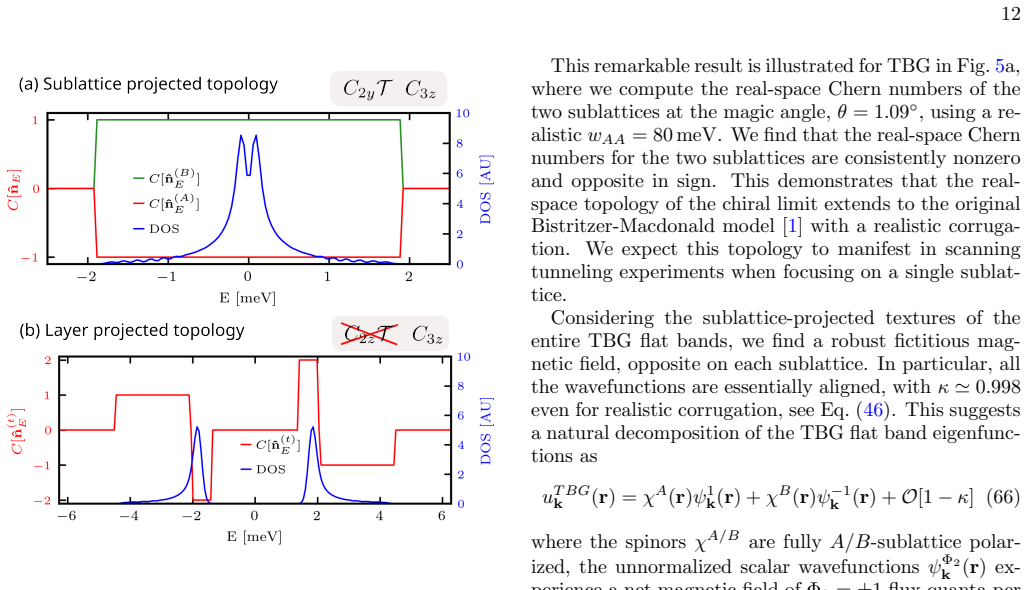
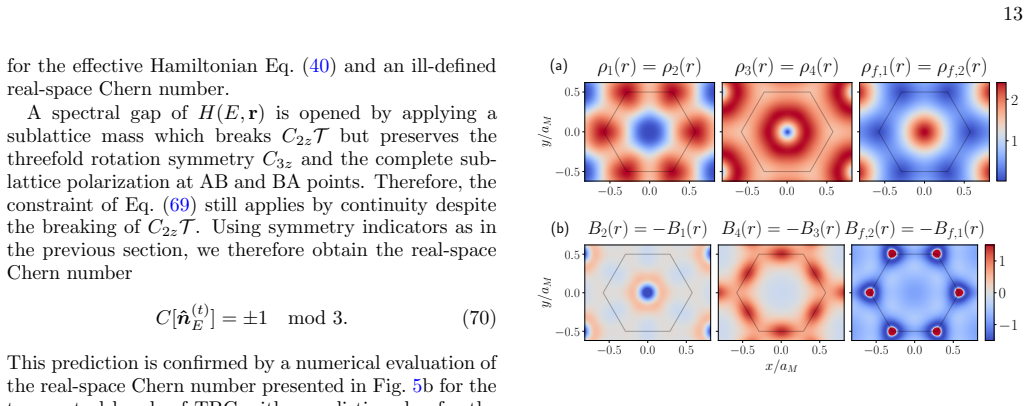
At the heart of the paper is the ensemble-weighted vector field $\mathbf{A}(r)=\sum_{\lambda,n,k\in\mathrm{BZ}} u^{\dagger}_{k,n,\lambda}(r)\boldsymbol{\mu}u_{k,n,\lambda}(r)p_{k,n,\lambda}$, normalized to $\hat{\mathbf n}(r)=\mathbf{A}(r)/|\mathbf{A}(r)|$. Its Pontryagin index $C[\hat{\mathbf n}]=\frac{1}{4\pi}\int \hat{\mathbf n}\cdot(\partial_x\hat{\mathbf n}\times\partial_y\hat{\mathbf n})d^2r$ is the real-space Chern number; it equals the Chern number of the upper band of the auxiliary position-dependent Hamiltonian $H(r)=\mathbf{A}(r)\cdot\boldsymbol{\mu}$, so it is stable as long as $|\mathbf{A}(r)|$ stays nonzero. Individual wavefunctions do not share this robustness: their real-space Chern number equals the integer flux $\Phi_1$ carried by the spinor part, and at zero applied flux it is nonzero only in special limits where the spinor has protected zeroes. Using symmetry indicators, the paper finds $C[\hat{\mathbf n}_E]=\pm 1 \pmod 3$ for valley-polarized twisted TMDs and for sublattice-projected TBG, and the same constraint for layer-projected TBG once $C_{2z}T$ is broken by a sublattice mass. Numerically, the authors verify $C[\hat{\mathbf n}_E]=-1$ across the top bands of twisted WSe$_2$ at $2.2^\circ$, and nonzero sublattice-projected Chern numbers for realistic TBG with $w_{AA}=80$ meV; in the topological heavy fermion model, the nontrivial real-space texture is carried by the light c-electrons rather than the localized Wannier orbitals.
Load-bearing premise
The load-bearing premise is that the valley-polarized state breaks time-reversal symmetry spontaneously while preserving $C_{3z}$ and $C_{2y}T$ in the ensemble weights; if that symmetry is broken, or if the layer-projected TBG argument is used without the $C_{2z}T$-breaking sublattice mass, the proof of a nonzero mod-3 real-space Chern number collapses.
Editorial extensions
If this is right
- If the central claim is correct, a fictitious magnetic field of one flux quantum per moiré cell is present in twisted TMDs and TBG for realistic parameters, not only in the chiral or adiabatic limits.
- The mod-3 constraint makes the nonzero real-space Chern number a symmetry-forced feature: it cannot be tuned away by changing twist angle or corrugation as long as the valley-polarized ensemble preserves $C_{3z}$ and $C_{2y}T$.
- Scanning tunneling microscopy of a single sublattice in TBG, or of layer polarization in twisted TMDs, should observe a texture whose winding is $\pm 1$ (mod 3), with the chiral-limit profile recovered almost perfectly even for $w_{AA}=80$ meV.
- In the topological heavy fermion picture, only the light c-electrons carry the real-space topology; the heavy Wannier-like f-states are topologically trivial, so approximations that replace the flat bands purely by AA-centered Wannier orbitals miss the fictitious field.
- For layer-projected TBG, breaking $C_{2z}T$ with a sublattice mass opens a spectral gap for the auxiliary Hamiltonian and yields $C[\hat{\mathbf n}^{(t)}_E]=\pm 1 \pmod 3$, with all three texture components observable in principle.
Reading between the lines
- Editorial inference: if the ensemble definition is the right measure, momentum-space Chern number may not be the essential ingredient for fractional Chern insulators in these materials; a real-space fictitious field could play the organizing role, and the zero-Chern-band fractional Chern insulator prediction cited by the paper is a direct place to test this.
- Editorial inference: any valley-polarized moiré material with $C_{3z}$ and $C_{2y}T$ should inherit the mod-3 nonzero real-space Chern number, while materials lacking these symmetries, such as hBN-aligned rhombohedral multilayer graphene or helical trilayer graphene, may require interaction-induced or alternative mechanisms.
- Editorial inference: a layer-resolved local spectral function would extend the energy-resolved texture beyond mean-field theory; the symmetry constraints suggest the mod-3 index could survive into the fractional Chern insulator phase, but that survival is not proven in the paper.
Editorial analysis
A structured set of objections, weighed in public.
Referee Report
Summary. The paper develops a theory of real-space topology in moiré systems. For individual Bloch wavefunctions, it argues that the real-space Chern number, defined via the layer/sublattice spinor texture, is generically zero at zero magnetic flux and only nonzero in fine-tuned cases with wavefunction zeros, such as the chiral limit of TBG or the adiabatic limit of twisted TMDs. The central proposal is to instead consider ensembles of wavefunctions, defining A(r) as a weighted sum of u†(r) μ u(r) over momenta, bands, and flavors, and to define a real-space Chern number C[ˆn] from the normalized vector ˆn(r)=A(r)/|A(r)|, equivalently as the Chern number of the upper band of H(r)=A(r)·μ. The paper proves that C3z and C2yT symmetries constrain C[ˆn_E] to be ±1 mod 3 for valley-polarized twisted TMDs and for sublattice-projected TBG, claims a similar constraint for layer-projected TBG once C2zT is broken by a sublattice mass, and supports the results with numerical calculations at representative twist angles. It also analyzes the topological heavy fermion model and finds that real-space topology is carried by the light c-electrons.
Significance. If the main claims hold, the paper provides a general and unifying picture of fictitious magnetic fields in moiré systems, extending previous chiral-limit and adiabatic-limit results to realistic parameter regimes and giving concrete STM-observable predictions. The core Stokes-theorem and symmetry-indicator arguments are clean, the numerical checks at the reported parameter points are consistent with the stated invariants, and the paper makes falsifiable predictions, including C[ˆn_E]=±1 mod 3 and κ values close to unity. The main weakness is that the strongest universal claim—nonvanishing topology for all twist angles and corrugations—rests on an unproven spectral-gap assumption for the auxiliary Hamiltonian H(E,r); the evidence is presented only at isolated parameter points.
major comments (3)
- The mod-3 constraint C[ˆn_E]=±1 mod 3 is derived under the assumption that the real-space Hamiltonian H(E,r)=A(E,r)·μ is gapped over the whole moiré unit cell. The symmetry relations (57)–(59) fix ˆn at AB and BA to be ±ẑ and force the z-component to vanish at AA, but they do not exclude |A(E,AA)|=0 or a zero elsewhere in the cell. Since a zero at a C3-invariant point can change the Chern number by ±1 rather than by a multiple of 3, Eqs. (57)–(59) alone do not imply nonvanishing C[ˆn_E]. The numerical checks in Figs. 4 and 5 are at isolated angles (θ=2.2° and 1.09°) and fixed corrugations, so the abstract's claim of nonzero topology 'across all twist angles and levels of corrugation' is not established. The authors should either prove a positive lower bound for |A(E,r)| in the relevant parameter range or reformulate the claim as conditional on the real-space gap and support it with a parameter scan.
- The theorem that C[ˆn_E] is nonzero requires broken time-reversal symmetry, implemented by spontaneous valley polarization, as the text itself states in §V B. The abstract and the opening of §VI do not state this condition and even claim the result for TBG 'across all twist angles and levels of corrugation'; for a time-reversal-invariant state the paper's own argument gives C[ˆn]=0. The scope of the central claim should be corrected in the abstract and introduction, for instance by stating explicitly that the nonzero index applies to valley-polarized ensembles.
- For the layer-projected Chern number, C2zT is broken by a sublattice mass, so the exact relation n_AB=-n_BA of Eq. (69) is no longer protected by symmetry. The sentence that Eq. (69) 'still applies by continuity' needs a proper justification: the useful continuity is that of the discrete C3 eigenvalues at AB and BA as long as no gap closing occurs there, not of the vector relation itself. As written, the transition from Eq. (69) to Eq. (70) is not automatic, and the range of the free parameter m_s for which the result holds is not quantified. Please provide the missing argument or numerical verification over a range of m_s.
minor comments (4)
- The energy-resolved ensemble uses a δ-function in energy; in numerical evaluation some broadening must be used. Please state the regularization and check that the reported C[ˆn_E] values are stable with respect to the broadening width.
- The first line, A^{(t)}(E,r)=R_z(2π/3)A^{(t)}(E,r), appears to be missing the coordinate transformation; it should relate A^{(t)}(E,r) at C3z-rotated points. Please correct.
- The statement that the vanishing of C_k is 'numerically verified' for generic momenta would benefit from a plot or a quantitative description of the scan over the Brillouin zone.
- When ρ(r)=0 at isolated points, the integrand defining κ is singular; please specify how this is handled in the numerical evaluation.
Circularity Check
No significant circularity: the real-space Chern number derivation is self-contained; the few self-citations are background and the gap assumptions are explicit, not circular reductions.
full rationale
The central derivation defines A(E,r) as a weighted sum of Bloch-state textures and C[hat n_E] as the Chern number of the upper band of H(E,r)=A(E,r)·mu; the symmetry constraints in Eqs. (57)-(59) and the symmetry-indicator result C = ±1 mod 3 (Eq. (60), App. D) follow from the assumed C3z and C2yT invariance of the ensemble, not from fitting a parameter to the target value. The numerical values C[hat n_E] = -1 at theta = 2.2° for TMDs and the sublattice/layer-projected TBG checks are independent evaluations, not inputs. The self-citation [58] (Kolář et al., Hofstadter spectrum) is used only to support the Landau-level eigenstate basis and the momentum-space Chern number of TMD bands; these facts are not load-bearing for the robustness theorem, and the symmetry-indicator argument relies on the external Fang-Gilbert-Bernevig result [78]. The paper honestly flags the one place where the gap assumption fails: Sec. VI.B.2 states that 'A(t)(E,AA) = 0, corresponding to a gap closing for the effective Hamiltonian Eq. (40) and an ill-defined real-space Chern number,' so C is ill-defined there until C2zT is broken; the subsequent continuity argument is a stated assumption rather than a claim derived from the broken-symmetry Hamiltonian. No equation was found that reduces by construction to its own input, and no fitted quantity is relabeled as a prediction. The verified gap-open cases and the explicit gap-closing caveat keep the derivation self-contained; any remaining concern about proving |A(E,r)| > 0 for all twist angles is a completeness issue, not circularity.
Assumptions & free parameters
free parameters (1)
- sublattice mass ms (TBG layer-projected calculation) =
5 meV
assumptions (5)
- standard math Magnetic translation algebra and integer-flux Bloch construction in Appendix A yield the boundary conditions Eq. (2) and the boundary integral Eq. (10).
- domain assumption Generic infinitesimal perturbations of a multicomponent wavefunction lift its real-space zeroes, based on the codimension argument around Eq. (34).
- domain assumption C3z and C2yT symmetries of the K-valley Hamiltonians survive in the spontaneously valley-polarized state, while time-reversal is broken.
- standard math Symmetry indicators for 2D C3-symmetric insulators (Ref. [78]) determine the Chern number modulo 3 from C3 eigenvalues at high-symmetry points.
- domain assumption The continuum model parameters for WSe2 [55], MoTe2 [79,80], and TBG [1] accurately represent the materials studied.
Cite this review
Pith. "Pith review of Robustness of real-space topology in moir\'e systems." pith.science (2026). https://pith.science/paper/YCO5HJG2
@misc{pith2026250700130,
  author       = {Pith},
  title        = {Pith review of: Robustness of real-space topology in moir\'e systems},
  year         = {2026},
  howpublished = {\url{https://pith.science/paper/YCO5HJG2}},
  note         = {Machine review of arXiv:2507.00130}
}
read the original abstract
The appearance of fractional Chern insulators in moir\'e systems can be rationalized by the presence of a fictitious magnetic field associated with the spatial texture of layer-resolved electronic wavefunctions. Here, we present a systematic study of real-space topology and the associated fictitious magnetic fields in moir\'e systems. We first show that at the level of individual Bloch wavefunctions, the real-space Chern number, akin to a Pontryagin index, is a fragile marker. It generically vanishes except for specific limits where the Bloch functions exhibit fine-tuned zeroes within the unit cell, such as the chiral limit of twisted bilayer graphene (TBG) or the adiabatic regime of twisted homobilayer transition metal dichalcogenides (TMD). We then show that these limitations do not apply to textures associated with ensembles of Bloch wavefunctions, such as entire bands or the ensemble of states at a given energy. The Chern number of these textures defines a robust topological index protected by a spectral gap. We find that symmetries constrain it to be nonzero for both twisted TMDs and TBG across all twist angles and levels of corrugation, implying experimental signatures in scanning tunneling microscopy measurements. We also study real-space topology within the topological heavy fermion model of TBG, finding that the real-space topological features are supported only by the light c-electrons.
Figures


Figures from the paper (4 more)


Reference graph
Works this paper leans on
-
[1]
These are obtained by taking pk,n,λ = δ(ϵk,n,λ − E) (42) and provide energy-resolved real-space textures, which we denote A(E, r)
Textures at a fixed energy We first consider textures of wavefunction ensembles consisting of states at a fixed energy. These are obtained by taking pk,n,λ = δ(ϵk,n,λ − E) (42) and provide energy-resolved real-space textures, which we denote A(E, r). This corresponds to the density of states typically probed in tunneling experiments [71–76], The associate...
-
[2]
Textures of a band Next, we consider textures associated with bands. By choosing pk,n,λ = δn,bδλ,λb , (44) we sum over all momenta within the Brillouin zone for a given band b and flavor λb, and obtain the intrinsic tex- ture associated with that band. The corresponding real- space Chern number encodes the number of flux quanta of the fictitious magnetic ...
-
[3]
(65) Using these, we introduce (for energy-resolved ensem- bles) A(A)(E, r) and A(B)(E, r), along the corresponding renormalized vectors ˆn(A) E and ˆn(B) E
Sublattice-projected Chern number We define the sublattice-projected Pauli matrices for the two sublattices A and B as µ(A) = µ ⊗ (1 + σz)/2, (64) µ(B) = µ ⊗ (1 − σz)/2. (65) Using these, we introduce (for energy-resolved ensem- bles) A(A)(E, r) and A(B)(E, r), along the corresponding renormalized vectors ˆn(A) E and ˆn(B) E . They define two real-space C...
-
[4]
(67) Using this, we can define A(t)(E, r)
Layer-projected Chern number Another natural option is to project onto a single layer, say the top layer, by defining µ(t) = [(1 + µz)/2] ⊗ σ. (67) Using this, we can define A(t)(E, r). However, now the symmetries available within a single valley reduce to C2zT and C3z. These constrain the vector A(t)(E, r) through A(t)(E, r) = Rz(2π/3)A(t)(E, r) A(t)(E, ...
-
[5]
Bistritzer and A
R. Bistritzer and A. H. MacDonald, Moire bands in twisted double-layer graphene, Proceedings of the Na- tional Academy of Sciences 108, 12233 (2011)
2011
-
[6]
F. Wu, T. Lovorn, E. Tutuc, I. Martin, and A. MacDon- ald, Topological insulators in twisted transition metal dichalcogenide homobilayers, Physical Review Letters 122, 086402 (2019)
2019
-
[7]
Y. Cao, V. Fatemi, A. Demir, S. Fang, S. L. Tomarken, J. Y. Luo, J. D. Sanchez-Yamagishi, K. Watanabe, T. Taniguchi, E. Kaxiras, R. C. Ashoori, and P. Jarillo- Herrero, Correlated insulator behaviour at half-filling in magic-angle graphene superlattices, Nature 556, 80 (2018)
2018
-
[8]
Yankowitz, S
M. Yankowitz, S. Chen, H. Polshyn, Y. Zhang, K. Watanabe, T. Taniguchi, D. Graf, A. F. Young, and C. R. Dean, Tuning superconductivity in twisted bilayer graphene, Science 363, 1059 (2019)
2019
Show all 113 references
-
[9]
Z. Hao, A. M. Zimmerman, P. Ledwith, E. Khalaf, D. H. Najafabadi, K. Watanabe, T. Taniguchi, A. Vish- wanath, and P. Kim, Electric fieldtunable superconduc- 18 tivity in alternating-twist magic-angle trilayer graphene, Science 371, 1133 (2021)
2021
-
[10]
M. Oh, K. P. Nuckolls, D. Wong, R. L. Lee, X. Liu, K. Watanabe, T. Taniguchi, and A. Yazdani, Evidence for unconventional superconductivity in twisted bilayer graphene, Nature 600, 240 (2021)
2021
-
[11]
X. Lu, P. Stepanov, W. Yang, M. Xie, M. A. Aamir, I. Das, C. Urgell, K. Watanabe, T. Taniguchi, G. Zhang, A. Bachtold, A. H. MacDonald, and D. K. Efetov, Su- perconductors, orbital magnets and correlated states in magic-angle bilayer graphene, Nature 574, 653 (2019)
2019
-
[12]
Y. Cao, D. Rodan-Legrain, J. M. Park, N. F. Q. Yuan, K. Watanabe, T. Taniguchi, R. M. Fernandes, L. Fu, and P. Jarillo-Herrero, Nematicity and competing orders in superconducting magic-angle graphene, Science 372, 264 (2021)
2021
-
[13]
X. Liu, Z. Wang, K. Watanabe, T. Taniguchi, O. Vafek, and J. I. A. Li, Tuning electron correlation in magic- angle twisted bilayer graphene using coulomb screening, Science 371, 1261 (2021)
2021
-
[14]
H. S. Arora, R. Polski, Y. Zhang, A. Thomson, Y. Choi, H. Kim, Z. Lin, I. Z. Wilson, X. Xu, J.-H. Chu, K. Watanabe, T. Taniguchi, J. Alicea, and S. Nadj- Perge, Superconductivity in metallic twisted bilayer graphene stabilized by wse2, Nature 583, 379 (2020)
2020
-
[15]
Stepanov, I
P. Stepanov, I. Das, X. Lu, A. Fahimniya, K. Watanabe, T. Taniguchi, F. H. L. Koppens, J. Lischner, L. Levitov, and D. K. Efetov, Untying the insulating and supercon- ducting orders in magic-angle graphene, Nature 583, 375 (2020)
2020
-
[16]
Saito, J
Y. Saito, J. Ge, K. Watanabe, T. Taniguchi, and A. F. Young, Independent superconductors and correlated in- sulators in twisted bilayer graphene, Nature Physics 16, 926 (2020)
2020
-
[17]
Zondiner, A
U. Zondiner, A. Rozen, D. Rodan-Legrain, Y. Cao, R. Queiroz, T. Taniguchi, K. Watanabe, Y. Oreg, F. von Oppen, A. Stern, E. Berg, P. Jarillo-Herrero, and S. Ilani, Cascade of phase transitions and dirac revivals in magic-angle graphene, Nature 582, 203 (2020)
2020
-
[18]
D. Wong, K. P. Nuckolls, M. Oh, B. Lian, Y. Xie, S. Jeon, K. Watanabe, T. Taniguchi, B. A. Bernevig, and A. Yazdani, Cascade of electronic transitions in magic-angle twisted bilayer graphene, Nature 582, 198 (2020)
2020
-
[19]
Wang, E.-M
L. Wang, E.-M. Shih, A. Ghiotto, L. Xian, D. A. Rhodes, C. Tan, M. Claassen, D. M. Kennes, Y. Bai, B. Kim, K. Watanabe, T. Taniguchi, X. Zhu, J. Hone, A. Rubio, A. N. Pasupathy, and C. R. Dean, Cor- related electronic phases in twisted bilayer transition metal dichalcogenides,...
2020
-
[20]
Y. Xia, Z. Han, K. Watanabe, T. Taniguchi, J. Shan, and K. F. Mak, Unconventional superconductivity in twisted bilayer wse2 (2024), arXiv:2405.14784 [cond- mat]
2024 arXiv
-
[21]
Y. Guo, J. Pack, J. Swann, L. Holtzman, M. Cothrine, K. Watanabe, T. Taniguchi, D. Mandrus, K. Barmak, J. Hone, A. J. Millis, A. N. Pasupathy, and C. R. Dean, Superconductivity in twisted bilayer wse2 (2024), arXiv:2406.03418 [cond-mat]
2024 arXiv
-
[22]
Ghiotto, E.-M
A. Ghiotto, E.-M. Shih, G. S. S. G. Pereira, D. A. Rhodes, B. Kim, J. Zang, A. J. Millis, K. Watanabe, T. Taniguchi, J. C. Hone, L. Wang, C. R. Dean, and A. N. Pasupathy, Quantum criticality in twisted transi- tion metal dichalcogenides, Nature 597, 345 (2021)
2021
-
[23]
Z. Lu, T. Han, Y. Yao, A. P. Reddy, J. Yang, J. Seo, K. Watanabe, T. Taniguchi, L. Fu, and L. Ju, Fractional quantum anomalous hall effect in multilayer graphene, Nature 626, 759 (2024)
2024
-
[24]
Z. Lu, T. Han, Y. Yao, Z. Hadjri, J. Yang, J. Seo, L. Shi, S. Ye, K. Watanabe, T. Taniguchi, and L. Ju, Ex- tended quantum anomalous hall states in graphene/hbn moir´ esuperlattices, Nature637, 1090 (2025)
2025
-
[25]
J. Xie, Z. Huo, X. Lu, Z. Feng, Z. Zhang, W. Wang, Q. Yang, K. Watanabe, T. Taniguchi, K. Liu, et al. , Even-and odd-denominator fractional quantum anoma- lous hall effect in graphene moire superlattices, arXiv preprint arXiv:2405.16944 (2024)
2024 arXiv
-
[26]
J. Cai, E. Anderson, C. Wang, X. Zhang, X. Liu, W. Holtzmann, Y. Zhang, F. Fan, T. Taniguchi, K. Watanabe, Y. Ran, T. Cao, L. Fu, D. Xiao, W. Yao, and X. Xu, Signatures of fractional quantum anomalous hall states in twisted mote2, Nature 622, 63 (2023)
2023
-
[27]
H. Park, J. Cai, E. Anderson, Y. Zhang, J. Zhu, X. Liu, C. Wang, W. Holtzmann, C. Hu, Z. Liu, T. Taniguchi, K. Watanabe, J.-H. Chu, T. Cao, L. Fu, W. Yao, C.-Z. Chang, D. Cobden, D. Xiao, and X. Xu, Observation of fractionally quantized anomalous hall effect, Nature 622, 74 (2023)
2023
-
[28]
Y. Zeng, Z. Xia, K. Kang, J. Zhu, P. Knppel, C. Vaswani, K. Watanabe, T. Taniguchi, K. F. Mak, and J. Shan, Thermodynamic evidence of fractional chern insulator in moir mote2, Nature 622, 69 (2023)
2023
-
[29]
F. Xu, Z. Sun, T. Jia, C. Liu, C. Xu, C. Li, Y. Gu, K. Watanabe, T. Taniguchi, B. Tong, J. Jia, Z. Shi, S. Jiang, Y. Zhang, X. Liu, and T. Li, Observation of integer and fractional quantum anomalous hall effects in twisted bilayer mote2, Physical Review X 13, 031037 (2023)
2023
-
[30]
B. A. Foutty, C. R. Kometter, T. Devakul, A. P. Reddy, K. Watanabe, T. Taniguchi, L. Fu, and B. E. Feld- man, Mapping twist-tuned multiband topology in bi- layer wse2, Science 384, 343 (2024)
2024
-
[31]
K. Kang, B. Shen, Y. Qiu, Y. Zeng, Z. Xia, K. Watan- abe, T. Taniguchi, J. Shan, and K. F. Mak, Evidence of the fractional quantum spin hall effect in moir mote2, Nature 628, 522 (2024)
2024
-
[32]
Y. Xie, A. T. Pierce, J. M. Park, D. E. Parker, E. Kha- laf, P. Ledwith, Y. Cao, S. H. Lee, S. Chen, P. R. Forrester, K. Watanabe, T. Taniguchi, A. Vishwanath, P. Jarillo-Herrero, and A. Yacoby, Fractional Chern in- sulators in magic-angle twisted bilayer graphene, Nature 600,...
2021
-
[33]
Neupert, L
T. Neupert, L. Santos, C. Chamon, and C. Mudry, Frac- tional quantum hall states at zero magnetic field, Phys. Rev. Lett. 106, 236804 (2011)
2011
-
[34]
E. J. Bergholtz and Z. Liu, Topological flat band models and fractional chern insulators, International Journal of Modern Physics B 27, 1330017 (2013)
2013
-
[35]
Regnault and B
N. Regnault and B. A. Bernevig, Fractional chern insu- lator, Phys. Rev. X 1, 021014 (2011)
2011
-
[36]
Tang, J.-W
E. Tang, J.-W. Mei, and X.-G. Wen, High-temperature fractional quantum hall states, Phys. Rev. Lett. 106, 236802 (2011)
2011
-
[37]
D. N. Sheng, Z.-C. Gu, K. Sun, and L. Sheng, Fractional quantum hall effect in the absence of landau levels, Na- ture Communications 2, 389 (2011)
2011
-
[38]
Qi, Generic wave-function description of fractional quantum anomalous hall states and fractional topolog- 19 ical insulators, Phys
X.-L. Qi, Generic wave-function description of fractional quantum anomalous hall states and fractional topolog- 19 ical insulators, Phys. Rev. Lett. 107, 126803 (2011)
2011
-
[39]
Zhai and W
D. Zhai and W. Yao, Theory of tunable flux lattices in the homobilayer moir´ e of twisted and uniformly strained transition metal dichalcogenides, Physical Review Ma- terials 4, 094002 (2020)
2020
-
[40]
Morales-Durn, N
N. Morales-Durn, N. Wei, J. Shi, and A. H. MacDonald, Magic angles and fractional chern insulators in twisted homobilayer transition metal dichalcogenides, Physical Review Letters 132, 096602 (2024)
2024
-
[41]
Zhang, N
F. Zhang, N. Morales-Dur´ an, Y. Li, W. Yao, J.-J. Su, Y.-C. Lin, C. Dong, X. Liu, F.-X. R. Chen, H. Kim, K. Watanabe, T. Taniguchi, X. Li, J. A. Robinson, A. H. Macdonald, and C.-K. Shih, Experimental signature of layer skyrmions and implications for band topology in twisted ...
2025
-
[42]
Thompson, K
E. Thompson, K. T. Chu, F. Mesple, X.-W. Zhang, C. Hu, Y. Zhao, H. Park, J. Cai, E. Anderson, K. Watanabe, T. Taniguchi, J. Yang, J.-H. Chu, X. Xu, T. Cao, D. Xiao, and M. Yankowitz, Microscopic signa- tures of topology in twisted MoTe2, Nature Physics , 1 (2025)
2025
-
[43]
Guerci, J
D. Guerci, J. Wang, and C. Mora, Layer skyrmions for ideal Chern bands and twisted bilayer graphene (2024), arXiv:2408.12652
2024 arXiv
-
[44]
Tarnopolsky, A
G. Tarnopolsky, A. J. Kruchkov, and A. Vish- wanath, Origin of Magic Angles in Twisted Bilayer Graphene, Physical Review Letters 122, 106405 (2019), arXiv:1808.05250
2019 arXiv
-
[45]
J. Wang, J. Cano, A. J. Millis, Z. Liu, and B. Yang, Exact landau level description of geometry and interac- tion in a flatband, Physical Review Letters 127, 246403 (2021), arXiv:2105.07491 [cond-mat]
2021 arXiv
-
[46]
J. Wang, Y. Zheng, A. J. Millis, and J. Cano, Chiral approximation to twisted bilayer graphene: Exact in- travalley inversion symmetry, nodal structure, and im- plications for higher magic angles, Physical Review Re- search 3, 023155 (2021)
2021
-
[47]
P. J. Ledwith, G. Tarnopolsky, E. Khalaf, and A. Vish- wanath, Fractional chern insulator states in twisted bi- layer graphene: An analytical approach, Physical Re- view Research 2, 023237 (2020), arXiv:1912.09634
2020 arXiv
-
[48]
J. Wang, S. Klevtsov, and Z. Liu, Origin of model fractional chern insulators in all topological ideal flat- bands: Explicit color-entangled wave function and ex- act density algebra, Physical Review Research5, 023167 (2023)
2023
-
[49]
J. Dong, J. Wang, P. J. Ledwith, A. Vishwanath, and D. E. Parker, Composite fermi liquid at zero magnetic field in twisted mote 2, Physical Review Letters 131, 136502 (2023)
2023
-
[50]
Song and B
Z.-D. Song and B. A. Bernevig, Magic-angle twisted bi- layer graphene as a topological heavy fermion problem, Physical Review Letters 129, 047601 (2022)
2022
-
[51]
Clugru, M
D. Clugru, M. Borovkov, L. L. H. Lau, P. Coleman, Z.- D. Song, and B. A. Bernevig, Twisted bilayer graphene as topological heavy fermion: Ii. analytical approxi- mations of the model parameters, Low Temperature Physics 49, 640 (2023)
2023
-
[52]
Shi and X
H. Shi and X. Dai, Heavy-fermion representation for twisted bilayer graphene systems, Physical Review B 106, 245129 (2022)
2022
-
[53]
Outside vortex cores where uk(r) vanishes, it defines a map from part of the unit cell to nonzero complex num- bers C× = C−{0}
More precisely, the wavefunction uk(r) defines a non- periodic map from the unit cell to complex numbers C. Outside vortex cores where uk(r) vanishes, it defines a map from part of the unit cell to nonzero complex num- bers C× = C−{0}. The fundamental group of C×, given π1(C×)...
-
[54]
Z. Liu, B. Mera, M. Fujimoto, T. Ozawa, and J. Wang, Theory of generalized landau levels and implication for non-abelian states (2024), arXiv:2405.14479 [cond-mat, physics:hep-th, physics:math-ph]
2024 arXiv
-
[55]
(11) as a phase term eiαk(r) can al- ways be transferred between the spinor and the scalar parts
There is some arbitrariness (gauge-freedom) in the de- composition of Eq. (11) as a phase term eiαk(r) can al- ways be transferred between the spinor and the scalar parts. Although this shift of phase can change the Berry connection, it does not affect the gauge-invariant Berr...
-
[56]
We also note that the scalar part ψΦ2 k drops out from this ratio
In contrast to uk(r) |uk(r)| and its phase vortices, the ratio u† k(r)µuk(r) |u† k(r)uk(r)| can be extended continuously at the zeroes of uk(r). We also note that the scalar part ψΦ2 k drops out from this ratio
-
[57]
Graf and F
A. Graf and F. Pi´ echon, Berry curvature and quan- tum metric in $N$-band systems: An eigenprojector approach, Physical Review B 104, 085114 (2021)
2021
-
[58]
C. J. D. Kemp, N. R. Cooper, and F. N. ¨Unal, Nested- sphere description of the $N$-level Chern number and the generalized Bloch hypersphere, Physical Review Re- search 4, 023120 (2022)
2022
-
[59]
Devakul, V
T. Devakul, V. Crpel, Y. Zhang, and L. Fu, Magic in twisted transition metal dichalcogenide bilayers, Nature Communications 12, 6730 (2021), arXiv:2106.11954
2021 arXiv
-
[60]
Li and F
B. Li and F. Wu, Variational mapping of chern bands to landau levels: Application to fractional chern insulators in twisted mote 2, Phys. Rev. B 111, 125122 (2025)
2025
-
[61]
J. Shi, N. Morales-Durn, E. Khalaf, and A. H. Mac- Donald, Adiabatic approximation and aharonov-casher bands in twisted homobilayer transition metal dichalco- genides, Physical Review B 110, 035130 (2024)
2024
-
[62]
Kol´ aˇ r, K
K. Kol´ aˇ r, K. Yang, F. von Oppen, and C. Mora, Hofstadter spectrum of chern bands in twisted transi- tion metal dichalcogenides, Phys. Rev. B 110, 115114 (2024)
2024
-
[63]
Roy, Band geometry of fractional topological insula- tors, Physical Review B 90, 165139 (2014)
R. Roy, Band geometry of fractional topological insula- tors, Physical Review B 90, 165139 (2014)
2014
-
[64]
Abouelkomsan, K
A. Abouelkomsan, K. Yang, and E. J. Bergholtz, Quan- tum metric induced phases in moir´ e materials, Physical Review Research 5, L012015 (2023)
2023
-
[65]
Fujimoto, D
M. Fujimoto, D. E. Parker, J. Dong, E. Khalaf, A. Vishwanath, and P. Ledwith, Higher vortexability: zero field realization of higher landau levels (2024), arXiv:2403.00856 [cond-mat]
2024 arXiv
-
[66]
Estienne, N
B. Estienne, N. Regnault, and V. Crpel, Ideal chern bands as landau levels in curved space, Physical Review Research 5, L032048 (2023)
2023
-
[67]
H. Liu, K. Yang, A. Abouelkomsan, Z. Liu, and E. J. Bergholtz, Broken symmetry in ideal chern bands, Phys. Rev. B 111, L201105 (2025)
2025
-
[68]
X. Wan, S. Sarkar, S.-Z. Lin, and K. Sun, Topologi- cal exact flat bands in two-dimensional materials under periodic strain, Physical Review Letters 130, 216401 (2023). 20
2023
-
[69]
P. M. Eugenio and O. Vafek, Twisted-bilayer FeSe and the Fe-based superlattices, SciPost Phys. 15, 081 (2023)
2023
-
[70]
Sheffer and A
Y. Sheffer and A. Stern, Chiral magic-angle twisted bi- layer graphene in a magnetic field: Landau level corre- spondence, exact wave functions, and fractional chern insulators, Physical Review B 104, L121405 (2021)
2021
-
[71]
J. Dong, P. J. Ledwith, E. Khalaf, J. Y. Lee, and A. Vishwanath, Many-body ground states from decom- position of ideal higher chern bands: Applications to chirally twisted graphene multilayers, Phys. Rev. Res. 5, 023166 (2023)
2023
-
[72]
P. J. Ledwith, A. Vishwanath, and E. Khalaf, Family of Ideal Chern Flatbands with Arbitrary Chern Number in Chiral Twisted Graphene Multilayers, Physical Review Letters 128, 176404 (2022)
2022
-
[73]
Guerci, Y
D. Guerci, Y. Mao, and C. Mora, Chern mosaic and ideal flat bands in equal-twist trilayer graphene, Physi- cal Review Research 6, L022025 (2024)
2024
-
[74]
Guerci, Y
D. Guerci, Y. Mao, and C. Mora, Nature of even and odd magic angles in helical twisted trilayer graphene, Phys. Rev. B 109, 205411 (2024)
2024
-
[75]
Y. Choi, J. Kemmer, Y. Peng, A. Thomson, H. Arora, R. Polski, Y. Zhang, H. Ren, J. Alicea, G. Refael, F. von Oppen, K. Watanabe, T. Taniguchi, and S. Nadj-Perge, Electronic correlations in twisted bilayer graphene near the magic angle, Nature Physics 15, 1174 (2019)
2019
-
[76]
Kerelsky, L
A. Kerelsky, L. J. McGilly, D. M. Kennes, L. Xian, M. Yankowitz, S. Chen, K. Watanabe, T. Taniguchi, J. Hone, C. Dean, A. Rubio, and A. N. Pasupathy, Maxi- mized electron interactions at the magic angle in twisted bilayer graphene, Nature 572, 95 (2019)
2019
-
[77]
C˘ alug˘ aru, N
D. C˘ alug˘ aru, N. Regnault, M. Oh, K. P. Nuckolls, D. Wong, R. L. Lee, A. Yazdani, O. Vafek, and B. A. Bernevig, Spectroscopy of twisted bilayer graphene cor- related insulators, Phys. Rev. Lett. 129, 117602 (2022)
2022
-
[78]
J. P. Hong, T. Soejima, and M. P. Zaletel, Detecting symmetry breaking in magic angle graphene using scan- ning tunneling microscopy, arXiv:2110.14674 [cond-mat] (2021), arXiv:2110.14674 [cond-mat]
2021 arXiv
-
[79]
K. P. Nuckolls, R. L. Lee, M. Oh, D. Wong, T. Soe- jima, J. P. Hong, D. Clugru, J. Herzog-Arbeitman, B. A. Bernevig, K. Watanabe, T. Taniguchi, N. Regnault, M. P. Zaletel, and A. Yazdani, Quantum textures of the many-body wavefunctions in magic-angle graphene, Nature 620, 525 (2023)
2023
-
[80]
H. Kim, Y. Choi, . Lantagne-Hurtubise, C. Lewandowski, A. Thomson, L. Kong, H. Zhou, E. Baum, Y. Zhang, L. Holleis, K. Watanabe, T. Taniguchi, A. F. Young, J. Alicea, and S. Nadj- Perge, Imaging inter-valley coherent order in magic- angle twisted trilayer graphene, Nature 623,...
2023
-
[81]
X. Liu, G. Farahi, C.-L. Chiu, Z. Papic, K. Watan- abe, T. Taniguchi, M. P. Zaletel, and A. Yazdani, Vi- sualizing Broken Symmetry and Topological Defects in a Quantum Hall Ferromagnet, arXiv:2109.11555 [cond- mat] (2021), arXiv:2109.11555 [cond-mat]
2021 arXiv
-
[82]
C. Fang, M. J. Gilbert, and B. A. Bernevig, Bulk topo- logical invariants in noninteracting point group symmet- ric insulators, Physical Review B 86, 115112 (2012)
2012
-
[83]
C.-E. Ahn, W. Lee, K. Yananose, Y. Kim, and G. Y. Cho, First landau level physics in second moir´ e band of 2 .1◦ twisted bilayer mote 2 (2024), arXiv:2403.19155 [cond-mat]
2024 arXiv
-
[84]
Wang, X.-W
C. Wang, X.-W. Zhang, X. Liu, J. Wang, T. Cao, and D. Xiao, Higher landau-level analogues and signatures of non-abelian states in twisted bilayer mote 2 (2024), arXiv:2404.05697 [cond-mat]
2024 arXiv
-
[85]
A. P. Reddy, N. Paul, A. Abouelkomsan, and L. Fu, Non-abelian fractionalization in topological minibands, Phys. Rev. Lett. 133, 166503 (2024)
2024
-
[86]
C. Xu, N. Mao, T. Zeng, and Y. Zhang, Multiple chern bands in twisted mote 2 and possible non-abelian states (2024), arXiv:2403.17003 [cond-mat]
2024
-
[87]
Zhang, C
X.-W. Zhang, C. Wang, X. Liu, Y. Fan, T. Cao, and D. Xiao, Polarization-driven band topology evolution in twisted mote2 and wse2 (2024), arXiv:2311.12776 [cond- mat]
2024 arXiv
-
[88]
Chen, W.-W
F. Chen, W.-W. Luo, W. Zhu, and D. Sheng, Robust non-abelian even-denominator fractional chern insulator in twisted bilayer mote2, Nature Communications 16, 2115 (2025)
2025
-
[89]
J. Yu, M. Xie, B. A. Bernevig, and S. D. Sarma, Magic- angle twisted symmetric trilayer graphene as topological heavy fermion problem, Physical Review B 108, 035129 (2023)
2023
-
[90]
Clugru, H
D. Clugru, H. Hu, R. L. Merino, N. Regnault, D. K. Efetov, and B. A. Bernevig, The thermoelectric effect and its natural heavy fermion explanation in twisted bilayer and trilayer graphene, arXiv e-prints (2024), arXiv:2402.14057 [cond-mat.str-el]
2024 arXiv
-
[91]
Zhou, Y.-J
G.-D. Zhou, Y.-J. Wang, N. Tong, and Z.-D. Song, Kondo phase in twisted bilayer graphene, Physical Re- view B 109, 045419 (2024)
2024
-
[92]
G. Rai, L. Crippa, D. Clugru, H. Hu, F. Paoletti, L. de Medici, A. Georges, B. A. Bernevig, R. Valent, G. San- giovanni, and T. Wehling, Dynamical correlations and order in magic-angle twisted bilayer graphene, Physical Review X 14, 031045 (2024)
2024
-
[93]
Herzog-Arbeitman, D
J. Herzog-Arbeitman, D. C˘ alug˘ aru, H. Hu, J. Yu, N. Regnault, J. Kang, B. A. Bernevig, and O. Vafek, Kekul\’e spiral order from strained topological heavy fermions, arXiv preprint arXiv:2502.08700 (2025)
2025
-
[94]
Z.-D. Song, B. Lian, N. Regnault, and B. A. Bernevig, TBG II: Stable Symmetry Anomaly in Twisted Bi- layer Graphene, Physical Review B 103, 205412 (2021), arXiv:2009.11872
2021 arXiv
-
[95]
Z. Song, Z. Wang, W. Shi, G. Li, C. Fang, and B. A. Bernevig, All ”Magic Angles” Are ”Stable” Topo- logical, Physical Review Letters 123, 036401 (2019), arXiv:1807.10676
2019 arXiv
-
[96]
H. C. Po, L. Zou, T. Senthil, and A. Vishwanath, Faithful Tight-binding Models and Fragile Topology of Magic-angle Bilayer Graphene, Physical Review B 99, 195455 (2019), arXiv:1808.02482
2019 arXiv
-
[97]
J. Ahn, S. Park, and B.-J. Yang, Failure of nielsen- ninomiya theorem and fragile topology in two- dimensional systems with space-time inversion symme- try: Application to twisted bilayer graphene at magic angle, Phys. Rev. X 9, 021013 (2019)
2019
-
[98]
Kang and O
J. Kang and O. Vafek, Symmetry, maximally localized Wannier states, and low energy model for the twisted bilayer graphene narrow bands, Physical Review X 8, 031088 (2018), arXiv:1805.04918
2018 arXiv
-
[99]
Koshino, N
M. Koshino, N. F. Q. Yuan, T. Koretsune, M. Ochi, K. Kuroki, and L. Fu, Maximally Localized Wannier Orbitals and the Extended Hubbard Model for Twisted Bilayer Graphene, Physical Review X 8, 031087 (2018). 21
2018
-
[100]
L. Zou, H. C. Po, A. Vishwanath, and T. Senthil, Band structure of twisted bilayer graphene: Emergent sym- metries, commensurate approximants, and Wannier ob- structions, Physical Review B 98, 085435 (2018)
2018
-
[101]
Y. Xie, B. Lian, B. Jck, X. Liu, C.-L. Chiu, K. Watan- abe, T. Taniguchi, B. A. Bernevig, and A. Yazdani, Spectroscopic signatures of many-body correlations in magic-angle twisted bilayer graphene, Nature 572, 101 (2019)
2019
-
[102]
Saito, F
Y. Saito, F. Yang, J. Ge, X. Liu, K. Watanabe, T. Taniguchi, J. I. A. Li, E. Berg, and A. F. Young, Isospin Pomeranchuk effect and the entropy of collective excitations in twisted bilayer graphene, Nature592, 220 (2021), arXiv:2008.10830
2021 arXiv
-
[103]
Rozen, J
A. Rozen, J. M. Park, U. Zondiner, Y. Cao, D. Rodan- Legrain, T. Taniguchi, K. Watanabe, Y. Oreg, A. Stern, E. Berg, P. Jarillo-Herrero, and S. Ilani, Entropic evi- dence for a pomeranchuk effect in magic-angle graphene, Nature 592, 214 (2021)
2021
-
[104]
P. J. Ledwith, J. Dong, A. Vishwanath, and E. Kha- laf, Nonlocal Moments in the Chern Bands of Twisted Bilayer Graphene (2025), arXiv:2408.16761 [cond-mat]
2025 arXiv
-
[105]
Jiang, U
Y. Jiang, U. Petralanda, G. Skorupskii, Q. Xu, H. Pi, D. C˘ alug˘ aru, H. Hu, J. Xie, R. A. Mustaf, P. H¨ ohn, V. Haase, M. G. Vergniory, M. Claassen, L. Elcoro, N. Regnault, J. Shan, K. F. Mak, D. K. Efetov, E. Mo- rosan, D. M. Kennes, A. Rubio, L. Xian, C. Felser, L. M. Scho...
2024 arXiv
-
[106]
Y. Choi, Y. Choi, M. Valentini, C. L. Patterson, L. F. W. Holleis, O. I. Sheekey, H. Stoyanov, X. Cheng, T. Taniguchi, K. Watanabe, and A. F. Young, Electric field control of superconductivity and quantized anoma- lous Hall effects in rhombohedral tetralayer graphene (2024), a...
2024 arXiv
-
[107]
T. Han, Z. Lu, Z. Hadjri, L. Shi, Z. Wu, W. Xu, Y. Yao, A. A. Cotten, O. S. Sedeh, H. Weldeyesus, J. Yang, J. Seo, S. Ye, M. Zhou, H. Liu, G. Shi, Z. Hua, K. Watanabe, T. Taniguchi, P. Xiong, D. M. Zumb¨ uhl, L. Fu, and L. Ju, Signatures of chiral superconductivity in rhombohe...
2025
-
[108]
Waters, A
D. Waters, A. Okounkova, R. Su, B. Zhou, J. Yao, K. Watanabe, T. Taniguchi, X. Xu, Y.-H. Zhang, J. Folk, and M. Yankowitz, Chern Insulators at Integer and Fractional Filling in Moir \’e Pentalayer Graphene, Physical Review X 15, 011045 (2025)
2025
-
[109]
Kang and O
J. Kang and O. Vafek, Strong coupling phases of par- tially filled twisted bilayer graphene narrow bands, Phys. Rev. Lett. 122, 246401 (2019)
2019
-
[110]
Bultinck, E
N. Bultinck, E. Khalaf, S. Liu, S. Chatterjee, A. Vish- wanath, and M. P. Zaletel, Ground State and Hid- den Symmetry of Magic Angle Graphene at Even In- teger Filling, Physical Review X 10, 031034 (2020), arXiv:1911.02045
2020 arXiv
-
[111]
Y. H. Kwan, G. Wagner, T. Soejima, M. P. Zaletel, S. H. Simon, S. A. Parameswaran, and N. Bultinck, Kekul´ e spiral order at all nonzero integer fillings in twisted bi- layer graphene, Phys. Rev. X 11, 041063 (2021)
2021
-
[112]
Z. Lin, W. Yang, H. Lu, D. Zhai, and W. Yao, Fractional chern insulator states in an isolated flat band of zero chern number, arXiv:2505.09009 (2025)
2025
-
[113]
S. H. Simon, F. Harper, and N. Read, Fractional chern insulators in bands with zero berry curvature, Phys. Rev. B 92, 195104 (2015)
2015
Reviewed August 6, 2026 · model on record in the stance chip above.
Discussion (0). Sign in to comment.