REVIEW 2 major objections 5 minor 2 cited by
Detailed Microwave Continuum Spectra from Bright Protoplanetary Disks in Taurus
T0 review · 2 major / 5 minor · reviewed 2026-08-06 · deepseek-v4-flash
Pith's one-line read Densely sampled microwave spectra of eight bright Taurus disks curve strongly with frequency, implying their submillimeter emission is largely optically thick and that conventional dust-mass estimates understate true masses by about an…
desk verdict The spectral curvature result is real and carefully measured, but the factor-of-ten mass claim rests on a kappa_43 posterior that likely reflects prior volume, not data. read the letter →
The pith
A machine-rendered reading of the paper's core claim, the machinery that carries it, and where it could break.
The reading
What carries the argument
The load-bearing machinery is an empirical multi-component spectral decomposition of the form $S_\nu = S^c_\nu + S^d_\nu$. The contamination is modeled as free-free emission with an optical depth that turns over smoothly between optically thick ($\alpha \approx 2$) and thin ($\alpha \approx -0.1$) regimes (Eq. 8), while the dust emission is modeled as a generalized power law whose local spectral index is a logistic function of frequency, $\eta(\nu) = \eta_- + (\eta_+ - \eta_-)[1 + e^{-\gamma(\nu - \nu_d)}]^{-1}$ (Eqs. 13–14). A forward-modeling calculation with eleven shared calibration nuisance parameters propagates the correlated flux-calibration uncertainties. The key product is the curvature curve $\alpha_d(\nu)$, which converts directly into an opacity index $\beta(\nu) = \alpha_d(\nu) - 2$ at optically thin frequencies; a precomputed opacity grid over grain-size distribution, porosity, and composition then translates the 43 GHz flux and index into a dust mass.
What would settle it
Take one of the targets, for example RY Tau, and image its 43 GHz continuum at sub-arcsecond resolution: if most of the centimeter flux comes from a compact jet or wind rather than from the disk, the steep dust spectrum inferred here is an artifact of the decomposition; if the centimeter emission traces the disk with low brightness temperatures, the optically thin dust interpretation and the tenfold mass correction stand.
Extended reading notes
Core claim
The central claim is that the eight disks observed here all exhibit substantial spectral curvature in their dust continuum, with local spectral indices $\alpha_{\rm d} \approx 2.8$–$4.0$ near 43 GHz declining to $\alpha_{\rm d} \approx 1.7$–$2.1$ near 340 GHz. With the low-frequency emission attributed to a single free-free component (spectral index $\alpha_{\rm c} \approx 1$ at 10 GHz, contributing 5–50% of the 43 GHz flux), the dust component is cleanly separated across the 4–360 GHz range, and no synchrotron or spinning-dust contribution is required. The declining index means the (sub)millimeter dust emission is partially optically thick, so the standard assumption of optically thin 230/340 GHz fluxes underestimates disk masses. Instead, adopting 43 GHz as optically thin and matching the inferred local indices to model absorption opacities yields dust masses of order 1000 Earth masses, roughly ten times the conventional estimates. The paper's concrete corollary is that centimeter-wavelength observations are a more faithful probe of disk solid mass than the millimeter bands currently used for demographic surveys.
Load-bearing premise
The decomposition assumes that all non-dust low-frequency emission can be described by one free-free component with a single turnover; if the cm-band emission is a blend of several mechanisms, or if cold dust contributes at cm wavelengths, the inferred 43 GHz dust spectral indices and the masses built from them would be biased.
Editorial extensions
If this is right
- Dust masses derived from 230 or 340 GHz fluxes understate the true solid mass of these disks by roughly an order of magnitude.
- Disk demographic studies that use millimeter fluxes as mass proxies are mixing optically thick emission with mass, so their inferred scaling relations and scatter need re-examination.
- Centimeter-band emission around 43 GHz is a more reliable tracer of optically thin dust and therefore of disk mass.
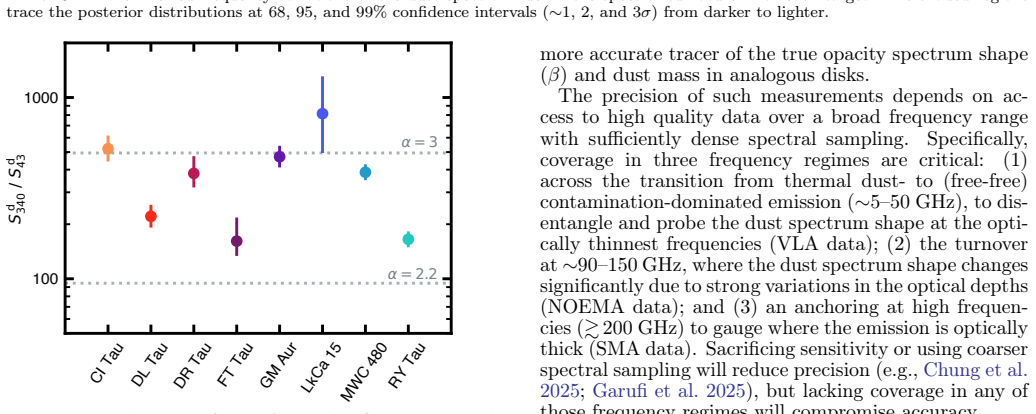
- The 340-to-43 GHz dust flux ratio varies by about a factor of five across the targets, so any single-frequency flux ratio is an unreliable universal mass proxy.
Reading between the lines
- If the optically thin 43 GHz assumption holds for the broader population, similar broadband observations of an unbiased sample could revise the census of disk masses and remove the apparent shortage of solids for planet formation.
- The steep low-frequency indices imply opacity spectra steeper than the canonical $\beta \approx 1$ extrapolation, so masses derived from a standard opacity law may be systematically low even for disks without directly observed curvature.
- Combining this sort of spectral decomposition with spatially resolved imaging could reveal whether the optically thick fraction is concentrated in ring-like dust traps or spread evenly through the disk.
- The absence of synchrotron and spinning-dust signatures in all eight targets suggests that future centimeter-band disk surveys may only need to model dust plus a single free-free component.
Editorial analysis
A structured set of objections, weighed in public.
Referee Report
Summary. The paper presents new, densely sampled 4-360 GHz continuum spectra of eight bright protoplanetary disks in Taurus, obtained with VLA, NOEMA, and SMA, supplemented by literature data. The authors model each spectrum as a sum of a free-free contamination component and a curved dust component, using several alternative empirical prescriptions with explicit treatment of correlated flux-calibration uncertainties. The main empirical finding is that the dust spectral index decreases with frequency, from α_d ≈ 2.8–4.0 near 43 GHz to ≈ 1.7–2.1 near 340 GHz for all eight disks, which they interpret as evidence that a substantial fraction of the (sub)millimeter dust emission is optically thick. In a second step, they use the 43 GHz dust flux and a model grid of dust absorption opacities to estimate dust masses, obtaining values peaking near ≈ 1000 M⊕, about an order of magnitude higher than traditional estimates based on 340 GHz fluxes with the Beckwith et al. (1990) opacity prescription.
Significance. The spectral-curvature measurements are a substantial new empirical contribution. The data handling is careful: the analysis propagates correlated calibration systematics through nuisance parameters, compares three independent dust prescriptions and two free-free prescriptions, and provides machine-readable data products. The finding that local dust spectral indices steepen at cm wavelengths, if confirmed, has broad implications for interpreting ALMA continuum surveys and for disk mass budgets. The derived mass estimates are more speculative: they depend on a strongly degenerate four-parameter dust model mapped from a single spectral-index measurement, and the paper does not currently demonstrate that the resulting opacity and mass distributions are driven by the data rather than by the priors. I therefore judge the core curvature claim to be solid but the headline mass numbers to require additional support.
major comments (2)
- [Section 4.2, Eq. (16), Figs. 11–12] The claim that the 43 GHz absorption opacities are 'clearly peaked at 0.03–0.1 cm2 g−1' is not established as a data-driven result. The posterior p(θ | α_d) conditions four dust parameters (p_d, a_max, f_fill, f_AC) on a single scalar observable, β(43 GHz) = α_d(43 GHz) − 2. The text and Appendix Figures 16–17 report that p_d, f_AC, and f_fill are essentially unconstrained and that a_max is broad and bimodal. In this regime the marginal posterior p(κ_43 | α_d) is close to the prior predictive distribution of κ_43 along the β iso-surface, and the uniform priors in p_d, f_AC, log f_fill, and log a_max have no reason to be flat in log κ_43. Because the mass estimate in Eq. (16) is inversely proportional to κ_43, the reported ≈ 1000 M⊕ peak may be a prior mode rather than an inference from the data. The authors should compare the κ_43 posterior to the prior predictive distribution, rerun the inference with modified priors (e.g., different ranges for a_max or f_fill, or log-uniform priors), and report how the peak and width of p(log κ_43) and p(log M_d) change. Without such a test, the 'order of magnitude higher' mass claim is not yet supported.
- [Section 4.2 and Figure 12] The mass distributions are summarized by their peak ('most probable') values, which is the statistic most sensitive to prior volume effects in a multimodal or skewed posterior. I recommend reporting the median and 68% credible intervals, and presenting results for at least one alternative set of priors, so that the reader can see which aspects of the mass estimate are stable. The associated text should also state more explicitly that the quoted masses are conditional on the assumed opacity grid, the adopted DSHARP-based composition, and the fixed T_d = 20 K, and that the 43 GHz flux is assumed to be optically thin.
minor comments (5)
- [Abstract and Section 5] The abstract's phrasing 'These masses are roughly an order of magnitude higher (≈ 1000 M⊕)' would be more accurate with a qualifier such as 'in our fiducial opacity model,' given the model dependence discussed in Section 4.2 and the caveats in Section 5.
- [Section 3.2.2, Table 5] The free-free turnover parameters log ν_c and log τ_c are unconstrained or only upper limits for most targets. The authors note that this ambiguity is propagated into the marginalized posteriors, and the Appendix comparison of two contamination prescriptions is reassuring. A short sentence quantifying the resulting systematic shift in α_d at 43 GHz (beyond the qualitative statement in the Appendix) would help readers assess the impact on the mass estimates.
- [Section 4.2, Appendix Figures 16–17] In the corner plots, the one-dimensional posterior for log κ_43 is shown, but the prior predictive distribution for log κ_43 is not. Adding this curve would directly address the prior-dominance concern and would make the figures considerably more informative.
- [Section 3.2.1, Table 4] The adopted calibration-group uncertainties σ_g (e.g., 5% for VLA C/X/Ku and 8–10% for NOEMA/SMA) are stated to be based on 'best available estimates,' but no explicit justification or reference is given for these values. Adding a brief justification would strengthen the error analysis.
- [Section 3.2.3, Equation (15)] The derivation of α(ν) from the sigmoid-index model is only described in words. A one-line derivation of the dη/dν term would improve readability, since this correction contributes non-negligibly to the reported α_d values at 43 GHz.
Circularity Check
No circular derivation: the spectral curvature is a direct fit to the data, and the mass estimates are transparent transformations with disclosed model assumptions; only a minor co-author opacity-grid citation appears.
full rationale
The paper's central claim is empirical: from densely sampled 4-360 GHz spectra it fits multi-component models (Eqs. 6-15) and reads off the dust spectral curvature alpha_d(nu). That claim is a fit to the measured fluxes, not an output of a fitted parameter renamed as a prediction, and it is cross-checked across two free-free prescriptions and three dust prescriptions in the Appendix. The subsequent dust mass estimates (Eq. 16) use the inferred 43 GHz dust flux, the measured alpha_d(43), and a precomputed opacity grid derived from a modified DSHARP model. The opacity posterior p(kappa_43 | alpha_d) is an underdetermined Bayesian inversion (one scalar constrains four dust parameters), so the reported kappa_43 peak may be prior-dominated; but this is a robustness or correctness concern, not circularity, because kappa_43 is not defined as the value that produces a target mass, and the mass posterior is not fed back into the spectral fit. The paper explicitly acknowledges the broad, bimodal, partially unconstrained dust-property posteriors and frames the masses as simplified estimates. The only notable self-citation is Ueda et al. (2025), a co-author reference that supplies the f_AC-modified composition/opacity grid used for the mass estimates; this is a model input rather than a load-bearing theorem, and the curvature finding is independent of it. No equation or parameter in the paper reduces to its own output by construction, so no specific circular step can be exhibited.
Assumptions & free parameters
free parameters (13)
- S0 =
0.47 to 1.88 mJy per target (Table 5)
- chi0 =
0.15 to 0.72 per target (Table 5)
- log tau_c =
Upper limits <0.2 to <1.2, otherwise unconstrained
- log nu_c =
Unconstrained (posteriors match priors)
- eta_- =
2.76 to 4.7 per target (Table 5)
- eta_+ =
2.0 to 2.6 per target (Table 5)
- log nu_d =
1.9 to 2.2 or upper limits (Table 5)
- log gamma =
-1.5 to -2.4 per target (Table 5)
- p_d =
Unconstrained
- a_max =
Broad peaked posterior
- f_fill =
Unconstrained
- f_AC =
Unconstrained
- T_d =
20 K fixed
assumptions (5)
- domain assumption Rayleigh-Jeans limit is appropriate at 43 GHz for disk temperatures above 20 K.
- domain assumption Emission at 43 GHz is optically thin.
- domain assumption The adopted opacity grid (modified DSHARP composition, Bruggeman mixing, distribution of hollow spheres) accurately represents real disk dust opacities.
- ad hoc to paper The non-dust emission is dominated by a single free-free mechanism.
- domain assumption The disk-averaged single-temperature approximation is adequate for mass estimates.
Cite this review
Pith. "Pith review of Detailed Microwave Continuum Spectra from Bright Protoplanetary Disks in Taurus." pith.science (2026). https://pith.science/paper/YCVGKQMV
@misc{pith2026250721268,
  author       = {Pith},
  title        = {Pith review of: Detailed Microwave Continuum Spectra from Bright Protoplanetary Disks in Taurus},
  year         = {2026},
  howpublished = {\url{https://pith.science/paper/YCVGKQMV}},
  note         = {Machine review of arXiv:2507.21268}
}
abstract
We present new observations that densely sample the microwave (4-360 GHz) continuum spectra from eight young systems in the Taurus region. Multi-component, empirical model prescriptions were used to disentangle the contributions from their dust disks and other emission mechanisms. We found partially optically thick, free-free emission in all these systems, with positive spectral indices (median $\alpha_{\rm c} \approx 1$ at 10 GHz) and contributing 5-50% of the 43 GHz fluxes. There is no evidence for synchrotron or spinning dust grain emission contributions for these targets. The inferred dust disk spectra all show substantial curvature: their spectral indices decrease with frequency, from $\alpha_{\rm d} \approx 2.8$-4.0 around 43 GHz to 1.7-2.1 around 340 GHz. This curvature suggests that a substantial fraction of the (sub)millimeter ($\gtrsim$ 200 GHz) dust emission may be optically thick, and therefore the traditional metrics for estimating dust masses are flawed. Assuming the emission at lower frequencies (43 GHz) is optically thin, the local spectral indices and fluxes were used to constrain the disk-averaged dust properties and estimate corresponding dust masses. These masses are roughly an order of magnitude higher ($\approx 1000 \, M_\oplus$) than those found from the traditional approach based on (sub)millimeter fluxes. These findings emphasize the value of broad spectral coverage - particularly extending to lower frequencies ($\sim$cm-band) - for accurately interpreting dust disk emission; such observations may help reshape our perspective on the available mass budgets for planet formation.
Figures


Figures from the paper (14 more)





Forward citations
Cited by 2 Pith papers
-
A JWST, ALMA and VLA survey of the Ophiuchus-A star-forming region: Unveiling hidden dust mass and connecting infrared outflows to their radio origins
A multi-wavelength survey of 20 Ophiuchus protostars finds dust masses tens to hundreds of times larger than millimetre-only estimates, if the adopted dust-opacity model is correct.
-
Ionized gas emission in protoplanetary disks with the SKAO
Synthetic SKA-Mid observations of simulated MHD and photoevaporative disk winds show that free-free emission is detectable in hours and stacked hydrogen recombination lines are spectrally resolvable in ~10 hours.
Reference graph
Works this paper leans on
-
[1]
, " * write output.state after.block = add.period write newline
ENTRY address archivePrefix author booktitle chapter doi edition editor eprint howpublished institution journal key month number organization pages publisher school series title misctitle type volume year version url label extra.label sort.label short.list INTEGERS output.state before.all mid.sentence after.sentence after.block FUNCTION init.state.consts ...
-
[2]
write newline
" write newline "" before.all 'output.state := FUNCTION format.url url empty "" new.block "" url * "" * if FUNCTION format.eprint eprint empty "" archivePrefix empty "" archivePrefix "arXiv" = new.block " " eprint * " " * new.block " " eprint * " " * if if if FUNCTION format.doi doi empty "" " " doi * " " * if FUNCTION format.pid doi empty eprint empty ur...
-
[3]
Adams , F., Emerson , J. P., & Fuller , G. A. 1990, , 357, 606, 10.1086/168949
doi:10.1086/168949 1990
-
[4]
Altenhoff , W., Thum , C., & Wendker , H. J. 1994, , 281, 161
1994
-
[5]
Andrews , S., Teague , R., Wirth , C. P., Huang , J., & Zhu , Z. 2024, , 970, 153, 10.3847/1538-4357/ad5285
-
[6]
2005, , 631, 1134, 10.1086/432712
Andrews , S., & Williams , J. 2005, , 631, 1134, 10.1086/432712
doi:10.1086/432712 2005
- [7]
-
[8]
Andrews , S., Wilner , D. J., Espaillat , C., et al. 2011, , 732, 42, 10.1088/0004-637X/732/1/42
Show all 137 references
-
[9]
Andrews , S. M. 2020, , 58, 483, 10.1146/annurev-astro-031220-010302
2020 doi
-
[10]
F., & Carrasco-Gonz \'a lez , C
Anglada , G., Rodr \' guez , L. F., & Carrasco-Gonz \'a lez , C. 2018, , 26, 3, 10.1007/s00159-018-0107-z
2018 doi
-
[11]
P., Tollerud , E
Astropy Collaboration , Robitaille , T. P., Tollerud , E. J., et al. 2013, , 558, A33, 10.1051/0004-6361/201322068
2013 doi
-
[12]
M., Sip o cz , B
Astropy Collaboration , Price-Whelan , A. M., Sip o cz , B. M., et al. 2018, , 156, 123, 10.3847/1538-3881/aabc4f
2018 doi
-
[13]
M., Lim , P
Astropy Collaboration , Price-Whelan , A. M., Lim , P. L., et al. 2022, , 935, 167, 10.3847/1538-4357/ac7c74
2022 doi
-
[14]
1991, , 381, 250, 10.1086/170646
Beckwith , S., & Sargent , A. 1991, , 381, 250, 10.1086/170646
1991 doi
-
[15]
I., Chini , R
Beckwith , S., Sargent , A. I., Chini , R. S., & Guesten , R. 1990, , 99, 924, 10.1086/115385
1990 doi
-
[16]
J., Clegg , P
Beichman , C., Neugebauer , G., Habing , H. J., Clegg , P. E., & Chester , T. J., eds. 1988, Infrared astronomical satellite (IRAS) catalogs and atlases. Volume 1: Explanatory supplement , Vol. 1
1988
-
[17]
P., Zhu , Z., et al
Birnstiel , T., Dullemond , C. P., Zhu , Z., et al. 2018, , 869, L45, 10.3847/2041-8213/aaf743
2018 doi
-
[18]
Bruggeman , D. A. G. 1935, Annalen der Physik, 416, 636, 10.1002/andp.19354160705
1935 doi
-
[19]
2019, , 883, 71, 10.3847/1538-4357/ab3d33
Carrasco-Gonz \'a lez , C., Sierra , A., Flock , M., et al. 2019, , 883, 71, 10.3847/1538-4357/ab3d33
2019 doi
-
[20]
2022, , 134, 114501, 10.1088/1538-3873/ac9642
CASA Team , Bean , B., Bhatnagar , S., et al. 2022, , 134, 114501, 10.1088/1538-3873/ac9642
2022 doi
-
[21]
B., & Lonsdale , C
Chiang , E., Phillips , R. B., & Lonsdale , C. J. 1996, , 111, 355, 10.1086/117788
1996 doi
-
[22]
M., Gurwell , M
Chung , C.-Y., Andrews , S. M., Gurwell , M. A., et al. 2024, , 273, 29, 10.3847/1538-4365/ad528b
2024 doi
-
[23]
2025, , 277, 45, 10.3847/1538-4365/adb717
Chung , C.-Y., Tsai , A.-L., Wright , M., et al. 2025, , 277, 45, 10.3847/1538-4365/adb717
2025 doi
-
[24]
2018, , 866, L6, 10.3847/2041-8213/aae36b
Clarke , C., Tazzari , M., Juhasz , A., et al. 2018, , 866, L6, 10.3847/2041-8213/aae36b
2018 doi
-
[25]
P., Ainsworth , R
Coughlan , C. P., Ainsworth , R. E., Eisl \"o ffel , J., et al. 2017, , 834, 206, 10.3847/1538-4357/834/2/206
2017 doi
-
[26]
2006, , 638, 314, 10.1086/498861
D'Alessio , P., Calvet , N., Hartmann , L., Franco-Hern \'a ndez , R., & Serv \' n , H. 2006, , 638, 314, 10.1086/498861
2006 doi
-
[27]
2021, Astrophysics Source Code Library, ascl
Dominik, C., Min, M., & Tazaki, R. 2021, Astrophysics Source Code Library, ascl
2021
-
[28]
Draine , B. T. 2006, , 636, 1114, 10.1086/498130
2006 doi
-
[29]
2023, in Astronomical Society of the Pacific Conference Series, Vol
Dr a \.z kowska , J., Bitsch , B., Lambrechts , M., et al. 2023, in Astronomical Society of the Pacific Conference Series, Vol. 534, Protostars and Planets VII, ed. S. Inutsuka , Y. Aikawa , T. Muto , K. Tomida , & M. Tamura , 717, 10.48550/arXiv.2203.09759
-
[30]
1996, , 309, 493
Dutrey , A., Guilloteau , S., Duvert , G., et al. 1996, , 309, 493
1996
-
[31]
2000, , 355, 165
Duvert , G., Guilloteau , S., M \'e nard , F., Simon , M., & Dutrey , A. 2000, , 355, 165
2000
-
[32]
F., et al
Dzib , S., Loinard , L., Rodr \' guez , L. F., et al. 2015, , 801, 91, 10.1088/0004-637X/801/2/91
2015 doi
-
[33]
2019, , 877, L34, 10.3847/2041-8213/ab2193
Espaillat , C., Mac \' as , E., Hern \'a ndez , J., & Robinson , C. 2019, , 877, L34, 10.3847/2041-8213/ab2193
2019 doi
-
[34]
2016, The Journal of Open Source Software, 24, 10.21105/joss.00024
Foreman-Mackey, D. 2016, The Journal of Open Source Software, 24, 10.21105/joss.00024
2016 doi
-
[35]
W., Lang , D., & Goodman , J
Foreman-Mackey , D., Hogg , D. W., Lang , D., & Goodman , J. 2013, , 125, 306, 10.1086/670067
2013 doi
-
[36]
Gaia Collaboration , Vallenari , A., Brown , A. G. A., et al. 2023, , 674, A1, 10.1051/0004-6361/202243940
2023 doi
-
[37]
2022, , 667, A124, 10.1051/0004-6361/202244042
Gangi , M., Antoniucci , S., Biazzo , K., et al. 2022, , 667, A124, 10.1051/0004-6361/202244042
2022 doi
-
[38]
2025, , 694, A290, 10.1051/0004-6361/202452496
Garufi , A., Carrasco-Gonz \'a lez , C., Mac \' as , E., et al. 2025, , 694, A290, 10.1051/0004-6361/202452496
2025 doi
- [39]
-
[40]
2010, Comm
Goodman , J., & Weare , J. 2010, Comm. App. Math. Comp. Sci., 5, 65
2010
-
[41]
2022, , 513, 3180, 10.1093/mnras/stac856
Greaves , J., & Mason , B. 2022, , 513, 3180, 10.1093/mnras/stac856
2022 doi
-
[42]
S., & Rice , W
Greaves , J. S., & Rice , W. K. M. 2010, , 407, 1981, 10.1111/j.1365-2966.2010.17043.x
2010
-
[43]
2002, , 40, 217, 10.1146/annurev.astro.40.060401.093806
G \"u del , M. 2002, , 40, 217, 10.1146/annurev.astro.40.060401.093806
2002
-
[44]
2022, Astronomy & Astrophysics, 664, A137
Guidi, G., Isella, A., Testi, L., et al. 2022, Astronomy & Astrophysics, 664, A137
2022
-
[45]
2011, , 529, A105, 10.1051/0004-6361/201015209
Guilloteau , S., Dutrey , A., Pi \'e tu , V., & Boehler , Y. 2011, , 529, A105, 10.1051/0004-6361/201015209
2011 doi
-
[46]
W., & Mundy , L
Hamidouche , M., Looney , L. W., & Mundy , L. G. 2006, , 651, 321, 10.1086/507693
2006 doi
-
[47]
R., Millman, K
Harris, C. R., Millman, K. J., van der Walt, S. J., et al. 2020, Nature, 585, 357, 10.1038/s41586-020-2649-2
2020 doi
-
[48]
D., Looney , L
Harrison , R., Lin , Z.-Y. D., Looney , L. W., et al. 2024, , 967, 40, 10.3847/1538-4357/ad39ec
2024 doi
-
[49]
W., Stephens , I
Harrison , R., Looney , L. W., Stephens , I. W., et al. 2019, , 877, L2, 10.3847/2041-8213/ab1e46
2019 doi
-
[50]
1995, , 452, 736, 10.1086/176344
Hartigan , P., Edwards , S., & Ghandour , L. 1995, , 452, 736, 10.1086/176344
1995 doi
-
[51]
B., Dong , R., Liu , B., & Muto , T
Hashimoto , J., Liu , H. B., Dong , R., Liu , B., & Muto , T. 2022, , 941, 66, 10.3847/1538-4357/aca01d
2022 doi
-
[52]
1996, , 311, 291
Henning , T., & Stognienko , R. 1996, , 311, 291
1996
-
[53]
Hildebrand , R. H. 1983, , 24, 267
1983
- [54]
-
[55]
2018, , 862, 116, 10.3847/1538-4357/aaccf0
Hoang , T., Lan , N.-Q., Vinh , N.-A., & Kim , Y.-J. 2018, , 862, 116, 10.3847/1538-4357/aaccf0
2018 doi
-
[56]
D., et al
Howard , C., Sandell , G., Vacca , W. D., et al. 2013, , 776, 21, 10.1088/0004-637X/776/1/21
2013 doi
-
[57]
A., Bae , J., Benisty , M., & Andrews , S
Huang , J., Bergin , E. A., Bae , J., Benisty , M., & Andrews , S. M. 2023, , 943, 107, 10.3847/1538-4357/aca89c
2023 doi
-
[58]
I., Qi , C., et al
Huang , J., \"O berg , K. I., Qi , C., et al. 2017, , 835, 231, 10.3847/1538-4357/835/2/231
2017 doi
-
[59]
M., Dullemond , C
Huang , J., Andrews , S. M., Dullemond , C. P., et al. 2018 a , , 869, L42, 10.3847/2041-8213/aaf740
2018 doi
-
[60]
M., Cleeves , L
Huang , J., Andrews , S. M., Cleeves , L. I., et al. 2018 b , , 852, 122, 10.3847/1538-4357/aaa1e7
2018 doi
-
[61]
M., Dullemond , C
Huang , J., Andrews , S. M., Dullemond , C. P., et al. 2020, , 891, 48, 10.3847/1538-4357/ab711e
2020 doi
-
[62]
J., Qi , C., & Hogerheijde , M
Hughes , A., Wilner , D. J., Qi , C., & Hogerheijde , M. R. 2008, , 678, 1119, 10.1086/586730
2008 doi
-
[63]
M., Espaillat , C., et al
Hughes , A., Andrews , S. M., Espaillat , C., et al. 2009, , 698, 131, 10.1088/0004-637X/698/1/131
2009 doi
-
[64]
Hunter, J. D. 2007, Computing In Science & Engineering, 9, 90
2007
-
[65]
M., & Sargent , A
Isella , A., Carpenter , J. M., & Sargent , A. I. 2009, , 701, 260, 10.1088/0004-637X/701/1/260
2009 doi
-
[66]
J., Carpenter , J
Isella , A., Chandler , C. J., Carpenter , J. M., P \'e rez , L. M., & Ricci , L. 2014, , 788, 129, 10.1088/0004-637X/788/2/129
2014 doi
-
[67]
M., & Carpenter , J
Isella , A., P \'e rez , L. M., & Carpenter , J. M. 2012, , 747, 136, 10.1088/0004-637X/747/2/136
2012 doi
-
[68]
2010, , 514, A1, 10.1051/0004-6361/200913811
Ishihara , D., Onaka , T., Kataza , H., et al. 2010, , 514, A1, 10.1051/0004-6361/200913811
2010 doi
-
[69]
J., Booth , R
Jennings , J., Tazzari , M., Clarke , C. J., Booth , R. A., & Rosotti , G. P. 2022, , 514, 6053, 10.1093/mnras/stac1770
2022 doi
-
[70]
2014, , 568, A42, 10.1051/0004-6361/201323199
Kataoka , A., Okuzumi , S., Tanaka , H., & Nomura , H. 2014, , 568, A42, 10.1051/0004-6361/201323199
2014 doi
-
[71]
2002, , 581, 357, 10.1086/344223
Kitamura , Y., Momose , M., Yokogawa , S., et al. 2002, , 581, 357, 10.1086/344223
2002 doi
-
[72]
W., Mundy , L
Kwon , W., Looney , L. W., Mundy , L. G., & Welch , W. J. 2015, , 808, 102, 10.1088/0004-637X/808/1/102
2015 doi
-
[73]
Liu , H. B. 2019, , 877, L22, 10.3847/2041-8213/ab1f8e
2019 doi
-
[74]
B., Casassus , S., Dong , R., et al
Liu , H. B., Casassus , S., Dong , R., et al. 2024 a , , 972, 163, 10.3847/1538-4357/ad5dab
2024 doi
-
[75]
B., Muto , T., Konishi , M., et al
Liu , H. B., Muto , T., Konishi , M., et al. 2024 b , , 685, A18, 10.1051/0004-6361/202348896
2024 doi
-
[76]
J., et al
Long , F., Pinilla , P., Herczeg , G. J., et al. 2018, , 869, 17, 10.3847/1538-4357/aae8e1
2018 doi
-
[77]
J., Harsono , D., et al
Long , F., Herczeg , G. J., Harsono , D., et al. 2019, , 882, 49, 10.3847/1538-4357/ab2d2d
2019 doi
-
[78]
J., et al
Long , F., Pinilla , P., Herczeg , G. J., et al. 2020, , 898, 36, 10.3847/1538-4357/ab9a54
2020 doi
-
[79]
G., & Welch , W
Looney , L., Mundy , L. G., & Welch , W. J. 2000, , 529, 477, 10.1086/308239
2000 doi
-
[80]
2021, , 648, A33, 10.1051/0004-6361/202039812
Mac \' as , E., Guerra-Alvarado , O., Carrasco-Gonz \'a lez , C., et al. 2021, , 648, A33, 10.1051/0004-6361/202039812
2021 doi
-
[81]
2016, , 829, 1, 10.3847/0004-637X/829/1/1
Mac \' as , E., Anglada , G., Osorio , M., et al. 2016, , 829, 1, 10.3847/0004-637X/829/1/1
2016 doi
- [82]
-
[83]
F., Morbidelli , A., & Guillot , T
Manara , C. F., Morbidelli , A., & Guillot , T. 2018, , 618, L3, 10.1051/0004-6361/201834076
2018 doi
-
[84]
1994, , 267, 361
Mannings , V., & Emerson , J. 1994, , 267, 361
1994
-
[85]
1997, , 490, 792, 10.1086/304897
Mannings , V., & Sargent , A. 1997, , 490, 792, 10.1086/304897
1997 doi
-
[86]
1967, , 147, 471, 10.1086/149030
Mezger , P., & Henderson , A. 1967, , 147, 471, 10.1086/149030
1967 doi
-
[87]
W., & de Koter , A
Min , M., Hovenier , J. W., & de Koter , A. 2005, , 432, 909, 10.1051/0004-6361:20041920
2005 doi
-
[88]
1993, Icarus, 106, 20, 10.1006/icar.1993.1156
Miyake , K., & Nakagawa , Y. 1993, Icarus, 106, 20, 10.1006/icar.1993.1156
1993
-
[89]
1993, icarus, 106, 20
Miyake, K., & Nakagawa, Y. 1993, icarus, 106, 20
1993
- [90]
-
[91]
\"O berg , K., Qi , C., Fogel , J. K. J., et al. 2010, , 720, 480, 10.1088/0004-637X/720/1/480
2010 doi
-
[92]
1996, , 466, 317, 10.1086/177512
Ohashi , N., Hayashi , M., Kawabe , R., & Ishiguro , M. 1996, , 466, 317, 10.1086/177512
1996 doi
-
[93]
1995, , 439, 288, 10.1086/175172
Osterloh , M., & Beckwith , S. 1995, , 439, 288, 10.1086/175172
1995 doi
-
[94]
2024, The am atmospheric model, 14.0, Zenodo, 10.5281/zenodo.13748391
Paine, S. 2024, The am atmospheric model, 14.0, Zenodo, 10.5281/zenodo.13748391
2024 doi
-
[95]
2012, , 751, L42, 10.1088/2041-8205/751/2/L42
Pascucci , I., Gorti , U., & Hollenbach , D. 2012, , 751, L42, 10.1088/2041-8205/751/2/L42
2012 doi
-
[96]
2014, , 795, 1, 10.1088/0004-637X/795/1/1
Pascucci , I., Ricci , L., Gorti , U., et al. 2014, , 795, 1, 10.1088/0004-637X/795/1/1
2014 doi
-
[97]
2017, , 230, 7, 10.3847/1538-4365/aa6df9
Perley , R., & Butler , B. 2017, , 230, 7, 10.3847/1538-4365/aa6df9
2017 doi
-
[98]
2006, , 460, L43, 10.1051/0004-6361:20065968
Pi \'e tu , V., Dutrey , A., Guilloteau , S., Chapillon , E., & Pety , J. 2006, , 460, L43, 10.1051/0004-6361:20065968
2006 doi
-
[99]
B., Hubickyj , O., Bodenheimer , P., et al
Pollack , J. B., Hubickyj , O., Bodenheimer , P., et al. 1996, Icarus, 124, 62, 10.1006/icar.1996.0190
1996
-
[100]
Rafikov , R. R. 2006, , 646, 288, 10.1086/504793
2006 doi
-
[101]
2011, , 532, A71, 10.1051/0004-6361/201117104
Rau , U., & Cornwell , T. 2011, , 532, A71, 10.1051/0004-6361/201117104
2011 doi
-
[102]
L., McCabe , C.-E., et al
Rebull , L., Padgett , D. L., McCabe , C.-E., et al. 2010, , 186, 259, 10.1088/0067-0049/186/2/259
2010 doi
-
[103]
Reynolds , S. P. 1986, , 304, 713, 10.1086/164209
1986 doi
-
[104]
C., Mac \' as, E., & Sarro, L
Ribas, \'A ., Espaillat, C. C., Mac \' as, E., & Sarro, L. M. 2020, Astronomy & Astrophysics, 642, A171
2020
-
[105]
C., Mac \' as , E., et al
Ribas , \'A ., Espaillat , C. C., Mac \' as , E., et al. 2017, , 849, 63, 10.3847/1538-4357/aa8e99
2017 doi
-
[106]
Ricci , L., Testi , L., Natta , A., & Brooks , K. J. 2010 a , , 521, A66, 10.1051/0004-6361/201015039
2010 doi
-
[107]
2010 b , , 512, A15, 10.1051/0004-6361/200913403
Ricci , L., Testi , L., Natta , A., et al. 2010 b , , 512, A15, 10.1051/0004-6361/200913403
2010 doi
-
[108]
2012, , 540, A6, 10.1051/0004-6361/201118296
Ricci , L., Trotta , F., Testi , L., et al. 2012, , 540, A6, 10.1051/0004-6361/201118296
2012 doi
-
[109]
J., Mundy , L
Rodmann , J., Henning , T., Chandler , C. J., Mundy , L. G., & Wilner , D. J. 2006, , 446, 211, 10.1051/0004-6361:20054038
2006 doi
- [110]
-
[111]
A., & Hamidouche , M
Sandell , G., Weintraub , D. A., & Hamidouche , M. 2011, , 727, 26, 10.1088/0004-637X/727/1/26
2011 doi
-
[112]
M., Zhang , K., et al
Sierra , A., P \'e rez , L. M., Zhang , K., et al. 2021, , 257, 14, 10.3847/1538-4365/ac1431
2021 doi
-
[113]
K., Harsono , D., et al
Sturm , J., McClure , M. K., Harsono , D., et al. 2022, , 660, A126, 10.1051/0004-6361/202141860
2022 doi
-
[114]
2016, , 588, A53, 10.1051/0004-6361/201527423
Tazzari , M., Testi , L., Ercolano , B., et al. 2016, , 588, A53, 10.1051/0004-6361/201527423
2016 doi
-
[115]
2021, , 506, 5117, 10.1093/mnras/stab1912
Tazzari , M., Testi , L., Natta , A., et al. 2021, , 506, 5117, 10.1093/mnras/stab1912
2021 doi
-
[116]
2025, , 984, L6, 10.3847/2041-8213/adc43b
Teague , R., Benisty , M., Facchini , S., et al. 2025, , 984, L6, 10.3847/2041-8213/adc43b
2025 doi
-
[117]
B., & Bally , J
Throop , H. B., & Bally , J. 2008, , 135, 2380, 10.1088/0004-6256/135/6/2380
2008 doi
-
[118]
2002, , 574, 740, 10.1086/341002
Tremaine , S., Gebhardt , K., Bender , R., et al. 2002, , 574, 740, 10.1086/341002
2002 doi
-
[119]
M., Birnstiel , T., & Wilner , D
Tripathi , A., Andrews , S. M., Birnstiel , T., & Wilner , D. J. 2017, , 845, 44, 10.3847/1538-4357/aa7c62
2017 doi
-
[120]
2016, , 829, L35, 10.3847/2041-8205/829/2/L35
Tsukagoshi , T., Nomura , H., Muto , T., et al. 2016, , 829, L35, 10.3847/2041-8205/829/2/L35
2016 doi
-
[121]
F., Rosotti , G
Tychoniec , ., Manara , C. F., Rosotti , G. P., et al. 2020, , 640, A19, 10.1051/0004-6361/202037851
2020 doi
-
[122]
T., Wright , C
Ubach , C., Maddison , S. T., Wright , C. M., et al. 2012, , 425, 3137, 10.1111/j.1365-2966.2012.21603.x
2012
- [123]
-
[124]
M., Carrasco-Gonz \'a lez , C., et al
Ueda , T., Andrews , S. M., Carrasco-Gonz \'a lez , C., et al. 2025, arXiv e-prints, arXiv:2507.14443. 2507.14443
2025 arXiv
-
[125]
2020, The Journal of Open Source Software, 5, 2004, 10.21105/joss.02004
van der Velden , E. 2020, The Journal of Open Source Software, 5, 2004, 10.21105/joss.02004
2020 doi
-
[126]
E., et al
Virtanen, P., Gommers, R., Oliphant, T. E., et al. 2020, Nature Methods, 17, 261, 10.1038/s41592-019-0686-2
2020 doi
-
[127]
M., Mac \' as, E., Zagaria, F., et al
Viscardi, E. M., Mac \' as, E., Zagaria, F., et al. 2025, Astronomy & Astrophysics, 695, A147
2025
-
[128]
Waskom, M. L. 2021, Journal of Open Source Software, 6, 3021, 10.21105/joss.03021
2021 doi
-
[129]
Weintraub , D., Sandell , G., & Duncan , W. D. 1989, , 340, L69, 10.1086/185441
1989 doi
-
[130]
Wilner, D. J. 2004, New Astronomy Reviews, 48, 1363
2004
-
[131]
J., D'Alessio , P., Calvet , N., Claussen , M
Wilner , D. J., D'Alessio , P., Calvet , N., Claussen , M. J., & Hartmann , L. 2005, , 626, L109, 10.1086/431757
2005 doi
-
[132]
J., Benisty , M., & Andrews , S
Winter , A. J., Benisty , M., & Andrews , S. M. 2024, , 972, L9, 10.3847/2041-8213/ad6d5d
2024 doi
-
[133]
2016, , 586, A103, 10.1051/0004-6361/201526538
Woitke , P., Min , M., Pinte , C., et al. 2016, , 586, A103, 10.1051/0004-6361/201526538
2016 doi
-
[134]
C., Rilinger , A
Xin , Z., Espaillat , C. C., Rilinger , A. M., Ribas , \'A ., & Mac \' as , E. 2023, , 942, 4, 10.3847/1538-4357/aca52b
2023 doi
-
[135]
F., & Palau , A
Zapata , L., Rodr \' guez , L. F., & Palau , A. 2017, , 834, 138, 10.3847/1538-4357/834/2/138
2017 doi
-
[136]
2019, , 877, L18, 10.3847/2041-8213/ab1f8c
Zhu , Z., Zhang , S., Jiang , Y.-F., et al. 2019, , 877, L18, 10.3847/2041-8213/ab1f8c
2019 doi
-
[137]
G., Mennella , V., Colangeli , L., & Bussoletti , E
Zubko , V. G., Mennella , V., Colangeli , L., & Bussoletti , E. 1996, , 282, 1321
1996
Reviewed August 6, 2026 · model on record in the stance chip above.
Discussion (0). Continue with ORCID to comment.