REVIEW 5 major objections 5 minor 39 references
PlaneHEC: Efficient Hand-Eye Calibration for Multi-view Robotic Arm via Any Point Cloud Plane Detection
T0 review · 5 major / 5 minor · reviewed 2026-08-06 · deepseek-v4-flash
Pith's one-line read The paper shows that the hand-eye transform $X$ of a robot-mounted depth camera can be recovered from a single flat surface by solving $Y = M_i X A_i$, using a closed-form linear solve refined by Gauss–Newton on SE(3).
desk verdict A genuinely new plane-constraint calibration formulation with solid real-robot validation, but the paper overclaims universality and omits the observability analysis that would make the method safe to use. read the letter →
The pith
A machine-rendered reading of the paper's core claim, the machinery that carries it, and where it could break.
The reading
What carries the argument
The central object is the plane-constraint equation $Y = M_i X A_i$, in which $M_i$ is a $1\times 4$ row vector (unit normal and signed distance) of the fixed plane observed from view $i$, $A_i$ is the robot pose from forward kinematics, and $X$ is the unknown camera-to-tool transform. The equation encodes the invariance of the plane in the robot base frame. The solution machinery is a Kronecker-product linear system for $\mathrm{vec}(R_X)$ whose least-squares solution is orthogonalized by SVD, a linear solve for $t_X$, and a Gauss–Newton update using the Lie-algebra perturbation model $(Xp)^\odot$, iterating until $\Delta X$ is small.
What would settle it
Collect point clouds of one plane from several views while keeping the robot end-effector orientation essentially constant (rotational diversity near zero). The paper's derivation predicts the coefficient matrix in Eq. 11 becomes rank-deficient and the recovered $X$ should scatter across trials; if repeated runs still give a stable, accurate $X$, the claimed need for non-parallel consecutive views is contradicted, whereas unstable $X$ would confirm the degeneracy.
Extended reading notes
Core claim
The central claim is that the hand-eye transformation $X$ can be fully recovered by observing one static plane from multiple robot poses and solving $Y = M_i X A_i$, where $M_i = (v_i^T, d_i)$ is the plane row vector from RANSAC and $A_i$ is the robot pose. The rotation part is rewritten as a homogeneous Kronecker-product system $(R_{A,j}^T \otimes v_j^T - R_{A,j+1}^T \otimes v_{j+1}^T)\mathrm{vec}(R_X)=0$, solved by SVD; the translation is then a linear least-squares problem. A Gauss–Newton iteration on SE(3) refines both jointly, using the closed-form result as initialization. The paper reports a mean rotation error of 0.13 degrees and a mean translation error of 3.35 mm on a RealSense-D435 camera on a FLEXIV-Rizon 4 arm using 30 views, and states that the translation error falls below the camera's depth accuracy because plane fitting averages many points.
Load-bearing premise
The method assumes the robot's reported poses $A_i$ are exact and that the observed views provide enough rotational diversity for the homogeneous linear system for $\mathrm{vec}(R_X)$ to have a unique least-squares solution; if the arm's orientation barely changes between views, the coefficient matrix becomes rank-deficient and the solved rotation is arbitrary.
Editorial extensions
If this is right
- Hand-eye calibration loses the need for calibration boards, markers, or precise geometric models; any sufficiently flat surface suffices.
- Because plane fitting uses many points, the reported 3.35 mm translation error is below the camera's depth noise, so calibration accuracy is not limited by raw sensor error.
- Rotation error below 0.7 degrees in all trials, with 0.13 degrees at 30 views, makes the method usable where orientation accuracy matters.
- With about 8.6 iterations and 0.28 seconds total runtime, the method is fast enough for online or repeated recalibration.
Reading between the lines
- The same plane-constraint equations could be extended to eye-to-hand setups or to multiple planes in a single view; the paper does not test these configurations, but the algebra does not depend on the mounting side.
- The authors leave the degeneracy condition uncharacterized; a quantitative threshold on the minimum rotation angle between consecutive views would let users verify their data collection before solving.
- Because the closed-form step is linear, a recursive update of the plane vector $M_i$ could turn PlaneHEC into an online calibration procedure; the paper only reports a batch solution.
Signed reviews
Editorial analysis
A structured set of objections, weighed in public.
Referee Report
Summary. PlaneHEC is a hand-eye calibration method for eye-in-hand RGB-D cameras that uses observations of an arbitrary planar surface. For each view, a RANSAC plane fit produces a 1x4 row vector M_i, and the robot pose A_i is read from the controller; these are combined into the constraint Y = M_i X A_i, where X is the unknown hand-eye transform. The paper derives a closed-form rotation estimate from vectorized pairwise differences of these constraints, solves for the translation, and then refines both with a Gauss-Newton iteration on SE(3). Experiments on a FLEXIV-Rizon 4 robot with a RealSense D435 report rotation and translation errors of 0.13 deg and 3.35 mm, along with reconstruction consistency checks and a runtime of 0.28 s, and the paper claims that PlaneHEC is the fastest and most accurate among compared point-cloud-based methods.
Significance. The central idea is practically attractive: no calibration object is needed, plane parameters aggregate many depth points against sensor noise, and the closed-form stage avoids the initialization problem of ICP-based approaches. The use of 1x4 plane-row constraints with a Kronecker-product linear solution is a useful reformulation of the hand-eye problem for depth cameras. If the derivation and evaluation are corrected, the method could be a solid engineering contribution to camera-robot calibration. The paper does not provide code or data, but it does validate on held-out reconstruction frames, which is a reasonable consistency check rather than a circular fit to the calibrated transform. The main weaknesses are technical inconsistencies in the optimization derivation, an uncharacterized degeneracy condition in the closed-form rotation stage, and a mismatch between the claimed simulation evaluation and the actual experiments.
major comments (5)
- [III-D (Eqs. 17-18)] The residual blocks in Eq. (17) use inconsistent subscripts (i/i+1 in the first line versus j/j+1 in the others) and include spurious M X (0;1) terms that do not cancel because M_j and M_{j+1} differ. Eq. (18) mirrors the same problems in the Jacobian. As written, these equations do not equal the columns of g_j = M_j X A_j - M_{j+1} X A_{j+1}, so the Gauss-Newton stage is not reproducible and may be incorrect. Please rewrite the residual and Jacobian with consistent indices and verify the perturbation signs.
- [III-A (Eq. 6)] The claimed normalization is not what right multiplication by A_average does: A_i times A_average has translation -R_{A,i} t_average + t_{A,i}, not t_{A,i} - t_average, so the resulting translation is not centered. More importantly, replacing A_i by a modified pose changes Y = M_i X A_i unless Y is redefined accordingly, so the plane constraint is not invariant under this operation. State precisely how the translations are normalized and prove that the plane equations remain satisfied; if left multiplication was intended, the effect on the constraint must still be addressed.
- [III-C (Eq. 11)] The rotation stage solves a homogeneous linear system whose unique least-squares solution requires the stacked coefficient matrix to have rank exactly 8. The paper gives no observability analysis, no pose-selection guidance, and no simulation that sweeps pose diversity. Degenerate motions such as pure translations, rotations about a single axis, or rotations about the plane normal make the coefficient matrix rank-deficient, in which case the SVD solution is an arbitrary vector in a null space and the resulting R_X is meaningless. This closed-form R_X is used as the initial value for Gauss-Newton, so the degeneracy directly undermines the overall method. Please add a rank/degeneracy condition and validate it with simulated or real pose-diversity experiments.
- [IV (Experiments)] The abstract and conclusion state that PlaneHEC was evaluated in both simulated and real-world environments, but the manuscript contains no simulation experiment at all. All numerical accuracy results come from a single real platform, and the values in Table I are standard deviations over 50 random subsets rather than errors against a known ground-truth X. Thus the headline figures (0.13 deg, 3.35 mm) demonstrate repeatability or consistency, not absolute calibration accuracy. Add a simulation study with known X and controlled plane-detection noise, or explicitly qualify the accuracy claims as consistency measures.
- [Table II and Section IV-D] Table II compares numbers taken from different publications with different sensors, robots, and accuracy levels, using et/max(Ec,ER) as a normalization; this does not establish that PlaneHEC is more accurate than the baselines under the same protocol. The runtime claim is also unclear: Section IV-D says the average processing time for 500 frames was approximately 0.01 s per frame, while Table II lists a runtime of 0.28 s and says the majority of runtime is plane detection. Clarify what the 0.28 s includes and, if feasible, run at least one baseline on the same platform before claiming state-of-the-art accuracy and speed.
minor comments (5)
- [Abstract/Conclusion] The claim of evaluation in 'simulated and real-world environments' is contradicted by the absence of any simulation section; this should be corrected in the abstract and conclusion.
- [Table I] The caption and text refer to rotation and translation 'errors', but the reported quantities are standard deviations of repeated estimates computed from random subsets; the terminology should be changed to variability or consistency.
- [III-A] The procedure for resolving the sign of the RANSAC plane normal so that Y equals M_base rather than -M_base is not described; please specify how the direction of the normal vector is determined.
- [IV-D] The runtime accounting needs consistency: 0.01 s per frame over 500 frames implies 5 s, not 0.28 s; state which stages are included in the reported runtime and which are excluded.
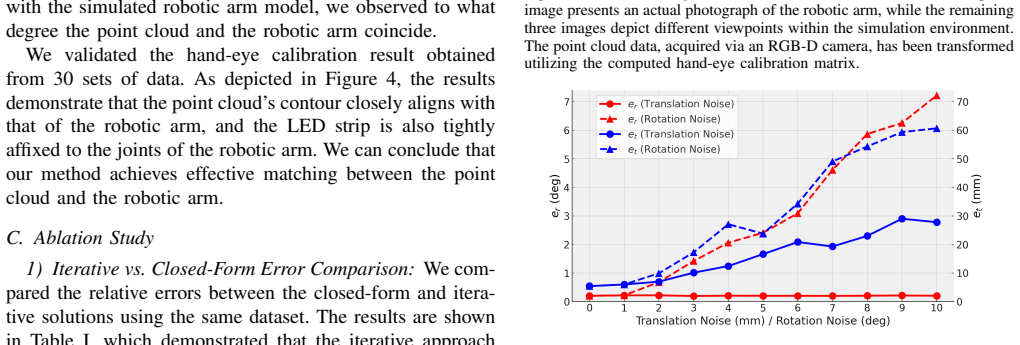
- [Figures 3 and 5] The axes and legends of Figures 3 and 5 are not described in the text or captions, making the plots difficult to interpret; please provide units and legend definitions.
Circularity Check
No significant circularity: PlaneHEC derives X from plane-invariance constraints and validates on held-out frames, with no fitted parameter presented as a prediction.
full rationale
The derivation chain is self-contained. The target hand-eye transformation X enters only through the plane-invariance constraint Y = M X A (Eq. 7). The closed-form stage solves the homogeneous linear system in Eq. 11 for vec(R_X) and then the non-homogeneous system in Eq. 12 for t_X. No free parameter is fitted to a known ground-truth hand-eye pose, and the reported accuracy is not constructed from the calibrated X. The Gauss-Newton refinement in Eqs. 13-23 minimizes the same residual and uses the closed-form solution only as an initial value. Validation explicitly uses held-out data: the paper states that after randomly selecting some sets of data to compute the calibration matrix, it uses 'the remaining data for plane reconstruction.' Thus the evaluation metric is independent of the calibrated X. The paper contains no load-bearing self-citations; the citations [33]-[35] are standard mathematical references for Kronecker products and Lie derivatives. The main substantive concern, an uncharacterized rank-degeneracy condition for Eq. 11 under insufficient pose diversity, is a correctness or observability limitation rather than a circular dependency, because it does not make the output equal to an input by construction.
Assumptions & free parameters
free parameters (4)
- RANSAC inlier distance threshold =
not disclosed
- RANSAC inlier ratio =
not disclosed
- Gauss-Newton convergence threshold =
not disclosed
- Number of calibration views =
30 for headline result
assumptions (6)
- domain assumption The observed surface is a single static plane in the robot base frame.
- domain assumption The robot pose readings A_i are accurate enough to serve as exact inputs.
- domain assumption RANSAC returns a plane equation that accurately represents the observed surface.
- domain assumption The multi-view configuration is non-degenerate, so Eq.11 has a unique solution for vec(R_X).
- domain assumption Gauss-Newton from the closed-form initialization converges to the global optimum.
- standard math Standard Kronecker-product and SVD identities hold.
Cite this review
Pith. "Pith review of PlaneHEC: Efficient Hand-Eye Calibration for Multi-view Robotic Arm via Any Point Cloud Plane Detection." pith.science (2026). https://pith.science/paper/YCXPH2AV
@misc{pith2026250719851,
  author       = {Pith},
  title        = {Pith review of: PlaneHEC: Efficient Hand-Eye Calibration for Multi-view Robotic Arm via Any Point Cloud Plane Detection},
  year         = {2026},
  howpublished = {\url{https://pith.science/paper/YCXPH2AV}},
  note         = {Machine review of arXiv:2507.19851}
}
read the original abstract
Hand-eye calibration is an important task in vision-guided robotic systems and is crucial for determining the transformation matrix between the camera coordinate system and the robot end-effector. Existing methods, for multi-view robotic systems, usually rely on accurate geometric models or manual assistance, generalize poorly, and can be very complicated and inefficient. Therefore, in this study, we propose PlaneHEC, a generalized hand-eye calibration method that does not require complex models and can be accomplished using only depth cameras, which achieves the optimal and fastest calibration results using arbitrary planar surfaces like walls and tables. PlaneHEC introduces hand-eye calibration equations based on planar constraints, which makes it strongly interpretable and generalizable. PlaneHEC also uses a comprehensive solution that starts with a closed-form solution and improves it withiterative optimization, which greatly improves accuracy. We comprehensively evaluated the performance of PlaneHEC in both simulated and real-world environments and compared the results with other point-cloud-based calibration methods, proving its superiority. Our approach achieves universal and fast calibration with an innovative design of computational models, providing a strong contribution to the development of multi-agent systems and embodied intelligence.
Figures


Figures from the paper (1 more)
Reference graph
Works this paper leans on
-
[1]
A comparative review of hand-eye calibration techniques for vision guided robots,
I. Enebuse, M. Foo, B. S. K. K. Ibrahim, H. Ahmed, F. Supmak, and O. S. Eyobu, “A comparative review of hand-eye calibration techniques for vision guided robots,” IEEE Access, vol. 9, pp. 113 143–113 155, 2021
work page 2021
-
[2]
An overview of hand-eye calibration,
J. Jiang, X. Luo, Q. Luo, L. Qiao, and M. Li, “An overview of hand-eye calibration,” The International Journal of Advanced Manufacturing Technology, vol. 119, no. 1, pp. 77–97, 2022
work page 2022
-
[3]
Embodied intel- ligence via learning and evolution,
A. Gupta, S. Savarese, S. Ganguli, and L. Fei-Fei, “Embodied intel- ligence via learning and evolution,” Nature communications, vol. 12, no. 1, p. 5721, 2021
work page 2021
-
[4]
Unifying Scene Representation and Hand-Eye Calibration with 3D Foundation Models
W. Zhi, H. Tang, T. Zhang, and M. Johnson-Roberson, “Unifying scene representation and hand-eye calibration with 3d foundation models,” arXiv preprint arXiv:2404.11683 , 2024
work page Pith review arXiv 2024
-
[5]
GBEC: Geometry-Based Hand-Eye Calibration
Y . Liu, J. Zhang, Z. She, A. Kheradmand, and M. Ar- mand, “Gbec: Geometry-based hand-eye calibration,” arXiv preprint arXiv:2404.05884, 2024
work page Pith review arXiv 2024
-
[6]
Extrinsic calibration of a robot mounted 3d imaging sensor,
B. Kaiser, R. A. Tauro, and H. Worn, “Extrinsic calibration of a robot mounted 3d imaging sensor,” International Journal of Intelligent Systems Technologies and Applications , vol. 5, no. 3-4, pp. 374–379, 2008
work page 2008
-
[7]
An overview of robot- sensor calibration methods for evaluation of perception systems,
M. Shah, R. D. Eastman, and T. Hong, “An overview of robot- sensor calibration methods for evaluation of perception systems,” in Proceedings of the Workshop on Performance Metrics for Intelligent Systems, 2012, pp. 15–20
work page 2012
-
[8]
S. Su, S. Gao, D. Zhang, and W. Wang, “Research on the hand–eye calibration method of variable height and analysis of experimental results based on rigid transformation,” Applied Sciences, vol. 12, no. 9, p. 4415, 2022
work page 2022
Show all 39 references
-
[9]
Efficient and accurate camera calibration technique for 3d machine vision
R. Y . Tsai, “Efficient and accurate camera calibration technique for 3d machine vision.” in IEEE conference on computer vision and pattern recognition, 1985
1985
-
[10]
Hand-eye calibration,
R. Horaud and F. Dornaika, “Hand-eye calibration,” The international journal of robotics research , vol. 14, no. 3, pp. 195–210, 1995
1995
-
[11]
Hand-eye calibration method with a three-dimensional-vision sensor considering the rotation param- eters of the robot pose,
J. Fu, Y . Ding, T. Huang, and X. Liu, “Hand-eye calibration method with a three-dimensional-vision sensor considering the rotation param- eters of the robot pose,” International Journal of Advanced Robotic Systems, vol. 17, no. 6, p. 1729881420977296, 2020
2020
-
[12]
Robust and accurate hand–eye calibration method based on schur matric decomposition,
J. Liu, J. Wu, and X. Li, “Robust and accurate hand–eye calibration method based on schur matric decomposition,”Sensors, vol. 19, no. 20, p. 4490, 2019
2019
-
[13]
Hand–eye calibration method based on three-dimensional visual measurement in robotic high-precision machining,
J. Fu, Y . Ding, T. Huang, H. Liu, and X. Liu, “Hand–eye calibration method based on three-dimensional visual measurement in robotic high-precision machining,” The International Journal of Advanced Manufacturing Technology, pp. 1–12, 2022
2022
-
[14]
Reconstruction-based hand–eye cal- ibration using arbitrary objects,
S. Xing, F. Jing, and M. Tan, “Reconstruction-based hand–eye cal- ibration using arbitrary objects,” IEEE Transactions on Industrial Informatics, vol. 19, no. 5, pp. 6545–6555, 2022
2022
-
[15]
Reghec: Hand-eye calibration via simultaneous multi- view point clouds registration of arbitrary object,
——, “Reghec: Hand-eye calibration via simultaneous multi- view point clouds registration of arbitrary object,” arXiv preprint arXiv:2304.14092, 2023
2023 arXiv
-
[16]
Fast eye-in-hand 3-d scanner-robot calibration for low stitching errors,
X. Liu, H. Madhusudanan, W. Chen, D. Li, J. Ge, C. Ru, and Y . Sun, “Fast eye-in-hand 3-d scanner-robot calibration for low stitching errors,” IEEE Transactions on Industrial Electronics , vol. 68, no. 9, pp. 8422–8432, 2020
2020
-
[17]
Six dof eye-to-hand calibration from 2d measurements using planar constraints,
F. B. Carlson, R. Johansson, and A. Robertsson, “Six dof eye-to-hand calibration from 2d measurements using planar constraints,” in 2015 IEEE/RSJ International Conference on Intelligent Robots and Systems (IROS). IEEE, 2015, pp. 3628–3632
2015
-
[18]
Generalized-icp,
A. V . Segal, D. H ¨ahnel, and S. Thrun, “Generalized-icp,” in Robotics: Science and Systems , 2009. [Online]. Available: https://api.semanticscholar.org/CorpusID:231748613
2009
-
[19]
Calibration of wrist-mounted robotic sensors by solving homogeneous transform equations of the form ax= xb,
Y . C. Shiu and S. Ahmad, “Calibration of wrist-mounted robotic sensors by solving homogeneous transform equations of the form ax= xb,” 1987
1987
-
[20]
A new technique for fully autonomous and efficient 3 d robotics hand/eye calibration,
R. Y . Tsai, R. K. Lenz et al., “A new technique for fully autonomous and efficient 3 d robotics hand/eye calibration,” IEEE Transactions on robotics and automation , vol. 5, no. 3, pp. 345–358, 1989
1989
-
[21]
A fully automatic hand-eye calibration system,
M. Antonello, A. Gobbi, S. Michieletto, S. Ghidoni, and E. Menegatti, “A fully automatic hand-eye calibration system,” in 2017 European conference on mobile robots (ECMR) . IEEE, 2017, pp. 1–6
2017
-
[22]
Simultaneous hand- eye and target estimation by 2d-3d generative point alignment,
G. Jin, X. Yu, Y . Chen, L. Zhang, and J. Li, “Simultaneous hand- eye and target estimation by 2d-3d generative point alignment,” IEEE Transactions on Automation Science and Engineering , 2023
2023
-
[23]
Online hand-eye calibration with decoupling by 3d textureless object tracking,
L. Jin, K. Xie, W. Chen, X. Cao, Y . Li, J. Li, J. Qian, and X. Qin, “Online hand-eye calibration with decoupling by 3d textureless object tracking,” in 2023 IEEE International Conference on Robotics and Automation (ICRA). IEEE, 2023, pp. 11 453–11 460
2023
-
[24]
Robotic hand-eye calibration with depth camera: A sphere model approach,
L. Yang, Q. Cao, M. Lin, H. Zhang, and Z. Ma, “Robotic hand-eye calibration with depth camera: A sphere model approach,” in 2018 4th International Conference on Control, Automation and Robotics (ICCAR). IEEE, 2018, pp. 104–110
2018
-
[25]
Simple and high-precision hand–eye calibration for 3d robot measurement systems,
L. Wu, X. Zang, M. Bai, X. Zhang, Y . Liu, and J. Zhao, “Simple and high-precision hand–eye calibration for 3d robot measurement systems,” Advanced Intelligent Systems , vol. 5, no. 12, p. 2300307, 2023
2023
-
[26]
Hand-eye calibration with a depth camera: 2d or 3d?
S. Kahn, D. Haumann, and V . Willert, “Hand-eye calibration with a depth camera: 2d or 3d?” in 2014 international conference on computer vision theory and applications (VISAPP) , vol. 3. IEEE, 2014, pp. 481–489
2014
-
[27]
General geometry calibration using arbitrary free-form surface in a vision-based robot system,
H. Xie, W. Li, and H. Liu, “General geometry calibration using arbitrary free-form surface in a vision-based robot system,” IEEE Transactions on Industrial Electronics, vol. 69, no. 6, pp. 5994–6003, 2021
2021
-
[28]
Automatic robot hand-eye calibration enabled by learning-based 3d vision,
L. Li, X. Yang, R. Wang, and X. Zhang, “Automatic robot hand-eye calibration enabled by learning-based 3d vision,” Journal of Intelligent & Robotic Systems , vol. 110, no. 3, p. 130, 2024
2024
-
[29]
Robot self-calibration using actuated 3d sensors,
A. Peters and A. C. Knoll, “Robot self-calibration using actuated 3d sensors,” Journal of Field Robotics, vol. 41, no. 2, pp. 327–346, 2024
2024
-
[30]
Learning markerless robot-depth camera calibration and end-effector pose estimation,
B. C. Sefercik and B. Akgun, “Learning markerless robot-depth camera calibration and end-effector pose estimation,” in Conference on Robot Learning . PMLR, 2023, pp. 1586–1595
2023
-
[31]
Easyhec: Accurate and automatic hand-eye calibration via differentiable rendering and space exploration,
L. Chen, Y . Qin, X. Zhou, and H. Su, “Easyhec: Accurate and automatic hand-eye calibration via differentiable rendering and space exploration,” IEEE Robotics and Automation Letters , 2023
2023
-
[32]
Rgb-d slam with structural regularities,
Y . Li, R. Yunus, N. Brasch, N. Navab, and F. Tombari, “Rgb-d slam with structural regularities,” in 2021 IEEE international conference on Robotics and automation (ICRA) . IEEE, 2021, pp. 11 581–11 587
2021
-
[33]
Simultaneous robot-world and hand- eye calibration using dual-quaternions and kronecker product,
A. Li, L. Wang, and D. Wu, “Simultaneous robot-world and hand- eye calibration using dual-quaternions and kronecker product,” Int. J. Phys. Sci, vol. 5, no. 10, pp. 1530–1536, 2010
2010
-
[34]
Solving the robot-world/hand-eye calibration problem using the kronecker product,
M. Shah, “Solving the robot-world/hand-eye calibration problem using the kronecker product,” Journal of Mechanisms and Robotics , vol. 5, no. 3, p. 031007, 2013
2013
-
[35]
Robot sensor calibration: solving ax= xb on the euclidean group,
F. C. Park and B. J. Martin, “Robot sensor calibration: solving ax= xb on the euclidean group,” IEEE Transactions on Robotics and Automation, vol. 10, no. 5, pp. 717–721, 1994
1994
-
[36]
Ransac for robotic applications: A survey,
J. M. Mart ´ınez-Otzeta, I. Rodr ´ıguez-Moreno, I. Mendialdua, and B. Sierra, “Ransac for robotic applications: A survey,”Sensors, vol. 23, no. 1, p. 327, 2022
2022
-
[37]
Analysis and noise modeling of the intel realsense d435 for mobile robots,
M. S. Ahn, H. Chae, D. Noh, H. Nam, and D. Hong, “Analysis and noise modeling of the intel realsense d435 for mobile robots,” in 2019 16th International Conference on Ubiquitous Robots (UR) . IEEE, 2019, pp. 707–711
2019
-
[38]
In situ translational hand-eye calibration of laser profile sensors using arbitrary objects,
P. K. Murali, I. Sorrentino, A. Rendiniello, C. Fantacci, E. Villagrossi, A. Polo, A. Ardesi, M. Maggiali, L. Natale, D. Pucci et al. , “In situ translational hand-eye calibration of laser profile sensors using arbitrary objects,” in 2021 IEEE International Conference on Robot...
2021
-
[39]
Hand-eye calibration method for a line structured light robot vision system based on a single planar constraint,
K. Zhong, J. Lin, T. Gong, X. Zhang, and N. Wang, “Hand-eye calibration method for a line structured light robot vision system based on a single planar constraint,” Robotics and Computer-Integrated Manufacturing, vol. 91, p. 102825, 2025
2025
Reviewed August 6, 2026 · model on record in the stance chip above.
Discussion (0). Continue with ORCID to comment.