REVIEW 4 major objections 4 minor 94 references
FreqAnchorAD: Language-Free Zero-Shot Anomaly Detection via Frequency-Deviation Anchoring
T0 review · 4 major / 4 minor · reviewed 2026-08-15 · deepseek-v4-flash
Pith's one-line read A language-free, frequency-aware zero-shot anomaly detector claims state-of-the-art image- and pixel-level results across thirteen industrial and medical benchmarks by organizing channel responses along a source-derived coordinate.
desk verdict Solid empirical package with an overplayed frequency story: the DCT and channel-permutation mechanism ablates to noise, so the paper needs a claim reset or stronger evidence before acceptance. read the letter →
The pith
A machine-rendered reading of the paper's core claim, the machinery that carries it, and where it could break.
The reading
What carries the argument
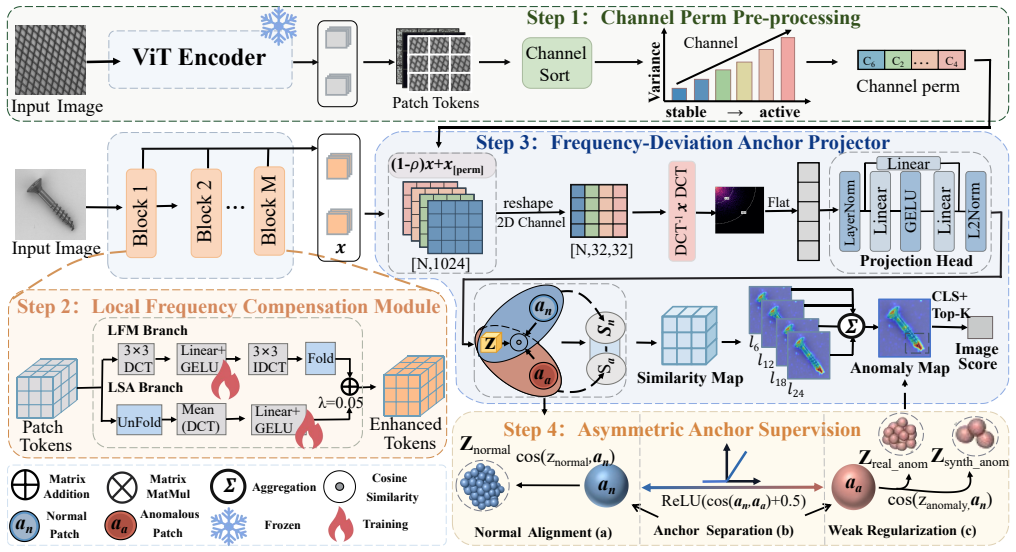
The load-bearing mechanism is the Frequency-Deviation Anchor Projector (FDAP), built on source-derived channel canonicalization. From source patch tokens at each layer, the method computes per-channel variance $v_c$ and the ascending permutation $\pi$ (Eq. 3); at inference every target token is reordered by $\pi$ (full canonicalization, $\rho=1$, while training uses soft interpolation $\rho=0.6$), reshaped into a balanced $H_c\times W_c$ grid (e.g. $32\times32$ for $D=1024$), and transformed by a 2D DCT over that channel coordinate, not over image space. After LayerNorm and a residual MLP projection, each patch is scored $\cos(z_i, a_a) - \cos(z_i, a_n)$ against learnable normal and anomaly anchors, and Asymmetric Anchor Supervision aligns normal patches strongly while weakly regularizing real and synthetic anomaly patches and separating the two anchors.
What would settle it
A cross-source permutation test: compute the FDAP channel permutation from one auxiliary source (e.g., VisA), then evaluate on a target using a permutation derived from a different source (e.g., MVTec) while keeping everything else fixed. If P-AUROC and P-AP fall to the plain-MLP level, the source-derived coordinate is target-specific rather than transferable, and the paper's central mechanism fails.
Extended reading notes
Core claim
Local anomalies are not universally high-frequency phenomena; they induce deviation patterns in low-, mid-, and high-frequency bands relative to normal references. The paper's central discovery is that these multi-band deviations can be exploited for zero-shot anomaly detection by (1) compensating frozen patch tokens with local spatial-frequency cues, (2) canonicalizing channels according to source-derived variance so that a spectral transform operates on a stable coordinate rather than arbitrary channel indices, and (3) measuring anomaly evidence as relative similarity to normal and anomaly anchors in the resulting channel-spectral space. On the cross-dataset protocol (VisA as source for MVTec, MVTec as source for VisA), the CLIP-based model reports I-AUROC 93.4 and P-AUROC 91.5 on MVTec, and the DINOv2 model reports P-F1 48.7 and P-AP 47.5 on MVTec, with average gains over VisualAD baselines across industrial and medical benchmarks.
Load-bearing premise
The load-bearing premise is that the channel-variance order computed from source categories is a stable, transferable coordinate system for unseen target categories, because the method fixes that permutation at inference and scores every patch in the reordered space.
Editorial extensions
If this is right
- Zero-shot anomaly detection does not require a language branch: purely visual, frozen backbones suffice, which simplifies deployment to unseen categories.
- Frequency-aware organization can improve pixel-level defect localization more than image-level recognition, since the largest gains in ablations are in P-AP and P-F1.
- The source-derived channel coordinate transfers across industrial and medical domains, suggesting that channel variance ordering carries domain-independent structure useful for anomaly scoring.
- Because FDAP uses a frozen encoder, the framework can be re-instantiated with new backbones (CLIP and DINOv2 both work) without retraining the encoder.
- Anomaly evidence is spread across spectral bands, so systems that only emphasize high-frequency detail may miss a substantial share of defects; in the paper's analysis, 60.25% of anomaly-localization sensitivity is not high-frequency dominant.
Reading between the lines
- Editorial: The paper's ablations always use the source dataset's own channel statistics; a direct test of whether a permutation computed from an unrelated source (e.g., using a VisA-derived permutation while evaluating with MVTec as source) preserves performance would separate true transferability from a source-specific artifact.
- Editorial: Because the DCT operates on a reordered channel grid, the same anchor-relative scoring could in principle work with other orthogonal bases or with a learned permutation from a small target-normal sample; such variants would probe how much of the gain comes from the ordering versus the fixed spectral basis.
- Editorial: The multi-band finding suggests the frequency-deviation representation may transfer to medical modalities where anomalies are subtle texture or boundary changes; the reported medical gains (e.g., OCT17 I-AUROC 95.0 versus 88.9 for the VisualAD baseline) point to a testable extension on X-ray or fundus datasets.
Signed reviews
Editorial analysis
A structured set of objections, weighed in public.
Referee Report
Summary. The manuscript proposes FreqAnchorAD, a language-free zero-shot anomaly detection method built on frozen CLIP/DINOv2 backbones. It combines a Local Frequency Compensation Module (LFCM) that injects local DCT statistics into patch tokens, a Frequency-Deviation Anchor Projector (FDAP) that canonicalizes channel order by source-derived variance and applies a 2D DCT plus anchor-relative cosine scoring, and Asymmetric Anchor Supervision (AAS) that trains normal and anomaly anchors. Experiments on six industrial and seven medical benchmarks report state-of-the-art mean image-level and pixel-level metrics relative to text-guided baselines and VisualAD, with consistent gains for both CLIP and DINOv2 backbones.
Significance. If the reported benchmark numbers are reproducible, FreqAnchorAD is a competitive language-free ZSAD method, and the cross-dataset evaluation protocol is appropriate. The paper is largely self-contained, the ablation logic is internally consistent, and the diagnostic observation that anomaly evidence is not universally high-frequency (Fig. 1) is a useful descriptive contribution. However, the paper's central mechanistic claim—that frequency-deviation anchoring is the active ingredient—is not supported by its own ablations: the DCT basis is nearly interchangeable with Identity, and a plain MLP almost matches FDAP. This substantially weakens the contribution as currently framed, even if the accuracy claims hold.
major comments (4)
- [Ablation Studies, Table 7] Under VisA→MVTec, replacing the 2D DCT with Identity changes P-AUROC by +0.1, P-AP by −0.7, I-AUROC by −0.1, and I-AP by −0.0. Since a fixed orthogonal transform before a learned linear/MLP layer can be absorbed into that layer, the paper provides no evidence that the frequency basis itself is load-bearing. The title-level claim of 'frequency-deviation anchoring' therefore needs either a decisive counterexample or a revised framing.
- [Ablation Studies, Table 5] LFCM + Plain MLP scores 90.9/42.6/91.4/96.1 versus LFCM + FDAP at 91.1/42.8/91.6/96.3 on VisA→MVTec, a difference of at most 0.2 points on every metric. The Table 3 ablation removes the entire FDAP block (projection head, anchors, and spectral transform), so it cannot isolate frequency-anchoring. The paper needs either a more decisive ablation or a more modest attribution of the gains.
- [Method, Eq. (3)] The source-derived channel permutation π is never ablated against a random fixed permutation or the native channel order. Table 4 varies only the soft-canonicalization coefficient ρ while keeping the same π, so the transferability of the channel coordinate from source to target categories is untested. This is a load-bearing gap because the method's inference relies on a fixed ρ=1 canonical coordinate computed from source statistics.
- [Method, Eq. (2)] X_s,a is defined as all patch tokens extracted from anomalous source images, not only tokens inside anomalous regions. Consequently the variance statistic v_c in Eq. (3) mixes normal-background and anomalous content, which clouds the interpretation of the resulting canonical coordinate. Please clarify whether this is intentional and report whether using only anomalous-region tokens changes the results.
minor comments (4)
- [Experiments, Eq. (17)] The image-level fusion uses λ_map=0.5 for CLIP and disables the CLS branch for DINOv2 and medical configurations; this detail should appear in the main text rather than only in the experimental setup paragraph.
- [Table 1] The FE-CLIP row has missing entries for KSDD2 and some metrics; please clarify why these are omitted and how the average is computed when entries are missing.
- [Figure 1] The per-category sample counts (n=...) and the bracketed percentages are difficult to read at reproduction size; a table or larger font would improve clarity.
- [Appendix] The paper repeatedly refers to the Appendix for implementation details, but the reviewed text does not include it; please ensure that the final version contains all hyperparameters, training schedules, and the full DINOv2 ablation results.
Circularity Check
No significant circularity: FreqAnchorAD trains on disjoint source categories and evaluates on unseen targets; the source-derived channel coordinate is a transferable design choice, not a fitted prediction, and the VisualAD comparison is a baseline, not load-bearing self-citation.
full rationale
FreqAnchorAD's derivation chain is self-contained with respect to the zero-shot protocol: Eq. (2)-(3) compute the channel permutation from the source split only, Eq. (4)-(10) define the anchor-relative score, and inference (Eq. 17) uses the fixed source-trained modules with no target-domain statistics. The target benchmark numbers are therefore external evidence rather than consequences of the method's definitions. The only element that is self-referential by construction is the source-derived channel coordinate itself, but the paper uses it to evaluate disjoint target categories; this is a transfer assumption, not a fitted-input-called-prediction. The paper's own ablations show the specific DCT basis is nearly interchangeable with Identity (Table 7) and a plain MLP nearly matches FDAP (Table 5), which is a serious correctness concern about the frequency-deviation mechanism, but it is not circularity under the stated definitions: the model still processes unseen targets and the output is not forced by the input. The VisualAD baseline is by overlapping authors, but it is used as a comparison, not as an unverified premise or uniqueness theorem, so self-citation is not load-bearing. The referenced Appendix is absent from the arXiv text, which is a completeness issue, not a circular step. Overall, no step in the claimed derivation reduces target predictions to training inputs or to a self-citation chain.
Assumptions & free parameters
free parameters (5)
- rho, training-time soft canonicalization coefficient =
0.6 (training), 1.0 (inference)
- lambda, LFCM residual fusion weight =
0.05
- lambda_map, image-level fusion weight =
0.5 for CLIP industrial; CLS head disabled otherwise
- anomaly-side regularization weights eta_r, eta_s, gamma, beta, alpha, margin m, sigma =
not numerically specified in main text
- source-derived channel permutation pi =
computed from source patch statistics
assumptions (3)
- domain assumption Pretrained CLIP and DINOv2 vision encoders provide transferable patch representations for unseen industrial and medical categories.
- domain assumption DCT2D over a source-derived channel grid is a meaningful spectral decomposition that preserves anomaly-relevant information.
- domain assumption The source-domain normal and anomalous patch labels are reliable enough to train anchors and compute variance orderings.
invented entities (2)
-
Source-derived channel-spectral anchor space
independent evidence
-
Normal and anomaly anchors a_n and a_a
independent evidence
Cite this review
Pith. "Pith review of FreqAnchorAD: Language-Free Zero-Shot Anomaly Detection via Frequency-Deviation Anchoring." pith.science (2026). https://pith.science/paper/YD4CC7Z6
@misc{pith2026260800695,
  author       = {Pith},
  title        = {Pith review of: FreqAnchorAD: Language-Free Zero-Shot Anomaly Detection via Frequency-Deviation Anchoring},
  year         = {2026},
  howpublished = {\url{https://pith.science/paper/YD4CC7Z6}},
  note         = {Machine review of arXiv:2608.00695}
}
read the original abstract
Zero-shot anomaly detection (ZSAD) aims to detect anomalies and localize defective regions in unseen target domains without target training data. Recent ZSAD methods build on pretrained vision models, particularly CLIP, and construct normal and anomaly references from textual prompts or learnable visual representations. These methods perform anomaly discrimination primarily in spatial feature spaces, where subtle changes in texture, boundaries, and local structures can be confused with normal appearance variations. Although inconspicuous spatially, such defects can disrupt local texture regularity or boundary continuity, inducing response deviations across frequency bands. However, existing ZSAD methods do not explicitly model these frequency-dependent characteristics. Our image-domain analysis reveals that local defects exhibit spatial-frequency deviations from normal references across low-, middle-, and high-frequency bands, indicating that anomaly evidence is not universally dominated by high-frequency responses. Motivated by this observation, we propose FreqAnchorAD, a frequency-aware framework that organizes frequency-enhanced responses for anchor-relative anomaly discrimination. Specifically, the Local Frequency Compensation Module (LFCM) enhances intermediate patch tokens with local spatial-frequency cues. The Frequency-Deviation Anchor Projector (FDAP), our core discrimination module, organizes enhanced responses along a source-derived channel coordinate and measures anomaly evidence through relative similarity to normal and anomaly anchors. Finally, Asymmetric Anchor Supervision (AAS) stabilizes normal-anchor alignment while preserving diverse anomaly patterns. Experiments on thirteen industrial and medical benchmarks show that FreqAnchorAD achieves state-of-the-art mean performance in image-level anomaly recognition and pixel-level defect localization.
Figures


Figures from the paper (1 more)

Reference graph
Works this paper leans on
-
[1]
Wavelet-Enhanced
Gardner, Cory and Dhiren, Aendri and Min, Byungseok and Ahn, Tae Hyuk , journal=. Wavelet-Enhanced. 2026 , doi=
2026
-
[2]
Proceedings of the AAAI Conference on Artificial Intelligence , volume=
FDP: A Frequency-Decomposition Preprocessing Pipeline for Unsupervised Anomaly Detection in Brain MRI , author=. Proceedings of the AAAI Conference on Artificial Intelligence , volume=
-
[3]
Proceedings of the IEEE/CVF International Conference on Computer Vision , pages=
Wave-MambaAD: Wavelet-driven State Space Model for Multi-class Unsupervised Anomaly Detection , author=. Proceedings of the IEEE/CVF International Conference on Computer Vision , pages=
-
[4]
Proceedings of the 32nd ACM International Conference on Multimedia , pages=
Filo: Zero-shot anomaly detection by fine-grained description and high-quality localization , author=. Proceedings of the 32nd ACM International Conference on Multimedia , pages=
-
[5]
IEEE Transactions on Computers , volume=
Discrete Cosine Transform , author=. IEEE Transactions on Computers , volume=. 1974 , doi=
1974
-
[6]
Engineering Applications of Artificial Intelligence , volume=
Frequency Domain Nuances Guided Parallel Transformer Model for Industrial Anomaly Localization , author=. Engineering Applications of Artificial Intelligence , volume=. 2025 , doi=
2025
-
[7]
Advanced Engineering Informatics , volume=
Simple and effective frequency-aware image restoration for industrial visual anomaly detection , author=. Advanced Engineering Informatics , volume=. 2025 , publisher=
2025
-
[8]
Knowledge-Based Systems , volume=
Dual-path frequency discriminators for few-shot anomaly detection , author=. Knowledge-Based Systems , volume=. 2024 , publisher=
2024
Show all 94 references
-
[9]
Advances in Neural Information Processing Systems , volume=
Fast fourier convolution , author=. Advances in Neural Information Processing Systems , volume=
-
[10]
Proceedings of the IEEE/CVF international conference on computer vision , pages=
Fcanet: Frequency channel attention networks , author=. Proceedings of the IEEE/CVF international conference on computer vision , pages=
-
[11]
Advances in neural information processing systems , volume=
Global filter networks for image classification , author=. Advances in neural information processing systems , volume=
-
[12]
Proceedings of the 38th International Conference on Machine Learning,
Alec Radford and Jong Wook Kim and Chris Hallacy and Aditya Ramesh and Gabriel Goh and Sandhini Agarwal and Girish Sastry and Amanda Askell and Pamela Mishkin and Jack Clark and Gretchen Krueger and Ilya Sutskever , title =. Proceedings of the 38th International Conference on ...
-
[13]
arXiv preprint arXiv:2305.17382 , year=
April-gan: A zero-/few-shot anomaly classification and segmentation method for cvpr 2023 vand workshop challenge tracks 1&2: 1st place on zero-shot ad and 4th place on few-shot ad , author=. arXiv preprint arXiv:2305.17382 , year=
2023 arXiv
-
[14]
CoRR , volume =
Xuhai Chen and Jiangning Zhang and Guanzhong Tian and Haoyang He and Wuhao Zhang and Yabiao Wang and Chengjie Wang and Yunsheng Wu and Yong Liu , title =. CoRR , volume =
-
[15]
The Twelfth International Conference on Learning Representations (ICLR) , pages=
Qihang Zhou and Guansong Pang and Yu Tian and Shibo He and Jiming Chen , title=. The Twelfth International Conference on Learning Representations (ICLR) , pages=
-
[16]
Jongheon Jeong and Yang Zou and Taewan Kim and Dongqing Zhang and Avinash Ravichandran and Onkar Dabeer , title =
-
[17]
Proceedings of the IEEE/CVF Conference on Computer Vision and Pattern Recognition (CVPR) , month =
Li, Xiaofan and Zhang, Zhizhong and Tan, Xin and Chen, Chengwei and Qu, Yanyun and Xie, Yuan and Ma, Lizhuang , title =. Proceedings of the IEEE/CVF Conference on Computer Vision and Pattern Recognition (CVPR) , month =. 2024 , pages =
2024
-
[18]
CoRR , volume =
Yi Li and Hualiang Wang and Yiqun Duan and Xiaomeng Li , title =. CoRR , volume =
-
[19]
CoRR , volume =
Yunkang Cao and Xiaohao Xu and Chen Sun and Yuqi Cheng and Zongwei Du and Liang Gao and Weiming Shen , title =. CoRR , volume =
-
[20]
CoRR , volume =
Hanqiu Deng and Zhaoxiang Zhang and Jinan Bao and Xingyu Li , title =. CoRR , volume =
-
[21]
CoRR , volume =
Kaiyang Zhou and Jingkang Yang and Chen Change Loy and Ziwei Liu , title =. CoRR , volume =
-
[22]
MVTec AD — A Comprehensive Real-World Dataset for Unsupervised Anomaly Detection , booktitle=
Bergmann, Paul and Fauser, Michael and Sattlegger, David and Steger, Carsten , year=. MVTec AD — A Comprehensive Real-World Dataset for Unsupervised Anomaly Detection , booktitle=
-
[23]
Computer Vision -
Yang Zou and Jongheon Jeong and Latha Pemula and Dongqing Zhang and Onkar Dabeer , title =. Computer Vision -
-
[24]
European conference on computer vision , pages=
Adaclip: Adapting clip with hybrid learnable prompts for zero-shot anomaly detection , author=. European conference on computer vision , pages=. 2024 , organization=
2024
-
[25]
Junnan Li and Dongxu Li and Caiming Xiong and Steven C. H. Hoi , editor =. International Conference on Machine Learning,
-
[26]
Junnan Li and Dongxu Li and Silvio Savarese and Steven C. H. Hoi , editor =. International Conference on Machine Learning,
-
[27]
Focal Loss for Dense Object Detection , booktitle =
Tsung. Focal Loss for Dense Object Detection , booktitle =
-
[28]
Proceedings of the 58th annual meeting of the association for computational linguistics , pages=
Dice loss for data-imbalanced NLP tasks , author=. Proceedings of the 58th annual meeting of the association for computational linguistics , pages=
-
[29]
13th International Congress on Ultra Modern Telecommunications and Control Systems and Workshops,
Stepan Jezek and Martin Jonak and Radim Burget and Pavel Dvorak and Milos Skotak , title =. 13th International Congress on Ultra Modern Telecommunications and Control Systems and Workshops,
-
[30]
Pankaj Mishra and Riccardo Verk and Daniele Fornasier and Claudio Piciarelli and Gian Luca Foresti , title =. 30th
-
[31]
Domen Tabernik and Samo Sela and Jure Skvarc and Danijel Skocaj , title =. J. Intell. Manuf. , volume =
-
[32]
Computers in Industry , volume=
Mixed supervision for surface-defect detection: From weakly to fully supervised learning , author=. Computers in Industry , volume=. 2021 , doi=
2021
-
[33]
2007 , howpublished=
Weakly Supervised Learning for Industrial Optical Inspection , author=. 2007 , howpublished=
2007
-
[34]
Hanqiu Deng and Xingyu Li , title =
-
[35]
Jiale Zhu and Peiyi Yan and Jielin Jiang and Yan Cui and Xiaolong Xu , title =
-
[36]
Yunkang Cao and Qian Wan and Weiming Shen and Liang Gao , title =. Knowl. Based Syst. , volume =
-
[37]
Self-Supervised Predictive Convolutional Attentive Block for Anomaly Detection , booktitle =
Nicolae. Self-Supervised Predictive Convolutional Attentive Block for Anomaly Detection , booktitle =
-
[38]
Jihun Yi and Sungroh Yoon , editor =. Patch. 15th Asian Conference on Computer Vision
-
[39]
Fabio Valerio Massoli and Fabrizio Falchi and Alperen Kantarci and Seymanur Akti and Hazim Kemal Ekenel and Giuseppe Amato , title =
-
[40]
Learning and Evaluating Representations for Deep One-Class Classification , booktitle =
Kihyuk Sohn and Chun. Learning and Evaluating Representations for Deep One-Class Classification , booktitle =
-
[41]
Dong Gong and Lingqiao Liu and Vuong Le and Budhaditya Saha and Moussa Reda Mansour and Svetha Venkatesh and Anton van den Hengel , title =
-
[42]
The Eleventh International Conference on Learning Representations,
Guoyang Xie and Jinbao Wang and Jiaqi Liu and Yaochu Jin and Feng Zheng , title =. The Eleventh International Conference on Learning Representations,
-
[43]
Towards Total Recall in Industrial Anomaly Detection , booktitle =
Karsten Roth and Latha Pemula and Joaquin Zepeda and Bernhard Sch. Towards Total Recall in Industrial Anomaly Detection , booktitle =
-
[44]
The Eleventh International Conference on Learning Representations,
Shancong Mou and Xiaoyi Gu and Meng Cao and Haoping Bai and Ping Huang and Jiulong Shan and Jianjun Shi , title =. The Eleventh International Conference on Learning Representations,
-
[45]
Yue Wang and Jinlong Peng and Jiangning Zhang and Ran Yi and Yabiao Wang and Chengjie Wang , title =
-
[46]
Matthew Baugh and James Batten and Johanna P. M. Zero-Shot Anomaly Detection with Pre-trained Segmentation Models , journal =
-
[47]
IEEE/CVF Conference on Computer Vision and Pattern Recognition (CVPR) , year=
Adapting Visual-Language Models for Generalizable Anomaly Detection in Medical Images , author=. IEEE/CVF Conference on Computer Vision and Pattern Recognition (CVPR) , year=
-
[48]
IEEE/CVF Conference on Computer Vision and Pattern Recognition (CVPR) , year=
Conditional Prompt Learning for Vision-Language Models , author=. IEEE/CVF Conference on Computer Vision and Pattern Recognition (CVPR) , year=
-
[49]
Proceedings of the IEEE/CVF International Conference on Computer Vision (ICCV) , year =
Khattak, Muhammad Uzair and Wasim, Syed Talal and Naseer, Muzammal and Khan, Salman and Yang, Ming-Hsuan and Khan, Fahad Shahbaz , title =. Proceedings of the IEEE/CVF International Conference on Computer Vision (ICCV) , year =
-
[50]
Proceedings of the IEEE/CVF Conference on Computer Vision and Pattern Recognition , pages=
Promptkd: Unsupervised prompt distillation for vision-language models , author=. Proceedings of the IEEE/CVF Conference on Computer Vision and Pattern Recognition , pages=
-
[51]
9th International Conference on Learning Representations,
Alexey Dosovitskiy and Lucas Beyer and Alexander Kolesnikov , title =. 9th International Conference on Learning Representations,
-
[52]
Proceedings of the IEEE/CVF international conference on computer vision , pages=
Emerging properties in self-supervised vision transformers , author=. Proceedings of the IEEE/CVF international conference on computer vision , pages=
-
[53]
Transactions on Machine Learning Research , year=
Oquab, Maxime and Darcet, Timoth. Transactions on Machine Learning Research , year=
-
[54]
Self-regulating Prompts: Foundational Model Adaptation without Forgetting , booktitle =
Muhammad Uzair Khattak and Syed Talal Wasim and Muzammal Naseer and Salman Khan and Ming. Self-regulating Prompts: Foundational Model Adaptation without Forgetting , booktitle =
-
[55]
CoRR , year =
Shilong Liu and Zhaoyang Zeng and Tianhe Ren and Feng Li and Hao Zhang and Jie Yang and Chunyuan Li and Jianwei Yang and Hang Su and Jun Zhu and Lei Zhang , title =. CoRR , year =
-
[56]
CoRR , year =
Yi Li and Hualiang Wang and Yiqun Duan and Xiaomeng Li , title =. CoRR , year =
-
[57]
2022 , url =
Yongming Rao and Wenliang Zhao and Guangyi Chen and Yansong Tang and Zheng Zhu and Guan Huang and Jie Zhou and Jiwen Lu , title =. 2022 , url =. doi:10.1109/CVPR52688.2022.01755 , timestamp =
2022
-
[58]
Proceedings of the IEEE/CVF Winter Conference on Applications of Computer Vision , pages=
Zero-shot versus many-shot: Unsupervised texture anomaly detection , author=. Proceedings of the IEEE/CVF Winter Conference on Applications of Computer Vision , pages=
-
[59]
Chinese Conference on Pattern Recognition and Computer Vision , year=
Enhancing Zero-Shot Anomaly Detection: CLIP-SAM Collaboration with Cascaded Prompts , author=. Chinese Conference on Pattern Recognition and Computer Vision , year=
-
[60]
ArXiv , year=
ClipSAM: CLIP and SAM Collaboration for Zero-Shot Anomaly Segmentation , author=. ArXiv , year=
-
[61]
arXiv preprint arXiv:2505.03285 , year=
Soft Reasoning Paths for Knowledge Graph Completion , author=. arXiv preprint arXiv:2505.03285 , year=
- [62]
-
[63]
European Conference on Computer Vision , year=
VCP-CLIP: A visual context prompting model for zero-shot anomaly segmentation , author=. European Conference on Computer Vision , year=
-
[64]
International conference on pattern recognition , pages=
Padim: a patch distribution modeling framework for anomaly detection and localization , author=. International conference on pattern recognition , pages=. 2021 , organization=
2021
-
[65]
2022 IEEE/CVF Conference on Computer Vision and Pattern Recognition (CVPR) , year=
Towards Total Recall in Industrial Anomaly Detection , author=. 2022 IEEE/CVF Conference on Computer Vision and Pattern Recognition (CVPR) , year=
2022
-
[66]
Proceedings of the IEEE/CVF winter conference on applications of computer vision , pages=
Fully convolutional cross-scale-flows for image-based defect detection , author=. Proceedings of the IEEE/CVF winter conference on applications of computer vision , pages=
-
[67]
2021 IEEE/CVF Conference on Computer Vision and Pattern Recognition (CVPR) , year=
CutPaste: Self-Supervised Learning for Anomaly Detection and Localization , author=. 2021 IEEE/CVF Conference on Computer Vision and Pattern Recognition (CVPR) , year=
2021
-
[68]
2024 IEEE/CVF Conference on Computer Vision and Pattern Recognition (CVPR) , year=
Toward Generalist Anomaly Detection via In-Context Residual Learning with Few-Shot Sample Prompts , author=. 2024 IEEE/CVF Conference on Computer Vision and Pattern Recognition (CVPR) , year=
2024
-
[69]
ArXiv , year=
AdaptCLIP: Adapting CLIP for Universal Visual Anomaly Detection , author=. ArXiv , year=
-
[70]
ArXiv , year=
MetaUAS: Universal Anomaly Segmentation with One-Prompt Meta-Learning , author=. ArXiv , year=
-
[71]
ArXiv , year=
StackCLIP: Clustering-Driven Stacked Prompt in Zero-Shot Industrial Anomaly Detection , author=. ArXiv , year=
-
[72]
2019 IEEE/CVF Conference on Computer Vision and Pattern Recognition (CVPR) , year=
OCGAN: One-Class Novelty Detection Using GANs With Constrained Latent Representations , author=. 2019 IEEE/CVF Conference on Computer Vision and Pattern Recognition (CVPR) , year=
2019
-
[73]
AAAI Conference on Artificial Intelligence , year=
Learning Semantic Context from Normal Samples for Unsupervised Anomaly Detection , author=. AAAI Conference on Artificial Intelligence , year=
-
[74]
2020 IEEE/CVF Conference on Computer Vision and Pattern Recognition (CVPR) , year=
Old Is Gold: Redefining the Adversarially Learned One-Class Classifier Training Paradigm , author=. 2020 IEEE/CVF Conference on Computer Vision and Pattern Recognition (CVPR) , year=
2020
-
[75]
European Conference on Computer Vision , year=
Learning to Detect Multi-class Anomalies with Just One Normal Image Prompt , author=. European Conference on Computer Vision , year=
-
[76]
2023 IEEE/CVF International Conference on Computer Vision (ICCV) , year=
Focus the Discrepancy: Intra- and Inter-Correlation Learning for Image Anomaly Detection , author=. 2023 IEEE/CVF International Conference on Computer Vision (ICCV) , year=
2023
-
[77]
IEEE Transactions on Industrial Informatics , year=
Prior Normality Prompt Transformer for Multiclass Industrial Image Anomaly Detection , author=. IEEE Transactions on Industrial Informatics , year=
-
[78]
ArXiv , year=
Generalized Denoising Auto-Encoders as Generative Models , author=. ArXiv , year=
-
[79]
2019 IEEE/CVF International Conference on Computer Vision (ICCV) , year=
Memorizing Normality to Detect Anomaly: Memory-Augmented Deep Autoencoder for Unsupervised Anomaly Detection , author=. 2019 IEEE/CVF International Conference on Computer Vision (ICCV) , year=
2019
-
[80]
International Joint Conference on Artificial Intelligence , year=
Soft Reasoning Paths for Knowledge Graph Completion , author=. International Joint Conference on Artificial Intelligence , year=
-
[81]
2025 IEEE/CVF Conference on Computer Vision and Pattern Recognition (CVPR) , year=
Bayesian Prompt Flow Learning for Zero-Shot Anomaly Detection , author=. 2025 IEEE/CVF Conference on Computer Vision and Pattern Recognition (CVPR) , year=
2025
-
[82]
2025 IEEE/CVF Conference on Computer Vision and Pattern Recognition (CVPR) , year=
AA-CLIP: Enhancing Zero-Shot Anomaly Detection via Anomaly-Aware CLIP , author=. 2025 IEEE/CVF Conference on Computer Vision and Pattern Recognition (CVPR) , year=
2025
-
[83]
Cell , volume=
Identifying medical diagnoses and treatable diseases by image-based deep learning , author=. Cell , volume=. 2018 , publisher=
2018
-
[84]
Proceedings of the IEEE/CVF conference on computer vision and pattern recognition , pages=
Multiresolution knowledge distillation for anomaly detection , author=. Proceedings of the IEEE/CVF conference on computer vision and pattern recognition , pages=
-
[85]
arXiv preprint arXiv:2107.02314 , year=
The rsna-asnr-miccai brats 2021 benchmark on brain tumor segmentation and radiogenomic classification , author=. arXiv preprint arXiv:2107.02314 , year=
2021 arXiv
-
[86]
and Freymann, John B
Bakas, Spyridon and Akbari, Hamed and Sotiras, Aristeidis and Bilello, Michel and Rozycki, Martin and Kirby, Justin S. and Freymann, John B. and Farahani, Keyvan and Davatzikos, Christos , journal=. Advancing. 2017 , doi=
2017
-
[87]
IEEE transactions on medical imaging , volume=
The multimodal brain tumor image segmentation benchmark (BRATS) , author=. IEEE transactions on medical imaging , volume=
-
[88]
2017 , doi=
Diagnostic assessment of deep learning algorithms for detection of lymph node metastases in women with breast cancer , author=. 2017 , doi=
2017
-
[89]
saliency maps from physicians , author=
WM-DOVA maps for accurate polyp highlighting in colonoscopy: Validation vs. saliency maps from physicians , author=. Computerized medical imaging and graphics : the official journal of the Computerized Medical Imaging Society , year=
-
[90]
International Conference on Pattern Recognition , pages=
The EndoTect 2020 challenge: evaluation and comparison of classification, segmentation and inference time for endoscopy , author=. International Conference on Pattern Recognition , pages=. 2021 , organization=
2020
-
[91]
and Riegler, Michael A
Jha, Debesh and Smedsrud, Pia H. and Riegler, Michael A. and Halvorsen, P. MultiMedia Modeling , series=. 2020 , publisher=
2020
-
[92]
The Twelfth International Conference on Learning Representations , year=
Musc: Zero-shot industrial anomaly classification and segmentation with mutual scoring of the unlabeled images , author=. The Twelfth International Conference on Learning Representations , year=
-
[93]
Proceedings of the IEEE/CVF Conference on Computer Vision and Pattern Recognition (CVPR) , month=
Hou, Yanning and Li, Peiyuan and Liu, Zirui and Wang, Yitong and Ruan, Yanran and Qiu, Jianfeng and Xu, Ke , title=. Proceedings of the IEEE/CVF Conference on Computer Vision and Pattern Recognition (CVPR) , month=. 2026 , pages=
2026
-
[94]
Proceedings of the IEEE/CVF International Conference on Computer Vision (ICCV) , month=
Gong, Tao and Chu, Qi and Liu, Bin and Zhou, Wei and Yu, Nenghai , title=. Proceedings of the IEEE/CVF International Conference on Computer Vision (ICCV) , month=. 2025 , pages=
2025
Reviewed August 15, 2026 · model on record in the stance chip above.
Discussion (0). Continue with ORCID to comment.