REVIEW 4 major objections 5 minor 34 references
Dual Recursive Feedback on Generation and Appearance Latents for Pose-Robust Text-to-Image Diffusion
T0 review · 4 major / 5 minor · reviewed 2026-08-05 · deepseek-v4-flash
Pith's one-line read This paper proposes a training-free dual-feedback sampler that recursively updates a shared injection noise so a generated image keeps an appearance image's identity while following a structure image's pose, even across very different objec
desk verdict A training-free pose-transfer plugin with strong qualitative results but a load-bearing flaw in its noising schedule and thin quantitative support; worth revising, not rejecting. read the letter →
The pith
A machine-rendered reading of the paper's core claim, the machinery that carries it, and where it could break.
The reading
What carries the argument
The central object is the shared injection noise $\epsilon$, added to both the generation latent and a re-scaled appearance latent in Algorithm 1. Because both trajectories depend on the same $\epsilon$, gradients of the appearance loss and the generation loss with respect to $\epsilon$ act as a communication channel: appearance information flows into the generation latent without a separate adapter. The second component is the fixed-point loss pair $d(z^a_{0|t}, z^a_0)$ and $d(z^g_{0|t}, z^g_{\mathrm{prev}})$, which keeps each predicted clean latent close to a reference, plus the exponential iteration weight $w^{(i)}_{\mathrm{iter}}$ that shifts emphasis from appearance in early recursions
What would settle it
Run DRF with the shared noise $\epsilon$ replaced by two independent noises, one for $z^g_t$ and one for $\tilde z^a_t$, keeping all hyper-parameters fixed. If the structure and appearance metrics (DINO self-similarity and DINO-I) do not degrade, the shared-noise coupling is not the load-bearing mechanism.
Extended reading notes
Core claim
The paper's central claim is that the coupling caused by a single injection noise is enough to transfer appearance information into the generation trajectory without a separate appearance model. Starting from the base controllable generation step, DRF adds a recursive correction: at each step it forms the appearance stochastic latent $\tilde z^a_t$ and generation latent $z^g_t$ using the same $\epsilon$, computes fixed-point losses $d(z^a_{0|t}, z^a_0)$ and $d(z^g_{0|t}, z^g_{\mathrm{prev}})$, and updates $\epsilon$ by $\epsilon \leftarrow \epsilon - \lambda \nabla_\epsilon L^{(i)}_{\mathrm{DRF}}$. The updated noise is reused in the next recursion. The authors argue that this dual fixed-poin
Load-bearing premise
The whole correction rests on the assumption that adding one shared noise vector to both the generation and appearance latents lets gradients of the appearance loss transfer appearance information into the generation latent without corrupting its structure; if that coupling does not actually transfer information, the dual feedback can distort the trajectory instead of refining it.
Editorial extensions
If this is right
- Pose transfer works across very different object classes without retraining or categorical assumptions about appearance and structure.
- Appearance and structure images can be swapped at inference time, with prompts controlling which object receives the appearance.
- The method is scheduler-agnostic, so pairing it with a fast ODE solver can cut sampling latency while keeping fidelity.
- The feedback loop can be added onto existing controllable T2I pipelines, improving their output without changing their weights.
Reading between the lines
- If the shared-noise coupling is the real mechanism, the same trick may generalize to more than two controllers: add more loss terms that all depend on one $\epsilon$, and the single noise becomes a budgeted communication channel among all constraints.
- The fixed-point view of generation feedback suggests a testable extension: treat the recursion depth $N$ as an optimizer schedule and adapt the step size $\lambda$ per step, which could cut the measured latency while preserving fidelity.
- The paper's own failure on unfamiliar faces suggests the fixed-point metric $d$ in latent space is not perceptual; swapping in an identity-aware distance could extend the method to face-preserving edits, a direct next experiment.
Editorial analysis
A structured set of objections, weighed in public.
Referee Report
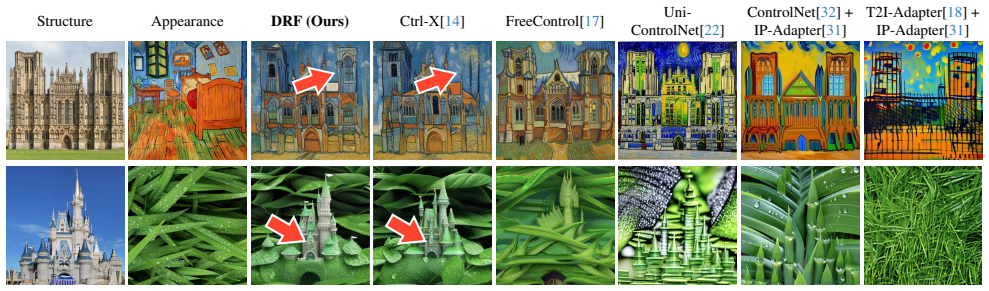
Summary. DRF is a training-free dual-feedback method for controllable T2I diffusion that claims to preserve both appearance and structure in class-invariant settings. The method interleaves two recursive updates: an 'appearance feedback' that pulls a denoised estimate of an appearance latent toward the clean appearance image, and a 'generation feedback' that aligns the generation latent with its previous recursive estimate. Both updates are performed by gradient descent on a shared injection noise epsilon (Eq. 12). The paper reports qualitative and quantitative comparisons against Ctrl-X, FreeControl, Uni-ControlNet, and IP-Adapter combinations, plus user studies and scheduler/backbone experiments.
Significance. If the method works as claimed, the contribution is valuable: it offers a training-free, plug-and-play control mechanism that works across model architectures and schedulers, with code released. The qualitative results, especially the cross-class pose transfer examples, are compelling and the plug-and-play enhancements in Fig. 9 are suggestive. However, the theoretical grounding is undermined by a non-standard noising step that invalidates the posterior-mean interpretation, and the empirical support is thin (no error bars, a 20-sample user study, and hyperparameters tuned on the evaluation metrics). The central claim that DRF 'retains the essential features of the appearance image while being appropriately corrected to preserve structure' is therefore not established by the manuscript's derivation, and the experimental evidence is not yet at the level that the claimed consistency would require.
major comments (4)
- [Sec. 3.2, Eq. (7)] The modified appearance latent \tilde z^a_t is not drawn from the same distribution as the noised latents used to train the score model. Standard noising (Eq. 1) gives z_t = sqrt(alpha_t) z_0 + sqrt(1-alpha_t) epsilon. Eq. (7) uses sqrt(alpha_t/alpha_{t-1}) and sqrt(1-alpha_t/alpha_{t-1}), which yields a cleaner latent with a different SNR than timestep t. Feeding this to a score network trained under Eq. (1) and applying the posterior-mean formula Eq. (5) produces a biased estimate of E[z_0 | \tilde z^a_t], so the loss Eq. (8) does not measure the fixed-point distance the authors intend, and the gradient update Eq. (12) inherits this bias. This is load-bearing: the paper's strongest claim is that the refined zg* preserves both appearance and structure, and that claim relies on this miscalibrated 'appearance feedback'. Fix by using the standard noising at the appropriate effective timest
- [Algorithm 1, lines 3-4] The same noise epsilon is injected into both the generation latent and the appearance latent. The authors describe this as 'the connection between z^g_t and \tilde z^a_t', but no statistical basis is given. z^g_{t-1} is an intermediate latent from the reverse process, not a clean sample; adding a fresh epsilon to it and to the clean appearance image creates an artificial coupling whose effect on the reverse trajectory is not analyzed. In particular, the recursive gradient update on epsilon can move z^g_t away from the intended denoising path, and the two feedback terms may conflict. The paper provides no convergence analysis or ablation isolating the shared-epsilon design choice. Please provide either a theoretical justification or an ablation showing that sharing epsilon is beneficial (or at least not harmful) compared to independent noises.
- [Sec. 5.2, Table 2] The empirical support for 'consistently outperforms' is weak. No error bars or significance tests are reported. On Canny, DRF's DINO-I is 0.7135, which is lower than FreeControl's 0.7381 and Ctrl-X's 0.7335; on Pose, the DINO-I difference between DRF and Ctrl-X is 0.0013, far below any plausible noise floor. The user study is based on only 20 comparison sets and no confidence intervals or inter-rater agreement are reported. Hyperparameters (lambda, rho, k, N, DRF interval) are selected on the same evaluation metrics according to the supplementary, creating a risk of optimistic bias. Please provide multiple seeds, confidence intervals or statistical tests, and a clear explanation of how the reported metrics support the strong qualitative claims.
- [Sec. 4, Successive rate] The 'successive rate' metric compares the ResNet-18 top-1 prediction of each generated image to a single target class. For class-invariant fusions (e.g., tiger appearance with human skeleton), the correct target class is ambiguous: should it be the appearance class, the structure class, or the prompt entity? The metric may be systematically biased toward methods that simply reproduce the appearance image. Also, ResNet-18 trained on ImageNet may not be reliable for generated images that fall outside the natural-image distribution. Please define precisely how the target class is chosen for each configuration and analyze the sensitivity of the reported conclusions to this choice.
minor comments (5)
- [Tab. 1 and Sec. 3.2] Notation mismatch: Tab. 1 defines z^a_t as the 'Noisy latent of I_a at time t', but the paper mainly uses \tilde z^a_t for the modified noisy latent in Eq. (7) and Fig. 5. Please clarify which variant is used where.
- [Fig. 5] Caption says 'outputs of DRF with \tilde z^a_t and z^a_t' but the column labels are not clear. The text discusses a comparison of modified vs. standard forward process, but the figure does not differentiate the two. Please relabel and add a clear legend.
- [Eq. (10)] The weighting in Eq. (10) is described as 'exponential' but also contains a square root. The plot in Fig. S5 compares 'Exponential', 'Cosine', 'Linear', so the formula should be consistent with the presented curves. Please check the definition of k and the range of i.
- [Sec. 6.2] The claim that DPM-Solver++ reduces latency by ~3x is based on comparing 40-step DDIM (47.87s) with 10-step DPM-Solver++ (15.56s). The metrics are not identical (DDIM at 50 steps vs DPM-Solver++ at 10 steps), so the comparison should be made at the same step count or with an explicit quality/latency trade-off curve.
- [Supplementary S2] The hyperparameter sweep in Fig. S4 is described as 'clear, monotonic sweet spot' but the figure is not referenced in the main text. Also, the chosen values (lambda=1.0, rho=0.001, K=5) are not justified against the evaluation dataset; please state the evaluation set and the variance across seeds.
Circularity Check
No material circularity: DRF is a self-contained optimization against defined losses; the only self-citation (IDS) is motivational, not load-bearing.
full rationale
The paper's derivation chain does not reduce to its inputs. The DRF loss in Eq. (11) is defined as a distance between posterior means and reference latents, and the shared noise epsilon is updated by gradient descent (Eq. 12). This is an optimization objective, not a fitted parameter renamed as a prediction. The quantitative evaluation is conducted against external baselines (Ctrl-X, FreeControl, ControlNet+IP-Adapter, etc.) on held-out metrics, so the central claim is empirical rather than derived from the method's own definitions. The citation to IDS [12] (which shares authors with the present paper) motivates the fixed-point idea, but the equations in Section 3.2 stand on their own and do not import an unverified uniqueness theorem or forbid alternatives. The modified noising in Eq. (7) is non-standard and may introduce bias in the posterior estimate, but that is a correctness concern, not a circularity. Hyperparameters (lambda, rho, k) are tuned and reported as ablations, not presented as predictions; no fitted value is subsequently called a result. Overall, no circular step is identifiable.
Assumptions & free parameters
free parameters (5)
- λ (update step size) =
1.0
- ρ (generation feedback weight) =
0.001
- recursion depth N (DRF iterations per step) =
5
- k (exponential weight constant, Eq. 10) =
not reported
- DRF application interval =
20 of 50 steps after first 5
assumptions (4)
- domain assumption A single shared noise vector is a valid coupling between generation and appearance latents
- domain assumption The CFG-score posterior mean z^{a}_{0|t} approximates the true appearance manifold well enough to serve as a fixed point
- domain assumption Ctrl-X's feature injection cleanly separates structure from appearance in the latent
- domain assumption Iterative fixed-point refinement converges to a reliable manifold
Cite this review
Pith. "Pith review of Dual Recursive Feedback on Generation and Appearance Latents for Pose-Robust Text-to-Image Diffusion." pith.science (2026). https://pith.science/paper/YD4FAEU5
@misc{pith2026250809575,
  author       = {Pith},
  title        = {Pith review of: Dual Recursive Feedback on Generation and Appearance Latents for Pose-Robust Text-to-Image Diffusion},
  year         = {2026},
  howpublished = {\url{https://pith.science/paper/YD4FAEU5}},
  note         = {Machine review of arXiv:2508.09575}
}
read the original abstract
Recent advancements in controllable text-to-image (T2I) diffusion models, such as Ctrl-X and FreeControl, have demonstrated robust spatial and appearance control without requiring auxiliary module training. However, these models often struggle to accurately preserve spatial structures and fail to capture fine-grained conditions related to object poses and scene layouts. To address these challenges, we propose a training-free Dual Recursive Feedback (DRF) system that properly reflects control conditions in controllable T2I models. The proposed DRF consists of appearance feedback and generation feedback that recursively refines the intermediate latents to better reflect the given appearance information and the user's intent. This dual-update mechanism guides latent representations toward reliable manifolds, effectively integrating structural and appearance attributes. Our approach enables fine-grained generation even between class-invariant structure-appearance fusion, such as transferring human motion onto a tiger's form. Extensive experiments demonstrate the efficacy of our method in producing high-quality, semantically coherent, and structurally consistent image generations. Our source code is available at https://github.com/jwonkm/DRF.
Figures


Figures from the paper (5 more)




Reference graph
Works this paper leans on
-
[1]
Ntire 2017 challenge on single image super-resolution: Dataset and study
Eirikur Agustsson and Radu Timofte. Ntire 2017 challenge on single image super-resolution: Dataset and study. In Pro- ceedings of the IEEE conference on computer vision and pat- tern recognition workshops, pages 126–135, 2017. 6
2017
-
[2]
Emerg- ing properties in self-supervised vision transformers
Mathilde Caron, Hugo Touvron, Ishan Misra, Herv ´e J´egou, Julien Mairal, Piotr Bojanowski, and Armand Joulin. Emerg- ing properties in self-supervised vision transformers. In Pro- ceedings of the IEEE/CVF international conference on com- puter vision, pages 9650–9660, 2021. 6
2021
-
[3]
Arcface: Additive angular margin loss for deep face recognition
Jiankang Deng, Jia Guo, Niannan Xue, and Stefanos Zafeiriou. Arcface: Additive angular margin loss for deep face recognition. In Proceedings of the IEEE/CVF con- ference on computer vision and pattern recognition , pages 4690–4699, 2019. 2
2019
-
[4]
Diffusion models beat gans on image synthesis
Prafulla Dhariwal and Alexander Nichol. Diffusion models beat gans on image synthesis. Advances in neural informa- tion processing systems, 34:8780–8794, 2021. 1
2021
-
[5]
Point2mesh: A self-prior for deformable meshes
Rana Hanocka, Gal Metzer, Raja Giryes, and Daniel Cohen- Or. Point2mesh: A self-prior for deformable meshes. arXiv preprint arXiv:2005.11084, 2020. 6, 7
arXiv 2005
-
[6]
Deep residual learning for image recognition
Kaiming He, Xiangyu Zhang, Shaoqing Ren, and Jian Sun. Deep residual learning for image recognition. In Proceed- ings of the IEEE conference on computer vision and pattern recognition, pages 770–778, 2016. 6
2016
-
[7]
Prompt-to-prompt im- age editing with cross attention control
Amir Hertz, Ron Mokady, Jay Tenenbaum, Kfir Aberman, Yael Pritch, and Daniel Cohen-Or. Prompt-to-prompt im- age editing with cross attention control. arXiv preprint arXiv:2208.01626, 2022. 1
arXiv 2022
-
[8]
Delta de- noising score
Amir Hertz, Kfir Aberman, and Daniel Cohen-Or. Delta de- noising score. In Proceedings of the IEEE/CVF International Conference on Computer Vision, pages 2328–2337, 2023. 1, 3
2023
Show all 34 references
-
[9]
Classifier-free diffusion guidance
Jonathan Ho and Tim Salimans. Classifier-free diffusion guidance. arXiv preprint arXiv:2207.12598, 2022. 3
2022 arXiv
-
[10]
Denoising dif- fusion probabilistic models
Jonathan Ho, Ajay Jain, and Pieter Abbeel. Denoising dif- fusion probabilistic models. Advances in neural information processing systems, 33:6840–6851, 2020. 1
2020
-
[11]
Surface reconstruction from point clouds: A survey and a benchmark
Zhangjin Huang, Yuxin Wen, Zihao Wang, Jinjuan Ren, and Kui Jia. Surface reconstruction from point clouds: A survey and a benchmark. IEEE transactions on pattern analysis and machine intelligence, 2024. 6, 7
2024
-
[12]
Identity-preserving distillation sampling by fixed-point iterator
SeonHwa Kim, Jiwon Kim, Soobin Park, Donghoon Ahn, Jiwon Kang, Seungryong Kim, Kyong Hwan Jin, and Eunju Cha. Identity-preserving distillation sampling by fixed-point iterator. arXiv preprint arXiv:2502.19930, 2025. 1, 3, 4
2025 arXiv
-
[13]
Segment any- thing
Alexander Kirillov, Eric Mintun, Nikhila Ravi, Hanzi Mao, Chloe Rolland, Laura Gustafson, Tete Xiao, Spencer White- head, Alexander C Berg, Wan-Yen Lo, et al. Segment any- thing. In Proceedings of the IEEE/CVF international confer- ence on computer vision, pages 4015–4026, 2023. 2
2023
-
[14]
Ctrl-x: Controlling structure and appearance for text-to-image generation without guidance
Kuan Heng Lin, Sicheng Mo, Ben Klingher, Fangzhou Mu, and Bolei Zhou. Ctrl-x: Controlling structure and appearance for text-to-image generation without guidance. Advances in Neural Information Processing Systems , 37: 128911–128939, 2025. 1, 3, 4, 5, 6, 7, 8
2025
-
[15]
Dpm-solver: A fast ode solver for diffu- sion probabilistic model sampling in around 10 steps
Cheng Lu, Yuhao Zhou, Fan Bao, Jianfei Chen, Chongxuan Li, and Jun Zhu. Dpm-solver: A fast ode solver for diffu- sion probabilistic model sampling in around 10 steps. Ad- vances in neural information processing systems , 35:5775– 5787, 2022. 8
2022
-
[16]
Dpm-solver++: Fast solver for guided sam- pling of diffusion probabilistic models.Machine Intelligence Research, pages 1–22, 2025
Cheng Lu, Yuhao Zhou, Fan Bao, Jianfei Chen, Chongxuan Li, and Jun Zhu. Dpm-solver++: Fast solver for guided sam- pling of diffusion probabilistic models.Machine Intelligence Research, pages 1–22, 2025. 8
2025
-
[17]
Freecontrol: Training-free spatial control of any text-to-image diffusion model with any condition
Sicheng Mo, Fangzhou Mu, Kuan Heng Lin, Yanli Liu, Bochen Guan, Yin Li, and Bolei Zhou. Freecontrol: Training-free spatial control of any text-to-image diffusion model with any condition. In Proceedings of the IEEE/CVF Conference on Computer Vision and Pattern Recognition , pa...
2024
-
[18]
T2i-adapter: Learning adapters to dig out more controllable ability for text-to-image diffusion models
Chong Mou, Xintao Wang, Liangbin Xie, Yanze Wu, Jian Zhang, Zhongang Qi, and Ying Shan. T2i-adapter: Learning adapters to dig out more controllable ability for text-to-image diffusion models. In Proceedings of the AAAI conference on artificial intelligence, pages 4296–4304, 20...
2024
-
[19]
Contrastive denoising score for text- guided latent diffusion image editing
Hyelin Nam, Gihyun Kwon, Geon Yeong Park, and Jong Chul Ye. Contrastive denoising score for text- guided latent diffusion image editing. In Proceedings of the IEEE/CVF conference on computer vision and pattern recognition, pages 9192–9201, 2024. 3
2024
-
[20]
Sdxl: Improving latent diffusion mod- els for high-resolution image synthesis
Dustin Podell, Zion English, Kyle Lacey, Andreas Blattmann, Tim Dockhorn, Jonas M ¨uller, Joe Penna, and Robin Rombach. Sdxl: Improving latent diffusion mod- els for high-resolution image synthesis. arXiv preprint arXiv:2307.01952, 2023. 1, 6, 8
2023 arXiv
-
[21]
Dreamfusion: Text-to-3d using 2d diffusion
Ben Poole, Ajay Jain, Jonathan T Barron, and Ben Milden- hall. Dreamfusion: Text-to-3d using 2d diffusion. arXiv preprint arXiv:2209.14988, 2022. 3
2022 arXiv
-
[22]
Unicontrol: A unified diffusion model for controllable visual generation in the wild
Can Qin, Shu Zhang, Ning Yu, Yihao Feng, Xinyi Yang, Yingbo Zhou, Huan Wang, Juan Carlos Niebles, Caiming Xiong, Silvio Savarese, et al. Unicontrol: A unified diffusion model for controllable visual generation in the wild. arXiv preprint arXiv:2305.11147, 2023. 5, 6, 7, 8
2023 arXiv
-
[23]
Learning transferable visual models from natural language supervi- sion
Alec Radford, Jong Wook Kim, Chris Hallacy, Aditya Ramesh, Gabriel Goh, Sandhini Agarwal, Girish Sastry, Amanda Askell, Pamela Mishkin, Jack Clark, et al. Learning transferable visual models from natural language supervi- sion. In International conference on machine learning, ...
2021
-
[24]
High-resolution image synthesis with latent diffusion models
Robin Rombach, Andreas Blattmann, Dominik Lorenz, Patrick Esser, and Bj ¨orn Ommer. High-resolution image synthesis with latent diffusion models. In Proceedings of the IEEE/CVF conference on computer vision and pattern recognition, pages 10684–10695, 2022. 1, 8
2022
-
[25]
Dreambooth: Fine tuning text-to-image diffusion models for subject-driven generation
Nataniel Ruiz, Yuanzhen Li, Varun Jampani, Yael Pritch, Michael Rubinstein, and Kfir Aberman. Dreambooth: Fine tuning text-to-image diffusion models for subject-driven generation. In Proceedings of the IEEE/CVF conference on computer vision and pattern recognition , pages 2250...
2023
-
[26]
Laion-5b: An open large-scale dataset for training next generation image-text models
Christoph Schuhmann, Romain Beaumont, Richard Vencu, Cade Gordon, Ross Wightman, Mehdi Cherti, Theo Coombes, Aarush Katta, Clayton Mullis, Mitchell Worts- man, et al. Laion-5b: An open large-scale dataset for training next generation image-text models. Advances in neural in- f...
2022
-
[27]
Denoising diffusion implicit models
Jiaming Song, Chenlin Meng, and Stefano Ermon. Denoising diffusion implicit models. arXiv preprint arXiv:2010.02502, 2020. 7, 8
2010 arXiv
-
[28]
Score-based generative modeling through stochastic differential equa- tions
Yang Song, Jascha Sohl-Dickstein, Diederik P Kingma, Ab- hishek Kumar, Stefano Ermon, and Ben Poole. Score-based generative modeling through stochastic differential equa- tions. arXiv preprint arXiv:2011.13456, 2020. 1
2011 arXiv
-
[29]
Splicing vit features for semantic appearance transfer
Narek Tumanyan, Omer Bar-Tal, Shai Bagon, and Tali Dekel. Splicing vit features for semantic appearance transfer. In Proceedings of the IEEE/CVF Conference on Computer Vision and Pattern Recognition, pages 10748–10757, 2022. 6, 7
2022
-
[30]
Plug-and-play diffusion features for text-driven image-to-image translation
Narek Tumanyan, Michal Geyer, Shai Bagon, and Tali Dekel. Plug-and-play diffusion features for text-driven image-to-image translation. InProceedings of the IEEE/CVF Conference on Computer Vision and Pattern Recognition , pages 1921–1930, 2023. 1, 5
1921
-
[31]
Ip- adapter: Text compatible image prompt adapter for text-to- image diffusion models
Hu Ye, Jun Zhang, Sibo Liu, Xiao Han, and Wei Yang. Ip- adapter: Text compatible image prompt adapter for text-to- image diffusion models. arXiv preprint arXiv:2308.06721,
-
[32]
Adding conditional control to text-to-image diffusion models
Lvmin Zhang, Anyi Rao, and Maneesh Agrawala. Adding conditional control to text-to-image diffusion models. In Proceedings of the IEEE/CVF international conference on computer vision, pages 3836–3847, 2023. 1, 2, 5, 6, 7, 8
2023
-
[33]
Unipc: A unified predictor-corrector framework for fast sampling of diffusion models
Wenliang Zhao, Lujia Bai, Yongming Rao, Jie Zhou, and Jiwen Lu. Unipc: A unified predictor-corrector framework for fast sampling of diffusion models. Advances in Neural Information Processing Systems, 36:49842–49869, 2023. 8
2023
-
[34]
A photo of a statue on stones
Qingnan Zhou and Alec Jacobson. Thingi10k: A dataset of 10,000 3d-printing models. arXiv preprint arXiv:1605.04797, 2016. 6 Dual Recursive Feedback on Generation and Appearance Latents for Pose-Robust Text-to-Image Diffusion Supplementary Material S1. Introduction This supplem...
2016 arXiv
Reviewed August 5, 2026 · model on record in the stance chip above.
Discussion (0). Sign in to comment.