REVIEW 4 major objections 6 minor 44 references
Attention Enhanced Entity Recommendation for Intelligent Monitoring in Cloud Systems
T0 review · 4 major / 6 minor · reviewed 2026-08-04 · deepseek-v4-flash
Pith's one-line read This paper proposes DiRecGNN, a heterogeneous-graph recommender that learns which dimensions a cloud monitor should track, and reports that it outperforms existing methods by 43% in MRR on production data.
desk verdict Real industrial problem, good deployment story, but the HR@k table violates the definition of Hit Ratio and makes the headline gains untrustworthy. read the letter →
The pith
A machine-rendered reading of the paper's core claim, the machinery that carries it, and where it could break.
The reading
What carries the argument
The monitor entity graph is a heterogeneous graph with three node types (monitors, metrics, dimensions) and three relationship types (monitor-dimension, metric-dimension, monitor-metric). On this graph, DiRecGNN runs transformer-style graph convolutions: multi-head attention weights are computed between a node and its typed neighbors, and edge-aware message transformation aggregates neighbor value vectors. To capture global structure beyond the local neighborhood, the model samples random walks with restart from each monitor and applies a separate attention mechanism over the sequence of nodes in each path (Random Walk Attention, RWA), using position embeddings. The training objective combin
What would settle it
Ask domain experts to independently specify the ideal dimension set for a sample of production monitors, and check whether DiRecGNN's top-k recommendations match the expert choices more often than the historical assignments; alternatively, compare incident-detection and false-alert rates between monitors created with the recommendations and monitors created without them.
Extended reading notes
Core claim
The central claim is that the optimal subset of dimensions for a cloud monitor can be learned from historical interactions in a monitor entity graph, and that the right architecture for this task is a transformer-style heterogeneous GNN. The model treats monitors, metrics, and dimensions as typed nodes with three edge types, applies multi-head attention with edge-aware message passing to aggregate local neighborhoods, and additionally samples random walks from each target node and applies attention over the path sequences to capture long-range dependencies that local message passing misses. A key component is the attention-alignment loss, which penalizes divergence of attention heads from th
Load-bearing premise
The training labels are the existing monitor-to-dimension edges—the very assignments the paper describes as unstructured and reactive—so the model is evaluated on how well it reproduces current practice, not on whether those practices are correct.
Editorial extensions
If this is right
- If correct, monitor configuration shifts from manual trial-and-error to a data-driven recommendation step, reducing both missed incidents from incomplete dimension coverage and noise from redundant dimensions.
- The combination of BCE, TOP1-max ranking, and attention-alignment losses provides a concrete recipe for training sparse-graph recommenders, where the alignment loss alone accounts for large gains.
- The finding that random-walk attention especially helps low-degree nodes suggests that explicit long-range path modeling is necessary for sparse heterogeneous graphs, not just deeper message passing.
- The reported linear scaling and sub-linear sampling indicate the approach can be deployed on very large production graphs without architectural changes.
- The competitive results on public benchmarks suggest the architecture is not domain-specific and transfers to other heterogeneous graph tasks such as node classification and link prediction.
Reading between the lines
- The evaluation treats the existing monitor-to-dimension edges as ground truth. If those assignments themselves are imperfect—which the paper's introduction says they are—the reported accuracy measures fidelity to current practice rather than quality of the resulting monitoring. A direct test would compare recommendations against expert-defined ideal configurations.
- The user study's 4.5/5 rating likely reflects the general value of structured recommendations, not proof that these particular recommendations improve monitoring. A randomized deployment with incident-detection and false-alert rates as outcomes would separate those.
- Since random-walk paths are sampled uniformly, a natural extension is to weight or learn the path sampling toward informative, sparsity-aware paths, which the paper itself mentions as future work; this could further help low-degree monitors.
- If the architecture transfers to other sparse heterogeneous recommendation settings, the attention-alignment loss could become a reusable module for keeping attention sparse and consistent across heads.
Editorial analysis
A structured set of objections, weighed in public.
Referee Report
Summary. The paper introduces DiRecGNN, a heterogeneous graph neural network with transformer-style attention over random-walk paths, attention-alignment loss, and ranking loss, for the task of recommending monitoring dimensions for cloud monitors. The method is evaluated on a production monitor-entity graph with 18k monitors, 4.6k metrics, and 8.3k dimensions, reporting large gains over several baselines, and is complemented by a small user study. The central claim is that DiRecGNN achieves HR@1=0.597, MRR=0.714, NDCG@k=0.555, and Recall@5=0.748, corresponding to a 55.8% HR@1 improvement and a 43.1% MRR improvement over the best baseline, with an average user rating of 4.5/5.
Significance. If the reported results are correct, this is a meaningful industrial application of heterogeneous graph representation learning, with a real deployment and a user study. The paper also contributes an attention-alignment loss that is designed for sparse graphs and a random-walk attention module for long-range dependencies. The strengths are the production-scale dataset, the deployment insights, and the attempt at a controlled user study. However, the numerical claims in the abstract and Section 5.2 are compromised by internal inconsistencies in Table 2 and by ambiguity in the definition of the reported metrics. The label-validity concern about using existing monitor-dimension edges as ground truth is also not fully addressed, and this limits the conclusiveness of the recommendation-quality claim.
major comments (4)
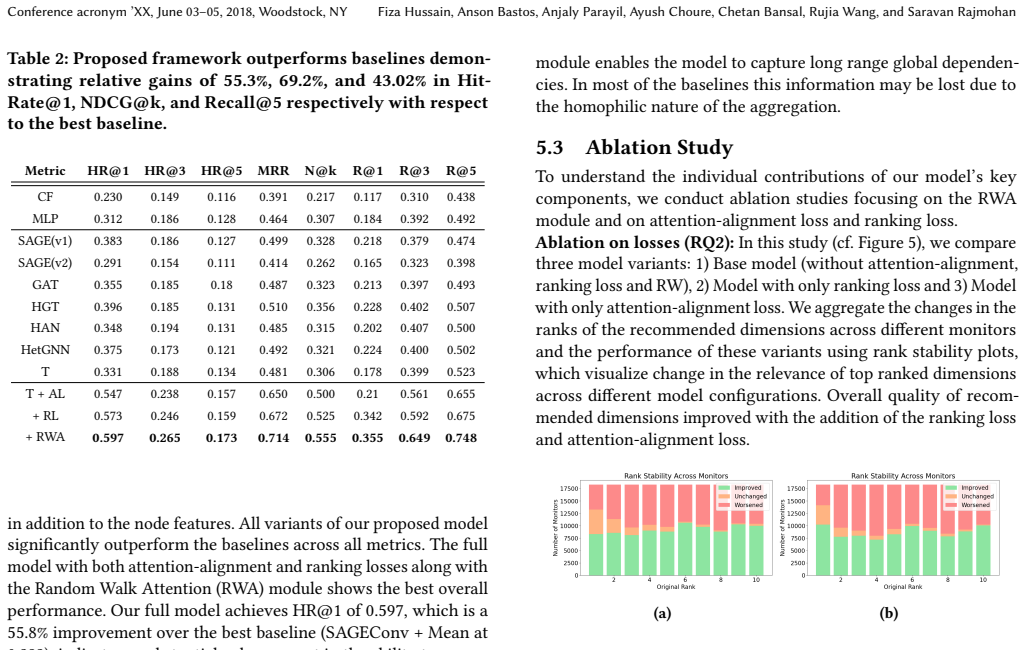
- [Table 2, Section 5.2] The Hit Ratio values in Table 2 decrease with k for every method (e.g., DiRecGNN: HR@1=0.597, HR@3=0.265, HR@5=0.173; HGT: 0.396, 0.185, 0.131). This violates the standard cumulative definition of Hit Ratio, where a correct rank-1 recommendation is necessarily also a correct rank-3 and rank-5 recommendation, so HR@k must be non-decreasing in k. The paper defines HR@k in Section 5.1.2 without specifying a non-cumulative variant. Either the values reported are not cumulative Hit Ratios (e.g., they are precision or exact-rank metrics) or the computation is incorrect. Since the headline '55.8% improvement in HR@1' rests on this column, this must be clarified and corrected before the central quantitative claim can be accepted.
- [Section 5.2, Table 2, Abstract] The claimed improvements are not with respect to the best baseline in the table. Table 2 shows HGT achieving HR@1=0.396 and MRR=0.510, both higher than SAGE(v1)'s 0.383 and 0.499. Yet the text in Section 5.2 says the 'best baseline' is SAGE(v1) and reports a 55.8% HR@1 improvement; the abstract reports a 43.1% MRR increase. Relative to HGT, the HR@1 improvement is 0.597/0.396-1 = 50.8% and the MRR improvement is 0.714/0.510-1 = 40.0%. The inconsistency also appears between the caption (55.3%) and the text (55.8%). These numbers must be reconciled, and all relative improvements should be computed relative to the actual best baseline.
- [Section 1, Section 5.2, Table 2] The training and evaluation labels are the existing 'monitor associated with dimension' edges. Section 1 criticizes the existing approach to selecting dimensions as 'unstructured and reactive,' and Figure 2b shows that most monitors use only a subset of the emitted dimensions. If the historical assignments contain incomplete coverage or redundant dimension choices, the model is trained to reproduce those assignments. The evaluation then measures fidelity to current practice, not the quality of the recommended monitoring configuration. The paper should explicitly discuss this limitation and, if possible, provide evidence (e.g., incident-based validation or a qualitative analysis of recommended vs. non-recommended dimensions) that the learned recommendations correspond to better monitoring outcomes.
- [Section 4.2, Equations (2)-(3)] The description of the random walk path module is confusing. The text says 'for a given monitor node m_i' but then defines paths with a target node d_i and 'destination node type (dimension in this case).' It is unclear whether the paths are sampled from a monitor, a dimension, or both, and how the path embeddings are matched to the query node in Eq. (3). This makes the architecture hard to reproduce. Please clarify the node type from which the random walks start, the exact path schema, and the alignment between path sequences and the query embedding.
minor comments (6)
- [Abstract and Section 5.2] The percentage increases in HR@1 are stated as 55.8% in the text and 55.3% in the Table 2 caption. Please make these consistent.
- [Table 2] The abbreviation 'N@k' is not defined in Section 5.1.2. Please define the value of k used for NDCG and Recall, or report the full metric names and their cutoff values.
- [Section 5.1.2] The paper states that learning rate is reduced when validation loss does not improve for 5 consecutive epochs and early stopping uses patience 10, but the relation between these two mechanisms is unclear. Please clarify whether the scheduler is checked on validation loss or training loss.
- [Section 6.1] The user study reports that 10 engineers agreed out of 30 sampled, but the text earlier says 'approximately 30 users' and then '10 agreed.' Please clearly report the response rate and whether the 30 sampled participants all agreed to be interviewed; the current wording is inconsistent.
- [References] The reference list contains unresolved placeholders such as 'Conference acronym ’XX' in the copyright block and the ACM reference format. These should be replaced with the actual venue and year.
- [Section 4.2] The definition 'L = 2 + 4(l-1)' for path length is not used consistently in the experiments (path lengths are {2, 6, 10}). Please align the notation with the actual path lengths and the number of nodes in the path sequence.
Circularity Check
No circular derivation: the central claim is an empirical held-out edge-prediction result, and neither the equations nor the cited prior work reduce to the paper's own fitted outputs.
full rationale
The paper's derivation chain is an empirical ML pipeline: it builds a monitor-entity graph, defines a ranking model via message passing (Eq. 2), random-walk attention (Eq. 3), and a composite loss (Eq. 7), then evaluates on a held-out 10% edge split with fixed negatives (Section 5.1.2). The target quantities HR@k, MRR, NDCG, and Recall are computed on test edges that are not used to fit the model, so the reported improvements are not equal by construction to any training objective or fitted parameter. The only self-citations with author overlap are [2] (Bastos et al., used alongside external [1] to motivate why attention may be homophilic) and [22] (prior metric-recommendation work cited as related work); neither is invoked as a uniqueness theorem or as the source of the model's components, and removing them would not change the equations. The suspicious monotonic decrease of HR@k with k in Table 2 and the mismatch in the claimed 'best baseline' are internal-consistency/reporting concerns, not circularity: reporting a different statistic under the name HR@k does not make the prediction depend on its own input. No step in the derivation is self-definitional, no fitted value is renamed as a prediction, and no external benchmark result is imported from the authors' prior work. Hence the paper is self-contained with respect to the circularity question.
Assumptions & free parameters
free parameters (4)
- lambda_al (attention-alignment strength) =
not reported
- random walk samples W and path lengths L =
W default not stated; L in {2,6,10}
- negative sampling ratio =
2.0
- dynamic loss balancing weights =
not reported
assumptions (4)
- domain assumption Existing monitor-to-dimension association edges are a valid ground-truth target for learning optimal dimension selection
- domain assumption The monitor entity graph is static and complete for the training window
- domain assumption E5 text embeddings of metric/dimension names capture the semantic features needed for the task
- ad hoc to paper Self-attention over random-walk paths captures long-range dependencies beyond message passing
Cite this review
Pith. "Pith review of Attention Enhanced Entity Recommendation for Intelligent Monitoring in Cloud Systems." pith.science (2026). https://pith.science/paper/YD5EYJCG
@misc{pith2026251020640,
  author       = {Pith},
  title        = {Pith review of: Attention Enhanced Entity Recommendation for Intelligent Monitoring in Cloud Systems},
  year         = {2026},
  howpublished = {\url{https://pith.science/paper/YD5EYJCG}},
  note         = {Machine review of arXiv:2510.20640}
}
read the original abstract
In this paper, we present DiRecGNN, an attention-enhanced entity recommendation framework for monitoring cloud services at Microsoft. We provide insights on the usefulness of this feature as perceived by the cloud service owners and lessons learned from deployment. Specifically, we introduce the problem of recommending the optimal subset of attributes (dimensions) that should be tracked by an automated watchdog (monitor) for cloud services. To begin, we construct the monitor heterogeneous graph at production-scale. The interaction dynamics of these entities are often characterized by limited structural and engagement information, resulting in inferior performance of state-of-the-art approaches. Moreover, traditional methods fail to capture the dependencies between entities spanning a long range due to their homophilic nature. Therefore, we propose an attention-enhanced entity ranking model inspired by transformer architectures. Our model utilizes a multi-head attention mechanism to focus on heterogeneous neighbors and their attributes, and further attends to paths sampled using random walks to capture long-range dependencies. We also employ multi-faceted loss functions to optimize for relevant recommendations while respecting the inherent sparsity of the data. Empirical evaluations demonstrate significant improvements over existing methods, with our model achieving a 43.1% increase in MRR. Furthermore, product teams who consumed these features perceive the feature as useful and rated it 4.5 out of 5.
Figures


Figures from the paper (6 more)



Reference graph
Works this paper leans on
-
[1]
Muhammet Balcilar, Guillaume Renton, Pierre Héroux, Benoit Gaüzère, Sébastien Adam, and Paul Honeine. 2021. Analyzing the Expressive Power of Graph Neural Networks in a Spectral Perspective. InInternational Conference on Learning Representations. https://openreview.net/forum?id=-qh0M9XWxnv
2021
-
[2]
Anson Bastos, Abhishek Nadgeri, Kuldeep Singh, Hiroki Kanezashi, Toyotaro Suzumura, and Isaiah Onando Mulang’. 2022. How Expressive are Transformers in Spectral Domain for Graphs?Transactions on Machine Learning Research (2022). https://openreview.net/forum?id=aRsLetumx1
2022
-
[3]
Fedor Borisyuk, Shihai He, Yunbo Ouyang, Morteza Ramezani, Peng Du, Xiaochen Hou, Chengming Jiang, Nitin Pasumarthy, Priya Bannur, Birjodh Tiwana, et al
-
[4]
Ivan Cantador, Peter Brusilovsky, and Tsvi Kuflik. 2011. Second workshop on information heterogeneity and fusion in recommender systems (HetRec2011). InProceedings of the Fifth ACM Conference on Recommender Systems(Chicago, Illinois, USA)(RecSys ’11). Association for Computing Machinery, New York, NY, USA, 387–388. doi:10.1145/2043932.2044016
arXiv 2011
-
[5]
Zhuangbin Chen, Yu Kang, Liqun Li, Xu Zhang, Hongyu Zhang, Hui Xu, Yangfan Zhou, Li Yang, Jeffrey Sun, Zhangwei Xu, et al. 2020. Towards intelligent incident management: why we need it and how we make it. InProceedings of the 28th ACM Joint Meeting on European Software Engineering Conference and Symposium on the Foundations of Software Engineering. 1487–1497
2020
-
[6]
Wei-Lin Chiang, Xuanqing Liu, Si Si, Yang Li, Samy Bengio, and Cho-Jui Hsieh
-
[7]
Xinyu Fu, Jiani Zhang, Ziqiao Meng, and Irwin King. 2020. Magnn: Metap- ath aggregated graph neural network for heterogeneous graph embedding. In Proceedings of the web conference 2020. 2331–2341
2020
-
[8]
Will Hamilton, Zhitao Ying, and Jure Leskovec. 2017. Inductive representation learning on large graphs.Advances in neural information processing systems30 (2017)
2017
Show all 44 references
-
[9]
Balázs Hidasi and Alexandros Karatzoglou. 2018. Recurrent neural networks with top-k gains for session-based recommendations. InProceedings of the 27th ACM international conference on information and knowledge management. 843–852
2018
-
[10]
Huiting Hong, Hantao Guo, Yucheng Lin, Xiaoqing Yang, Zang Li, and Jieping Ye. 2020. An attention-based graph neural network for heterogeneous structural learning. InProceedings of the AAAI conference on artificial intelligence, Vol. 34. 4132–4139
2020
-
[11]
Binbin Hu, Zhiqiang Zhang, Chuan Shi, Jun Zhou, Xiaolong Li, and Yuan Qi
-
[12]
Ziniu Hu, Yuxiao Dong, Kuansan Wang, and Yizhou Sun. 2020. Heterogeneous graph transformer. InProceedings of the web conference 2020. 2704–2710
2020
-
[13]
Ziniu Hu, Yuxiao Dong, Kuansan Wang, and Yizhou Sun. 2020. Heterogeneous Graph Transformer. InProceedings of The Web Conference 2020(Taipei, Tai- wan)(WWW ’20). Association for Computing Machinery, New York, NY, USA, 2704–2710. doi:10.1145/3366423.3380027
2020
-
[14]
InProceedings of the AAAI Conference on Artificial Intelligence, Vol
Cash-out user detection based on attributed heterogeneous information network with a hierarchical attention mechanism. InProceedings of the AAAI Conference on Artificial Intelligence, Vol. 33. 946–953
-
[15]
Thomas N Kipf and Max Welling. 2016. Semi-supervised classification with graph convolutional networks.arXiv preprint arXiv:1609.02907(2016)
2016 arXiv
-
[16]
Qingsong Lv, Ming Ding, Qiang Liu, Yuxiang Chen, Wenzheng Feng, Siming He, Chang Zhou, Jianguo Jiang, Yuxiao Dong, and Jie Tang. 2021. Are we really making much progress? Revisiting, benchmarking, and refining heterogeneous graph neural networks. arXiv:2112.14936 [cs.LG] https...
2021 arXiv
-
[17]
Wenbing Huang, Tong Zhang, Yu Rong, and Junzhou Huang. 2018. Adaptive sam- pling towards fast graph representation learning.Advances in neural information processing systems31 (2018)
2018
-
[18]
Vinod Nair, Ameya Raul, Shwetabh Khanduja, Vikas Bahirwani, Qihong Shao, Sundararajan Sellamanickam, Sathiya Keerthi, Steve Herbert, and Sudheer Dhuli- palla. 2015. Learning a hierarchical monitoring system for detecting and di- agnosing service issues. InProceedings of the 21...
2015
-
[19]
Rumelhart, Geoffrey E
David E. Rumelhart, Geoffrey E. Hinton, and Ronald J. Williams. 1986. Learning representations by back-propagating errors.Nature323, 6088 (01 Oct 1986), 533–536. doi:10.1038/323533a0
1986 doi
-
[20]
Jesús Montes, Alberto Sánchez, Bunjamin Memishi, María S Pérez, and Gabriel Antoniu. 2013. GMonE: A complete approach to cloud monitoring.Future Generation Computer Systems29, 8 (2013), 2026–2040
2013
-
[21]
Yunsheng Shi, Zhengjie Huang, Shikun Feng, Hui Zhong, Wenjin Wang, and Yu Sun. 2020. Masked label prediction: Unified message passing model for semi- supervised classification.arXiv preprint arXiv:2009.03509(2020)
2020 arXiv
-
[22]
Pooja Srinivas, Fiza Husain, Anjaly Parayil, Ayush Choure, Chetan Bansal, and Saravan Rajmohan. 2024. Intelligent Monitoring Framework for Cloud Services: A Data-Driven Approach. InProceedings of the 46th International Conference on Software Engineering: Software Engineering i...
2024
-
[23]
Aravind Sankar, Yozen Liu, Jun Yu, and Neil Shah. 2021. Graph neural networks for friend ranking in large-scale social platforms. InProceedings of the Web Conference 2021. 2535–2546
2021
-
[24]
Gomez, Lukasz Kaiser, and Illia Polosukhin
Ashish Vaswani, Noam Shazeer, Niki Parmar, Jakob Uszkoreit, Llion Jones, Aidan N. Gomez, Lukasz Kaiser, and Illia Polosukhin. 2023. Attention Is All You Need. arXiv:1706.03762 [cs.CL] https://arxiv.org/abs/1706.03762
2023 arXiv
-
[25]
Petar Velickovic, Guillem Cucurull, Arantxa Casanova, Adriana Romero, Pietro Lio, Yoshua Bengio, et al. 2017. Graph attention networks.stat1050, 20 (2017), 10–48550
2017
-
[26]
Chellammal Surianarayanan and Pethuru Raj Chelliah. 2019. Essentials of Cloud Computing.Cham: Springer International Publishing(2019)
2019
-
[27]
Liang Wang, Nan Yang, Xiaolong Huang, Binxing Jiao, Linjun Yang, Daxin Jiang, Rangan Majumder, and Furu Wei. 2022. Text embeddings by weakly-supervised contrastive pre-training.arXiv preprint arXiv:2212.03533(2022)
2022 arXiv
-
[28]
Xiao Wang, Houye Ji, Chuan Shi, Bai Wang, Yanfang Ye, Peng Cui, and Philip S Yu
-
[29]
Hulong Wang, Zesheng Shen, Shuzhen Jiang, Guang Sun, and Ren-Jie Zhang
-
[30]
Carl Yang, Aditya Pal, Andrew Zhai, Nikil Pancha, Jiawei Han, Charles Rosenberg, and Jure Leskovec. 2020. MultiSage: Empowering GCN with contextualized multi- embeddings on web-scale multipartite networks. InProceedings of the 26th ACM SIGKDD international conference on knowle...
2020
-
[31]
Rex Ying, Ruining He, Kaifeng Chen, Pong Eksombatchai, William L Hamilton, and Jure Leskovec. 2018. Graph convolutional neural networks for web-scale recommender systems. InProceedings of the 24th ACM SIGKDD international conference on knowledge discovery & data mining. 974–983
2018
-
[32]
Seongjun Yun, Minbyul Jeong, Raehyun Kim, Jaewoo Kang, and Hyunwoo J Kim
-
[33]
InThe world wide web conference
Heterogeneous graph attention network. InThe world wide web conference. 2022–2032
2022
-
[34]
Xiao Wang, Houye Ji, Chuan Shi, Bai Wang, Yanfang Ye, Peng Cui, and Philip S Yu. 2019. Heterogeneous Graph Attention Network. InThe World Wide Web Conference(San Francisco, CA, USA)(WWW ’19). Association for Computing Machinery, New York, NY, USA, 2022–2032. doi:10.1145/330855...
2019
-
[35]
Chuxu Zhang, Dongjin Song, Chao Huang, Ananthram Swami, and Nitesh V. Chawla. 2019. Heterogeneous Graph Neural Network. InProceedings of the 25th ACM SIGKDD International Conference on Knowledge Discovery & Data Mining (Anchorage, AK, USA)(KDD ’19). Association for Computing M...
2019
-
[36]
Muhan Zhang, Zhicheng Cui, Marion Neumann, and Yixin Chen. 2018. An end- to-end deep learning architecture for graph classification. InProceedings of the AAAI conference on artificial intelligence, Vol. 32
2018
-
[37]
Jianan Zhao, Xiao Wang, Chuan Shi, Binbin Hu, Guojie Song, and Yanfang Ye
-
[38]
Graph transformer networks.Advances in neural information processing systems32 (2019)
2019
-
[39]
Hanqing Zeng, Hongkuan Zhou, Ajitesh Srivastava, Rajgopal Kannan, and Viktor Prasanna. 2019. Graphsaint: Graph sampling based inductive learning method. arXiv preprint arXiv:1907.04931(2019)
2019 arXiv
-
[40]
Chuxu Zhang, Dongjin Song, Chao Huang, Ananthram Swami, and Nitesh V Chawla. 2019. Heterogeneous graph neural network. InProceedings of the 25th Conference acronym ’XX, June 03–05, 2018, Woodstock, NY Fiza Hussain, Anson Bastos, Anjaly Parayil, Ayush Choure, Chetan Bansal, Ruj...
2019
-
[44]
In Proceedings of the AAAI conference on artificial intelligence, Vol
Heterogeneous graph structure learning for graph neural networks. In Proceedings of the AAAI conference on artificial intelligence, Vol. 35. 4697–4705
-
[2019]
InProceedings of the 25th ACM SIGKDD international conference on knowledge discovery & data mining
Cluster-gcn: An efficient algorithm for training deep and large graph convolutional networks. InProceedings of the 25th ACM SIGKDD international conference on knowledge discovery & data mining. 257–266
-
[2021]
Journal of Physics: Conference Series1757, 1 (jan 2021), 012168
User-based Collaborative Filtering Algorithm Design and Implementation. Journal of Physics: Conference Series1757, 1 (jan 2021), 012168. doi:10.1088/1742- 6596/1757/1/012168
2021 doi
-
[2024]
InProceedings of the 30th ACM SIGKDD Conference on Knowledge Discovery and Data Mining
Lignn: Graph neural networks at linkedin. InProceedings of the 30th ACM SIGKDD Conference on Knowledge Discovery and Data Mining. 4793–4803
Reviewed August 4, 2026 · model on record in the stance chip above.
Discussion (0). Sign in to comment.