REVIEW 3 major objections 5 minor 1 cited by
Spectral signatures of nonstabilizerness and criticality in infinite matrix product states
T0 review · 3 major / 5 minor · reviewed 2026-08-02 · deepseek-v4-flash
Pith's one-line read The stabilizer Rényi entropy of an infinite matrix product state carries its own correlation length, distinct from the standard one, that diverges at continuous phase transitions.
desk verdict Exact skeleton results and the SRE correlation length definition are the real contributions; the universal-criticality claim is a conjecture supported by suggestive, not conclusive, numerics. read the letter →
The pith
A machine-rendered reading of the paper's core claim, the machinery that carries it, and where it could break.
The reading
What carries the argument
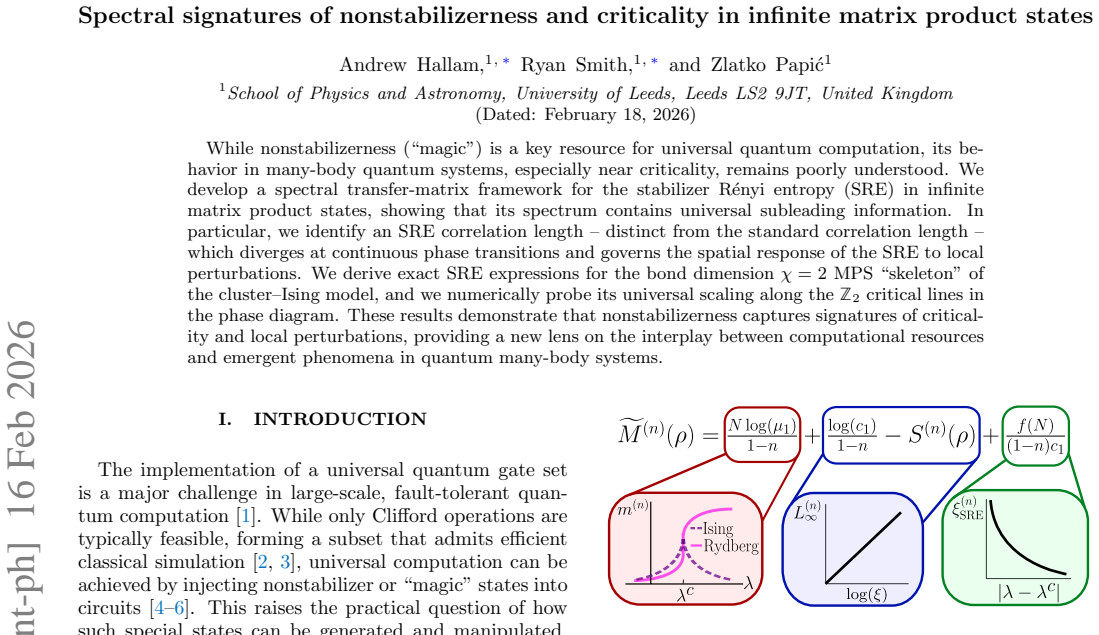
The central object is the replica transfer matrix E (Eq. 9), built from 2n copies of the MPS tensor and Pauli replica operators; its spectral decomposition E = Σ μ_i |R_i^m)(L_i^m| generalizes the ordinary MPS transfer matrix. The ratio of subleading to leading eigenvalues defines ξ_SRE, while the overlap c1 between the dominant eigenvectors of E and the replicated ordinary transfer matrix defines the boundary/mutual SRE. This spectral split converts the SRE of a finite subsystem into a three-term expression (extensive, boundary, exponential correction), and converts two-point responses of magic into a sum of a disconnected term plus an exponential with length ξ_SRE.
What would settle it
Compute the ratio |μ2/μ1| of the SRE replica transfer matrix for an iMPS approximation of a known continuous phase transition, e.g., in the XXZ or J1–J2 chain, and check whether it approaches 1, i.e., whether ξ_SRE diverges. If for some transition the ordinary correlation length diverges while |μ2/μ1| stays bounded below 1, the universal-criticality claim fails. A more direct check is to look for the predicted exponential decay e^(−r/ξ_SRE) in the two-point SRE response in finite exact-diagonalization chains; if the decay instead follows the standard correlation length ξ, the distinct-length c
Extended reading notes
Core claim
The central claim is that the eigenspectrum of the SRE replica transfer matrix E—not just its dominant eigenvalue—carries universal information. For an N-site subsystem, the paper derives M^(n)(ρ) = N log μ1/(1−n) + [log(c1 + f(N))]/(1−n), with f(N) ≈ c2 e^(−N/ξ_SRE) for large N; the length ξ_SRE = −1/log|μ2/μ1| is the SRE correlation length. This length governs both the approach of subsystem SRE to its thermodynamic limit and the exponential decay of SRE correlations induced by two spatially separated local unitary perturbations. The paper argues and verifies that ξ_SRE diverges at continuous phase transitions—with a different exponent from the standard correlation length—so nonstabilizerne
Load-bearing premise
The broad claim that ξ_SRE diverges at every continuous phase transition rests on the assumption that the gap between the two leading eigenvalues of the SRE replica transfer matrix closes at the same critical points as the ordinary transfer matrix gap; this is proven exactly only for the χ = 2 skeleton and verified numerically along the cluster-Ising critical lines within a limited window.
Editorial extensions
If this is right
- The SRE of a finite subsystem is not featureless: it carries an exponentially decaying correction whose length scale can be read off from the second eigenvalue of the replica transfer matrix.
- The SRE correlation length diverges at continuous phase transitions, so it can label critical points even where the SRE density or mutual SRE looks smooth.
- Magic correlations respond to local unitaries with a characteristic decay e^(−r/ξ_SRE), giving an operational way to measure nonstabilizerness length scales.
- For the χ = 2 cluster-Ising skeleton, exact formulas give ξ ≈ 1/(2g) and ξ_SRE ≈ 1/(14g²); the SRE reaches its maximum at g* = ±(3−2√2), where the preparing unitaries are closest to magic gates.
- Along the Z2 critical line, the mutual SRE grows as (1/8) log ξ_SRE after a pre-asymptotic crossover, matching the predicted boundary CFT coefficient.
Reading between the lines
- If the gap of the SRE replica transfer matrix closes generically at criticality, ξ_SRE could become a standard numerical diagnostic for magic-specific length scales, complementing entanglement entropy.
- The exact skeleton shows ξ_SRE diverges faster than ξ, suggesting magic correlations may be longer-ranged than ordinary ones near criticality; if this persists in other models, it would mean nonstabilizerness is a more sensitive probe of long-range order.
- A testable extension is to compute ξ_SRE for other critical chains, e.g., the XXZ chain or J1–J2 chain, and check whether the ratio of critical exponents tracks properties of the replicated CFT.
- The sign of the mutual SRE is negative in the SPT phase of the skeleton, hinting that it encodes entanglement dominance; one could ask whether this sign correlates with symmetry-protected topological order in general.
Signed reviews
Editorial analysis
A structured set of objections, weighed in public.
Referee Report
Summary. The paper develops a spectral transfer-matrix framework for the stabilizer Rényi entropy (SRE) of infinite matrix product states. For an N-site subsystem, Eqs. (17)–(19) decompose the SRE into an extensive term set by the dominant eigenvalue μ1 of the 2n-replica transfer matrix E, an O(1) boundary term, and subleading corrections that decay with a newly defined SRE correlation length ξ_SRE = −1/log|μ2/μ1|. The paper shows that ξ_SRE controls the exponential decay of the SRE response to two local unitary perturbations (Sec. IV). For the χ=2 cluster–Ising MPS skeleton, the eigenvalues of E are obtained in closed form (Eq. (40)), giving ξ and ξ_SRE that diverge at g=0 with different exponents (Eq. (51)). Numerics for the full cluster–Ising model map m^(2), L∞^(2), and ξ_SRE across the phase diagram (Fig. 4) and test a proposed universal scaling W∞^(2) = (1/8) log ξ_SRE + b along the Z2 critical lines (Eq. (53), Fig. 5). Appendices provide exact diagonalization benchmarks and a χ=4 skeleton example.
Significance. The spectral decomposition in Sec. III is clean and exact for any iMPS, and the skeleton results (Eqs. (40), (50), (51)) provide a valuable analytic benchmark. The perturbation-response formula in Sec. IV gives ξ_SRE a concrete operational meaning that goes beyond a formal definition. If the universal divergence of ξ_SRE at continuous transitions is generic, the paper would establish a new nonstabilizerness length scale and a route to detect criticality using magic even when the SRE density is smooth. However, the generality of that claim and the coefficient 1/8 in Eq. (53) are not yet established: the exact evidence covers a two-parameter skeleton, and the numerical evidence is limited to one model with a narrow converged window (χ_t ≤ 64).
major comments (3)
- [III A, VI B, Conclusions] The abstract and Conclusions assert that ξ_SRE diverges at continuous phase transitions in general, but the proof covers only the χ=2 skeleton (Eq. (50)) and the χ=4 skeleton (Appendix C), plus numerical cluster-Ising Z2 lines with χ_t≤64 (Fig. 5). The subleading gap of the filtered Pauli-replica transfer matrix E (Eq. (9)) is not guaranteed to close whenever the physical transfer-matrix gap closes; the local Pauli filter Λ could, in principle, suppress the soft mode. This unproven gap-closing step is exactly what converts the skeleton calculation into the headline universality claim. The authors should either prove gap closure for a class of MPS (e.g., symmetry-constrained or free-fermion states) or explicitly restrict the claim to the studied cases. A concrete test would be a different universality class, such as the XXZ or J1–J2 chain.
- [Eq. (53), Sec. VI B] The universal scaling form W∞^(n) = (2Δ_{2n}/(n−1)) log ξ_SRE + b is introduced by analogy with the BCFT result Eq. (27), with an ad hoc factor-of-two reduction for a single boundary; it is not derived from the spectral decomposition. Numerical support is partial: only g_c=0 and g_c=2 are consistent with the 1/8 slope, while intermediate points overshoot (Fig. 5(c)). Appendix E states that ξ_SRE is not fully converged at the largest χ_t and that the cleanest linear behavior is found using log ξ rather than log ξ_SRE. Since Eq. (53) underlies the 'universal scaling' claim in the abstract, this is load-bearing. The authors should either derive the form from the spectral framework or clearly label it as a conjecture supported only at the Ising and cluster endpoints.
- [Eqs. (19)–(20), Sec. III A] The decomposition relies on f(N)≪c1 in the large-N limit, i.e., on |μ2/μ1|<1. At a continuous transition in the χ→∞ limit, μ2→μ1, so the exponential correction does not decay and the limits N→∞ and χ→∞ do not commute. The paper should state the finite-χ interpretation of ξ_SRE in Eq. (53) and explain how the double-scaling limit is taken. Without this, the definition of ξ_SRE as a 'diverging correlation length' at criticality is ambiguous, and the numerical extraction of the 1/8 slope in Fig. 5 rests on an implicit choice of ordering of limits.
minor comments (5)
- [Sec. V B] The text near Fig. 3 says 'Figure 2(c) shows the effect of separation distance r...' — the correct cross-reference is Fig. 3(c).
- [Eq. (12)] The notation M^(n)(ρ) for the mixed-state SRE is used before it is defined. Please give the explicit mixed-state definition (analogous to Eq. (6)) or cite the original reference more precisely.
- [Appendix B, Eqs. (B6)–(B7)] The superscripts S^(2)(ρ_AB) and I^(2)(A:B) should be S^(n)(ρ_AB) and I^(n)(A:B) for the general n-th order Rényi and mutual SRE, unless the authors intend to specialize to n=2.
- [Fig. 4(c)] The divergence of ξ_SRE along the critical lines is visually inferred from a color plot. A logarithmic color scale or contour lines would make the divergence much easier to assess.
- [Sec. V A, c_i discussion] The statement that c3 diverges while c1→0.25 as g→−1, and that these divergences 'are acceptable' because 'the coefficients c_i are weighted with the corresponding eigenvalue,' would benefit from a brief explanation of the regularization mechanism.
Circularity Check
No circular derivation: the spectral decomposition is an exact identity, and the universal 1/8 slope is imported from an external BCFT result and tested, not fitted.
full rationale
The central decomposition, Eqs. (12)-(20), is algebraic: given the SRE replica transfer matrix E defined in Eq. (9), the contraction in Eq. (12) is exact, and the spectral expansion Eq. (13) directly gives the three-term structure and the definition of ξ_SRE in Eq. (20) as -1/log|μ2/μ1|. This is a definition from the spectrum, not a fitted parameter. The perturbation response derivation, Eqs. (34)-(37), similarly follows by inserting the spectral resolution of E, and the numerical check in Fig. 3 fixes ξ_SRE from the exact Eq. (50) while fitting only an amplitude, so it does not fit the quantity it claims to predict. The χ=2 skeleton and χ=4 skeleton results are exact eigenvalue computations (Eqs. (40), (50)-(51), Appendix C), not fits. The proposed scaling form Eq. (53) is explicitly introduced by analogy with the external BCFT result Eq. (27) from Ref. [40]; its coefficient 1/8 is taken from that external source, and the paper then tests it against iMPS and exact diagonalization data. Deviations are acknowledged as pre-asymptotic in Figs. 5(c), 8(c), 9(b)-(c), and Appendix E, which also states that ξ_SRE is not fully converged at the largest χ_t. This is a convergence caveat about numerical support, not circularity. The only self-citation, Ref. [61], is used for motivation and as a contrasting example in the introduction; it is not load-bearing for the derived spectral identities or the universal scaling claim. The unproven generic step—that |μ2/μ1|→1 whenever |λ2|→1 at every continuous transition—is an assumption/correctness risk, not circularity, because the paper never defines ξ_SRE in terms of ξ and explicitly allows different critical exponents. Score 2 reflects only the presence of a minor, non-load-bearing self-citation; no circular step is present.
Assumptions & free parameters
free parameters (1)
- b (non-universal offset in Eq. (53)) =
not given (fit offset in W∞ vs log ξ_SRE)
assumptions (7)
- domain assumption SRE replica-trick formula for iMPS: m^(n) = (1-n)^{-1} log μ1, with μ1 the dominant eigenvalue of the replica transfer matrix E (Eq. (10)).
- domain assumption Injective iMPS transfer matrix has a unique dominant eigenvalue λ1=1 and exponentially decaying correlations with length ξ = -1/log|λ2| (Eqs. (2)-(4)).
- domain assumption The dominant eigenvectors of E^{⊗2n} are (L1|^{⊗2n}) and |R1)^{⊗2n}, so the environment outside the subsystem is described by the replicated dominant eigenvectors.
- domain assumption Finite-entanglement scaling: at criticality, the iMPS correlation length diverges as χ increases and SE = (c/6) log ξ.
- domain assumption BCFT result Eq. (27): W^(n)(ℓ) = (4Δ_{2n}/(n-1)) log ℓ_c with Δ_{2n}=1/16 for the Ising (Z_2) universality class.
- ad hoc to paper The proposed scaling form Eq. (53), W∞^(n) = (2Δ_{2n}/(n-1)) log ξ_SRE + b, with the factor-of-two reduction for the single boundary.
- domain assumption The truncation of the Pauli-basis MPS at bond dimension χ_t provides a good approximation of the n-th order SRE transfer matrix spectrum for the quantities computed.
invented entities (1)
-
SRE correlation length ξ_SRE^(n) = -1/log|μ2/μ1|
independent evidence
Cite this review
Pith. "Pith review of Spectral signatures of nonstabilizerness and criticality in infinite matrix product states." pith.science (2026). https://pith.science/paper/YDAL7VTW
@misc{pith2026260215116,
  author       = {Pith},
  title        = {Pith review of: Spectral signatures of nonstabilizerness and criticality in infinite matrix product states},
  year         = {2026},
  howpublished = {\url{https://pith.science/paper/YDAL7VTW}},
  note         = {Machine review of arXiv:2602.15116}
}
abstract
While nonstabilizerness (''magic'') is a key resource for universal quantum computation, its behavior in many-body quantum systems, especially near criticality, remains poorly understood. We develop a spectral transfer-matrix framework for the stabilizer R\'enyi entropy (SRE) in infinite matrix product states, showing that its spectrum contains universal subleading information. In particular, we identify an SRE correlation length -- distinct from the standard correlation length -- which diverges at continuous phase transitions and governs the spatial response of the SRE to local perturbations. We derive exact SRE expressions for the bond dimension $\chi=2$ MPS ''skeleton'' of the cluster-Ising model, and we numerically probe its universal scaling along the $\mathbb{Z}_2$ critical lines in the phase diagram. These results demonstrate that nonstabilizerness captures signatures of criticality and local perturbations, providing a new lens on the interplay between computational resources and emergent phenomena in quantum many-body systems.
Figures


Figures from the paper (6 more)


Forward citations
Cited by 1 Pith paper
-
Magic without a phase: phase-independent stabilizer R\'enyi entropy in gluon scattering
A phase-averaged stabilizer Rényi entropy is introduced for tree-level gluon scattering, with color-independent phase-independent magic that is larger in 3→2 than 2→2 and has a soft-limit lower bound in 2→3.
Reference graph
Works this paper leans on
-
[1]
M. A. Nielsen and I. L. Chuang,Quantum Computation and Quantum Information: 10th Anniversary Edition (Cambridge University Press, 2010)
2010
-
[2]
D. Gottesman, The heisenberg representation of quan- tum computers (1998), arXiv:quant-ph/9807006 [quant- ph]
arXiv 1998
-
[3]
Eastin and E
B. Eastin and E. Knill, Restrictions on transversal en- coded quantum gate sets, Phys. Rev. Lett.102, 110502 (2009)
2009
-
[4]
E. Knill, Fault-tolerant postselected quantum computa- tion: Schemes (2004), arXiv:quant-ph/0402171 [quant- ph]
arXiv 2004
-
[5]
Bravyi and A
S. Bravyi and A. Kitaev, Universal quantum computa- tion with ideal clifford gates and noisy ancillas, Phys. Rev. A71, 022316 (2005)
2005
-
[6]
E. T. Campbell and D. E. Browne, Bound states for magic state distillation in fault-tolerant quantum com- putation, Phys. Rev. Lett.104, 030503 (2010)
2010
-
[7]
Howard and E
M. Howard and E. Campbell, Application of a resource theory for magic states to fault-tolerant quantum com- puting, Phys. Rev. Lett.118, 090501 (2017)
2017
-
[8]
Zhou, Z.-C
S. Zhou, Z.-C. Yang, A. Hamma, and C. Chamon, Single T gate in a Clifford circuit drives transition to universal entanglement spectrum statistics, SciPost Phys.9, 087 (2020)
2020
Show all 101 references
-
[9]
K. Goto, T. Nosaka, and M. Nozaki, Probing chaos by magic monotones, Phys. Rev. D106, 126009 (2022)
2022
-
[10]
Liu and A
Z.-W. Liu and A. Winter, Many-body quantum magic, PRX Quantum3, 020333 (2022)
2022
-
[11]
Leone, S
L. Leone, S. F. E. Oliviero, and A. Hamma, Stabilizer R´ enyi entropy, Phys. Rev. Lett.128, 050402 (2022)
2022
-
[12]
Haug and L
T. Haug and L. Piroli, Quantifying nonstabilizerness of matrix product states, Phys. Rev. B107, 035148 (2023)
2023
-
[13]
P. S. Tarabunga, E. Tirrito, T. Chanda, and M. Dal- monte, Many-body magic via pauli-markov chains— from criticality to gauge theories, PRX Quantum4, 040317 (2023)
2023
-
[14]
Turkeshi, M
X. Turkeshi, M. Schir` o, and P. Sierant, Measuring non- stabilizerness via multifractal flatness, Phys. Rev. A 108, 042408 (2023)
2023
-
[15]
Bejan, C
M. Bejan, C. McLauchlan, and B. B´ eri, Dynamical magic transitions in monitored Clifford+Tcircuits, PRX Quantum5, 030332 (2024)
2024
-
[16]
Niroula, C
P. Niroula, C. D. White, Q. Wang, S. Johri, D. Zhu, C. Monroe, C. Noel, and M. J. Gullans, Phase transition in magic with random quantum circuits, Nature Physics 20, 1786 (2024)
2024
-
[17]
P. S. Tarabunga and C. Castelnovo, Magic in general- ized Rokhsar-Kivelson wavefunctions, Quantum8, 1347 (2024)
2024
-
[18]
T. Haug, L. Aolita, and M. Kim, Probing quantum com- plexity via universal saturation of stabilizer entropies, Quantum9, 1801 (2025)
2025
-
[19]
Kitaev and J
A. Kitaev and J. Preskill, Topological entanglement en- tropy, Phys. Rev. Lett.96, 110404 (2006)
2006
-
[20]
Levin and X.-G
M. Levin and X.-G. Wen, Detecting topological order in a ground state wave function, Phys. Rev. Lett.96, 110405 (2006)
2006
-
[21]
Li and F
H. Li and F. D. M. Haldane, Entanglement spectrum as a generalization of entanglement entropy: Identification of topological order in non-abelian fractional quantum hall effect states, Phys. Rev. Lett.101, 010504 (2008)
2008
-
[22]
Pollmann, E
F. Pollmann, E. Berg, A. M. Turner, and M. Os- hikawa, Symmetry protection of topological phases in 19 one-dimensional quantum spin systems, Phys. Rev. B 85, 075125 (2012)
2012
-
[23]
J. H. Bardarson, F. Pollmann, and J. E. Moore, Un- bounded growth of entanglement in models of many- body localization, Phys. Rev. Lett.109, 017202 (2012)
2012
-
[24]
Serbyn, Z
M. Serbyn, Z. Papi´ c, and D. A. Abanin, Universal slow growth of entanglement in interacting strongly disor- dered systems, Phys. Rev. Lett.110, 260601 (2013)
2013
-
[25]
Lukin, M
A. Lukin, M. Rispoli, R. Schittko, M. E. Tai, A. M. Kaufman, S. Choi, V. Khemani, J. L´ eonard, and M. Greiner, Probing entanglement in a many- body–localized system, Science364, 256–260 (2019)
2019
-
[26]
Laflorencie, Quantum entanglement in condensed matter systems, Physics Reports646, 1 (2016)
N. Laflorencie, Quantum entanglement in condensed matter systems, Physics Reports646, 1 (2016)
2016
-
[27]
Schollw¨ ock, The density-matrix renormalization group in the age of matrix product states, Annals of Physics326, 96 (2011), january 2011 Special Issue
U. Schollw¨ ock, The density-matrix renormalization group in the age of matrix product states, Annals of Physics326, 96 (2011), january 2011 Special Issue
2011
-
[28]
J. I. Cirac, D. P´ erez-Garc ´ ıa, N. Schuch, and F. Ver- straete, Matrix product states and projected entangled pair states: Concepts, symmetries, theorems, Rev. Mod. Phys.93, 045003 (2021)
2021
-
[29]
S. R. White, Density matrix formulation for quan- tum renormalization groups, Phys. Rev. Lett.69, 2863 (1992)
1992
-
[30]
S. F. E. Oliviero, L. Leone, A. Hamma, and S. Lloyd, Measuring magic on a quantum processor, npj Quantum Information8, 148 (2022)
2022
-
[31]
Heinrich and D
M. Heinrich and D. Gross, Robustness of Magic and Symmetries of the Stabiliser Polytope, Quantum3, 132 (2019)
2019
-
[33]
P. S. Tarabunga, Critical behaviors of non-stabilizerness in quantum spin chains, Quantum8, 1413 (2024)
2024
-
[34]
M. Frau, P. S. Tarabunga, M. Collura, M. Dalmonte, and E. Tirrito, Nonstabilizerness versus entanglement in matrix product states, Phys. Rev. B110, 045101 (2024)
2024
-
[36]
Liu and B
Z. Liu and B. K. Clark, Nonequilibrium quantum monte carlo algorithm for stabilizer R´ enyi entropy in spin sys- tems, Phys. Rev. B111, 085144 (2025)
2025
-
[37]
P. S. Tarabunga, E. Tirrito, M. C. Ba˜ nuls, and M. Dal- monte, Nonstabilizerness via matrix product states in the pauli basis, Phys. Rev. Lett.133, 010601 (2024)
2024
-
[38]
Y.-M. Ding, Z. Wang, and Z. Yan, Evaluating many- body stabilizer R´ enyi entropy by sampling reduced Pauli strings: Singularities, volume law, and nonlocal magic, PRX Quantum6, 030328 (2025)
2025
-
[39]
Viscardi, M
M. Viscardi, M. Dalmonte, A. Hamma, and E. Tirrito, Interplay of entanglement structures and stabilizer en- tropy in spin models (2025), arXiv:2503.08620 [quant- ph]
2025
-
[40]
Hoshino, M
M. Hoshino, M. Oshikawa, and Y. Ashida, Stabi- lizer R´ enyi entropy and conformal field theory (2025), arXiv:2503.13599 [quant-ph]
2025
-
[41]
C. P. Moca, D. Sticlet, and B. D´ ora, Non-stabilizerness as a diagnostic of criticality and exceptional points in non-hermitian spin chains (2025), arXiv:2510.17248 [quant-ph]
2025
-
[42]
A. G. Catalano, S. B. Koˇ zi´ c, G. Torre, C. Ciaramel- letti, S. Paganelli, F. Franchini, and S. M. Giampaolo, Resource complexity of symmetry protected topological phases (2025), arXiv:2509.08053 [quant-ph]
2025 arXiv
-
[43]
Bera and M
S. Bera and M. Schir` o, Non-stabilizerness of Sachdev- Ye-Kitaev model, SciPost Phys.19, 159 (2025)
2025
-
[44]
Zhang, S
P. Zhang, S. Zhou, and N. Sun, Stabilizer R´ enyi entropy and its transition in the coupled Sachdev-Ye-Kitaev model (2025), arXiv:2509.17417 [quant-ph]
2025
-
[45]
Jasser, J
B. Jasser, J. Odavi´ c, and A. Hamma, Stabilizer entropy and entanglement complexity in the sachdev-ye-kitaev model, Phys. Rev. B112, 174204 (2025)
2025
-
[46]
Russomanno, G
A. Russomanno, G. Passarelli, D. Rossini, and P. Lu- cignano, Nonstabilizerness in the unitary and monitored quantum dynamics of XXZ-staggered and Sachdev-Ye- Kitaev models, Phys. Rev. B112, 064312 (2025)
2025
-
[47]
Turkeshi, E
X. Turkeshi, E. Tirrito, and P. Sierant, Magic spreading in random quantum circuits, Nature Communications 16, 2575 (2025)
2025
-
[48]
P. R. N. Falc˜ ao, P. Sierant, J. Zakrzewski, and E. Tir- rito, Nonstabilizerness dynamics in many-body localized systems, Phys. Rev. Lett.135, 240404 (2025)
2025
-
[49]
Hern´ andez-Yanes, P
T. Hern´ andez-Yanes, P. Sierant, J. Zakrzewski, and M. P lodzie´ n, Nonstabilizerness in quantum-enhanced metrological protocols, Phys. Rev. A113, 012416 (2026)
2026
-
[50]
Odavi´ c, M
J. Odavi´ c, M. Viscardi, and A. Hamma, Stabilizer en- tropy in nonintegrable quantum evolutions, Phys. Rev. B112, 104301 (2025)
2025
-
[51]
Tirrito, X
E. Tirrito, X. Turkeshi, and P. Sierant, Anticoncen- tration and nonstabilizerness spreading under ergodic quantum dynamics, Phys. Rev. Lett.135, 220401 (2025)
2025
-
[52]
J. A. Monta˜ n` a L´ opez and P. Kos, Exact solution of long- range stabilizer R´ enyi entropy in the dual-unitary XXZ model, Journal of Physics A: Mathematical and Theo- retical57, 475301 (2024)
2024
-
[53]
C. P. Moca, D. Sticlet, B. D´ ora, A. Valli, D. Szombathy, and G. Zar´ and, Non-stabilizerness generation in a multi- particle quantum walk (2025), arXiv:2504.19750 [quant- ph]
2025
-
[54]
Dowling, P
N. Dowling, P. Kos, and X. Turkeshi, Magic resources of the Heisenberg picture, Phys. Rev. Lett.135, 050401 (2025)
2025
-
[55]
Dowling, K
N. Dowling, K. Modi, and G. A. L. White, Bridging en- tanglement and magic resources within operator space, Phys. Rev. Lett.135, 160201 (2025)
2025
-
[56]
Collura, J
M. Collura, J. D. Nardis, V. Alba, and G. Lami, The non-stabilizerness of fermionic gaussian states (2025), arXiv:2412.05367 [quant-ph]
2025
-
[57]
Sierant, P
P. Sierant, P. Stornati, and X. Turkeshi, Fermionic magic resources of quantum many-body systems, PRX Quantum7, 010302 (2026)
2026
-
[58]
Sarkis, P
M. Sarkis, P. Martinez-Azcona, and A. Tkatchenko, Magic for hybrid boson-fermion systems: A Grassmann phase-space approach (2025), arXiv:2509.05264 [quant- ph]
2025 arXiv
-
[59]
Wang, Z.-C
C. Wang, Z.-C. Yang, T. Zhou, and X. Chen, Magic transition in monitored free fermion dynamics (2025), arXiv:2507.10688 [quant-ph]
2025 arXiv
-
[60]
Crew, Y.-L
S. Crew, Y.-L. Li, H.-H. Li, and P.-Y. Chang, Magic entropy in hybrid spin-boson systems (2025), arXiv:2508.06018 [cond-mat.str-el]
2025 arXiv
-
[61]
Smith, Z
R. Smith, Z. Papi´ c, and A. Hallam, Nonstabilizerness in kinetically constrained Rydberg atom arrays, Phys. 20 Rev. B111, 245148 (2025)
2025
-
[63]
C. Cao, G. Cheng, A. Hamma, L. Leone, W. Munizzi, and S. F. Oliviero, Gravitational backreaction is magi- cal, PRX Quantum6, 040375 (2025)
2025
-
[64]
Passarelli, R
G. Passarelli, R. Fazio, and P. Lucignano, Nonstabiliz- erness of permutationally invariant systems, Phys. Rev. A110, 022436 (2024)
2024
-
[65]
Hoshino and Y
M. Hoshino and Y. Ashida, Stabilizer R´ enyi entropy en- codes fusion rules of topological defects and boundaries (2025), arXiv:2507.10656 [quant-ph]
2025
-
[66]
M. A. Rajabpour, Stabilizer-shannon renyi equiva- lence: Exact results for quantum critical chains (2025), arXiv:2509.10700 [quant-ph]
2025 arXiv
-
[67]
D´ ora and C
B. D´ ora and C. P. Moca, Momentum space nonstabi- lizerness for the transverse field quantum ising model, Phys. Rev. B112, 125427 (2025)
2025
-
[68]
S. F. E. Oliviero, L. Leone, and A. Hamma, Magic-state resource theory for the ground state of the transverse- field Ising model, Phys. Rev. A106, 042426 (2022)
2022
-
[69]
P. R. N. Falc˜ ao, P. S. Tarabunga, M. Frau, E. Tirrito, J. Zakrzewski, and M. Dalmonte, Nonstabilizerness in U(1) lattice gauge theory, Phys. Rev. B111, L081102 (2025)
2025
-
[70]
L.-Y.-N. Liu, S. Yi, and J. Cui, Stabilizer R´ enyi entropy for translation-invariant matrix product states (2025), arXiv:2508.03534 [quant-ph]
2025 arXiv
-
[71]
M. M. Wolf, G. Ortiz, F. Verstraete, and J. I. Cirac, Quantum phase transitions in matrix product systems, Phys. Rev. Lett.97, 110403 (2006)
2006
-
[72]
Smith, B
A. Smith, B. Jobst, A. G. Green, and F. Pollmann, Crossing a topological phase transition with a quantum computer, Phys. Rev. Res.4, L022020 (2022)
2022
-
[73]
Calabrese and J
P. Calabrese and J. Cardy, Entanglement entropy and quantum field theory, Journal of Statistical Mechanics: Theory and Experiment2004, P06002 (2004)
2004
-
[74]
Tagliacozzo, T
L. Tagliacozzo, T. R. de Oliveira, S. Iblisdir, and J. I. Latorre, Scaling of entanglement support for matrix product states, Phys. Rev. B78, 024410 (2008)
2008
-
[75]
Pollmann, S
F. Pollmann, S. Mukerjee, A. M. Turner, and J. E. Moore, Theory of finite-entanglement scaling at one- dimensional quantum critical points, Phys. Rev. Lett. 102, 255701 (2009)
2009
-
[76]
Leone and L
L. Leone and L. Bittel, Stabilizer entropies are mono- tones for magic-state resource theory, Phys. Rev. A110, L040403 (2024)
2024
-
[77]
P. S. Tarabunga and T. Haug, Efficient mutual magic and magic capacity with matrix product states, SciPost Phys.19, 085 (2025)
2025
-
[78]
Haug and P
T. Haug and P. S. Tarabunga, Efficient witnessing and testing of magic in mixed quantum states (2025), arXiv:2504.18098 [quant-ph]
2025 arXiv
-
[79]
Lami and M
G. Lami and M. Collura, Nonstabilizerness via perfect pauli sampling of matrix product states, Phys. Rev. Lett.131, 180401 (2023)
2023
-
[80]
P. S. Tarabunga, E. Tirrito, M. C. Ba˜ nuls, and M. Dal- monte, Nonstabilizerness via matrix product states in the Pauli basis, Phys. Rev. Lett.133, 010601 (2024)
2024
-
[81]
R. G. Melko, A. B. Kallin, and M. B. Hastings, Finite- size scaling of mutual information in monte carlo sim- ulations: Application to the spin- 1 2 XXZ model, Phys. Rev. B82, 100409 (2010)
2010
-
[82]
Wilms, M
J. Wilms, M. Troyer, and F. Verstraete, Mutual in- formation in classical spin models, Journal of Statisti- cal Mechanics: Theory and Experiment2011, P10011 (2011)
2011
-
[83]
Kudler-Flam, R´ enyi mutual information in quantum field theory, Phys
J. Kudler-Flam, R´ enyi mutual information in quantum field theory, Phys. Rev. Lett.130, 021603 (2023)
2023
-
[84]
M. M. Wolf, F. Verstraete, M. B. Hastings, and J. I. Cirac, Area laws in quantum systems: Mutual infor- mation and correlations, Phys. Rev. Lett.100, 070502 (2008)
2008
-
[85]
C. D. White, C. Cao, and B. Swingle, Conformal field theories are magical, Phys. Rev. B103, 075145 (2021)
2021
-
[86]
Sarkar, C
S. Sarkar, C. Mukhopadhyay, and A. Bayat, Character- ization of an operational quantum resource in a critical many-body system, New Journal of Physics22, 083077 (2020)
2020
-
[87]
N. Bao, C. Cao, and V. P. Su, Magic state distillation from entangled states, Phys. Rev. A105, 022602 (2022)
2022
-
[88]
J. R. Fliss, Knots, links, and long-range magic, Journal of High Energy Physics2021, 90 (2021)
2021
-
[89]
N. G. Jones, J. Bibo, B. Jobst, F. Pollmann, A. Smith, and R. Verresen, Skeleton of matrix-product-state- solvable models connecting topological phases of mat- ter, Phys. Rev. Res.3, 033265 (2021)
2021
-
[90]
Zou and J
L. Zou and J. Haah, Spurious long-range entanglement and replica correlation length, Phys. Rev. B94, 075151 (2016)
2016
-
[91]
M. B. Hastings, I. Gonz´ alez, A. B. Kallin, and R. G. Melko, Measuring Renyi entanglement entropy in quan- tum monte carlo simulations, Phys. Rev. Lett.104, 157201 (2010)
2010
-
[92]
Smacchia, L
P. Smacchia, L. Amico, P. Facchi, R. Fazio, G. Florio, S. Pascazio, and V. Vedral, Statistical mechanics of the cluster ising model, Phys. Rev. A84, 022304 (2011)
2011
-
[93]
Zauner-Stauber, L
V. Zauner-Stauber, L. Vanderstraeten, M. T. Fishman, F. Verstraete, and J. Haegeman, Variational optimiza- tion algorithms for uniform matrix product states, Phys. Rev. B97, 045145 (2018)
2018
-
[94]
Camp and N
I. Camp and N. G. Jones, Matrix-product state skele- tons in Onsager-integrable quantum chains (2025), arXiv:2511.07212 [quant-ph]
2025 arXiv
-
[95]
Boesl, Y.-J
J. Boesl, Y.-J. Liu, F. Pollmann, and M. Knap, Skeleton of isometric tensor network states for abelian string-net models (2025), arXiv:2511.13821 [quant-ph]
2025 arXiv
-
[96]
Maity and R
S. Maity and R. Hamazaki, Local spreading of stabilizer R´ enyi entropy in a brickwork random Clifford circuit (2025), arXiv:2511.07769 [quant-ph]
2025
-
[97]
Bejan, P
M. Bejan, P. W. Claeys, and J. Yao, Magic spreading under unitary Clifford dynamics (2025), arXiv:2511.21487 [quant-ph]
2025
-
[98]
Nehra, P
R. Nehra, P. S. Tarabunga, M. Frau, M. Collura, E. Tir- rito, and M. Dalmonte, Topological magic response in quantum spin chains (2025), arXiv:2512.16673 [quant- ph]
2025
-
[99]
Bravyi, D
S. Bravyi, D. Browne, P. Calpin, E. Campbell, D. Gos- set, and M. Howard, Simulation of quantum circuits by low-rank stabilizer decompositions, Quantum3, 181 (2019)
2019
-
[100]
Rubboli, R
R. Rubboli, R. Takagi, and M. Tomamichel, Mixed- state additivity properties of magic monotones based on quantum relative entropies for single-qubit states and beyond, Quantum8, 1492 (2024)
2024
-
[101]
D. Haag, F. Baccari, and G. Styliaris, Typical corre- lation length of sequentially generated tensor network 21 states, PRX Quantum4, 030330 (2023)
2023
-
[102]
Altland and M
A. Altland and M. R. Zirnbauer, Nonstandard symme- try classes in mesoscopic normal-superconducting hy- brid structures, Phys. Rev. B55, 1142 (1997)
1997
-
[103]
Verresen, N
R. Verresen, N. G. Jones, and F. Pollmann, Topology and edge modes in quantum critical chains, Phys. Rev. Lett.120, 057001 (2018)
2018
-
[104]
N. G. Jones and R. Verresen, Asymptotic correlations in gapped and critical topological phases of 1D quantum systems, Journal of Statistical Physics175, 1164 (2019)
2019
Reviewed August 2, 2026 · model on record in the stance chip above.
Discussion (0). Continue with ORCID to comment.