REVIEW 4 major objections 6 minor 14 references
Multi-view Story Characterization from Movie Plot Synopses and Reviews
T0 review · 4 major / 6 minor · reviewed 2026-08-14 · deepseek-v4-flash
Pith's one-line read User reviews lift automatic movie tagging by about 4 F1 points.
desk verdict A useful multi-view model with a real F1 gain and a neat extraction idea, but the paper's headline 74% for open-vocabulary tags is internally inconsistent with the appendix's stricter criterion and should be re-reported. read the letter →
The pith
A machine-rendered reading of the paper's core claim, the machinery that carries it, and where it could break.
The reading
What carries the argument
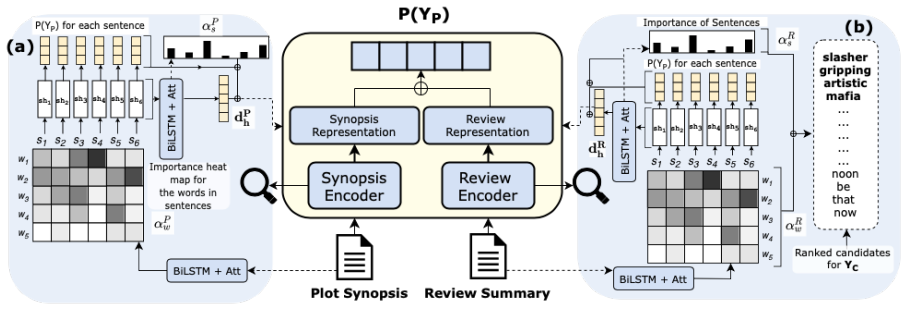
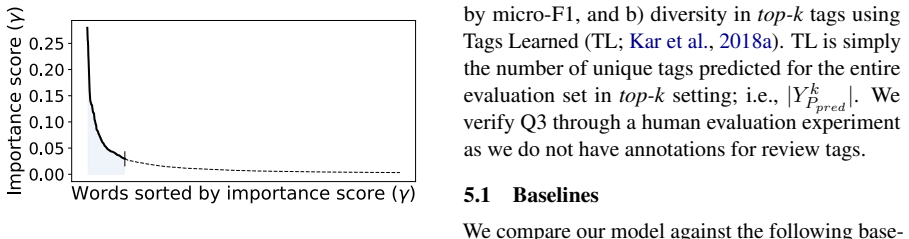
The load-bearing mechanism is a pair of hierarchical attention encoders—BiLSTMs with word-level attention feeding sentence representations, then sentence-level attention to form a document vector—one for the synopsis and one for a text-rank summary of up to 100 user reviews. The two document vectors are merged by gated fusion, $z = \sigma(W_z[d^{PS}_h,d^R_h])$, with $h = z*h^{PS} + (1-z)*h^R$, and sentence-level tag predictions are aggregated as in multiple instance learning. After training, the review encoder's attention weights define an importance score for each word, $\gamma_{ij} = \alpha^R_{W_{ij}} \alpha^R_{s_i} |s_i|$, and words whose rank curve flattens below a slope threshold become candidate open-vocabulary tags.
What would settle it
Run the extraction on a larger held-out sample and ask annotators to mark every review span that names a story attribute; if the model's top-ranked attention words consistently miss those spans, or if relevance rates on the larger sample fall well below the reported 74%, the unsupervised tagset is an artifact of attention rather than a story signal.
Extended reading notes
Core claim
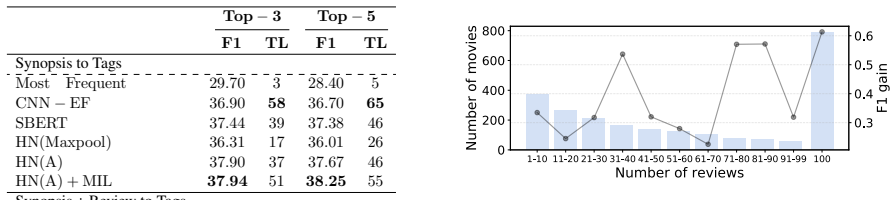
The paper argues that movie reviews carry story attributes that synopses miss, and that a model trained on both can tag a film better than one trained on synopses alone. On the test set, its gated-fusion multi-view model reaches 41.84 micro-F1 (top-3 tags) using synopses and reviews, against 37.94 for the best synopsis-only variant in the same paper. The same trained review encoder supplies word- and sentence-level attention scores, and ranking review words by those scores yields an open-vocabulary tagset beyond the predefined 71 labels without any tag-level supervision; in a human evaluation on 21 films, about 74% of 141 extracted tags were judged relevant by at least one of three raters.
Load-bearing premise
Everything about the unsupervised part rests on one premise: attention weights trained to predict the 71 predefined tags also mark words that name new story attributes, and the only check is human rating of 141 tags from 21 movies.
Editorial extensions
If this is right
- A practical tagging system can start from synopses alone and accept reviews as they arrive; the same trained model handles both settings with no reconfiguration.
- At least roughly 31-40 reviews per movie are enough to see a reliable gain in tag F1, so systems can decide when to switch from synopsis-only to multi-view mode.
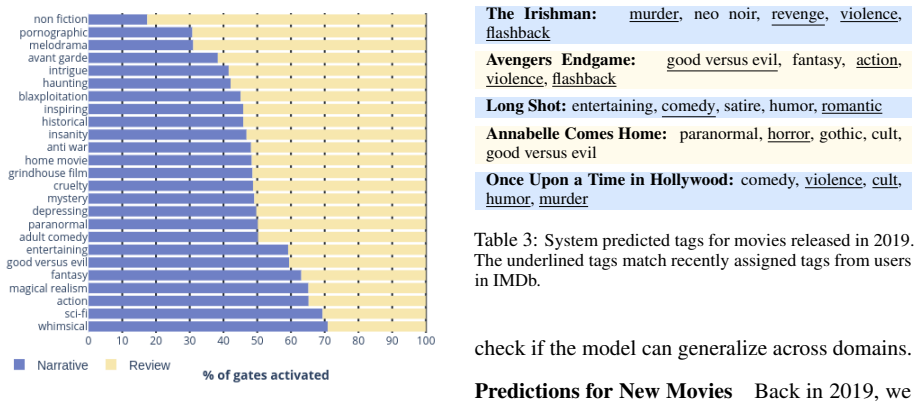
- Tags like non-fiction, inspiring, haunting, and pornographic are better recovered from reviews than synopses, suggesting review text is not merely redundant with plot.
- Attention-derived open-vocabulary tags extend the closed 71-label tagset, so story description is no longer bounded by what appears in training and development sets.
- The 74% human-relevance rate on extracted tags, if stable, means user reviews can be mined for new story attributes without annotating reviews word by word.
Reading between the lines
- A natural extension would be to calibrate the slope threshold per movie instead of fixing it on validation, since movie length and review style vary; an adaptive threshold may improve extraction for longer reviews.
- The same attention-as-supervision trick could be applied to books, TV episodes, or video game narratives, where plot summaries and reader/viewer reviews are both available; the paper's out-of-domain examples hint at this but are not systematic.
- The gating vector $z$ could be interpreted per tag as the model's source preference; a failure analysis comparing gate activations with review helpfulness ratings might reveal when reviews mislead rather than help.
- Because the open-vocabulary tagset is derived only from attention, a direct comparison of gamma-ranked words against human-annotated relevant spans would be the clean test of whether attention is truly tracking story content.
Signed reviews
Editorial analysis
A structured set of objections, weighed in public.
Referee Report
Summary. The paper addresses automatic story characterization by predicting a closed set of 71 story tags from movie plot synopses and user reviews. It extends the MPST corpus with review summaries, proposes a hierarchical attention encoder with multiple-instance learning and gated fusion of synopsis/review representations, and reports that gated fusion achieves 41.84 micro-F1 versus 37.94 for the best synopsis-only system. It further proposes extracting an open-vocabulary tagset from review attention weights, validated by a human evaluation on 21 movies. The dataset and code are released.
Significance. If the results hold, the paper makes a useful empirical contribution: it provides evidence that user reviews contain complementary signal for story tagging, and it sketches a weakly supervised route to open-vocabulary attributes. The supervised comparison is consistent across Table 2, the subset analysis, and the human evaluation, and the dataset/resource contribution is concrete. The qualitative generalization checks for 2019 movies and non-movie narratives are a valuable addition. However, the unsupervised extraction contribution rests on a human evaluation whose reported 74% relevance figure conflicts with the appendix's stated two-vote criterion, and the main review-versus-synopsis gain is reported without significance testing or variance estimates.
major comments (4)
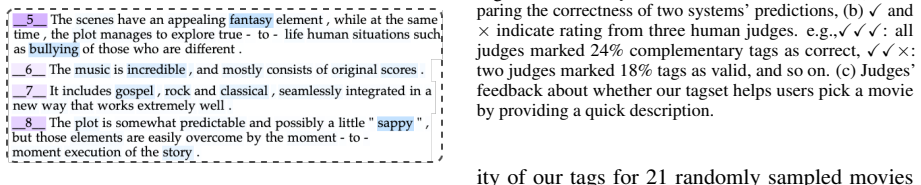
- [Section 6.1 and Appendix F] Section 6.1 reports that 24% + 18% + 32% = 74% of the open-vocabulary tags YC were 'marked as relevant by at least one judge,' but Appendix F explicitly states the evaluation protocol as 'We consider a tag as relevant if it has at least two votes.' Under the appendix's stated standard, the relevant fraction is 24% + 18% = 42%, not 74%. This is not merely a presentational difference: the 74% figure is the headline quantitative evidence for the unsupervised extraction contribution. The paper must adopt one standard consistently, report both criteria, and adjust the claims in the abstract and Section 6.1 accordingly. Please also provide the per-tag vote distributions underlying Figure 7(b) so the reader can verify both numbers.
- [Section 5, Table 2] The central claim that adding reviews improves tag prediction (37.94 to 41.84 in top-3 micro-F1) is not accompanied by statistical significance testing or variance estimates. The t-test footnote applies only to the comparison among gated fusion, merge-texts, and concatenation; it does not compare the review-based models with the synopsis-only systems. Because the reported gains are small in absolute terms and each configuration appears to be trained once, I ask for either multiple seeds with standard deviations or a significance test for the synopsis-only versus synopsis+reviews comparison.
- [Section 4.2, Eq. (1)] The importance score gamma_ij = alpha_Wij * alpha_si * |si| treats word-level attention as a direct measure of semantic relevance, and the stopping threshold of 5e-3 is set 'based on our observations on the validation set.' This makes the extraction loop partly self-referential: the same attention weights trained for closed-set tag prediction define both the candidate tags and, via validation-based thresholding, their stopping criterion. The human evaluation is an external check, but it only covers 21 movies. To strengthen this contribution, please provide an additional validation of attention-based importance, such as a comparison with held-out review-side annotations or a sensitivity analysis over the threshold.
- [Section 6.1] The human evaluation uses three judges on 21 movies and 141 tags, but no inter-annotator agreement statistic is reported. Given that the central quantitative claim for YC depends on judge votes, please report agreement (e.g., Fleiss' kappa) and clarify how disagreements were adjudicated.
minor comments (6)
- [Abstract] 'demonstrate how can we take advantage' should be 'demonstrate how we can take advantage.'
- [Section 4.2] 'Figure-3' should be 'Figure 3.'
- [Table 2] The footnote explaining the t-test should state explicitly which pairwise comparisons were tested; the current single asterisk is ambiguous.
- [Appendix F] The emoticon legend is useful, but the appendix's relevance criterion is inconsistent with the main text; please align the two or explicitly report both standards.
- [Section 6.3, Table 3] The claim that 'most of these tags except neo noir were found in IMDB' is informal; consider reporting the number of matched tags per movie.
- [Throughout] Capitalization of IMDb/IMDB and MPST is inconsistent; please standardize.
Circularity Check
No significant circularity: core F1 gains are tested on held-out labels and open-vocabulary tags are externally human-evaluated.
full rationale
The paper's central quantitative claim (Table 2: gated fusion 41.84 vs synopsis-only HN(A)+MIL 37.94 micro-F1) is an empirical head-to-head comparison on a held-out test set against gold labels from the MPST corpus; no prediction is recomputed from a fitted parameter or from the model's own output. The open-vocabulary extraction (Section 4.2, Eq. 1) defines candidate tags from the trained review encoder's attention weights, but the paper does not present this extraction as a supervised prediction whose validity is established by the training objective. Its validity is checked externally through human judges on 21 movies in Section 6.1, and the attention-to-relevance link is an explicit domain assumption rather than an equation that reduces to the model's loss. The stopping threshold of 5e-3 is a validation-tuned hyperparameter, not a fitted label or a renamed prediction. The self-citations (Kar et al. 2018a for the MPST dataset, Kar et al. 2018b for the CNN-EF baseline) point to public resources and prior published systems; they are not invoked as a uniqueness theorem or as an unverified ansatz, and the paper also includes independent baselines such as SBERT. The reported discrepancy between the main-text summary that about 74% of open-vocabulary tags were relevant 'by at least one judge' and Appendix F's stated criterion of 'at least two votes' is an internal-consistency/correctness concern, not a circular-derivation concern. Overall, I find no step where a claimed result is equivalent by construction to its input.
Assumptions & free parameters
free parameters (1)
- Open-vocabulary tag extraction threshold =
5e-3
assumptions (4)
- domain assumption User-assigned tags in the MPST corpus are a valid gold standard for story attributes
- domain assumption TextRank summaries of the collected reviews preserve the opinion-rich content needed for tag prediction
- domain assumption Attention weights learned under bag-level supervision indicate word-level relevance for story attributes
- domain assumption Treating each sentence as an instance in a multiple instance learning framework is valid for tag prediction
Cite this review
Pith. "Pith review of Multi-view Story Characterization from Movie Plot Synopses and Reviews." pith.science (2026). https://pith.science/paper/YDBI6L5N
@misc{pith2026190809083,
  author       = {Pith},
  title        = {Pith review of: Multi-view Story Characterization from Movie Plot Synopses and Reviews},
  year         = {2026},
  howpublished = {\url{https://pith.science/paper/YDBI6L5N}},
  note         = {Machine review of arXiv:1908.09083}
}
read the original abstract
This paper considers the problem of characterizing stories by inferring properties such as theme and style using written synopses and reviews of movies. We experiment with a multi-label dataset of movie synopses and a tagset representing various attributes of stories (e.g., genre, type of events). Our proposed multi-view model encodes the synopses and reviews using hierarchical attention and shows improvement over methods that only use synopses. Finally, we demonstrate how can we take advantage of such a model to extract a complementary set of story-attributes from reviews without direct supervision. We have made our dataset and source code publicly available at https://ritual.uh.edu/ multiview-tag-2020.
Figures

Figures from the paper (4 more)

Reference graph
Works this paper leans on
-
[10]
Sentence- BERT: Sentence embeddings using Siamese BERT- networks. In Proceedings of the 2019 Conference on Empirical Methods in Natural Language Processing and the 9th International Joint Conference on Natu- ral Language Processing (EMNLP-IJCNLP), pages 3982–3992, Hong Kong, China. Association for Computational Linguistics. Ashish Vaswani, Noam Shazeer, N...
work page 2019
-
[11]
In 2014 IEEE International Con- ference on Data Mining, pages 1037–1042
Scalable multi- instance learning. In 2014 IEEE International Con- ference on Data Mining, pages 1037–1042. Joseph Worsham and Jugal Kalita
work page 2014
-
[12]
In Proceedings of the 27th Inter- national Conference on Computational Linguistics , pages 1963–1973
Genre Iden- tification and the Compositional Effect of Genre in Literature. In Proceedings of the 27th Inter- national Conference on Computational Linguistics , pages 1963–1973. Association for Computational Linguistics. Yumo Xu and Mirella Lapata
work page 1963
-
[2004]
In Proceedings of the 2004 Con- ference on Empirical Methods in Natural Language Processing
Textrank: Bring- ing order into text. In Proceedings of the 2004 Con- ference on Empirical Methods in Natural Language Processing. Jeffrey Pennington, Richard Socher, and Christopher Manning
work page 2004
-
[2006]
Movie Review Mining and Summarization. In Proceedings of the 15th ACM International Conference on In- formation and Knowledge Management, CIKM ’06, pages 43–50, New York, NY , USA. ACM. Appendix A Data Pre-processing and Input Representation We tokenize the synopses and reviews using spaCy10 NLP library. To remove rare words and other noise, we retain the...
-
[2008]
In Proceedings of the ECML/PKDD 2008 Discovery Challenge
Multilabel text classification for automated tag suggestion. In Proceedings of the ECML/PKDD 2008 Discovery Challenge. Jim Keeler and David E. Rumelhart
work page 2008
-
[2010]
Coling 2010 Organizing Committee
, pages 653–661. Coling 2010 Organizing Committee. E. Lin, S. Fang, and J. Wang
work page 2010
-
[2013]
Mining on- line book reviews for sentimental clustering. In 2013 27th International Conference on Advanced In- formation Networking and Applications Workshops, pages 179–184. Bing Liu
work page 2013
Show all 14 references
-
[2014]
In Proceedings of the 2014 conference on empirical methods in natural language process- ing (EMNLP), pages 1532–1543
Glove: Global vectors for word rep- resentation. In Proceedings of the 2014 conference on empirical methods in natural language process- ing (EMNLP), pages 1532–1543. Philipp Petrenz
2014
-
[2015]
In 3rd Inter- national Conference on Learning Representations, ICLR 2015, San Diego, CA, USA, May 7-9, 2015, Conference Track Proceedings
Neural machine translation by jointly learning to align and translate. In 3rd Inter- national Conference on Learning Representations, ICLR 2015, San Diego, CA, USA, May 7-9, 2015, Conference Track Proceedings. Douglas Biber
2015
-
[2016]
Hierarchical attention networks for document classification. In Proceedings of the 2016 Conference of the North American Chapter of the Association for Computa- tional Linguistics: Human Language Technologies , pages 1480–1489, San Diego, California. Associa- tion for Computati...
2016
-
[2017]
In 5th Inter- national Conference on Learning Representations, ICLR 2017, Toulon, France, April 24-26, 2017, Workshop Track Proceedings
Gated mul- timodal units for information fusion. In 5th Inter- national Conference on Learning Representations, ICLR 2017, Toulon, France, April 24-26, 2017, Workshop Track Proceedings. Dzmitry Bahdanau, Kyunghyun Cho, and Yoshua Ben- gio
2017
-
[2018]
What’s This Movie About? A Joint Neural Network Archi- tecture for Movie Content Analysis. In Proceedings of the 2018 Conference of the North American Chap- ter of the Association for Computational Linguistics: Human Language Technologies, Volume 1 (Long Pa- pers), pages 1770–...
2018
-
[2019]
BERT: Pre-training of deep bidirectional transformers for language under- standing. In Proceedings of the 2019 Conference of the North American Chapter of the Association for Computational Linguistics: Human Language Technologies, Volume 1 (Long and Short Papers) , pages 4171–...
2019
Reviewed August 14, 2026 · model on record in the stance chip above.
Discussion (0). Continue with ORCID to comment.