REVIEW 3 major objections 4 minor 47 references
Soft phonons and ultralow lattice thermal conductivity in the Dirac semimetal Cd3As2
T0 review · 3 major / 4 minor · reviewed 2026-08-14 · deepseek-v4-flash
Pith's one-line read This paper identifies soft optical phonon modes at the Brillouin zone center of the Dirac semimetal Cd3As2 as the origin of its anomalously low lattice thermal conductivity, explaining both the low value and its non-monotonic temperature…
desk verdict The paper reports genuinely new phonon data for Cd3As2 and a plausible soft-phonon mechanism, but the quantitative thermal-conductivity numbers rest on a 10-atom proxy cell that the authors themselves call only qualitative; worth peer review with that caveat made central. read the letter →
The pith
A machine-rendered reading of the paper's core claim, the machinery that carries it, and where it could break.
The reading
What carries the argument
The central object is the lowest optical phonon branch (LOB) at the Brillouin zone center, a group of soft optical modes below 1 THz whose frequency depends strongly on the electronic smearing parameter in the density-functional calculation. This frequency controls the phase space for three-phonon Umklapp scattering of heat-carrying acoustic phonons: the lower the LOB frequency, the larger the scattering phase space and the lower the lattice thermal conductivity. The temperature dependence is argued to arise from the competition between ordinary Umklapp scattering, which grows with temperature, and the stiffening of the soft mode, which shrinks the phase space; the paper captures this qualitatively by equating the fictitious electronic temperature with the lattice temperature.
What would settle it
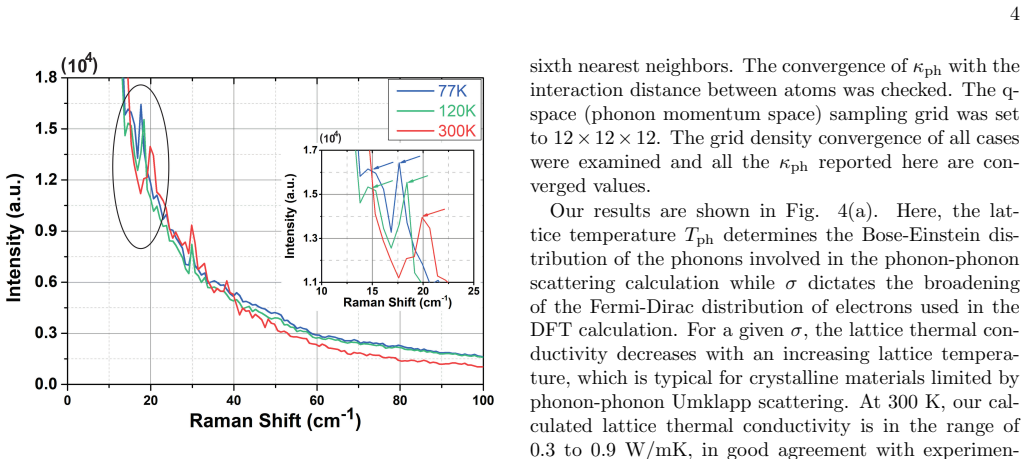
Track the 20 cm⁻¹ Raman mode from 77 K to 450 K: the paper's explanation requires this soft mode to stiffen with increasing temperature; observing the opposite trend would falsify the claimed soft-mode–Umklapp balance behind the non-monotonic thermal conductivity.
Extended reading notes
Core claim
The central claim is that low-frequency (below 1 THz) optical phonon modes at the zone center of Cd3As2 are responsible for the material's ultralow lattice thermal conductivity. The paper shows that these modes are extremely sensitive to the Fermi-Dirac smearing parameter used in density-functional calculations, with the lowest optical branch falling to roughly 0.1 THz at a smearing of 0.01 eV, and interprets this as a Kohn anomaly tied to the Dirac nodes. Raman measurements reveal a mode near 20 cm⁻¹ whose frequency decreases on cooling, consistent with the soft-mode picture. Anharmonic phonon-Boltzmann calculations on a simplified 10-atom substructure show that the softer dispersion dramatically increases the scattering rates of low-frequency acoustic phonons, producing lattice thermal conductivity values in the 0.3–0.9 W/mK range at 300 K and a non-monotonic temperature dependence when the fictitious electronic temperature is set equal to the lattice temperature.
Load-bearing premise
The load-bearing premise is that the simplified 10-atom substructure crystal, used for the expensive anharmonic force-constant and phonon-scattering calculations, faithfully represents the soft-phonon physics and thermal transport of the real 80-atom Cd3As2 cell; only the long-wavelength dispersion agreement near the zone center is shown to justify this proxy.
Editorial extensions
If this is right
- If the soft-phonon mechanism is right, Cd3As2's low thermal conductivity is intrinsic rather than defect-driven, so reducing defect densities will not substantially raise it.
- The non-monotonic temperature dependence, with conductivity rising above roughly 450 K, becomes a fingerprint of soft optical phonons coupled to the electronic structure and may appear in other topological semimetals.
- The Kohn anomaly interpretation implies that tuning the Fermi level or the Dirac-node separation through doping or strain should shift the soft-mode frequency and thereby the thermal conductivity.
- Materials with Dirac or Weyl nodes may generically exhibit very low lattice thermal conductivity when phonon wavevectors connecting nodes fall inside the phonon Brillouin zone.
Reading between the lines
- A testable extension: measurements of thermal conductivity on isotopically pure, high-quality films with varied carrier density could separate the soft-phonon contribution from residual point-defect scattering.
- The substructure proxy could be validated by computing anharmonic force constants for the full 80-atom cell using an interatomic potential fitted to first-principles forces; if the soft modes and enhanced scattering survive, the mechanism is robust.
- If the Kohn anomaly is the true cause, hydrostatic pressure or epitaxial strain, which moves the Dirac nodes, should shift the lowest optical branch and provide an external handle on thermal conductivity.
Signed reviews
Editorial analysis
A structured set of objections, weighed in public.
Referee Report
Summary. The paper reports a combined first-principles and Raman spectroscopy study of the lattice dynamics of the Dirac semimetal Cd3As2. It identifies soft optical phonon modes near the Brillouin zone center, with calculated frequencies below 1 THz and Raman features near 15 and 20 cm^-1. The authors argue that these soft modes enlarge the phonon-phonon scattering phase space and are responsible for the anomalously low lattice thermal conductivity (0.3-0.7 W/mK at 300 K). They further propose that the strong dependence of the soft-mode frequency on the DFT electronic smearing parameter σ reflects a Kohn anomaly associated with the Dirac nodes, and that the interplay between Umklapp scattering and temperature-dependent soft-mode frequencies can explain the reported non-monotonic temperature dependence of the lattice thermal conductivity. Thermal transport calculations are performed with ShengBTE using a 10-atom substructure instead of the full 80-atom primitive cell, with different σ values and a Tel=Tph correspondence used to generate a non-monotonic κph(T) curve.
Significance. If the central mechanism is substantiated, the paper would provide a microscopic explanation for two striking observations in Cd3As2: the ultralow lattice thermal conductivity and its unusual increase with temperature above roughly 300 K. It would also connect topological electronic structure (Dirac nodes) to phonon thermodynamics, with implications for thermal management and thermoelectric applications. The strength of the work is its combination of explicit DFT phonon calculations for the full 80-atom cell, temperature-dependent Raman spectroscopy on high-quality films, and candid discussion of computational limitations. However, the quantitative thermal-transport claim rests on approximations that the authors themselves characterize as qualitative, and the Kohn-anomaly attribution is acknowledged to be incomplete without dynamic electron-phonon coupling.
major comments (3)
- [Thermal transport section (Fig. 4)] The lattice thermal conductivity and scattering rates in Fig. 4 are computed entirely for the 10-atom substructure, not the 80-atom primitive cell, and the paper states that this approach is expected only to 'qualitatively capture' the soft-phonon physics. Since κph is an integral over the full Brillouin zone, agreement of the long-wavelength dispersions along Γ-Z does not validate the three-phonon phase space generated by the low-lying optical branches across the whole zone. Please provide a quantitative test of the substructure approximation (e.g., a full-zone comparison of all phonon branches, or a coarser-q anharmonic calculation for the 80-atom cell), or explicitly downgrade the abstract's causal claim from 'are the origin' to a qualitative mechanism proposal.
- [Fig. 4(a), Tel=Tph mapping] The dotted curve in Fig. 4(a) is obtained by setting the fictitious electronic temperature Tel = σ/kB equal to the lattice temperature Tph, but no derivation or independent validation is given for this equality. Because σ controls both the phonon spectrum and the scattering calculation, the non-monotonic curve is an interpolation across separate σ-dependent models rather than a prediction from a single temperature-dependent Hamiltonian. Please provide a microscopic argument for this mapping, or clearly label the dotted curve as a qualitative illustration and avoid presenting it as a quantitative reproduction of the experimental temperature dependence.
- [Kohn anomaly discussion (Fig. 2(b), Raman section)] The attribution of the soft modes to a Kohn anomaly rests on the σ-dependence of the lowest optical branch in static DFT and a slight dip near q0, while the Raman experiment resolves modes near 20 and 15 cm^-1 but cannot resolve the lowest optical branch itself; the paper also acknowledges that dynamic electron-phonon coupling is not treated. The thermal-transport mechanism is logically independent of this electronic origin, so please clearly separate the well-supported finding of soft optical phonons from the more speculative Kohn-anomaly interpretation.
minor comments (4)
- [Fig. 2 caption] The figure caption does not identify which curve or color corresponds to each σ value in Fig. 2(b); please add a legend or explicitly state the mapping in the caption.
- [Methods, electronic smearing] The parameter σ is introduced as a Fermi-Dirac smearing width in the DFT calculation, but it would help to state explicitly that it is the VASP smearing parameter (ISMEAR=-1 with specified SIGMA) and to explain how its value was chosen for the equilibrium calculations.
- [References] Reference [17] is cited as an arXiv preprint; if a journal version exists, please update the citation. Also, the reference list would benefit from a consistent format for arXiv identifiers.
- [Raman discussion] The text notes that the lowest optical branch cannot be resolved due to a strong quasielastic background; a brief quantitative statement about the background subtraction procedure or the signal-to-noise ratio would strengthen confidence in the fitted peak positions.
Circularity Check
No significant circularity: the central low-κ calculation is parameter-free first-principles transport, and the Tel=Tph mapping is an openly stated qualitative assumption, not a fitted prediction.
full rationale
The paper's central claim—that soft optical phonons enlarge the three-phonon scattering phase space and cause the ultralow lattice thermal conductivity—rests on independently computed inputs: DFT phonon dispersions for the 80-atom cell, Raman measurements of soft modes near 15–20 cm−1, and an iterative BTE solution (ShengBTE) using third-order IFCs from finite displacements. No experimental thermal conductivity value is used to set any parameter; the calculated 0.3–0.9 W/mK range at 300 K is compared with measurements post hoc, and σ is a DFT electronic-smearing parameter whose effect on the LOB frequency is computed, not fitted to κ. The 10-atom substructure is admittedly a computational proxy, justified by long-wavelength dispersion agreement and explicitly said to only 'qualitatively capture' the physics; this is a modeling approximation, not a circular reduction. The non-monotonic κ(T) curve is generated by the stated assumption Tel = Tph, which the paper labels as a qualitative comparison and a simplified treatment rather than a rigorous prediction; because the equality is not fitted to, and does not reproduce quantitatively, the measured temperature trend, it does not constitute a fitted input renamed as a prediction. The only self-citation ([41]) is peripheral and non-load-bearing. Accordingly, the derivation chain is self-contained for its central claim.
Assumptions & free parameters
free parameters (1)
- Electronic smearing parameter sigma (Fermi-Dirac broadening in DFT) =
0.01 eV (Tel ~ 115 K) and other values shown in Fig. 4
assumptions (4)
- domain assumption DFT with PBE, PAW, and spin-orbit coupling yields accurate electronic structure and interatomic force constants for Cd3As2.
- ad hoc to paper Phonon dispersion and thermal transport of the 10-atom Cd3As2 substructure faithfully represent the real 80-atom primitive cell for heat transport.
- ad hoc to paper The fictitious electronic temperature Tel = sigma/kB equals the lattice temperature Tph in modeling temperature-dependent phonon frequencies.
- domain assumption Kohn anomaly physics is captured by static electronic screening in DFT with smearing.
Cite this review
Pith. "Pith review of Soft phonons and ultralow lattice thermal conductivity in the Dirac semimetal Cd3As2." pith.science (2026). https://pith.science/paper/YDDILIAA
@misc{pith2026190803810,
  author       = {Pith},
  title        = {Pith review of: Soft phonons and ultralow lattice thermal conductivity in the Dirac semimetal Cd3As2},
  year         = {2026},
  howpublished = {\url{https://pith.science/paper/YDDILIAA}},
  note         = {Machine review of arXiv:1908.03810}
}
read the original abstract
Recently, Cd3As2 has attracted intensive research interest as an archetypical Dirac semimetal, hosting three-dimensional linear-dispersive electronic bands near the Fermi level. Previous studies have shown that single-crystalline Cd3As2 has an anomalously low lattice thermal conductivity, ranging from 0.3 W/mK to 0.7 W/mK at 300 K, which has been attributed to point defects. In this work, we combine first-principles lattice dynamics calculations and temperature-dependent high-resolution Raman spectroscopy of high-quality single-crystal thin films grown by molecular beam epitaxy to reveal the existence of a group of soft optical phonon modes at the Brillouin zone center of Cd3As2. These soft phonon modes significantly increase the scattering phase space of heat-carrying acoustic phonons and are the origin of the low lattice thermal conductivity of Cd3As2. Furthermore, we show that the interplay between the phonon-phonon Umklapp scattering rates and the soft optical phonon frequency explains the unusual non-monotonic temperature dependence of the lattice thermal conductivity of Cd3As2. Our results further suggest that the soft phonon modes are potentially induced by a Kohn anomaly associated with the Dirac nodes, in analogy to similar, nonetheless weaker, effects in graphene and Weyl semimetals.
Figures


Figures from the paper (1 more)

Reference graph
Works this paper leans on
-
[1]
A. J. Rosenbergand T. C. Harman, Cd 3As2 - a noncu- bic semiconductor with unusually high electron mobility, Journal of Applied Physics 30, 1621 (1959)
work page 1959
-
[2]
T. Schumann, M. Goyal, H. Kim, and S. Stemmer, Molec- ular beam epitaxy of Cd 3As2 on a III-V substrate, APL Materials 4, 126110 (2016)
work page 2016
-
[3]
Z. Wang, H. Weng, Q. Wu, X. Dai, and Z. Fang, Three- dimensional dirac semimetal and quantum transport in Cd3As2, Physical Review B 88, 125427 (2013)
work page 2013
-
[4]
S. Borisenko, Q. Gibson, D. Evtushinsky, V. Zabolotnyy, B. B¨ uchner, and R. J. Cava, Experimental realization of a three-dimensional Dirac semimetal, Physical Review Letters 113, 027603 (2014)
work page 2014
-
[5]
Z. Liu, J. Jiang, B. Zhou, Z. Wang, Y. Zhang, H. Weng, D. Prabhakaran, S. Mo, H. Peng, P. Dudin, et al. , A stable three-dimensional topological Dirac semimetal Cd3As2, Nature Materials 13, 677 (2014)
work page 2014
-
[6]
S. Jeon, B. B. Zhou, A. Gyenis, B. E. Feldman, I. Kimchi, A. C. Potter, Q. D. Gibson, R. J. Cava, A. Vishwanath, and A. Yazdani, Landau quantization and quasiparti- cle interference in the three-dimensional Dirac semimetal Cd3As2, Nature Materials 13, 851 (2014)
work page 2014
-
[7]
M. Neupane, S.-Y. Xu, R. Sankar, N. Alidoust, G. Bian, C. Liu, I. Belopolski, T.-R. Chang, H.-T. Jeng, H. Lin, et al. , Observation of a three-dimensional topological Dirac semimetal phase in high-mobility Cd 3As2, Nature Communications 5, 3786 (2014)
work page 2014
-
[8]
I. Crassee, R. Sankar, W.-L. Lee, A. Akrap, and M. Or- lita, 3d dirac semimetal Cd 3As2: A review of material properties, Physical Review Materials 2, 120302 (2018)
work page 2018
Show all 47 references
-
[9]
Liang, Q
T. Liang, Q. Gibson, M. N. Ali, M. Liu, R. J. Cava, and N. P. Ong, Ultrahigh mobility and giant magnetoresis- tance in the Dirac semimetal Cd 3As2, Nature Materials 14, 280 (2015)
2015
-
[10]
Liang, J
T. Liang, J. Lin, Q. Gibson, T. Gao, M. Hirschberger, M. Liu, R. J. Cava, and N. P. Ong, Anomalous Nernst effect in the Dirac semimetal Cd 3As2, Physical Review Letters 118, 136601 (2017)
2017
-
[11]
Schumann, L
T. Schumann, L. Galletti, D. A. Kealhofer, H. Kim, M. Goyal, and S. Stemmer, Observation of the quan- tum Hall effect in confined films of the three-dimensional Dirac semimetal Cd 3As2, Physical Review Letters 120, 016801 (2018). 6
2018
-
[12]
Skinnerand L
B. Skinnerand L. Fu, Large, nonsaturating thermopower in a quantizing magnetic field, Science Advances 4, eaat2621 (2018)
2018
-
[13]
H. Wang, X. Luo, W. Chen, N. Wang, B. Lei, F. Meng, C. Shang, L. Ma, T. Wu, X. Dai, et al. , Magnetic-field enhanced high-thermoelectric performance in topological Dirac semimetal Cd3As2 crystal, Science Bulletin 63, 411 (2018)
2018
-
[14]
Hosseini, N
T. Hosseini, N. Yavarishad, J. Alward, N. Kouklin, and M. Gajdardziska-Josifovska, Large thermopower, crys- talline Cd 3As2 by low-temperature vapor deposition for room temperature heat waste recovery, Advanced Elec- tronic Materials 2, 1500319 (2016)
2016
-
[15]
Z. Song, J. Zhao, Z. Fang, and X. Dai, Detecting the chi- ral magnetic effect by lattice dynamics in Weyl semimet- als, Physical Review B 94, 214306 (2016)
2016
-
[16]
Rinkel, P
P. Rinkel, P. L. Lopes, and I. Garate, Signatures of the chiral anomaly in phonon dynamics, Physical Review Letters 119, 107401 (2017)
2017
-
[17]
Cheng, T
B. Cheng, T. Schumann, Y. Wang, X. Zhang, D. Bar- balas, S. Stemmer, and N. Armitage, A large effec- tive phonon magnetic moment in a Dirac semimetal, arXiv:1905.00309 (2019)
2019 arXiv
-
[18]
D. P. Spitzer, G. A. Castellion, and G. Haacke, Anoma- lous thermal conductivity of Cd 3As2 and the Cd 3As2- Zn3As2 alloys, Journal of Applied Physics 37, 3795 (1966)
1966
-
[19]
Armitageand H
D. Armitageand H. Goldsmid, The thermal conductivity of cadmium arsenide, Journal of Physics C: Solid State Physics 2, 2138 (1969)
1969
-
[20]
J. Zhu, T. Feng, S. Mills, P. Wang, X. Wu, L. Zhang, S. T. Pantelides, X. Du, and X. Wang, Record-low and anisotropic thermal conductivity of a quasi-one- dimensional bulk zrte5 single crystal, ACS Applied Ma- terials & Interfaces 10, 40740 (2018)
2018
-
[21]
Piscanec, M
S. Piscanec, M. Lazzeri, F. Mauri, A. Ferrari, and J. Robertson, Kohn anomalies and electron-phonon inter- actions in graphite, Physical Review Letters 93, 185503 (2004)
2004
-
[22]
Lazzeriand F
M. Lazzeriand F. Mauri, Nonadiabatic Kohn anomaly in a doped graphene monolayer, Physical Review Letters 97, 266407 (2006)
2006
-
[23]
Nguyen, F
T. Nguyen, F. Han, N. Andrejevic, P.-P. Ricardo, A. Apte, Y. Tsurimaki, Z. Ding, K. Zhang, A. Alatas, E. E. Alp, S. Chi, J. Fernandez-Baca, M. Matsuda, D. A. Tennant, Y. Zhao, Z. Xu, J. W. Lynn, S. Huang, and M. Li, Discovery of topological singularity induced Kohn anomaly in ...
2019 arXiv
-
[24]
Kresseand J
G. Kresseand J. Furthm¨ uller, Efficient iterative schemes for ab initio total-energy calculations using a plane-wave basis set, Phys. Rev. B 54, 11169 (1996)
1996
-
[25]
Kresseand J
G. Kresseand J. Furthm¨ uller, Efficiency of ab-initio total energy calculations for metals and semiconductors using a plane-wave basis set, Comp. Mater. Sci. 6, 15 (1996)
1996
-
[26]
P. E. Bl¨ ochl, Projector augmented-wave method, Phys. Rev. B 50, 17953 (1994)
1994
-
[27]
Kresseand D
G. Kresseand D. Joubert, From ultrasoft pseudopoten- tials to the projector augmented-wave method, Phys. Rev. B 59, 1758 (1999)
1999
-
[28]
J. P. Perdew, K. Burke, and M. Ernzerhof, Generalized gradient approximation made simple, Phys. Rev. Lett. 77, 3865 (1996)
1996
-
[29]
Steiner, S
S. Steiner, S. Khmelevskyi, M. Marsmann, and G. Kresse, Calculation of the magnetic anisotropy with projected-augmented-wave methodology and the case study of disordered Fe 1−xCox alloys, Physical Review B 93, 224425 (2016)
2016
-
[30]
M. N. Ali, Q. Gibson, S. Jeon, B. B. Zhou, A. Yazdani, and R. J. Cava, The crystal and electronic structures of Cd 3As2, the three-dimensional electronic analogue of graphene, Inorganic Chemistry 53, 4062 (2014)
2014
-
[31]
A. M. Conte, O. Pulci, and F. Bechstedt, Electronic and optical properties of topological semimetal Cd 3As2, Sci- entific Reports 7, 45500 (2017)
2017
-
[32]
Esfarjani, G
K. Esfarjani, G. Chen, and H. T. Stokes, Heat transport in silicon from first-principles calculations, Physical Re- view B 84, 085204 (2011)
2011
-
[33]
Togoand I
A. Togoand I. Tanaka, First principles phonon calcula- tions in materials science, Scr. Mater. 108, 1 (2015)
2015
-
[34]
Hellmanand D
O. Hellmanand D. A. Broido, Phonon thermal transport in Bi 2Te3 from first principles, Physical Review B 90, 134309 (2014)
2014
-
[35]
Delaire, J
O. Delaire, J. Ma, K. Marty, A. F. May, M. A. McGuire, M.-H. Du, D. J. Singh, A. Podlesnyak, G. Ehlers, M. Lumsden, et al., Giant anharmonic phonon scattering in PbTe, Nature Materials 10, 614 (2011)
2011
-
[36]
Kohn, Image of the fermi surface in the vibration spectrum of a metal, Physical Review Letters 2, 393 (1959)
W. Kohn, Image of the fermi surface in the vibration spectrum of a metal, Physical Review Letters 2, 393 (1959)
1959
-
[37]
Jandl, S
S. Jandl, S. Desgreniers, C. Carlone, and M. Aubin, The Raman spectrum of Cd 3As2, Journal of Raman Spec- troscopy 15, 137 (1984)
1984
-
[38]
Sharafeev, V
A. Sharafeev, V. Gnezdilov, R. Sankar, F. Chou, and P. Lemmens, Optical phonon dynamics and electronic fluctuations in the dirac semimetal Cd3As2, Physical Re- view B 95, 235148 (2017)
2017
-
[39]
Weszka, M
J. Weszka, M. Renucci, and A. Zwick, Some aspects of ra- man scattering in Cd 3As2 single crystals, Physica Status Solidi (b) 133, 57 (1986)
1986
-
[40]
S. Lee, K. Esfarjani, T. Luo, J. Zhou, Z. Tian, and G. Chen, Resonant bonding leads to low lattice thermal conductivity, Nature Communications 5, 3525 (2014)
2014
-
[41]
S.-Y. Yue, T. Xu, and B. Liao, Ultralow thermal con- ductivity in a two-dimensional material due to surface- enhanced resonant bonding, Materials Today Physics 7, 89 (2018)
2018
-
[42]
C. Li, O. Hellman, J. Ma, A. May, H. Cao, X. Chen, A. Christianson, G. Ehlers, D. Singh, B. Sales, et al. , Phonon self-energy and origin of anomalous neutron scat- tering spectra in SnTe and PbTe thermoelectrics, Physi- cal Review Letters 112, 175501 (2014)
2014
-
[43]
C. W. Li, J. Hong, A. F. May, D. Bansal, S. Chi, T. Hong, G. Ehlers, and O. Delaire, Orbitally driven giant phonon anharmonicity in SnSe, Nature Physics 11, 1063 (2015)
2015
-
[44]
W. Li, J. Carrete, N. A. Katcho, and N. Mingo, Sheng- BTE: A solver of the Boltzmann transport equation for phonons, Computer Physics Communications 185, 1747 (2014)
2014
-
[45]
J. E. Turney, E. S. Landry, A. J. H. McGaughey, and C. H. Amon, Predicting phonon properties and thermal conductivity from anharmonic lattice dynamics calcula- tions and molecular dynamics simulations, Phys. Rev. B 79, 064301 (2009)
2009
-
[46]
W. Li, L. Lindsay, D. A. Broido, D. A. Stewart, and N. Mingo, Thermal conductivity of bulk and nanowire Mg2SixSn1−x alloys from first principles, Phys. Rev. B 86, 174307 (2012)
2012
-
[47]
Giustino, Electron-phonon interactions from first prin- 7 ciples, Reviews of Modern Physics 89, 015003 (2017)
F. Giustino, Electron-phonon interactions from first prin- 7 ciples, Reviews of Modern Physics 89, 015003 (2017)
2017
Reviewed August 14, 2026 · model on record in the stance chip above.
Discussion (0). Continue with ORCID to comment.