REVIEW 3 major objections 5 minor 37 references
An efficient bounded-variable nonlinear least-squares algorithm for embedded MPC
T0 review · 3 major / 5 minor · reviewed 2026-08-14 · deepseek-v4-flash
Pith's one-line read By expressing MPC problem matrices as abstract functions of the model and tuning parameters, this paper eliminates the problem-construction step and lets a single bounded-variable nonlinear least-squares solver handle linear, nonlinear…
desk verdict The sparse QR-update machinery and operator abstraction are the real contributions; the nonlinear/adaptive claim rests on a penalty-parameter guarantee the authors themselves admit they do not have. read the letter →
The pith
A machine-rendered reading of the paper's core claim, the machinery that carries it, and where it could break.
The reading
What carries the argument
The load-bearing identity is the quadratic-penalty reformulation (6) that replaces the model equality constraints $h_k(z_k,\phi_k)=0$ by the single penalty term $\tfrac{1}{2\rho}\|h_k\|^2$, converting constrained MPC into a box-constrained nonlinear least-squares problem $\min_{p_k\le z_k\le q_k} \tfrac{1}{2}\|r_k(z_k)\|_2^2$. The second mechanism is the pair of abstract operators $J_{ix}$ and $J_{tiX}$, which compute the $i$-th column of the Jacobian scaled by a scalar and the inner product of the $i$-th row of $J^\top$ with a vector, using only the model coefficients and the integers defining the sparsity pattern. These operators make the solver parameter-free: the compiled code does not change when the model or tuning parameters change. The third mechanism is the sparse recursive thin QR factorization of Section 6, whose predicted nonzero structure is characterized in Corollaries 2 and 3, reducing the cost of active-set bound flips to operations on nonzeros only.
What would settle it
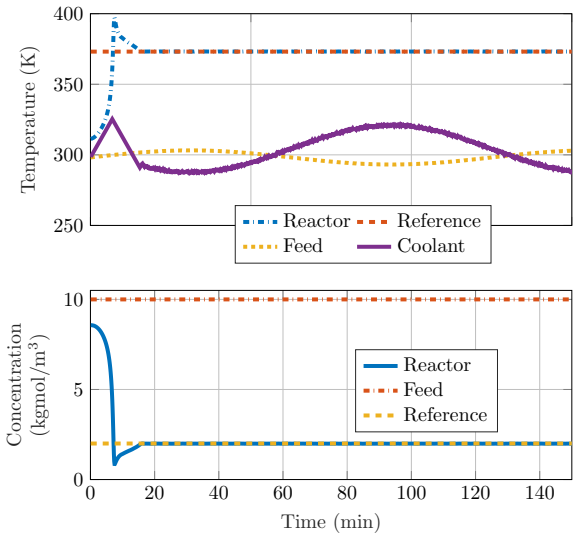
Run the algorithm on a nonlinear model with a stiff or poorly scaled Jacobian and increase $\rho$ until constraint residuals meet a target; if at some $\rho$ the least-squares subproblem becomes numerically rank-deficient (or the solver converges to a point with equality residual above the specified tolerance), the single-penalty step has failed to solve the intended constrained MPC problem. A concrete test: for the CSTR benchmark with $N_p=N_u=160$, measure the worst-case $\|h(z,\phi)\|_2$ while increasing $\sqrt{\rho}$ from $10^2$ to $10^6$ and record the smallest $\rho$ at which the residual stops decreasing or the solver's condition number grows beyond, say, $10^{12}$.
Extended reading notes
Core claim
The central claim is that the problem-construction phase of MPC can be eliminated systematically. For the class of models expressible as a differentiable input-output equation $M(Y_k,U_k,S_k)=0$, the Jacobian of the residual in the least-squares formulation (6) has a sparsity pattern that depends only on a few integers: model orders $n_a,n_b$, output and input dimensions $n_y,n_u$, and horizons $N_p,N_u$. By ordering decision variables appropriately, every column of the Jacobian can be generated on the fly by two operators $J_{ix}$ and $J_{tiX}$ that read off the appropriate model coefficients, so neither the matrix $J$ nor the MPC problem itself is ever stored. The authors prove global convergence of the resulting bounded-variable nonlinear least-squares algorithm (BVNLLS) via an Armijo-type backtracking line search, and they derive rigorous upper bounds on the nonzero structure of the thin QR factors, which lets the inner active-set solver update its factorization using Givens rotations only on nonzero entries. With this machinery, one implementation solves linear MPC in a single least-squares pass and nonlinear or adaptive MPC by iterating the same solver, with numerical experiments on a CSTR benchmark showing roughly two orders of magnitude speedup over generic nonlinear programming solvers on small problems.
Load-bearing premise
The whole method rests on the assumption that a single, hand-tuned penalty parameter $\rho$ can be chosen large enough to keep the model-equality violations negligible while still leaving the least-squares Jacobian numerically full-rank; the paper proves this is safe only for linear models, and states that the extension to the general nonlinear case 'is not immediate and thereby poses a risk given that the bound is not deterministic'.
Editorial extensions
If this is right
- A single embedded solver, with no code regeneration, can handle linear MPC, nonlinear MPC, and adaptive MPC as long as the prediction model fits the differentiable input-output form (1) and the cost is a sum of squares.
- Because the problem matrices are never formed, memory use stays nearly independent of the prediction horizon, growing only with the stored model coefficients and the QR factors of the current active set.
- Linear MPC is solved in one least-squares solve with no backtracking, since the Gauss-Newton subproblem is exact; nonlinear MPC iterates the same solver with warm starts from the previous sampling instant.
- The sparsity-analysis results (Theorem 2 and Corollaries 1-3) guarantee that the predicted nonzero structure of the QR factors is determined only by the model and horizon parameters, so a library-free C implementation can skip zero flops without sparse-matrix storage.
- For feasible problems with general nonlinear inequality constraints, the same NLLS-box solver can be used inside a bound-constrained Lagrangian method, at the price of solving multiple instances rather than one.
Reading between the lines
- The two-operator abstraction is a template that likely transfers to any least-squares problem whose Jacobian columns are shifts of a short parameter-dependent kernel, such as structured low-rank or convolutional inverse problems, not just MPC.
- Because the paper only proves the single-penalty near-optimality for linear models, a natural testable extension is an adaptive scheme that raises $\rho$ only when the observed equality residual exceeds a threshold, or combines the penalty with a few bound-constrained Lagrangian iterations to certify constraint satisfaction at convergence.
- The reordering of decision variables suggested in Section 6.4 to move the columns of $u_{k+N_u-1}$ last is a fill-reducing heuristic; one could benchmark it against a symbolic minimum-degree ordering of the same sparsity pattern to see whether further gains are available.
- If the prediction model is replaced by a neural network fitted to data, the same operators could be used with autodiff-generated Jacobians, making the approach a candidate for data-driven adaptive MPC with no per-iteration problem reformulation.
Signed reviews
Editorial analysis
A structured set of objections, weighed in public.
Referee Report
Summary. The paper proposes an embedded-MPC solver that avoids the usual online construction of the optimization problem. The constrained MPC problem (5) is replaced by a box-constrained nonlinear least-squares problem (6) in which the model equality constraints are eliminated by a single large quadratic penalty with parameter rho. The authors then present a bounded-variable nonlinear least-squares algorithm (BVNLLS, Algorithm 1), an operator abstraction of the Jacobian so that the solver does not need to form or store problem matrices (Algorithms 2 and 3), and sparse recursive thin QR update rules for the inner active-set least-squares solver. Numerical results on a CSTR example report large speedups over fmincon and IPOPT for increasing prediction horizons. The paper's own Section 3 limits the theoretical support for the single-penalty reformulation to linear models, and Section 4.2 proves only an Armijo decrease property rather than a full global convergence theorem. The benchmark comparison warm-starts the proposed solver but does not report warm-starting the baseline solvers.
Significance. If the central claims held, the paper would be a useful contribution to embedded MPC: the operator abstraction in Section 5 genuinely eliminates a repeated problem-construction step for parameter-varying models, the sparse QR structure analysis in Section 6 is nontrivial, and the library-free C implementation with the reported speedups would be attractive for real-time applications. The paper also gives a clean proof of the equivalence between the bound-constrained Lagrangian method and an NLLS-box problem (Proposition 1), and it is honest about the provenance of several results in the authors' earlier conference papers. However, the significance is currently limited by the gap between what is proved and what is claimed: for nonlinear models the key equivalence between (5) and (6) has no deterministic penalty bound, and the 'global convergence' theorem does not establish convergence to a constrained optimum.
major comments (3)
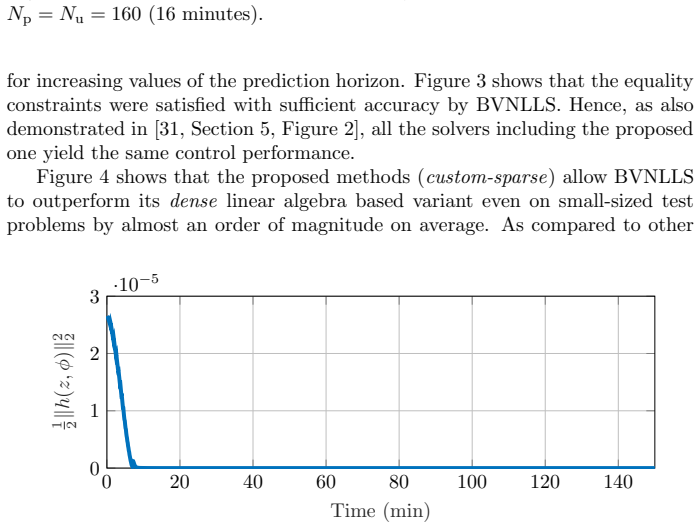
- [Section 3, Eqs. (5)-(6)] The reformulation of the constrained MPC problem (5) as the box-constrained penalized problem (6) is load-bearing for nonlinear and adaptive MPC, but the paper does not supply a supporting theorem for this case. The text states that the guarantee of [29, Theorem 1] applies to quadratic cost with linear equality constraints, and that the extension to general h_k 'is not immediate and thereby poses a risk given that the bound is not deterministic.' No theorem in this manuscript provides a deterministic bound on the penalty parameter rho for the general model (1), nor does any result show that a rho large enough to make the equality residual small can be chosen while keeping the Jacobian of the residual full rank. The CSTR example in Section 7 uses sqrt(rho)=1e4 and reports residuals below 3e-5, but that is one problem instance and one tuning value. As written, the paper establishes that Algorithm 1 solves the penalized problem (6), not that it solves the intended constrained problem (5). I ask the authors either to prove a deterministic penalty-bound result under explicit regularity assumptions or to restrict the claims accordingly.
- [Section 4.2, Theorem 1] The theorem is titled 'Global convergence of BVNLLS,' but the proof establishes only that for each iteration there exists a sufficiently small alpha satisfying the Armijo decrease condition (21), using a Taylor expansion. This is a local descent argument; it does not prove that the sequence of iterates converges, nor that its limit points are stationary points of (6) or (5). A standard global convergence proof would need assumptions such as boundedness of the level set, continuity of r and its Jacobian, and a limit-point argument, together with a treatment of the line-search termination. Please either rename and qualify the result (e.g., 'Armijo decrease property') or provide a genuine global convergence theorem with explicit assumptions.
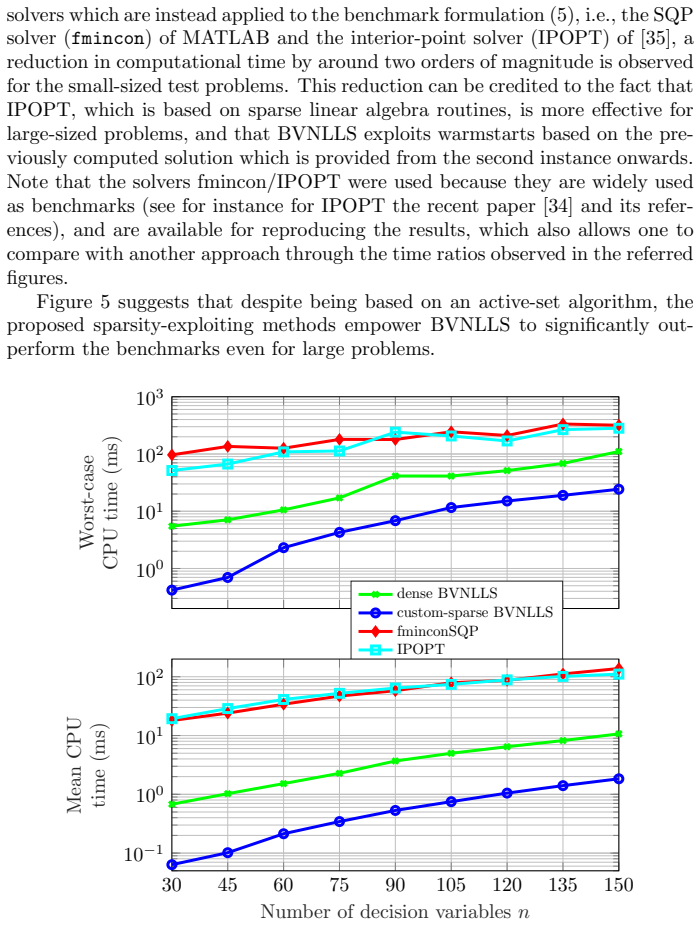
- [Section 7.2, Figures 4-5] The computational comparison is not symmetric. The text notes that BVNLLS 'exploits warmstarts based on the previously computed solution which is provided from the second instance onwards,' while fmincon and IPOPT are not reported to be warm-started with comparable initial guesses. Since warm-starting from the previous sampling instant is natural in MPC, the reported two-orders-of-magnitude speedup conflates algorithmic speed with initialization advantage. Please either warm-start the baseline solvers in the same way and re-report the timings, or present cold-start timings for all solvers so that the comparison isolates the algorithmic contribution.
minor comments (5)
- [Algorithm 1, Step 12] The output line says 'Local minimum z* of (5)', but Algorithm 1 solves the penalized problem (6); the comment should refer to (6).
- [Section 4.2, Lemma 2] Lemma 2 invokes Lemma 4 before Lemma 4 is stated; the ordering or the cross-references should be adjusted for readability.
- [Section 5.2, Algorithms 2-3] The computation of beta and eta is described only in prose ('at most one integer division'); giving closed-form expressions would improve reproducibility and reduce the risk of indexing errors.
- [Section 6.4] The discussion of the predicted nonzero structure says that the predicted structure 'rarely contains indices of zero elements' and that R may become dense after reorthogonalization; this caveat is important and should be repeated prominently wherever the sparse QR speedups are claimed.
- [General] The paper relies heavily on the authors' own prior results [29]-[31] for the penalty equivalence and for the dense BVLS solver; since those results are load-bearing, the manuscript should state precisely which parts of Sections 2-4 are newly proved here and which are quoted from [29]-[31].
Circularity Check
No significant circularity: the paper's new contributions (abstract operators and sparse recursive QR updates) are derived in place; the nonlinear single-penalty guarantee is an openly flagged risk, not a circular reduction.
full rationale
The paper's main technical content is derived in this manuscript rather than being presupposed: Theorem 1 proves global convergence of BVNLLS from the Armijo-type descent argument, Theorem 2 and Corollaries 1-3 derive predicted nonzero structures of QR factors from the Gram-Schmidt relations, and Algorithms 2-3 implement the matrix-free operators directly from the structure in (29). The penalized problem (6) is an explicit relaxation of the constrained problem (5), not a renamed version of it. The single-QPM accuracy result from the authors' prior paper [29] is cited only for quadratic costs with linear equality constraints; the manuscript immediately concedes: 'The extension of such a result to the general case is not immediate and thereby poses a risk given that the bound is not deterministic.' That admission is a correctness/robustness gap for the nonlinear claim, not a circular step, because the paper does not pretend that the theorem already contains the nonlinear result. Similarly, the inner BVLS solver of [30] is a prior algorithm, but the sparse recursive update for that solver is developed here and the numerical experiments compare against independent solvers (fmincon, IPOPT) on a CSTR benchmark. No fitted parameter is renamed as a prediction, no variable is defined in terms of its own target, and no uniqueness theorem is imported from the authors' prior work to forbid alternatives. The disclosed overlap with the authors' conference papers [29,31] is therefore a matter of self-citation rather than demonstrated circularity.
Assumptions & free parameters
free parameters (1)
- rho (quadratic penalty parameter) =
sqrt(rho) = 1e4 in the CSTR experiments
assumptions (5)
- domain assumption The prediction function M in (1) is differentiable, and the residual Jacobian J in Algorithm 1 is full rank at every iteration.
- ad hoc to paper A single quadratic-penalty iteration with sufficiently large rho gives a solution of (6) close to the solution of (5).
- domain assumption The performance index is a sum of squares of differentiable functions and all inequalities are box constraints, with general inequalities handled only via nonnegative slack variables.
- domain assumption The weighting matrix W in (6) is diagonal.
- standard math Modified Gram-Schmidt with reorthogonalization remains correct when operations outside the predicted nonzero structure are skipped.
Cite this review
Pith. "Pith review of An efficient bounded-variable nonlinear least-squares algorithm for embedded MPC." pith.science (2026). https://pith.science/paper/YDTMJH64
@misc{pith2026190807247,
  author       = {Pith},
  title        = {Pith review of: An efficient bounded-variable nonlinear least-squares algorithm for embedded MPC},
  year         = {2026},
  howpublished = {\url{https://pith.science/paper/YDTMJH64}},
  note         = {Machine review of arXiv:1908.07247}
}
read the original abstract
This paper presents a new approach to solve linear and nonlinear model predictive control (MPC) problems that requires small memory footprint and throughput and is particularly suitable when the model and/or controller parameters change at runtime. Typically MPC requires two phases: 1) construct an optimization problem based on the given MPC parameters (prediction model, tuning weights, prediction horizon, and constraints), which results in a quadratic or nonlinear programming problem, and then 2) call an optimization algorithm to solve the resulting problem. In the proposed approach the problem construction step is systematically eliminated, as in the optimization algorithm problem matrices are expressed in terms of abstract functions of the MPC parameters. We present a unifying algorithmic framework based on active-set methods with bounded variables that can cope with linear, nonlinear, and adaptive MPC variants based on a broad class of prediction models and a sum-of-squares cost function. The theoretical and numerical results demonstrate the potential, applicability, and efficiency of the proposed framework for practical real-time embedded MPC.
Figures

Figures from the paper (2 more)

Reference graph
Works this paper leans on
-
[29]
N. Saraf and A. Bemporad. Fast model predictive control based on linear input/output models and bounded-variable least squares. In Proc. 56th IEEE Conference on Decision and Control , pages 1919–1924, Melbourne, Australia, 2017
work page 1919
-
[1]
J. A. E. Andersson, J. Gillis, G. Horn, J. B. Rawlings, and M. Diehl. CasADi – A software framework for nonlinear optimization and optimal control. Mathematical Programming Computation, 11(1):1–36, 2019
work page 2019
-
[2]
S. Bellavia, M. Macconi, and B. Morini. An affine scaling trust-region ap- proach to bound-constrained nonlinear systems. Applied Numerical Math- ematics, 44(3):257 – 280, 2003. 27
work page 2003
-
[3]
A. Bemporad, D. Bernardini, R. Long, and J. Verdejo. Model predictive control of turbocharged gasoline engines for mass production. In WCXTM: SAE World Congress Experience , Detroit, MI, USA, April 2018
work page 2018
- [4]
- [5]
-
[6]
F. Borrelli, A. Bemporad, and M. Morari. Predictive control for linear and hybrid systems. Cambridge University Press, 2017
work page 2017
-
[7]
M. Cannon. Efficient nonlinear model predictive control algorithms. Annual Reviews in Control, 28(2):229–237, 2004
work page 2004
Show all 37 references
-
[8]
Cavanini, G
L. Cavanini, G. Cimini, and G. Ippoliti. Computationally efficient model predictive control for a class of linear parameter-varying systems. IET Control Theory & Applications , 12(10):1384–1392, 2018
2018
-
[9]
J. W. Daniel, W. B. Gragg, L. Kaufman, and G. W. Stewart. Reorthogo- nalization and stable algorithms for updating the Gram-Schmidt QR fac- torization. Mathematics of Computation , 30(136):772–795, 1976
1976
-
[10]
T.A. Davis. Direct Methods for Sparse Linear Systems . Society for Indus- trial and Applied Mathematics, Philadelphia, PA, 2006
2006
-
[11]
Di Cairano and I
S. Di Cairano and I. V. Kolmanovsky. Real-time optimization and model predictive control for aerospace and automotive applications. In Proc. An- nual American Control Conference (ACC) , pages 2392–2409, Milwaukee, WI, 2018
2018
-
[12]
Diamond and S
S. Diamond and S. Boyd. Matrix-Free Convex Optimization Modeling , pages 221–264. In: Goldegorin B. (eds) Optimization and Its Applications in Control and Data Sciences. Springer Optimization and Its Applications, vol 115. Springer, Cham, 2016
2016
-
[13]
Diehl, H.G
M. Diehl, H.G. Bock, and J.P. Schl¨ oder. A Real-Time Iteration Scheme for Nonlinear Optimization in Optimal Feedback Control. SIAM Journal on Control and Optimization , 43(5):1714–1736, 2005
2005
-
[14]
Diehl, H.J
M. Diehl, H.J. Ferreau, and N. Haverbeke. Efficient Numerical Methods for Nonlinear MPC and Moving Horizon Estimation. In L. Magni, D.M. Raimondo, and F. Allg¨ ower, editors,Nonlinear Model Predictive Control. Lecture Notes in Control and Information Sciences , volume 384, pages 56–
-
[15]
Dongarra, V
J. Dongarra, V. Eijkhout, and P. Luszczek. Recursive approach in sparse matrix LU factorization. Sci. Program., 9(1):51–60, 2001
2001
-
[16]
G. H. Golub and C. F. Van Loan. Matrix Computations. 4th ed. The John Hopkins University Press, Baltimore, MD, 2013. 28
2013
-
[17]
J. L. Jerez, P. J. Goulart, S. Richter, G. A. Constantinides, E. C. Kerrigan, and M. Morari. Embedded online optimization for model predictive control at megahertz rates. IEEE Transactions on Automatic Control , 59:3238– 3251, 2014
2014
-
[18]
Joe Qin and T
S. Joe Qin and T. A. Badgwell. A survey of industrial model predictive control technology. Control Engineering Practice, 11(7):733 – 764, 2003
2003
-
[19]
Kerrigan and J.M
E.C. Kerrigan and J.M. Maciejowski. Soft constraints and exact penalty functions in model predictive control. In Proc. UKACC International Con- ference (Control), Cambridge, UK, 2000
2000
-
[20]
Kouzoupis, G
D. Kouzoupis, G. Frison, A. Zanelli, and M. Diehl. Recent advances in quadratic programming algorithms for nonlinear model predictive control. Vietnam Journal of Mathematics , Sept. 2018
2018
-
[21]
C. L. Lawson and R. J. Hanson. Solving Least Squares Problems . Classics in Applied Mathematics. Society for Industrial and Applied Mathematics, Philadelphia, PA, 1995
1995
-
[22]
Nesterov
Y. Nesterov. Introductory Lectures on Convex Optimization: A Basic Course. Kluwer Academic, Dordrecht, The Netherlands, 2004
2004
-
[23]
Nocedal and S
J. Nocedal and S. Wright. Numerical Optimization. 2nd ed. Springer, 2006
2006
-
[24]
T. Ohtsuka. A continuation/GMRES method for fast computation of non- linear receding horizon control. Automatica, 40(4):563–574, 2004
2004
-
[25]
D. Piga, M. Forgione, S. Formentin, and A. Bemporad. Performance- oriented model learning for data-driven MPC design. IEEE control systems letters, 3(3):577–582, 2019
2019
-
[26]
Rafal and W.F
M.D. Rafal and W.F. Stevens. Discrete dynamic optimization applied to on-line optimal control. AiChE Journal, 14(1):85–91, 1968
1968
-
[27]
Y. Saad. Iterative Methods for Sparse Linear Systems . 2nd ed. Society for Industrial and Applied Mathematics, 2003
2003
-
[28]
N. Saraf. Bounded-variable least-squares methods for linear and nonlinear model predictive control . Ph.D. dissertation, IMT School for Advanced Studies Lucca, Italy, 2019
2019
-
[30]
Saraf and A
N. Saraf and A. Bemporad. A bounded-variable least-squares solver based on stable QR updates. IEEE Transactions on Automatic Control , 2019
2019
-
[31]
Saraf, M
N. Saraf, M. Zanon, and A. Bemporad. A fast NMPC approach based on bounded-variable nonlinear least squares. In Proc. 6th IFAC Conference on Nonlinear Model Predictive Control, pages 337–342, Madison, WI, August 2018. 29
2018
-
[32]
Stella, A
L. Stella, A. Themelis, P. Sopasakis, and P. Patrinos. A Simple and Ef- ficient Algorithm for Nonlinear Model Predictive Control. In Proc. 56th IEEE Conference on Decision and Control , pages 1939–1944, Melbourne, Australia, 2017
1939
-
[33]
L. N. Trefethen and D. Bau. Numerical Linear Algebra. Society for Indus- trial and Applied Mathematics, Philadelphia, PA, 1997
1997
-
[34]
Verschueren, G
R. Verschueren, G. Frison, D. Kouzoupis, N. van Duijkeren, A. Zanelli, B. Novoselnik, J. Frey, T. Albin, R. Quirynen, and M. Diehl. acados: a modular open-source framework for fast embedded optimal control. arXiv preprint, 2019
2019
-
[35]
W¨ achter and L.T
A. W¨ achter and L.T. Biegler. On the Implementation of a Primal-Dual Interior Point Filter Line Search Algorithm for Large-Scale Nonlinear Pro- gramming. Mathematical Programming, 106(1):25–57, 2006
2006
-
[36]
Wang and S
Y. Wang and S. Boyd. Fast model predictive control using online opti- mization. IEEE Transactions on Control Systems Technology, 18:267–278, 2010. 30
2010
-
[98]
Springer, Berlin, Heidelberg, 2009
2009
Reviewed August 14, 2026 · model on record in the stance chip above.
Discussion (0). Continue with ORCID to comment.