REVIEW 3 major objections 4 minor 1 cited by
Vector Boson Fusion Signatures of Superheavy Majorana Neutrinos at Muon Colliders
T0 review · 3 major / 4 minor · reviewed 2026-08-07 · deepseek-v4-flash
Pith's one-line read Future high-energy muon colliders could infer heavy Majorana neutrinos with masses far above the collider energy, down to mixing angles near 0.001, through t-channel vector-boson-fusion muon-pair production.
desk verdict A solid, useful projection paper whose abstract overstates the reach; the body's own width constraint kills the 100 TeV/0.001 headline. read the letter →
The pith
A machine-rendered reading of the paper's core claim, the machinery that carries it, and where it could break.
The reading
What carries the argument
The load-bearing object is the 2-to-4 vector-boson-fusion process $\mu^+\mu^\pm \to \nu_\mu \nu_\mu \mu^+\mu^\pm$, in which the heavy Majorana neutrino $N$ is exchanged in the t-channel, with an interfering s-channel contribution in the opposite-sign case. The heavy neutrino is described by a simplified type-I seesaw model in which a sterile state $N$ mixes with the muon neutrino through $V_{\mu N}$ and thereby inherits charged- and neutral-current couplings; the paper treats $M_N$ and $V_{\mu N}$ as free parameters and caps $\Gamma_N/M_N$ at 30% to stay within the regime where the simplified model is reliable. In the multi-TeV limit the t-channel amplitude does not decouple, so the cross section falls only as $|V_{\mu N}|^4/M_N^4$, which is what allows an indirect search to reach masses far above the collider energy. The discriminating kinematics, namely central energetic muons, large missing transverse energy, and a strong azimuthal correlation between the subleading muon and the missing momentum, are captured either by sequential cuts or by boosted decision trees trained on kinematic variables, with the multivariate model exploiting correlations among the muon azimuthal separation, the di-muon invariant mass, and the transverse-momentum sum.
What would settle it
A full detector-level simulation of a 10 TeV muon collider, applied to the vector-boson-fusion signal and its Standard Model backgrounds, would settle the central claim; if reconstructed forward muons or isolation efficiencies differ from the simplified simulation, the 95% exclusion contours in the ($M_N$, $|V_{\mu N}|^2$) plane would shift beyond the 0--20% systematic band shown in the paper.
Extended reading notes
Core claim
The central claim is that in the multi-TeV regime, vector-boson-fusion t-channel exchange of a heavy Majorana neutrino $N$ in the processes $\mu^+\mu^- \to \mu^+\mu^- \nu_\mu\nu_\mu$ and $\mu^+\mu^+ \to \mu^+\mu^+ \nu_\mu\nu_\mu$ gives a signal that survives for $M_N$ much larger than $\sqrt{s}$, scaling as $|V_{\mu N}|^4/M_N^4$ for large masses, and that this mechanism is detectable at future muon colliders. Concretely, the analysis finds sensitivity to masses up to about 100 TeV at large mixing, but the width-to-mass constraint $\Gamma_N/M_N < 30\%$ confines the credible reach to roughly 20 TeV for mixings of order a few percent, with all four configurations (1, 3, 10 TeV $\mu^+\mu^-$ and 2 TeV $\mu^+\mu^+$) showing exclusion power in the very-heavy regime. A boosted-decision-tree selection improves the reach by about two orders of magnitude in $|V_{\mu N}|^2$ at the highest masses, down to $|V_{\mu N}|^2 \sim 10^{-6}$, while the same-sign $\mu^+\mu^+$ mode cleanly isolates the t-channel amplitude and the opposite-sign mode benefits from s-channel/t-channel interference near $M_N \sim 0.5$--1 TeV. The authors frame this result as a complement to direct-production searches and to the existing same-sign WW scattering bounds at hadron colliders.
Load-bearing premise
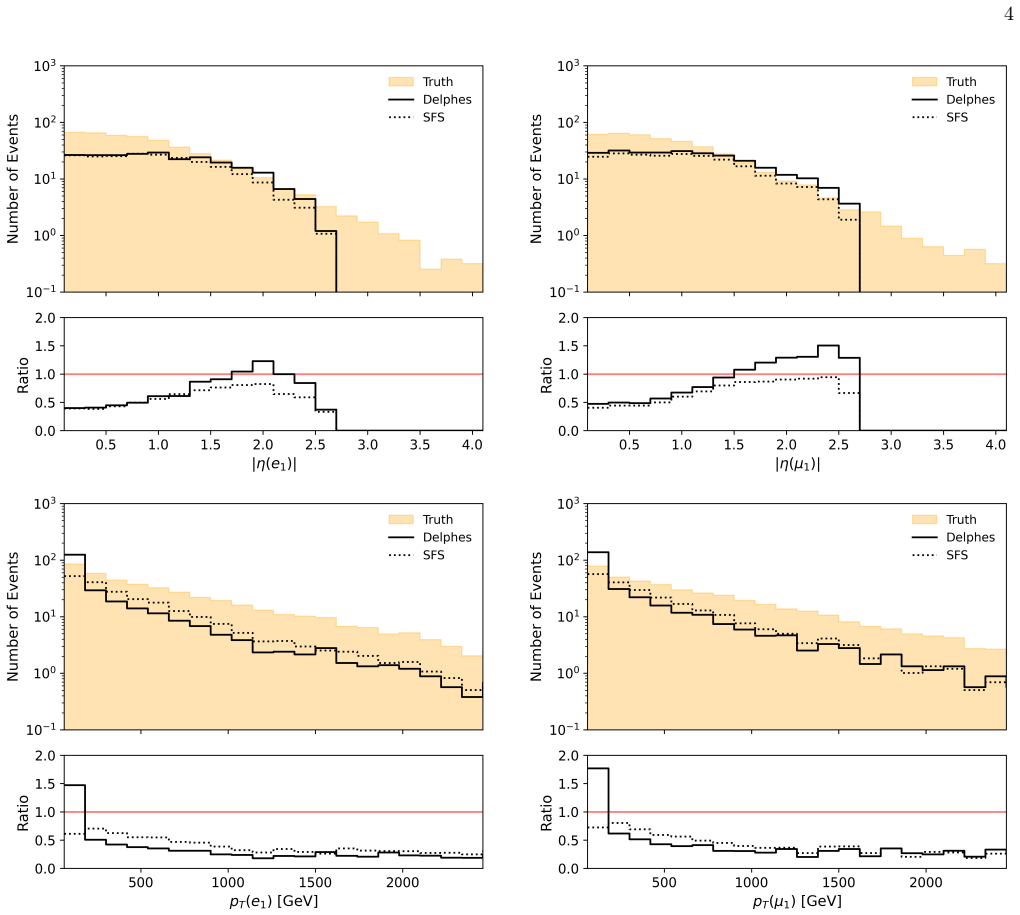
The projected exclusions assume the simplified fast detector simulation accurately represents a future muon collider experiment, including beam-induced backgrounds and forward object reconstruction; the simulation is validated only against one alternative fast-simulation approach on top-pair events at 10 TeV, not against a full detector model.
Editorial extensions
If this is right
- A 2 TeV same-sign $\mu^+\mu^+$ collider could place meaningful constraints on superheavy neutrinos down to $M_N \sim 500$ GeV and up to about 100 TeV at large mixing, isolating the t-channel contribution without s-channel contamination.
- For heavy neutrino masses above about 10 TeV, lower-energy $\mu^+\mu^-$ colliders can outperform the 10 TeV machine, because the Standard Model backgrounds at 10 TeV more closely mimic the signal topology while lower-energy backgrounds are kinematically suppressed.
- The BDT analysis extends the best-case sensitivity to $|V_{\mu N}|^2 \sim 10^{-6}$ for the heaviest masses, about two orders of magnitude beyond the cut-based exclusions.
- The projected exclusions remain stable when the background systematic uncertainty is varied from 0% to 20%, with only minor degradation.
- The VBF channel is complementary to direct on-shell production: below $M_N \sim \sqrt{s}$ direct searches are stronger, while above that threshold VBF takes over.
Reading between the lines
- Editorial inference: the same non-decoupling t-channel scaling suggests the VBF topology could be repurposed as a model-independent probe of electroweak-scale lepton-number violation, testing effective operators rather than the single seesaw state assumed here.
- Editorial inference: the headline 100 TeV contours should be read alongside the paper's own width caveat; a more conservative experimental planning target is the roughly 20 TeV reach at few-percent mixing until a full off-shell treatment of the broad-width region is available.
- Editorial inference: comparing same-sign and opposite-sign event rates would test the Majorana character of the exchanged state more directly than exclusion contours, since only a Majorana neutrino mediates the lepton-number-violating same-sign process at tree level.
- Editorial inference: the feature-importance ranking suggests that a future experimental analysis could concentrate on a few observables, namely azimuthal separation of the two muons, di-muon invariant mass, and transverse-momentum sum, simplifying systematic-error propagation without losing much sensitivity.
Editorial analysis
A structured set of objections, weighed in public.
Referee Report
Summary. The paper studies vector-boson-fusion (VBF) production of heavy Majorana neutrinos at future muon colliders, using MadGraph5_aMC@NLO, Pythia8, and a MadAnalysis5 SFS fast detector simulation. It considers muon-antimuon collisions at sqrt(s) = 1, 3, and 10 TeV and same-sign muon collisions at sqrt(s) = 2 TeV (muTRISTAN), and derives 95% CL exclusion contours in the (M_N, |V_muN|^2) plane with both cut-based and BDT-based analyses. The advertised headline is that active-sterile mixing angles as small as |V_muN| ~ 0.001 could be probed for neutrino masses up to 100 TeV. However, the body of the paper explicitly states that the 100 TeV reach is only technically possible for Gamma_N/M_N > 30%, which the paper itself labels unphysical, and that the realistic width-limited reach is about 20 TeV for few-percent mixing.
Significance. If the 100 TeV, |V_muN| ~ 0.001 claim were supported, this would provide strong motivation for a high-energy muon collider. The paper has clear strengths: a standard, reproducible Monte Carlo chain; multiple collider configurations and luminosity scenarios; validation of the SFS detector card against Delphes; inclusion of background-systematic bands; and explicit discussion of the width-to-mass-ratio reliability condition. The realistic result, a VBF-driven reach up to about 20 TeV for few-percent mixing in the physical Gamma_N/M_N < 30% region, is itself valuable and complementary to existing LHC and muTRISTAN projections. The main weakness is not the technical setup but the mismatch between the headline claim and the body's own physicality criterion, which must be fixed before the paper can be accepted.
major comments (3)
- [Section III.1 (after Fig. 7), Abstract, Section IV] The abstract and conclusion claim that active-sterile mixing angles as small as 0.001 could be probed for neutrino masses up to 100 TeV, and the conclusion repeats that |V_muN|^2 ~ 10^-6 is reachable in the most favourable benchmarks. Yet Section III.1 states: 'Our results indicate that sensitivity to heavy neutrinos with masses up to 100 TeV is technically possible, but only in extreme cases featuring Gamma_N/M_N > 30%. More realistic scenarios with Gamma_N/M_N < 30% remain accessible up to around 20 TeV, provided the active-sterile mixing is of order a few percent.' Since Section II.1 defines Gamma_N/M_N < 30% as the reliability condition for the simplified model, and since Figs. 7 and 10 shade Gamma_N/M_N > 30% as 'unphysical', the advertised simultaneous (100 TeV, |V_muN| = 0.001) reach is not supported by the paper's own analysis. This is a load-bearing internal contradiction. Please revise the abstract, introduction, and conclusions so that the physical-region reach (about 20 TeV for few-percent mixing) is the primary claim, and present any 100 TeV statement only as an explicitly unphysical limiting case.
- [Section III.1 (benchmark scenarios) and Section II.1] The cut-based analysis at sqrt(s) = 10 TeV uses benchmark scenarios with M_N = 100, 500, and 1000 GeV and V_muN = 1.0, 1.0, and 0.5, respectively. The M_N = 1 TeV benchmark therefore has |V_muN|^2 = 0.25, whereas Section II.1 states that at M_N = 1 TeV the condition Gamma_N/M_N < 30% requires |V_muN|^2 <~ 0.2. Thus one of the three benchmarks used to optimize the cuts lies outside the region the paper itself defines as reliable. This inconsistency should be corrected by changing the benchmark or by explicitly justifying why the width constraint is relaxed for cut optimisation.
- [Section II.2 (detector validation)] The SFS detector parametrisation is validated only against Delphes for inclusive top-antitop production at sqrt(s) = 10 TeV (Figs. 1-3). The signal and background processes in this paper involve forward/central muons and missing transverse energy, and beam-induced background is a known challenge for muon colliders, but no validation against a full Geant-level muon-collider detector simulation is provided. Since the projected exclusion contours depend on muon reconstruction, isolation, and missing-energy performance, the impact of the fast-simulation approximation on the quoted reach should be quantified, for example by comparing a subset of signal and background samples with a public full-simulation muon-collider card or by varying the object-efficiency assumptions in the SFS card.
minor comments (4)
- [Section II.2] The text contains a typo: 'Hea vyN' should read 'HeavyN'. Also, Eq. (3.1) uses sigma_B for the background systematic uncertainty inside the square root; the notation should be clarified in the text (e.g., define it as an absolute uncertainty, not a relative one).
- [Abstract and Section IV] The paper derives 95% CL exclusion limits, but the abstract and conclusion use the phrase 'discovery potential'. These are distinct statistical statements; please rephrase to distinguish exclusion reach from discovery significance.
- [Sections III.1 and III.2] The notation 'mu+mu+-' and 'mu+mu+' is sometimes written ambiguously as 'mu+mu^pm' in the text; the two collider modes should be written explicitly as 'mu+mu-' and 'mu+mu+' throughout.
- [Reference list] Reference [46] contains a typo ('tyep-I' should be 'type-I'). Please also check that all references to the muTRISTAN design parameters are consistent with the published version of the proposal.
Circularity Check
No significant circularity: the exclusions follow from simulated event counts; the abstract-body 100 TeV mismatch is an internal consistency issue, not a derivation loop.
full rationale
The derivation chain is self-contained: signal and SM-background events are generated with MadGraph5_aMC@NLO, Pythia8, and the SFS/MadAnalysis5 detector chain, and the exclusion contours are obtained by applying cut-based or BDT selections and counting signal and background events in Eq. (3.1). No physics parameter is fitted to data. The BDT classifiers are trained and tested on the same generator samples, but that is an internal classification procedure, not a prediction derived from its own output. The SFS detector card is benchmarked against an independent Delphes muon-collider simulation for inclusive top-pair production (Figs. 1-3), so the detector model is not self-referential. The width-to-mass ratio is computed with MadWidth and used only to flag unphysical regions, not to define the reach. The high-mass scaling sigma ~ |V_muN|^4/M_N^4 is cited from prior literature including a coauthor, but it is an analytic result that is also realized in the explicitly simulated samples up to 100 TeV and is not used as a uniqueness or ansatz argument. The self-citations (MadAnalysis5, SFS, Fuks et al.) are normal toolchain and scaling references and are not load-bearing in a circular sense. The most important caveat is an internal inconsistency rather than circularity: Section III.1 explicitly states that 'sensitivity to heavy neutrinos with masses up to 100 TeV is technically possible, but only in extreme cases featuring Gamma_N/M_N > 30%,' and that sub-30%-width scenarios are limited to about 20 TeV at few-percent mixing, whereas the abstract advertises 100 TeV and |V_muN| ~ 0.001 without that qualification. That is a correctness, consistency, and presentation issue, not a case of a result being equivalent to its inputs by construction.
Assumptions & free parameters
free parameters (2)
- Heavy neutrino mass M_N =
not fitted; scanned over 10 GeV to 100 TeV
- Active-sterile mixing V_μN =
not fitted; benchmark values such as 1.0, 0.1, 0.025
assumptions (4)
- domain assumption The type-I seesaw-inspired simplified model with one sterile neutrino mixing only with the muon flavor captures the relevant phenomenology for VBF-induced production.
- domain assumption Leading-order matrix elements from MadGraph5_aMC@NLO with the HeavyN UFO are accurate for the t-channel VBF signal and background cross sections.
- domain assumption The SFS detector parametrisation faithfully reproduces the performance of a future muon collider detector.
- domain assumption The simulated SM backgrounds represent the dominant irreducible backgrounds for the targeted final states.
Cite this review
Pith. "Pith review of Vector Boson Fusion Signatures of Superheavy Majorana Neutrinos at Muon Colliders." pith.science (2026). https://pith.science/paper/YDTX2LRW
@misc{pith2026250606159,
  author       = {Pith},
  title        = {Pith review of: Vector Boson Fusion Signatures of Superheavy Majorana Neutrinos at Muon Colliders},
  year         = {2026},
  howpublished = {\url{https://pith.science/paper/YDTX2LRW}},
  note         = {Machine review of arXiv:2506.06159}
}
abstract
We investigate the sensitivity of future high-energy muon colliders to heavy Majorana neutrinos, considering both opposite-sign ($\mu^+\mu^-$) and same-sign ($\mu^+\mu^+$) collision modes. We focus on $\mu^+\mu^-$ colliders operating at centre-of-mass energies of 1, 3 and 10 TeV, as well as the proposed $\mu$TRISTAN facility at 2 TeV, and we analyse the production of heavy neutrinos via vector boson fusion in the $t$-channel, a mechanism that becomes dominant in the multi-TeV regime. We evaluate its exclusion potential in terms of the heavy neutrino mass and the mixing of the heavy neutrino with its Standard Model counterparts, using both cut-based selections and boosted decision trees trained to exploit the distinct kinematic signatures of heavy Majorana neutrino exchanges. Our results demonstrate the complementarity between collider configurations, and show that active-sterile mixing angles as small as 0.001 could be probed for neutrino masses up to 100 TeV, an experimentally inaccessible region of the parameter space at current facilities. Altogether, this work establishes the discovery potential of muon colliders for testing super-heavy Majorana neutrinos, complementary to conventional probes, and provides compelling motivation for the next generation of high-energy lepton colliders.
Figures


Figures from the paper (7 more)


Forward citations
Cited by 1 Pith paper
-
Multiboson Signatures of Doubly Charged Scalars at a Same-Sign Muon Collider
A same-sign muon collider at 2 TeV with 1 ab^-1 could reach 2-sigma sensitivity to Type-II seesaw doubly charged scalars decaying to WW up to roughly 425-430 GeV, slightly extending current LHC coverage.
Reference graph
Works this paper leans on
-
[1]
Fukuda et al., Evidence for oscillation of atmospheric neutrinos, Phys
Super-Kamiokande collaboration, Y. Fukuda et al., Evidence for oscillation of atmospheric neutrinos, Phys. Rev. Lett.81 (1998) 1562–1567, [hep-ex/9807003]
arXiv 1998
-
[2]
SNO collaboration, Q. R. Ahmad et al.,Direct evidence for neutrino flavor transformation from neutral current interactions in the Sudbury Neutrino Observatory, Phys. Rev. Lett.89 (2002) 011301, [nucl-ex/0204008]
arXiv 2002
-
[3]
Minkowski,µ → eγ at a Rate of One Out of109 Muon Decays?, Phys
P. Minkowski,µ → eγ at a Rate of One Out of109 Muon Decays?, Phys. Lett. B67 (1977) 421–428
1977
-
[4]
M. Gell-Mann, P. Ramond and R. Slansky,Complex Spinors and Unified Theories, Conf. Proc. C790927 (1979) 315–321, [1306.4669]
arXiv 1979
-
[5]
S. L. Glashow,The Future of Elementary Particle Physics, NATO Sci. Ser. B61 (1980) 687
1980
-
[6]
R. N. Mohapatra and G. Senjanovic,Neutrino Mass and Spontaneous Parity Nonconservation, Phys. Rev. Lett.44 (1980) 912
1980
-
[7]
Yanagida,Horizontal gauge symmetry and masses of neutrinos, Conf
T. Yanagida,Horizontal gauge symmetry and masses of neutrinos, Conf. Proc. C7902131 (1979) 95–99
1979
-
[8]
Magg and C
M. Magg and C. Wetterich,Neutrino Mass Problem and Gauge Hierarchy, Phys. Lett. B94 (1980) 61–64
1980
Show all 88 references
-
[9]
R. E. Shrock,General Theory of Weak Leptonic and Semileptonic Decays. 1. Leptonic Pseudoscalar Meson Decays, with Associated Tests For, and Bounds on, Neutrino Masses and Lepton Mixing, Phys. Rev. D24 (1981) 1232
1981
-
[10]
Schechter and J
J. Schechter and J. W. F. Valle,Neutrino Masses in SU(2) x U(1) Theories, Phys. Rev. D22 (1980) 2227
1980
-
[11]
T. P. Cheng and L.-F. Li,Neutrino Masses, Mixings and Oscillations in SU(2) x U(1) Models of Electroweak Interactions, Phys. Rev. D22 (1980) 2860
1980
-
[12]
R. N. Mohapatra and G. Senjanovic,Neutrino Masses and Mixings in Gauge Models with Spontaneous Parity Violation, Phys. Rev. D23 (1981) 165
1981
-
[13]
Lazarides, Q
G. Lazarides, Q. Shafi and C. Wetterich,Proton Lifetime and Fermion Masses in an SO(10) Model, Nucl. Phys. B181 (1981) 287–300
1981
-
[14]
R. Foot, H. Lew, X. G. He and G. C. Joshi,Seesaw Neutrino Masses Induced by a Triplet of Leptons, Z. Phys. C 44 (1989) 441
1989
-
[15]
A. Atre, T. Han, S. Pascoli and B. Zhang,The Search for Heavy Majorana Neutrinos, JHEP 05 (2009) 030, [0901.3589]
2009 arXiv
-
[16]
Y. Cai, T. Han, T. Li and R. Ruiz,Lepton Number Violation: Seesaw Models and Their Collider Tests, Front. in Phys.6 (2018) 40, [1711.02180]
2018 arXiv
-
[17]
Boscolo, J.-P
M. Boscolo, J.-P. Delahaye and M. Palmer,The future prospects of muon colliders and neutrino factories, Rev. Accel. Sci. Tech.10 (2019) 189–214, [1808.01858]
2019 arXiv
-
[18]
J. P. Delahaye, M. Diemoz, K. Long, B. Mansoulié, N. Pastrone, L. Rivkin et al.,Muon Colliders, 1901.06150
1901 arXiv
-
[19]
K. Long, D. Lucchesi, M. Palmer, N. Pastrone, D. Schulte and V. Shiltsev,Muon colliders to expand frontiers of particle physics, Nature Phys.17 (2021) 289–292, [2007.15684]
2021 arXiv
-
[20]
Al Ali et al.,The muon Smasher’s guide, Rept
H. Al Ali et al.,The muon Smasher’s guide, Rept. Prog. Phys. 85 (2022) 084201, [2103.14043]
2022 arXiv
-
[21]
K. M. Black et al.,Muon Collider Forum report, JINST 19 (2024) T02015, [2209.01318]
2024 arXiv
-
[22]
Hamada, R
Y. Hamada, R. Kitano, R. Matsudo, H. Takaura and M. Yoshida,µTRISTAN, PTEP 2022 (2022) 053B02, [2201.06664]
2022 arXiv
-
[23]
Accettura et al.,Towards a muon collider, Eur
C. Accettura et al.,Towards a muon collider, Eur. Phys. J. C83 (2023) 864, [2303.08533]
2023 arXiv
-
[24]
Fridell, R
K. Fridell, R. Kitano and R. Takai,Lepton flavor physics at µ+µ+ colliders, JHEP 06 (2023) 086, [2304.14020]. 15
2023 arXiv
-
[25]
Akturk, B
D. Akturk, B. Dagli, B. Ketenoglu, A. Ozturk and S. Sultansoy,µTRISTAN and LHC/Tevatron/FCC/SppC Based Antimuon-Hadron Colliders, 2406.02647
-
[26]
Li, C.-Y
T. Li, C.-Y. Yao and M. Yuan,Searching for heavy neutral lepton and lepton number violation through VBS at high-energy muon colliders, JHEP 09 (2023) 131, [2306.17368]
2023 arXiv
-
[27]
P. Li, Z. Liu and K.-F. Lyu,Heavy neutral leptons at muon colliders, JHEP 03 (2023) 231, [2301.07117]
2023 arXiv
-
[28]
T. H. Kwok, L. Li, T. Liu and A. Rock,Searching for heavy neutral leptons at a future muon collider, Phys. Rev. D110 (2024) 075009, [2301.05177]
2024 arXiv
-
[29]
Keung and G
W.-Y. Keung and G. Senjanovic,Majorana Neutrinos and the Production of the Right-handed Charged Gauge Boson, Phys. Rev. Lett.50 (1983) 1427
1983
-
[30]
del Aguila, J
F. del Aguila, J. A. Aguilar-Saavedra and R. Pittau, Heavy neutrino signals at large hadron colliders, JHEP 10 (2007) 047, [hep-ph/0703261]
2007 arXiv
-
[31]
Banerjee, P
S. Banerjee, P. S. B. Dev, A. Ibarra, T. Mandal and M. Mitra,Prospects of Heavy Neutrino Searches at Future Lepton Colliders, Phys. Rev. D92 (2015) 075002, [1503.05491]
2015 arXiv
-
[32]
Nemevšek, F
M. Nemevšek, F. Nesti and G. Popara, Keung-Senjanović process at the LHC: From lepton number violation to displaced vertices to invisible decays, Phys. Rev. D97 (2018) 115018, [1801.05813]
2018 arXiv
-
[33]
Pascoli, R
S. Pascoli, R. Ruiz and C. Weiland,Heavy neutrinos with dynamic jet vetoes: multilepton searches at√s = 14 , 27, and 100 TeV, JHEP 06 (2019) 049, [1812.08750]
2019 arXiv
-
[34]
B. Fuks, J. Neundorf, K. Peters, R. Ruiz and M. Saimpert,Majorana neutrinos in same-signW ±W ± scattering at the LHC: Breaking the TeV barrier, Phys. Rev. D103 (2021) 055005, [2011.02547]
2021 arXiv
-
[35]
Mękała, J
K. Mękała, J. Reuter and A. F. Żarnecki,Heavy neutrinos at future linear e+e− colliders, JHEP 06 (2022) 010, [2202.06703]
2022 arXiv
-
[36]
Nemevšek and F
M. Nemevšek and F. Nesti,Left-right symmetry at an FCC-hh, Phys. Rev. D108 (2023) 015030, [2306.12104]
2023 arXiv
-
[37]
Frank, B
M. Frank, B. Fuks, A. Jueid, S. Moretti and O. Ozdal, A novel search strategy for right-handed charged gauge bosons at the Large Hadron Collider, JHEP 02 (2024) 150, [2312.08521]
2024 arXiv
-
[38]
ATLAScollaboration, M. Aaboud et al.,Search for heavy Majorana or Dirac neutrinos and right-handedW gauge bosons in final states with two charged leptons and two jets at√s = 13 TeV with the ATLAS detector, JHEP 01 (2019) 016, [1809.11105]
2019 arXiv
-
[39]
Aaboud et al.,Search for a right-handed gauge boson decaying into a high-momentum heavy neutrino and a charged lepton in pp collisions with the ATLAS detector at√s = 13 TeV, Phys
ATLAScollaboration, M. Aaboud et al.,Search for a right-handed gauge boson decaying into a high-momentum heavy neutrino and a charged lepton in pp collisions with the ATLAS detector at√s = 13 TeV, Phys. Lett. B798 (2019) 134942, [1904.12679]
2019 arXiv
-
[40]
Aad et al.,Search for Majorana neutrinos in same-sign WW scattering events from pp collisions at√s = 13 TeV, Eur
ATLAScollaboration, G. Aad et al.,Search for Majorana neutrinos in same-sign WW scattering events from pp collisions at√s = 13 TeV, Eur. Phys. J. C83 (2023) 824, [2305.14931]
2023 arXiv
-
[41]
Aad et al.,Search for heavy Majorana neutrinos in e±e± and e±µ± final states via WW scattering in pp collisions at s=13 TeV with the ATLAS detector, Phys
ATLAScollaboration, G. Aad et al.,Search for heavy Majorana neutrinos in e±e± and e±µ± final states via WW scattering in pp collisions at s=13 TeV with the ATLAS detector, Phys. Lett. B856 (2024) 138865, [2403.15016]
2024 arXiv
-
[42]
CMS collaboration, A. M. Sirunyan et al.,Search for a heavy right-handed W boson and a heavy neutrino in events with two same-flavor leptons and two jets at√s = 13 TeV, JHEP 05 (2018) 148, [1803.11116]
2018 arXiv
-
[43]
CMS collaboration, A. M. Sirunyan et al.,Search for heavy Majorana neutrinos in same-sign dilepton channels in proton-proton collisions at√s = 13 TeV, JHEP 01 (2019) 122, [1806.10905]
2019 arXiv
-
[44]
Tumasyan et al.,Search for a right-handed W boson and a heavy neutrino in proton-proton collisions at√s = 13 TeV, JHEP 04 (2022) 047, [2112.03949]
CMS collaboration, A. Tumasyan et al.,Search for a right-handed W boson and a heavy neutrino in proton-proton collisions at√s = 13 TeV, JHEP 04 (2022) 047, [2112.03949]
2022 arXiv
-
[45]
Tumasyan et al.,Probing Heavy Majorana Neutrinos and the Weinberg Operator through Vector Boson Fusion Processes in Proton-Proton Collisions at s=13 TeV, Phys
CMS collaboration, A. Tumasyan et al.,Probing Heavy Majorana Neutrinos and the Weinberg Operator through Vector Boson Fusion Processes in Proton-Proton Collisions at s=13 TeV, Phys. Rev. Lett.131 (2023) 011803, [2206.08956]
2023 arXiv
-
[46]
A. Das, J. Li, S. Mandal, T. Nomura and R. Zhang, Testing tree level TeV scale tyep-I and type-II seesaw scenarios in µTRISTAN, 2410.21956
-
[47]
Jiang, T
R. Jiang, T. Yang, S. Qian, Y. Ban, J. Li, Z. You et al., Searching for Majorana neutrinos at a same-sign muon collider, Phys. Rev. D109 (2024) 035020, [2304.04483]
2024 arXiv
-
[48]
C. H. de Lima, D. McKeen, J. N. Ng, M. Shamma and D. Tuckler,Probing lepton number violation at same-sign lepton colliders, Phys. Rev. D111 (2025) 075002, [2411.15303]
2025 arXiv
-
[49]
P. S. B. Dev, J. Heeck and A. Thapa,Neutrino mass models at µTRISTAN, Eur. Phys. J. C84 (2024) 148, [2309.06463]
2024 arXiv
-
[50]
Bandyopadhyay and S
P. Bandyopadhyay and S. Parashar,Probing a scalar singlet-triplet extension of the standard model via vector boson fusion at a muon collider, Phys. Rev. D110 (2024) 115032, [2410.06298]
2024 arXiv
-
[51]
B. Fuks, J. Neundorf, K. Peters, R. Ruiz and M. Saimpert,Probing the Weinberg operator at colliders, Phys. Rev. D103 (2021) 115014, [2012.09882]
2021 arXiv
-
[52]
P. S. B. Dev, A. Pilaftsis and U.-k. Yang,New Production Mechanism for Heavy Neutrinos at the LHC, Phys. Rev. Lett.112 (2014) 081801, [1308.2209]
2014 arXiv
-
[53]
D. Alva, T. Han and R. Ruiz,Heavy Majorana neutrinos from W γfusion at hadron colliders, JHEP 02 (2015) 072, [1411.7305]
2015 arXiv
-
[54]
J. Y. Araz, B. Fuks and G. Polykratis,Simplified fast detector simulation in MADANALYSIS 5, Eur. Phys. J. C 81 (2021) 329, [2006.09387]
2021 arXiv
-
[55]
J. Y. Araz, B. Fuks, M. D. Goodsell and M. Utsch, Recasting LHC searches for long-lived particles with MadAnalysis 5, Eur. Phys. J. C82 (2022) 597, [2112.05163]
2022 arXiv
-
[56]
J. Y. Araz, A. Buckley and B. Fuks,Searches for new physics with boosted top quarks in the MadAnalysis 5 and Rivet frameworks, Eur. Phys. J. C83 (2023) 664, [2303.03427]
2023 arXiv
-
[57]
Conte, B
E. Conte, B. Fuks and G. Serret,MadAnalysis 5, A User-Friendly Framework for Collider Phenomenology, Comput. Phys. Commun.184 (2013) 222–256, [1206.1599]
2013 arXiv
-
[58]
Conte, B
E. Conte, B. Dumont, B. Fuks and C. Wymant, Designing and recasting LHC analyses with MadAnalysis 5, Eur. Phys. J. C74 (2014) 3103, [1405.3982]
2014 arXiv
-
[59]
Conte and B
E. Conte and B. Fuks,Confronting new physics theories to LHC data with MADANALYSIS 5, Int. J. Mod. 16 Phys. A33 (2018) 1830027, [1808.00480]
2018 arXiv
-
[60]
Alwall, C
J. Alwall, C. Duhr, B. Fuks, O. Mattelaer, D. G. Öztürk and C.-H. Shen,Computing decay rates for new physics theories with FeynRules and MadGraph 5_aMC@NLO, Comput. Phys. Commun.197 (2015) 312–323, [1402.1178]
2015 arXiv
-
[61]
Degrande, O
C. Degrande, O. Mattelaer, R. Ruiz and J. Turner, Fully-Automated Precision Predictions for Heavy Neutrino Production Mechanisms at Hadron Colliders, Phys. Rev. D94 (2016) 053002, [1602.06957]
2016 arXiv
-
[62]
N. D. Christensen, P. de Aquino, C. Degrande, C. Duhr, B. Fuks, M. Herquet et al.,A Comprehensive approach to new physics simulations, Eur. Phys. J. C71 (2011) 1541, [0906.2474]
2011 arXiv
-
[63]
Alloul, N
A. Alloul, N. D. Christensen, C. Degrande, C. Duhr and B. Fuks,FeynRules 2.0 - A complete toolbox for tree-level phenomenology, Comput. Phys. Commun.185 (2014) 2250–2300, [1310.1921]
2014 arXiv
-
[64]
Degrande,Automatic evaluation of UV and R2 terms for beyond the Standard Model Lagrangians: a proof-of-principle, Comput
C. Degrande,Automatic evaluation of UV and R2 terms for beyond the Standard Model Lagrangians: a proof-of-principle, Comput. Phys. Commun.197 (2015) 239–262, [1406.3030]
2015 arXiv
-
[65]
Degrande, C
C. Degrande, C. Duhr, B. Fuks, D. Grellscheid, O. Mattelaer and T. Reiter,UFO - The Universal FeynRules Output, Comput. Phys. Commun.183 (2012) 1201–1214, [1108.2040]
2012 arXiv
-
[66]
Darmé et al.,UFO 2.0: the ‘Universal Feynman Output’ format, Eur
L. Darmé et al.,UFO 2.0: the ‘Universal Feynman Output’ format, Eur. Phys. J. C83 (2023) 631, [2304.09883]
2023 arXiv
-
[67]
Alwall, R
J. Alwall, R. Frederix, S. Frixione, V. Hirschi, F. Maltoni, O. Mattelaer et al.,The automated computation of tree-level and next-to-leading order differential cross sections, and their matching to parton shower simulations, JHEP 07 (2014) 079, [1405.0301]
2014 arXiv
-
[68]
Bierlich et al.,A comprehensive guide to the physics and usage of PYTHIA 8.3, SciPost Phys
C. Bierlich et al.,A comprehensive guide to the physics and usage of PYTHIA 8.3, SciPost Phys. Codeb.2022 (2022) 8, [2203.11601]
2022 arXiv
-
[69]
Cacciari, G
M. Cacciari, G. P. Salam and G. Soyez,The anti-kt jet clustering algorithm, JHEP 04 (2008) 063, [0802.1189]
2008 arXiv
-
[70]
Cacciari, G
M. Cacciari, G. P. Salam and G. Soyez,FastJet User Manual, Eur. Phys. J.C72 (2012) 1896, [1111.6097]
2012 arXiv
-
[71]
Collamati, C
F. Collamati, C. Curatolo, D. Lucchesi, A. Mereghetti, N. Mokhov, M. Palmer et al.,Advanced assessment of beam-induced background at a muon collider, JINST 16 (2021) P11009, [2105.09116]
2021 arXiv
-
[72]
Muon Collider collaboration, C. Aimè, C. Riccardi, P. Salvini and I. Vai,Simulated performance of a multi-purpose experiment at a Muon Collider, PoS ICHEP2022 (2022) 1109
2022
-
[73]
Bartosik et al., Simulated Detector Performance at the Muon Collider, 2203.07964
Muon Collider collaboration, N. Bartosik et al., Simulated Detector Performance at the Muon Collider, 2203.07964
-
[74]
Arominski et al.,A detector for CLIC: main parameters and performance, 1812.07337
CLICdp collaboration, D. Arominski et al.,A detector for CLIC: main parameters and performance, 1812.07337
-
[75]
Grefe,Detector Optimization Studies and Light Higgs Decay into Muons at CLIC
C. Grefe,Detector Optimization Studies and Light Higgs Decay into Muons at CLIC. PhD thesis, Bonn U.,
-
[76]
Zimmermann,LHC/FCC-based muon colliders, J.Phys.Conf.Ser
F. Zimmermann,LHC/FCC-based muon colliders, J.Phys.Conf.Ser. 1067 (2018) 022017
2018
-
[77]
Benedikt et al.,Future Circular Hadron Collider FCC-hh: Overview and Status, 2203.07804
M. Benedikt et al.,Future Circular Hadron Collider FCC-hh: Overview and Status, 2203.07804
-
[78]
de Favereau, C
DELPHES 3 collaboration, J. de Favereau, C. Delaere, P. Demin, A. Giammanco, V. Lemaître, A. Mertens et al.,DELPHES 3, A modular framework for fast simulation of a generic collider experiment, JHEP 02 (2014) 057, [1307.6346]
2014 arXiv
-
[79]
CMS collaboration, A. Hayrapetyan et al.,Search for heavy neutral leptons in final states with electrons, muons, and hadronically decaying tau leptons in proton-proton collisions at√s = 13 TeV, JHEP 06 (2024) 123, [2403.00100]
2024 arXiv
-
[80]
B. P. Roe, H.-J. Yang, J. Zhu, Y. Liu, I. Stancu and G. McGregor,Boosted decision trees, an alternative to artificial neural networks, Nucl. Instrum. Meth. A543 (2005) 577–584, [physics/0408124]
2005 arXiv
-
[81]
Coadou,Boosted Decision Trees and Applications, EPJ Web Conf.55 (2013) 02004
Y. Coadou,Boosted Decision Trees and Applications, EPJ Web Conf.55 (2013) 02004
2013
-
[82]
Albertsson et al.,Machine Learning in High Energy Physics Community White Paper, J
K. Albertsson et al.,Machine Learning in High Energy Physics Community White Paper, J. Phys. Conf. Ser. 1085 (2018) 022008, [1807.02876]
2018 arXiv
-
[83]
Carleo, I
G. Carleo, I. Cirac, K. Cranmer, L. Daudet, M. Schuld, N. Tishby et al.,Machine learning and the physical sciences, Rev. Mod. Phys.91 (2019) 045002, [1903.10563]
2019 arXiv
-
[84]
A. S. Cornell, W. Doorsamy, B. Fuks, G. Harmsen and L. Mason,Boosted decision trees in the era of new physics: a smuon analysis case study, JHEP 04 (2022) 015, [2109.11815]
2022 arXiv
-
[85]
Choudhury, A
A. Choudhury, A. Mondal and S. Sarkar,Searches for the BSM scenarios at the LHC using decision tree-based machine learning algorithms: a comparative study and review of random forest, AdaBoost, XGBoost and LightGBM frameworks, Eur. Phys. J. ST233 (2024) 2425–2463, [2405.06040]
2024 arXiv
-
[86]
A. S. Cornell, B. Fuks, M. D. Goodsell and A. M. Ncube, Improving smuon searches with neural networks, Eur. Phys. J. C85 (2025) 51, [2411.04526]
2025 arXiv
-
[87]
Hastie, R
T. Hastie, R. Tibshirani and J. Friedman,The Elements of Statistical Learning. Springer, 2009, 10.1007/978-0-387-84858-7
2009 doi
- [88]
Reviewed August 7, 2026 · model on record in the stance chip above.
Discussion (0). Sign in to comment.