REVIEW 3 major objections 5 minor 33 references
An Augmentation-Aware Theory for Self-Supervised Contrastive Learning
T0 review · 3 major / 5 minor · reviewed 2026-08-07 · deepseek-v4-flash
Pith's one-line read The paper proves that the supervised risk of contrastive learning is bounded by the InfoNCE risk plus two measurable augmentation distances: a minimum same-class distance and a maximum same-image distance.
desk verdict The paper's central bound is false as stated; a constant representation violates Theorem 2.1, and the error traces to a misstated CURL identity. read the letter →
The pith
A machine-rendered reading of the paper's core claim, the machinery that carries it, and where it could break.
The reading
What carries the argument
The load-bearing object is the error decomposition of Theorem 2.5, which rewrites the InfoNCE risk as a weighted sum over the number $k$ of negative samples that share the anchor's label. Each inner term is then compared, via convexity of log-sum-exp, to the corresponding supervised inner risk, leaving exactly two augmentation distances as the residual: the minimum same-class different-image distance and the maximum same-image distance. This decomposition is what makes the bound 'augmentation-aware' without assuming conditional independence of anchor and positive, and it is why the two distances appear independently of $K$. The Section 4 analysis additionally relies on a semantic label assumption in which each image is a disjoint union of semantic areas with label-specific pixel distributions; that model is what turns the abstract distances into predictions about random crop and color distortion.
What would settle it
Measure the two distances directly in pixel space on images with ground-truth semantic segmentation (or on synthetic images built from overlapping, non-disjoint regions) while shrinking the crop size and increasing color-jitter probability; if the minimum same-class distance does not decrease while the maximum same-image distance increases, the predicted trade-off is contradicted. Similarly, on real benchmarks, if linear-probing accuracy does not peak near the augmentation parameters that minimize the sum of the two representation-level distances, the bound's practical claim fails.
Extended reading notes
Core claim
On the paper's own terms, the central discovery is Theorem 2.1: with $R_{\mathrm{sup}}$ the risk of the linear-probing mean classifier and $R_{\mathrm{un}}$ the InfoNCE risk, $R_{\mathrm{sup}} \le \frac{1}{1-\tau_K}\big[ R_{\mathrm{un}} - \tau_K \mathbb{E}\log(\mathrm{Col}+1) + \mathbb{E}_{c,\bar{x},\bar{x}'\sim\rho_c}\mathbb{E}_a \min_{a'} \lVert f(a(\bar{x}))-f(a'(\bar{x}'))\rVert + 5\,\mathbb{E}_{c,\bar{x}'\sim\rho_c}\max_{a,a'}\lVert f(a(\bar{x}'))-f(a'(\bar{x}'))\rVert \big]$, where $\tau_K$ is the class-collision probability. The first augmentation term asks how close two augmentations of different images from the same class can be brought; the second asks how far two views of the same image can spread. Under a centered-representation assumption the coefficient 5 improves to 1, and under a Lipschitz assumption the same bound shape holds at the pixel level. The paper then proposes a semantic-label generative model of images and uses it to argue that stronger random crop and color distortion shrink the first distance while inflating the second, producing a trade-off that matches its experiments.
Load-bearing premise
The analysis of how crop and color distortion affect the bound assumes that a real image can be partitioned into disjoint semantic regions, each with one label and label-specific pixel statistics; if real images do not decompose this cleanly, the predicted trade-off between the two distance terms loses its foundation.
Editorial extensions
If this is right
- Downstream classification error is not just about the unsupervised loss: two augmentation distances that can be computed from the encoder and the augmented dataset are explicit drivers of the bound.
- Augmentation strength has a principled optimum: minimize the sum of the minimum same-class distance and the maximum same-image distance, rather than choosing parameters by trial and error.
- Because the two distance terms are independent of the number of negatives $K$, earlier conclusions about the role of $K$ in contrastive bounds carry over unchanged.
- Stronger augmentation is a genuine trade-off, not uniformly good or bad: it improves same-class connectivity while hurting same-image invariance, so each augmentation family has a sweet spot.
- With a centered representation assumption, the maximum same-image distance enters with coefficient 1 instead of 5, making the bound quantitatively tighter and the sum of the two distances the direct target.
Reading between the lines
- If the bound is tight in practice, the two distances provide a label-free diagnostic: monitoring them on a held-out set during training could reveal whether the augmentation pipeline is under- or over-strong before any linear probe is trained.
- The semantic-label mechanism suggests a testable explanation for why the standard crop-plus-color recipe works: cropping reduces the same-class distance by avoiding semantic boundaries, color jitter reduces it further for single-semantic crops, and neither alone achieves both effects; this is the paper's implicit reading of the known crop-only/color-only accuracy gap.
- The decomposition's only structural requirement on the loss is symmetric treatment of negative samples, so the same augmentation-aware bound might extend to other symmetric contrastive losses, and checking that extension would be a natural next experiment.
- One could turn the bound into an augmentation-selection method by treating the sum of distances as an objective to minimize over candidate augmentation distributions, which the paper does not propose but its theory points to.
Editorial analysis
A structured set of objections, weighed in public.
Referee Report
Summary. The paper develops a theoretical framework for self-supervised contrastive learning that makes the role of data augmentation explicit. Its main result (Theorem 2.1) claims that the supervised risk of the mean classifier is bounded by the InfoNCE risk plus a class-collision term plus two augmentation-induced distances: the minimum same-class different-image distance and the maximum same-image distance. The proof proceeds through a decomposition of the InfoNCE loss into inner risks indexed by the number of same-class negatives (Theorem 2.5), a bound on each inner risk (Theorem 2.6), an intermediate bound on an auxiliary risk Rbar_sup (Theorem 2.7), and an identity (Lemma 2.8, attributed to CURL) relating Rbar_sup to Rsup. Section 4 introduces a semantic-label generative model for pixel intensities and claims a trade-off: stronger cropping or color distortion decreases the minimum same-class distance while increasing the maximum same-image distance. Section 5 reports pixel- and representation-level experiments on CIFAR-100 and TinyImagenet supporting this qualitative trade-off and the claim that the optimal augmentation parameters minimize the distance sum.
Significance. If the main bound were correct, it would be a valuable addition to the theory of contrastive learning: unlike CURL-style bounds, it would identify geometric properties of the representation (minimum same-class distance and maximum same-image distance) as measurable drivers of downstream accuracy independent of the number of negatives. The risk decomposition in Theorem 2.5 is a potentially reusable idea, and the experiments in Figures 2-6 document the qualitative trade-off and its correlation with downstream accuracy clearly. However, the central theorem is falsified by an elementary counterexample, the claimed identity in Lemma 2.8 is incorrect, and the Section 4 analysis draws monotonicity conclusions from upper bounds and relies on an invalid per-pixel choice of a global augmentation parameter. Because the main theoretical claim does not survive scrutiny, the contribution as it stands cannot be accepted.
major comments (3)
- [§2.3, Lemma 2.8 and Theorem 2.1 (Eqs. (7), (14))] The main theorem is false as stated. Consider C=3, K=1, uniform class priors, and the constant representation f(x)=v with ||v||=1 for all x. All class means equal v, so the supervised risk (6) is Rsup = log(1+2) = log 3. In the InfoNCE loss every inner product is 1, so Run = log 2. The collision probability is tau_1 = 1/3 and E log(Col+1) = (1/3) log 2; both augmentation-distance terms in (7) vanish because f is constant, so inequality (7) reads log 3 <= (3/2)(log 2 - (1/3)(1/3 log 2)) = (4/3) log 2, which is contradicted by log 3. The false step is Lemma 2.8. With the paper's definitions, Rbar_sup = log 2 in this example, whereas the right-hand side of the claimed identity (14) equals (2/3) log 3 + (1/9) log 2, so (14) is not an identity. The discrepancy is not merely a wrong inequality direction: for a well-separated two-class representation with f(x)=e_c on class c, one obtains Rbar_sup = (1/2) log 2 + (1/2) log(1+1/e), while (1-tau_1)Rsup + tau_1 E log(Col+1) = (1/2) log(1+1/e) + (1/4) log 2, so neither the equality nor a fixed inequality direction of (14) holds in general. Because Theorem 2.7 bounds only Rbar_sup and Lemma 2.8 is the sole bridge to Rsup, Theorem 2.1 is unproven and false as stated; Theorem 2.4, which invokes Theorem 2.1, inherits the failure.
- [§4.2, Eqs. (20)-(21)] The claim that the minimum same-class distance increases with crop size is not supported by the derived inequalities. Equations (20) and (21) are upper bounds: the single-semantic case is at most 2σ and the multi-semantic case is at most 2σ plus a bias term that grows with the number of pixels crossing semantic boundaries. The text concludes that a larger crop size results in larger value of Ec Ex,x' Ea min ..., but comparing two upper bounds cannot establish a monotone ordering of the underlying expectations; two random variables with increasingly loose upper bounds need not be ordered. A direct argument on the expectations, or a matching lower bound that moves monotonically with the crop scale parameter δ, is required for the trade-off claimed in the abstract and tested in Figure 2.
- [§4.3, Eq. (23)] The derivation that color distortion halves the minimum same-class distance is invalid. Equation (23) states that its second term is σ with the equality holding by taking λ^(i) = μ_s^(i)/ξ'^(i)_{j,ℓ}, but λ^(i) is a single scalar drawn from Unif(0,b] for the entire channel, whereas the ratio μ_s^(i)/ξ'^(i)_{j,ℓ} varies over pixels. No single value of λ can equal this ratio for all pixels simultaneously, so the second term in (23) cannot be driven to zero as claimed, and the conclusion that color distortion reduces the minimum same-class distance by half compared with (20) is unsupported.
minor comments (5)
- [§2.1, Eq. (5)] The denominator of the softmax is written as a sum over i=1,...,K, but Rsup is the C-class risk of the mean classifier g: R^d -> R^C; the index range appears to be a typo for 1,...,C and should be corrected.
- [§2.2, Theorem 2.4] The display defining RadS(F) is missing a closing parenthesis on the supremum expression, and 'unsuperivsed' is misspelled; additionally, the bound is stated to hold with probability at least 1-δ but the hypothesis does not explicitly restrict δ to (0,1).
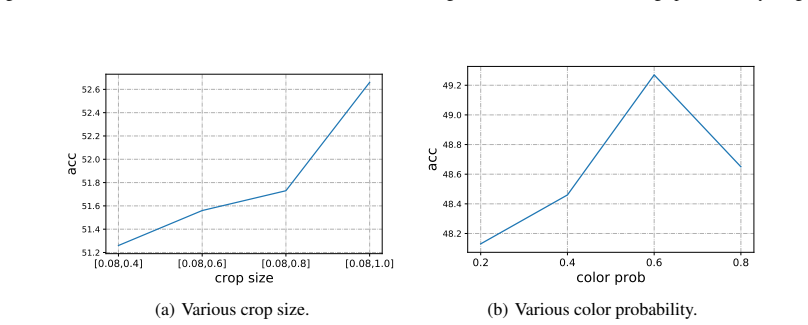
- [§5, Figures 3 and 4] The captions appear to be swapped: Figure 3, captioned 'maximum distance between same-class different-image augmentations', actually plots MaxSameImageDist, while Figure 4, captioned 'minimum distance between different same-image data augmentations', plots MinSameClassDist; the same issue occurs in Figures 8 and 9.
- [§4.1 and Appendix B.2] The semantic generative model is underspecified: no distribution over the disjoint random partition (J_m) is defined, and the proof of Eq. (37) uses the identity augmentation Id in A without stating this as an assumption in the main text.
- [§5.2, Figures 5 and 6] The coincidence between the minimizer of the sum of the two distance terms and the maximizer of downstream accuracy is only suggestive, because Theorem 2.3 bounds Rsup by a combination of Run, the collision term, and the two distances; the experiments do not measure Run or the collision term under the varying augmentation parameters.
Circularity Check
No circularity: the augmentation-aware bound is derived from the InfoNCE risk and explicit representation distances, with the CURL bridge cited from external prior work; no fitted parameter is renamed as a prediction.
full rationale
The main derivation chain is self-contained in the relevant sense. Theorem 2.1 is obtained by decomposing Run by number of same-class negatives (Theorem 2.5), bounding each inner risk r_k against r_sup_k minus explicit representation distances (Theorem 2.6), summing these bounds to control the auxiliary risk Rbar_sup (Theorem 2.7), and finally converting Rbar_sup to Rsup through the CURL collision lemma cited from Arora et al. (2019) and Nozawa & Sato (2021), which are external authors rather than self-citations. The two distance terms in inequalities (7) and (13) are genuine quantities produced by the proof; they are not fitted constants, not defined in terms of Rsup, and not renamed versions of the target risk. The Section 4 semantic-label model is an explicit generative assumption used to reason about crop and color distortions, but its parameters (q_y and pixel distributions eta) are not estimated from the verification data, and the trade-off statements are analytic consequences of the assumed model rather than predictions of fitted values. The only self-citations (e.g., Cui et al. 2023 in Related Work) are contextual and not load-bearing for the central bound. Any concern that Lemma 2.8 is mis-stated or that the bound fails for a constant representation is a mathematical correctness issue, not a reduction of the theorem to its own inputs.
Assumptions & free parameters
free parameters (2)
- Lipschitz constant c_L
- Semantic pixel statistics (mu_s, sigma_s)
assumptions (6)
- standard math Jensen's inequality and convexity of log-sum-exp
- domain assumption Identity augmentation is in the support of P_A
- domain assumption Encoders are normalized, ||f(x)||=1
- domain assumption Assumption 2.2 (centered representation)
- domain assumption Assumption 4.1 (Lipschitz continuity of f)
- ad hoc to paper Semantic label generative model
invented entities (1)
-
Semantic labels and semantic areas
Cite this review
Pith. "Pith review of An Augmentation-Aware Theory for Self-Supervised Contrastive Learning." pith.science (2026). https://pith.science/paper/YE2BS2SM
@misc{pith2026250522196,
  author       = {Pith},
  title        = {Pith review of: An Augmentation-Aware Theory for Self-Supervised Contrastive Learning},
  year         = {2026},
  howpublished = {\url{https://pith.science/paper/YE2BS2SM}},
  note         = {Machine review of arXiv:2505.22196}
}
read the original abstract
Self-supervised contrastive learning has emerged as a powerful tool in machine learning and computer vision to learn meaningful representations from unlabeled data. Meanwhile, its empirical success has encouraged many theoretical studies to reveal the learning mechanisms. However, in the existing theoretical research, the role of data augmentation is still under-exploited, especially the effects of specific augmentation types. To fill in the blank, we for the first time propose an augmentation-aware error bound for self-supervised contrastive learning, showing that the supervised risk is bounded not only by the unsupervised risk, but also explicitly by a trade-off induced by data augmentation. Then, under a novel semantic label assumption, we discuss how certain augmentation methods affect the error bound. Lastly, we conduct both pixel- and representation-level experiments to verify our proposed theoretical results.
Figures


Figures from the paper (7 more)


Reference graph
Works this paper leans on
-
[1]
Sequence-to-sequence contrastive learning for text recognition
Aberdam, A., Litman, R., Tsiper, S., Anschel, O., Slossberg, R., Mazor, S., Manmatha, R., and Perona, P. Sequence-to-sequence contrastive learning for text recognition. In CVPR, 2021
work page 2021
-
[2]
A theoretical analysis of contrastive unsupervised representation learning
Arora, S., Khandeparkar, H., Khodak, M., Plevrakis, O., and Saunshi, N. A theoretical analysis of contrastive unsupervised representation learning. In ICML, 2019
work page 2019
-
[3]
Investigating the role of negatives in contrastive representation learning
Ash, J., Goel, S., Krishnamurthy, A., and Misra, D. Investigating the role of negatives in contrastive representation learning. In AISTATS, 2022
work page 2022
-
[4]
On the surrogate gap between contrastive and supervised losses
Bao, H., Nagano, Y., and Nozawa, K. On the surrogate gap between contrastive and supervised losses. In ICML, 2022
work page 2022
-
[5]
A simple framework for contrastive learning of visual representations
Chen, T., Kornblith, S., Norouzi, M., and Hinton, G. A simple framework for contrastive learning of visual representations. In ICML, 2020 a
work page 2020
- [6]
-
[7]
Improved baselines with momentum contrastive learning
Chen, X., Fan, H., Girshick, R., and He, K. Improved baselines with momentum contrastive learning. arXiv preprint arXiv:2003.04297, 2020 b
arXiv 2003
-
[8]
An empirical study of training self-supervised vision transformers
Chen, X., Xie, S., and He, K. An empirical study of training self-supervised vision transformers. arXiv preprint arXiv:2104.02057, 2021
arXiv 2021
Show all 33 references
-
[9]
Rethinking weak supervision in helping contrastive learning
Cui, J., Huang, W., Wang, Y., and Wang, Y. Rethinking weak supervision in helping contrastive learning. In ICML, 2023
2023
-
[10]
Bootstrap your own latent-a new approach to self-supervised learning
Grill, J.-B., Strub, F., Altch \'e , F., Tallec, C., Richemond, P., Buchatskaya, E., Doersch, C., Avila Pires, B., Guo, Z., Gheshlaghi Azar, M., et al. Bootstrap your own latent-a new approach to self-supervised learning. NeurIPS, 2020
2020
-
[11]
Z., Wei, C., Gaidon, A., and Ma, T
HaoChen, J. Z., Wei, C., Gaidon, A., and Ma, T. Provable guarantees for self-supervised deep learning with spectral contrastive loss. In NeurIPS, 2021
2021
-
[12]
Momentum contrast for unsupervised visual representation learning
He, K., Fan, H., Wu, Y., Xie, S., and Girshick, R. Momentum contrast for unsupervised visual representation learning. In CVPR, 2020
2020
-
[13]
Your contrastive learning is secretly doing stochastic neighbor embedding
Hu, T., Liu, Z., Zhou, F., Wang, W., and Huang, W. Your contrastive learning is secretly doing stochastic neighbor embedding. In ICLR, 2023
2023
-
[14]
Towards the generalization of contrastive self-supervised learning
Huang, W., Yi, M., Zhao, X., and Jiang, Z. Towards the generalization of contrastive self-supervised learning. In ICLR, 2023
2023
-
[15]
Contrastive self-supervised learning for sensor-based human activity recognition
Khaertdinov, B., Ghaleb, E., and Asteriadis, S. Contrastive self-supervised learning for sensor-based human activity recognition. In IJCB, 2021
2021
-
[16]
Revisiting contrastive learning through the lens of neighborhood component analysis: an integrated framework
Ko, C.-Y., Mohapatra, J., Liu, S., Chen, P.-Y., Daniel, L., and Weng, L. Revisiting contrastive learning through the lens of neighborhood component analysis: an integrated framework. In ICML, 2022
2022
-
[17]
Koenderink, J. J. The structure of images. Biological cybernetics, 50 0 (5): 0 363--370, 1984
1984
-
[18]
Learning to discriminate information for online action detection: Analysis and application
Lee, S., Eun, H., Moon, J., Choi, S., Kim, Y., Jung, C., and Kim, C. Learning to discriminate information for online action detection: Analysis and application. IEEE Transactions on Pattern Analysis and Machine Intelligence, 45 0 (5): 0 5918--5934, 2022
2022
-
[19]
Generalization analysis for contrastive representation learning
Lei, Y., Yang, T., Ying, Y., and Zhou, D.-X. Generalization analysis for contrastive representation learning. In ICML, 2023
2023
-
[20]
and Sato, I
Nozawa, K. and Sato, I. Understanding negative samples in instance discriminative self-supervised representation learning. In NeurIPS, 2021
2021
-
[21]
W., Hallacy, C., Ramesh, A., Goh, G., Agarwal, S., Sastry, G., Askell, A., Mishkin, P., Clark, J., et al
Radford, A., Kim, J. W., Hallacy, C., Ramesh, A., Goh, G., Agarwal, S., Sastry, G., Askell, A., Mishkin, P., Clark, J., et al. Learning transferable visual models from natural language supervision. In ICML, 2021
2021
-
[22]
M., Kumar, A., Xie, S
Shen, K., Jones, R. M., Kumar, A., Xie, S. M., HaoChen, J. Z., Ma, T., and Liang, P. Connect, not collapse: Explaining contrastive learning for unsupervised domain adaptation. In ICML, 2022
2022
-
[23]
What makes for good views for contrastive learning? NeurIPS, 2020
Tian, Y., Sun, C., Poole, B., Krishnan, D., Schmid, C., and Isola, P. What makes for good views for contrastive learning? NeurIPS, 2020
2020
-
[24]
and Isola, P
Wang, T. and Isola, P. Understanding contrastive representation learning through alignment and uniformity on the hypersphere. In ICML, 2020
2020
-
[25]
Chaos is a ladder: A new theoretical understanding of contrastive learning via augmentation overlap
Wang, Y., Zhang, Q., Wang, Y., Yang, J., and Lin, Z. Chaos is a ladder: A new theoretical understanding of contrastive learning via augmentation overlap. In ICLR, 2021
2021
-
[26]
A message passing perspective on learning dynamics of contrastive learning
Wang, Y., Zhang, Q., Du, T., Yang, J., Lin, Z., and Wang, Y. A message passing perspective on learning dynamics of contrastive learning. In ICLR, 2023
2023
-
[27]
Non-negative contrastive learning
Wang, Y., Zhang, Q., Guo, Y., and Wang, Y. Non-negative contrastive learning. In ICLR, 2024
2024
-
[28]
Understanding contrastive learning via distributionally robust optimization
Wu, J., Chen, J., Wu, J., Shi, W., Wang, X., and He, X. Understanding contrastive learning via distributionally robust optimization. NeurIPS, 2024
2024
-
[29]
On mutual information in contrastive learning for visual representations
Wu, M., Zhuang, C., Mosse, M., Yamins, D., and Goodman, N. On mutual information in contrastive learning for visual representations. arXiv preprint arXiv:2005.13149, 2020
2005 arXiv
-
[30]
Barlow twins: Self-supervised learning via redundancy reduction
Zbontar, J., Jing, L., Misra, I., LeCun, Y., and Deny, S. Barlow twins: Self-supervised learning via redundancy reduction. In ICML, 2021
2021
-
[31]
On the generalization of multi-modal contrastive learning
Zhang, Q., Wang, Y., and Wang, Y. On the generalization of multi-modal contrastive learning. In International Conference on Machine Learning, pp.\ 41677--41693. PMLR, 2023
2023
-
[32]
S., Sharma, Y., Schneider, S., Bethge, M., and Brendel, W
Zimmermann, R. S., Sharma, Y., Schneider, S., Bethge, M., and Brendel, W. Contrastive learning inverts the data generating process. In ICML, 2021
2021
-
[33]
write newline
" write newline "" before.all 'output.state := FUNCTION n.dashify 't := "" t empty not t #1 #1 substring "-" = t #1 #2 substring "--" = not "--" * t #2 global.max substring 't := t #1 #1 substring "-" = "-" * t #2 global.max substring 't := while if t #1 #1 substring * t #2 gl...
Reviewed August 7, 2026 · model on record in the stance chip above.
Discussion (0). Sign in to comment.