REVIEW 4 major objections 6 minor 29 references
Machine Learning Framework for Magnetic Candidate Discovery in Cerium-Based Compounds
T0 review · 4 major / 6 minor · reviewed 2026-08-12 · deepseek-v4-flash
Pith's one-line read A four-stage computational pipeline—Random Forest structural screening, cerium-specific Goodenough–Kanamori exchange filtering, Ising Monte Carlo, and autoencoder phase reconstruction—identifies CeGaO3 as a candidate Ising ferromagnet…
desk verdict A useful integration of existing methods with a solid EuO benchmark, but the Ce-specific claims rest on an under-specified Goodenough-Kanamori coupling and need parameter disclosure plus independent DFT+U validation. read the letter →
The pith
A machine-rendered reading of the paper's core claim, the machinery that carries it, and where it could break.
The reading
What carries the argument
The load-bearing object is the material-level modified-goodenough–Kanamori coupling $J_{\mathrm{Ce}} = \langle J_p \rangle$, the mean over nonzero Ce–anion–Ce pathway sums of Eq. (1), where each pathway sum includes the standard $\sigma$, $\pi$, and $90^\circ$ terms plus a cerium-specific f→5d virtual channel $J_{f\to 5d} \propto 2 b_{fd}^2 / [(4 S_i S_j) \Delta_{fd}]$. This single number does triple duty: it keeps a candidate only if $J_{\mathrm{Ce}} > 0$, it sets the uniform coupling in the Ising Hamiltonian $H = -J \sum_{\langle ij\rangle} S_i S_j$, and through $k_B$ it fixes the reported transition temperatures in kelvin. Around this sits the rest of the pipeline: a seven-feature Random Forest (unit-cell volume, density, site count, space group, atomic density, Ce and transition-metal SOAP overlaps) that generates the ferromagnetic candidate pool with out-of-fold predictions, Glauber dynamics for Binder-cumulant $T_C$ estimates, constant-magnetization Kawasaki dynamics on CIF-derived magnetic graphs, graph-distance affinity features $v_i$, and a one-dimensional-latent autoencoder whose latent standard deviation locates the binodal.
What would settle it
Compute the Ce–anion–Ce exchange couplings of CeGaO3 and CeF3 with a first-principles method such as DFT+U or hybrid functionals; if the calculated $J_{\mathrm{Ce}}$ is negative, or far below 4.73 and 3.66 meV, then the predicted ferromagnetism and the reported transition temperatures are artifacts of the assumed model. On the experimental side, magnetization and specific-heat measurements of polycrystalline or oriented CeGaO3 should show a spontaneous moment and an order-disorder feature near 327 K for the central claim to hold.
Extended reading notes
Core claim
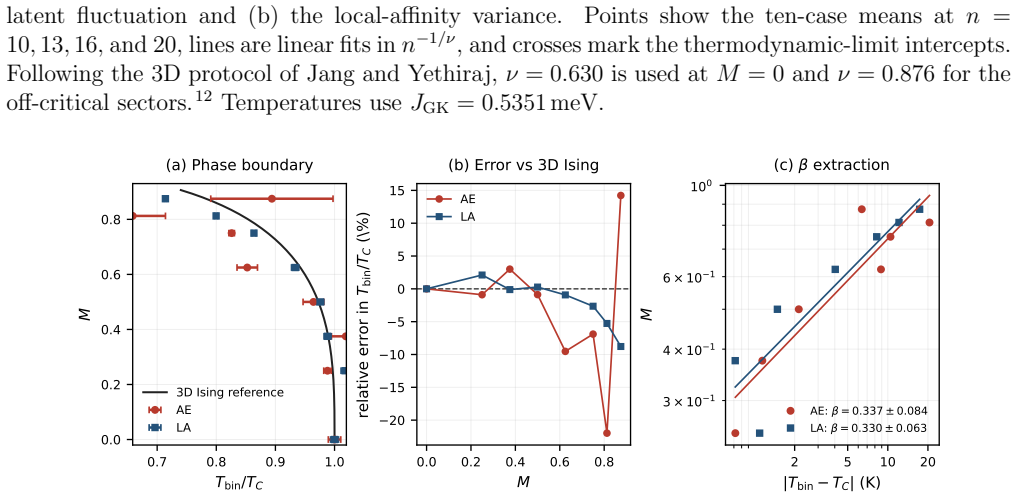
On its own terms, the paper's central discovery is a validated workflow rather than a single material. The modified-GK screen, which adds a positive f→5d virtual-excitation channel to the standard Goodenough–Kanamori superexchange terms, assigns material-level couplings $J_{\mathrm{Ce}} = +4.7280$ meV to CeGaO3 and $+3.6631$ meV to CeF3; Glauber Binder-cumulant crossings then give $T_C = 326.8\pm 19.7$ K and $340.7\pm 15.2$ K respectively. The autoencoder and local-affinity binodal reconstructions for CeGaO3 yield order-parameter exponents ($0.300\pm 0.209$ and $0.363\pm 0.057$) consistent with the 3D Ising value, while CeF3's recovered exponents are far from Ising, which the authors read as indicating magnetic excitations rather than a sharp order-disorder transition. EuO, run through the same graph and simulation machinery, gives $T_C = 60.6\pm 0.9$ K versus the experimental roughly 69 K, providing an external check that the workflow is not grossly off-scale. The result is stated carefully: these are computationally predicted ferromagnets whose uniaxial anisotropy still needs experimental confirmation.
Load-bearing premise
Everything downstream—which compounds stay in the candidate pool, the Ising Hamiltonian, and every temperature in kelvin—rests on the assumption that the average modified-goodenough–Kanamori coupling $J_{\mathrm{Ce}}$ correctly represents the real exchange in the compound, even though the f-to-5d correction is specified only as a proportionality and the quoted values are asserted without derivation.
Editorial extensions
If this is right
- If the workflow is sound, CeGaO3 moves from an understudied geometry to a concrete synthesis target for confirming Ce-based Ising ferromagnetism, with a predicted ordering temperature near 327 K and a 3D-Ising-like order-parameter exponent.
- The pipeline's 237 positive-exchange candidates constitute a shortlist for higher-cost first-principles and anisotropy calculations, concentrating effort on a small fraction of the 1,011 Ce compounds screened.
- EuO's benchmark error (about 12% at the Glauber level) sets a realistic expectation: predicted transition temperatures for new Ce candidates should be read as approximate, with comparable or larger uncertainty.
- The framework is claimed to transfer beyond Ce: the same stages with analogous f-orbital corrections apply to other rare-earth and actinide magnetic systems.
- The CeF3 result shows the screen can flag a positive-exchange ferromagnet whose simulated phase behavior is not Ising-like, so the pipeline distinguishes a general ferromagnetic candidate from an Ising-anisotropy candidate.
Reading between the lines
- If the modified-GK coupling for CeGaO3 is later confirmed by first-principles exchange calculations, the predicted ordering temperature near 327 K would make it an unusually high-$T_C$ cerium-only ferromagnet; the paper itself does not compare this against known Ce intermetallics.
- The same pipeline applied to neodymium- and samarium-based compounds could yield a family of rare-earth gap-magnet candidates, since the f-to-5d correction generalizes to other lanthanides.
- The non-Ising exponents recovered for CeF3 are a built-in falsifier: experimental single-crystal studies should show no sharp uniaxial transition, suggesting the strong positive $J$ from the f-to-5d channel may be an artifact of the model rather than a material property.
- A cheap testable extension would be to rerun the autoencoder stage on the EuO configurations with tanh activations to quantify the claimed bias of that activation choice, since the paper's activation-function analysis is qualitative.
Editorial analysis
A structured set of objections, weighed in public.
Referee Report
Summary. The paper proposes a multi-stage computational pipeline for discovering candidate Ising ferromagnets among Ce-based compounds. A Random Forest classifier trained on Materials Project magnetic labels predicts ferromagnetic candidates from structural and SOAP descriptors; a modified Goodenough–Kanamori (GK) screen with an added f-to-5d virtual-excitation channel retains compounds with positive mean exchange J_Ce; Glauber Monte Carlo estimates critical temperatures; conserved-magnetization Kawasaki Monte Carlo on crystal-derived magnetic graphs generates phase boundaries, which are reconstructed by a local-affinity feature and a one-dimensional autoencoder; critical exponents are extracted from the binodal. The pipeline is demonstrated on EuO as an external benchmark and applied to two Ce candidates, CeF3 and CeGaO3, with the central claim that CeGaO3 is a candidate Ising ferromagnet.
Significance. If the full pipeline were validated end-to-end, it would be a useful transferable framework for prioritizing lanthanide-based magnetic candidates: the structural RF stage is fast, the MC/autoencoder machinery is generic, and the EuO benchmark is a genuine external test of the phase-mapping workflow. Strengths of the paper include the explicit EuO benchmark reproducing the 3D Ising exponent within uncertainty (β_AE = 0.337 ± 0.084, β_LA = 0.330 ± 0.063), the careful reporting of phase-boundary errors for both AE and LA methods, the acknowledgment that the effective-J approximation is a limitation, and the commitment to release code and data. However, the Ce-specific predictions rest on an under-specified f-to-5d modification of the GK model whose numerical parameters are not given, and the same J_Ce is used both to select candidates and to define the simulated Hamiltonian. This creates a circularity that the EuO benchmark does not resolve, because the EuO coupling is itself an output of the same screening model. The RF stage also provides near-chance balanced accuracy for the minority classes, so the practical filtering power of that stage is limited.
major comments (4)
- [Goodenough–Kanamori Screening with f-Orbital Correction, Eq. (1)] The f-to-5d correction is specified only as a proportionality, J_{f→5d} ∝ 2 b_fd^2 / [(4 S_i S_j) Δ_fd], with no numerical values for b_fd, Δ_fd, S_i, S_j, no angular prefactor, and no derivation of the three reported couplings (0.5351, 3.6631, 4.7280 meV). Because J_Ce serves simultaneously as the positive-exchange filter (J_Ce > 0) and as the uniform coupling J in Eq. (2), all predicted T_C values in Table 2 scale linearly with this undisclosed input. The EuO benchmark cannot independently validate the model because J_GK = 0.5351 meV is an output of the same screen. The authors should disclose the parameters, provide a sensitivity analysis (for example, varying the f-to-5d amplitude by a factor of two), or replace the screening with a first-principles evaluation for the two Ce candidates. The concluding remark that DFT+U validation is future work is not sufficient to support the central CeGaO3 claim.
- [Results and Discussion, Ce-Based Candidate Phase Diagrams] The identification of CeGaO3 as a candidate Ising ferromagnet is circular in structure: the same modified-GK coupling J_Ce > 0 selects the compound, and the same J is then inserted as the uniform coupling in the Ising Hamiltonian whose ferromagnetic phase is simulated. The EuO benchmark validates the MC/autoencoder machinery but not the Ce-specific exchange input. A non-circular test would be to compute J from an independent method (DFT+U or the published first-principles study in Ref. 26) and compare the predicted T_C and magnetic order. Without such a test, the CeGaO3 prediction is inherited from the assumed J rather than independently derived from the material.
- [Ferromagnetic Prediction Using Structural Characteristics] The balanced accuracies for the ternary and combined RF models are 0.434 and 0.453, only slightly above the 1/3 chance level for three classes, and the macro-F1 scores are 0.450 and 0.467. Since the out-of-fold predictions from this model define the 838-compound FM candidate pool, the RF stage contributes little filtering power beyond the majority FM label. The subsequent no-TM-overlap, z≥6, and CIF-availability filters are post-hoc, and the paper does not report how many of the 237 positive-exchange candidates survive each filter or why CeF3 and CeGaO3 are representative of the surviving set. The authors should quantify the selectivity of each funnel stage and report the RF confusion matrix, or explicitly frame the RF stage as a baseline descriptor benchmark rather than a load-bearing screening component.
- [Results and Discussion, Ce-Based Candidate Phase Diagrams] The CeF3 analysis yields β_LA = -0.102 ± 0.111, which the paper itself describes as 'not physically meaningful for an order-parameter exponent.' While this is an honest report, it means the pipeline's phase-diagram characterization fails for one of the two Ce candidates, and the negative exponent is left unexplained. The paper should analyze why the conserved-magnetization binodal fits fail for CeF3 (for example, lattice connectivity or finite-size effects) or restrict the phase-diagram claims to CeGaO3. As written, the abstract's statement that the framework 'characterize[s] their magnetic phase transitions and critical properties' is not supported for CeF3.
minor comments (6)
- [Figures 4, 8, and 10] There are typos in the figure captions and axis labels: 'T emperature' should be 'Temperature', and the axis label 'n 1/' should read 'n^{-1/ν}'. In Figure 10 the exponent labels are missing the β symbol.
- [Model and Methods, Ferromagnetic Prediction Using Structural Characteristics] The seven-feature descriptor includes 'space group,' but the encoding scheme is not specified. Please clarify whether it is one-hot, ordinal, or a numerical space-group number, since this affects the interpretation of feature importances.
- [Model and Methods, Goodenough–Kanamori Screening with f-Orbital Correction, Eq. (1)] The summation index 'c' in Eq. (1) is used before the channel index is defined. Please list the standard GK terms (σ, π, 90°) explicitly and state the sign rules used, or provide a reference to the specific GK formulation adopted.
- [Model and Methods, Monte Carlo Simulation with Conserved Magnetization] The finite-size scaling uses ν = 0.876 (3D percolation) for off-critical magnetization sectors, taken from the reference protocol. The paper should justify transferring this exponent to material-derived graphs with non-cubic connectivity, or discuss the sensitivity of the extracted T_bin to this choice.
- [Results and Discussion, EuO Benchmark Validation] The text and figures refer to 'ten independent autoencoder cases,' but the main text never defines what distinguishes the cases (initialization seeds, data subsampling, or architecture variants). Please specify this in the Methods section.
- [Supporting Information, Data, and Code Availability] The data and code are stated to 'will be made publicly available on GitHub' without a URL or version identifier. A permanent repository link or DOI is needed for the availability claim to be verifiable.
Circularity Check
The ferromagnetic sign for CeGaO3 is inherited from the positive-J modified-GK screen via the same J used in the Ising Hamiltonian; the phase-diagram machinery is nontrivial but does not independently establish ferromagnetism.
-
self definitional
[Goodenough–Kanamori Screening with f-Orbital Correction (Eq. 1); Monte Carlo Simulation with Conserved Magnetization (Eq. 2); Results and Discussion, Ce-Based Candidate Phase Diagrams]
"Materials with J_Ce > 0 are retained as FM candidates; the remainder are classified as AFM or nonmagnetic within the screening model. The modified-GK values are used both to identify positive-exchange Ce graphs and, through their material-level mean, as the uniform coupling for the Glauber and Kawasaki models. ... The modified-GK value is used for screening, for identifying the magnetic Ce–anion–Ce connectivity, and as the uniform material-level coupling J=J_GK on every retained ferromagnetic bond."
The same material-level modified-GK coupling J_Ce is the screening criterion (retain only J_Ce > 0) and the coupling J in H = -J sum S_i S_j. On a three-dimensional Ce–anion–Ce graph with z >= 6, a positive uniform J makes the Hamiltonian ferromagnetic by construction: the sign of the interaction is imposed before any Monte Carlo run. The Glauber/Kawasaki simulations therefore cannot test whether CeGaO3 is ferromagnetic; they only locate the ordering temperature for an already ferromagnetic model. The concluding statement that CeGaO3 is a candidate Ising ferromagnet, with T_C = 326.8 K, is an arithmetic consequence of the input J = 4.7280 meV, not an independent confirmation.
full rationale
The circular core is real but narrow. Equation (1) defines J_Ce through the modified-GK channel J_f->5d, the screen retains materials with J_Ce > 0, and Eq. (2) uses the same material-level mean J as the Hamiltonian coupling. Thus the central 'candidate Ising ferromagnet' conclusion inherits its ferromagnetic sign from the screening input, and the kelvin-scale T_C values are linearly tied to J values (0.5351, 3.6631, 4.7280 meV) that are asserted without giving b_fd, Delta_fd, S_i, S_j, or the prefactor. This is a self-definitional loop for the ordering sign and temperature scale. The loop is only partial: CeF3's recovered exponents are far from the 3D Ising value (beta_LA = -0.102), so the MC/autoencoder stage can fail its own Ising assumption and the phase-diagram reconstruction is not vacuous. The EuO benchmark is external, but it validates the MC/autoencoder workflow rather than the modified-GK J input, because J_EuO = 0.5351 meV is produced by the same under-specified screening formula. No load-bearing self-citation is present, and Ref. 26 is an independent first-principles study. Accordingly, the footprint is partial circularity rather than full tautology: score 6.
Assumptions & free parameters
free parameters (4)
- f-to-5d correction scale (b_fd, Delta_fd, angular factor) =
unspecified; effective J_Ce values quoted: EuO 0.5351 meV, CeF3 3.6631 meV, CeGaO3 4.7280 meV
- SOAP descriptor hyperparameters =
n_max=5, l_max=3, r_c=5 Angstrom
- local-affinity graph window d =
per material, size, and magnetization sector
- finite-size scaling exponents nu =
nu=0.630 at M=0, nu=0.876 off-critical
assumptions (5)
- domain assumption Materials Project spin-polarized DFT magnetic labels are treated as ground truth for the RF training and evaluation.
- domain assumption Goodenough-Kanamori sign rules, plus an additive positive f-to-5d channel, capture Ce-anion-Ce superexchange at screening level.
- ad hoc to paper A single uniform coupling J = <J_p> over all retained magnetic bonds reproduces the material's phase behavior.
- domain assumption The CIF-derived nearest-neighbor magnetic graphs correctly represent the physical exchange connectivity.
- domain assumption The 3D Ising universality class is the appropriate reference for these crystal-graph Ising models.
Cite this review
Pith. "Pith review of Machine Learning Framework for Magnetic Candidate Discovery in Cerium-Based Compounds." pith.science (2026). https://pith.science/paper/YEK4VYGS
@misc{pith2026260808088,
  author       = {Pith},
  title        = {Pith review of: Machine Learning Framework for Magnetic Candidate Discovery in Cerium-Based Compounds},
  year         = {2026},
  howpublished = {\url{https://pith.science/paper/YEK4VYGS}},
  note         = {Machine review of arXiv:2608.08088}
}
read the original abstract
Cerium (Ce), the most abundant lanthanide, offers significant potential for addressing shortages in high-performance magnetic materials, particularly through the discovery of compounds suitable for gap magnets. However, predicting Ce-based ferromagnets with uniaxial magnetic anisotropy remains challenging because their magnetic behavior depends strongly on crystal structure, exchange geometry, and electronic interactions. Here, we present a physics-guided computational framework to screen known Ce-based crystal structures and identify promising Ising ferromagnets for future synthesis. A Random Forest classifier uses seven structural and SOAP descriptors, including unit-cell volume, density, atomic sites, space group, atomic density, Ce SOAP overlap, and transition-metal SOAP overlap, to prioritize candidate compounds. Selected crystallographic structures are then analyzed using Ising-model Monte Carlo simulations to characterize phase behavior and critical properties. Critical exponents extracted from simulated phase transitions provide quantitative insight into magnetic regimes and anisotropy-related effects. We further employ autoencoders trained on affinity-based features from simulated spin configurations to identify latent signatures of phase evolution and transition behavior. Together, this framework integrates structural screening, statistical-mechanical simulation, and machine learning to accelerate the identification of promising Ce-based magnetic materials and provide candidates for experimental synthesis and validation.
Figures


Figures from the paper (7 more)




Reference graph
Works this paper leans on
-
[1]
Spintronics: Fundamentals and applications
Z uti\' c , I.; Fabian, J.; Das Sarma, S. Spintronics: Fundamentals and applications. Rev. Mod. Phys. 2004, 76, 323--410
work page 2004
-
[2]
Pecharsky, V. K.; Gschneidner, K. A., Jr. Magnetocaloric effect and magnetic refrigeration. J. Magn. Magn. Mater. 1999, 200, 44--56
work page 1999
-
[3]
Coey, J. M. D. Magnetism and Magnetic Materials; Cambridge University Press: Cambridge, 2010
work page 2010
-
[4]
Goodenough, J. B. Magnetism and the Chemical Bond; Interscience: New York, 1963
work page 1963
-
[5]
Superexchange interaction and symmetry properties of electron orbitals
Kanamori, J. Superexchange interaction and symmetry properties of electron orbitals. J. Phys. Chem. Solids 1959, 10, 87--98
work page 1959
-
[6]
Anomalous transport phenomena in Eu-chalcogenide alloys
Kasuya, T.; Yanase, A. Anomalous transport phenomena in Eu-chalcogenide alloys. Rev. Mod. Phys. 1968, 40, 684--696
work page 1968
-
[7]
Kune s , J.; Ku, W.; Pickett, W. E. Exchange coupling in Eu monochalcogenides from first principles. J. Phys. Soc. Jpn. 2005, 74, 1408--1411
work page 2005
-
[8]
Bedolla, E.; Padierna, L. C.; Casta\ n eda-Priego, R. Machine learning for condensed matter physics. J. Phys.: Condens. Matter 2021, 33, 053001
work page 2021
Show all 29 references
-
[9]
M.; Zhu, J.-X
Ghosh, A.; Ronning, F.; Nakhmanson, S. M.; Zhu, J.-X. Machine learning study of magnetism in uranium-based compounds. Phys. Rev. Materials 2020, 4, 064414
2020
-
[10]
Structure-driven prediction of magnetic order in uranium compounds
Broyles, C.; Charles, W.; Ran, S. Structure-driven prediction of magnetic order in uranium compounds. Phys. Rev. Mater. 2024, 8, 114405
2024
-
[11]
Discovering phase transitions with unsupervised learning
Wang, L. Discovering phase transitions with unsupervised learning. Phys. Rev. B 2016, 94, 195105
2016
-
[12]
Unsupervised machine learning method for the phase behavior of the constant magnetization Ising model in two and three dimensions
Jang, I.; Yethiraj, A. Unsupervised machine learning method for the phase behavior of the constant magnetization Ising model in two and three dimensions. J. Phys. Chem. B 2025, 129, 532--539
2025
-
[13]
The magnetic, optical, and transport properties of representatives of a class of magnetic semiconductors: The europium chalcogenides
Mauger, A.; Godart, C. The magnetic, optical, and transport properties of representatives of a class of magnetic semiconductors: The europium chalcogenides. Phys. Rep. 1986, 141, 51--176
1986
-
[14]
P.; Hautier, G.; Chen, W.; Richards, W
Jain, A.; Ong, S. P.; Hautier, G.; Chen, W.; Richards, W. D.; Dacek, S.; Cholia, S.; Gunter, D.; Skinner, D.; Ceder, G.; Persson, K. A. Commentary: The Materials Project: A materials genome approach to accelerating materials innovation. APL Mater. 2013, 1, 011002
2013
-
[15]
P.; Cholia, S.; Jain, A.; Brafman, M.; Gunter, D.; Ceder, G.; Persson, K
Ong, S. P.; Cholia, S.; Jain, A.; Brafman, M.; Gunter, D.; Ceder, G.; Persson, K. A. The Materials Application Programming Interface (API): A simple, flexible and efficient API for materials data based on REpresentational State Transfer (REST) principles. Comput. Mater. Sci. 2...
2015
-
[16]
P.; Richards, W
Ong, S. P.; Richards, W. D.; Jain, A.; Hautier, G.; Kocher, M.; Cholia, S.; Gunter, D.; Chevrier, V. L.; Persson, K. A.; Ceder, G. Python Materials Genomics (pymatgen): A robust, open-source python library for materials analysis. Comput. Mater. Sci. 2013, 68, 314--319
2013
-
[17]
P.; Kondor, R.; Cs\' a nyi, G
Bart\' o k, A. P.; Kondor, R.; Cs\' a nyi, G. On representing chemical environments. Phys. Rev. B 2013, 87, 184115
2013
-
[18]
Glauber, R. J. Time-dependent statistics of the Ising model. J. Math. Phys. 1963, 4, 294--307
1963
-
[19]
Diffusion constants near the critical point for time-dependent Ising models
Kawasaki, K. Diffusion constants near the critical point for time-dependent Ising models. I. Phys. Rev. 1966, 145, 224--230
1966
-
[20]
W.; Rosenbluth, M
Metropolis, N.; Rosenbluth, A. W.; Rosenbluth, M. N.; Teller, A. H.; Teller, E. Equation of state calculations by fast computing machines. J. Chem. Phys. 1953, 21, 1087--1092
1953
-
[21]
Ponte, P.; Melko, R. G. Kernel methods for interpretable machine learning of order parameters. Phys. Rev. B 2017, 96, 205146
2017
-
[22]
Importance of feature construction in machine learning for phase transitions
Jang, I.; Kaur, S.; Yethiraj, A. Importance of feature construction in machine learning for phase transitions. J. Chem. Phys. 2022, 157, 094904
2022
-
[23]
Als-Nielsen, J.; Birgeneau, R. J. Mean field theory, the Ginzburg criterion, and marginal dimensionality of phase transitions. Am. J. Phys. 1977, 45, 554--560
1977
-
[24]
The critical temperature of the 2D-Ising model through deep learning autoencoders
Alexandrou, C.; Athenodorou, A.; Chrysostomou, C.; Paul, S. The critical temperature of the 2D-Ising model through deep learning autoencoders. Eur. Phys. J. B 2020, 93, 226
2020
-
[25]
Hybridization, crystal field and magnetism in rare earths and core level spectroscopy
Jo, T.; Imada, S. Hybridization, crystal field and magnetism in rare earths and core level spectroscopy. J. Alloys Compd. 1993, 193, 170--174
1993
-
[26]
S.; Farout, M.; Salmani, E.; Erum, N.; Kim, S
Kabi, O.; Samih, A.; El Fdil, R.; Fadil, Z.; Abu-Jafar, M. S.; Farout, M.; Salmani, E.; Erum, N.; Kim, S. C.; Raorane, C. J.; Husain, F. M. A first-principles study of structural, electronic, magnetic, and mechanical properties in CeGaO _3 . Physica B: Condens. Matter 2025, 69...
2025
-
[27]
Improved high-temperature expansion and critical equation of state of three-dimensional Ising-like systems
Campostrini, M.; Pelissetto, A.; Rossi, P.; Vicari, E. Improved high-temperature expansion and critical equation of state of three-dimensional Ising-like systems. Phys. Rev. E 1999, 60, 3526--3563
1999
-
[28]
V.; Korableva, S
Savinkov, A. V.; Korableva, S. L.; Tagirov, M. S. Revised measurements and interpretation of magnetic properties of oriented CeF _3 single crystals. J. Low Temp. Phys. 2016, 185, 603--608
2016
-
[29]
L.; Bl\" o te, H
Talapov, A. L.; Bl\" o te, H. W. J. The magnetization of the 3D Ising model. J. Phys. A: Math. Gen. 1996, 29, 5727
1996
Reviewed August 12, 2026 · model on record in the stance chip above.
Discussion (0). Continue with ORCID to comment.