Simple analytical flux-tuned iSWAP pulses for leakage suppression
Pith reviewed 2026-06-27 06:39 UTC · model grok-4.3
The pith
An analytical flux modulation method called Φ-DRAG suppresses leakage below 10^{-4} in fast tunable-coupler iSWAP gates.
A machine-rendered reading of the paper's core claim, the machinery that carries it, and where it could break.
Core claim
We show that Φ-DRAG differs fundamentally from conventional microwave implementations and derive modified flux modulation protocols that suppress leakage below 10^{-4} for fast entangling gates. The method remains effective across a range of asymmetry between qubit anharmonicities and different circuit parameters, enabling high-fidelity two-qubit gates within the fifteen nanosecond range.
What carries the argument
Φ-DRAG, the flux-domain version of derivative removal by adiabatic gate, which supplies an analytical correction to the flux pulse envelope that cancels leading-order diabatic transitions.
If this is right
- Fast iSWAP gates become feasible at 15 ns duration while maintaining leakage below 10^{-4}.
- The same analytical correction works for a range of qubit anharmonicity mismatches.
- High-fidelity two-qubit operations are achievable without numerical optimization of every pulse.
- The approach applies across different circuit parameters in flux-tunable architectures.
Where Pith is reading between the lines
- The method may reduce the need for extensive pulse calibration in large-scale superconducting processors.
- Similar flux-domain corrections could be derived for other entangling gates such as CZ in the same hardware.
- If the model holds, the technique provides a parameter-free starting point that can be further refined by closed-loop optimization.
Load-bearing premise
The effective two-qubit Hamiltonian and leakage model used to derive the Φ-DRAG correction accurately capture the dominant diabatic transitions without significant unmodeled higher-order effects.
What would settle it
An experiment measuring population leakage above 10^{-4} when applying the derived analytical flux pulses on a tunable-coupler device would falsify the central performance claim.
Figures
read the original abstract
Fast, high-fidelity two-qubit gates are a key requirement for fault-tolerant quantum computation. Tunable coupler architectures provide a flexible approach for implementing entangling gates through flux control with large on-off ratios, but fast flux modulation can induce diabatic transitions and population leakage to non-computational states, limiting gate performance. Here we present an analytical flux control method enabling derivative removal by adiabatic gate ($\Phi$-DRAG) for suppressing leakage in flux tunable two-qubit gates. We show that $\Phi$-DRAG differs fundamentally from conventional microwave implementations and derive modified flux modulation protocols that suppress leakage below $10^{-4}$ for fast entangling gates. The method remains effective across a range of asymmetry between qubit anharmonicities and different circuit parameters, enabling high-fidelity two-qubit gates within the fifteen nanosecond range.
Editorial analysis
A structured set of objections, weighed in public.
Referee Report
Summary. The manuscript introduces Φ-DRAG, an analytical flux-modulation protocol for derivative removal by adiabatic gate in tunable-coupler iSWAP gates. It derives modified flux pulses that suppress leakage below 10^{-4} for gates in the 15 ns range, shows that the approach differs from conventional microwave DRAG, and demonstrates robustness across qubit anharmonicity asymmetries and circuit parameters.
Significance. If the effective-model derivation and leakage bound hold under realistic device conditions, the result supplies a parameter-light analytical tool for fast, high-fidelity two-qubit gates in superconducting architectures, directly addressing a practical bottleneck for fault-tolerant quantum computation.
major comments (2)
- [§3, Eq. (12)] §3, Eq. (12): the leakage bound of 10^{-4} is obtained from the effective two-qubit Hamiltonian; the manuscript should explicitly state the range of higher-order terms neglected and provide a quantitative estimate of their contribution for the fastest (15 ns) gates.
- [§4.2, Fig. 4] §4.2, Fig. 4: the numerical validation uses a fixed set of circuit parameters; the claim of robustness across “different circuit parameters” requires an additional sweep or table showing leakage versus coupler anharmonicity and coupling strength.
minor comments (2)
- Notation for the flux-drive amplitude and its derivative is introduced without a consolidated table; a short symbol table would improve readability.
- The abstract states the method “remains effective across a range of asymmetry,” but the corresponding figure caption does not list the exact asymmetry values tested.
Simulated Author's Rebuttal
We thank the referee for their careful reading of the manuscript and for the constructive comments. We are pleased with the recommendation for minor revision and address each major comment below.
read point-by-point responses
-
Referee: [§3, Eq. (12)] §3, Eq. (12): the leakage bound of 10^{-4} is obtained from the effective two-qubit Hamiltonian; the manuscript should explicitly state the range of higher-order terms neglected and provide a quantitative estimate of their contribution for the fastest (15 ns) gates.
Authors: We agree with this suggestion. The effective Hamiltonian in Eq. (12) is derived by neglecting higher-order terms in the perturbative expansion of the time-dependent Schrödinger equation. In the revised manuscript, we will explicitly state the neglected terms (O(1/ω²) and higher) and provide a quantitative estimate based on numerical integration showing that their contribution to leakage is less than 5×10^{-5} for the 15 ns gates, thus not affecting the 10^{-4} bound significantly. revision: yes
-
Referee: [§4.2, Fig. 4] §4.2, Fig. 4: the numerical validation uses a fixed set of circuit parameters; the claim of robustness across “different circuit parameters” requires an additional sweep or table showing leakage versus coupler anharmonicity and coupling strength.
Authors: While Fig. 4 already shows robustness to variations in qubit anharmonicities, we acknowledge that the numerical results are for a fixed coupler anharmonicity and coupling strength. To strengthen the claim, we will add a new figure in §4.2 presenting leakage versus coupler anharmonicity (ranging from -200 to -300 MHz) and coupling strength (10-30 MHz) for the Φ-DRAG pulses at 15 ns gate time. revision: yes
Circularity Check
No significant circularity detected
full rationale
The paper presents an analytical derivation of Φ-DRAG flux modulation protocols from an effective two-qubit Hamiltonian and leakage model. No equations, fitting procedures, or self-citations are shown to reduce any claimed prediction or result to its own inputs by construction. The central claim of leakage suppression below 10^{-4} rests on the model's validity rather than any internal redefinition or fitted-input renaming. This is the common honest outcome for derivation-focused papers whose assumptions are stated externally to the derivation itself.
Axiom & Free-Parameter Ledger
axioms (1)
- domain assumption Standard circuit-QED Hamiltonian for two transmons coupled by a tunable coupler
Reference graph
Works this paper leans on
-
[1]
(2) with and without control corrections, as shown in Fig
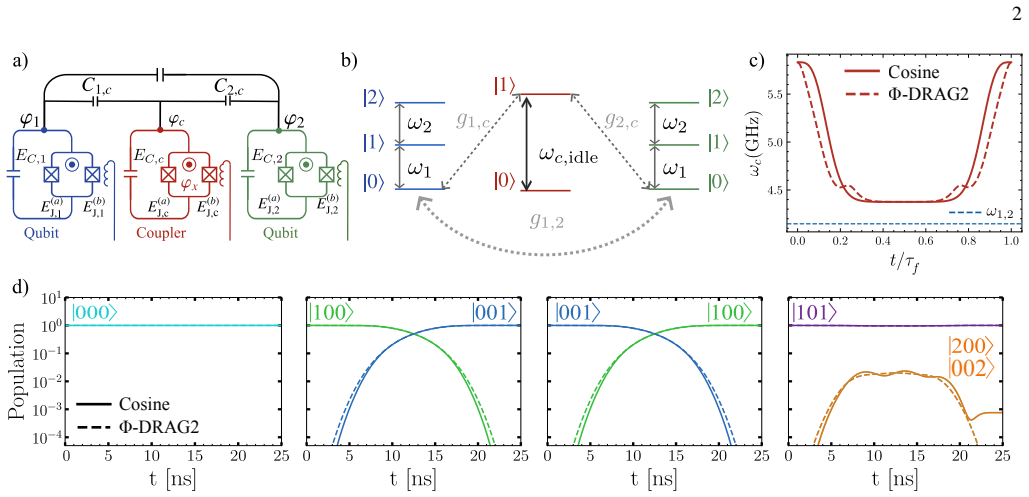
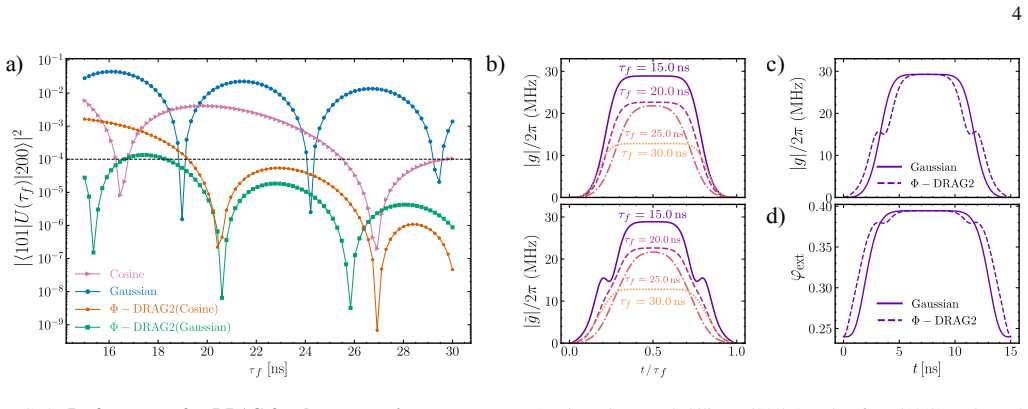
and compare leakage to|200⟩from Eq. (2) with and without control corrections, as shown in Fig. 3. Since|200⟩ and|002⟩are on resonance they undergo identical dynam- ics. Consequently, suppressing one state automatically sup- presses the other. We initially modulate the external flux as, φext(t)=φ max+(φid −φmax) cos8(πt/τ f ), whereφ id corresponds to the ...
-
[2]
(8) is non-trivial
Engineering the flux pulse shape from the effective coupling Owing to the nonlinear relation between the effective cou- pling and the external flux, the experimental implementation of Eq. (8) is non-trivial. In case of absence of an algorithm that inverts the coupling pulse directly to the flux pulse we can work as follows. We determine the corrected flux...
2004
-
[3]
Krantz, M
P. Krantz, M. Kjaergaard, F. Yan, T. P. Orlando, S. Gustavsson, and W. D. Oliver, A quantum engineer’s guide to superconduct- ing qubits, Applied Physics Reviews6, 021318 (2019)
2019
-
[4]
Kjaergaard, M
M. Kjaergaard, M. E. Schwartz, J. Braum ¨uller, P. Krantz, J. I.- J. Wang, S. Gustavsson, and W. D. Oliver, Superconducting qubits: Current state of play, Annual Review of Condensed Matter Physics11, 369 (2020)
2020
-
[5]
Besedin, M
I. Besedin, M. Kerschbaum, J. Knoll, and et al., Lattice surgery realized on two distance-three repetition codes with supercon- ducting qubits, Nature Physics22, 189 (2026)
2026
-
[6]
V . Sivak, A. Morvan, M. Broughton, M. Neeley, A. Eickbusch, D. Abanin,et al., Reinforcement learning control of quantum error correction (2025), arXiv:2511.08493 [quant-ph]
Pith/arXiv arXiv 2025
- [7]
-
[8]
T. He, W. Lin, and et al., Experimental quantum error correc- tion below the surface code threshold via all-microwave leakage suppression, Phys. Rev. Lett.135, 260601 (2025)
2025
-
[9]
DiCarlo, J
L. DiCarlo, J. M. Chow, J. M. Gambetta, L. S. Bishop, B. R. Johnson, D. I. Schuster, J. Majer, A. Blais, L. Frunzio, S. M. Girvin, and R. J. Schoelkopf, Demonstration of two-qubit algo- rithms with a superconducting quantum processor, Nature460, 240 (2009)
2009
-
[10]
Y . Chen, C. Neill, P. Roushan, N. Leung, M. Fang, R. Barends, J. Kelly, B. Campbell, Z. Chen, B. Chiaro, A. Dunsworth, E. Jeffrey, A. Megrant, J. Y . Mutus, P. J. J. O’Malley, C. M. Quintana, D. Sank, A. Vainsencher, J. Wenner, T. C. White, M. R. Geller, A. N. Cleland, and J. M. Martinis, Qubit architec- ture with high coherence and fast tunable coupling...
2014
-
[11]
F. Yan, P. Krantz, Y . Sung, M. Kjaergaard, D. L. Campbell, T. P. Orlando, S. Gustavsson, and W. D. Oliver, Tunable coupling scheme for implementing high-fidelity two-qubit gates, Phys. Rev. Appl.10, 054062 (2018)
2018
-
[12]
Heunisch, C
L. Heunisch, C. Eichler, and M. J. Hartmann, Tunable cou- pler to fully decouple and maximally localize superconducting qubits, Phys. Rev. Appl.20, 064037 (2023)
2023
-
[13]
Y . Sung, L. Ding, J. Braum ¨uller, A. Veps¨al¨ainen, B. Kannan, M. Kjaergaard, A. Greene, G. O. Samach, C. McNally, D. Kim, A. Melville, B. M. Niedzielski, M. E. Schwartz, J. L. Yoder, T. P. Orlando, S. Gustavsson, and W. D. Oliver, Realization of high-fidelity cz andzz-free iswap gates with a tunable coupler, Phys. Rev. X11, 021058 (2021)
2021
-
[14]
J. B. Chang, M. R. Vissers, A. D. C ´orcoles, M. Sandberg, J. Gao, D. W. Abraham, J. M. Chow, J. M. Gambetta, M. B. Rothwell, G. A. Keefe, M. Steffen, and D. P. Pappas, Improved superconducting qubit coherence using titanium nitride, Ap- plied Physics Letters103, 012602 (2013)
2013
-
[15]
A. P. M. Place, L. V . H. Rodgers, P. Mundada, B. M. Smitham, M. Fitzpatrick, Z. Leng, A. Premkumar, J. Bryon, A. Vraji- toarea, S. Sussman, G. Cheng, T. Madhavan, H. K. Babla, X. H. Le, Y . Gang, B. J ¨ack, A. Gyenis, N. Yao, R. J. Cava, N. P. de Leon, and A. A. Houck, New material platform for supercon- ducting transmon qubits with coherence times excee...
2021
-
[16]
M. P. Bland, F. Bahrami, J. G. C. Martinez, P. H. Prestegaard, B. M. Smitham, A. Joshi, E. Hedrick, S. Kumar, A. Yang, A. C. Pakpour-Tabrizi, A. Jindal, R. D. Chang, G. Cheng, N. Yao, R. J. Cava, N. P. de Leon, and A. A. Houck, Millisecond life- times and coherence times in 2d transmon qubits, Nature647, 343 (2025)
2025
-
[17]
N. S. Smirnovet al., High-fidelity two-qubit gates with trans- mon qubits using bipolar flux pulses and tunable couplers (2025), arXiv:2509.04965 [quant-ph]
arXiv 2025
-
[18]
A. Q. Chen, X. Wu, S. Strong, and S. Poletto, Unlocking a fast adiabatic cz gate and exact residual zz cancellation be- 9 tween fixed-frequency transmons using a floating tunable cou- pler (2026), arXiv:2604.05048 [quant-ph]
Pith/arXiv arXiv 2026
-
[19]
Li, J.-C
T.-M. Li, J.-C. Zhang, B.-J. Chen, K. Huang, H.-T. Liu, Y .-X. Xiao, C.-L. Deng, G.-H. Liang, C.-T. Chen, Y . Liu, H. Li, Z.-T. Bao, K. Zhao, Y . Xu, L. Li, Y . He, Z.-H. Liu, Y .-H. Yu, S.-Y . Zhou, Y .-J. Liu, X. Song, D. Zheng, Z. Xiang, Y .-H. Shi, K. Xu, and H. Fan, High-precision pulse calibration of tunable cou- plers for high-fidelity two-qubit ga...
2025
-
[20]
Q. Ding, A. V . Oppenheim, P. T. Boufounos, S. Gustavsson, J. A. Grover, T. A. Baran, and W. D. Oliver, Pulse design of baseband flux control for adiabatic controlled-phase gates in superconducting circuits, Physical Review Applied23, 064013 (2025)
2025
-
[21]
Motzoi, J
F. Motzoi, J. M. Gambetta, P. Rebentrost, and F. K. Wilhelm, Simple pulses for elimination of leakage in weakly nonlinear qubits, Phys. Rev. Lett.103, 110501 (2009)
2009
-
[22]
Motzoi and F
F. Motzoi and F. K. Wilhelm, Improving frequency selection of driven pulses using derivative-based transition suppression, Phys. Rev. A88, 062318 (2013)
2013
-
[23]
J. D. D. C. Jesus, B. Li, Y . Gao, R. Barends, F. A. C ´ardenas- L´opez, and F. Motzoi, Analytical blueprint for 99.999% fidelity x-gates on present superconducting hardware under strong driv- ing (2025), arXiv:2512.19919 [quant-ph]
arXiv 2025
-
[24]
Hyypp ¨a, A
E. Hyypp ¨a, A. Veps ¨al¨ainen, M. Papi ˇc, C. F. Chan, S. Inel, A. Landra, W. Liu, J. Luus, F. Marxer, C. Ockeloen-Korppi, S. Orbell, B. Tarasinski, and J. Heinsoo, Reducing leakage of single-qubit gates for superconducting quantum processors using analytical control pulse envelopes, PRX Quantum5, 030353 (2024)
2024
-
[25]
B. Li, T. Calarco, and F. Motzoi, Experimental error suppres- sion in cross-resonance gates via multi-derivative pulse shap- ing, npj Quantum Information10, 66 (2024)
2024
-
[26]
Y . Gao, A. Galicia, J. D. Da Costa Jesus, Y . Liu, Y . Had- dad, D. A. V olkov, J. R. Guimar ˜aes, H. Bhardwaj, M. Jerger, M. Neis, B. Li, F. A. C ´ardenas-L´opez, F. Motzoi, P. A. Bu- shev, and R. Barends, Ultrafast single qubit gates through multi- photon transition removal (2025), arXiv:2511.22365 [quant- ph]
arXiv 2025
-
[27]
J. Koch, T. M. Yu, J. Gambetta, A. A. Houck, D. I. Schus- ter, J. Majer, A. Blais, M. H. Devoret, S. M. Girvin, and R. J. Schoelkopf, Charge-insensitive qubit design derived from the cooper pair box, Phys. Rev. A76, 042319 (2007)
2007
-
[28]
M. H. Goerz, F. Motzoi, K. B. Whaley, and C. P. Koch, Charting the circuit QED design landscape using optimal control theory, npj Quantum Information3, 37 (2017)
2017
-
[29]
J. R. Schrieffer and P. A. Wolff, Relation between the anderson and kondo hamiltonians, Phys. Rev.149, 491 (1966)
1966
-
[30]
Wu and X
Y . Wu and X. Yang, Strong-coupling theory of periodically driven two-level systems, Phys. Rev. Lett.98, 013601 (2007)
2007
-
[31]
Watts, J
P. Watts, J. c. v. Vala, M. M. M ¨uller, T. Calarco, K. B. Wha- ley, D. M. Reich, M. H. Goerz, and C. P. Koch, Optimizing for an arbitrary perfect entangler. i. functionals, Phys. Rev. A91, 062306 (2015)
2015
-
[32]
Groszkowski, A
P. Groszkowski, A. G. Fowler, F. Motzoi, and F. K. Wilhelm, Tunable coupling between three qubits as a building block for a superconducting quantum computer, Phys. Rev. B84, 144516 (2011)
2011
-
[33]
L. S. Theis, F. Motzoi, and F. K. Wilhelm, Simultaneous gates in frequency-crowded multilevel systems using fast, robust, an- alytic control shapes, Phys. Rev. A93, 012324 (2016)
2016
-
[34]
R. Wang, Y . Feng, Y . Zhang, J. Ding, B. Li, F. Motzoi, Y . Gao, H. Xu, Z. Yang, W. Nuerbolati, H. Yu, W. Sun, and F. Yan, Sup- pressing spurious transitions using spectrally balanced pulse, Phys. Rev. Lett.135, 160804 (2025)
2025
-
[35]
Hellings, N
C. Hellings, N. Lacroix, A. Remm, R. Boell, J. Herrmann, S. Laz˘ar, S. Krinner, F. m. c. Swiadek, C. K. Andersen, C. Eich- ler, and A. Wallraff, Calibrating magnetic flux control in super- conducting circuits by compensating distortions on timescales from nanoseconds up to tens of microseconds, Phys. Rev. Res. 7, 043142 (2025)
2025
-
[36]
M. A. Rol, L. Ciorciaro, F. K. Malinowski, B. M. Tarasinski, R. E. Sagastizabal, C. C. Bultink, Y . Salathe, N. Haandbaek, J. Sedivy, and L. DiCarlo, Time-domain characterization and correction of on-chip distortion of control pulses in a quantum processor, Applied Physics Letters116, 054001 (2020)
2020
-
[37]
Barends, J
R. Barends, J. Kelly, A. Megrant, A. Veitia, D. Sank, E. Jeffrey, T. C. White, J. Mutus, A. G. Fowler, B. Campbell, Y . Chen, Z. Chen, B. Chiaro, A. Dunsworth, C. Neill, P. O’Malley, P. Roushan, A. Vainsencher, J. Wenner, A. N. Korotkov, A. N. Cleland, and J. M. Martinis, Superconducting quantum circuits at the surface code threshold for fault tolerance, ...
2014
-
[38]
Motzoi, J
F. Motzoi, J. M. Gambetta, S. T. Merkel, and F. K. Wilhelm, Optimal control methods for rapidly time-varying hamiltonians, Phys. Rev. A84, 022307 (2011)
2011
-
[39]
van Dijk, E
J. van Dijk, E. Kawakami, R. Schouten, M. Veldhorst, L. Van- dersypen, M. Babaie, E. Charbon, and F. Sebastiano, Impact of classical control electronics on qubit fidelity, Phys. Rev. Appl. 12, 044054 (2019)
2019
-
[40]
Landiet al., Characterization of arbitrary waveform genera- tor by low resolution and oversampling signal acquisition, Mea- surement45, 2498 (2012)
C. Landiet al., Characterization of arbitrary waveform genera- tor by low resolution and oversampling signal acquisition, Mea- surement45, 2498 (2012)
2012
-
[41]
Singh, R
J. Singh, R. Zeier, T. Calarco, and F. Motzoi, Compensating for nonlinear distortions in controlled quantum systems, Phys. Rev. Appl.19, 064067 (2023)
2023
discussion (0)
Sign in with ORCID, Apple, or X to comment. Anyone can read and Pith papers without signing in.