REVIEW 4 major objections 5 minor 46 references
Waltz: Temperature-Aware Cooperative Compression for High-Performance Compression-Based CSDs
T0 review · 4 major / 5 minor · reviewed 2026-08-05 · deepseek-v4-flash
Pith's one-line read A temperature-aware scheduler that splits compression between the host CPU and a compression SSD prevents thermal shutdowns and boosts throughput.
desk verdict Waltz presents a plausible design and a real problem, but the no-shutdown claim is only shown in a fitted model inside FEMU, and the conclusion overstates the evidence. read the letter →
The pith
A machine-rendered reading of the paper's core claim, the machinery that carries it, and where it could break.
The reading
What carries the argument
The load-bearing mechanism is a temperature-threshold scheduler with two thresholds, Tsoft and Thard, fed by the drive's S.M.A.R.T. temperature reading once per second. Below Tsoft the device's hardware engine handles all compression and decompression; between Tsoft and Thard, decompression migrates to the host CPU; at or above Thard, compression also migrates to the host, letting the hardware engine idle so the device cools. A cooperative compression framework (CCF) reconciles the mismatched granularities and algorithms of F2FS and the CCSD so each compressed block can be decompressed by the side that knows its format, signalled through a reserved NVMe command bit. Two policies, Waltzs and
What would settle it
Run the Waltz scheduler on a real compression SSD with no in-package cooling while issuing continuous sequential writes and logging the onboard temperature sensor; if the drive reaches the thermal-emergency threshold (~86°C), enters throttling, or shuts down while following Waltz's policy, the central claim fails. A cheaper check: compare the emulator's predicted temperature trace against a real drive's sensor trace under the same workload and show a divergence large enough to change scheduling decisions.
Extended reading notes
Core claim
Waltz is a temperature-aware cooperative compression scheme that divides (de)compression work between the F2FS host file system and a compression-based computational SSD (CCSD). The paper claims that by reading the device's temperature and moving decompression to the host when the drive passes a soft threshold, then compression too when it passes a hard threshold, the scheduler prevents the thermal emergencies—throttling and in-flight shutdown—that occur when the hardware compression engine runs continuously. Because throttling is eliminated, the paper reports write throughput up to 391.5% and read throughput up to 627% higher than a throttling baseline, on average, in microbenchmarks. Two v
Load-bearing premise
The argument rests on the fitted temperature model—derived from real compression SSDs but embedded in an emulator—accurately reproducing how a real drive would heat up and cool down under Waltz's scheduling, since Waltz itself was never run on real hardware.
Editorial extensions
If this is right
- If the central claim is right, thermal throttling and in-flight shutdown can be avoided without in-package cooling, even under continuous compressible writes that would overheat a vanilla CCSD in about eight minutes.
- The device engine can stay the default and dominant executor—about 84% of (de)compression tasks remain on the device on average—so host CPU and memory overhead stay low while the drive cools only when close to the thresholds.
- Write amplification and throughput become a runtime-configurable tradeoff: Waltzs reduces WAF by about 34.6% versus the baseline on real workloads, while Waltzp trades WAF for higher throughput.
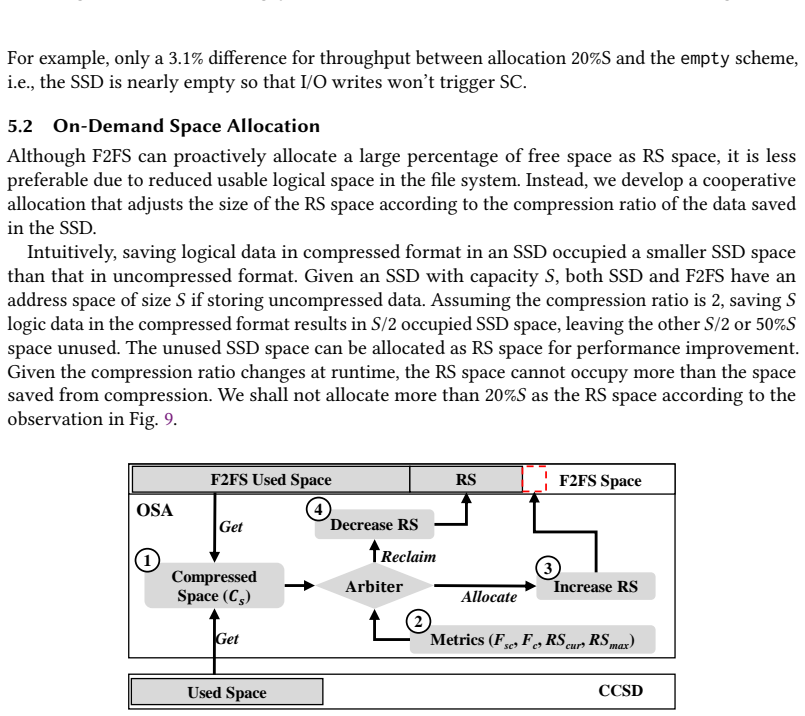
- The savings from compression can be used not just for lifetime extension but also to enlarge F2FS reserved space, which reduces segment-cleaning overhead and yields further performance gains.
- The scheme's metadata and scheduling overheads are small (a few bytes plus a once-per-second temperature read), making it deployable inside existing F2FS without a dedicated cooling solution.
Reading between the lines
- The asymmetric cost structure suggests the same two-threshold policy could govern other computational storage: whenever an accelerator's task can also run, more slowly, on the host CPU, the host can act as a thermal buffer that absorbs the expensive operation just long enough for the device to cool.
- Because decompression is cheaper than compression on the host, one could set the soft threshold differently for read-heavy versus write-heavy workloads, or even rotate compression duties across a pool of drives to keep rack temperature down—both are testable extensions of Waltz's logic.
- The 20% reserved-space cap is tuned offline; a natural follow-up is to make that cap track the live compression ratio and segment-cleaning frequency, letting the saved-space benefit adapt to changing workloads.
Editorial analysis
A structured set of objections, weighed in public.
Referee Report
Summary. The paper studies thermal and performance trade-offs of host-side and device-side compression for compression-based computational SSDs (CCSDs). It reports real-device measurements showing that CCSD compression can cause thermal emergencies and shutdowns, while F2FS host-side compression causes large software-stack overhead. The authors propose Waltz, a temperature-aware cooperative compression framework that schedules (de)compression between F2FS and the CCSD based on the device temperature. Waltz includes a cooperative compression framework (CCF), a temperature-aware scheduler (TCS), and a configuration selector (TWINS) with two variants, Waltzs and Waltzp, for space- and performance-oriented optimization. It also introduces on-demand space allocation (OSA) that repurposes compression-saved space as F2FS reserved space. The evaluation uses a FEMU-based CCSD emulator with a fitted temperature model and reports large throughput improvements over a throttling baseline, as well as WAF and CPU-usage results.
Significance. If the central claims hold, the paper makes a useful contribution: it provides quantitative real-hardware evidence of the CCSD overheating problem, proposes a plausible cross-layer software-hardware scheduling mechanism, and shows how compression-saved space can be reused to improve F2FS segment cleaning. The design ideas—cooperative host/device compression and temperature-triggered offloading—are timely and likely to interest the storage systems community. However, the evaluation currently rests on an unvalidated thermal model embedded in an emulator, and the conclusion overstates the platform on which the system was evaluated. The real-device measurements and the F2FS-side implementation are strengths, but the device-side firmware behavior and the no-shutdown claim are not validated on real hardware.
major comments (4)
- [§6.1, §8, Fig. 12] The central claim that Waltz 'prevents thermal emergencies under all workloads' is not established by a real-device experiment. Section 6.1 states that the real CCSD implementation was 'circumvented' by first building a temperature model from real ASIC-based CCSDs and integrating the fitted model into FEMU. Fig. 12 reports that Waltzs/Waltzp temperatures are 'derived from the model in the emulator,' while only the Baseline temperature is read from the in-package sensor. Yet §8 says 'Evaluations on the real CCSD platform.' No model equation, fitted parameters, calibration residuals, or validation against held-out traces are provided. Since the scheduler's safety depends on the model reproducing real thermal dynamics (time constants, cooling, sensor lag), the no-shutdown claim is currently a simulation result. This must be addressed either by validating the fitted model against real closed
- [§4.5.2, Fig. 3] TCS sets Tsoft=76°C and Thard=85°C, with T_emergency=86°C, and reads the temperature once per second. Fig. 3 shows that on the real device the temperature continues to rise for an extended period even after throttling starts at 76°C. With only a 1°C margin between Thard and the emergency shutdown temperature, and with 1s sampling, the paper must demonstrate that the scheduler's reaction—reading S.M.A.R.T., deciding, and issuing host offload—cannot overshoot 86°C on the real device. The fitted emulator model may not capture this thermal inertia or the command/sensor latency. No worst-case latency analysis or sensitivity study is provided. This is load-bearing for the paper's primary claim of preventing in-flight shutdowns.
- [§6.1, §5.2, Fig. 11] Several key parameters are calibrated on the same offline measurements used to frame the evaluation: Tsoft and Thard are derived from Fig. 3, rsr_max is set to 20% from Fig. 11, and FTsc, FTc, Ts are chosen from an offline study described in §6.1. The paper gives no sensitivity analysis for these thresholds. This is a concern because the performance and thermal-safety results may be overfit to the specific device and workload configuration. At minimum, the authors should vary Tsoft (and preferably RSmax and the frequency thresholds) and report the effect on throughput and temperature. They should also discuss possible oscillation or hysteresis behavior of the TCS state machine, which is not addressed.
- [§6.3, Figs. 14–17] Headline numbers such as 'up to 391.5% and 627%' write/read throughput improvement over Baseline, and '95.5%' for Waltzs over TCS, are reported as averages over three runs, but the figures show no error bars, confidence intervals, or per-run spread. Given that the emulator's timing behavior under Waltz scheduling is validated only indirectly, the magnitude of these improvements should be treated as preliminary. The paper should include variance information and, ideally, a comparison of emulator timing against the real CCSD to support the throughput claims.
minor comments (5)
- [Table 2] The column header 'Tc == Thard' should be 'Tc >= Thard' (or 'Tc > Thard') to match the TCS description in §4.3, which uses 'greater than or equal to.'
- [§3.4] The sentence 'Since neither of these schemes do not uses CCSDs' has a grammar error and should read 'neither scheme uses CCSDs.'
- [§6.2, Fig. 13] The distribution of (de)compression tasks in Fig. 13 is said to be 'calculated based on the ratios of temperature rise and fall times and the throughput of the host side and device side on the CCSD product.' This indirect method is unclear; please describe exactly how the percentages were computed, or provide direct instrumentation measurements.
- [Artifacts] The paper does not provide an artifact link, the fitted temperature model, or the FEMU configuration scripts. Since the evaluation depends critically on the emulator model, making these available would substantially improve reproducibility and reviewer confidence.
- [Fig. 3] The figure caption uses 'Thru.' without defining the abbreviation; please spell out 'Throughput.' Also, the two Y axes (temperature and throughput) should be labeled more clearly to avoid confusion.
Circularity Check
No circular derivation found: Waltz's claims rest on a fitted-plant simulation and a non-load-bearing self-citation, neither of which reduces the result to its inputs.
full rationale
The paper's derivation is self-contained in the circularity sense. The temperature model in §6.1 is fitted from real ASIC-based CCSD measurements and then used as the plant in FEMU; Waltz is a controller tested against that plant. The no-shutdown outcome is a closed-loop simulation output, not a restatement of the fitted parameters, and the fitted model is not refit to force the conclusion. The thresholds Tsoft=76°C and Thard=85°C are measured device characteristics used as control setpoints, not predictions. The self-citation of COCO [32] is used only for motivation/comparison, and no Waltz mechanism depends on it. The notable weakness is evidentiary, not circular: §8's 'Evaluations on the real CCSD platform' overstates §6.1's admission that real firmware changes were 'circumvented' and that Waltz temperatures are 'derived from the model in the emulator' while only Baseline is sensor-read; this is a validation/accuracy gap, not a definitional reduction.
Assumptions & free parameters
free parameters (6)
- Tsoft =
76°C
- Thard =
85°C
- RSmax (rsr_max) =
20% of device capacity
- Ts =
1% of device capacity
- FTsc =
4 times/second
- FTc =
256 times/second
assumptions (5)
- domain assumption The temperature model fitted from real ASIC-based CCSDs predicts CCSD temperature accurately under arbitrary workloads.
- domain assumption FEMU emulates the performance of the real CCSD closely enough for the comparisons.
- domain assumption Real workloads' compression ratios follow a Zipfian distribution.
- domain assumption Host-side decompression costs less than host-side compression, so the scheduler can move decompression first.
- domain assumption Reserved space beyond 20% of device capacity yields negligible benefit.
Cite this review
Pith. "Pith review of Waltz: Temperature-Aware Cooperative Compression for High-Performance Compression-Based CSDs." pith.science (2026). https://pith.science/paper/YEYZIIHJ
@misc{pith2026250905365,
  author       = {Pith},
  title        = {Pith review of: Waltz: Temperature-Aware Cooperative Compression for High-Performance Compression-Based CSDs},
  year         = {2026},
  howpublished = {\url{https://pith.science/paper/YEYZIIHJ}},
  note         = {Machine review of arXiv:2509.05365}
}
read the original abstract
Data compression is widely adopted for modern solid-state drives (SSDs) to mitigate both storage capacity and SSD lifetime issues. Researchers have proposed compression schemes at different system layers, including device-side solutions like CCSDs ( c ompression-based c omputational SSDs) and compression supported by host-side, like F2FS (flash-friendly file system). We conduct quantitative studies to understand how host-side and device-side compression schemes affect the temperature and performance of SSD-based storage systems. From our experiments, device-side compression, facilitated by a hardware compression engine, can raise the temperature of CCSDs to intolerable levels, resulting in throttling and service shutdown. In contrast, host-side compression causes software-stack overhead, which often results in large performance degradation and resource consumption. To ensure efficient data compression with high performance and better temperature control, we propose Waltz, a temperature-aware cooperative compression method that schedules (de)compression tasks at the host and device sides by monitoring device temperature. Furthermore, we introduce two variants (Waltzs and Waltzp) for space and performance optimization, respectively. Waltz is implemented within F2FS, achieving high performance while extending SSD lifetime and preventing overheating-induced in-flight shutdowns.
Figures


Figures from the paper (16 more)




Reference graph
Works this paper leans on
-
[1]
2024. CSD3000 Solid State Drive. https://scaleflux.com/products/csd-3000/
work page 2024
-
[2]
2024. Dell EMC PowerMax. https://www.dell.com/en-tw/blog/rise-of-data-centric-computing-with-computational- storage/
work page 2024
-
[3]
2024. e2compr. http://e2compr.sourceforge.net/
work page 2024
- [4]
- [5]
-
[6]
2024. FIO: Flexible I/O Tester. https://github.com/axboe/fio
work page 2024
-
[7]
Flashreduce data reduction in pure storage
2024. Flashreduce data reduction in pure storage. http://www.purestorage.com/flasharray/flashreduce.html
work page 2024
-
[8]
2024. Ntfs compressed files. http://www.ntfs.com/ntfs-compressed.htm
work page 2024
Show all 46 references
-
[9]
SAMSUNG SmartSSD
2024. SAMSUNG SmartSSD. https://semiconductor.samsung.com/ssd/smart-ssd/
2024
-
[10]
ScaleFlux Computational Storage
2024. ScaleFlux Computational Storage. https://scaleflux.com/
2024
-
[11]
Scriptable database and system performance benchmark
2024. Scriptable database and system performance benchmark. https://github.com/akopytov/sysbench
2024
-
[12]
Keivan Alizadeh, Iman Mirzadeh, Dmitry Belenko, Karen Khatamifard, Minsik Cho, Carlo C Del Mundo, Mohammad Rastegari, and Mehrdad Farajtabar. 2024. LLM in a flash: Efficient Large Language Model Inference with Limited Memory. arXiv:2312.11514 [cs.CL] https://arxiv.org/abs/2312.11514
2024 arXiv
-
[13]
Ganger, and George Amvrosiadis
Matias Bjørling, Abutalib Aghayev, Hans Holmberg, Aravind Ramesh, Damien Le Moal, Gregory R. Ganger, and George Amvrosiadis. 2021. ZNS: Avoiding the Block Interface Tax for Flash-based SSDs. InUSENIX Annual Technical Conference (USENIX ATC 21). USENIX Association, 689–703. htt...
2021
-
[14]
Khadija Bouraqia, Essaid Sabir, Mohamed Sadik, and Latif Ladid. 2020. Quality of Experience for Streaming Services: Measurements, Challenges and Insights. IEEE Access 8 (2020), 13341–13361. https://doi.org/10.1109/ACCESS.2020. 2965099
2020 doi
-
[15]
Xiang Gao, Mingkai Dong, Xie Miao, Wei Du, Chao Yu, and Haibo Chen. 2019. EROFS: A Compression-friendly Readonly File System for Resource-scarce Devices. In USENIX Annual Technical Conference (USENIX ATC 19) . USENIX Association, Renton, WA, 149–162. http://www.usenix.org/conf...
2019
-
[16]
MW Green. 1986. Pareto Distributions
1986
-
[17]
Hyunho Gwak, Yunji Kang, and Dongkun Shin. 2015. Reducing garbage collection overhead of log-structured file systems with GC journaling. In International Symposium on Consumer Electronics (ISCE) . 1–2. https://doi.org/10.1109/ ISCE.2015.7177770
2015
-
[18]
Xiaokang Hu, Fuzong Wang, Weigang Li, Jian Li, and Haibing Guan. 2019. QZFS: QAT Accelerated Compression in File System for Application Agnostic and Cost Efficient Data Storage. InUSENIX Annual Technical Conference (USENIX ATC 19). USENIX Association, Renton, WA, 163–176. http...
2019
-
[19]
Cheng Ji, Li-Pin Chang, Riwei Pan, Chao Wu, Congming Gao, Liang Shi, Tei-Wei Kuo, and Chun Jason Xue. 2021. Pattern-Guided File Compression with User-Experience Enhancement for Log-Structured File System on Mobile Devices. In USENIX Conference on File and Storage Technologies ...
2021
-
[20]
Cheng Ji, Li-Pin Chang, Liang Shi, Congming Gao, Chao Wu, Yuangang Wang, and Chun Jason Xue. 2017. Lightweight Data Compression for Mobile Flash Storage. 16, 5s, Article 183 (sep 2017), 18 pages. https://doi.org/10.1145/3126511
2017 doi
-
[21]
Jeong-Uk Kang, Heeseung Jo, Jin-Soo Kim, and Joonwon Lee. 2006. A Superblock-Based Flash Translation Layer for NAND Flash Memory. In Proceedings of the 6th ACM & IEEE International Conference on Embedded Software (Seoul, Korea) (EMSOFT ’06). Association for Computing Machinery...
2006
-
[22]
Taejin Kim, Duwon Hong, Sangwook Shane Hahn, Myoungjun Chun, Sungjin Lee, Jooyoung Hwang, Jongyoul Lee, and Jihong Kim. 2019. Fully Automatic Stream Management for Multi-Streamed SSDs Using Program Contexts. In USENIX Conference on File and Storage Technologies (FAST 19) . USE...
2019
-
[23]
Tomer Lange, Joseph (Seffi) Naor, and Gala Yadgar. 2022. Offline and Online Algorithms for SSD Management. SIGMETRICS Perform. Eval. Rev. 50, 1 (jul 2022), 89–90. https://doi.org/10.1145/3547353.3522630
2022
-
[24]
Changman Lee, Dongho Sim, Jooyoung Hwang, and Sangyeun Cho. 2015. F2FS: A New File System for Flash Storage. In USENIX Conference on File and Storage Technologies (FAST 15) . USENIX Association, Santa Clara, CA, 273–286. https://www.usenix.org/conference/fast15/technical-sessi...
2015
-
[25]
Shipman, Sarp Oral, Feiyi Wang, and Jongman Kim
Junghee Lee, Youngjae Kim, Galen M. Shipman, Sarp Oral, Feiyi Wang, and Jongman Kim. 2011. A semi-preemptive garbage collector for solid state drives. In (IEEE ISPASS) IEEE International Symposium on Performance Analysis of Systems and Software. 12–21. https://doi.org/10.1109/...
2011
-
[26]
Cangyuan Li, Ying Wang, Cheng Liu, Shengwen Liang, Huawei Li, and Xiaowei Li. 2021. GLIST: Towards In- Storage Graph Learning. In USENIX Annual Technical Conference (USENIX ATC 21) . USENIX Association, 225–238. https://www.usenix.org/conference/atc21/presentation/li-cangyuan
2021
-
[27]
Huaicheng Li, Mingzhe Hao, Michael Hao Tong, Swaminathan Sundararaman, Matias Bjørling, and Haryadi S. Gunawi
-
[28]
Dongil Park, Seungyong Cheon, and Youjip Won. 2015. Suspend-aware Segment Cleaning in Log-structured File System. In USENIX Workshop on Hot Topics in Storage and File Systems (HotStorage 15) . USENIX Association, Santa Clara, CA. https://www.usenix.org/conference/hotstorage15/...
2015
-
[29]
Hyunseung Park, Eunjae Lee, Jaeho Kim, and Sam H. Noh. 2021. Lightweight Data Lifetime Classification Using Migration Counts to Improve Performance and Lifetime of Flash-Based SSDs (APSys ’21). Association for Computing Machinery, New York, NY, USA, 25–33. https://doi.org/10.1...
2021
-
[30]
Ohad Rodeh, Josef Bacik, and Chris Mason. 2013. BTRFS: The Linux B-Tree Filesystem.ACM Trans. Storage 9, 3, Article 9 (aug 2013), 32 pages. https://doi.org/10.1145/2501620.2501623
2013
-
[31]
Russell Sears, Mark Callaghan, and Eric Brewer. 2008. Rose: Compressed, Log-Structured Replication. Proc. VLDB Endow. 1, 1 (aug 2008), 526–537. https://doi.org/10.14778/1453856.1453914
2008
-
[32]
Yunpeng Song, Yiyang Huang, Yina Lv, Yi Zhang, and Liang Shi. 2023. When F2FS Meets Compression-Based SSD!. In Proceedings of the 15th ACM Workshop on Hot Topics in Storage and File Systems (Boston, MA, USA) (HotStorage ’23). Association for Computing Machinery, New York, NY, ...
2023
-
[33]
Yunpeng Song, Yina Lv, and Liang Shi. 2023. Adaptive Differential Wearing for Read Performance Optimization on High-Density NAND Flash Memory. IEEE Transactions on Computer-Aided Design of Integrated Circuits and Systems (2023), 1–1. https://doi.org/10.1109/TCAD.2023.3297971
2023
-
[34]
Yunpeng Song, Yina Lv, and Liang Shi. 2023. DECC: Differential ECC for Read Performance Optimization on High- Density NAND Flash Memory. In Proceedings of the 28th Asia and South Pacific Design Automation Conference (Tokyo, Japan) (ASPDAC ’23). Association for Computing Machin...
2023
-
[35]
Vasily Tarasov, Erez Zadok, and Spencer Shepler. 2016. Filebench: A Flexible Framework for File System Benchmarking. login Usenix Mag. 41, 1 (2016). https://www.usenix.org/publications/login/spring2016/tarasov
2016
-
[36]
Jon Tate, Christian Burns, Bosmat Tuv-El, Jorge Quintal, et al. 2018. IBM Real-time Compression in IBM SAN Volume Controller and IBM Storwize V7000 . IBM Redbooks
2018
-
[37]
Chao Wu, Cheng Ji, and Chun Jason Xue. 2019. Reinforcement Learning based Background Segment Cleaning for Log-structured File System on Mobile Devices. In IEEE International Conference on Embedded Software and Systems (ICESS). 1–8. https://doi.org/10.1109/ICESS.2019.8782508
2019
-
[38]
Erci Xu, Mai Zheng, Feng Qin, Yikang Xu, and Jiesheng Wu. 2019. Lessons and Actions: What We Learned from 10K SSD-Related Storage System Failures. In USENIX Annual Technical Conference (USENIX ATC 19) . USENIX Association, Renton, WA, 961–976. https://www.usenix.org/conference...
2019
-
[39]
Chien, and Haryadi S
Shiqin Yan, Huaicheng Li, Mingzhe Hao, Michael Hao Tong, Swaminathan Sundararaman, Andrew A. Chien, and Haryadi S. Gunawi. 2017. Tiny-Tail Flash: Near-Perfect Elimination of Garbage Collection Tail Latencies in NAND , Vol. 1, No. 1, Article . Publication date: September 2025. ...
2017 doi
-
[40]
Jiacheng Zhang, Jiwu Shu, and Youyou Lu. 2016. ParaFS: A Log-Structured File System to Exploit the Internal Parallelism of Flash Devices. In USENIX Annual Technical Conference (USENIX ATC 16) . USENIX Association, Denver, CO, 87–100. https://www.usenix.org/conference/atc16/tec...
2016
-
[41]
Xuebin Zhang, Jiangpeng Li, Hao Wang, Danni Xiong, Jerry Qu, Hyunsuk Shin, Jung Pill Kim, and Tong Zhang. 2017. Realizing Transparent OS/Apps Compression in Mobile Devices at Zero Latency Overhead. IEEE Trans. Comput. 66, 7 (2017), 1188–1199. https://doi.org/10.1109/TC.2017.2664838
2017
-
[42]
Xuebin Zhang, Jiangpeng Li, Hao Wang, Kai Zhao, and Tong Zhang. 2016. Reducing Solid-State Storage Device Write Stress through Opportunistic In-place Delta Compression. In USENIX Conference on File and Storage Technologies (FAST 16). USENIX Association, Santa Clara, CA, 111–12...
2016
-
[43]
Ning Zheng, Xubin Chen, Jiangpeng Li, Qi Wu, Yang Liu, Yong Peng, Fei Sun, Hao Zhong, and Tong Zhang. 2020. Re-think Data Management Software Design Upon the Arrival of Storage Hardware with Built-in Transparent Compression. In USENIX Workshop on Hot Topics in Storage and File...
2020
-
[44]
You Zhou, Fei Wu, Ping Huang, Xubin He, Changsheng Xie, and Jian Zhou. 2015. An Efficient Page-Level FTL to Optimize Address Translation in Flash Memory. In Proceedings of the Tenth European Conference on Computer Systems (Bordeaux, France) (EuroSys ’15). Association for Compu...
2015
-
[45]
Aviad Zuck, Sivan Toledo, Dmitry Sotnikov, and Danny Harnik. 2014. Compression and SSDs: Where and How?. In Workshop on Interactions of NVM/Flash with Operating Systems and Workloads (INFLOW 14) . USENIX Association, Broomfield, CO. https://www.usenix.org/conference/inflow14/w...
2014
-
[2018]
The CASE of FEMU: Cheap, accurate, scalable and extensible flash emulator. In FAST. USENIX Association, Oakland, CA, 83–90. https://www.usenix.org/conference/fast18/presentation/li
Reviewed August 5, 2026 · model on record in the stance chip above.
Discussion (0). Continue with ORCID to comment.