REVIEW 3 major objections 5 minor 33 references
Hunting for heavy Dark Matter in the Galactic Center with ground-based Cherenkov telescopes
T0 review · 3 major / 5 minor · reviewed 2026-08-14 · deepseek-v4-flash
Pith's one-line read A mock 250-hour H.E.S.S.-I observation of the Galactic Center could exclude the thermal wino dark matter candidate at 95% confidence, even for dark matter halos with cores up to 2 kiloparsecs.
desk verdict A useful proceedings-scale mock forecast of H.E.S.S.-I sensitivity to wino DM, but the background model omits diffuse gamma rays and the exclusion language outruns the analysis. read the letter →
The pith
A machine-rendered reading of the paper's core claim, the machinery that carries it, and where it could break.
The reading
What carries the argument
The central object is the next-to-leading-logarithmic (NLL) resummed wino annihilation photon spectrum, $dN_\gamma/dE = 2\delta(E-m_{\rm DM}) + dN_\gamma^{\rm ep}/dE + dN_\gamma^{\rm ct}/dE$, with $\langle\sigma v\rangle_{\rm line} = \langle\sigma v\rangle_{\gamma\gamma}+\langle\sigma v\rangle_{\gamma Z}/2$. This spectrum combines the mono-energetic line from $\chi^0\chi^0\to\gamma\gamma$ with endpoint photons from three-body decays and continuum photons from $W/Z$ decay, and it encodes the Sommerfeld enhancement from electroweak-boson exchange between the wino triplet states as well as resummed Sudakov double logarithms of $\alpha_W \ln^2(m_{\rm DM}/m_W)$. The analysis pipeline maps this spectrum onto an expected photon flux via $d\Phi_\gamma/dE = \langle\sigma v\rangle_{\rm line}/(8\pi m_{\rm DM}^2)\, dN_\gamma/dE \times J$, where the J-factor $J = \int_{\rm ROI} d\Omega \int_0^\infty ds\, \rho_{\rm DM}^2$ carries all dependence on the assumed dark matter distribution. A two-dimensional Poisson likelihood, binned in energy and space, then separates the signal from a residual background built from cosmic-ray proton, helium, and electron spectra, using H.E.S.S.-I instrument response functions and 250 hours of live time.
What would settle it
Recompute the 95% C.L. limit at $m_{\rm DM} = 2.9$ TeV using a cored halo with a 2 kpc core but a different functional form, for example Burkert or cored isothermal, instead of the profile used here; if the limit then lies above the predicted thermal wino cross section, the central claim that cores up to 2 kpc are probed would fail.
Extended reading notes
Core claim
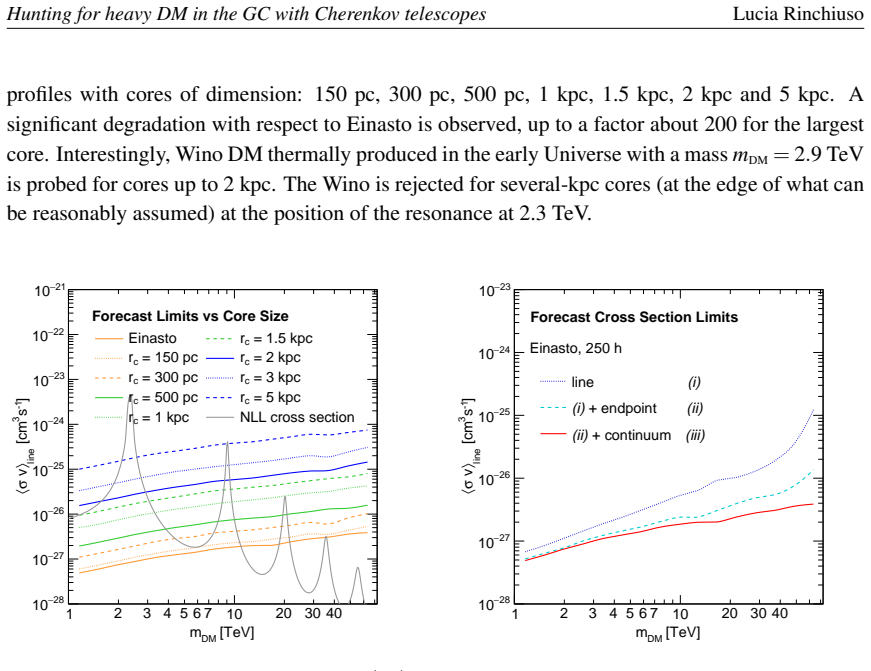
The paper's central claim is a set of forecast 95% C.L. upper limits on the wino annihilation cross section to line photons, $\langle\sigma v\rangle_{\rm line}$, as a function of wino mass from 1 to 70 TeV, for a mock 250-hour H.E.S.S.-I observation of the Galactic Center. Under the Einasto dark matter profile, the predicted thermal wino cross section lies above the forecast limits for masses up to about 10 TeV and near the ~20 TeV Sommerfeld resonance, so H.E.S.S.-I would rule out the wino over most of its relevant mass range. For cored halos the sensitivity degrades by up to a factor of about 200 at a 5 kpc core, yet the 2.9 TeV thermal wino is still excluded for core radii up to 2 kpc. The result depends on using the full next-to-leading-logarithmic resummed spectrum: adding the endpoint contribution improves the line-only limits by factors of 1.4 to 2.1, and the continuum emission improves them by a further 8% to 27% depending on the mass.
Load-bearing premise
The forecast stands or falls on the assumed dark matter density profile in the inner Galactic Center: the inner slope of a cuspy halo and the exact functional form and size of any core, with cored profiles reducing sensitivity by up to about 200 and the 2 kpc core claim depending on the specific parametrization chosen.
Editorial extensions
If this is right
- If the inner Milky Way halo follows the Einasto profile, a 250-hour H.E.S.S.-I observation of the Galactic Center would exclude the thermal wino as the dark matter for masses up to roughly 10 TeV and around the 20 TeV resonance.
- If the halo is cored, the 2.9 TeV thermal wino remains within reach as long as the core radius is no larger than about 2 kpc; a 5 kpc core weakens the limit by a factor of about 200.
- The endpoint and continuum components of the wino spectrum are not negligible corrections: they improve the line-only sensitivity by factors of 1.4 to 2.1 and a further 8% to 27%, respectively, depending on the wino mass.
- These forecasts probe the predicted thermal cross section of a canonical minimal dark matter candidate, so current ground-based Cherenkov arrays can meaningfully constrain TeV-scale thermal WIMP dark matter.
- The five-telescope H.E.S.S. II array, with its larger exposure, lower energy threshold, and inner Galaxy pointing strategy, is expected to improve on these limits still further.
Reading between the lines
- Because the endpoint and continuum contributions improve the limit by up to a factor of about two, previously published H.E.S.S. limits that used line-only spectra may be conservative; re-casting those data with the full spectrum could strengthen the existing cross-section bounds on heavy WIMPs by a similar factor.
- The roughly 200-fold swing in sensitivity between the Einasto profile and a 5 kpc core implies that any future Galactic Center annihilation signal would be highly degenerate between the annihilation cross section and the inner slope of the dark matter halo; a credible particle-physics interpretation would need an independent measurement of the J-factor.
- The same mock-analysis pipeline could be adapted to other heavy electroweak multiplets, such as the higgsino or a fermionic quintuplet, by replacing only the annihilation spectrum and cross section, producing comparable forecasts for the next generation of Cherenkov telescopes.
- A dynamical determination of the Milky Way's inner dark matter profile, for instance from stellar kinematics in the central kiloparsecs, would sharpen or overturn the headline claim: if the true core exceeds about 2 kpc, the thermal wino becomes much harder to exclude with H.E.S.S.-I alone.
Editorial analysis
A structured set of objections, weighed in public.
Referee Report
Summary. This ICRC2019 proceedings paper presents a mock analysis forecasting the sensitivity of the H.E.S.S.-I array to TeV-scale wino dark matter annihilating in the Galactic Center. The analysis combines the next-to-leading-logarithmic wino photon spectrum from Ref. [25] (line, endpoint, and continuum components) with H.E.S.S.-I instrument response functions, a 250-hour livetime, a two-dimensional Poisson likelihood, and a set of Einasto and cored dark matter density profiles. The headline result is that H.E.S.S.-I would set 95% C.L. upper limits on the line cross section that exclude the thermal wino at 2.9 TeV for Einasto profiles, reach wino masses up to about 10 TeV, and still exclude the 2.9 TeV thermal wino for cored profiles with core radii up to 2 kpc, despite a sensitivity degradation of up to a factor of about 200 for a 5 kpc core.
Significance. If the forecasts are correct, the paper provides a useful and timely estimate of the discovery and exclusion potential of an established IACT array for a canonical TeV-scale WIMP, incorporating state-of-the-art spectral theory. Its strengths are the use of a parameter-free NLL-resummed spectrum, including the recently computed endpoint contribution, rather than a phenomenological line-plus-continuum template, and the explicit decomposition of the sensitivity gain from the endpoint and continuum components (Fig. 2, right), which quantifies that the endpoint improves the limits by factors of 1.4-2.1 in the mass range shown. The treatment of cored profiles is also a useful sensitivity study that directly addresses a dominant astrophysical uncertainty. However, the quantitative conclusions are not yet fully supported because the mock background is not validated against the observed H.E.S.S. Galactic Center field and because the cored-profile parameterization is not specified; these issues are fixable but should be resolved before the forecast is used for scientific conclusions.
major comments (3)
- [Section 3.2] The residual background model is built only from cosmic-ray proton, helium, and electron spectra convolved with the H.E.S.S.-I IRFs and a 90% hadron-rejection factor, and it omits the astrophysical diffuse gamma-ray emission and unresolved sources that are present in the observed Galactic Center field. The paper does not validate this mock background by comparing the resulting expected limits with the observed 95% C.L. limits from Ref. [1] on the same 250-hour dataset. Because the upper limits on <sigma v>_line scale with the assumed background, an underestimated background would artificially strengthen the central claim that the thermal wino is excluded, including the marginal cored-profile cases. I request a concrete cross-check: reproduce the observed limit from Ref. [1] with the same likelihood, or add a template for the diffuse emission and show the change in the predicted limits.
- [Section 3.1, Eq. (3.2)] The cored density profiles are not specified as functions. Section 4 lists core radii from 150 pc to 5 kpc, and Section 3.1 states that the Einasto density ceases to increase below the core radius, but no formula is given for how the density is flattened or matched to Einasto. The J-factor is highly sensitive to this choice, with the paper quoting up to a factor of about 200 between Einasto and a 5 kpc core, so the headline claim that the 2.9 TeV thermal wino is excluded for cores up to 2 kpc depends on an unspecified interpolation. Please provide the explicit functional form used and test at least one alternative cored parameterization, for example a constant-density core or a Burkert-like profile, to demonstrate robustness of the 2 kpc statement.
- [Section 3.2] The two-dimensional Poisson likelihood is described only in words; the number of energy bins, the spatial binning after the exclusion regions, and the normalization of the background by the control region are not given. The numerical limits in Fig. 2 cannot be reproduced or independently checked without these details, and the paper also does not state how systematic uncertainties, for example on the IRFs or background normalization, enter the likelihood. Please provide the full likelihood and test-statistic definitions, including the binning and the nuisance-parameter treatment, or make explicit reference to a companion paper where these are given.
minor comments (5)
- [Section 3.2] The sentence 'the energy resolution is modeled as a Gaussian with with 0.1' contains a duplicated 'with' and should read 'with 0.1'.
- [Abstract and Section 1] H.E.S.S. is expanded as 'High Energy Spectroscopic System'; the correct expansion is 'High Energy Stereoscopic System'.
- [Figure 1, left panel] The legend entry 'enpoint + continuum' has a typo and should read 'endpoint + continuum'.
- [Section 4, first paragraph] The statement that H.E.S.S. 'can reject the Wino in most of the relevant DM mass range' overstates the results shown in Fig. 2, where the Einasto limit lies below the NLL cross section only for masses below about 10 TeV and near the resonance around 20 TeV; please rephrase to match the figure.
- [Section 5] The final sentence claims a further improvement with H.E.S.S.-II and the Inner Galaxy Survey, but this statement is not derived from the mock analysis presented here; please mark it explicitly as an outlook or support it with a forecast.
Circularity Check
No significant circularity: the mock forecast is built from external Wino spectra and detector/background models, and the predicted sensitivities are not fed back into any fitted input.
full rationale
The paper is explicitly a mock forecasting study: it combines a theoretical Wino annihilation spectrum and cross section, detector response models, and assumed cosmic-ray backgrounds to compute projected 95% C.L. upper limits on the annihilation cross section. The only notable self-citation is the use of the Wino spectrum from Baumgart et al. [25], whose author list overlaps with two of the present authors (Rodd and Slatyer). This does not constitute circularity: the cited spectrum calculation is a parameter-free field-theoretic result with stated assumptions (electroweak Sudakov resummation) that does not use, as input, the H.E.S.S. mock data or any quantity that this paper predicts. The forecast limits are obtained by convolving that external spectrum with H.E.S.S.-I IRFs and with background estimates derived from published cosmic-ray proton, helium, and electron spectra [32]; no parameter is fitted to the mock observations in a way that would make a later limit the same as a fitted input. The comparison of the computed upper limits with the thermal-relic cross section is likewise a straightforward ratio of two independently derived quantities. The absence of a validation against the observed H.E.S.S. Galactic Center background is a robustness or correctness concern, not a circular one: the background model could be inaccurate, but it is not constructed from the paper's own predictions. Overall, the derivation chain is self-contained and externally anchored, so the circularity score is 0.
Assumptions & free parameters
free parameters (1)
- DM density core radius (rc) =
Scanned over: 0 (Einasto), 150 pc, 300 pc, 500 pc, 1 kpc, 1.5 kpc, 2 kpc, 3 kpc, 5 kpc
assumptions (5)
- domain assumption Einasto DM density profile with alpha=0.17, rs=20 kpc, and rho(8.5 kpc)=0.39 GeV/cm^3
- ad hoc to paper Cored DM profiles are a one-parameter family that flattens the Einasto profile inside a core radius rc
- domain assumption The wino annihilation spectrum and cross-section from Baumgart et al. [25] are correct
- domain assumption Residual background consists of misidentified hadrons and electrons with spectra from [32], with a 90% hadron rejection efficiency
- standard math Poisson likelihood with a TS threshold of 2.71 for 95% C.L. limits
Cite this review
Pith. "Pith review of Hunting for heavy Dark Matter in the Galactic Center with ground-based Cherenkov telescopes." pith.science (2026). https://pith.science/paper/YFJAY4R2
@misc{pith2026190804317,
  author       = {Pith},
  title        = {Pith review of: Hunting for heavy Dark Matter in the Galactic Center with ground-based Cherenkov telescopes},
  year         = {2026},
  howpublished = {\url{https://pith.science/paper/YFJAY4R2}},
  note         = {Machine review of arXiv:1908.04317}
}
read the original abstract
A TeV scale electroweak particle is a well motivated candidate for the dark matter (DM) of our Universe. Yet such a particle may only be detectable using indirect detection instruments sensitive to TeV-scale gamma rays that can result from dark matter annihilations. We present a mock analysis of the sensitivity for the present ground-based Cherenkov telescope array H.E.S.S. (High Energy Spectroscopic System) to detect TeV scale DM in the Galactic Center region. The work combines next-to-leading-logarithmic order calculations for the annihilation photon spectrum, as well as a comprehensive treatment of detector effects and expected backgrounds. Forecast limits on the sensitivity of H.E.S.S. have been derived across the important TeV mass range, assuming different DM density profiles and focusing on the canonical WIMP dark matter candidate Wino.These limits test our present and future ability to probe the predicted thermal cross section for some of the most promising DM candidates that could be discovered in the coming decade.
Figures

Reference graph
Works this paper leans on
-
[25]
Baumgart et al., JHEP 1901 (2019) 036 [arXiv:1808.08956 [hep-ph]]
M. Baumgart et al., JHEP 1901 (2019) 036 [arXiv:1808.08956 [hep-ph]]
arXiv 2019
-
[1]
H. Abdallah et al. [HESS Collaboration], Phys. Rev. Lett. 120, no. 20, 201101 (2018) [arXiv:1805.05741 [astro-ph.HE]]
arXiv 2018
-
[2]
H. Abdallah et al. [H.E.S.S. Collaboration], Phys. Rev. Lett. 117, no. 11, 111301 (2016) [arXiv:1607.08142 [astro-ph.HE]]
arXiv 2016
-
[3]
M. Cirelli, N. Fornengo and A. Strumia, Nucl. Phys. B 753 (2006) 178 [hep-ph/0512090]
arXiv 2006
-
[4]
M. Cirelli, A. Strumia and M. Tamburini, Nucl. Phys. B 787 (2007) 152 [arXiv:0706.4071 [hep-ph]]
arXiv 2007
-
[5]
M. Cirelli, R. Franceschini and A. Strumia, Nucl. Phys. B 800 (2008) 204 [arXiv:0802.3378 [hep-ph]]
arXiv 2008
-
[6]
M. Cirelli and A. Strumia, New J. Phys. 11 (2009) 105005 [arXiv:0903.3381 [hep-ph]]
arXiv 2009
-
[7]
M. Cirelli, T. Hambye, P. Panci, F. Sala and M. Taoso, JCAP 1510 (2015) no.10, 026 [arXiv:1507.05519 [hep-ph]]
arXiv 2015
Show all 33 references
-
[8]
G. F. Giudice, M. A. Luty, H. Murayama and R. Rattazzi, JHEP 9812 (1998) 027 [hep-ph/9810442]
1998 arXiv
- [9]
-
[10]
Arkani-Hamed, A
N. Arkani-Hamed, A. Delgado and G. F. Giudice, Nucl. Phys. B 741 (2006) 108 [hep-ph/0601041]
2006 arXiv
-
[11]
Hisano, S
J. Hisano, S. Matsumoto, M. Nagai, O. Saito and M. Senami, Phys. Lett. B 646 (2007) 34 [hep-ph/0610249]
2007 arXiv
-
[12]
Hryczuk, R
A. Hryczuk, R. Iengo and P. Ullio, JHEP 1103 (2011) 069 [arXiv:1010.2172 [hep-ph]]
2011 arXiv
-
[13]
Beneke, A
M. Beneke, A. Bharucha, F. Dighera, C. Hellmann, A. Hryczuk, S. Recksiegel and P. Ruiz-Femenia, JHEP 1603 (2016) 119 [arXiv:1601.04718 [hep-ph]]
2016 arXiv
-
[14]
Hisano, S
J. Hisano, S. Matsumoto and M. M. Nojiri, Phys. Rev. Lett. 92 (2004) 031303 [hep-ph/0307216]
2004 arXiv
-
[15]
Hisano, S
J. Hisano, S. Matsumoto, M. M. Nojiri and O. Saito, Phys. Rev. D 71 (2005) 063528 [hep-ph/0412403]
2005 arXiv
-
[16]
Arkani-Hamed, D
N. Arkani-Hamed, D. P. Finkbeiner, T. R. Slatyer and N. Weiner, Phys. Rev. D 79 (2009) 015014 [arXiv:0810.0713 [hep-ph]]. 6 Hunting for heavy DM in the GC with Cherenkov telescopes Lucia Rinchiuso
2009 arXiv
-
[17]
Hryczuk and R
A. Hryczuk and R. Iengo, JHEP 1201 (2012) 163 Erratum: [JHEP 1206 (2012) 137] [arXiv:1111.2916 [hep-ph]]
2012 arXiv
-
[18]
Bauer, T
M. Bauer, T. Cohen, R. J. Hill and M. P. Solon, JHEP 1501, 099 (2015) [arXiv:1409.7392 [hep-ph]]
2015 arXiv
-
[19]
Ovanesyan, T
G. Ovanesyan, T. R. Slatyer and I. W. Stewart, Phys. Rev. Lett. 114 (2015) no.21, 211302 [arXiv:1409.8294 [hep-ph]]
2015 arXiv
-
[20]
Baumgart, I
M. Baumgart, I. Z. Rothstein and V . Vaidya, JHEP1504 (2015) 106 [arXiv:1412.8698 [hep-ph]]
2015 arXiv
-
[21]
Baumgart and V
M. Baumgart and V . Vaidya, JHEP1603 (2016) 213 [arXiv:1510.02470 [hep-ph]]
2016 arXiv
-
[22]
Ovanesyan, N
G. Ovanesyan, N. L. Rodd, T. R. Slatyer and I. W. Stewart, Phys. Rev. D 95 (2017) no.5, 055001 [arXiv:1612.04814 [hep-ph]]
2017 arXiv
-
[23]
Cirelli et al., JCAP 1103 (2011) 051 Erratum: [JCAP 1210 (2012) E01] [arXiv:1012.4515 [hep-ph]]
M. Cirelli et al., JCAP 1103 (2011) 051 Erratum: [JCAP 1210 (2012) E01] [arXiv:1012.4515 [hep-ph]]
2011 arXiv
-
[24]
Baumgart, T
M. Baumgart, T. Cohen, I. Moult, N. L. Rodd, T. R. Slatyer, M. P. Solon, I. W. Stewart and V . Vaidya, JHEP 1803 (2018) 117 [arXiv:1712.07656 [hep-ph]]
2018 arXiv
-
[26]
Einasto, Trudy Astrofizicheskogo Instituta Alma-Ata 5 (1965) 87
J. Einasto, Trudy Astrofizicheskogo Instituta Alma-Ata 5 (1965) 87
1965
-
[27]
Abramowski et al
A. Abramowski et al. [H.E.S.S. Collaboration], Phys. Rev. Lett. 106 (2011) 161301 [arXiv:1103.3266 [astro-ph.HE]]
2011 arXiv
-
[28]
Pieri, J
L. Pieri, J. Lavalle, G. Bertone and E. Branchini, Phys. Rev. D 83 (2011) 023518 [arXiv:0908.0195 [astro-ph.HE]]
2011 arXiv
-
[29]
Catena and P
R. Catena and P. Ullio, JCAP 1008 (2010) 004 [arXiv:0907.0018 [astro-ph.CO]]
2010 arXiv
-
[30]
T. K. Chan, D. Kereš, J. Oñorbe, P. F. Hopkins, A. L. Muratov, C.-A. Faucher-Giguère and E. Quataert, Mon. Not. Roy. Astron. Soc. 454 (2015) no.3, 2981 [arXiv:1507.02282 [astro-ph.GA]]
2015 arXiv
-
[31]
Mollitor, E
P. Mollitor, E. Nezri and R. Teyssier, Mon. Not. Roy. Astron. Soc. 447 (2015) no.2, 1353 [arXiv:1405.4318 [astro-ph.GA]]
2015 arXiv
-
[32]
BernlÃ˝ uhret al
K. BernlÃ˝ uhret al. [CTA Consortium], Astropart. Phys. 43 (2013) 171 [arXiv:1210.3503 [astro-ph.IM]]
2013 arXiv
-
[33]
Cowan, K
G. Cowan, K. Cranmer, E. Gross and O. Vitells, Eur. Phys. J. C 71, 1554 (2011) Erratum: [Eur. Phys. J. C 73, 2501 (2013)] [arXiv:1007.1727 [physics.data-an]]. 7
2011 arXiv
Reviewed August 14, 2026 · model on record in the stance chip above.
Discussion (0). Continue with ORCID to comment.