Nuclei in high-energy neutrino sources: A multimessenger study of in-source propagation
Pith reviewed 2026-06-26 07:49 UTC · model grok-4.3
The pith
Injected nuclear composition in sources like NGC 1068 imprints distinct features on neutrino and gamma-ray emissions.
A machine-rendered reading of the paper's core claim, the machinery that carries it, and where it could break.
Core claim
Monte Carlo modeling of in-source nuclear and electromagnetic cascades demonstrates that the injected nuclear composition leaves observable imprints on the emerging neutrino and gamma-ray spectra; these imprints are in principle constrainable by MeV-GeV gamma-ray observations with future instruments.
What carries the argument
Monte Carlo simulation of nuclear and electromagnetic cascades that tracks the propagation and interaction of injected nuclei inside a source with given size, density, and magnetic field.
If this is right
- Different injected nuclear species produce distinct neutrino spectral shapes and normalizations.
- The gamma-ray spectrum below 100 MeV carries additional information about the nuclear composition through cascade development.
- Future MeV-GeV gamma-ray telescopes can set quantitative limits on allowed nuclear compositions.
- Re-analysis of existing COMPTEL data already provides preliminary consistency checks on the modeled cascades.
Where Pith is reading between the lines
- The same simulation framework could be applied to other candidate neutrino sources to test whether composition effects are universal or environment-dependent.
- If composition can be constrained, it would indirectly limit the possible acceleration and injection mechanisms operating in dense astrophysical environments.
Load-bearing premise
The physical parameters chosen for the NGC 1068 source environment are representative enough that the simulated cascade imprints remain qualitatively valid for real sources.
What would settle it
A measured neutrino or MeV-GeV gamma-ray spectrum from NGC 1068 (or a similar source) that deviates substantially from all simulated spectra for plausible injected compositions would falsify the claim that composition imprints are observable and constraining.
Figures
read the original abstract
The joint observation of astrophysical sources in gamma rays and neutrinos can provide invaluable insight into the physical conditions of the source, including its size, particle densities, and acceleration and production mechanisms. In this work, we investigate the role of nuclear composition in high-energy astrophysical environments. Using NGC 1068 as a representative example, we perform detailed Monte Carlo simulations of nuclear and electromagnetic cascades within the source and study the imprints of the injected nuclear composition on the resulting neutrino and gamma-ray emissions. We further discuss the importance of MeV-GeV gamma-ray observations for constraining the source composition in the context of future gamma-ray experiments. A dedicated re-analysis of archival COMPTEL observations is also presented.
Editorial analysis
A structured set of objections, weighed in public.
Referee Report
Summary. The paper claims that Monte Carlo simulations of nuclear and electromagnetic cascades in NGC 1068 show that the injected nuclear composition leaves observable imprints on the resulting neutrino and gamma-ray spectra, which can be constrained by MeV-GeV gamma-ray observations from future experiments; it also presents a re-analysis of archival COMPTEL data.
Significance. If the composition-dependent imprints survive variations in source parameters, the work would strengthen the case for multimessenger constraints on the nuclear content of neutrino sources and highlight the diagnostic power of MeV-GeV gamma rays, complementing existing neutrino and high-energy gamma-ray data.
major comments (1)
- [NGC 1068 modeling and simulation setup] The simulations fix the NGC 1068 source radius, gas density, photon field, and magnetic-field strength without a systematic scan. Because photodisintegration, pair production, and synchrotron losses scale differently with these quantities, a factor-of-few change can shift the energy of composition-dependent features or suppress them; the absence of such a scan leaves the robustness of the reported imprints untested.
minor comments (1)
- The abstract states that a dedicated re-analysis of archival COMPTEL observations is presented; the methods, energy range, and quantitative results of this re-analysis should be described in more detail so readers can assess its impact on the composition constraints.
Simulated Author's Rebuttal
We thank the referee for their constructive feedback. We address the single major comment below.
read point-by-point responses
-
Referee: The simulations fix the NGC 1068 source radius, gas density, photon field, and magnetic-field strength without a systematic scan. Because photodisintegration, pair production, and synchrotron losses scale differently with these quantities, a factor-of-few change can shift the energy of composition-dependent features or suppress them; the absence of such a scan leaves the robustness of the reported imprints untested.
Authors: We agree that the lack of a parameter scan leaves the robustness of the reported imprints incompletely tested. The source parameters were fixed to representative values drawn from the multi-wavelength literature on NGC 1068. To address this concern, the revised manuscript will include a limited sensitivity study in which the radius, gas density, photon field, and magnetic-field strength are varied within their observational uncertainties. This will show that the qualitative composition-dependent features in the neutrino and gamma-ray spectra survive moderate changes, although their precise energies can shift. A full systematic scan is beyond the scope of the present work but the added analysis will strengthen the claims. revision: partial
Circularity Check
No circularity: simulation results grounded in standard cascade physics
full rationale
The paper conducts Monte Carlo simulations of nuclear and electromagnetic cascades in NGC 1068 using established models for photodisintegration, pair production, and synchrotron losses. The central claim—that injected nuclear composition produces observable imprints on neutrino and gamma-ray spectra—is a direct output of these forward simulations with fixed source parameters, not a fitted quantity or self-referential definition. No equations, predictions, or self-citations reduce the result to its inputs by construction, and the work remains self-contained against external benchmarks of cascade physics.
Axiom & Free-Parameter Ledger
free parameters (1)
- NGC 1068 source size, density, and magnetic field
axioms (1)
- domain assumption Standard Monte Carlo treatment of nuclear photodisintegration, pion production, and electromagnetic cascades
Reference graph
Works this paper leans on
-
[1]
This changes the nuclear composition during propagation and produces secondary fragments that may continue interacting in the source
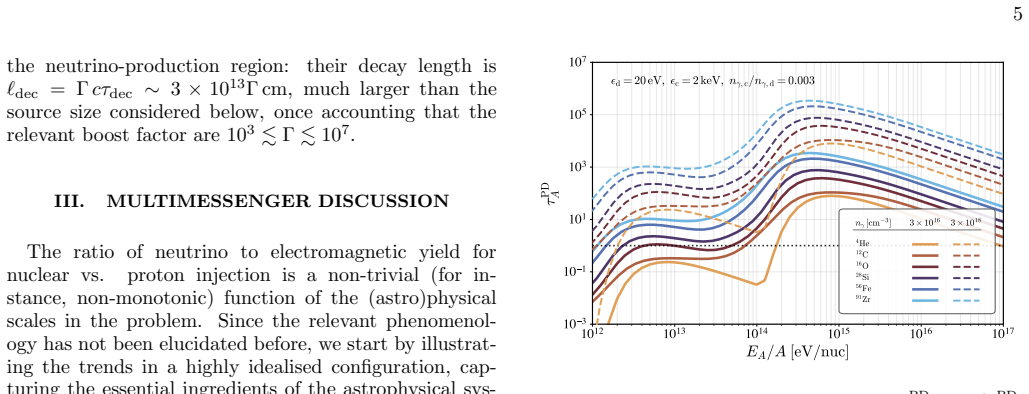
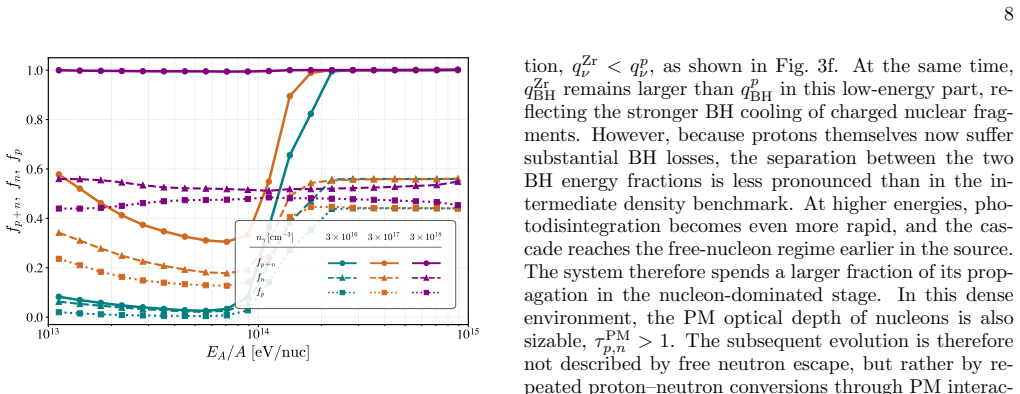
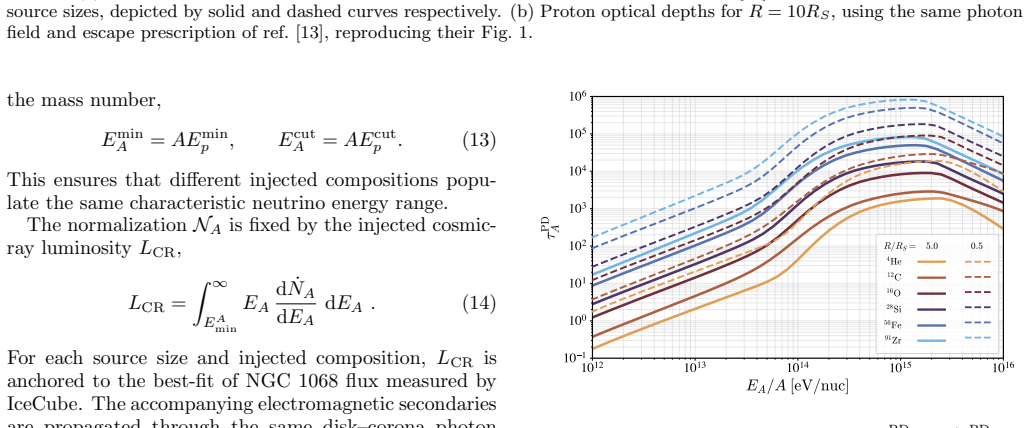
Photodisintegration (PD) A nucleus of mass numberAand chargeZcan be ex- cited by absorbing a background photon in its rest frame and de-excite by ejecting one or more photons, nucle- ons, or light nuclear fragments. This changes the nuclear composition during propagation and produces secondary fragments that may continue interacting in the source. In our ...
2023
-
[2]
Its interaction length is computed using the photonuclear cross section parametrization of Kossov [30]
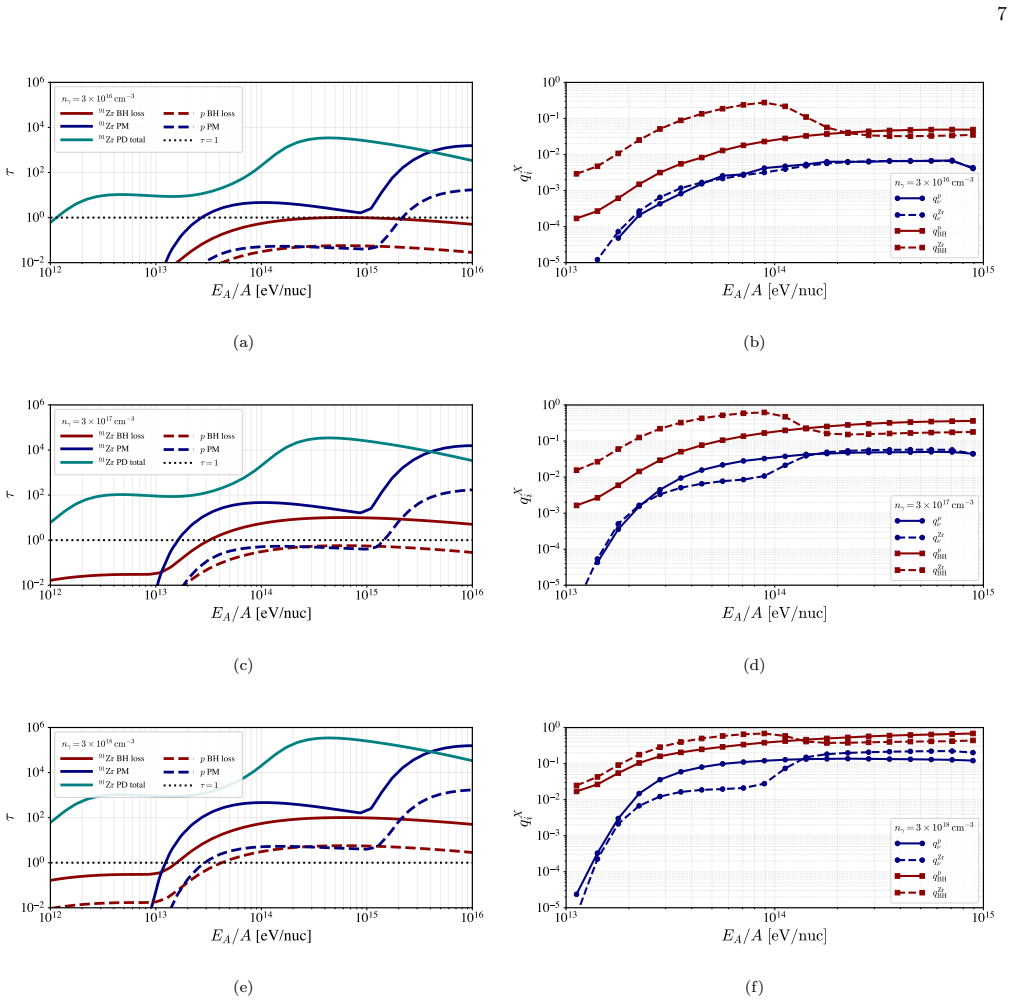
Photomeson (PM) Photomeson (PM) production is included as a discrete photonuclear channel. Its interaction length is computed using the photonuclear cross section parametrization of Kossov [30]. For nucleons, we use the corresponding nu- cleon fit. For nuclei, we use theA-dependent above-GDR part of the parametrization, retaining the quasi-deuteron, ∆-res...
-
[3]
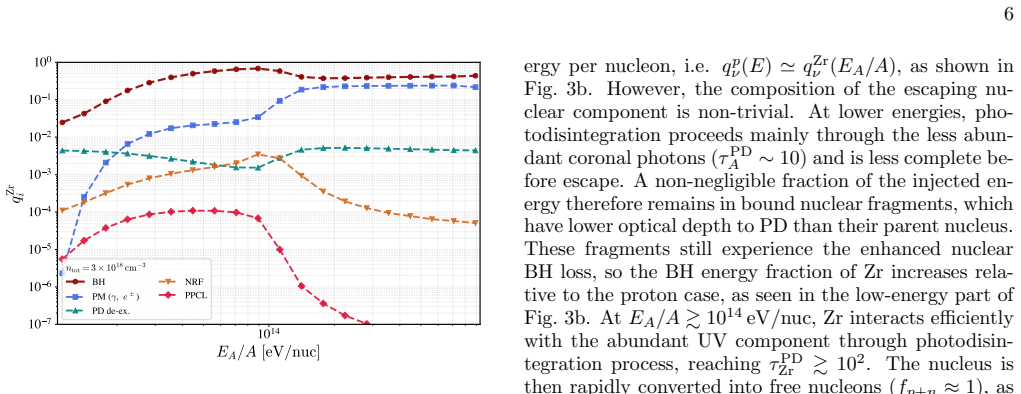
Bethe-Heitler (BH) Pair Production Bethe–Heitler (BH) pair production, AZ +γ→A Z +e + +e − ,(2) is included as a continuous energy-loss process for charged nuclei, using the cross section based on the 5 SOPHIA website 4 parametrization of ref. [34]. The nuclear species is left unchanged, while the producede ± pairs are injected into the electromagnetic ca...
-
[4]
Here we also include the capture into theLshell, which provides an additional source of line photons after the captured electron makes a transition to theKshell
Pair Production with Capture in the L shell Pair production with capture (PPC) is an analogue of the Bethe–Heitler pair production, with the final statee− captured directly into a bound atomic state with quan- tum numbersnℓj, AZ +γ→A Z(e− nℓj) +e + .(3) PPC has been discussed in the context of charge-state evolution of ultra-high-energy nuclei in photon b...
-
[5]
fractional energy
Nuclear Decay Nuclear beta decays are included in the propagation menu for completeness. The decay lengths are computed from tabulated rest-frame partial beta-decay rates, de- rived from the IAEA LiveChart database [37] for the same set of 1989 isotopes used in the TALYS/TENDL photodisintegration network. Since the propagated nu- clei are bare, electron-c...
1989
-
[6]
M. G. Aartsenet al.(IceCube), Science342, 1242856 (2013), arXiv:1311.5238 [astro-ph.HE]
Pith/arXiv arXiv 2013
-
[7]
M. G. Aartsenet al.(IceCube), Phys. Rev. Lett.111, 021103 (2013), arXiv:1304.5356 [astro-ph.HE]
Pith/arXiv arXiv 2013
-
[8]
M. G. Aartsenet al.(IceCube), Phys. Rev. Lett.115, 081102 (2015), arXiv:1507.04005 [astro-ph.HE]
Pith/arXiv arXiv 2015
-
[9]
S. R. Kelner, F. A. Aharonian, and V. V. Bugayov, Phys. Rev. D74, 034018 (2006), [Erratum: Phys.Rev.D 79, 039901 (2009)], arXiv:astro-ph/0606058
Pith/arXiv arXiv 2006
-
[10]
T. Kamae, N. Karlsson, T. Mizuno, T. Abe, and T. Koi, Astrophys. J.647, 692 (2006), [Erratum: Astrophys.J. 662, 779 (2007)], arXiv:astro-ph/0605581
Pith/arXiv arXiv 2006
-
[11]
C. D. Dermer, Astronomy & Astrophysics157, 223 (1986)
1986
-
[12]
K. Murase, M. Ahlers, and B. C. Lacki, Phys. Rev. D 88, 121301 (2013), arXiv:1306.3417 [astro-ph.HE]
Pith/arXiv arXiv 2013
-
[13]
K. Murase, D. Guetta, and M. Ahlers, Phys. Rev. Lett. 116, 071101 (2016), arXiv:1509.00805 [astro-ph.HE]
Pith/arXiv arXiv 2016
-
[14]
A. Capanema, A. Esmaili, and K. Murase, Phys. Rev. D101, 103012 (2020), arXiv:2002.07192 [hep-ph]
arXiv 2020
-
[15]
A. Capanema, A. Esmaili, and P. D. Serpico, JCAP02, 037 (2021), arXiv:2007.07911 [hep-ph]
arXiv 2021
-
[16]
K. Fang, J. S. Gallagher, and F. Halzen, Astrophys. J. 933, 190 (2022), arXiv:2205.03740 [astro-ph.HE]
arXiv 2022
-
[17]
Abbasiet al.(IceCube), Science378, 538 (2022), arXiv:2211.09972 [astro-ph.HE]
R. Abbasiet al.(IceCube), Science378, 538 (2022), arXiv:2211.09972 [astro-ph.HE]
arXiv 2022
-
[18]
A. Das, B. T. Zhang, and K. Murase, Astrophys. J.972, 44 (2024), arXiv:2405.09332 [astro-ph.HE]
arXiv 2024
-
[19]
A. Das, K. Murase, and B. T. Zhang, (2026), arXiv:2604.01222 [astro-ph.HE]
arXiv 2026
-
[20]
G. R. Farrar, Phys. Rev. Lett.134, 081003 (2025), arXiv:2405.12004 [astro-ph.HE]
arXiv 2025
-
[21]
B. T. Zhang, K. Murase, N. Ekanger, M. Bhattacharya, and S. Horiuchi, (2024), arXiv:2405.17409 [astro-ph.HE]
Pith/arXiv arXiv 2024
-
[22]
M. Unger, G. R. Farrar, and L. A. Anchordoqui, Phys. Rev. D92, 123001 (2015), arXiv:1505.02153 [astro- ph.HE]
Pith/arXiv arXiv 2015
-
[23]
M. S. Muzio, M. Unger, and G. R. Farrar, Phys. Rev. D 100, 103008 (2019), arXiv:1906.06233 [astro-ph.HE]
arXiv 2019
-
[24]
M. S. Muzio, G. R. Farrar, and M. Unger, Phys. Rev. D 105, 023022 (2022), arXiv:2108.05512 [astro-ph.HE]
arXiv 2022
-
[25]
D. Boncioli, A. Fedynitch, and W. Winter, Sci. Rep.7, 4882 (2017), arXiv:1607.07989 [astro-ph.HE]
Pith/arXiv arXiv 2017
-
[26]
D. Biehl, D. Boncioli, A. Fedynitch, and W. Winter, Astron. Astrophys.611, A101 (2018), arXiv:1705.08909 [astro-ph.HE]
Pith/arXiv arXiv 2018
-
[27]
B. T. Zhang and K. Murase, Mon. Not. Roy. Astron. Soc. 524, 76 (2023), arXiv:2302.14048 [astro-ph.HE]
arXiv 2023
-
[28]
A. Esmaeili, A. Esmaili, and P. D. Serpico, Phys. Rev. D111, 043004 (2025), arXiv:2410.11958 [hep-ph]
arXiv 2025
-
[29]
A. Esmaeili, A. Capanema, A. Esmaili, and P. D. Ser- pico, Phys. Rev. D106, 123016 (2022), arXiv:2208.06440 [hep-ph]
arXiv 2022
-
[30]
A. Esmaeili, A. Esmaili, and P. D. Serpico, Comput. Phys. Commun.299, 109154 (2024), arXiv:2310.01510 [hep-ph]
arXiv 2024
-
[31]
A. J. Koning, D. Rochman, J. C. Sublet, N. Dzysiuk, M. Fleming, and S. van der Marck, Nucl. Data Sheets 155, 1 (2019)
2019
-
[32]
Koning, S
A. Koning, S. Hilaire, and S. Goriely, Eur. Phys. J. A 59, 131 (2023), [Erratum: Eur.Phys.J.A 59, 146 (2023)]
2023
-
[33]
N. Ekanger, M. Bhattacharya, K. Murase, and S. Hori- uchi, (2026), arXiv:2603.06381 [astro-ph.HE]
arXiv 2026
-
[34]
J. F. Soriano, L. A. Anchordoqui, and D. F. Torres, Phys. Rev. D98, 043001 (2018), arXiv:1805.00409 [astro- ph.HE]. 15
Pith/arXiv arXiv 2018
-
[35]
Kossov, Eur
M.V. Kossov, Eur. Phys. J. A14, 377 (2002)
2002
-
[36]
H. Ishida, M. Kusakabe, and H. Okada, Phys. Rev. D 90, 083519 (2014), arXiv:1403.5995 [astro-ph.CO]
Pith/arXiv arXiv 2014
-
[37]
K. Murase and J. F. Beacom, Phys. Rev. D82, 043008 (2010), arXiv:1002.3980 [astro-ph.HE]
Pith/arXiv arXiv 2010
-
[38]
A. Mucke, R. Engel, J. P. Rachen, R. J. Protheroe, and T. Stanev, Comput. Phys. Commun.124, 290 (2000), arXiv:astro-ph/9903478
Pith/arXiv arXiv 2000
-
[39]
M. J. Chodorowski, A. A. Zdziarski, and M. Sikora, Astrophys. J.400, 181 (1992)
1992
-
[40]
S. R. Kelner and F. A. Aharonian, Phys. Rev. D 78, 034013 (2008), [Erratum: Phys.Rev.D 82, 099901 (2010)], arXiv:0803.0688 [astro-ph]
Pith/arXiv arXiv 2008
-
[41]
C. K. Agger and A. H. Sorensen, Phys. Rev. A55, 402 (1997)
1997
-
[42]
LiveChart of the Nu- clides,
IAEA Nuclear Data Section, “LiveChart of the Nu- clides,”https://nds.iaea.org/relnsd/vcharthtml /VChartHTML.html, accessed: 2026-04-28
2026
- [43]
-
[44]
V. A. Acciariet al.(MAGIC), Astrophys. J.883, 135 (2019), arXiv:1906.10954 [astro-ph.HE]
arXiv 2019
-
[45]
Schoenfelder (COMPTEL), Astron
V. Schoenfelder (COMPTEL), Astron. Astrophys. Suppl. Ser.143, 145 (2000), arXiv:astro-ph/0002366
Pith/arXiv arXiv 2000
-
[46]
J. Kn¨ odlsederet al., Astron. Astrophys.593, A1 (2016), arXiv:1606.00393 [astro-ph.IM]
Pith/arXiv arXiv 2016
-
[47]
J. A. Tomsicket al., PoSICRC2023, 745 (2023), arXiv:2308.12362 [astro-ph.HE]
arXiv 2023
-
[48]
R. Caputoet al., J. Astron. Telesc. Instrum. Syst.8, 044003 (2022), arXiv:2208.04990 [astro-ph.IM]
arXiv 2022
-
[49]
De Angeliset al.(e-ASTROGAM), Exper
A. De Angeliset al.(e-ASTROGAM), Exper. Astron. 44, 25 (2017), arXiv:1611.02232 [astro-ph.HE]
Pith/arXiv arXiv 2017
discussion (0)
Sign in with ORCID, Apple, or X to comment. Anyone can read and Pith papers without signing in.