UV/IR mixing as an artifact of non-covariant quantisation
Pith reviewed 2026-06-27 00:06 UTC · model grok-4.3
The pith
UV/IR mixing in noncommutative scalar fields is an artifact of quantization that breaks deformed Poincaré symmetry.
A machine-rendered reading of the paper's core claim, the machinery that carries it, and where it could break.
Core claim
In the models considered, the UV/IR mixing is an artifact of a quantisation that breaks the deformed symmetry rather than a feature of noncommutativity itself. The procedure depends on the choice of noncommutative functional derivative, and two natural choices are isolated, distinguished by the space in which the Leibniz rule remains undeformed. The first, which carries the undeformed statistics, reproduces the standard scheme and yields n-point functions that break the deformed Poincaré covariance and exhibit the UV/IR mixing. The second, which adapts the functional calculus to the braided statistics, yields covariant n-point functions free of this mixing. Covariance is fixed by the quantis
What carries the argument
The choice between a noncommutative functional derivative that preserves undeformed statistics versus one that adapts to braided statistics.
If this is right
- Covariant n-point functions without UV/IR mixing follow when the functional derivative is chosen to adapt to braided statistics.
- The covariance of the n-point functions is controlled by the quantization scheme while finiteness is controlled separately by the propagator.
- The same conclusions hold for the T-Minkowski models, the Euclidean three-dimensional quantum gravity model, and the quantum two-sphere.
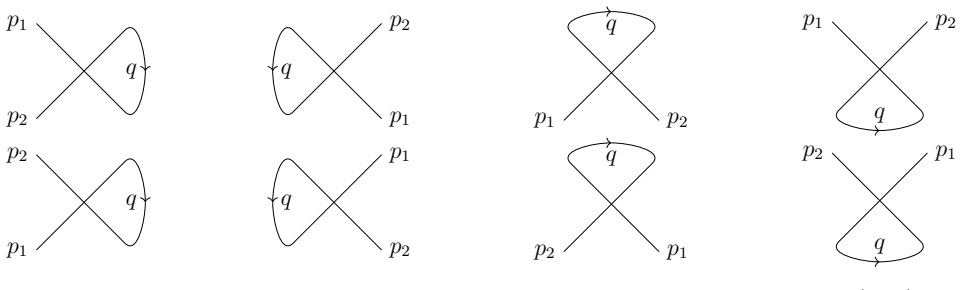
- Both covariance breaking and UV/IR mixing originate from the intertwining of external and loop momenta in non-planar diagrams.
Where Pith is reading between the lines
- The same separation between covariance and finiteness may allow previous calculations in other noncommutative models to be revisited with the symmetry-preserving derivative.
- The braided-statistics choice could connect the path-integral approach to existing treatments of deformed symmetries in quantum gravity models.
- If the distinction between the two functional derivatives survives in interacting theories, it would separate the question of symmetry preservation from the question of ultraviolet finiteness.
Load-bearing premise
That there exist two distinct natural choices of noncommutative functional derivative, one of which preserves the deformed symmetry.
What would settle it
An explicit loop calculation in a T-Minkowski model or the three-dimensional quantum gravity model that uses the braided-statistics derivative and still produces UV/IR mixing in the n-point functions.
Figures

read the original abstract
We study the path integral quantisation of a scalar field on a generic noncommutative deformation of Minkowski space, built as a quantum homogeneous space of a deformed Poincar\'e group. We show that the procedure depends on the choice of noncommutative functional derivative, and we isolate two natural choices, distinguished by the space in which the Leibniz rule remains undeformed. The first, which carries the undeformed statistics, reproduces the standard scheme and yields n-point functions that break the deformed Poincar\'e covariance and exhibit the UV/IR mixing of [8]. The second, which adapts the functional calculus to the braided statistics of the fields in the spirit of [20], yields covariant n-point functions free of this mixing. We trace both the covariance breaking and the mixing to a single source, the intertwining of external and loop momenta in the non-planar contributions, and conclude that, in the models considered, the UV/IR mixing of [8] is an artifact of a quantisation that breaks the deformed symmetry rather than a feature of noncommutativity itself. We further disentangle covariance, fixed by the quantisation scheme, from finiteness, fixed independently by the propagator, and illustrate the formalism on the T-Minkowski models, the Euclidean three-dimensional quantum gravity model, and the quantum two-sphere.
Editorial analysis
A structured set of objections, weighed in public.
Referee Report
Summary. The manuscript studies path-integral quantization of a scalar field on a generic noncommutative deformation of Minkowski space realized as a quantum homogeneous space of a deformed Poincaré group. It isolates two choices of noncommutative functional derivative, distinguished by whether the Leibniz rule remains undeformed. The first choice reproduces the standard scheme, yields n-point functions that break deformed Poincaré covariance, and reproduces the UV/IR mixing of reference [8]. The second choice adapts the functional calculus to braided statistics and produces covariant n-point functions without this mixing. Both the covariance violation and the mixing are traced to the intertwining of external and loop momenta in non-planar diagrams. The paper concludes that the UV/IR mixing of [8] is an artifact of a quantization that breaks the deformed symmetry rather than an intrinsic feature of noncommutativity, and it separates covariance (fixed by the quantization scheme) from finiteness (fixed by the propagator). Concrete illustrations are provided for the T-Minkowski models, the Euclidean three-dimensional quantum gravity model, and the quantum two-sphere.
Significance. If the central claim holds, the work would clarify a persistent issue in noncommutative QFT by showing that UV/IR mixing can be eliminated once the quantization preserves the deformed symmetry. The explicit separation of covariance from finiteness, together with the concrete calculations on three distinct models, would be a useful contribution. The manuscript gives credit to the braided-statistics approach of [20] and supplies model-specific illustrations that could serve as benchmarks for future work.
major comments (2)
- [Section introducing the functional derivatives] The two natural choices of functional derivative are introduced solely by whether the Leibniz rule remains undeformed in the algebra of fields or the dual algebra of momenta; no derivation of this distinction from the coaction of the deformed Poincaré group, the definition of the path-integral measure, or the quantum homogeneous space structure is supplied. This modeling choice is load-bearing for the classification of all prior results as non-covariant.
- [Section on n-point functions and covariance restoration] The claim that the braided-statistics choice yields covariant n-point functions free of UV/IR mixing rests on the assertion that the intertwining of external and loop momenta is eliminated, yet the manuscript does not exhibit explicit expressions for the n-point functions or the non-planar diagrams that would allow verification of this cancellation.
minor comments (2)
- [Abstract] The abstract refers to reference [8] for the original UV/IR mixing result; the bibliography entry should be expanded with full publication details for reader convenience.
- [Throughout] Notation for the two functional derivatives (e.g., symbols distinguishing the undeformed-Leibniz versus braided versions) should be introduced once and used consistently throughout the text to improve readability.
Simulated Author's Rebuttal
We thank the referee for the careful reading and constructive comments. We address each major comment below.
read point-by-point responses
-
Referee: [Section introducing the functional derivatives] The two natural choices of functional derivative are introduced solely by whether the Leibniz rule remains undeformed in the algebra of fields or the dual algebra of momenta; no derivation of this distinction from the coaction of the deformed Poincaré group, the definition of the path-integral measure, or the quantum homogeneous space structure is supplied. This modeling choice is load-bearing for the classification of all prior results as non-covariant.
Authors: The distinction is motivated by the braided statistics of the fields under the coaction of the deformed Poincaré group on the quantum homogeneous space, following the approach of reference [20]. The undeformed Leibniz rule corresponds to the standard quantization that violates covariance, while the braided choice preserves it. We will add a concise derivation linking the choices explicitly to the coaction in the revised manuscript. revision: partial
-
Referee: [Section on n-point functions and covariance restoration] The claim that the braided-statistics choice yields covariant n-point functions free of UV/IR mixing rests on the assertion that the intertwining of external and loop momenta is eliminated, yet the manuscript does not exhibit explicit expressions for the n-point functions or the non-planar diagrams that would allow verification of this cancellation.
Authors: The general mechanism traces covariance breaking and UV/IR mixing to momentum intertwining in non-planar diagrams. Explicit support is given via the concrete calculations on the T-Minkowski models, Euclidean 3D quantum gravity, and quantum two-sphere. We will include additional explicit expressions for the non-planar diagrams in the revision to allow direct verification. revision: yes
Circularity Check
No significant circularity; explicit comparison of two defined quantisation schemes
full rationale
The paper isolates two functional derivative choices by the location where the Leibniz rule remains undeformed, then explicitly computes the resulting n-point functions and traces the presence or absence of UV/IR mixing to the intertwining of external and loop momenta in non-planar terms under each choice. This constitutes a direct side-by-side evaluation of the consequences of each scheme rather than any reduction of the output to the input by definition, fitting, or self-citation chain. The distinction is introduced as two natural options within the paper's framework, with the central claim following from the explicit calculation of covariance breaking in one case; no load-bearing step equates a prediction to a fitted parameter or renames a prior result as a derivation.
Axiom & Free-Parameter Ledger
axioms (2)
- domain assumption Path integral quantization is well-defined on quantum homogeneous spaces of a deformed Poincaré group.
- ad hoc to paper There exist two natural choices of noncommutative functional derivative distinguished by whether the Leibniz rule remains undeformed.
Reference graph
Works this paper leans on
-
[1]
Quantized space-time
H. S. Snyder, “Quantized space-time”, Phys. Rev.71(1947) 38-41
1947
-
[2]
Quantum Field Theory on Noncommutative Spaces
R. J. Szabo, “Quantum Field Theory on Noncommutative Spaces”, Phys. Rep.378(2003) 207-299, arXiv:hep-th/0109162
Pith/arXiv arXiv 2003
-
[3]
The quantum structure of space–time at the Planck scale and quantum fields
S. Doplicher, K. Fredenhagen and J. E. Roberts, “The quantum structure of space–time at the Planck scale and quantum fields”, Comm. Math. Phys.172(1995) 187, arXiv:hep-th/0303037
Pith/arXiv arXiv 1995
-
[4]
Quantum gravity phenomenology at the dawn of the multi-messenger era - A review
A.Addaziet al., “Quantum gravity phenomenology at the dawn of the multi-messenger era - A review”, Prog. Part. Nuc. Phys.125(2022) 103948, arXiv:2111.05659
arXiv 2022
-
[5]
Ponzano-Regge model revisited III: Feynman diagrams and Effective field theory
L. Freidel and E. R. Livine, “Ponzano-Regge model revisited III: Feynman diagrams and Effective field theory”, Class. Quant. Grav.23(2006) 2021-2062, arXiv:hep-th/0502106. 63
Pith/arXiv arXiv 2006
-
[6]
Onq-regularization
S. Majid, “Onq-regularization”, Int. Jour. Mod. Phys. A5(1990) 4689-4696
1990
-
[7]
Untwisting NoncommutativeR d and the Equivalence of Quantum Field Theories
R. Oeckl, “Untwisting NoncommutativeR d and the Equivalence of Quantum Field Theories”, Nuc. Phys. B581(2000) 559-574, arXiv:hep-th/0003018
Pith/arXiv arXiv 2000
-
[8]
Noncommutative perturbative dynamics
S. Minwalla, M. Van Raamsdonk and N. Seiberg, “Noncommutative perturbative dynamics”, JHEP 02(2000) 20, arXiv:hep-th/9912072
Pith/arXiv arXiv 2000
-
[9]
The IR/UV Connection in the Non-Commutative Gauge Theories
A. Matusis, L. Susskind and N. Toumbas, “The IR/UV Connection in the Non-Commutative Gauge Theories”, JHEP12(2000) 002, arXiv:hep-th/0002075
Pith/arXiv arXiv 2000
-
[10]
Onκ-deformation and UV/IR mixing
H. Grosse and M. Wohlgenannt, “Onκ-deformation and UV/IR mixing”, Nuc. Phys. B748(2006) 473-484, arXiv:hep-th/0507030
Pith/arXiv arXiv 2006
-
[11]
Noncommutative field theory from angular twist
M. Dimitrijević Ćirić, N. Konjik, M. A. Kurkov, F. Lizzi and P. Vitale, “Noncommutative field theory from angular twist”, Phys. Rev. D98(2018) 085011, arXiv:1806.06678
Pith/arXiv arXiv 2018
-
[14]
Cancellation of soft and collinear divergences in noncommutative QED
B. Mirza and M. Zarei, “Cancellation of soft and collinear divergences in noncommutative QED”, Phys. Rev. D74(2006), arXiv:hep-th/0609181
Pith/arXiv arXiv 2006
-
[15]
A. Jafar Salim and N. Sadooghi, “Dynamics of the O(N) model in a strong magnetic background field as a modified noncommutative field theory”, Phys. Rev. D73(2006), arXiv:hep-th/0602023
Pith/arXiv arXiv 2006
-
[16]
High energy improved scalar quantum field theory from noncom- mutative geometry without UV/IR-mixing
A. Schenkel and C. F. Uhlemann, “High energy improved scalar quantum field theory from noncom- mutative geometry without UV/IR-mixing”, Phys. Lett. B694(2010) 258-260, arXiv:1002.4191
Pith/arXiv arXiv 2010
-
[17]
On the UV/IR mixing of Lie algebra-type noncommutatitiveϕ4-theories
K. Hersent, “On the UV/IR mixing of Lie algebra-type noncommutatitiveϕ4-theories”, JHEP2024 (2024) 23, arXiv:2309.08917
arXiv 2024
-
[18]
IR dynamics from UV divergences: UV/IR mixing, NCFT, and the hierarchy problem
N. Craig and S. Koren, “IR dynamics from UV divergences: UV/IR mixing, NCFT, and the hierarchy problem”, JHEP2020(2020), arXiv:1909.01365
arXiv 2020
-
[19]
Emergent gravity from noncommutative gauge theory
H. Steinacker, “Emergent gravity from noncommutative gauge theory”, JHEP2007(2007) 049, arXiv:0708.2426
Pith/arXiv arXiv 2007
-
[20]
R. Oeckl, “Braided Quantum Field Theory”, Comm. Math. Phys.217(2001) 451-473, arXiv:hep- th/9906225
arXiv 2001
-
[21]
Braided Quantum Electrodynam- ics
M. Dimitrijević Ćirić, N. Konjik, V. Radovanović and R. J. Szabo, “Braided Quantum Electrodynam- ics”, JHEP2023(2023) 211, arXiv:2302.10713
arXiv 2023
-
[22]
Braided scalar quantum field theory
D. Bogdanović, M. Dimitrijević Ćirić, V. Radovanović, R. J. Szabo and G. Trojani, “Braided scalar quantum field theory”, arXiv preprint (2024), arXiv:2406.02372
arXiv 2024
-
[23]
Braided Scalar Quantum Electrodynamics
M. Dimitrijević Ćirić, N. Konjik, V. Radovanović, R. J. Szabo and G. Trojani, “Braided Scalar Quantum Electrodynamics”, arXiv preprint (2024), arXiv:2408.14583
arXiv 2024
-
[24]
Covariant quantization of field theories on T-Minkowski noncommutative spacetimes
G. Fabiano and F. Mercati, “Covariant quantization of field theories on T-Minkowski noncommutative spacetimes”, arXiv preprint (2025), arXiv:2508.04527
arXiv 2025
-
[25]
T-Minkowski noncommutative spacetimes I: Poincaré groups, differential calculi and braiding
F. Mercati, “T-Minkowski noncommutative spacetimes I: Poincaré groups, differential calculi and braiding”, Progress of Theoretical and Experimental Physics2024(2024) 7, arXiv:2311.16249
arXiv 2024
-
[26]
Gauge theories on quantum spaces
K. Hersent, P. Mathieu and J.-C. Wallet, “Gauge theories on quantum spaces”, Phys. Rep.1014 (2023) 1-83, arXiv:2210.11890
arXiv 2023
-
[27]
A Gravity Theory on Noncommutative Spaces
P. Aschieri, C. Blohmann, M. Dimitrijević, F. Meyer, P. Schupp and J. Wess, “A Gravity Theory on Noncommutative Spaces”, Class. Quant. Grav.22(2005) 3511-3522, arXiv:hep-th/0504183. 64
Pith/arXiv arXiv 2005
-
[28]
q-deformation of Poincaré algebra
J. Lukierski, A. Nowicki, H. Ruegg and V. N. Tolstoy, “q-deformation of Poincaré algebra”, Phys. Lett. B264(1991) 331-338
1991
-
[29]
Bicrossproduct structure ofκ-Poincare group and non-commutative geome- try
S. Majid and H. Ruegg, “Bicrossproduct structure ofκ-Poincare group and non-commutative geome- try”, Phys. Lett. B334(1994) 348-354, arXiv:hep-th/9405107
Pith/arXiv arXiv 1994
-
[30]
Quantum groups and their representations
A. Klimyk and K. Schmüdgen, “Quantum groups and their representations”, Springer Science & Business Media (1997)
1997
-
[31]
T-Minkowski noncommutative spacetimes II: classical field theory
F. Mercati, “T-Minkowski noncommutative spacetimes II: classical field theory”, Prog. Theor. and Exp. Phys.2024(2024) 123B05, arXiv:2404.08729
arXiv 2024
-
[32]
κ-Poincaré invariant quantum field theories with KMS weight
T. Poulain and J.-C. Wallet, “κ-Poincaré invariant quantum field theories with KMS weight”, Phys. Rev. D98(2018) 025002, arXiv:1801.02715
Pith/arXiv arXiv 2018
-
[33]
Pauli-Jordan function and scalar field quantization inκ-Minkowski non- commutative spacetime
F. Mercati and M. Sergola, “Pauli-Jordan function and scalar field quantization inκ-Minkowski non- commutative spacetime”, Phys. Rev. D98(2018) 045017, arXiv:1801.01765
Pith/arXiv arXiv 2018
-
[34]
LocalD= 4Field Theory onκ-Deformed Minkowski Space
P. Kosiński, J. Lukierski and P. Maślanka, “LocalD= 4Field Theory onκ-Deformed Minkowski Space”, Phys. Rev. D62(2000) 025004, arXiv:hep-th/9902037
Pith/arXiv arXiv 2000
-
[35]
Principles of harmonic analysis
A. Dietmar and S. Echterhoff, “Principles of harmonic analysis”, Springer (2014)
2014
-
[36]
Generalized Weyl Systems andκ-Minkowski space
A. Agostini, F. Lizzi and A. Zampini, “Generalized Weyl Systems andκ-Minkowski space”, Mod. Phys. Lett. A17(2002) 2105-2126, arXiv:hep-th/0209174
Pith/arXiv arXiv 2002
-
[37]
Topological Vector Spaces, Distributions and Kernels: Pure and Applied Mathematics
F. Treves, “Topological Vector Spaces, Distributions and Kernels: Pure and Applied Mathematics”, Elsevier25(1967)
1967
-
[38]
G. Fiore and J. Wess, “On "full" twisted Poincare’ symmetry and QFT on Moyal-Weyl spaces”, Phys. Rev. D75(2007) 105022, arXiv:hep-th/0701078
Pith/arXiv arXiv 2007
-
[39]
Foundations of Quantum Group Theory
S. Majid, “Foundations of Quantum Group Theory”, Cambridge University Press (1995)
1995
-
[40]
κ-Poincaré-comodules, Braided Tensor Products and Noncommutative Quan- tum Field Theory
F.Lizzi andF. Mercati, “κ-Poincaré-comodules, Braided Tensor Products and Noncommutative Quan- tum Field Theory”, Phys. Rev. D103(2021) 126009, arXiv:2101.09683
arXiv 2021
-
[41]
Multiparticle states in braided lightlikeκ-Minkowski noncommutative QFT
G. Fabiano and F. Mercati, “Multiparticle states in braided lightlikeκ-Minkowski noncommutative QFT”, Phys. Rev. D109(2024) 046011, arXiv:2310.15063
arXiv 2024
-
[42]
Then-dimensionalκ-Poincaré algebra and group
P. Maślanka, “Then-dimensionalκ-Poincaré algebra and group”, Jour. Phys. A26(1993) L1251
1993
-
[43]
Quantum particles in non-commutative space-time: an identity crisis
M. Arzano and J. Kowalski-Glikman, “Quantum particles in non-commutative space-time: an identity crisis”, Phys. Rev. D107(2023) 065001, arXiv:2212.03703
arXiv 2023
-
[44]
Power-counting theorem for non-local matrix models and renormali- sation
H. Grosse and R. Wulkenhaar, “Power-counting theorem for non-local matrix models and renormali- sation”, Comm. Math. Phys.254(2005) 91-127, arXiv:hep-th/0305066
Pith/arXiv arXiv 2005
-
[45]
Renormalisation ofφ4-theory on noncommutativeR2 in the matrix base
H. Grosse and R. Wulkenhaar, “Renormalisation ofφ4-theory on noncommutativeR2 in the matrix base”, JHEP0312(2003) 019, arXiv:hep-th/0307017
Pith/arXiv arXiv 2003
-
[46]
Renormalisation ofφ4-theory on noncommutativeR4 in the matrix base
H. Grosse and R. Wulkenhaar, “Renormalisation ofφ4-theory on noncommutativeR4 in the matrix base”, Comm. Math. Phys.256(2005) 305-374, arXiv:hep-th/0401128
Pith/arXiv arXiv 2005
-
[47]
A translation-invariant renormalizable non- commutative scalar model
R. Gurau, J. Magnen, V. Rivasseau and A. Tanasa, “A translation-invariant renormalizable non- commutative scalar model”, Comm. Math. Phys.287(2009) 275-290, arXiv:0802.0791
Pith/arXiv arXiv 2009
-
[48]
New Lie-algebraic and quadratic deformations of Minkowski space from twisted Poincare symmetries
J. Lukierski and M. Woronowicz, “New Lie-algebraic and quadratic deformations of Minkowski space from twisted Poincare symmetries”, Phys. Lett. B633(2006) 116-124, arXiv:hep-th/0508083
Pith/arXiv arXiv 2006
-
[49]
Quantization of Lie groups and Lie algebras
L. Fadeev, N. Y. Reshetikhin and L. A. Takhtajan, “Quantization of Lie groups and Lie algebras”, Algebr. Analiz. (Russia)1(1988) 129-139
1988
-
[50]
S. Zakrzewski, “Poisson Poincaré groups”, arXiv preprint (1994), arXiv:hep-th/9412099
Pith/arXiv arXiv 1994
-
[51]
Poisson Structures on the Poincaré Group
S. Zakrzewski, “Poisson Structures on the Poincaré Group”, Comm. Math. Phys.185(1997) 285–311, arXiv:q-alg/9602001. 65
Pith/arXiv arXiv 1997
-
[52]
Gauge theory on twist-noncommutative spaces
T. Meier and S. J. van Tongeren, “Gauge theory on twist-noncommutative spaces”, JHEP12(2023) 045, arXiv:2305.15470
arXiv 2023
-
[53]
Braided quantum field theories and their symmetries
Y. Sasai and N. Sasakura, “Braided quantum field theories and their symmetries”, Prog. Theor. Phys. 118(2007) 785-814, arXiv:0704.0822
Pith/arXiv arXiv 2007
-
[54]
Ponzano-Regge model revisited II: Equivalence with Chern-Simons
L.Freidel and D. Louapre, “Ponzano-Regge model revisited II: Equivalence with Chern-Simons”, arXiv preprint (2005), arXiv:gr-qc/0410141
Pith/arXiv arXiv 2005
-
[55]
Y. Sasai and N. Sasakura, “The Cutkosky rule of three dimensional noncommutative field theory in Lie algebraic noncommutative spacetime”, JHEP06(2009) 013, arXiv:0902.3050
Pith/arXiv arXiv 2009
-
[56]
Non-factorizable ribbon Hopf Algebras
Q. Faes and M. Manko, “Non-factorizable ribbon Hopf Algebras”, arXiv preprint (2025), arXiv:2503.19532
arXiv 2025
-
[57]
Twisting of Quantum Differentials and the Planck Scale Hopf Algebra
S. Majid and R. Oeckl, “Twisting of Quantum Differentials and the Planck Scale Hopf Algebra”, Comm. Math. Phys.205(1999) 617-655, arXiv:math/9811054
Pith/arXiv arXiv 1999
-
[58]
Twists and spectral triples for isospectral deformations
A. Sitarz, “Twists and spectral triples for isospectral deformations”, Lett. Math. Phys.58(2001) 69-79, arXiv:math/0102074
Pith/arXiv arXiv 2001
-
[59]
P. Aschieri, M. Dimitrijević, F. Meyer, S. Schraml and J. Wess, “Twisted Gauge Theories”, Lett. Math. Phys.78(2006) 61-71, arXiv:hep-th/0603024
Pith/arXiv arXiv 2006
-
[60]
D. V. Vassilevich, “Twist to close”, Mod. Phys. Lett. A21(2006) 1279-1284, arXiv:hep-th/0602185
Pith/arXiv arXiv 2006
-
[61]
Twist Symmetry and Gauge Invariance
M. Chaichian and A. Tureanu, “Twist Symmetry and Gauge Invariance”, Phys. Lett. B637(2006) 199-202, arXiv:hep-th/0604025
Pith/arXiv arXiv 2006
-
[62]
Noncommutative Geometry and Gravity
P. Aschieri, M. Dimitrijević, F. Meyer and J. Wess, “Noncommutative Geometry and Gravity”, Class. Quant. Grav.23(2006) 1883-1912, arXiv:hep-th/0510059
Pith/arXiv arXiv 2006
-
[63]
Cartan structure equations and Levi-Civita connection in braided geometry
P. Aschieri, “Cartan structure equations and Levi-Civita connection in braided geometry”, arXiv preprint (2020), arXiv:2006.02761
Pith/arXiv arXiv 2020
-
[64]
Braided Cartan calculi and submanifold algebras
T. Weber, “Braided Cartan calculi and submanifold algebras”, Jour. Geo. Phys.150(2020) 103612, arXiv:1907.13609
arXiv 2020
-
[65]
Braided Commutative Geometry and Drinfel’d Twist Deformations
T. Weber, “Braided Commutative Geometry and Drinfel’d Twist Deformations”, PhD thesis (2020), arXiv:2002.11478. 66
arXiv 2020
discussion (0)
Sign in with ORCID, Apple, or X to comment. Anyone can read and Pith papers without signing in.